
LEAD ANALYST
Utkarsh Khirodkar is a Lead Market Research Analyst at MetaStat Insight, specializing in market intelligence, technology sector assessments, and competitive strategy.

Metastat Insights reveals the Industrial and Logistics Real Estate market is projected to grow from USD 579.5 million in 2025 to USD 1,011 million by 2033, at a CAGR of 7.2%. The report explores key drivers, challenges, segmentation, and major players in the industry.
Metastat Insights has published "Global Industrial and Logistics Real Estate Market Size, Share, By Property Type (Warehouses and Distribution Centers, Manufacturing and Production Facilities, Cold Storage and Temperature-Controlled Facilities, Flex, R&D and Light Industrial Facilities, Industrial Outdoor Storage and Yard Facilities, Others (Cleanrooms, Hazardous-Material Storage, Aerospace-Specialty Facilities)), By Ownership (Owner-Occupied and Leased), By End-Use Industry (E-commerce, Third-Party Logistics, Freight and Express, Retail and Consumer Goods, Automotive and Mobility, Food and Beverage, Pharmaceuticals and Healthcare, Electronics and High-Tech, Industrial Manufacturing and Engineering, Renewable Energy and Clean Technology, Others (Aerospace, Chemicals, Textiles)), Industry Analysis, Growth, Trends, and Forecast, 2026-2033", which indicates the market valuation will expand from USD 579.5 million in 2025 to USD 1,011 million by 2033, reflecting a compound annual growth rate (CAGR) of 7.2%.
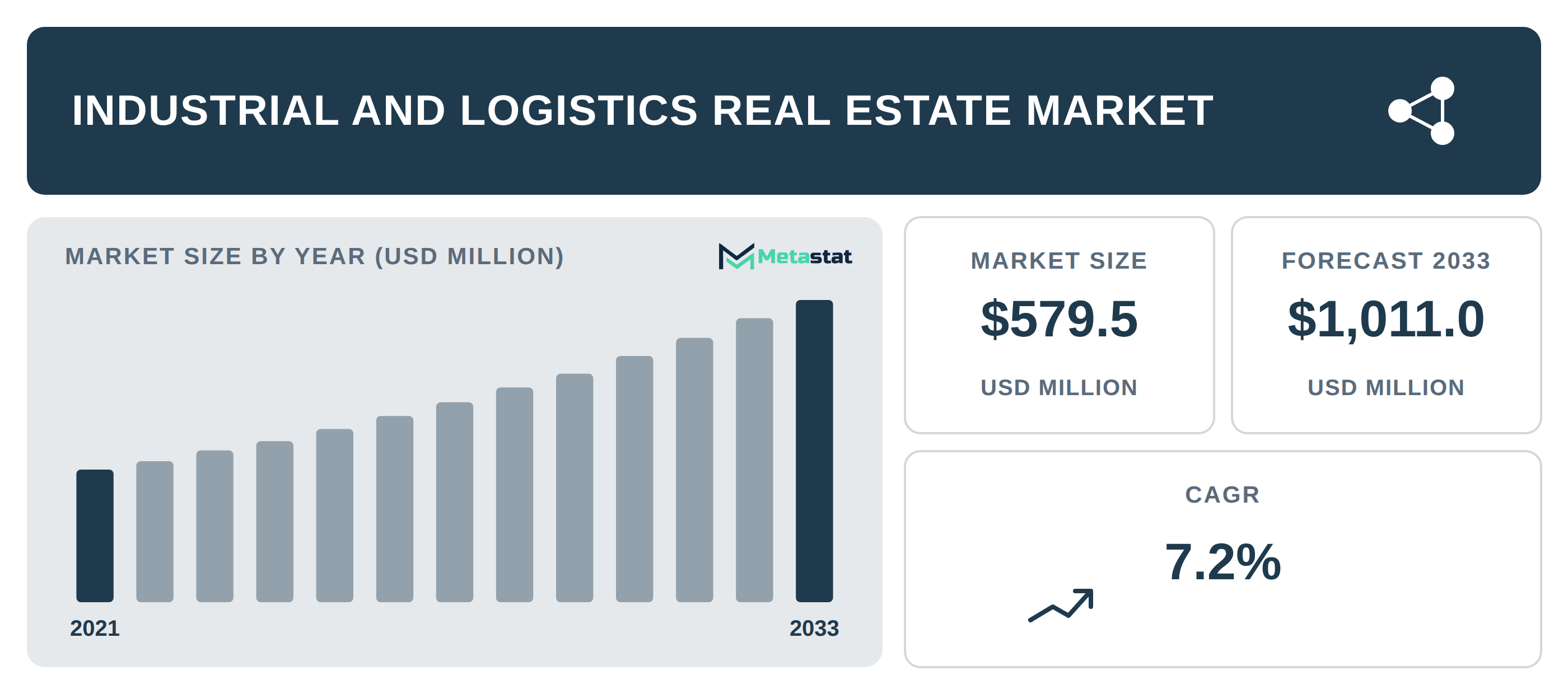
Demand for the Industrial and Logistics Real Estate market is escalating significantly, primarily due to the growth of e-commerce and omnichannel retailing. Businesses are optimizing their fulfillment strategies to enhance rapid order processing and delivery capabilities. This shift generates increased requirements for warehouses and distribution centers. The integration of advanced technologies in warehouse automation boosts operational efficiency, further supporting market expansion.
Despite the promising growth trajectory, various constraints hinder the market's progress. Supply limitations and rising operational costs present significant challenges. Regulatory compliance related to environmental standards increases construction costs, while macroeconomic pressures, including inflation, affect profitability. These obstacles complicate the landscape for developers and investors, consequently limiting the pace of new project developments within the Industrial and Logistics Real Estate market.
The market is categorized based on property type, ownership, and end-use industry. Key segments encompass warehouses, manufacturing facilities, and cold storage options. The Asia Pacific region holds substantial growth potential driven by rapid urbanization and escalating consumer demand. In North America, established logistics networks attract substantial investment, while Europe encounters distinct regulatory dynamics that shape market trends.
Notable companies operating within the Industrial and Logistics Real Estate market include Americold Realty Trust, Inc., CBRE Group Inc., Prologis, Inc., and Cushman & Wakefield. These organizations are committed to enhancing operational capabilities and broadening their market presence through strategic investments and partnerships. Their initiatives cultivate a competitive environment that promotes innovation and efficiency throughout the sector.
For further insights, readers are invited to explore the complete report: Global Industrial and Logistics Real Estate Market.
Related Report
Global Industrial and Logistics Real Estate MarketLEAD ANALYST
Utkarsh Khirodkar is a Lead Market Research Analyst at MetaStat Insight, specializing in market intelligence, technology sector assessments, and competitive strategy.

ENERGY & INFRASTRUCTURE INDUSTRY CONSULTANT
Automotive and Transportation · Electronics and Semiconductor · Energy and Power · Machinery & Equipment
Saurabh Vasant Ganvir consults for Energy & Infrastructure Industry at MetaStat Insight, specializing in renewable energy, solar EPC, and electric vehicle (EV) infrastructure markets.