
LEAD ANALYST
Utkarsh Khirodkar is a Lead Market Research Analyst at MetaStat Insight, specializing in market intelligence, technology sector assessments, and competitive strategy.

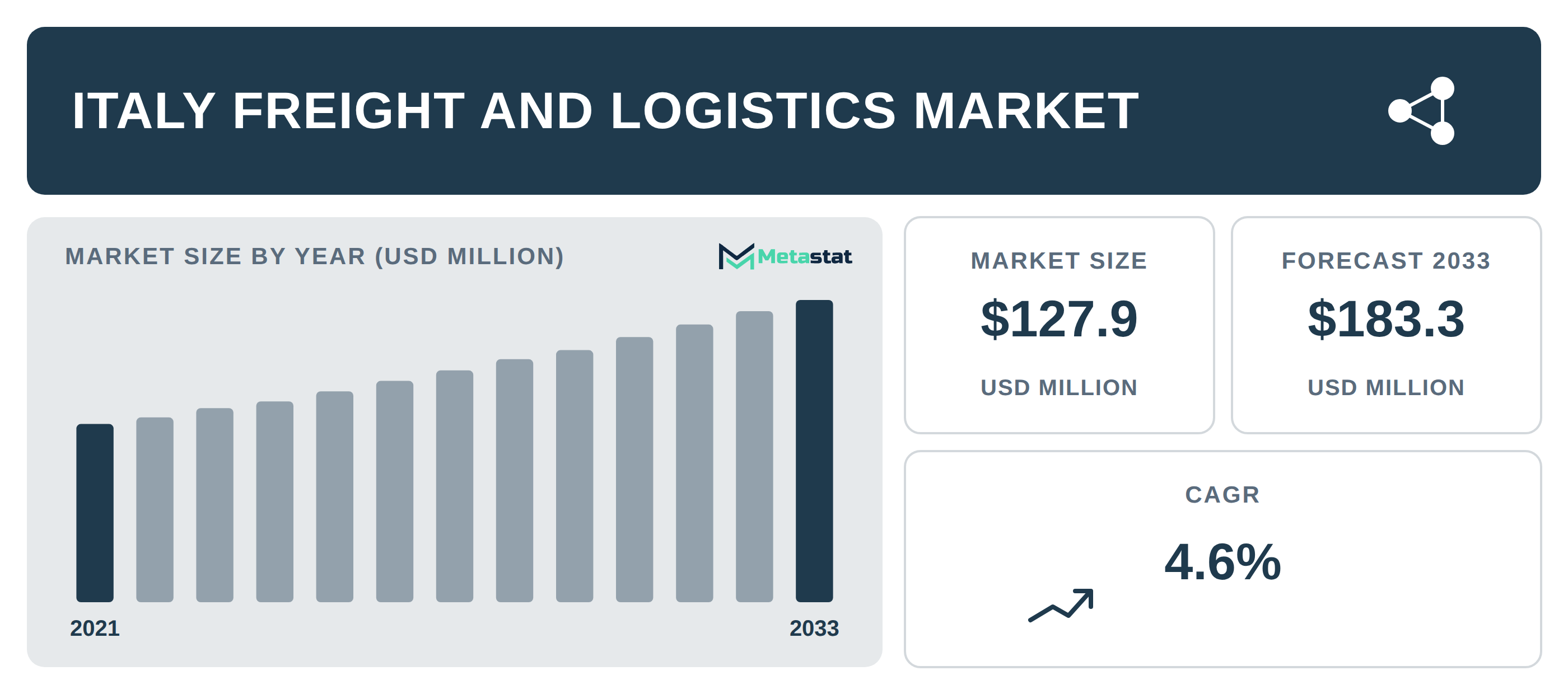
Metastat Insights has published a comprehensive report forecasting the Italy Freight and Logistics market growth from USD 127.9 million in 2025 to USD 183.3 million by 2033, at a CAGR of 4.6%. The report covers market drivers, restraints, segmentation, and key players.
Metastat Insights has published "Italy Freight and Logistics Market Size, Share, By Service Type (Freight Transportation, Freight Forwarding, Contract Logistics and 3PL, Standalone Warehousing and Storage, Courier, Express and Parcel Services, Customs Brokerage and Trade Compliance, Others (Project Logistics, Reverse Logistics, Specialized Cargo Handling)), By Mode of Transport (Road, Maritime, Rail, Air), By End-Use Industry (Automotive, Industrial Manufacturing and Machinery, Retail and E-Commerce, Food, Beverage and Agrifood, Fashion and Luxury, Healthcare and Pharmaceuticals, Chemicals and Petrochemicals, Construction and Building Materials, Energy and Utilities, Others (Aerospace, Electronics, Waste and Recycling)), Industry Analysis, Growth, Trends, and Forecast, 2026-2033", indicating that the Italy Freight and Logistics market was valued at USD 127.9 million in 2025 and is projected to reach USD 183.3 million by 2033, growing at a CAGR of 4.6%.
Key factors driving demand in the Italy Freight and Logistics market include ongoing urban logistics investments and the consolidation of logistics platforms. Increasing e-commerce activities fuel the need for efficient last-mile delivery solutions, leading to enhanced operational efficiencies. Companies are adapting to new consumer expectations for rapid delivery, which necessitates investment in technology and infrastructure. Advances in digital freight platforms and warehouse automation streamline logistics operations, thus improving service delivery and reducing costs. The focus on sustainability, including fleet decarbonization initiatives, is reshaping operational strategies, allowing firms to align with environmental goals while enhancing competitiveness.
Challenges impacting growth include rising regulatory compliance costs that impose significant operational burdens on service providers. These constraints limit investments in necessary infrastructure and technological upgrades. Labor shortages and increased operational costs further hinder efficiency, resulting in reduced profit margins for logistics companies. Geopolitical tensions complicate supply chains, creating uncertainties that affect logistics operations and strategic planning. Companies navigate these complexities by diversifying their supply chains and enhancing resilience against disruptions, but these adaptations require significant investment and strategic adjustments.
The Italy Freight and Logistics market is segmented by service type, mode of transport, and end-use industry. Major service types include Freight Transportation, Freight Forwarding, Contract Logistics and 3PL, Standalone Warehousing, Courier Services, and Customs Brokerage. The market is divided by transport modes, including Road, Maritime, Rail, and Air. Each segment displays distinct growth trajectories influenced by factors including technological advancements, regulatory requirements, and changing consumer preferences. For instance, the Freight Transportation segment is expected to grow due to heightened e-commerce demand, while the Air transport segment is poised for significant growth, with a projected CAGR of 5.5% during the forecast period.
Several key players operate within the Italy Freight and Logistics market, including DHL Group, DSV A/S, Kuehne+Nagel International AG, CEVA Logistics, GEODIS, Rhenus Group, UPS, and AP Moller - Maersk. These companies enhance their service offerings through strategic investments in technology and innovation, enabling them to meet evolving customer demands. The competition among logistics providers is increasing, driving operational efficiencies and expanding service capabilities. Companies that proactively adapt to market changes and invest in sustainable practices are well-positioned to succeed in the coming years.
For more insights, please visit the full report: Italy Freight and Logistics Market.
Related Report
Italy Freight and Logistics MarketLEAD ANALYST
Utkarsh Khirodkar is a Lead Market Research Analyst at MetaStat Insight, specializing in market intelligence, technology sector assessments, and competitive strategy.

ENERGY & INFRASTRUCTURE INDUSTRY CONSULTANT
Automotive and Transportation · Electronics and Semiconductor · Energy and Power · Machinery & Equipment
Saurabh Vasant Ganvir consults for Energy & Infrastructure Industry at MetaStat Insight, specializing in renewable energy, solar EPC, and electric vehicle (EV) infrastructure markets.