
LEAD ANALYST
Utkarsh Khirodkar is a Lead Market Research Analyst at MetaStat Insight, specializing in market intelligence, technology sector assessments, and competitive strategy.

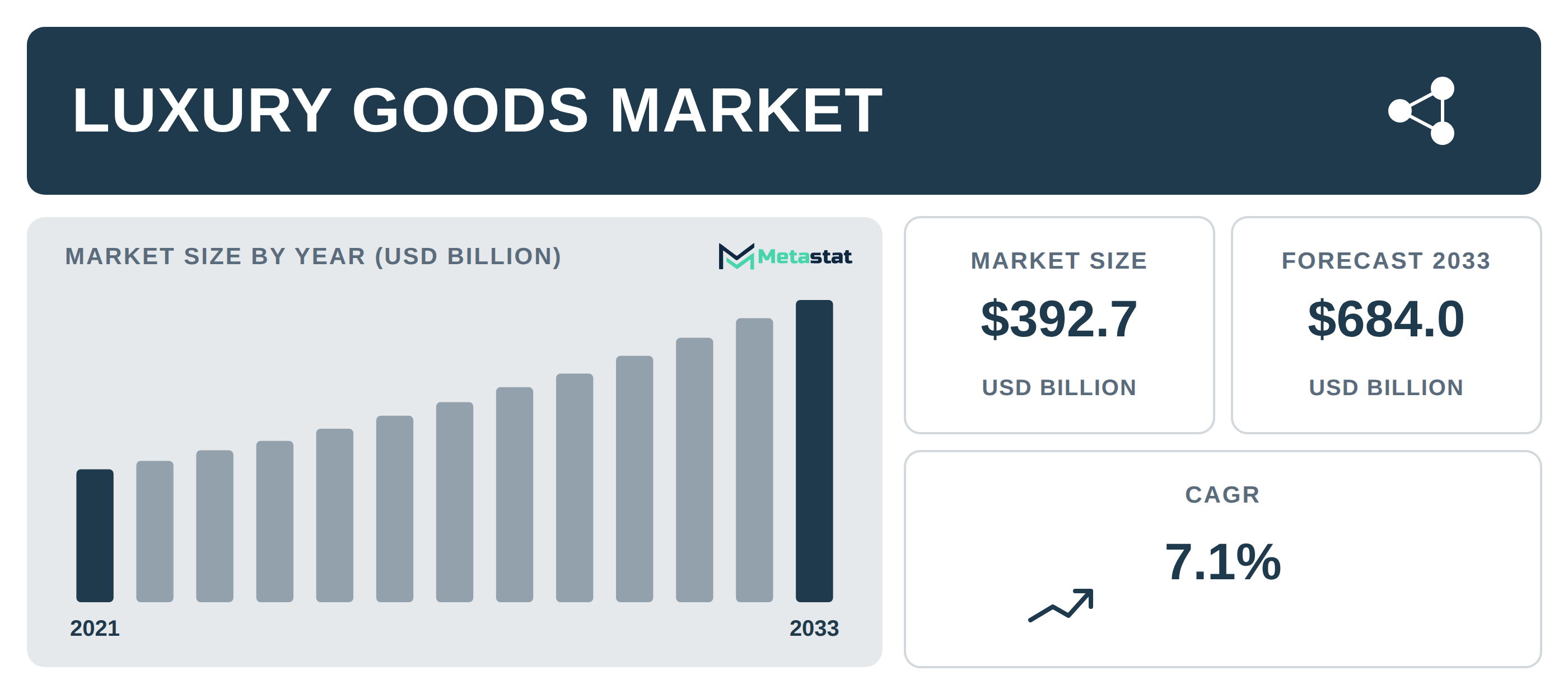
Metastat Insights has published a comprehensive report on the Luxury Goods market, revealing its expected growth from USD 392.7 billion in 2025 to USD 684 billion by 2033, with a CAGR of 7.1%. The report delves into market dynamics, key players, and consumer trends shaping the luxury landscape.
Metastat Insights has published "Global Luxury Goods Market Size, Share, By Product Type (Jewellery and High Jewellery, Luxury Watches, Luxury Leather Goods and Handbags, Luxury Apparel and Clothing, Luxury Footwear, Luxury Eyewear, Luxury Fragrances and Cosmetics, and Luxury Accessories and Writing Instruments), By Distribution Channel (Direct-to-Consumer, Luxury Multi-Brand Retailers, Department Stores, E-commerce, and Travel Retail and Duty-Free), By Consumer Type (Women, Men, and Unisex), By Price Range (Entry-Level Luxury, Accessible Luxury, Premium Luxury, and Ultra-Luxury), Industry Analysis, Growth, Trends, and Forecast, 2026-2033", with the market valued at USD 392.7 billion in 2025 and projected to reach USD 684 billion by 2033, growing at a CAGR of 7.1%.
Increasing consumer spending represents a primary driver of the Luxury Goods market. Enhanced disposable incomes allow individuals to invest more in premium products, positioning luxury items because symbols of status and achievement. Economic recovery across various regions supports this growth, leading to heightened consumer confidence. The ongoing shift toward urban living and a growing middle class in developing economies further fuels the demand for luxury goods. Increased digital engagement and the expansion of online shopping platforms improve access to luxury products, making it easier for consumers to purchase items from a diverse array of brands.
Regulatory compliance and inflationary pressures pose significant challenges to the Luxury Goods market. Stricter regulations increase operational costs for producers, diverting resources that could instead support innovation efforts. Inflation affects raw material and logistics costs, prompting brands to modify their pricing strategies. These factors deter potential consumers and slow overall market growth. Geopolitical instability introduces uncertainty, impacting trade relations and supply routes, which complicates cost structures and profitability.
The Luxury Goods market is segmented by product type, with Luxury Leather Goods and Handbags leading the segment. Predictions indicate that Luxury Watches will reach USD 99.8 billion by 2033, while the jewellery and high jewellery segment is expected to increase from USD 30.9 billion in 2026 to USD 43.6 billion by 2033. Regionally, the Asia Pacific commands the largest market share at 40.8%, followed by Europe at 29.6% and North America at 21.7%. The North American market is anticipated to grow to USD 127.9 billion by 2033.
Notable companies within the Luxury Goods market include LVMH, CHANEL, Burberry Group plc, and Prada S.p.A. These organizations actively shape market dynamics through innovation and strategic partnerships. Their commitment to sustainability and ethical practices aligns with evolving consumer preferences, enhancing brand loyalty and market presence.
To explore more about the insights and detailed analysis, visit the full report: Global Luxury Goods Market.
Related Report
Global Luxury Goods MarketLEAD ANALYST
Utkarsh Khirodkar is a Lead Market Research Analyst at MetaStat Insight, specializing in market intelligence, technology sector assessments, and competitive strategy.