
The Patient Centric Healthcare App Market is positioned for robust growth between 2026 and 2033, heavily influenced by shifting consumer preferences toward healthy lifestyles, escalating chronic disease metrics, and rapid mobile infrastructure developments. Mobile health tools are actively empowering individuals to take comprehensive responsibility for their personal health while establishing collaborative digital channels with physical care providers.
Strategic Infrastructure and Growth Drivers
A significant catalyst accelerating market momentum is the rising worldwide prevalence of long-term medical conditions. Data from the World Health Organization (WHO) highlighted that the incidence of chronic illness spiked by 57% in 2020. In the United States, historical evaluations from the National Health Council indicated that chronic diseases impacted roughly 133 million individuals, representing more than 45% of the country's population. Furthermore, the European Commission noted that chronic medical conditions are responsible for over 86% of all recorded deaths within the European Union.
These demographic shifts are concurrently driving peripheral hardware markets, including the wearable patch market. Simultaneously, high smartphone adoption acts as a critical market facilitator. Medical apps on mobile devices directly improve the baseline efficiency of care delivery networks, lower total medical expenses, and provide broad access to high-quality clinical interventions via integrated telemedicine systems.
Versatile Functionality and Mobile Ecosystems
Modern patient-centric applications provide diverse, high-value clinical utilities. Users regularly utilize these mobile interfaces to track specific fitness metrics, record individual heart rates, and measure single-lead ECG data. Beyond standard monitoring, these applications seamlessly capture dietary and daily calorie tracking information, deploy medication reminder alarms, manage complex conditions like diabetes, and provide direct consumer access to lab results, diagnostic reports, and personal electronic medical records (EMR).
Market Segmentation Overview
According to the extensive scope analysis published by MetaStat Insight, the global industry is strictly categorized across three core pillars:
-
By Type: Phone-Based Apps, Web-Based Apps, and Others.
-
By Category: Diseases & Treatment Management, Wellness Management, and Others.
-
By Operating System: Android, iOS, Windows, and Others.
Phone-based applications demonstrated exceptional market expansion in 2020, sustained by the explosive scaling of mobile-centric medical software. Roughly 165,000 health apps are published and active across popular app ecosystems. To ensure patient safety, the U.S. Food and Drug Administration (FDA) has enforced strict regulatory guidelines aimed at clinical-grade applications.
A notable milestone in regulatory validation includes the FDA clearance of reSET-O, a mobile health (mHealth) platform engineered by Pear Therapeutics. This prescription-based digital therapeutic provides a structured 12-week course delivering behavioral therapy and fluency training to support standard clinical outpatient care for opioid use disorder (OUD).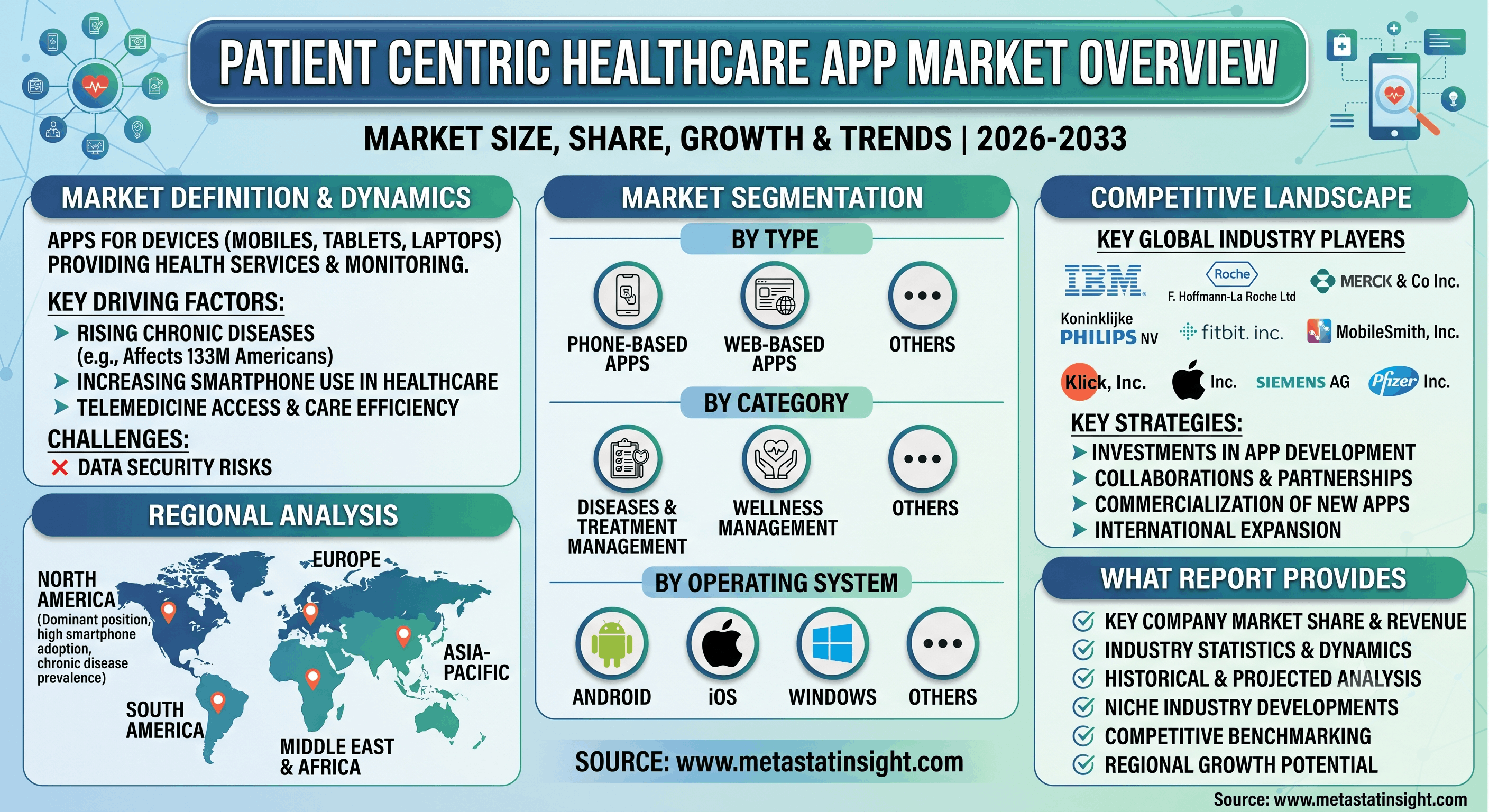
Regional and Competitive Landscape
Geographically, North America held a dominant position in the industry in 2020. This regional strength is underpinned by rapid consumer tech adoption, early awareness of advanced healthcare platforms, and aggressive corporate partnerships. A prominent example includes the joint alliance between UnitedHealth Group and Microsoft Corporation to introduce the ProtectWell application, which uses an AI-powered healthcare bot to systematically screen users for symptom profiles or viral exposure.
Key global industry stakeholders steering active market innovation include:
IBM Corporation, F. Hoffmann-La Roche Ltd, Merck & Co Inc., Koninklijke Philips NV, Fitbit, Inc., MobileSmith, Inc., Klick, Inc., Apple, Inc., Siemens AG, and Pfizer Inc.
Prominent market participants continue to deploy capital into collaborative research, strategic international commercialization pacts, and targeted investments. For example, Tilak Healthcare established a major international promotion agreement with Novartis Pharma AG to deploy OdySight, a clinically validated prescription application designed for interactive remote vision testing and engagement puzzles for patients experiencing age-related chronic eye conditions.
About MetaStat Insight
MetaStat Insight is a premier global market research firm specializing in highly technical, data-driven industry intelligence. We deliver accurate, multi-variable quantitative studies across critical industrial frameworks, offering actionable strategic recommendations that empower global business entities to maximize operational agility, track competitive benchmarking, and scale into high-potential economic segments.
Related Report
View full market research reportAbout the Authors

LEAD ANALYST
Utkarsh Khirodkar is a Lead Market Research Analyst at MetaStat Insight, specializing in market intelligence, technology sector assessments, and competitive strategy.

LEAD PRINCIPAL ANALYST, PHARMA AND HEALTHCARE
Food and Beverages · Healthcare · Healthcare IT · Medical Devices
Ajay Devgire is the Lead Healthcare Analyst at MetaStat Insight, leading strategic research and market intelligence initiatives across the global healthcare domain.

PRINCIPAL CONSULTANT - ENTERPRISE AI & EMERGING TECHNOLOGIES
Banking & Finance · Electronics and Semiconductor · Energy and Power · Healthcare IT · Information & Technology · Professional Services
Vijay Gunti is a Principal Consultant at MetaStat Insight, bringing over two decades of experience across enterprise digital transformation, technology strategy, and intelligent systems.