
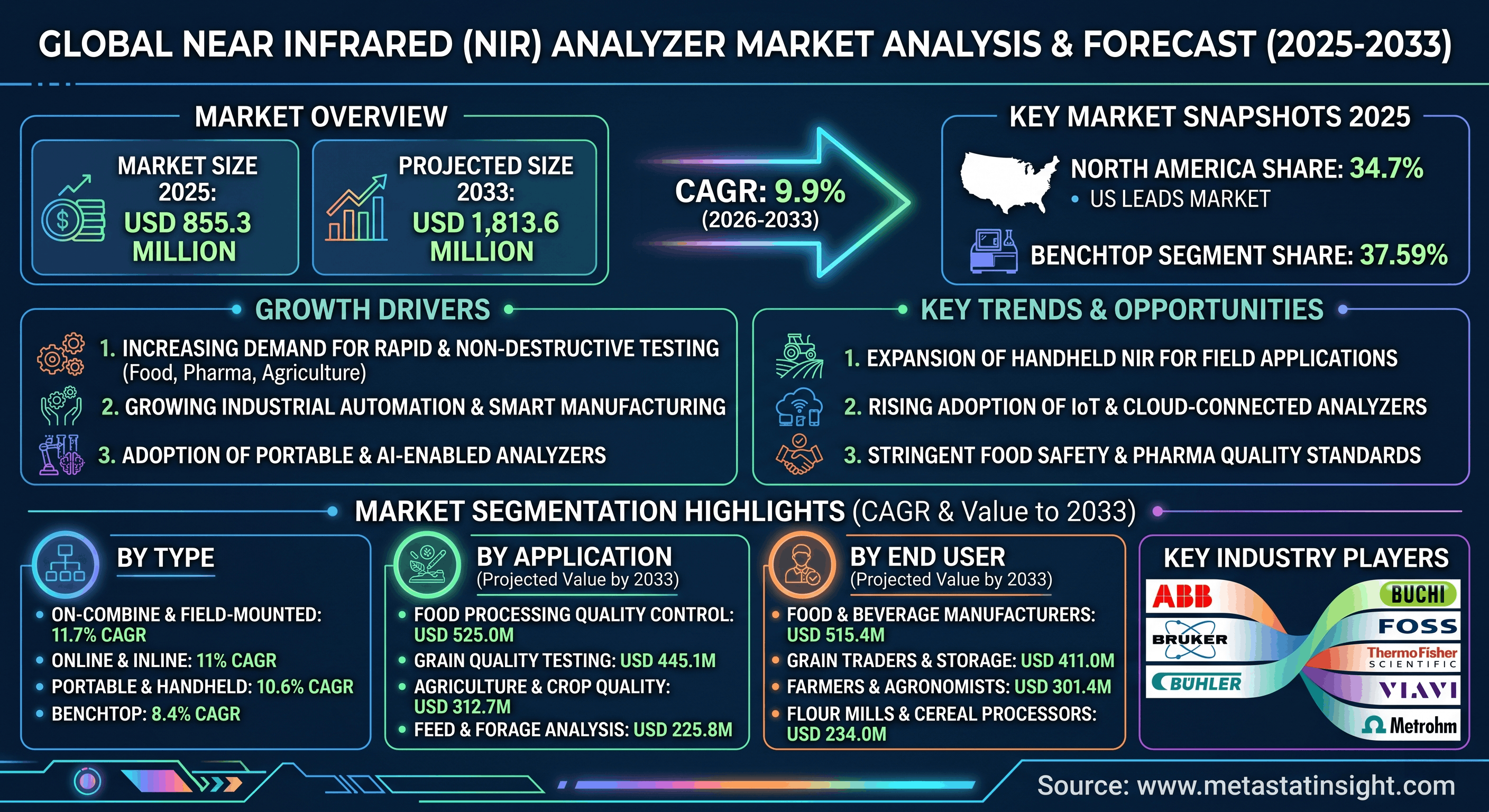
A detailed research analysis published by Metastat Insights reveals that the Global Near Infrared (NIR) Analyzer Market is experiencing rapid expansion. Valued at USD 855.3 million in 2025, the market is projected to reach USD 1,813.6 million by 2033, expanding at a compound annual growth rate (CAGR) of 9.9%.
This industry surge is primarily driven by an increasing demand for fast, real-time, and non-destructive testing solutions. Industrial sectors including food processing, pharmaceuticals, agriculture, chemicals, and oil & gas are rapidly adopting NIR analyzers. These systems enable operators to monitor moisture levels, evaluate chemical composition, and ensure product consistency without damaging testing samples.
Strategic Metrics and Technological Evolution
According to the report, the growing implementation of smart manufacturing and industrial automation acts as a primary catalyst for inline and online processing systems. Facilities are heavily investing in connected monitoring networks to support real-time quality control and reduce material waste.
Key market metrics detailed in the study include:
-
Regional Dominance: North America secured a leading 34.7% market share in 2025, driven by a robust pharmaceutical manufacturing infrastructure and rigid food safety compliance in the United States.
-
Segment Analysis: Benchtop NIR Analyzers hold a major 37.59% value share in 2025. Meanwhile, the Portable and Handheld segment is gaining substantial traction, projected to grow from USD 228.5 million in 2026 to USD 461.7 million by 2033 at a 10.6% CAGR.
-
Application Velocities: Food Processing Quality Control is projected to achieve a market size of USD 525.0 million by 2033, closely followed by Grain Quality Testing at USD 445.1 million.
Market Challenges and Strategic Outlook
Despite robust expansion pathways, the research highlights specific structural constraints. High initial installation costs and regular system calibration requirements limit technological penetration among capital-constrained small and mid-sized enterprises. Furthermore, the operational reliance on highly skilled professionals to interpret complex spectral data poses an deployment barrier in regions dealing with technical personnel shortages.
Looking forward, the integration of cloud-connected monitoring software, wireless IoT networks, and AI-enabled spectral analysis platforms will continue to lower operational complexities. Industry heavyweights such as ABB Ltd., Bruker Corporation, BUCHI Labortechnik AG, Bühler Group, FOSS Analytical, KPM Analytics, Metrohm AG, Thermo Fisher Scientific Inc., and VIAVI Solutions Inc. remain focused on automated, user-friendly solutions to expand their market footprint.
About Metastat Insights:
Metastat Insights delivers data-driven market intelligence reports across diverse global industries.
Related Report
View full market research reportAbout the Authors

LEAD ANALYST
Utkarsh Khirodkar is a Lead Market Research Analyst at MetaStat Insight, specializing in market intelligence, technology sector assessments, and competitive strategy.

INDUSTRY CONSULTANT - CHEMICALS & ADVANCED MATERIALS
Chemicals and Materials · Machinery & Equipment · Packaging
Amit Gadhekar Consultant for Chemicals and Materials at MetaStat Insight, directing sector-specific intelligence, research, and strategic consulting across global chemical and processing markets.