
LEAD ANALYST
Utkarsh Khirodkar is a Lead Market Research Analyst at MetaStat Insight, specializing in market intelligence, technology sector assessments, and competitive strategy.

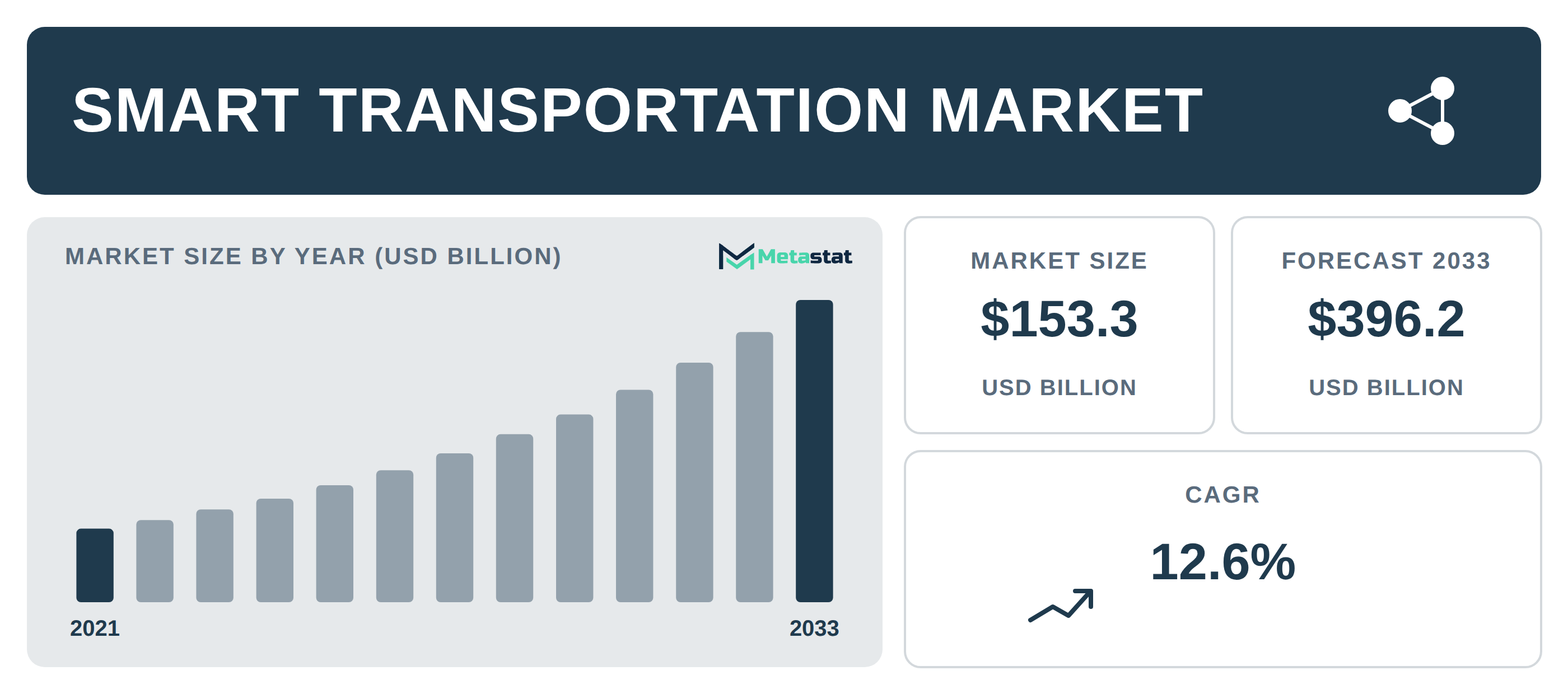
Metastat Insights announces the release of a new report on the Smart Transportation market, projected to grow from USD 153.3 billion in 2025 to USD 396.2 billion by 2033, at a CAGR of 12.6%. The report covers key trends, drivers, and competitive dynamics in the industry.
Metastat Insights has published "Global Smart Transportation Market Size, Share, By Type (Advanced Traffic Management Systems (ATMS), Advanced Traveler Information Systems (ATIS), Advanced Transportation Pricing Systems (ATPS), Advanced Public Transportation Systems (APTS), Advanced Commercial Vehicle Operations (ACVOS), and Cooperative Vehicle-Infrastructure Systems (CVIS)), By Application (Traffic Management, Public Transport and Ticketing, Road Safety and Security, Freight and Fleet Management, Environmental and Emission Monitoring, Smart Parking and Guidance, Tolling and Congestion Pricing, and Connected and Autonomous Vehicle (CAV) Support), By Mode of Transport (Roadways, Railways, Airways, and Maritime), By Technology (IoT Sensors and V2X, AI and Machine-Learning Analytics, Digital Twin Platforms, 5G and C-V2X Connectivity, and Other Technologies), Industry Analysis, Growth, Trends, and Forecast, 2026-2033", reporting that the market was valued at USD 153.3 billion in 2025 and is projected to reach USD 396.2 billion by 2033, growing at a CAGR of 12.6%.
The Smart Transportation market experiences significant expansion, primarily driven by advancements in technology and infrastructure. Increasing urbanization escalates the demand for efficient transportation solutions, compelling cities to invest in smart systems. While populations migrate toward urban centers, the necessity for effective public transport and traffic management solutions intensifies, creating a favorable environment for market growth. The emphasis on sustainability and environmental stewardship influences investments in technologies that reduce carbon emissions, further stimulating demand.
Regulatory compliance poses significant challenges for the Smart Transportation market. Stricter environmental regulations create barriers for companies attempting to introduce new technologies, owing to compliance often demanding substantial financial investments. Geopolitical tensions and trade deficits complicate international partnerships, adding operational costs and uncertainties for market participants. These factors hinder growth, particularly for smaller firms that struggle to meet compliance requirements and face high capital investment needs. Workforce skill shortages and privacy concerns regarding data security contribute to hesitancy in adoption.
The market segmentation reveals diverse dynamics across various categories. North America holds a significant share at 33.8%, followed by Europe at 28.7% and Asia Pacific at 27.6%. The remaining market is divided among South America and the Middle East and Africa. By type, advanced traffic management systems are projected to grow from USD 48.3 billion in 2026 to USD 107 billion by 2033, while advanced traveler information systems are anticipated to reach USD 71.3 billion by 2033. These segments highlight the ongoing transformation in traffic management and traveler information delivery.
Leading companies in the Smart Transportation market include Siemens AG, Thales Group, IBM Corporation, Garmin Ltd, NoTraffic, TomTom NV, Cubic Corporation, Mobileye, and Applied Information. These organizations focus on leveraging innovative technologies, including IoT and AI, to enhance operational efficiency and user experiences. Their ongoing investments in research and development support the emergence of next-generation solutions, ensuring competitiveness in this evolving market.
For more insights, readers access the full report titled Global Smart Transportation Market.
Related Report
Global Smart Transportation MarketLEAD ANALYST
Utkarsh Khirodkar is a Lead Market Research Analyst at MetaStat Insight, specializing in market intelligence, technology sector assessments, and competitive strategy.

ENERGY & INFRASTRUCTURE INDUSTRY CONSULTANT
Automotive and Transportation · Electronics and Semiconductor · Energy and Power · Machinery & Equipment
Saurabh Vasant Ganvir consults for Energy & Infrastructure Industry at MetaStat Insight, specializing in renewable energy, solar EPC, and electric vehicle (EV) infrastructure markets.