
Metastat Insight, a leading global market research firm, has released its latest comprehensive study on the Global Sports Flooring Market. According to the report, the market is valued at USD 15.3 billion in 2025 and is projected to grow at a Compound Annual Growth Rate (CAGR) of 4.9%, reaching a substantial USD 22.4 billion by 2033.
The report highlights a transformative shift in the sports infrastructure industry, where the demand for specialized surfaces extends far beyond traditional stadiums into educational campuses, urban redevelopment projects, and commercial fitness centers.
Key Market Drivers and Trends
The growth of the Global Sports Flooring market is primarily fueled by a rising emphasis on athlete safety and performance optimization.Modern facilities are increasingly specifying surfaces engineered for superior shock absorption, consistent ball rebound, and injury prevention.
"Facility planners are no longer just looking for a surface to play on; they are seeking multi-purpose systems that balance athletic functionality with architectural value," states the Lead Analyst at Metastat Insight. "We are seeing a surge in demand for adaptable flooring that can support professional sports during peak hours while remaining durable enough for community events and public gatherings."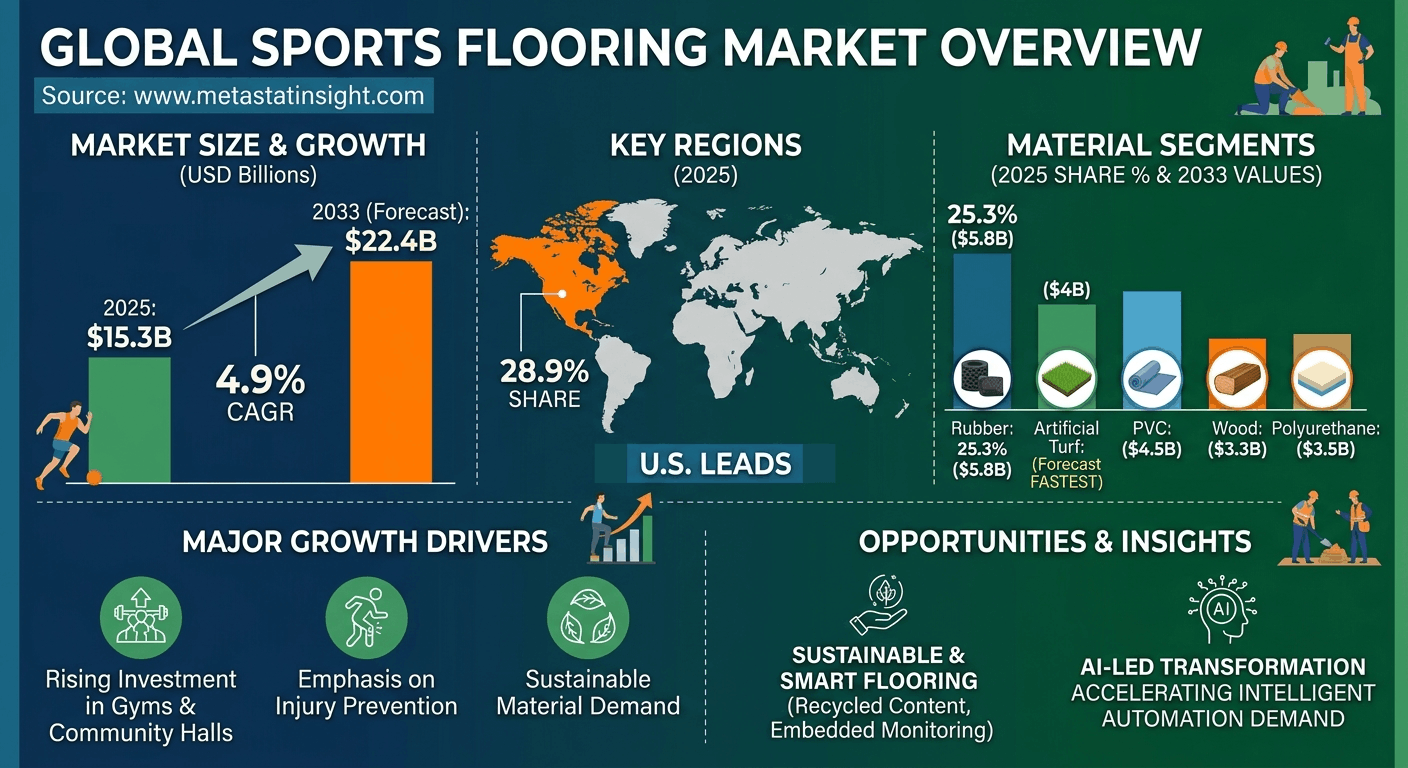
Segment Insights: Rubber Flooring Leads the Charge
The market is categorized by material types, including Rubber, PVC, Wood, Artificial Turf, and Polyurethane.
-
Rubber Flooring: Accounting for a significant 25.3% market share in 2025, this segment is valued at USD 4.1 billion. It is expected to grow to USD 5.8 billion by 2033, supported by its durability and low-maintenance needs.
-
Artificial Turf: Poised for the fastest growth among material types, this segment is projected to reach USD 4 billion by 2033 at a 6.2% CAGR, driven by its all-weather performance in outdoor stadiums and training grounds.
-
Wood Flooring: While maintaining a premium position in professional basketball and indoor arenas, the wood segment is expected to reach USD 3.3 billion by 2033.
Sustainability and the "Smart" Revolution
A major highlight of the report is the emergence of sustainable and smart sports flooring.To meet green building frameworks, manufacturers are increasingly utilizing recycled rubber compounds and low-VOC (Volatile Organic Compound) systems. Furthermore, the integration of AI-led enterprise transformation is accelerating the demand for intelligent automation within the market. Embedded sensors and digital monitoring solutions are now being used to track surface wear, moisture variation, and usage intensity, enabling predictive maintenance for facility operators.
Regional Dominance
North America remains the dominant force in the industry, holding a 28.9% market share in 2025. The region, led by the United States, is expected to expand at a 4.9% CAGR, reaching USD 5.5 billion by 2033. Growth in this region is attributed to high renovation activity and robust institutional spending. Meanwhile, the Asia-Pacific region is identified as a high-growth territory due to rapid stadium development and public recreation infrastructure projects in China and India.
Competitive Landscape
The market is characterized by a mix of specialized material providers and global infrastructure giants. Key industry players identified in the report include:
-
Resilient & Synthetic Leaders: Gerflor SAS, FieldTurf Tarkett, Inc., Forbo Holding AG, Mondo S.p.A., and Sika AG.
-
Wood Flooring Specialists: Connor Sports, Junckers, and Robbins Sports Surfaces.
-
Outdoor & Turf Specialists: Shaw Sports Turf, AstroTurf, and Polytan.
About Metastat Insight
Metastat Insight provides data-driven market analysis and strategic outlooks across various industrial sectors. Our reports help stakeholders identify key growth drivers, navigate market challenges, and capitalize on emerging opportunities.
Related Report
View full market research reportAbout the Authors

LEAD ANALYST
Utkarsh Khirodkar is a Lead Market Research Analyst at MetaStat Insight, specializing in market intelligence, technology sector assessments, and competitive strategy.

INDUSTRY CONSULTANT - CHEMICALS & ADVANCED MATERIALS
Chemicals and Materials · Machinery & Equipment · Packaging
Amit Gadhekar Consultant for Chemicals and Materials at MetaStat Insight, directing sector-specific intelligence, research, and strategic consulting across global chemical and processing markets.