
LEAD ANALYST
Utkarsh Khirodkar is a Lead Market Research Analyst at MetaStat Insight, specializing in market intelligence, technology sector assessments, and competitive strategy.

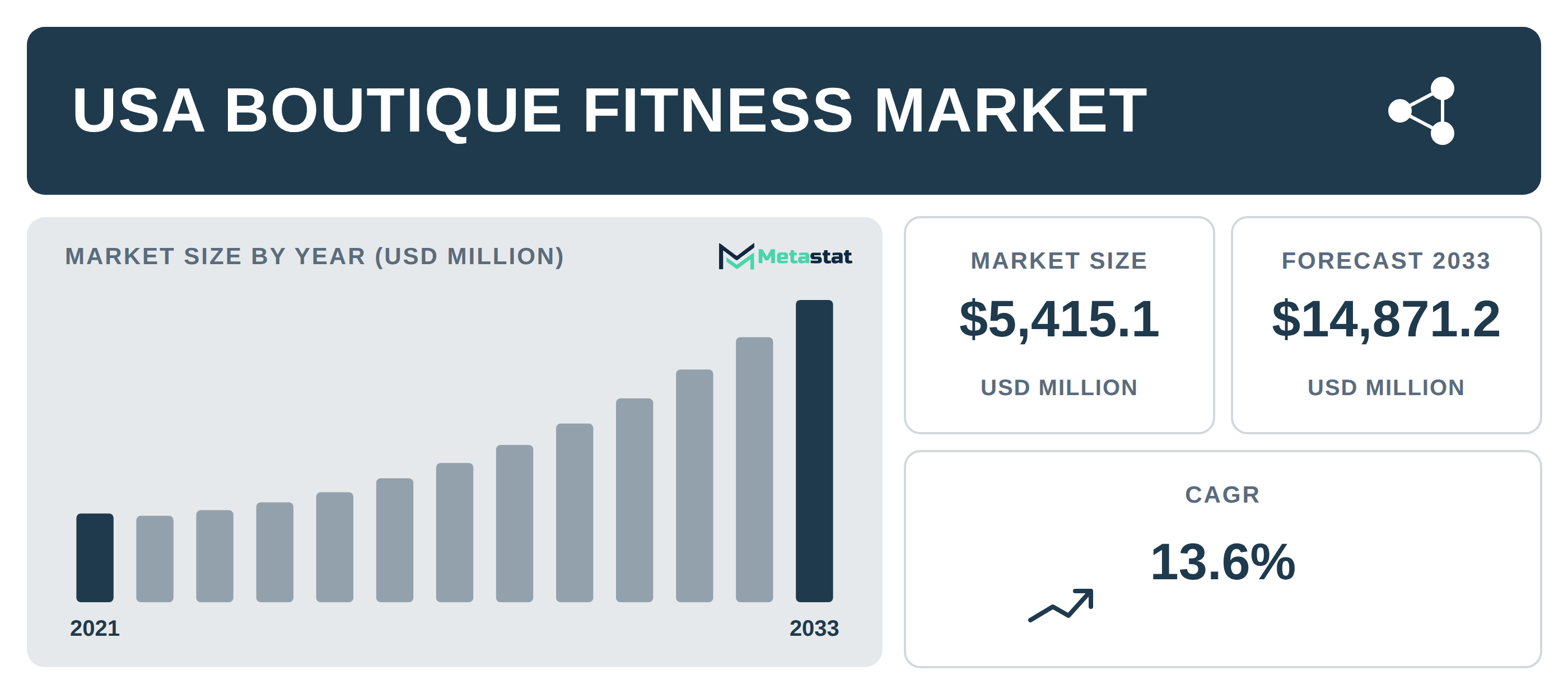
Metastat Insights reports that the USA Boutique Fitness market, valued at USD 5,415.1 million in 2025, is projected to grow at a CAGR of 13.6% to USD 14,871.2 million by 2033.
Metastat Insights has published "USA Boutique Fitness Market Size, Share, By Business Model (Franchise Model and Independently Owned), By Fitness Studio Type (Yoga Studios, Pilates Studios, CrossFit Boxes, Spin and Cycling Studios, HIIT Studios, Dance Studios, Barre Studios, and Boxing and Kickboxing Studios), By Demographics (Women's Only Studios, Men's Only Studios, Co-Ed Studios, and Kids and Family Studios), By Fitness Level (Beginner Studios, Intermediate/Advanced Studios, and Specialized Studios), Industry Analysis, Growth, Trends, and Forecast, 2026-2033", which indicates the market was valued at USD 5,415.1 million in 2025 and is projected to reach USD 14,871.2 million by 2033, growing at a CAGR of 13.6%.
Rising consumer interest in fitness and wellness significantly influences the USA Boutique Fitness market. Individuals increasingly seek specialized fitness experiences that cater to diverse demographic groups, reflecting broader lifestyle changes. This growing emphasis on personal fitness supports sustained demand for boutique fitness studios that offer unique training methodologies, including yoga and Pilates. The continuous evolution of consumer preferences drives innovation in service offerings, pushing fitness providers to enhance their value propositions. While disposable incomes rise, the number of participants in boutique fitness classes increases, creating opportunities for studios to expand their customer bases.
The USA Boutique Fitness market encounters challenges due to regulatory compliance and legal mandates that impact operational flexibility. Increased scrutiny on health and safety standards requires significant investments in technology and training, diverting resources from growth initiatives. Macroeconomic factors, including inflation, contribute to rising operational costs, affecting profitability for both franchise and independently owned studios. Supply chain disruptions further complicate the market, leading to potential revenue loss. The fragmentation of the market creates additional hurdles, with diverse player strategies complicating competition and slowing market adoption rates.
The USA Boutique Fitness market is segmented by business model, fitness studio type, demographics, and fitness level. Franchise models dominate the market, accounting for 59.7% of the total share, while independently owned studios represent 40.3%. The franchise segment is expected to grow from USD 3,629.7 million in 2026 to USD 8,621.3 million by 2033, reflecting a CAGR of 13.2%. Independently owned studios are projected to reach USD 6,249.9 million by 2033, with a CAGR of 14.2%. In terms of fitness studio types, yoga studios demonstrate substantial growth potential, while women's only studios reflect a significant increase in demand, driven by a shift toward specialized fitness environments.
Several key players operate within the USA Boutique Fitness market, including 24 Hour Fitness, Anytime Fitness, CorePower Yoga, Orangetheory Fitness, and Pure Barre. These companies focus on various business models and fitness studio types, contributing to the overall growth and dynamics of the market. Their adaptations to evolving consumer preferences and investments in innovative service offerings enhance their competitive positions.
For further insights and detailed analysis, readers access the full report at USA Boutique Fitness Market.
Related Report
View full market research reportLEAD ANALYST
Utkarsh Khirodkar is a Lead Market Research Analyst at MetaStat Insight, specializing in market intelligence, technology sector assessments, and competitive strategy.