
LEAD ANALYST
Utkarsh Khirodkar is a Lead Market Research Analyst at MetaStat Insight, specializing in market intelligence, technology sector assessments, and competitive strategy.

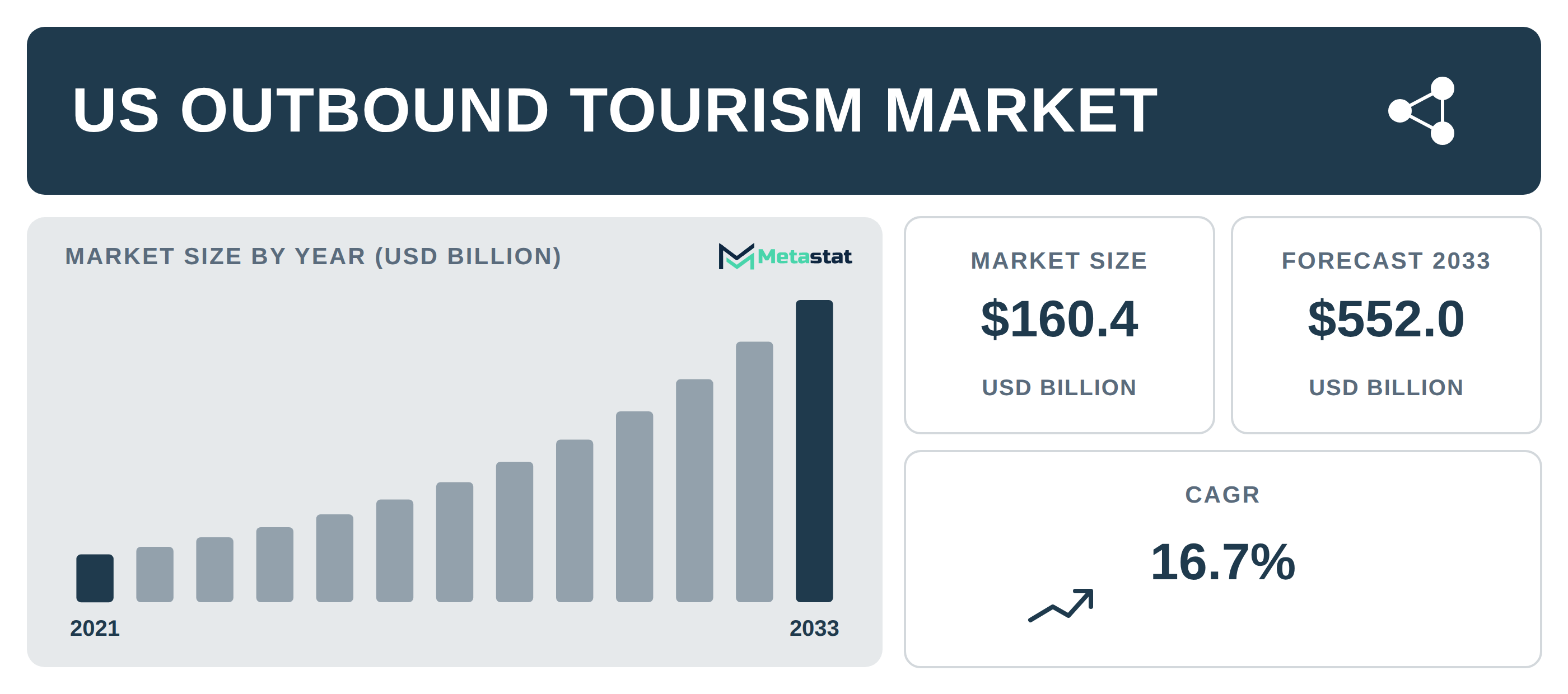
Metastat Insights forecasts significant growth in the US Outbound Tourism market, increasing from USD 160.4 billion in 2025 to USD 552 billion by 2033, at a CAGR of 16.7%. The report analyzes key segments and market drivers.
Metastat Insights has published "US Outbound Tourism Market Size, Share, By Travel Purpose (Leisure and Vacation, Visiting Friends and Relatives, Business Travel, Education and Study, Medical and Wellness Travel, Religious and Pilgrimage Travel, Sports and Events and Others), By Booking Channel (Direct Supplier Channels, Online Travel Agencies, Traditional Travel Agencies, Tour Operators and Wholesalers and Corporate Travel Management Companies), By Travel Party Composition (Solo Travelers, Couples and Families with Children, Adult Groups, Multigenerational Groups and Others), By Travel Duration (Short-Term (1-3 Days), Medium-Term (4-7 Days), Long-Term (8-14 Days), Extended (15-30 Days) and Others), Industry Analysis, Growth, Trends, and Forecast, 2026-2033", reporting a market value of USD 160.4 billion in 2025 and projecting growth to USD 552 billion by 2033, representing a compound annual growth rate (CAGR) of 16.7%.
A variety of factors are fueling growth in the US Outbound Tourism market. Increased disposable incomes and improved living standards have led consumers to travel abroad more frequently. The recovery of international travel post-pandemic has reignited interest in global destinations, prompting consumers to invest more in travel experiences. The desire for unique and personalized travel experiences, combined with technological advancements in booking platforms, is enhancing accessibility and engaging potential travelers.
Despite the optimistic growth projections, the US Outbound Tourism market faces several challenges. Regulatory complexities create significant obstacles, with shifting regulations imposing barriers on market participants. Compliance with safety standards and consumer protection laws demands considerable resources, which could otherwise be allocated for growth. Inflationary pressures and fluctuating costs of services are limiting consumer spending power, which, in turn, affects travel budgets and diminishes travel frequency.
Segmented by travel purpose, booking channel, travel party composition, and travel duration, the US Outbound Tourism market reveals diverse consumer preferences. Leisure and vacation travel dominate the market, comprising a significant share of 60.8%, while visiting friends and relatives accounts for 26.8%. The market is evolving in terms of booking channels, with direct supplier channels projected to grow to USD 252.8 billion by 2033, and online travel agencies expected to reach USD 149 billion in the same period. This segmentation illustrates the varying motivations driving outbound tourism and the potential for targeted marketing strategies.
Several prominent companies operate within the US Outbound Tourism market. Key players include Expedia Group, Inc., Booking.com (Booking Holdings Inc.), American Express Travel, Delta Air Lines, Inc., and United Airlines. These companies are adapting to the dynamic landscape by leveraging technology and enhancing customer experiences to maintain competitiveness. Their strategies include substantial investments in digital transformation, optimizing operational efficiency, and addressing shifting consumer preferences.
For more detailed insights, readers are invited to explore the full report: US Outbound Tourism Market.
Related Report
US Outbound Tourism MarketLEAD ANALYST
Utkarsh Khirodkar is a Lead Market Research Analyst at MetaStat Insight, specializing in market intelligence, technology sector assessments, and competitive strategy.