
LEAD ANALYST
Utkarsh Khirodkar is a Lead Market Research Analyst at MetaStat Insight, specializing in market intelligence, technology sector assessments, and competitive strategy.

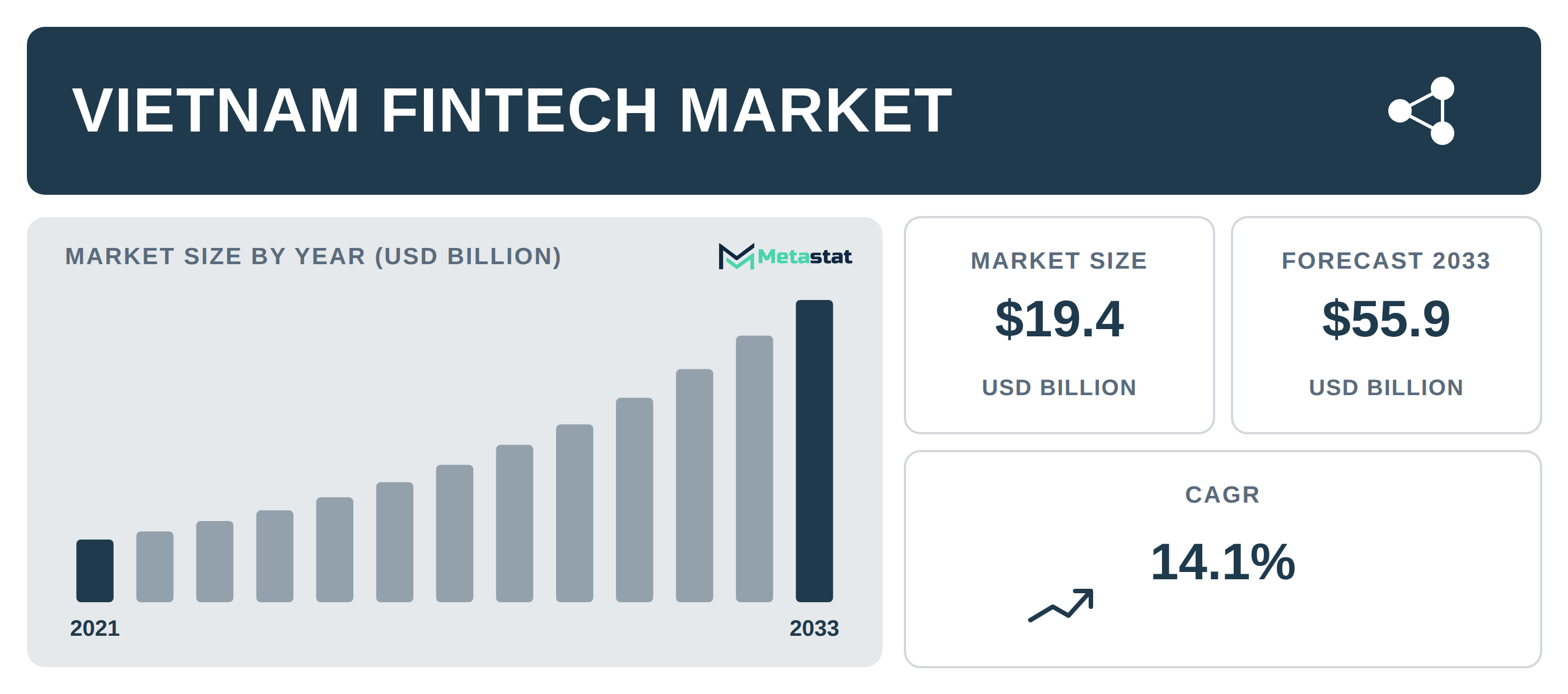
Metastat Insights has published a report on the Vietnam Fintech market, forecasting growth from USD 19.4 billion in 2025 to USD 55.9 billion by 2033, with a CAGR of 14.1%. Key segments include digital payments, digital lending, and neobanking.
Metastat Insights has published "Vietnam Fintech Market Size, Share, By Service Type (Digital Payments and Money Transfers, Digital Lending and Consumer Credit, Buy Now Pay Later, Digital Banking and Neobanking, WealthTech and Digital Investment, InsurTech, RegTech, RiskTech and Digital Identity), By Technology (Application Programming Interfaces (APIs) and Open Banking, Artificial Intelligence (AI), Blockchain, Distributed Computing), By Deployment Mode (Cloud, On-Premises), By End User (Consumers, Small and Medium-Sized Enterprises, Large Enterprises, Banks and Financial Institutions, Insurance Companies, Government and Public-Sector Organizations), Industry Analysis, Growth, Trends, and Forecast, 2026-2033", stating the Vietnam Fintech market was valued at USD 19.4 billion in 2025 and is projected to reach USD 55.9 billion by 2033, growing at a CAGR of 14.1%.
Digital transformation significantly influences the Vietnam Fintech market, reshaping conventional financial services. The increase in smartphone usage and internet access enables the adoption of digital solutions, leading to heightened demand for digital payments, online lending, and neobanking services. Financial institutions leverage technological advancements, including artificial intelligence and automation, to enhance efficiency and improve customer experiences. This transition toward digital platforms has spurred competition among service providers, with venture funding bolstering startups and established players in creating innovative fintech solutions.
The Vietnam Fintech market encounters notable challenges stemming from regulatory compliance issues. Evolving regulations heighten operational costs, deterring new entrants and stifling innovation. Macroeconomic factors, including inflation and currency fluctuations, complicate the landscape, affecting consumer spending and demand for fintech services. Infrastructure deficiencies in rural regions limit access to digital financial services, while a lack of skilled labor in advanced technologies hinders development. Data security risks undermine consumer trust, necessitating a careful balance between innovation and data protection.
The Vietnam Fintech market is categorized by service type, technology, deployment mode, and end user. Key segments encompass digital payments and money transfers, digital lending, and neobanking. The digital payments segment is anticipated to expand from USD 7.3 billion in 2026 to USD 15.3 billion by 2033, driven by growing smartphone penetration. The digital lending segment is projected to reach USD 9.5 billion by 2033, fueled by increasing consumer demand for accessible credit solutions. Technological advancements, especially in artificial intelligence and cloud deployment, are pivotal drivers of this growth.
Several key players operate in the Vietnam Fintech market, including M_Service JSC (MoMo), Vietnam Payment Solution JSC (VNPAY), ZION JSC (ZaloPay), Viettel Digital Services Corporation (Viettel Money), and ShopeePay Vietnam. These companies contribute to the market's growth by enhancing service delivery and expanding their offerings to meet consumer demands. Strategic capital allocation and infrastructure investments are essential for maintaining competitive advantages in this fragmented market.
For a detailed analysis, including insights on market trends and growth forecasts, visit the full report on the Vietnam Fintech Market.
Related Report
Vietnam Fintech MarketLEAD ANALYST
Utkarsh Khirodkar is a Lead Market Research Analyst at MetaStat Insight, specializing in market intelligence, technology sector assessments, and competitive strategy.

PRINCIPAL CONSULTANT - ENTERPRISE AI & EMERGING TECHNOLOGIES
Banking & Finance · Electronics and Semiconductor · Energy and Power · Healthcare IT · Information & Technology · Professional Services
Vijay Gunti is a Principal Consultant at MetaStat Insight, bringing over two decades of experience across enterprise digital transformation, technology strategy, and intelligent systems.