
LEAD ANALYST
Utkarsh Khirodkar is a Lead Market Research Analyst at MetaStat Insight, specializing in market intelligence, technology sector assessments, and competitive strategy.

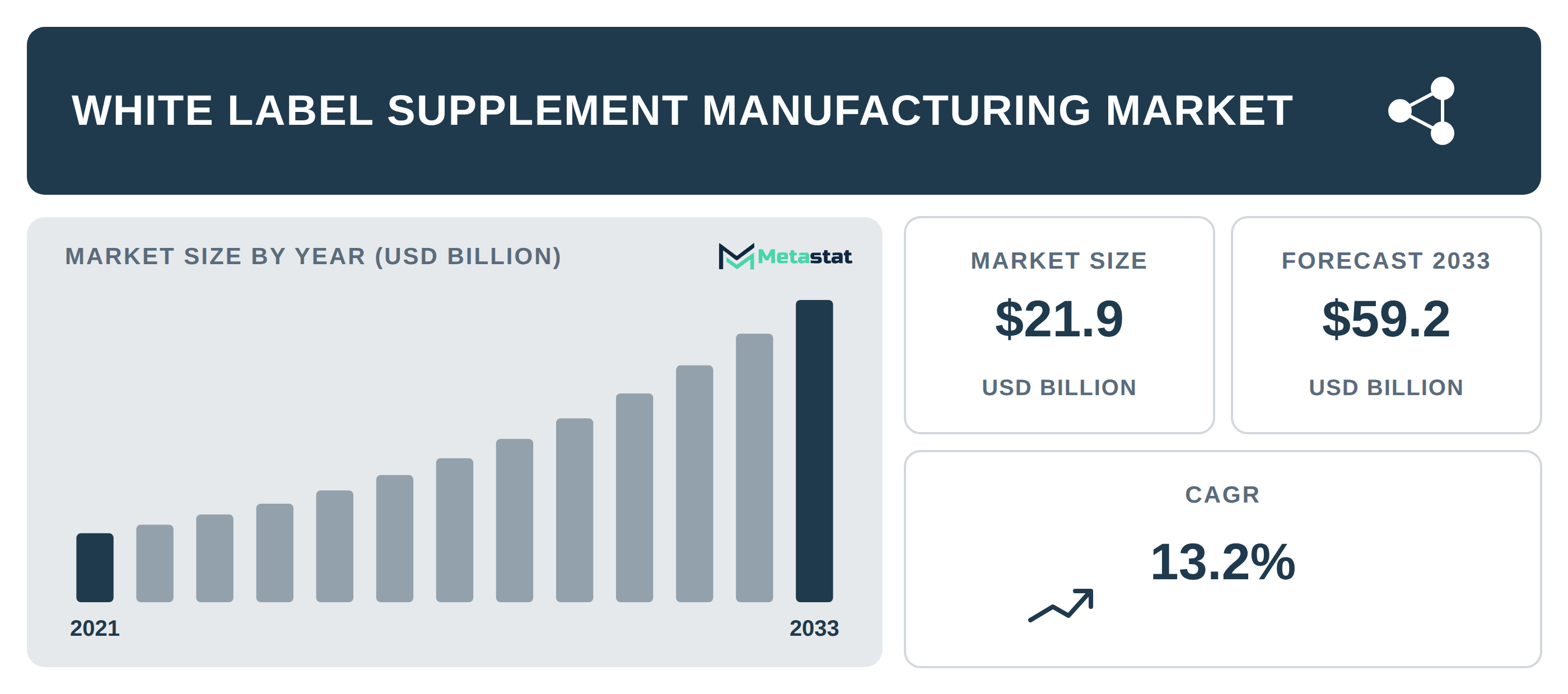
Metastat Insights reveals the White Label Supplement Manufacturing market is valued at USD 21.9 billion in 2025 and projected to grow to USD 59.2 billion by 2033, with a CAGR of 13.2%. The report details driving factors, challenges, and market segmentation.
Metastat Insights has published "Global White Label Supplement Manufacturing Market Size, Share, By Product Format (including powders, hard capsules, softgels, gummies, liquid supplements, sachets, and bars), By Supplement Category (including vitamins, sports nutrition, protein, herbs, weight management, beauty, and gut health), By Customer Type (including supplement brands, retail brands, e-commerce, distributors, and pharmacies), By Manufacturing Model (covering ready-to-brand, semi-custom, fully custom, and contract manufacturing), Industry Analysis, Growth, Trends, and Forecast, 2026-2033", followed by the headline figures (USD 21.9 billion in 2025, USD 59.2 billion by 2033, 13.2% CAGR).
The White Label Supplement Manufacturing market experiences strong growth driven by increasing consumer demand for personalized supplements. Rising health consciousness and a focus on tailored nutrition significantly influence this trend. Market participants are capitalizing on the shift toward private label dietary supplements, which allows brands to offer unique products while meeting evolving consumer preferences. The demand for diverse delivery formats, including powders, capsules, and gummies, reflects this shift. E-commerce and direct-to-consumer sales channels further enhance accessibility and market penetration for these products.
Regulatory compliance presents notable challenges within the White Label Supplement Manufacturing market, impacting operational efficiency and raising costs for manufacturers. Compliance with standards set by regulatory bodies including the FDA and cGMP is essential for maintaining product quality and consumer safety. These regulations hinder production timelines, especially for smaller manufacturers, limiting their competitiveness. Macroeconomic factors, including inflation and raw material price volatility, further complicate the market landscape by affecting profit margins and production costs.
The White Label Supplement Manufacturing market segments into various categories, including product format, supplement category, customer type, and manufacturing model. By product format, powders represent a significant share, projected to reach USD 11.5 billion by 2033, while tablets and caplets are anticipated to grow to USD 13.5 billion. The market shows strong interest in sports nutrition and performance supplements, with a CAGR of 14.1%. Regional dynamics reveal North America leading in market share, driven by health and wellness products, closely followed by Europe and emerging opportunities in Asia-Pacific.
Several companies operate within the White Label Supplement Manufacturing market, including 13:e Protein Import AB, Aetos Life Care, Aminolabs, and Makers Nutrition, LLC. These firms aim to enhance their capabilities and expand their product offerings through strategic investments and technological advancements. The competitive environment reflects ongoing consolidation trends, with mergers and acquisitions shaping the industry and enhancing operational efficiencies.
For further insights and detailed analysis, readers are invited to access the full report at Global White Label Supplement Manufacturing Market.
Related Report
Global White Label Supplement Manufacturing MarketLEAD ANALYST
Utkarsh Khirodkar is a Lead Market Research Analyst at MetaStat Insight, specializing in market intelligence, technology sector assessments, and competitive strategy.