
LEAD ANALYST
Utkarsh Khirodkar is a Lead Market Research Analyst at MetaStat Insight, specializing in market intelligence, technology sector assessments, and competitive strategy.

Automotive Display System Market By Display Type (Instrument Cluster Display, Center Stack Display, Head-Up Display (HUD), Rear Seat Entertainment Display, and Other), By Technology (Liquid Crystal Display (LCD), Thin-Film Transistor (TFT) LCD, OLED Display, Micro LED Display, and Projection Display), By Size (Small Displays (Up to 5 inches), Medium Displays (6 to 10 inches), and Large Displays (Above 10 inches)), By Vehicle Type (Passenger Cars, Commercial Vehicles, Electric Vehicles, and Luxury Vehicles), Industry Analysis, Size, Share, Growth, Trends, and Forecast, 2025-2032
Report ID
MSI-4261
Published
February, 2026
Pages
255 Pages
Format
Report Details
Choose Your License
Automotive Display System Market
The global automotive display system market has evolved from a specialty niche of simple dashboards to an amazingly complex center of in-car communications, navigation, and entertainment. In its first phase, car displays were mere analog gauges that indicated speed, fuel, and temperature. The late 1980s saw the very first giant leap with digital odometers and simple LCD panels being seen in luxury vehicles. These early developments were precursors to the future integration of visual data with the act of driving, paving the way for what would become more sophisticated infotainment systems.
With car interiors becoming digitized in the early 2000s, makers began incorporating color screens for media functions and navigation. It was as much about functionality as it was about aesthetics. The increasing ability of smartphones across these decades reshaped consumer expectations and compelled automakers to provide interactive and intuitive user interfaces. The automotive display system market around the world slowly kept up with some consumer demands in terms of connectivity, touch control, and customization. Displays ceased being data tools but increasingly became part of tools of engagement and control. The previous decade experienced the advent of high-definition displays, OLED and AMOLED technology, and head-up displays revolutionize the driving experience. The increasing focus on automotive safety has provided a key driver of change, as drivers became reliant on visual screens, 360-degree surveillance, and augmented reality overlays to assist. Governments in the big economic blocs created standards for safer user interfaces, indirectly driving the adoption of smart display systems. The situation today is one of an automaker hovering at the crossroads of design, data, and automation. Car companies are trying out curved panels, multi-screen designs, and voice-controlled screens to design frictionless human-machine interaction.
Near future displays will transcend from dashboards to windshields, side panels, and even steering wheels, redefining how information is utilized within cars. From humble beginnings in analog meters to present-day digital communities, the global automotive display system market will continue to redefine the vocabulary of mobility, transforming cars into intelligent companions and not merely transport devices.
The global automotive display system market is mainly classified based on Display Type, Technology, Size, Vehicle Type.
|
Forecast Period |
2025-2032 |
|
Market Size in 2025 |
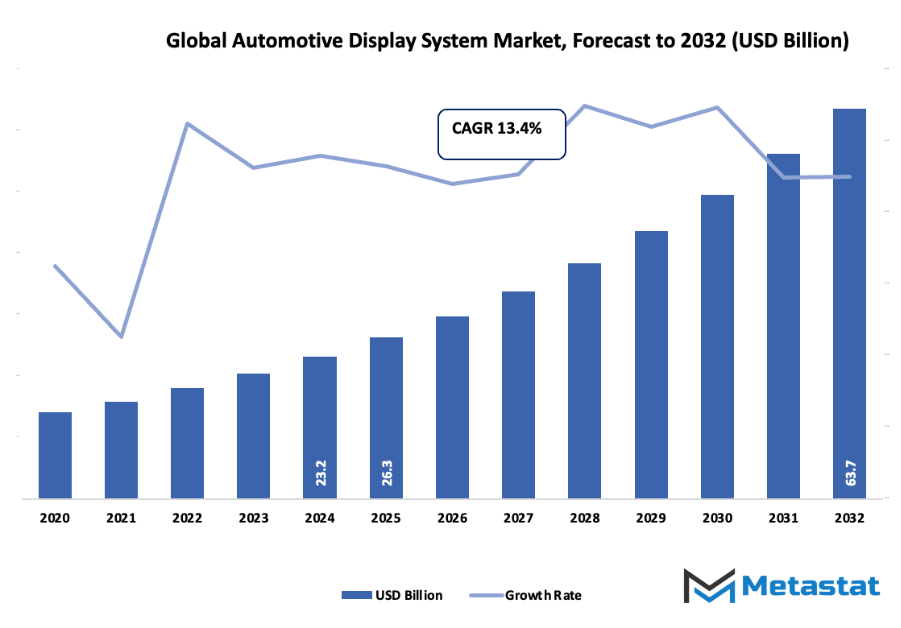
$26.3 Billion |
|
Market Size by 2032 |
$63.7 Billion |
|
Growth Rate from 2025 to 2032 |
13.4% |
|
Base Year |
2024 |
|
Regions Covered |
North America, Europe, Asia-Pacific, South America, Middle East & Africa |
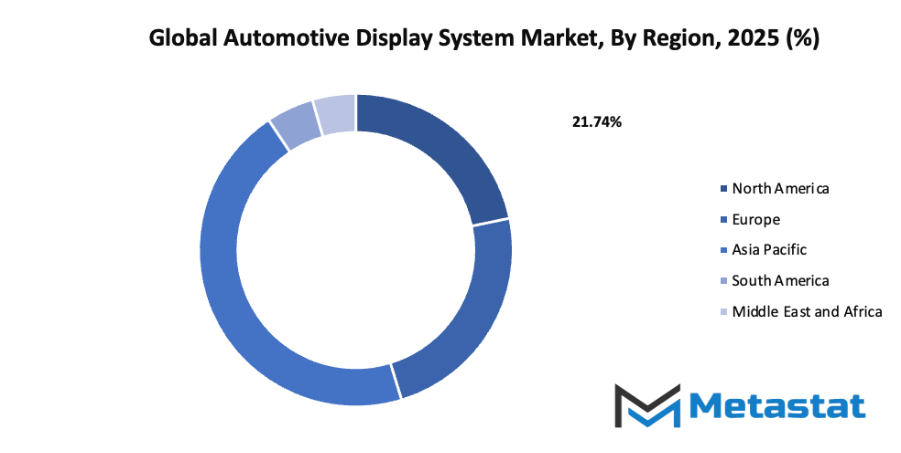
The global automotive display system market is positioned to undergo remarkable transformation in the coming years. The industry is a mix of both international industry leaders and emerging regional competitors. Important competitors include LG Display Co., Ltd., Panasonic Corporation, Delphi Technologies, Robert Bosch GmbH, Visteon Corporation, Continental AG, 3M Company, Nippon Seiki Co., Ltd., Magneti Marelli S.p.A, Qualcomm Technologies Inc., Denso Corporation, Alpine Electronics, Inc., Aptiv, Valeo, AU Optronics Corp., Yazaki Corporation, Magna International Inc., and Pioneer Corporation. These companies are expected to drive innovation and shape the standards for next-generation Automotive Display Systems, as vehicles increasingly integrate digital and interactive technologies.
In the future, Automotive Display Systems will no longer serve merely as tools for presenting information; they will become central to vehicle intelligence, safety, and user experience. The push toward electric and autonomous vehicles will accelerate the adoption of advanced displays, including high-resolution digital dashboards, augmented reality head-up displays, and customizable interfaces that respond to driver and passenger preferences. Companies at the forefront will invest heavily in research and development to enhance visibility, reduce energy consumption, and ensure displays can withstand diverse environmental conditions.
Regional players are likely to influence innovation by introducing cost-effective solutions tailored to local markets, ensuring that technological advancements are accessible across a broader range of vehicles. This balance between global leaders and emerging competitors will create a dynamic environment where continuous innovation is necessary to maintain market presence. Partnerships, mergers, and strategic collaborations will shape the competitive landscape, allowing companies to combine expertise in electronics, software, and automotive engineering.
As vehicles become increasingly connected, Automotive Display Systems will serve as the interface linking drivers to intelligent transport systems, navigation aids, and real-time traffic management. The integration of artificial intelligence and machine learning into display systems will make vehicles more responsive to situational awareness, predictive maintenance alerts, and enhanced safety warnings. Future designs will focus on improving user engagement through intuitive interfaces, multi-sensory feedback, and seamless interaction with other in-car technologies.
Market size is forecast to rise from USD 26.3 Billion in 2025 to over USD 63.7 Billion by 2032. Automotive Display System will maintain dominance but face growing competition from emerging formats.
In summary, the global automotive display system market is positioned for significant growth, driven by both established industry leaders and emerging regional competitors. Companies such as LG Display Co., Ltd., Panasonic Corporation, Delphi Technologies, Robert Bosch GmbH, Visteon Corporation, Continental AG, 3M Company, Nippon Seiki Co., Ltd., Magneti Marelli S.p.A, Qualcomm Technologies Inc., Denso Corporation, Alpine Electronics, Inc., Aptiv, Valeo, AU Optronics Corp., Yazaki Corporation, Magna International Inc., and Pioneer Corporation will define the trajectory of innovation. The future will see automotive displays becoming smarter, more interactive, and integral to vehicle operation, reshaping how technology enhances safety, connectivity, and overall driving experience.
This research report categorizes the global automotive display system market based on various segments and regions, forecasts revenue growth, and analyzes trends in each submarket. The report analyses the key growth drivers, opportunities, and challenges influencing the global automotive display system market. Recent market developments and competitive strategies such as expansion, type launch, development, partnership, merger, and acquisition have been included to draw the competitive landscape in the market. The report strategically identifies and profiles the key market players and analyses their core competencies in each sub-segment of the global automotive display system market.
Find answers to common questions about this report
Global Automotive Display System market is valued at $26.3 Billion in 2025.
Global Automotive Display System market is estimated to grow with a CAGR of 13.4% from 2025 to 2032.
Global Automotive Display System market is estimated to reach $63.7 Billion by 2032.
Top players operating in the Automotive Display System industry includes LG Display Co., Ltd., Panasonic Corporation, Delphi Technologies, Robert Bosch GmbH, and others.
The analysts below cover Automotive and Transportation research at Metastat Insights.
LEAD ANALYST
Utkarsh Khirodkar is a Lead Market Research Analyst at MetaStat Insight, specializing in market intelligence, technology sector assessments, and competitive strategy.

ENERGY & INFRASTRUCTURE INDUSTRY CONSULTANT
Automotive and Transportation · Electronics and Semiconductor · Energy and Power · Machinery & Equipment
Saurabh Vasant Ganvir consults for Energy & Infrastructure Industry at MetaStat Insight, specializing in renewable energy, solar EPC, and electric vehicle (EV) infrastructure markets.
Tracking maintenance cycle demand for secondary flight display units and terrain collision avoidance systems across regional jet fleets involves complex aftermarket dynamics. MetaStat Insight provided practical analysis separating airline retrofit programs from OEM forward-fit production schedules in North America and Southeast Asia. The supplier matrix highlighted component obsolescence timelines without resorting to vague generalizations. The dataset served as a dependable reference during our annual program review meetings.
Evaluating secondary resin quality across post-consumer packaging streams requires reliable technical segmentation. MetaStat Insight delivered an objective assessment that distinguished between extrusion-grade flake pricing and optical sorting throughput limitations across Western Europe. The competitive positioning breakdown for licensed depolymerization technology providers answered several questions during our feedstock feasibility audit. Their team clarified regional trade restrictions on mixed plastic scrap quickly when our team submitted follow-up requests.
Evaluating sovereign cloud deployments for core banking platforms demands a clear view of data residency regulations and migration exit strategies. MetaStat Insight delivered an exhaustive review of regional latency tolerances, mainframe decommission milestones, and third-party vendor concentration risk. The regulatory compliance mapping across European and Asian financial jurisdictions gave our team a dependable baseline for multi-cloud infrastructure discussions.
Explore related market intelligence reports worth reading alongside this one.