
LEAD ANALYST
Utkarsh Khirodkar is a Lead Market Research Analyst at MetaStat Insight, specializing in market intelligence, technology sector assessments, and competitive strategy.

Car Rental Market Size, Share, By End User (Self Drive Individual, Chauffeur Drive, Corporate Fleet Subscription, and P2P Rental), By Vehicle Type (Mini, Economy Cars, Compact, Intermediate Cars, Standard & Full Size Cars, SUVs, MPVs, Luxury, and Premium Cars), By Booking Mode (Offline and Online), By Rental Length (Short Term, Medium Term, and Long Term), Industry Analysis, Growth, Trends, and Forecast, 2026-2033
Report ID
MSI-4247
Published
January, 2026
Pages
255 Pages
Format
Report Details
Choose Your License
Car Rental Market
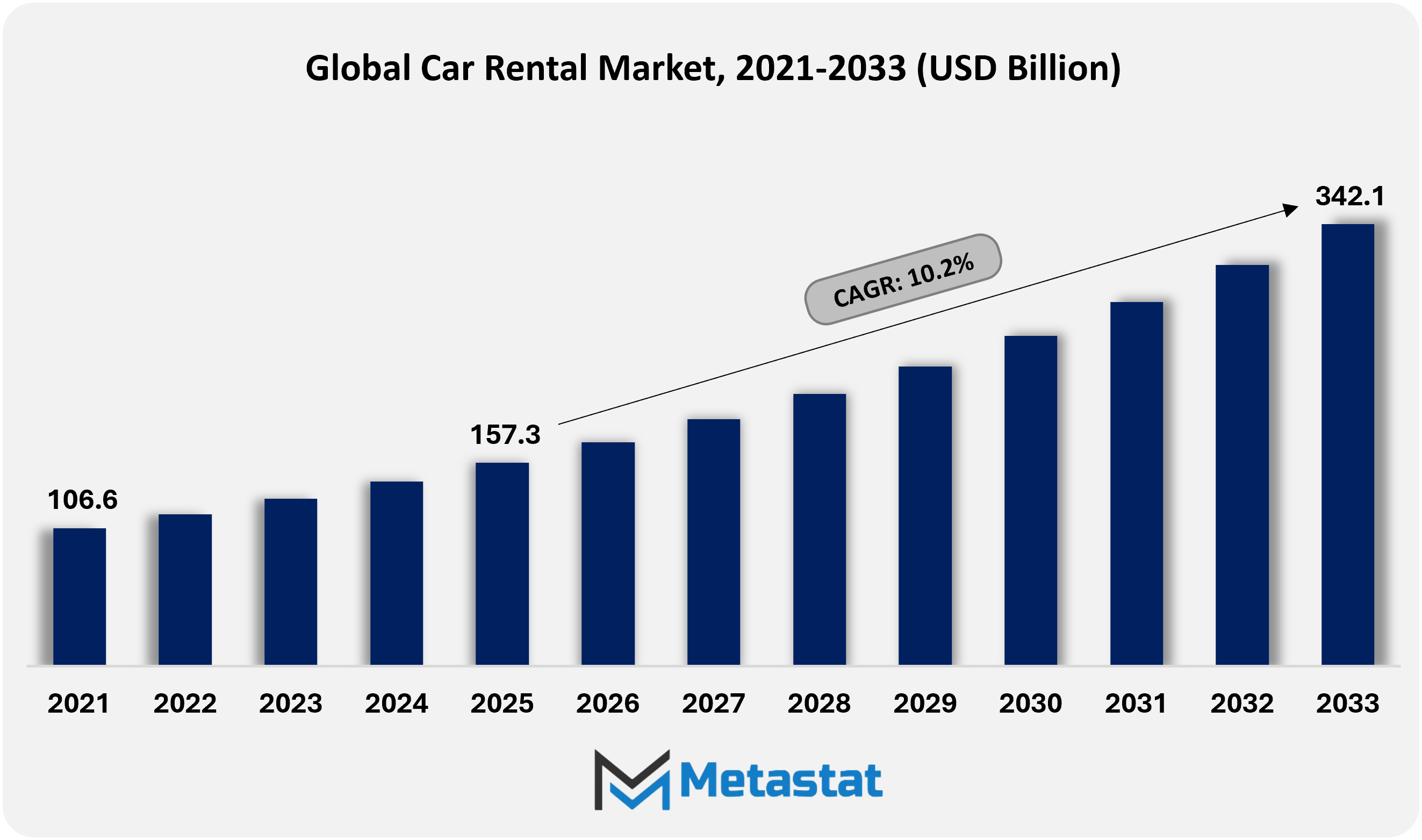
The global car rental market is going to evolve as the vital part, a la broader mobility and transportation industry which will offer the use of cars temporarily for both, personal and commercial purposes. Such a market would cover all those rental services that exist, operations based at airports, and app-based on-demand mobility platforms that make it easier for users to get vehicles for flexible durations. By using technologies like booking systems, telemetry, and fleet management solutions, the industry will be able to increase efficiency in operations, enhance the customer experience, and get better use of the vehicles.
The services offered in the market will accommodate customers whose needs may vary widely from leisure visitors and business commuters to corporate fleets and short-term urban mobility users. The market will be diverse with various types of cars, SUVs, and specialty vehicles. The options will range from premium to economy designed to satisfy different customer preferences and affordability levels. Digital platforms, which are innovative in nature, will enable easy and quick car rentals, real-time vehicle tracking, and contactless pick-up and drop-off that will change the whole world of car rental experiences in the future.
The global car rental market is also likely to benefit from shifts in urban mobility styles, such as electrification and hybridisation of vehicles, the emergence of unnatural mobility models, and partnerships with ride-hailing and travel services. An increasing number of companies will be using technology to get the maximum value from their fleets and help manage their operating costs, deploying sustainable assets to reduce costs and improve sustainability. Digital innovation, customer-focused services, and proactive fleet management rolled into one, will keep the market accessible to drivers and users around the world and provide mobility solutions that are convenient, flexible and efficient.
Market Segmentation Analysis
The global car rental market is mainly classified based on End-Use, Vehicle, Application, Booking Mode.
By End-Use is further segmented into:
By Vehicle the market is divided into:
By Application the market is further divided into:
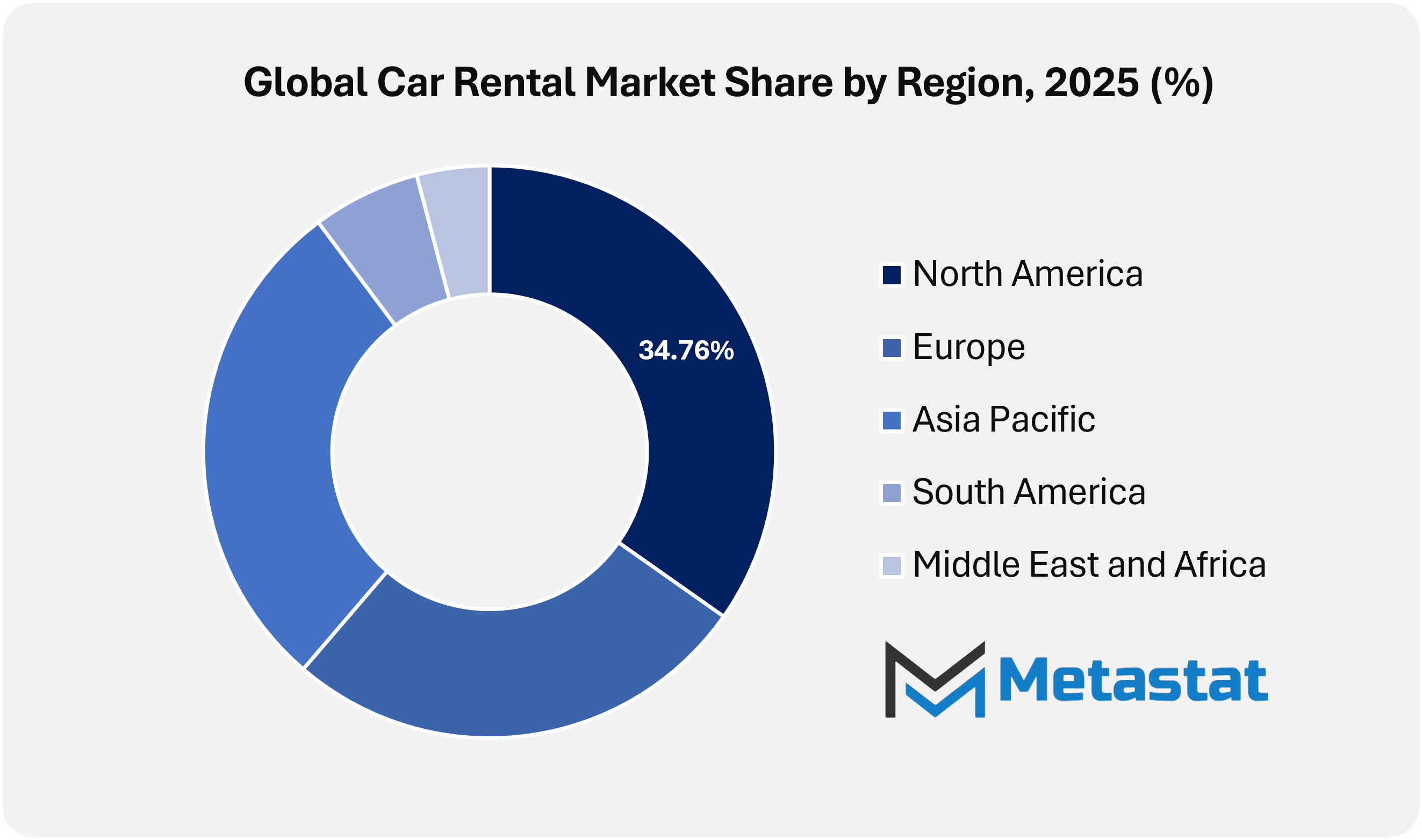
The global car rental market will exhibit significant changes from one region to another that will be influenced by factors such as daily travel patterns, the rate of urbanization, and overall economic development. In this context, North America that comprises the U.S., Canada, and Mexico, will still be at the forefront of this market as the use of car rentals for business trips and leisure was the general practice in the region. Among other things, high-tech booking platforms, a large number of airport-based operations, and well-established rental networks will be the main factors bringing about the efficient use of the fleet and better customer experiences.
Europe or the UK, Germany, France, Italy, and the remaining part of the continent will seemingly be more concerned with digital transformation in general, the greening of the industry, and shared mobility models. There will be a considerable demand for electric and hybrid vehicles in this region, and this will be in tandem with the existing regulatory frameworks and environmental policies. The rental of urban mobility services alongside the traditional operations will offer the market a landscape that is both rich and resilient.
The Asia-Pacific region that mainly consists of India, China, Japan, South Korea, and other countries will be a highly prosperous area in the coming years as domestic and international travel, business activities, and urban population will be on the rise. The car rental market in South America, with Brazil and Argentina as its leaders, will opt for adaptive rental programs as an easy way of helping the tourism and corporate mobility sectors to grow. At the same time, the Middle East & Africa, made up of GCC countries, Egypt, and South Africa, will see a rise in the use of car rental services as the business traveler segment, tourism sectors, and population of expatriates will all be benefiting from this. Regardless of location, the global car rental market will undergo transformation by way of technology, customer-focused services, and the provision of sustainable mobility solutions as an alternative to the traditional vehicle rental options.
The global car rental market will be influenced by the presence of a number of established international companies working together with regional operators who are more flexible and which are going to be a very competitive and innovation-driven environment. Some of the biggest companies in the world like Enterprise Holdings, Inc., The Hertz Corporation, Avis Budget Group, Europcar, Sixt, Localiza, Movida, Carzonrent India Pvt Ltd, Al-Futtaim Vehicle Rentals (AVR), ECO Mobility, Advantage Car Rental, Bettercar Rental LLC, and Zoomcar Ltd. are going to be the main reason behind changes in the market through their extensive fleet networks, booking platforms that are digital, and their customer service that is advanced. They will be relying on technology-driven solutions such as telematics, the use of the mobile phone, and artificial intelligence-managed fleets in order to make their operations more efficient and have more customers.
Besides those already in the market, regional and emerging competitors are another fact that should be considered in the whole picture. They can provide services that meet the specific needs of the people living in urban areas with regards to mobility, domestic tourism, and short rentals. Their establishment will be on the use of different rental models, app-based solutions and targeting a very special group of users which takes the pressure off the large multinational corporations and keeps their rivals at bay by driving innovation at the same time widening the clientele.
Among other things, the emphasis placed on the future of the global car rental market would involve taking into consideration the use of digital technologies, the importance of sustainable mobility and employee flexibility in the work environment. Corporations will gradually move towards electric and hybrid cars, subscription rentals, and their flawless confluence with the whole experience of traveling to a destination. Essentially, the market focus on the transfer of automotive technology and digital innovations will remain one of the key factors impacting the urban transportation, corporate mobility, and tourism sectors all over the globe, benefiting vehicle rental operations that intend to be accessible, efficient, and environmentally friendly for different types of users.
To conclude, the global car rental market will persist in redefining mobility alternatives through the flexibility, convenience, and technology-driven accessibility to vehicles for different customer segments. The fusion of digital platforms, sustainable vehicles, and innovative service models will lead to more operational efficiency and a superior user experience. This Market plays an important role in urban transport and commercial transport, as it prepares to evolve for future outlooks while supporting compromised mobility and sustainable travel worldwide.
This research report categorizes the global car rental market based on various segments and regions, forecasts revenue growth, and analyzes trends in each submarket. The report analyses the key growth drivers, opportunities, and challenges influencing the global car rental market. Recent market developments and competitive strategies such as expansion, type launch, development, partnership, merger, and acquisition have been included to draw the competitive landscape in the market. The report strategically identifies and profiles the key market players and analyses their core competencies in each sub-segment of the global car rental market.
By End User:
By Vehicle Type:
By Booking Mode:
By Rental Length:
By Application:
Key Global Car Rental Industry Players
|
Report Attributes |
Details |
|
Study Period |
2021-2033 |
|
Base Year |
2025 |
|
Estimated Year |
2026 |
|
Forecast Period |
2026-2033 |
|
Historical Period |
2021-2025 |
|
Growth Rate |
CAGR 10.2% from 2026 to 2033 |
|
Revenue Unit |
USD billion |
|
Segmentation |
By End User, Vehicle Type, Booking Mode, Rental Length, and Region |
|
By End User |
|
|
By Vehicle Type |
|
|
By Booking Mode |
|
|
By Rental Length |
|
|
By Application |
|
|
By Region |
North America (By End User, Vehicle Type, Booking Mode, Rental Length, and Country)
|
|
|
Europe (By End User, Vehicle Type, Booking Mode, Rental Length, and Country)
|
|
|
Asia Pacific (By End User, Vehicle Type, Booking Mode, Rental Length, and Country)
|
|
|
South America (By End User, Vehicle Type, Booking Mode, Rental Length, and Country)
|
|
|
Middle East and Africa (By End User, Vehicle Type, Booking Mode, Rental Length, and Country)
|
Find answers to common questions about this report
The Metastat Insights study shows that the Global Car Rental market size was USD 157.3 billion in 2025.
The Global Car Rental market is expected to grow at a CAGR of 10.2% over the forecast period (2026-2033)
The Metastat Insights analysis shows that the North America Car Rental market size is estimated to be USD 109.5 billion by 2033.
Top players operating in the Car Rental industry includes ACE Rent A Car, Advantage Rent-a-car, Alamo Rent A Car, ALD Automotive, Al-Futtaim Vehicle Rentals (AVR), Avis Car Rental, Budget Car Rental, CAR Inc., Carzonrent, Centauro Rent a Car, Dollar Rent A Car, Enterprise Holdings, Europcar, Fox Rent A Car, Getaround, Goldcar, Green Motion, Hertz, Localiza, Movida, Myles, National Car Rental, OK Mobility, Payless Car Rental, Record go Mobility, Revv, Sixt, Thrifty Car Rental, Turo, and Uber.
The analysts below cover Automotive and Transportation research at Metastat Insights.
LEAD ANALYST
Utkarsh Khirodkar is a Lead Market Research Analyst at MetaStat Insight, specializing in market intelligence, technology sector assessments, and competitive strategy.

ENERGY & INFRASTRUCTURE INDUSTRY CONSULTANT
Automotive and Transportation · Electronics and Semiconductor · Energy and Power · Machinery & Equipment
Saurabh Vasant Ganvir consults for Energy & Infrastructure Industry at MetaStat Insight, specializing in renewable energy, solar EPC, and electric vehicle (EV) infrastructure markets.
Floating offshore wind feasibility relies heavily on specialized installation vessel availability and port crane limits, which most broad renewable energy forecasts ignore. The report delivered a thorough analysis of dry dock capacity, mooring chain supply constraints, and raw material pricing trends for deepwater anchor installations. It served as a solid independent sanity check for our offshore project capital expenditure assumptions.
Assessing commercial microgrid software adoption requires looking past top-level installation numbers and examining utility interconnection queues. The research provided verifiable data on average permitting timelines, tariff structures, and battery storage integration costs across regional utility territories. That grounded perspective was valuable for our team when building five-year demand projections for industrial microgrid controllers.
Ambulatory surgical centers have very different purchasing cycles for robotic-assisted surgery platforms than major hospital networks. The MetaStat Insight study focused squarely on capital expenditure depreciation, procedural reimbursement pathways, and surgeon training overhead. That operational clarity made it much simpler to validate multi-year procedure growth forecasts against actual ambulatory center adoption patterns.
Explore related market intelligence reports worth reading alongside this one.
Starting from
$2950