
LEAD ANALYST
Utkarsh Khirodkar is a Lead Market Research Analyst at MetaStat Insight, specializing in market intelligence, technology sector assessments, and competitive strategy.

Cloud ITSM Market By Deployment Model (Public Cloud, Private Cloud, and Hybrid Cloud), By Technology (Configuration Management, Performance Management, Network Management, Database Management System, and Other), By Organization Size (SMEs and Large Enterprises), By Verticals (BFSI, IT, Telecom, Government, Public Sector, Retail, Consumer Goods, Manufacturing, Energy, Utilities, and Other), Industry Analysis, Size, Share, Growth, Trends, and Forecast, 2033
Report ID
MSI-4220
Published
February, 2026
Pages
256 Pages
Format
Report Details
Choose Your License
Cloud ITSM Market
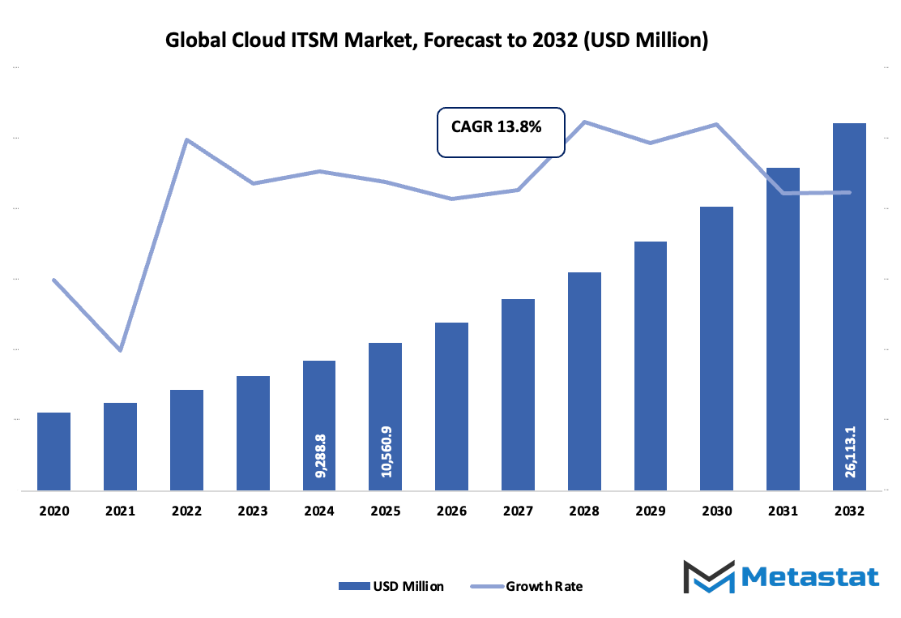
Global cloud ITSM market size of approximately USD 10560.9 million in 2025, growing at a CAGR of approximately 13.8% from 2032, with potential to reach USD 26113.1 million.
Public Cloud command nearing 60.4% market share, driving innovation and expanding applications through intense research.
Principal growth trends: Growing adoption of cloud technology to reduce costs and increase scalability, Growing demand for remote IT services and management of digital workplace
Opportunities: Scaling up artificial intelligence-driven automation and self-service capabilities in Cloud ITSM
Principal insight: Value growth in the market at an exponential rate over the decade with enormous growth opportunities.
The global cloud ITSM market has emerged as a uniting power for the information technology service management industry, revolutionizing the management, delivery, and support of digital services for businesses. The evolution started in the early 2000s when companies started moving away from traditional on-premise IT management systems that were not only flexible but also costly and time-consuming to maintain and upgrade. As cloud computing began to gain momentum, companies realized the value of mobility and remote access and hence began conducting the initial experiments with cloud-based service management platforms.
The first significant shift was when organizations realized cloud delivery had the potential to unite dispersed IT processes on one platform, streamlining service delivery and lowering operational expense. Over time, this led to full-service management suites designed specifically for the cloud. The advent of SaaS-based ITSM platforms in the 2010s was a game-changer, allowing even mid-sized organizations to gain from advanced IT service tools without having to invest heavily in infrastructure.
From there, the global cloud ITSM market matured through convergence with automation, analytics, and AI. These capabilities transformed mundane service processes into data-driven workflows that could anticipate issues before they disrupted processes. Organizations started using predictive insights to enhance performance, while end users needed seamless, fast, and intuitive digital support experiences. This increasing focus on user experience led providers to build ITSM solutions that mirror consumer technology—easy, connected, and mobile-enabled.
Regulatory settings also played a part. As growing data privacy laws and compliance frameworks worldwide increased, service providers adjusted their platforms to accommodate the new governance needs, with transparency and control of the way data is handled. This consciousness of regulation gave enterprises the assurance to move major service management functions into the cloud.
Today, the global cloud ITSM industry is at a point where distinctions between business strategy and IT operations continue to blur.
Its future will likely pivot toward increased automation, closer integration with enterprise applications, and more customized service management methodology. What began as a cost-effective alternative to legacy systems will increasingly become more of a strategic anchor for organizations that must offer seamless digital experiences across all facets of their business.
The global cloud ITSM market is mainly classified based on Deployment Model, Technology, Organization Size, Verticals.
Public Cloud: The global cloud ITSM market will witness vast growth through the public cloud model, offering flexibility, scalability, and cost-effectiveness. The model will be utilized by many organizations to gain easier access to cloud-based IT service management tools. The trend will grow due to high demand for rapid deployment and reduced infrastructure maintenance costs.
Private Cloud: The global cloud ITSM market will expand with the rise in private cloud adoption by companies to attain enhanced control and data security. The model will provide customized ITSM solutions suitable for sensitive data and compliance. Regulated industry companies will prefer private cloud deployments for secure operations and improved governance.
Hybrid Cloud: The global cloud ITSM market will be driven by hybrid cloud adoption, with a combination of security and flexibility. Hybrid cloud will allow organizations to take advantage of public cloud benefits as well as on-premises infrastructures. Organizations will utilize hybrid environments more to handle changing workloads without compromising on sensitive data and mission-critical applications.
Configuration Management: The global cloud ITSM market will be underpinned by configuration management technologies that enhance operational accuracy. Such systems will track and maintain compatibility within IT systems. Automation will reduce human errors and enhance resource optimization, making configuration management key to guaranteeing stability in electronic infrastructures in the future.
Performance Management: Global Cloud ITSM will see performance management tools as the highlight of real-time monitoring and improving service delivery. The technologies will enable organizations to track real-time information, predict failures, and make life easier for users. Constant analysis and optimization will remain the secret to meeting growing performance requirements.
Network Management: The global cloud ITSM market will heavily rely on network management to maintain continuous links to the service. Monitoring and fault-fixing tools will be essential with complicated networks. Seamless communication, system reliability, and enhanced reaction to connectivity problems across all industries will be offered through effective network management.
Database Management System: The global cloud ITSM market will integrate advanced database management systems to organize, save, and analyze growing data volumes. These systems will facilitate instant decision-making and improve service accuracy. Enhanced data handling abilities will assist in faster processing, better reporting, and more efficient IT service management functions.
Other: The global cloud ITSM market will also have other technologies such as automation, analytics, and integration of AI. All of these additions will improve innovation and productivity so that smarter IT service management can be facilitated. Automation will help to mitigate repetitive tasks while analytics will enhance insights for maximum operational and strategic decision-making.
Small and Medium Enterprises (SMEs): The global cloud ITSM market will attract SMEs due to cost-efficient solutions and scalability benefits. Cloud-based ITSM will help smaller firms access advanced tools without heavy infrastructure investment. The ease of integration and flexibility of cloud systems will empower SMEs to improve their service quality and efficiency.
Large Enterprises: The global cloud ITSM market will grow as large enterprises adopt advanced ITSM frameworks for complex operations. These organizations will prioritize customization, security, and compliance in their cloud adoption. Investments in AI-driven ITSM tools will enhance process automation and ensure higher service performance across global business environments.
BFSI: The global cloud ITSM market will grow in the BFSI sector due to the need for secure, compliant, and efficient IT services. Financial institutions will use cloud ITSM to manage operations, enhance data protection, and meet customer service expectations while ensuring regulatory compliance and disaster recovery readiness.
IT and Telecom: The global cloud ITSM market will expand in IT and telecom sectors as digital transformation accelerates. These industries will rely on cloud-based ITSM to manage vast network infrastructures and enhance customer support. Automation and real-time monitoring will improve service efficiency and help reduce system downtime.
Government & Public Sector: The global cloud ITSM market will see adoption in the government and public sector to modernize infrastructure and enhance transparency. Cloud ITSM will support digital governance initiatives by improving data management and service delivery. The shift toward cloud platforms will enable better coordination and citizen engagement.
Retail & Consumer Goods: The global cloud ITSM market will help the retail and consumer goods sector by enhancing customer service operations. Cloud-based ITSM will enable better inventory tracking, faster response times, and seamless integration across platforms. Retailers will benefit from improved data insights and efficient service delivery systems.
Manufacturing: The global cloud ITSM market will support manufacturing by integrating operational systems with IT management. Real-time data tracking and predictive maintenance will enhance production efficiency. Cloud ITSM will streamline workflows, reduce downtime, and optimize supply chain operations, improving overall manufacturing performance and productivity.
Energy & Utilities: The global cloud ITSM market will play a vital role in energy and utilities by managing complex infrastructures and critical assets. Cloud ITSM tools will ensure continuous monitoring, predictive maintenance, and efficient resource allocation. These improvements will lead to higher operational reliability and sustainable energy management.
Other: The global cloud ITSM market will extend to other sectors including healthcare, education, and logistics. These industries will adopt cloud ITSM to achieve better service control, compliance, and automation. The shift toward digital service management will enable smarter operations and stronger adaptability in dynamic environments.
|
Forecast Period |
2025-2032 |
|
Market Size in 2025 |
$10560.9 Million |
|
Market Size by 2032 |
$26113.1 Million |
|
Growth Rate from 2025 to 2032 |
13.8% |
|
Base Year |
2025 |
|
Regions Covered |
North America, Europe, Asia-Pacific, South America, Middle East & Africa |
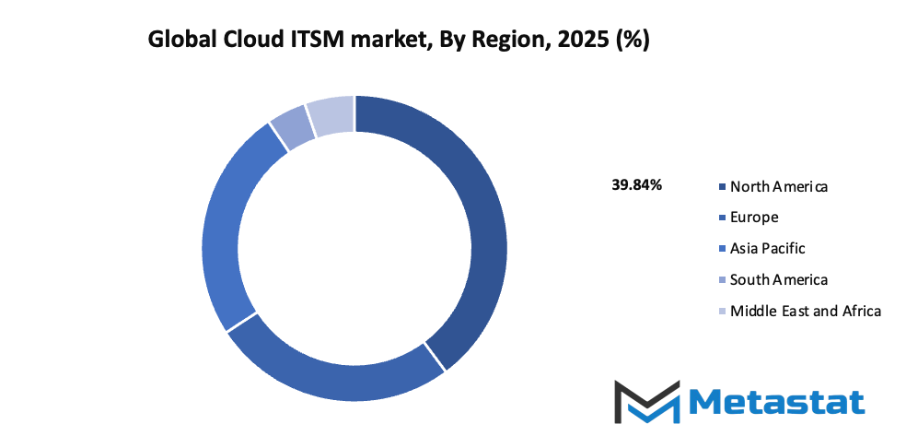
Based on geography, the global cloud ITSM market is divided into North America, Europe, Asia-Pacific, South America, and the Middle East & Africa.
North America is further divided into the U.S., Canada, and Mexico, whereas Europe consists of the UK, Germany, France, Italy, and the Rest of Europe.
Asia-Pacific is segmented into India, China, Japan, South Korea, and the Rest of Asia-Pacific.
The South America region includes Brazil, Argentina, and the Rest of South America, while the Middle East & Africa is categorized into GCC Countries, Egypt, South Africa, and the Rest of the Middle East & Africa.
Growing adoption of cloud technologies for cost efficiency and scalability: The global cloud ITSM market will benefit from the increasing use of cloud technologies, as businesses look for solutions that offer cost savings and easy scalability. Cloud-based IT service management tools reduce the need for physical infrastructure, allowing faster upgrades and better performance without large investments in hardware.
Rising demand for remote IT support and digital workplace management: The global cloud ITSM market will experience strong growth due to the rise in remote work and digital workplace environments. Organizations are focusing on tools that support employees working from different locations while maintaining smooth IT operations. Cloud-based ITSM platforms enable real-time monitoring, issue tracking, and efficient service delivery.
Data security and compliance concerns in cloud environments: The global cloud ITSM market must address growing concerns about data protection and compliance with international regulations. Organizations handling sensitive information need strong security frameworks to prevent data breaches. Ensuring compliance with standards such as GDPR and ISO will remain essential for maintaining customer trust.
Integration challenges with legacy IT systems: The global cloud ITSM market will continue to encounter difficulties when merging new cloud solutions with older IT infrastructures. Many organizations still rely on legacy systems that lack compatibility with modern platforms. Overcoming these integration barriers requires strategic planning and gradual migration to cloud-based operations.
Expansion of AI-driven automation and self-service capabilities in Cloud ITSM: The global cloud ITSM market will see major progress through AI-based automation and self-service options. Automated workflows will enable quicker problem resolution, while AI-powered chatbots and predictive tools will help organizations provide continuous support. These developments will enhance efficiency and deliver smarter service management solutions.
The global cloud ITSM market is shaped by a combination of established international leaders and emerging regional competitors. Companies such as ServiceNow, BMC Software, Atlassian, Efecte, Ivanti, TeamDynamix, SolarWinds, IBM Corporation, Micro Focus, Freshworks, SAP, ManageEngine, EasyVista, SolarWinds Worldwide, LLC., Microsoft, SysAid, Alemba, Zendesk, and Agiloft play significant roles in defining the competitive environment. The presence of both large-scale providers and regional players ensures that the market will continue to experience dynamic shifts. Established companies are likely to focus on expanding their technological capabilities, improving integration with other cloud solutions, and enhancing user experience, while regional competitors will concentrate on cost-efficient solutions, customization, and rapid adaptation to local market needs.
Strategic insights point to a future in which agility and innovation will determine market leadership. Providers that invest in artificial intelligence, automation, and predictive analytics will gain an edge by offering faster incident resolution, proactive service management, and enhanced operational efficiency. The competitive landscape will encourage collaborations, acquisitions, and partnerships as companies seek to strengthen portfolios and extend global reach. Simultaneously, emerging competitors will capitalize on niche opportunities, targeting sectors that require specialized cloud ITSM solutions and delivering focused, scalable services.
Market size is forecast to rise from USD 10560.9 million in 2025 to over USD 26113.1 million by 2032. Cloud ITSM will maintain dominance but face growing competition from emerging formats.
The evolution of the Cloud ITSM market suggests that companies will not only compete on product features but also on customer experience, speed of deployment, and adaptability to evolving technology demands. Those able to anticipate future challenges, such as growing cybersecurity needs, complex hybrid environments, and increasing demand for mobile-first management tools, will likely position themselves as leaders. As global demand for cloud-based service management grows, the competitive landscape will continuously reshape, with strategic decisions guiding which organizations achieve long-term sustainability and influence.
This research report categorizes the Cloud ITSM market based on various segments and regions, forecasts revenue growth, and analyzes trends in each submarket. The report analyses the key growth drivers, opportunities, and challenges influencing the Cloud ITSM market. Recent market developments and competitive strategies such as expansion, type launch, development, partnership, merger, and acquisition have been included to draw the competitive landscape in the market. The report strategically identifies and profiles the key market players and analyses their core competencies in each sub-segment of the Cloud ITSM market.
Find answers to common questions about this report
Global Cloud ITSM market is valued at $10560.9 million in 2025.
Global Cloud ITSM market is estimated to grow with a CAGR of 13.8% from 2025 to 2032.
Global Cloud ITSM market is estimated to reach $26113.1 million by 2032.
Top players operating in the Cloud ITSM industry includes ServiceNow, BMC Software, Atlassian, Efecte, Ivanti, TeamDynamix, SolarWinds, IBM, and Others.
The analysts below cover Information & Technology research at Metastat Insights.
LEAD ANALYST
Utkarsh Khirodkar is a Lead Market Research Analyst at MetaStat Insight, specializing in market intelligence, technology sector assessments, and competitive strategy.

PRINCIPAL CONSULTANT - ENTERPRISE AI & EMERGING TECHNOLOGIES
Banking & Finance · Electronics and Semiconductor · Energy and Power · Healthcare IT · Information & Technology · Professional Services
Vijay Gunti is a Principal Consultant at MetaStat Insight, bringing over two decades of experience across enterprise digital transformation, technology strategy, and intelligent systems.

LEAD CONSULTANT - COMMUNICATION, TELECOM, AND IT
Electronics and Semiconductor · Information & Technology · Machinery & Equipment · Professional Services
Ravindra Sathe Consultants for Communication, Telecom, and IT at MetaStat Insight. He leads the firm's industry research initiatives across telecommunications infrastructure, digital connectivity, enterprise networking, and emerging information technology domains.
Replacing petrochemical surfactants with bio-based alternatives requires realistic timelines on industrial precision fermentation scaling. The market research broke down commercialization timelines, feedstock sugar price sensitivities, and regional cosmetic ingredient regulatory approvals in Europe and East Asia. That supplier readiness mapping gave our formulations team reliable context when comparing renewable chemical sourcing roadmaps.
Tracking ceramic matrix composite adoption in high-bypass aero engines requires strict attention to material qualification cycles and FAA airworthiness testing milestones. The MetaStat Insight team provided a detailed timeline of silicon carbide fiber manufacturing capacity and commercial foundry lead times. Having clear visibility into upstream thermal barrier coating supply helped us stress-test our long-term component procurement strategy.
Transitioning ultra-class mining haul trucks to alternative power requires concrete data on remote hydrogen refueling infrastructure economics. The report evaluated megawatt-scale electrolyzer installation expenses, onsite storage safety mandates, and heavy-duty fuel cell stack degradation under continuous duty cycles. That technical rigor helped our engineers benchmark realistic total operating cost horizons for off-highway fleet decarbonization.
Explore related market intelligence reports worth reading alongside this one.