
LEAD ANALYST
Utkarsh Khirodkar is a Lead Market Research Analyst at MetaStat Insight, specializing in market intelligence, technology sector assessments, and competitive strategy.

Global Commercial Switch Market Size, Share, By Type (Single Pole Single Throw, Single Pole Double Throw, Double Pole Single Throw, and Double Pole Double Throw), By Price (Low, Medium, and High), By Distribution Channel (Sales Through Intermediaries, Online Sales, Dual Distribution, and Direct Sales), By End User (Industrial Sector, Commercial Sector, and Residential Sector), Industry Analysis, Growth, Trends, and Forecast, 2026-2033
Report ID
MSI-4754
Published
May, 2026
Pages
314 Pages
Format
Report Details
Choose Your License
Commercial Switch Market
Global Commercial Switch market size is valued at USD 21.7 billion in 2025 and projected to grow at a CAGR of 4.2% during the forecast period, reaching USD 30.1 billion by 2033.
North America holds 30.3% market share in 2025, with the U.S. leading the regional market.
The Single Pole Single Throw segment accounts for a market share of 34.2% in 2025.
Key trends driving growth: Increasing commercial infrastructure development and smart building adoption is propelling demand for advanced switching solutions, along with Rising deployment of automation and connected electrical systems across enterprises is accelerating commercial switch integration.
Opportunities include expansion of IoT-enabled and energy-efficient switching technologies is creating strong growth opportunities in next-generation commercial applications.
Key insight: The Global Commercial Switch market is gaining steady momentum owing to infrastructure modernization, smart facility upgrades, safety compliance standards, and durable electrical component demand.
The Global Commercial Switch Market is moving beyond conventional on-off electrical control and becoming an important part of modern building automation systems. Commercial switches are increasingly used as integrated control points for lighting automation, occupancy-based operation, energy management, and connected facility infrastructure across offices, retail spaces, healthcare buildings, hospitality properties, and institutional facilities.
Over the coming years, product development will shift toward modular designs, touchless interfaces, antimicrobial surfaces, and IoT-enabled switching solutions. The Global Commercial Switch Market will benefit from renovation activity in aging commercial buildings and the rising preference for intelligent power control systems in high-traffic facilities.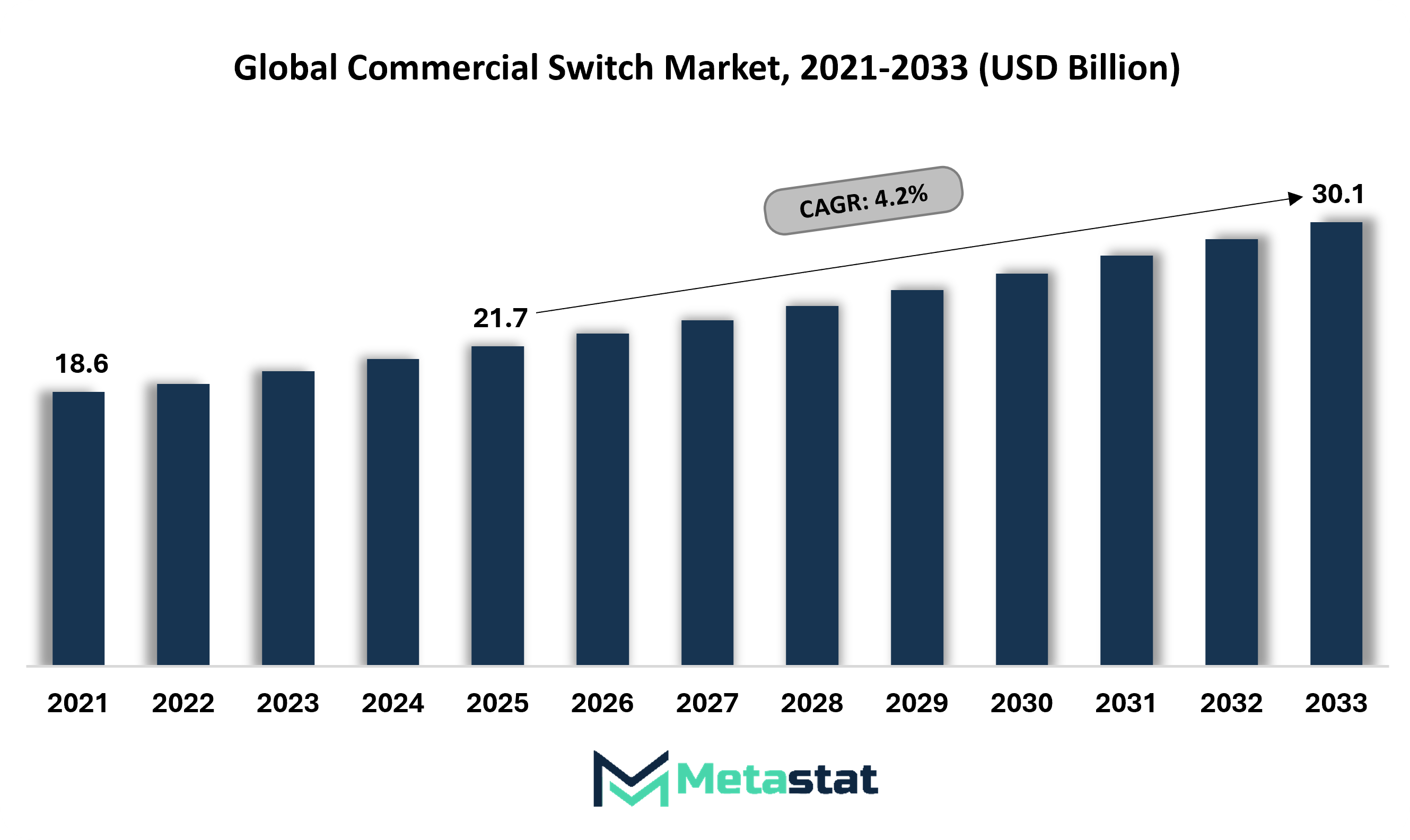
Increasing commercial infrastructure development and smart building adoption are propelling demand for advanced switching solutions.
Rapid development of offices, retail facilities, healthcare campuses, hospitality projects, and mixed-use properties is increasing the requirement for reliable switching networks. Smart building planning is encouraging sensor-connected controls, centralized monitoring, and efficient energy routing. Future projects will prefer durable switch systems that support safety, scalability, and digital control requirements.
Rising deployment of automation and connected electrical systems across enterprises is accelerating commercial switch integration.
Enterprise facilities are expanding automated lighting, climate control, access systems, surveillance devices, and connected equipment. Growing dependence on synchronized electrical flow is increasing the need for responsive commercial switches. Future workplaces will adopt integrated switch systems that support faster operations, predictive maintenance, and business continuity goals.
High installation and maintenance costs associated with advanced switching systems are limiting adoption across cost-sensitive customer segments.
Advanced commercial switch systems frequently require premium components, skilled installation teams, software configuration, and periodic servicing. Budget-focused customers across small enterprises, local facilities, and small commercial properties will delay upgrades. Future demand growth will rely on modular designs, simplified servicing models, and improved lifecycle economics.
Availability of low-cost unorganized alternatives is creating pricing pressure on established manufacturers.
The presence of low-cost local products is intensifying price competition across procurement channels. Established brands face pressure on margins, distributor loyalty, and premium positioning. Future success will depend on warranty strength, certified safety performance, energy savings, and long-term durability benefits over uncertified market offerings.
Expansion of IoT-enabled and energy-efficient switching technologies is creating strong growth opportunities in next-generation commercial applications.
Connected switches with remote control, usage analytics, occupancy response, and energy monitoring are gaining commercial attention. Sustainability objectives are encouraging low-energy designs and smart load control. Future opportunities will rise across green buildings, data centers, airports, hospitals, and digitally controlled enterprise campuses worldwide.
The Global Commercial Switch Market is classified based on Type, Price, Distribution Channel, End User, and Region.
Single Pole Single Throw segment is valued at USD 7.7 billion in 2026 and is projected to reach USD 10.0 billion by 2033, at a CAGR of 3.7% during the forecast period.
Single Pole Single Throw configuration supports simple on and off control across lighting panels, vending systems, compact equipment, and utility boards. Adoption is supported by low maintenance needs, easy installation, and reliable switching cycles. Future adoption will rise through smart retrofitting programs across commercial properties and managed facilities.
Single Pole Double Throw segment is valued at USD 5.6 billion in 2026 and is projected to reach USD 7.3 billion by 2033, at a CAGR of 4% during the forecast period.
Single Pole Double Throw design enables selection between two circuits within control cabinets, alarm systems, and signal routing devices. Market interest is increasing through flexible operations and compact layouts. Future expansion will come from automation upgrades, advanced monitoring networks, and space-saving electrical assemblies across commercial infrastructure.
Double Pole Single Throw segment is valued at USD 4.2 billion in 2026 and is projected to reach USD 5.6 billion by 2033, at a CAGR of 4% during the forecast period.
Double Pole Single Throw format manages multiple circuits through a single switching action, supporting stronger isolation and coordinated energy control. Usage remains significant across HVAC systems, industrial tools, and safety panels. Future demand will strengthen through energy management projects and stricter electrical safety practices worldwide.
Double Pole Double Throw segment is valued at USD 5.0 billion in 2026 and is projected to reach USD 7.2 billion by 2033, at a CAGR of 5.3% during the forecast period.
Double Pole Double Throw arrangement enables switching between outputs while controlling dual circuits. Preference remains high within motor control, backup power lines, and equipment transfer systems. Future adoption will emerge from smart buildings, data centers, and resilient electrical networks requiring reliable transition control.
Low segment is projected to reach USD 7.8 billion by 2033, at a CAGR of 2.8% during the forecast period.
Low-price switches attract budget-focused buyers seeking practical switching solutions for routine operations. Popularity remains strong among small businesses, local contractors, and replacement projects. Future sales will increase through volume procurement, urban expansion, and wider access to standardized commercial electrical products across developing economies.
Medium segment is projected to reach USD 14.2 billion by 2033, at a CAGR of 4.3% during the forecast period.
Medium price range balances durability, performance, and cost efficiency, making it a common choice for offices, retail chains, and service facilities. Buyers often prefer reliable quality without premium spending. Future momentum will develop through maintenance cycles, moderate automation demand, and rising compliance standards in commercial spaces.
High segment is projected to reach USD 8.1 billion by 2033, at a CAGR of 5.5% during the forecast period.
High price segment includes premium switches with advanced materials, longer service life, smart integration, and specialized certifications. Adoption remains strong across hospitals, airports, hotels, and mission-critical sites. Future development will accelerate through connected infrastructure projects and preference for lifecycle value over upfront spending.
Sales Through Intermediaries segment is projected to reach USD 13.5 billion by 2033.
Sales through intermediaries include wholesalers, distributors, and electrical dealers that support broad product reach. Channel strength comes from local inventory access, technical guidance, and faster procurement. Future relevance will remain strong where contractor relationships, regional supply networks, and immediate replacement demand continue to expand.
Online Sales & Dual Distribution segment is projected to reach USD 7.2 billion by 2033.
Online Sales & Dual Distribution combines digital platforms with physical supply networks, improving buyer convenience and pricing visibility. Buyers benefit from easier comparison, faster ordering, and flexible delivery options. Future expansion will develop through e-commerce maturity, catalog digitization, and integrated inventory management systems.
Direct Sales segment is projected to reach USD 9.4 billion by 2033.
Direct sales channel connects manufacturers with enterprise buyers requiring bulk orders, custom specifications, and service agreements. Channel value rises through stronger margins and clearer communication during procurement cycles. Future demand will increase among large projects seeking dedicated support, tailored contracts, and scheduled supply commitments.
Industrial Sector segment is projected to grow at a CAGR of 4.6% during the forecast period.
Industrial sector demand is driven by equipment control, process safety, heavy equipment panels, and energy management systems. Strong preference exists for rugged performance and long operating life. Future gains will follow factory modernization, robotics adoption, and expansion of manufacturing capacity across multiple regions.
Commercial Sector segment is projected to grow at a CAGR of 4.1% during the forecast period.
Commercial sector utilization covers offices, malls, hospitality venues, healthcare buildings, and educational campuses requiring dependable switching systems. Adoption rises through maintenance activity and smart building programs. Future expansion will strengthen with connected workplaces, efficient energy controls, and expansion of service-based infrastructure worldwide.
Residential Sector segment is projected to grow at a CAGR of 3.6% during the forecast period.
Residential sector adoption supports apartments, gated communities, mixed-use towers, and premium housing projects using commercial-grade switches for durability. Interest is rising through design upgrades and safety awareness. Future opportunities will expand with urban housing development, home automation adoption, and premium interior electrical options.
Based on geography, the Global Commercial Switch market is divided into North America, Europe, Asia-Pacific, South America, Middle East, and Africa.
In North America, the Commercial Switch Market gains momentum from strict electrical safety codes and strong preference for branded, connected switching products.
Europe is expected to maintain steady growth in the Commercial Switch Market, supported by building renovation activity, strict electrical safety standards, and increasing adoption of smart building technologies across commercial spaces.
Asia-Pacific provides substantial opportunities for the Commercial Switch Market through expanding urban infrastructure, commercial real estate development, and manufacturing growth.
Within Asia-Pacific, the Commercial Switch Market benefits from growing smart city investments and rapid upgrades across hospitality and education facilities.
Across the Middle East, Africa, and South America, the Commercial Switch market progresses through infrastructure expansion, tourism-led industrial initiatives, and modernization of public facilities.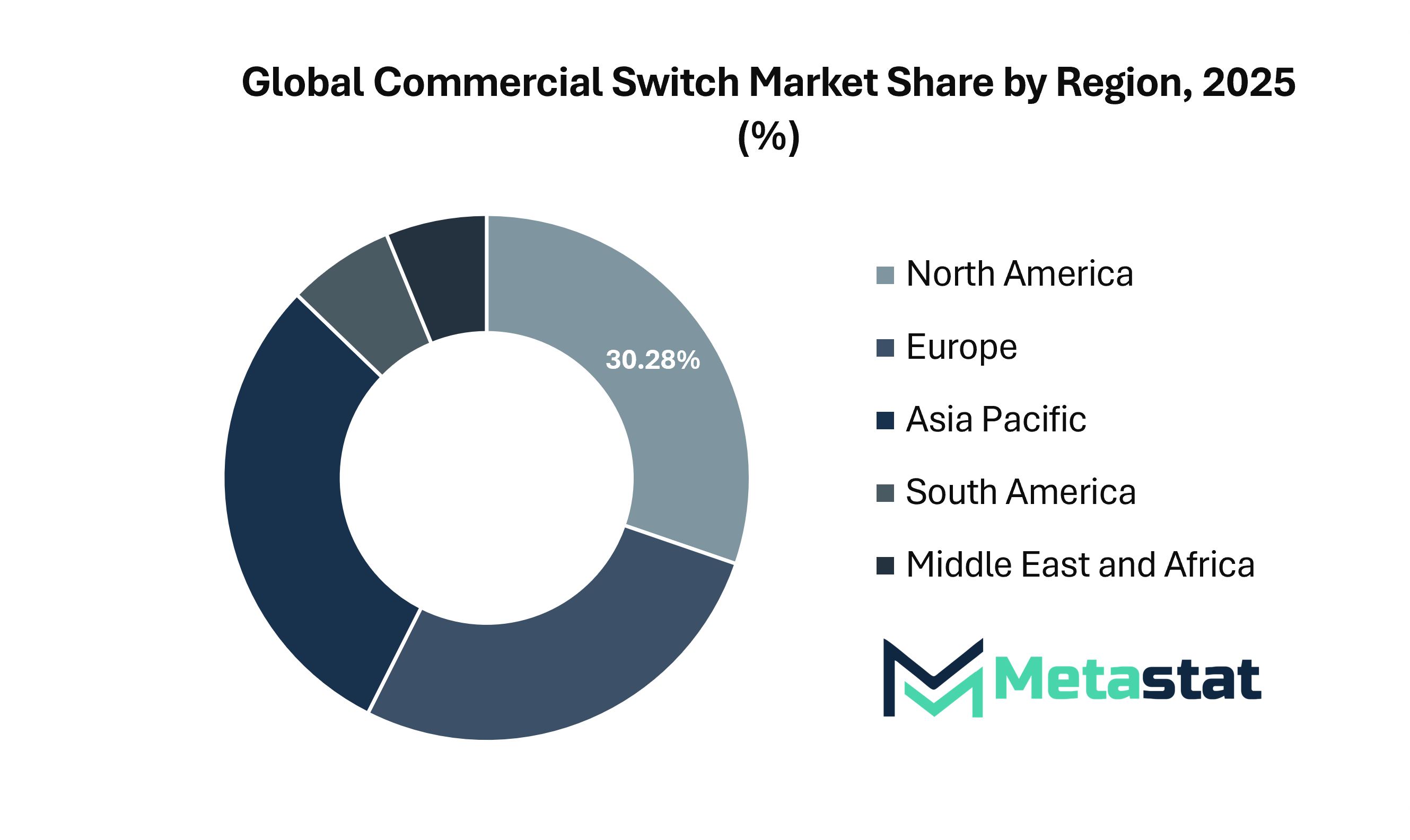
The Global Commercial Switch Market includes several manufacturers competing through product quality, safety performance, reliability, pricing, and supply availability. ABB Ltd., APEM SAS, and Albrecht Jung GmbH & Co. KG are recognized for broad industrial experience and established electrical product portfolios. Alps Alpine Co., Ltd. and BTicino S.p.A. bring strong design capabilities, while Bremas Ersce S.p.A. serves control requirements in demanding commercial and industrial environments. C&K Components, Inc. and Camsco Electric Co., Ltd. support varied switching applications, while Carling Technologies, Inc., CHINT Group Co., Ltd., and CTS Corporation continue to expand their regional reach through distributor networks.
Eaton Corporation plc, EAO AG, and E-Switch, Inc. are recognized for durable components used across offices, retail units, and control panels. GEWISS S.p.A. and Gira Giersiepen GmbH & Co. KG focus on modern installations with clean styling and functional design. GM Modular Private Limited and Havells India Limited benefit from strong domestic demand and dealer networks. Honeywell International Inc. and Hubbell Incorporated add scale through broad electrical portfolios, while Johnson Electric Holdings Limited, Kraus & Naimer GmbH, and Legrand SA continue investing in engineering, testing, and service support to strengthen customer relationships across regional markets.
Leviton Manufacturing Co., Inc., Littelfuse, Inc., and LOVATO Electric S.p.A. are valued where reliability and quick response matter. Lutron Electronics Co., Inc. is strongly associated with smart control solutions for commercial interiors. Marquardt GmbH and MENNEKES Elektrotechnik GmbH & Co. KG support specialized electrical applications with established standards. Niko Group NV and NKK SWITCHES CO., LTD. complete a competitive field where buyers assess ratings, lifecycle, design, warranty coverage, technical support, and delivery schedules before placing orders.
Competition among these companies is driving continuous improvements in materials, safety ratings, design quality, and ease of installation. Some manufacturers compete through premium styling, while others grow by offering value-focused product lines for contractors managing large projects. Regional presence, inventory availability, and support teams often influence final buying decisions beyond price alone. Partnerships with builders, facility managers, and electrical distributors also support wider sales channel development. Over time, companies that balance pricing, reliable performance, and fast service will maintain stronger positions among professional buyers across global markets.
Market size is forecast to rise from USD 21.7 billion in 2025 to over USD 30.1 billion by 2033.
The Global Commercial Switch Market is expected to integrate increasingly with digital facility ecosystems, where switches function as intelligent control nodes rather than standalone hardware. Future adoption will center on touchless operation, voice compatibility, occupancy intelligence, energy monitoring, and centralized facility control.
This research report categorizes the Commercial Switch market based on key segments and regions, forecasts revenue growth, and analyses trends in each submarket. The report analyses the key growth drivers, opportunities, and challenges influencing the Commercial Switch market. Recent market developments and competitive strategies such as expansion, product launch, partnership, merger, and acquisition have been included to draw the competitive landscape in the market.
The report strategically identifies and profiles the key market players and analyses their core competencies in each sub-segment of the Commercial Switch market.
|
Report Attributes |
Details |
|
Study Period |
2021-2033 |
|
Base Year |
2025 |
|
Estimated Year |
2026 |
|
Forecast Period |
2026-2033 |
|
Historical Period |
2021-2025 |
|
Growth Rate |
CAGR 4.2% from 2026 to 2033 |
|
Revenue Unit |
USD billion |
|
Sales Volume Unit |
Thousand Units |
|
Segmentation |
By Type, Price, Distribution Channel, End User, and Region |
|
By Region |
North America (By Type, Price, Distribution Channel, End User, and Country)
|
|
Europe (By Type, Price, Distribution Channel, End User, and Country)
|
|
|
Asia Pacific (By Type, Price, Distribution Channel, End User, and Country)
|
|
|
South America (By Type, Price, Distribution Channel, End User, and Country)
|
|
|
Middle East and Africa (By Type, Price, Distribution Channel, End User, and Country)
|
Find answers to common questions about this report
Top players operating in the Commercial Switch industry includes ABB Ltd., APEM SAS, Albrecht Jung GmbH & Co. KG, Alps Alpine Co., Ltd., BTicino S.p.A., Bremas Ersce S.p.A., and C&K Components, Inc.
Global Commercial Switch market is estimated to reach USD 30.1 billion by 2033.
The Single Pole Single Throw is the leading type of segment in the Global market.
High installation and maintenance costs associated with advanced switching systems are limiting adoption across cost-sensitive customer segments will hamper the market growth within the forecast period.
North America region dominates the market.
Increasing commercial infrastructure development and smart building adoption is propelling demand for advanced switching solutions and rising deployment of automation and connected electrical systems across enterprises is accelerating commercial switch integration are key driving factors, boosting the market.
The Metastat Insights analysis shows that the North America Commercial Switch market size is estimated to be USD 8.8 billion by 2033.
The Global Commercial Switch market is expected to grow at a CAGR of 4.2% over the forecast period (2026-2033).
The Metastat Insights study shows that the Global Commercial Switch market size was USD 21.7 billion in 2025.
The analysts below cover Electronics and Semiconductor research at Metastat Insights.
LEAD ANALYST
Utkarsh Khirodkar is a Lead Market Research Analyst at MetaStat Insight, specializing in market intelligence, technology sector assessments, and competitive strategy.

PRINCIPAL CONSULTANT - ENTERPRISE AI & EMERGING TECHNOLOGIES
Banking & Finance · Electronics and Semiconductor · Energy and Power · Healthcare IT · Information & Technology · Professional Services
Vijay Gunti is a Principal Consultant at MetaStat Insight, bringing over two decades of experience across enterprise digital transformation, technology strategy, and intelligent systems.

PRINCIPAL CONSULTANT - QUALITY SYSTEMS & COMPLIANCE
Electronics and Semiconductor · Machinery & Equipment · Professional Services
Omkar Phadtare is an Industry Consultant at MetaStat Insight, specializing in quality systems, regulatory compliance, and standards benchmarking to drive data-driven market intelligence and strategic industry research.

ENERGY & INFRASTRUCTURE INDUSTRY CONSULTANT
Automotive and Transportation · Electronics and Semiconductor · Energy and Power · Machinery & Equipment
Saurabh Vasant Ganvir consults for Energy & Infrastructure Industry at MetaStat Insight, specializing in renewable energy, solar EPC, and electric vehicle (EV) infrastructure markets.

LEAD CONSULTANT - COMMUNICATION, TELECOM, AND IT
Electronics and Semiconductor · Information & Technology · Machinery & Equipment · Professional Services
Ravindra Sathe Consultants for Communication, Telecom, and IT at MetaStat Insight. He leads the firm's industry research initiatives across telecommunications infrastructure, digital connectivity, enterprise networking, and emerging information technology domains.
Our team was tracking whether regional recycling infrastructure could realistically absorb the growing volume of lithium iron phosphate batteries over the next decade. The report did a solid job separating announced hydrometallurgical plant capacity from active, permitted operational throughput. That distinction made the feedstock availability projections and regional recovery rate models far more credible than standard commercial overviews.
Tracking capacity expansion in single-use bioprocessing requires dependable data on raw material availability and cleanroom-grade polymer supply chains. The competitive landscape chapter gave a grounded evaluation of secondary component suppliers across North America and Asia-Pacific rather than simply reprinting press releases. Having that level of supplier benchmarking helped clarify dual-sourcing considerations for our clinical pipeline planning.
When evaluating distributed energy resource management systems, standard research summaries tend to gloss over the operational differences between front-of-the-meter utility deployments and behind-the-meter industrial sites. The MetaStat Insight report addressed those distinctions directly, especially regarding software interoperability standards and grid interconnection backlogs. The five-year market sizing across regional transmission organizations provided actionable context for our grid modernization strategy.
Explore related market intelligence reports worth reading alongside this one.