
LEAD ANALYST
Utkarsh Khirodkar is a Lead Market Research Analyst at MetaStat Insight, specializing in market intelligence, technology sector assessments, and competitive strategy.

Global Cross-Border Payments Market Size, Share, By Transaction Type (Business-to-Business (B2B), Business-to-Consumer (B2C), Consumer-to-Business (C2B), Consumer-to-Consumer (C2C) and Others (G2B, G2C, B2G, C2G)), By Payment Method (Bank Transfers & Account-to-Account Payments, Card-Based Payments, Digital Wallet & Mobile Money Payments, Cash-Based Remittance Transfers and Others (Cheques, Prepaid and Alternative Transfer Methods)), By Payer/Customer Type (Large Enterprises, Small & Medium-Sized Enterprises, Financial Institutions & Payment Service Providers, Individuals & Households and Government & Public-Sector Organizations), Industry Analysis, Growth, Trends, and Forecast, 2026-2033
Report ID
MSI-4973
Published
August, 2026
Pages
305 Pages
Format
Historical
Base year
Forecast
Forecast period
Report Details
Choose Your License
Global Cross-Border Payments Market
The global Cross-Border Payments market was valued at USD 188.2 billion in 2025 and is projected to reach USD 330.8 billion by 2033, growing at a CAGR of 7.3% over the forecast period.
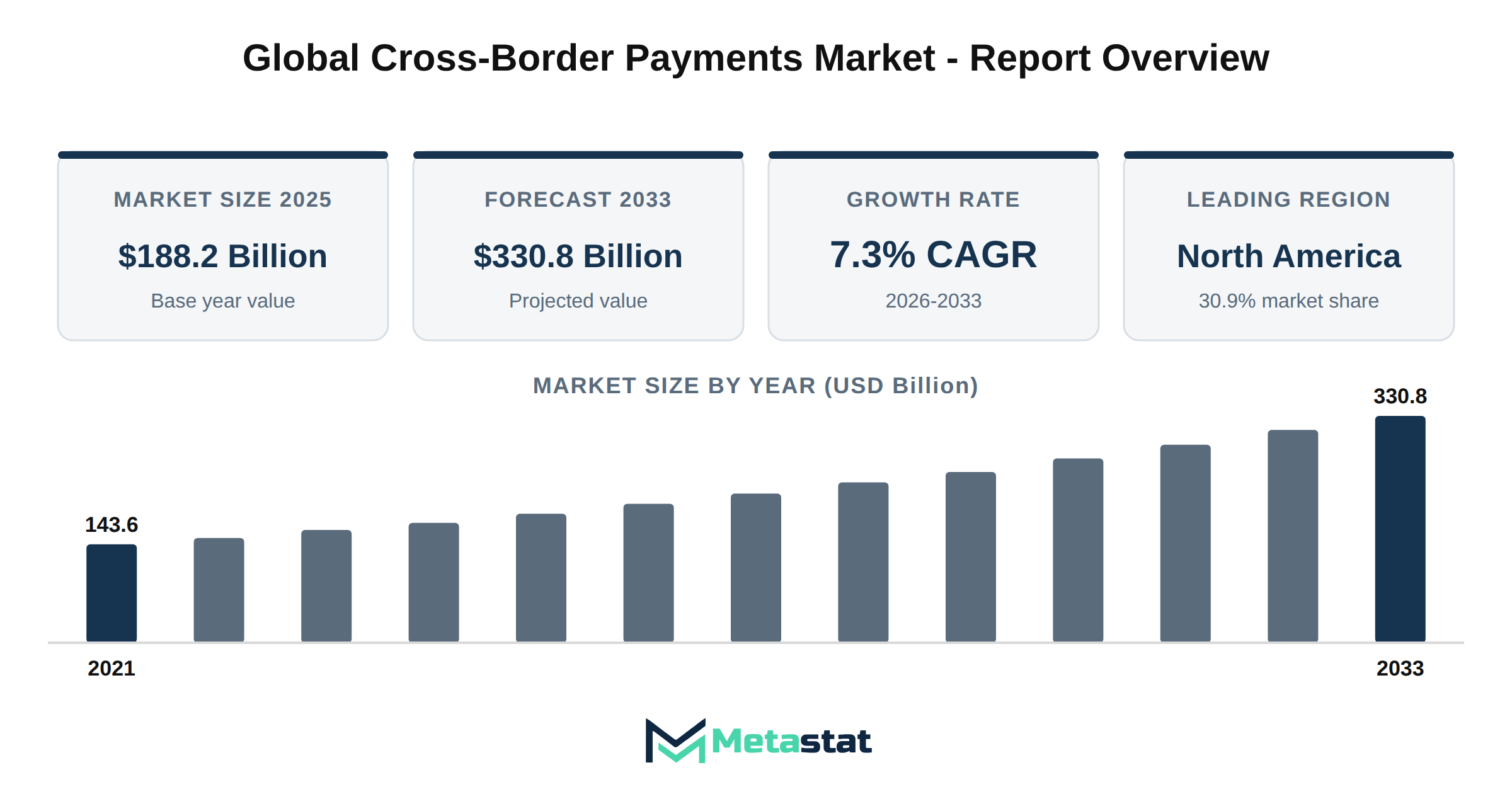
The global Cross-Border Payments market was valued at USD 188.2 billion in 2025 and is projected to reach USD 330.8 billion by 2033, reflecting a compound annual growth rate (CAGR) of 7.3%. The market experienced steady growth from USD 143.6 billion in 2021 to USD 174.8 billion in 2024. This upward trajectory demonstrates the increasing necessity for efficient international transactions.
Several factors drive this growth, including advancements in technology and finance. The evolution of ISO 20022 and SWIFT GPI enhances transaction speed and transparency, enabling smoother cross-border interactions. This transformation supports enterprises seeking to optimize their global payment processes, resulting in improved operational efficiency and cost-effectiveness.
The integration of tokenized deposit settlement models facilitates secure and expedited transactions, attracting more participants to the market. The expansion of Cross-Border Payment APIs simplifies access to payment services, promoting innovation among financial institutions and fintech companies. This trend fulfills the diverse needs of businesses across various sectors.
Digital wallets and card payouts are becoming increasingly prominent, aligning with shifting consumer preferences for convenient transaction methods. The rise in e-commerce and cross-border trade fuels demand for these payment solutions, compelling service providers to enhance their offerings. Growth opportunities emerge for companies operating within the Cross-Border Payments market.
Regulatory compliance and risk management, including measures against money laundering and fraud, shape the market landscape. Financial institutions and payment service providers implement stringent controls to comply with evolving regulations, which increases operational costs. Adapting to these requirements influences competitive dynamics within the market, driving innovation and differentiation among participants.
The Cross-Border Payments market is experiencing a profound transformation fueled by the demand for 24/7 instant payment solutions. This shift enables businesses to conduct transactions at any time, enhancing operational efficiency and customer satisfaction. Financial institutions are investing in technologies that support real-time processing, leading to a significant uptick in cross-border transaction volumes.
The evolution of ISO 20022 and SWIFT GPI is reshaping the framework for global payments. These standards facilitate richer data exchange, improving transparency and traceability in transactions. Adoption of these protocols by banks and payment service providers enhances interoperability and streamlines compliance processes, thereby improving trust and reliability in cross-border transactions.
Tokenized deposit settlement models are emerging in response to the demand for secure and efficient payment mechanisms. This innovation allows for the use of digital tokens representing real-world assets in cross-border transactions, reducing counterparty risk and enhancing liquidity. Financial institutions are exploring these models to improve transaction speed and security, driving competitive advantage.
Cross-border payment API integration is becoming a critical component for businesses seeking efficient transaction capabilities. By integrating APIs, companies enhance their payment processing infrastructure, allowing for quicker settlements and improved customer experiences. This trend is particularly prevalent among fintech companies aiming to provide innovative solutions to consumers and businesses alike.
Correspondent banking relationships are evolving, emphasizing local-rail interoperability. Financial institutions are seeking to establish direct connections with local banks to reduce reliance on traditional correspondent banking networks. This shift lowers costs and accelerates transaction speed, benefiting businesses engaged in international trade.
The expansion of digital wallets and card payout options is reshaping consumer preferences in cross-border payments. Many consumers favor digital solutions for their convenience and speed, prompting financial institutions to expand their offerings. This trend enhances competition among payment providers, driving innovation and improving service delivery.
Regulatory compliance remains a significant focus for market participants. Anti-Money Laundering (AML) measures, sanctions, and fraud controls are critical components in ensuring the integrity of cross-border transactions. Financial institutions allocate substantial resources to comply with these regulations, impacting operational costs and strategic initiatives.
The market faces various macroeconomic headwinds, including inflationary pressures and currency volatility. Inflationary pressures and currency volatility influence transaction costs and pricing strategies, prompting businesses to adapt their approaches to mitigate risks associated with fluctuating exchange rates. Strategic allocation of capital and investment in infrastructure become vital to maintain competitiveness in an unpredictable economic environment.
Future strategic outlooks for the Cross-Border Payments market emphasize the need for innovation and sustainable transformation. Companies prioritize research and development to explore next-generation technologies that enhance transaction efficiency and security. This focus aligns with broader trends in the financial services industry, where digital transformation and sustainability are essential.
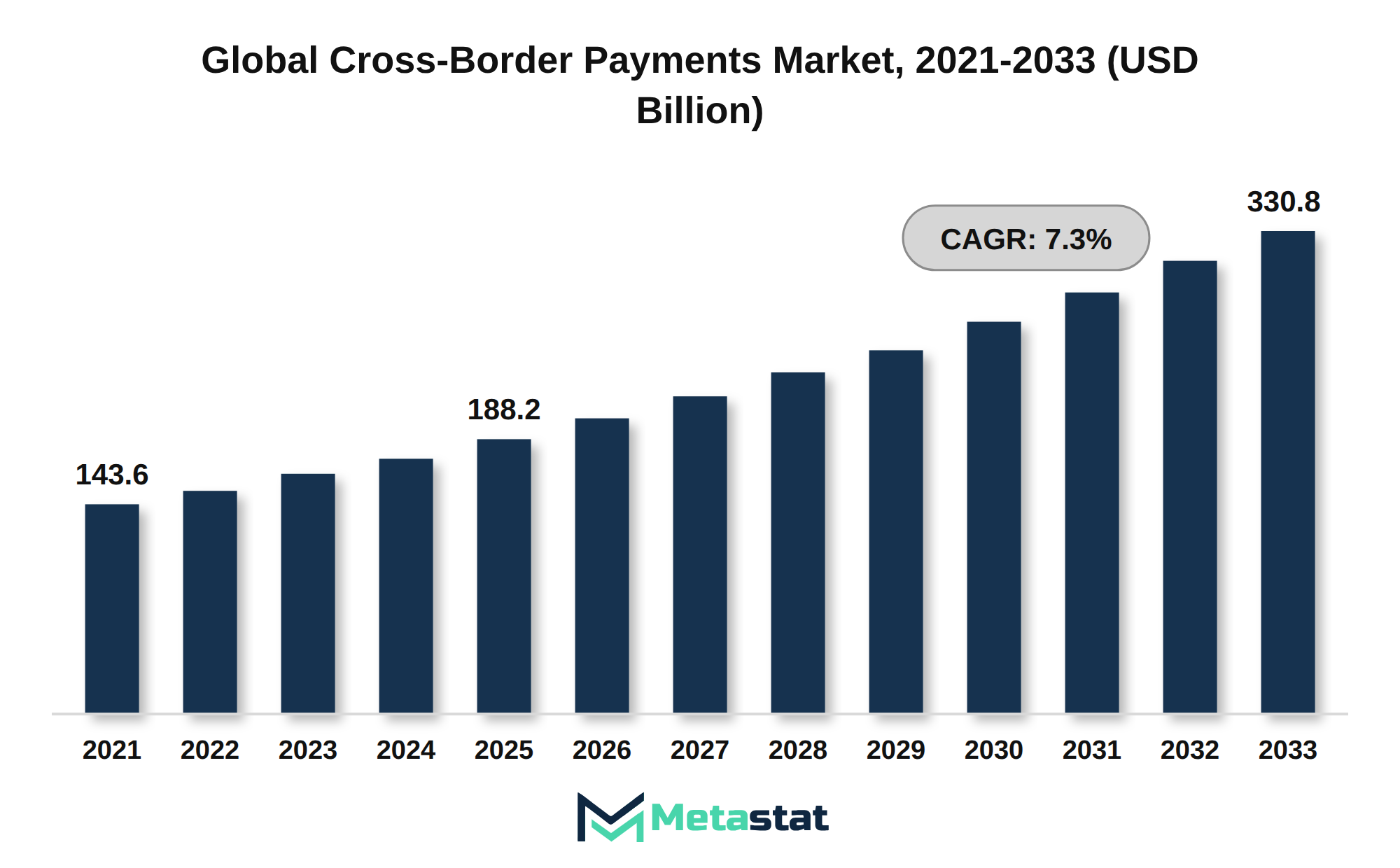
The Cross-Border Payments market benefits significantly from ongoing digital transformation initiatives across various sectors. Businesses increasingly invest in advanced technologies, including automation, artificial intelligence, and software adoption, to enhance operational capabilities and improve customer experiences. This shift towards digitization streamlines legacy processes and enhances transaction speed and security, increasing trust among consumers and enterprises.
Increasing globalization and evolving consumer preferences drive demand for efficient cross-border transactions. Companies recognize the importance of integrating digital payment solutions to meet the diverse needs of their customer base. Leveraging innovative technologies improves transaction accuracy and reduces operational costs. This trend encourages investment in the Cross-Border Payments market, leading to higher growth rates.
The focus on operational productivity aligns closely with the evolving landscape of consumer behaviors. Enterprises prioritize cost-efficiency initiatives, enabling management of expenses while expanding market reach. Integration of digital payment systems supports these objectives by reducing transaction times and minimizing overhead costs. Overall, these factors create an environment conducive to growth in the Cross-Border Payments market.
The Cross-Border Payments market experiences notable growth driven by increased globalization and improved market access. Expanding trade corridors and localized production strategies enhance cross-border transactions, with businesses seeking efficient payment solutions to navigate international markets. Enhanced economic ties among countries encourage firms to engage in global commerce, resulting in a surge of transactions requiring cross-border payment services.
The integration of digital platforms facilitates international transactions, enabling businesses to connect with global partners and consumers. Consequently, companies invest in innovative payment solutions to meet the demands of an increasingly interconnected market. This trend influences various sectors, including retail, e-commerce, and financial services, because organizations prioritize efficient payment methods to capture global opportunities.
The shift toward globalization drives investment in infrastructure development and asset modernization. Companies upgrade their digital and physical capabilities to support increased transaction volumes, ultimately enhancing operational efficiency. Such developments contribute to the overall growth trajectory of the Cross-Border Payments market, with an anticipated market value of USD 330.8 billion by 2033.
The Cross-Border Payments market faces considerable challenges from regulatory compliance hurdles. Increasingly stringent regulations across different regions require companies to adapt their operations and implement extensive compliance measures, which raises operational costs. Financial institutions and payment service providers absorb these expenses, affecting their profitability and limiting their capacity for innovation and expansion.
Legal mandates surrounding anti-money laundering (AML) and know your customer (KYC) regulations introduce complexity in transaction processing. This complexity results in delays and inefficiencies, impacting customer experience and creating friction in the payment process. Consequently, such hurdles deter potential entrants into the market, stifling competition and limiting growth opportunities.
Macroeconomic headwinds, including inflationary pressures, challenge companies in the Cross-Border Payments market. Rising costs reduce margins and force organizations to reassess their pricing strategies. Enterprises that struggle to pass these costs onto consumers risk losing market share to more agile competitors.
Infrastructure gaps in certain regions prevent the effective execution of cross-border transactions. Inadequate connectivity and deployment bottlenecks create inefficiencies, hindering the scalability of payment solutions. Firms encounter delays in processing payments, reducing overall transaction volume and affecting revenue growth.
Data security vulnerabilities and privacy concerns remain significant obstacles in the Cross-Border Payments market. Incidents of data breaches erode consumer trust and lead to increased scrutiny from regulatory bodies. Financial institutions and payment providers invest heavily in cybersecurity measures, diverting funds away from growth initiatives.
Geopolitical instability affects cross-border transactions by creating uncertainty in international trade and financial flows. Businesses become cautious in expanding their global operations, which limits the volume of cross-border payments processed. This hesitation contributes to market stagnation, resulting from companies prioritizing stability over growth owing to fluctuating geopolitical conditions.
The Cross-Border Payments market faces significant challenges stemming from geopolitical fragmentation and trade deficits. Increasing political tensions and shifting alliances disrupt traditional trade routes, complicating payment mechanisms across borders. These conditions prompt heightened scrutiny on transaction validity, resulting in increased compliance overhead for financial institutions and payment service providers.
Tariff friction further exacerbates the situation, leading to unpredictable costs and pricing strategies for businesses engaged in international trade. Companies operating within the market experience margin pressures, necessitating adjustments in pricing models to remain competitive. This dynamic creates an environment where businesses navigate a complex web of tariffs and regulations, impacting their operational efficiency.
Technological disruptions present another hurdle for the Cross-Border Payments market. Rapid advancements in payment technologies create a pressing need for businesses to integrate these innovations swiftly. However, interoperability friction often arises, driven by differing standards and platforms that complicate transaction processing. Firms struggle to keep pace with the evolving technological landscape, risking their competitive edge.
Cybersecurity risks and data vulnerabilities introduce layers of complexity. The increasing incidence of cyberattacks forces companies to invest significantly in robust security measures. Ensuring data integrity and protecting customer information remain paramount concerns, diverting resources that could otherwise be allocated to growth initiatives. These factors collectively contribute to a challenging environment for the Cross-Border Payments market, where adaptability and resilience are crucial for success.
The Cross-Border Payments market experiences significant opportunities stemming from emerging technological disruptions. Innovations including blockchain, artificial intelligence, and machine learning enhance transaction speed, security, and efficiency, enabling greater adoption from various industries. This technological shift supports financial institutions and payment service providers in offering more robust solutions, catering to the evolving needs of customers seeking efficient cross-border transactions.
Geographical expansion presents another avenue for growth. Emerging markets in Asia Pacific, South America, and the Middle East and Africa exhibit increasing demand for cross-border payment solutions driven by local economies modernizing and integrating into the global economy. Enhanced connectivity and digital infrastructures in these regions facilitate smoother transactions, positioning them because key players in the market's future.
Strategic consolidation within the market further strengthens competitive positioning. Mergers and acquisitions among established players and fintech startups enable the development of comprehensive service offerings, addressing diverse customer needs across various segments. This trend enhances the value proposition for clients and drives market expansion through increased operational capabilities.
Digital procurement shifts and evolving buying behaviors contribute significantly to the market's dynamics. Increased reliance on digital platforms for cross-border transactions reflects a broader trend towards efficiency and cost-effectiveness, particularly among small and medium-sized enterprises. This shift enhances market penetration and creates new revenue streams, encouraging further investment in innovative payment solutions.
Overall, the Cross-Border Payments market stands poised for substantial growth, supported by technological advancements, geographical diversification, and the ongoing evolution of consumer behavior. Stakeholders who capitalize on these opportunities will likely secure a competitive edge in this changing environment.
The Global Cross-Border Payments market is segmented based on Transaction Type, Payment Method, and Payer/Customer Type.
Valued at USD 117.6 billion in 2026, the Business-to-Business (B2B) segment within the Cross-Border Payments market is projected to reach USD 192.7 billion by 2033, with a CAGR of 7.3% during the forecast period. This growth results from increasing globalization and the rise of e-commerce, prompting businesses to seek efficient cross-border payment solutions. Large enterprises, in particular, drive demand for B2B cross-border transactions due to their expanding international operations and the need for effective payment processes.
Technological maturation in payment systems enhances security and speed, making B2B transactions more attractive to businesses. Adoption of next-generation upgrades, including blockchain technology, has improved transaction transparency and reduced fees. Regulatory compliance continues to influence market dynamics, with businesses aligning their payment solutions with evolving standards and requirements across different regions.
Business-to-Business (B2B) transactions often involve higher volumes and values than other transaction types, contributing to their significant share of the market. Cost structures reflect the complexity of cross-border dealings, with fluctuations in pricing impacting margins. Despite potential challenges, the segment presents strategic opportunity windows for growth, especially for financial institutions and payment service providers seeking to innovate and expand their service offerings.
Investment in digital infrastructure remains critical, driven by businesses prioritizing effective payment experiences. The resilience of supply chains and robust raw material sourcing strategies support the segment’s growth, while logistical vulnerabilities highlight the need for reliable payment solutions in international trade.
Rapid expansion in the Business-to-Consumer (B2C) segment reflects a significant shift in consumer behavior, driven by increasing global e-commerce and digital payment adoption. The rise of online shopping and international services fuels demand for effective transaction methods, particularly in remittances and online purchases. Consumers favoring convenience and speed push businesses to enhance their payment systems and offer diverse options.
The Business-to-Consumer (B2C) segment is estimated to reach USD 56.3 billion by 2033, at a CAGR of 8% during the forecast period. Adoption of next-generation payment technologies, including digital wallets and mobile payments, contributes to this growth. Enhanced security features and improved user interfaces attract consumers seeking reliable and efficient payment solutions.
Regulatory compliance and evolving consumer expectations shape the segment's dynamics, requiring businesses to adapt quickly to changes. While payment methods diversify, organizations face pressures related to cost structures and pricing volatility, influencing profit margins. The ongoing shift towards digital solutions presents strategic opportunity windows for businesses willing to invest in innovative technologies and infrastructure, positioning themselves favorably within the Cross-Border Payments market.
Anticipated growth in the Consumer-to-Business (C2B) segment reflects a shift towards more direct interactions between consumers and businesses, particularly in cross-border transactions. Increased globalization and the expansion of e-commerce drive demand for streamlined payment solutions, enabling consumers to engage with international businesses seamlessly. Enhanced digital payment technologies facilitate secure and efficient transactions, appealing to a broad range of consumers seeking convenience and reliability in cross-border payments.
This segment is expected to reach USD 27.7 billion by 2033. Rising adoption of digital wallets and mobile payment platforms enhances accessibility for consumers, further propelling growth within this segment. Businesses increasingly recognize the benefits of offering cross-border payment options, while competition intensifies, leading to innovations in payment methods and pricing strategies.
Regulatory compliance remains a significant consideration for businesses operating in the Consumer-to-Business space. Adhering to various international regulations presents challenges, impacting operational costs and market entry strategies. Companies that successfully navigate these regulations position themselves favorably in a competitive market, enhancing their growth potential.
Investment in technological advancements, including blockchain and artificial intelligence, supports operational efficiency and strengthens security measures. The evolution of the Consumer-to-Business segment aligns with broader trends within the Cross-Border Payments market, creating an environment ripe for substantial expansion in the coming years.
Growth in the Consumer-to-Consumer (C2C) segment reflects an increasing demand for efficient money transfers between individuals. The expansion of digital platforms and mobile applications facilitates easy access to cross-border payment solutions, enhancing user experiences. This segment is projected to grow at a CAGR of 6.1% during the forecast period, demonstrating significant interest from consumers looking for cost-effective and instant transfer options.
Technological advancements, including blockchain and peer-to-peer payment systems, contribute to the segment's growth by promoting transparency and security in transactions. Increasing adoption of digital wallets and mobile money services further supports this trend, enabling consumers to transfer funds with minimal fees. The market experiences heightened competition among various service providers who focus on user-friendly interfaces and rapid transaction processes.
Changing consumer behaviors and preferences towards online shopping and international remittances drive the demand for C2C payments. Factors including globalization and the rise of the gig economy enhance the need for cross-border payment solutions, making the market increasingly relevant. Regulatory compliance and standards that promote security and fraud prevention remain essential in building trust among consumers.
Overall, the shift towards digital transformation in financial services positions the Consumer-to-Consumer segment because a vital component of the broader Cross-Border Payments market. Businesses and financial institutions are expected to continue investing in innovative solutions that cater to the evolving needs of consumers, ensuring market resilience and sustainability in the long term.
Growth in the "Others (G2B, G2C, B2G, C2G)" segment of the Cross-Border Payments market is driven by increasing demand for government-to-business (G2B) and consumer-to-government (C2G) transactions. Enhanced digital infrastructure enables improved interaction between governments and businesses, resulting in faster processing times and lower transaction costs. This shift toward digitalization supports the need for efficient payment solutions, promoting wider adoption among various stakeholders.
Technological advancements, including blockchain and distributed ledger technologies, contribute to segment expansion. These innovations facilitate secure and transparent transactions, appealing to businesses and consumers seeking reliability in cross-border interactions. Regulatory compliance standards further influence market dynamics, with governments pushing for enhanced security measures and anti-money laundering protocols, driving investment in compliant payment solutions.
Consumption shifts towards digital solutions reflect changing user preferences, particularly among younger generations accustomed to instant transactions. This demographic trend encourages investment in user-friendly platforms that cater to the growing demand for convenience and accessibility in payment methods. Increased integration of these technologies within existing financial ecosystems creates opportunities for market players to innovate and differentiate their offerings.
Strategic opportunity windows arise owing to governments and enterprises prioritizing digital transformation initiatives. These initiatives focus on streamlining cross-border transactions while improving efficiency and reducing costs. Investment in advanced payment infrastructures continues to reshape the segment, positioning it for growth within the broader Cross-Border Payments market.
Valued at USD 92.4 billion in 2026, the Bank Transfers & Account-to-Account Payments segment is projected to reach USD 145.1 billion by 2033, at a CAGR of 6.7% during the forecast period. The increasing adoption of digital banking solutions drives demand within this segment, allowing consumers and businesses to conveniently transfer funds across borders, enhancing transaction efficiency and reducing costs. Financial institutions focus on upgrading their technological frameworks to improve the speed and security of these transactions, which further contributes to market expansion.
Regulatory compliance standards play a crucial role in shaping the dynamics of this segment. Institutions actively invest in ensuring adherence to international regulations while optimizing operations to minimize disruptions. The evolving landscape of consumer preferences influences transaction methods, with a notable shift toward digital solutions that facilitate effective payments. Increased consumer confidence in online financial platforms boosts transaction volumes, leading to significant growth opportunities for entities operating within the Cross-Border Payments market.
Strategic partnerships among financial institutions, payment service providers, and technology firms strengthen market resilience. Collaborations enhance service offerings and expand geographical reach, allowing firms to tap into previously underserved regions. While competition intensifies, organizations invest in next-generation upgrades and product evolution, focusing on features that enhance user experience while maintaining cost efficiency. The segment's trajectory aligns with the broader growth patterns observed in the Cross-Border Payments market, demonstrating robust potential through 2033.
Growth in card-based payments reflects a significant shift in consumer preferences and technological advancements in the Cross-Border Payments market. Increasing adoption of digital payment solutions influences this segment, with consumers increasingly favoring convenience and security in transactions. The rise of e-commerce and cross-border shopping drives this trend, increasing demand for reliable and fast payment methods.
Technological maturation supports the expansion of card-based payments, with innovations including contactless payments and enhanced fraud detection systems attracting consumers and businesses. This segment's evolution leads to improved user experiences and a heightened sense of security, further encouraging adoption. Regulatory compliance standards regarding data security and anti-fraud measures influence market dynamics, prompting companies to invest in technologies that meet these requirements.
The card-based payments segment is estimated to reach USD 75.1 billion by 2033, at a CAGR of 7.1% during the forecast period. Competition among payment service providers intensifies owing to players striving to differentiate their offerings through innovative features and enhanced security protocols. Strategic partnerships between financial institutions and technology firms create opportunities for development and market penetration.
Overall, this segment's growth aligns with broader trends in the Cross-Border Payments market, where consumer behavior shifts towards digital and contactless payment solutions. The ongoing emphasis on convenience, security, and compliance positions card-based payments for sustained expansion in the coming years.
Growth in the Digital Wallet & Mobile Money Payments segment reflects a strong shift towards convenience and speed in cross-border transactions. Increasing smartphone penetration and internet accessibility drive consumer adoption across various demographics, leading to a significant rise in demand for these payment methods. Enhanced security features and user-friendly interfaces further support this growth, appealing particularly to younger, tech-savvy users.
Regulatory compliance standards play an influential role in shaping market dynamics, owing to firms striving to meet local and international requirements while expanding their digital payment offerings. This compliance addresses the growing concern over fraud and data privacy, establishing trust among users and encouraging increased transaction volumes. Cost structures associated with technological advancements contribute to competitive pricing strategies, enhancing market penetration and stimulating growth.
Technological maturation within the segment enables providers to offer innovative features and services that enhance user experience. Next-gen upgrades, including integration with emerging technologies like blockchain and artificial intelligence, support efficient transaction processing and reduce operational costs. Strategic opportunity windows arise from the increasing demand for efficient cross-border transactions, incentivizing investment in digital wallet and mobile money platforms.
Projected to reach USD 73.2 billion by 2033, this segment represents a significant portion of the overall Cross-Border Payments market. Continued investments in infrastructure and user education will further support growth, reinforcing the position of digital wallets and mobile money because preferred payment methods for cross-border transactions.
Growth in the Cash-Based Remittance Transfers segment reflects a steady demand for traditional payment methods, driven by the need for reliable cross-border transactions. This segment is projected to grow at a CAGR of 5.4% during the forecast period. Drivers include a significant migrant population that relies on remittances to support families in their home countries, creating an environment conducive to consistent transaction volumes. The emergence of digital solutions alongside cash-based methods enhances accessibility for users who prefer in-person transactions while leveraging modern technologies.
Regulatory compliance continues to shape the dynamics of this segment. Stringent regulations regarding money laundering and fraud prevention exert pressure on service providers, ensuring that transactions remain secure and transparent. Maintaining compliance necessitates investment in advanced monitoring technologies, which lead to increased operational costs. Pricing volatility within the segment primarily stems from fluctuating exchange rates, impacting the overall cost of remittance services. Consumers remain sensitive to these changes, directly influencing their choice of service providers.
Competition intensifies due to new players entering the Cash-Based Remittance Transfers market, offering innovative solutions tailored to specific consumer needs. Strategic partnerships between established banking institutions and fintech firms enhance service offerings, improving transaction speeds and reducing costs. This collaboration creates an environment ripe for growth, because players expand their reach into underserved markets. Investment in technology and infrastructure further strengthens service delivery, capturing a larger share of the growing remittance market.
Overall, the Cash-Based Remittance Transfers segment significantly contributes to the Cross-Border Payments market, reflecting a blend of traditional and modern payment methodologies. Continuous innovation and adaptation to consumer preferences position this segment for sustained growth within the broader cross-border payments landscape.
Demand for alternative transfer methods including cheques and prepaid solutions reflects ongoing changes in consumer preferences, particularly among individuals and small businesses seeking flexibility and security in transactions. Increased digital adoption contributes to a shift toward these payment methods, highlighting their relevance in the evolving financial ecosystem. This segment caters to users who prefer traditional methods alongside newer options, creating diverse opportunities within the Cross-Border Payments market.
Adoption factors driving this segment include the need for secure and traceable payment options amid rising concerns over fraud and data breaches. Regulatory compliance standards further influence the use of alternative methods, ensuring they align with anti-money laundering (AML) practices and other financial regulations. These dynamics create a stable environment for alternative transfer methods, urging stakeholders to innovate continuously.
Investment in technological advancements enhances the efficiency and reliability of alternative payment methods. Emerging technologies streamline the payment process, enabling faster transaction times. This segment remains viable for businesses looking to offer a range of options to their customers. The continued evolution of alternative transfer methods aligns with the broader technological maturation seen across the Cross-Border Payments market.
Cost structures surrounding alternative transfer methods often present challenges. Pricing volatility and margin pressures arise from fluctuations in currency exchange rates, impacting the profitability of these transactions. Businesses navigate these complexities while maintaining service quality. This prompts exploration of strategic opportunity windows within the market.
The landscape of alternative transfer methods faces substitution risks resulting from new technologies that emerge, posing competitive challenges. Companies in the Cross-Border Payments market continually assess these risks to adapt their offerings and meet changing consumer demands. By recognizing these dynamics, firms position themselves to capitalize on growth opportunities arising from evolving payment preferences.
Valued at USD 62.2 billion in 2026, the Large Enterprises segment within the Cross-Border Payments market is projected to reach USD 97.6 billion by 2033, achieving a CAGR of 6.7% during the forecast period. Growth in this segment arises from the increasing need for efficient global payment solutions among large corporations. Globalization prompts large enterprises to engage in cross-border transactions, necessitating robust payment systems that secure transactions while minimizing costs and delays.
The adoption of advanced technological solutions, including blockchain and Artificial Intelligence, enhances transaction speed and security, further driving growth within this segment. Large enterprises increasingly demand real-time payments, influencing the development of next-gen payment platforms. Enhanced customer experiences through streamlined payment processes contribute to competitive advantages for large corporations, encouraging further investments in these technologies.
Regulatory compliance standards significantly impact the operational strategies of large enterprises, requiring them to implement sophisticated systems that ensure adherence to various international regulations. Companies in this segment invest in compliance solutions to mitigate risks associated with cross-border transactions. Pricing volatility in foreign exchange markets presents challenges that large enterprises navigate through strategic hedging and payment optimization techniques.
Expansion of the segment hinges on supply chain resilience and the integration of innovative payment methods that accommodate diverse consumer preferences across global markets. Large enterprises leveraging digital wallets and mobile payment solutions position themselves favorably to capture market share. Strategic opportunity windows arise from shifts in consumer behavior and preferences, affirming the importance of agility in the payment strategies of large corporations.
Demand from Small & Medium-Sized Enterprises (SMEs) significantly influences the Cross-Border Payments market. These enterprises increasingly seek efficient and cost-effective payment solutions to facilitate international transactions, driven by the globalization of their operations. SMEs often experience pressure to compete with larger firms, prompting them to adopt cross-border payment methods that enhance liquidity and speed up transaction times.
Technological advancements play a crucial role in the expansion of this segment. The rise of digital payment platforms and mobile money solutions enables SMEs to access previously unavailable markets. Enhanced security features and regulatory compliance have further encouraged SMEs to adopt these solutions, thereby reducing operational risks associated with international payments.
The Small & Medium-Sized Enterprises segment is estimated to reach USD 80.3 billion by 2033, at a CAGR of 8.4% during the forecast period. Increasing adoption of cloud-based services, coupled with the need for efficient payment processes, positions this segment for significant growth. SMEs benefit from improved cash flow management and reduced transaction costs, allowing them to reinvest in growth opportunities and innovation.
Competitive dynamics within the market intensify due to numerous payment service providers tailoring their offerings to meet the unique needs of SMEs. Partnerships between financial institutions and fintech companies are increasingly common, creating an ecosystem that supports SMEs in navigating complex international payment landscapes. This collaborative approach encourages innovation and efficiency, enhancing the overall value proposition for SMEs.
Valued at USD 62.2 billion in 2026, the Financial Institutions & Payment Service Providers segment is anticipated to reach USD 69.3 billion by 2033. Regulatory compliance standards and technological advancements drive adoption within this segment, enabling institutions to streamline their cross-border payment processes. Increased demand for efficient payment solutions stems from the growing need for financial institutions to enhance operational capabilities and serve a diverse clientele.
Technological maturation plays a critical role in shaping payment service providers' strategies. The transition toward digital solutions, including blockchain technology and real-time payment systems, drives innovation and increases market competitiveness. Payment service providers that invest in next-gen upgrades gain a strategic advantage, ensuring the provision of cost-effective and secure services to clients.
Cost structures and pricing volatility exert pressure on profitability within this segment. Financial institutions navigate these challenges by optimizing their operational frameworks and leveraging data analytics to enhance decision-making processes. This focus on efficiency results in lower transaction costs and improved service delivery, positioning them favorably in the evolving cross-border payments market.
Strategic opportunity windows arise due to the demand for cross-border payments continuing to grow, propelled by globalization and the expansion of e-commerce. Financial institutions that adapt to emerging trends and consumer preferences are likely to capture a larger market share. The integration of new technologies, alongside a robust regulatory framework, is essential for sustaining growth and meeting evolving customer expectations.
Demand from Individuals and Households plays a critical role in the Cross-Border Payments market, driven by increasing online shopping and remittance flows across borders. This segment is projected to grow at a CAGR of 6.1% during the forecast period. The rise of digital platforms and mobile applications enhances accessibility and convenience for individual users, facilitating cross-border transactions. Technological advancements, including improved security protocols and real-time payment processing, contribute significantly to user confidence and adoption rates.
Changes in consumer behavior, including a preference for contactless payments and digital wallets, influence market dynamics. Individuals and households increasingly seek efficient and cost-effective methods for transferring funds internationally, leading to greater reliance on digital wallet and mobile payment solutions. Growing awareness about financial inclusion and enhanced financial literacy among individuals further supports the segment's expansion.
Regulatory compliance and evolving standards in various jurisdictions shape the operational landscape for providers targeting this segment. Adherence to these regulations ensures security and builds trust among users. Growth in remittance volumes, particularly from migrant workers sending money home, directly impacts the revenue potential of the market. Overall, the combination of technological maturation, shifting consumption patterns, and regulatory advancements creates a favorable environment for the Individuals and Households segment within the broader Cross-Border Payments market.
Investment by government and public-sector organizations in cross-border payments reflects the growing need for efficiency and transparency in transactions. Increasing globalization encourages these entities to adopt advanced payment solutions that facilitate international operations. Regulatory compliance standards shape the adoption of payment methods, influencing organizations to invest in technologies that ensure adherence to legal frameworks while optimizing transaction costs.
Technological maturation drives segment expansion, enabling governments to leverage blockchain and digital payment systems for secure and efficient cross-border transactions. This evolution allows for real-time tracking and improved reporting capabilities, enhancing the overall operational efficiency of public sector organizations. Strategic opportunity windows emerge owing to organizations prioritizing digital transformation initiatives to enhance service delivery and operational capacity.
Cost structures for government payments reflect budget constraints while seeking reliable and cost-effective payment solutions. Pricing volatility related to currency exchange rates requires organizations to adopt hedging strategies to mitigate risks associated with international transactions. The cross-border payments market supports this objective by providing innovative solutions that cater to the unique requirements of public-sector financial management.
Consumption shifts towards digital payment methods among governmental entities indicate a growing preference for automated solutions over traditional cash-based remittance transfers. Disruptive alternatives including digital wallets and account-to-account payments create competitive pressures, driving innovation in the market. Organizations explore new payment technologies to remain competitive and ensure efficient operations.
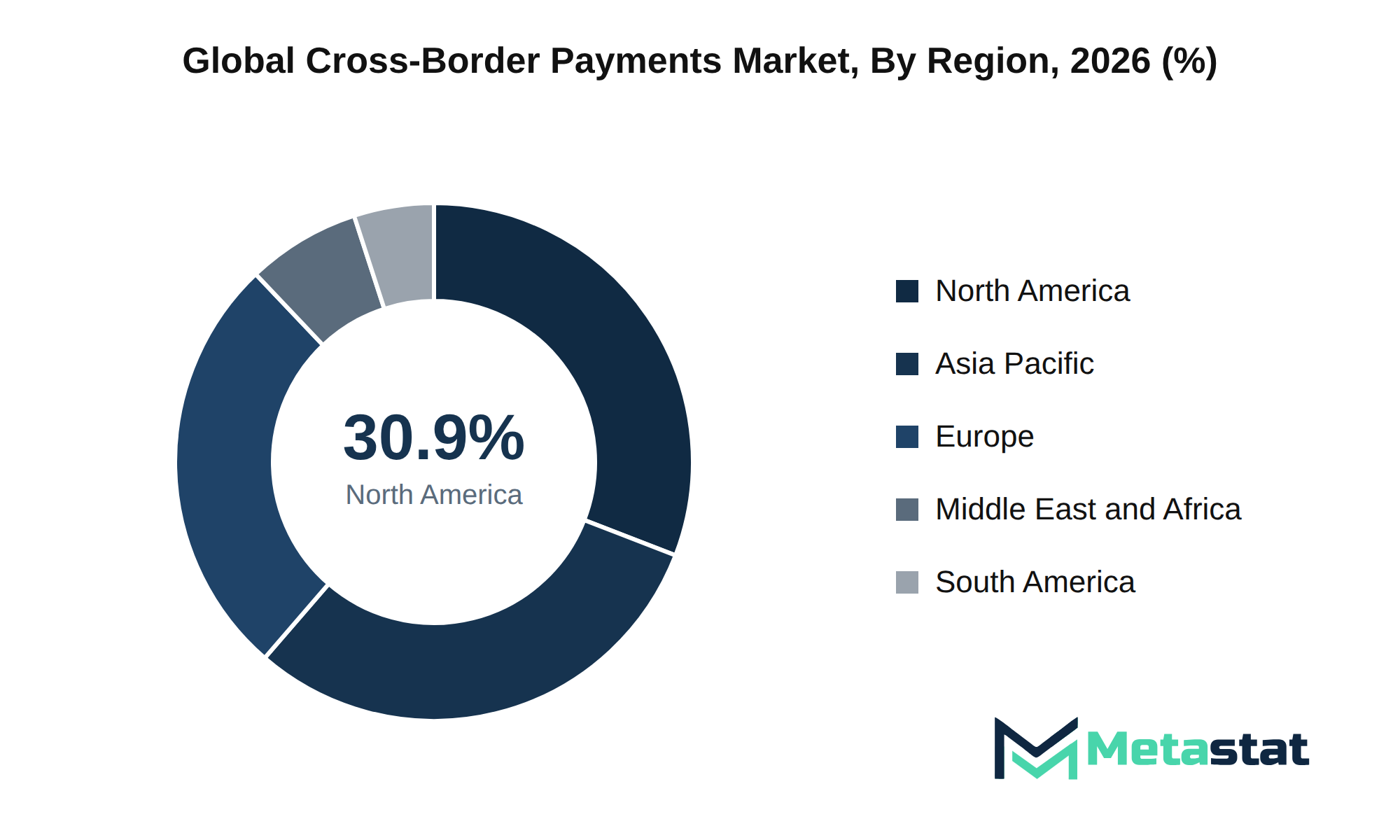
Based on geography, the Global Cross-Border Payments market is divided into North America, Europe, Asia-Pacific, South America, Middle East, and Africa.
North America represents a significant portion of the Cross-Border Payments market, contributing 30.9% of the global market share in 2025. The region is projected to expand at a CAGR of 7.3% during the forecast period, reaching a market size of USD 96.6 billion by the end of 2033. The presence of large enterprises alongside small and medium-sized enterprises drives demand for cross-border payment solutions. Investment in infrastructure modernization and technological advancements improves the efficiency of payment processing across the United States, Canada, and Mexico.
The adoption of digital wallet and mobile money payments demonstrates strong growth potential, reflecting changing consumer behaviors and preferences. The trend of nearshoring and regional supply chain optimization increases cross-border trade activities, creating opportunities for service providers. Regulatory frameworks within the region support the facilitation of cross-border transactions, ensuring compliance while fostering a competitive environment.
Domestic market participants, including major financial institutions, play a crucial role in shaping the competitive dynamics of the market. Their ability to innovate and adapt to evolving customer needs enhances their market positioning. Overall, North America's Cross-Border Payments market is anticipated to experience sustained growth, driven by robust demand across various transaction types and evolving payment methods.
Europe represents a significant portion of the Cross-Border Payments market, holding a substantial market share in 2025. The region's robust economic infrastructure and cross-border trade corridors facilitate the growth of various transaction types, particularly Business-to-Business (B2B) payments. Increasing globalization and digitalization drive demand for efficient payment solutions among enterprises operating in multiple countries.
Countries including Germany, France, the UK, Italy, and Spain reflect high adoption rates of digital wallets and card-based payments, indicating a shift in consumer preferences towards more convenient payment methods. The competitive landscape in Europe features several domestic market participants, including Citigroup Inc., JPMorgan Chase & Co., and HSBC Holdings plc, which consistently invest in technological advancements and localized solutions to enhance their offerings.
Regulatory frameworks across Europe, characterized by compliance mandates and trade policy shifts, impact market dynamics significantly. Enhanced cross-border trade agreements and geopolitical developments further influence the market, creating both opportunities and challenges for service providers. The ongoing modernization of payment infrastructure supports increased efficiency and security, ultimately driving growth in the Cross-Border Payments market.
Localized procurement dynamics, along with cultural nuances in payment preferences, shape the strategies of firms operating within the region. With a growing emphasis on nearshoring initiatives, companies are likely to expand their operations closer to home, further stimulating demand for cross-border payment solutions. The continued evolution of consumer behavior and expectations positions Europe because a critical player in the global Cross-Border Payments market.
With a projected market share of 30.5% in 2025, Asia-Pacific plays a significant role in global cross-border payments. The region is characterized by strong demand for innovative payment solutions driven by a rapidly expanding digital economy. Countries including China, Japan, and India lead in the adoption of various payment methods, including bank transfers and digital wallets, contributing significantly to market growth.
Infrastructure modernization across Asia-Pacific supports the expansion of cross-border payment services. Enhanced financial technology and increasing internet penetration enable more consumers and businesses to engage in international transactions. Countries like South Korea and Australia exhibit high adoption rates due to advanced technological frameworks and strong regulatory environments that promote innovation.
The region's diverse economic landscape includes a mix of mature markets and emerging economies. Southeast Asia remains an underpenetrated territory, presenting opportunities for market participants to tap into increasing cross-border trade among its nations. Localized procurement dynamics and cultural nuances influence B2B buying behaviors, encouraging tailored solutions that connect with businesses operating in the region.
Geopolitical fragmentation and regulatory frameworks impact the competitive landscape. Domestic market participants, including local financial institutions and payment service providers, drive consolidation trends that enhance service offerings. Investment in foreign direct investment (FDI) flows encourages geographic expansion, allowing companies to establish a local presence and cater effectively to the demands of the cross-border payments market.
The Cross-Border Payments market in South America experiences unique dynamics shaped by its economic landscape. Brazil and Argentina represent the primary markets within the region, accounting for an increasing share of cross-border transactions. Economic growth in these countries drives demand for reliable payment solutions, supported by businesses increasingly engaging in international trade. The region's regulatory frameworks, including local compliance mandates, influence operational strategies for both international and domestic players.
Efforts to modernize payment infrastructure support the expansion of cross-border payments. Investment in technology enhances the efficiency and security of transactions, benefiting various sectors including e-commerce and retail. Cultural nuances and regional B2B buying behaviors impact how businesses approach cross-border exchanges, tailoring solutions to meet local preferences.
Challenges remain, with geopolitical fragmentation affecting trade routes and relationships between countries. Despite these hurdles, South America shows potential for growth in the Cross-Border Payments market, driven by increasing digitalization and consumer demand for more efficient payment options. While companies seek to capitalize on these emerging opportunities, the competitive landscape continues to evolve, highlighting the importance of strategic entry barriers and domestic market participants in shaping the future of cross-border transactions.
The Middle East and Africa region plays a notable role in the Cross-Border Payments market, with a projected market share of 7.1% in 2025. Increasing cross-border trade and the adoption of digital payment methods among consumers and businesses drive demand. Countries including Saudi Arabia, UAE, and South Africa exhibit strong growth potential, supported by governmental initiatives aimed at enhancing financial technology infrastructure and regulatory frameworks.
Investment in infrastructure modernization, particularly in the digital payment sector, strengthens operational capabilities and facilitates smoother transactions across borders. Local compliance mandates and trade policy shifts create a more conducive environment for cross-border transactions, enhancing market accessibility for both consumers and businesses.
Regional competitive landscapes indicate a presence of domestic market participants, leading to vendor consolidation trends that enhance service offerings. Cultural nuances and regional B2B buying behaviors shape the market dynamics, influencing payment preferences among businesses and consumers alike. The continued growth and evolution of the Cross-Border Payments market in this diverse region is supported by these factors.
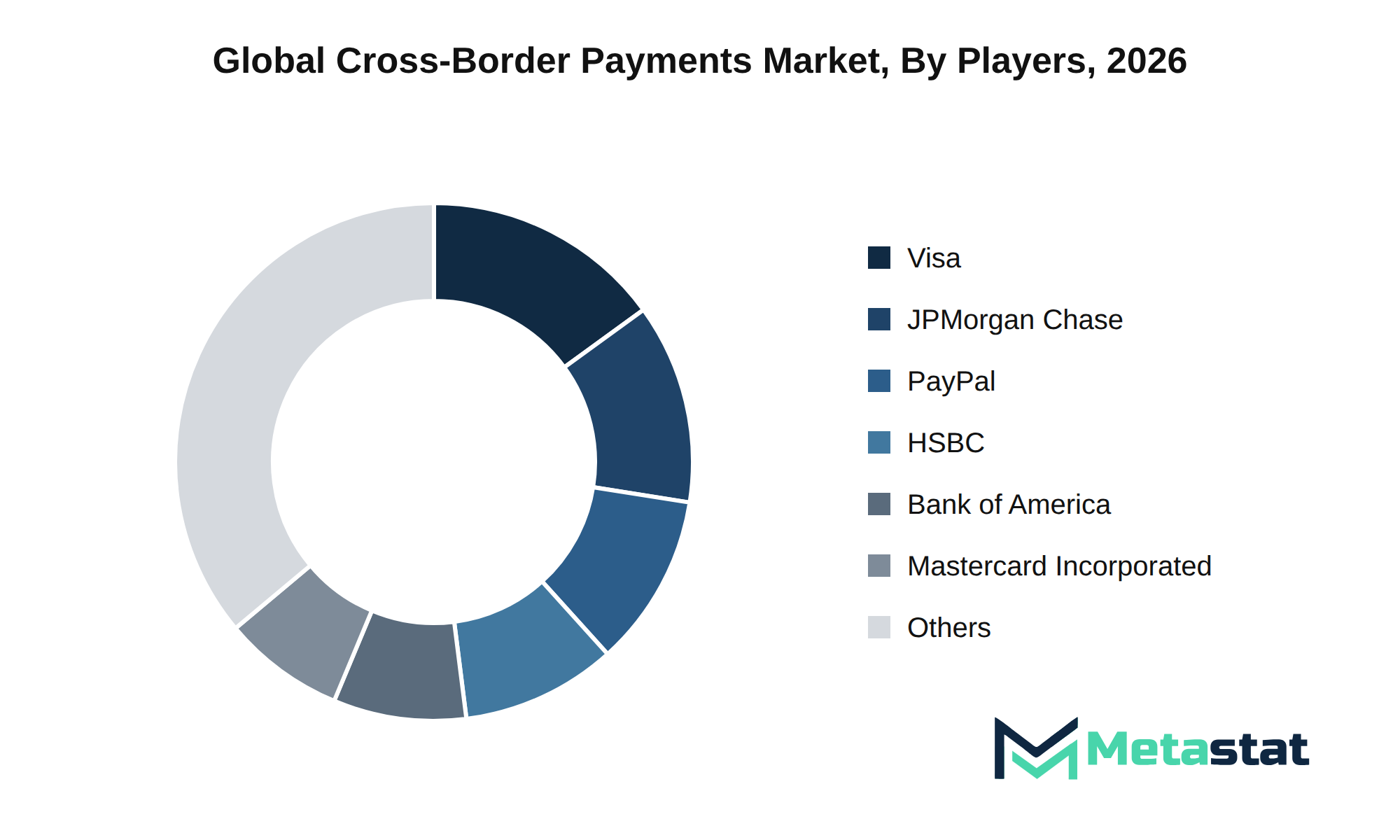
The competitive dynamics within the Cross-Border Payments market feature several key players focusing on mergers, acquisitions, and strategic consolidations to enhance market positioning. Major institutions including Citigroup Inc., JPMorgan Chase & Co., and HSBC Holdings plc engage in various partnerships and joint ventures aimed at expanding service offerings and improving technological capabilities. This strategic behavior enables these companies to leverage their existing infrastructure and customer bases effectively.
Pricing strategies in the market vary significantly, reflecting the diverse needs of customers across different segments. Players like Visa Inc. and Mastercard Incorporated emphasize product differentiation through technological advancements and proprietary solutions. Investment in research and development drives innovation, with companies allocating resources to advanced payment technologies to create competitive advantages.
The market experiences barriers to entry influenced by established brand equity and customer loyalty, presenting challenges for new entrants. Nevertheless, startups like Wise plc and Airwallex disrupt traditional models by offering innovative platforms that appeal to tech-savvy consumers. This competitive environment encourages ongoing evolution characterized by strategic growth vectors and defensive imperatives aimed at maintaining market share.
Market size is forecast to rise from USD 188.2 billion in 2025 to over USD 330.8 billion by 2033. The market experiences growth driven by multiple factors, including evolving consumer preferences and advancements in payment technologies. Increased cross-border trade and globalization contribute to rising demand for efficient payment solutions.
While the market matures, demand shifts toward innovative payment methods and platforms that address emerging needs. Companies investing in next-generation technologies gain competitive advantages, enhancing transaction efficiency and security. Regulatory changes and compliance milestones impact operational frameworks, influencing market dynamics.
The geopolitical environment presents challenges and opportunities, reshaping trade corridors and supply chains. Capital allocation and infrastructure investments are crucial for enabling growth, particularly in underserved regions. Identifying high-growth pockets and unmet enterprise needs drives strategic initiatives among market players.
Overall, the Cross-Border Payments market is expected to maintain a strong growth trajectory, influenced by macroeconomic factors, technological advancements, and evolving regulations. Companies prioritizing innovation and adaptability position themselves effectively within this expanding market.
The report strategically identifies and profiles the key market players and analyses their core competencies in each sub-segment of the Cross-Border Payments market.
Report Attributes | Details |
Study Period | 2021-2033 |
Base Year | 2025 |
Estimated Year | 2026 |
Forecast Period | 2026-2033 |
Historical Period | 2021-2025 |
Growth Rate | CAGR 7.3% from 2026 to 2033 |
Revenue Unit | USD billion |
Segmentation | By Transaction Type, Payment Method, Payer/Customer Type, and Region |
By Region | North America (By Transaction Type, Payment Method, Payer/Customer Type, and Country)
|
Europe (By Transaction Type, Payment Method, Payer/Customer Type, and Country)
| |
Asia Pacific (By Transaction Type, Payment Method, Payer/Customer Type, and Country)
| |
South America (By Transaction Type, Payment Method, Payer/Customer Type, and Country)
| |
Middle East and Africa (By Transaction Type, Payment Method, Payer/Customer Type, and Country)
|
Find answers to common questions about this report
The Cross-Border Payments market size was valued at USD 188.2 billion in 2025, according to the Metastat Insights study.
The Cross-Border Payments market is projected to grow at a CAGR of 7.3% during the forecast period from 2026 to 2033.
The North America Cross-Border Payments market size is estimated to reach USD 96.6 billion by 2033.
The Business-to-Business (B2B) segment leads the Cross-Border Payments market, with a projected value of USD 192.7 billion by 2033. This segment's growth reflects a compound annual growth rate (CAGR) of 7.3% from 2026 to 2033.
Key drivers for the Cross-Border Payments market include ongoing digital transformation initiatives, increased globalization, and evolving consumer preferences. Businesses invest in advanced technologies to enhance operational capabilities and improve transaction efficiency, while expanding trade corridors and localized production strategies further boost demand for efficient payment solutions.
North America holds the dominant share of the Cross-Border Payments market, with a value of USD 96.6 billion projected for 2033, representing 30.9 percent of the total market.
Regulatory compliance hurdles and increasing operational costs significantly restrain growth in the Cross-Border Payments market. Stringent regulations, including anti-money laundering and know your customer mandates, introduce complexity and inefficiencies, impacting customer experience. geopolitical instability and infrastructure gaps create uncertainties that hinder transaction volumes and operational efficiency.
Increasing globalization and evolving consumer preferences drive demand for efficient cross-border transactions. Businesses invest in advanced technologies to enhance operational capabilities, improve transaction accuracy, and reduce costs, creating an environment conducive to product adoption in the Cross-Border Payments market.
The Cross-Border Payments market is estimated to reach a valuation of USD 330.8 billion by 2033.
Key players in the Cross-Border Payments market include Citigroup Inc., JPMorgan Chase & Co., HSBC Holdings plc, Bank of America Corporation, Visa Inc., Mastercard Incorporated, PayPal Holdings, Inc., and The Western Union Company.
The analysts below cover Banking & Finance research at Metastat Insights.
LEAD ANALYST
Utkarsh Khirodkar is a Lead Market Research Analyst at MetaStat Insight, specializing in market intelligence, technology sector assessments, and competitive strategy.

PRINCIPAL CONSULTANT - ENTERPRISE AI & EMERGING TECHNOLOGIES
Banking & Finance · Electronics and Semiconductor · Energy and Power · Healthcare IT · Information & Technology · Professional Services
Vijay Gunti is a Principal Consultant at MetaStat Insight, bringing over two decades of experience across enterprise digital transformation, technology strategy, and intelligent systems.
Integrating zero-trust access controls across legacy electronic health record systems involves complex compliance overhead. Team produced an analysis that clearly separated identity governance and administration tools from privileged access management platforms. Their evaluation of HIPAA and GDPR compliance features across cloud native solutions gave our architecture group clear baseline criteria. The custom data request regarding biometric authentication adoption in hospital networks was returned promptly with clear documentation.
Evaluating calorific value requirements and air permit compliance across municipal waste facilities requires localized data. Metastat Insight structured their analysis around operational throughput capacity and feedstock composition variations in Latin America and Eastern Europe. Their competitive mapping of sorting equipment vendors helped clarify technology differences between optical separators and heavy media systems. The study provided an objective baseline during our capital expenditure reviews.
Decarbonizing industrial thermal processes hinges on refrigerant regulations and compressor efficiency limits. Metastat Insights delivered a thorough market analysis that evaluated natural refrigerants like CO2 and hydrocarbons against synthetic low-GWP alternatives. The breakdown of utility incentives and grid capacity constraints across key European manufacturing hubs offered valuable perspective. The follow-up conversation with their sector analysts addressed our specific questions on mechanical vapor recompression systems efficiently.
Explore related market intelligence reports worth reading alongside this one.