
LEAD ANALYST
Utkarsh Khirodkar is a Lead Market Research Analyst at MetaStat Insight, specializing in market intelligence, technology sector assessments, and competitive strategy.

Global Card Payment Processing Solutions Market Size, Share, By Card Type (Credit Cards, Debit Cards, Prepaid Cards), By Transaction Environment (Card-present and Card-not-present), By Merchant Size (Large Enterprises and Small and Medium Enterprises), By End-use Industry (Retail, Food Service and Hospitality, Travel and Transportation, Healthcare, Media and Entertainment, Utilities and Telecommunications), Industry Analysis, Growth, Trends, and Forecast, 2026-2033
Report ID
MSI-3504
Published
October, 2026
Pages
301 Pages
Format
Historical
Base year
Forecast
Forecast period
Report Details
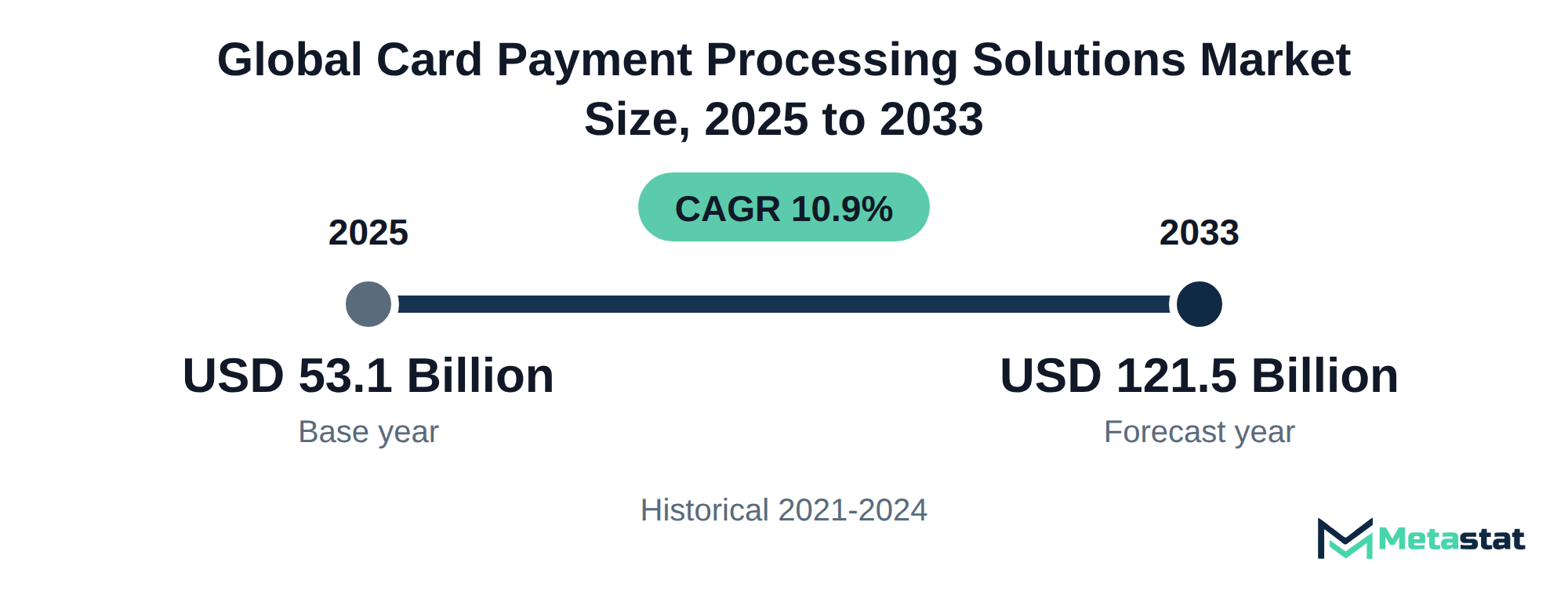
Market Valuation: Valued at $53.1 Billion in 2025, projected to reach $121.5 Billion by 2033 at a 10.9% CAGR.
Dominant Segment: Credit Cards hold the largest share of the market, driven by consumer reliance on credit for both online and in-store purchases. This segment's growth is supported by increasing consumer preference for cashless transactions and promotional offers.
Geographic Lead: North America is the leading region, accounting for 38.2% of the market in 2025, with the US expected to maintain its dominance due to advanced technological infrastructure and high consumer spending.
What's Inside: The report provides a comprehensive analysis of the competitive landscape, market segmentation, and growth trends across various card types and transaction environments, covering the forecast period from 2026 to 2033.
High Growth Expected in Debit Card Adopt: The Debit Cards segment is projected to grow at a CAGR of 11.2%, reflecting a significant shift towards digital transactions as consumers increasingly prefer the convenience and security of debit card payments.
SoftPOS and Contactless Acceptance: The emergence of SoftPOS and contactless payment solutions is expanding access for small merchants, enabling them to adopt modern payment technologies without the need for traditional hardware.
Choose Your License
Global Card Payment Processing Solutions Market
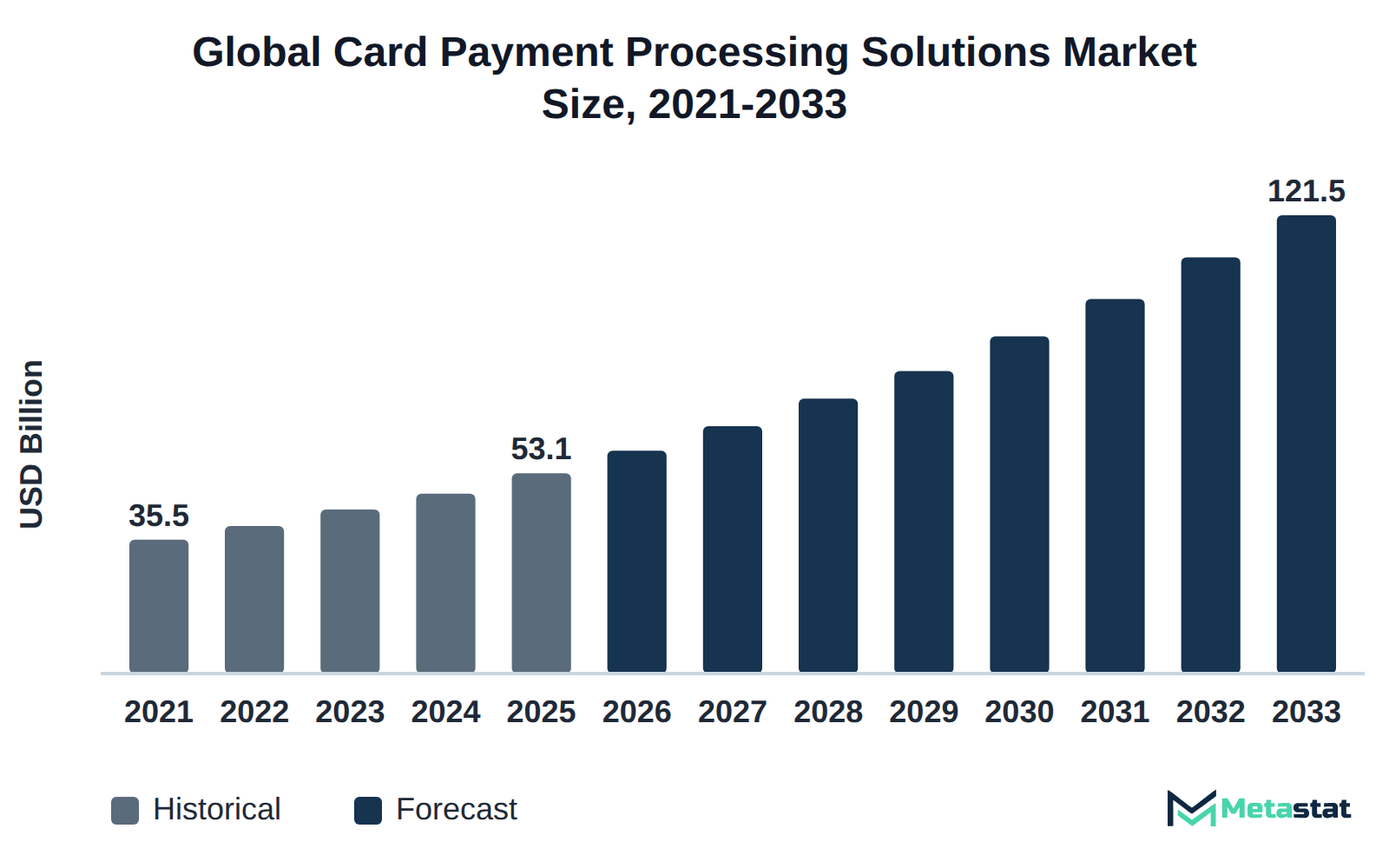
The global Card Payment Processing Solutions market was valued at USD 53.1 billion in 2025 and is projected to reach USD 121.5 billion by 2033, growing at a CAGR of 10.9% over the forecast period.
The Card Payment Processing Solutions market encompasses a range of services and technologies facilitating electronic payment transactions. Buyers invest in these solutions to enhance operational efficiency, improve customer experience, and ensure secure payment processing. Rising consumer preferences for digital payments drive increasing demand for innovative payment methods and experiences across various sectors.
Growth in the market is propelled by the rapid increase in online shopping and the need for efficient payment experiences. Among the segments, Credit Cards represent the largest share, reflecting consumer reliance on credit facilities for both online and in-store purchases. North America holds 38.2% of the market in 2025, with the US leading in 2026. The region's advanced technological infrastructure and high consumer spending contribute to its dominance.
The expanding adoption of mobile payment solutions stands out as a critical growth driver. Consumers increasingly prefer the convenience of mobile transactions, prompting businesses to integrate mobile payment options into their offerings. This trend boosts transaction volumes and enhances customer satisfaction, further fueling the market expansion.
Investments in the Card Payment Processing Solutions market are driven by the increasing demand for efficient, secure, and convenient payment options across various sectors. Businesses recognize the value of streamlining payment processes and enhancing customer experiences, leading to higher spending on advanced solutions. The adoption of digital payment methods, including credit and debit cards, significantly influences buyer behavior, with firms prioritizing solutions that offer improved transaction speed and security.
Expanding e-commerce and the rising trend of contactless payments also fuel market growth. Among the segments, credit cards represent the highest value, reflecting consumer preference for flexible payment options. This region's strong infrastructure and high consumer spending power support widespread adoption of payment processing technologies.
Technological advancements shape the Card Payment Processing Solutions market. Innovations including mobile payment solutions and integrated payment processing systems enhance efficiency and customer engagement. Businesses seeking to remain competitive drive the demand for these solutions, further supporting market growth and attracting investment from key players within the industry.
Network tokenization significantly enhances card authorization performance within the Card Payment Processing Solutions market. This technology replaces sensitive card information with unique identifiers, reducing the risk of fraud and improving transaction security. The card-not-present transaction environment is projected to reach USD 62.2 billion by 2033, driven by the increasing adoption of online shopping and digital payments.
The implementation of 3D Secure, a protocol that adds an additional layer of authentication during online transactions, further complements network tokenization. This dual approach protects cardholder data and boosts merchant confidence in accepting online payments. The projected CAGR of 12.8% for the card-not-present segment reflects growing demand for secure payment solutions.
For merchants, investing in network tokenization and 3D Secure translates into lower chargeback rates and increased customer trust. Chargeback management software addresses the disputes that remain after these controls are in place. Enhanced security measures reduce the likelihood of fraud-related losses, positively impacting operational costs. Together, these technologies help businesses attract more customers and grow revenue in a competitive market.
SoftPOS and contactless acceptance increasingly expand card processing options for small merchants, facilitating access to payment solutions without the burden of traditional hardware. This shift reflects a growing trend towards more flexible payment methods that improve customer convenience. For example, the card-not-present transaction environment is projected to reach USD 62.2 billion by 2033, demonstrating a significant opportunity for small merchants to integrate contactless technology into their operations.
Small merchants often face challenges related to upfront costs and the complexities of traditional payment processing setups. The emergence of mobile point-of-sale (mPOS) solutions allows these merchants to accept payments through smartphones or tablets, effectively bypassing expensive terminal equipment. The ability to process payments without a physical card reader significantly reduces barriers to entry for small businesses. Competitive pricing models have started to dominate the landscape, featuring pay-as-you-go options that align transaction fees with revenue, improving cash flow management for smaller entities.
This trend of cost-effective solutions in the card payment processing solutions market enables small merchants to thrive in a competitive environment. Enhanced accessibility to payment technologies incentivizes adoption, driving growth in various sectors, including retail and food service. Consequently, the integration of SoftPOS and contactless acceptance positions small merchants to benefit from increased customer engagement and transaction volumes.
Cross-border card acquiring emerges as a key component in enhancing revenue streams for payment processors, driven by the increasing globalization of e-commerce. The growth in cross-border payments reflects a significant shift in consumer behavior, with businesses actively seeking solutions that facilitate international purchases. The Card Payment Processing Solutions market anticipates a marked increase in revenue from these transactions.
In 2023, the market reached USD 43.5 billion, and projections indicate substantial growth momentum, with expectations of reaching USD 121.5 billion by 2033. This trajectory highlights the appeal of cross-border transactions, particularly in regions like North America, which held a dominant market share of 38.2% in 2025. Payment processors targeting cross-border capabilities position themselves favorably to capture the growing demand from enterprises that rely on international sales.
Recurring billing further complements this trend, offering businesses a reliable revenue model, particularly within the subscription-based services sector. Consumer preferences shift toward subscription models, and businesses that implement efficient recurring billing systems benefit from improved cash flow and customer retention. Combining cross-border card acquiring with recurring billing solutions strengthens the service offering for payment processors and creates a competitive advantage in the Card Payment Processing Solutions market.
Card payment processors reduce costs for merchants while decreasing the likelihood of failed transactions. Efficient transaction processing minimizes losses associated with declined payments and chargebacks. For instance, the Card-not-present segment, which encompasses online transactions, is projected to reach USD 62.2 billion by 2033, reflecting a compound annual growth rate (CAGR) of 12.8%. This growth indicates that more merchants are adopting solutions that enhance the security and reliability of online payments.
The effective use of fraud detection technologies and streamlined payment systems leads to a reduction in failed transactions. By implementing advanced algorithms and machine learning, card payment processors identify fraudulent activities in real-time, significantly decreasing chargeback rates. This operational efficiency results in substantial cost savings for merchants, particularly in high-volume sectors including retail and e-commerce, which constitute a significant portion of the Card Payment Processing Solutions market.
The integration of digital wallets and alternative payment methods through card payment processors further enhances transaction success rates. For example, the Retail end-use industry is expected to grow from USD 22.5 billion in 2026 to USD 47 billion by 2033, driven by the increasing adoption of diverse payment options. These advancements improve customer satisfaction and give merchants a more resilient revenue stream.
Rapid growth in e-commerce and digital transactions drives increased demand for card payment processing solutions among retailers and service providers. Consumers increasingly prefer cashless transactions, leading to a shift in buyer behavior and necessitating enhanced payment processing capabilities. This trend contributes to heightened transaction volumes and improved payment efficiency. This growth results from businesses striving to meet consumer expectations for effective and secure payment options. Investment in innovative payment technologies remains essential for companies seeking to enhance their competitive position. The market continues to adapt as demand for digital payments grows.
Increasing consumer preferences for contactless and online payments further drive this demand, prompting retailers to adopt advanced processing solutions. Enhanced security features, including tokenization, significantly improve consumer trust, driving even more transactions through digital channels. The increased volume of transactions leads to expanded revenue opportunities for payment processors, contributing to overall market growth.
Technological advancements in mobile payment solutions significantly influence the Card Payment Processing Solutions market. The integration of advanced security features, including biometric authentication and encryption, increases consumer confidence in mobile transactions. These enhancements attract a range of users, including millennials and tech-savvy consumers, who prefer the convenience of mobile payments over traditional methods. Retailers and service providers increasingly adopt these solutions to streamline payment processes and improve customer experiences.
The rise of mobile payment apps and platforms, coupled with better compatibility with point-of-sale systems, encourages merchants to embrace these technologies. Adoption of mobile payment solutions reduces transaction times and enhances operational efficiency. The market benefits from this shift, as an increasing number of companies adopt mobile technologies, driving growth opportunities for payment processors and technology providers. Enhanced mobile payment capabilities continue to shape competitive dynamics within the market, driving innovation and attracting investment.
High processing fees present a significant barrier for small and medium enterprises (SMEs) in the Card Payment Processing Solutions market. These fees create challenges in budget management, often leading to slower uptake of essential payment technologies. SMEs typically operate on tighter margins compared to larger enterprises, making cost concerns particularly pressing. The operational costs associated with adopting advanced payment systems deter these businesses from upgrading their current solutions or expanding their payment capabilities.
The impact of high processing fees shows in smaller order volumes and delayed implementation of innovative payment technologies. Many SMEs opt for basic solutions that lack advanced features, resulting in limitations in customer experience and transaction efficiency. This trend restricts the overall growth potential within the market, as SMEs represent a substantial portion of the buyer base. Addressing these high costs is crucial for wider adoption of card payment processing solutions among this segment.
Supply chain disruptions in the Card Payment Processing Solutions market result in escalating talent costs. The demand for skilled professionals in technology and customer support escalates, influencing overall operational expenses. Companies struggle to attract and retain talent due to competitive pressures and limited availability of skilled labor. Rising costs associated with hiring and training employees create margin pressure, affecting profitability.
In response, suppliers prioritize investment in employee development and retention strategies. Enhanced training programs and competitive compensation packages help attract skilled workers. Companies increasingly adopt automated systems to streamline processes, alleviating the burden on existing staff and maintaining service levels without excessive hiring. This approach supports operational efficiency while addressing the talent shortage, enabling companies to sustain growth in a competitive environment.
Debit cards exhibit significant growth potential within the Card Payment Processing Solutions market, with a compound annual growth rate (CAGR) of 11.2% through 2033. This expansion arises from increasing consumer preference for digital transactions, emphasizing speed and convenience. Industries including retail and e-commerce particularly drive this demand, as consumers seek efficient payment options that align with their purchasing behaviors. The anticipated market value for debit cards reaches USD 52.6 billion by 2033, reflecting a strong shift in payment preferences. Enhanced security features and user-friendly interfaces associated with debit card solutions further support this upward trajectory, making them attractive to both consumers and merchants. Growth in this segment positions stakeholders to capitalize on evolving spending patterns and the increasing acceptance of contactless payments, ensuring sustained revenue opportunities across various sectors.
The Global Card Payment Processing Solutions market is segmented based on Card Type, Transaction Environment, Merchant Size, and End-use Industry.
The Credit Cards segment is valued at USD 31.2 billion in 2026 and is projected to reach USD 62.9 billion by 2033, at a CAGR of 10.5% during the forecast period. This segment caters primarily to consumers seeking flexibility in payment options and is widely used in retail, online services, and personal finance management. A significant driver for the Credit Cards segment stems from increasing consumer preference for cashless transactions, enhancing convenience for users. Promotional offers and rewards programs attract more buyers compared to other card types including Debit and Prepaid Cards. The segment shows relatively strong growth, supported by evolving payment technologies and wider card acceptance in sectors including e-commerce and travel.
Debit Cards segment is estimated to reach USD 52.6 billion by 2033, at a CAGR of 11.2% during the forecast period. This segment primarily targets consumers who prefer cashless transactions, allowing for convenient purchases and online payments. Increasing consumer inclination toward debit card usage over cash has become a driving force. Enhanced security features and ease of use contribute to the growing adoption among individuals and businesses alike. Compared to Credit Cards, which exhibit a CAGR of 10.5%, the Debit Cards segment demonstrates a stronger growth trajectory. This segment's expansion reflects a shift toward digital payment solutions among users seeking straightforward and secure transaction methods. The market sees enhanced competition from emerging technologies and services that facilitate integration into various purchasing environments, further influencing the demand for debit card processing solutions.
The Prepaid Cards segment is expected to reach USD 6 billion by 2033. This segment primarily serves consumers seeking flexibility in managing their funds without requiring a traditional bank account. Demand for prepaid cards has risen due to the growing acceptance of cashless transactions and financial inclusion initiatives targeting the unbanked population. Compared to credit and debit cards, prepaid cards experience slower growth, with a compound annual growth rate (CAGR) not specified in the data. The prepaid card segment diverges from others due to its appeal to budget-conscious users and those preferring to limit spending to available funds. Increasing adoption in various sectors, including retail and travel, contributes significantly to the overall expansion of the market.
Card-present segment is valued at USD 32.4 billion in 2026 and is projected to reach USD 59.3 billion by 2033, at a CAGR of 9% during the forecast period. This segment primarily facilitates in-person transactions, commonly used in retail environments and hospitality settings where customers physically present their cards. Growth stems from increasing consumer preference for contactless payment options, enhancing the speed and convenience of transactions. The rise of point-of-sale terminal technology enables merchants to offer efficient payment experiences. Compared to the card-not-present segment, which is projected to grow at a CAGR of 12.8%, the card-present segment exhibits slower growth, reflecting a more mature adoption curve. However, it remains essential for maintaining customer engagement and loyalty through enhanced payment experiences.
Primarily for online transactions, this segment caters to a diverse range of industries, including e-commerce, travel, and entertainment. The surge in online shopping and digital services drives demand for card-not-present transactions, allowing consumers to make purchases without physical card interaction. This segment exhibits faster growth compared to card-present transactions, which are projected to achieve a CAGR of 9% during the same period. With a distinct focus on security measures including two-factor authentication, the card-not-present segment addresses rising concerns about fraud and data breaches. This proactive response to security challenges differentiates it significantly from other transaction environments, ensuring substantial growth in response to shifting consumer behaviors.
Large Enterprises segment is valued at USD 37.7 billion in 2026 and is projected to reach USD 73.3 billion by 2033, at a CAGR of 10% during the forecast period. This segment caters primarily to large corporations that process substantial volumes of transactions, often requiring customized and sophisticated payment solutions. Demand for robust security features and advanced analytics drives growth in this segment, aligning with the trend toward digital transformation in the corporate sector. Large Enterprises typically face different pricing structures compared to Small and Medium Enterprises, allowing for enhanced features and lower transaction fees due to higher transaction volumes. This segment's growth trajectory remains strong, with a projected CAGR of 10%, distinguishing it from the Small and Medium Enterprises segment, which is expected to grow at a faster rate of 12.3% through 2033. Such dynamics shape competitive strategies and investment decisions across the market.
Small and Medium Enterprises segment is estimated to reach USD 48.3 billion by 2033, at a CAGR of 12.3% during the forecast period. This segment primarily serves smaller businesses and startups that require efficient and cost-effective payment processing solutions. Demand for these services is driven by the increasing adoption of digital transactions and e-commerce platforms, allowing businesses to reach a broader customer base. Compared to Large Enterprises, this segment experiences a faster growth trajectory, reflecting a shift in payment preferences among consumers who favor convenience and security. Factors including competitive pricing and enhanced technology for mobile payments support this expansion, positioning the segment favorably within broader market dynamics.
The retail segment is valued at USD 22.5 billion in 2026 and is projected to reach USD 47 billion by 2033, at a CAGR of 11.1% during the forecast period. This segment caters primarily to businesses involved in selling goods and services directly to consumers, ranging from small shops to large department stores. The growing trend of e-commerce and the increasing adoption of digital payment solutions drive demand within this segment. Compared to the broader market, the retail segment experiences significant growth, supported by the shift toward online shopping and contactless payment methods. The rise of mobile wallets and various digital payment options enhances convenience for shoppers, leading to higher transaction volumes. This segment's growth is particularly pronounced among small and medium-sized enterprises seeking to capitalize on the increasing preference for fast and secure payment methods.
Food Service and Hospitality segment is estimated to reach USD 22.8 billion by 2033, at a CAGR of 10.4% during the forecast period. This segment serves restaurants, catering services, and hotels, facilitating card transactions for dining, accommodation, and event hosting. The increasing reliance on digital payment solutions drives demand for efficient payment processing in this sector. With a focus on customer experience and convenience, processors are innovating features including mobile ordering and contactless payments. Compared to other segments, this segment exhibits a notable growth rate, driven by the sector's expansion and shifting consumer preferences towards cashless payments. The segment's growth potential is enhanced by rising disposable incomes and consumer spending on dining and entertainment, which contribute to the overall demand for card payment processing solutions in the market.
Travel and Transportation segment is expected to reach USD 15.6 billion by 2033. This segment serves various travel-related services, including airlines, hotels, and transportation providers, facilitating efficient transactions for customers. Increasing travel demand and a shift towards digital payment solutions significantly influence this segment. Growth in online booking platforms, including online travel agencies, accelerates the adoption of card payment processing solutions, distinguishing it from other segments including Retail. While the Travel and Transportation segment experiences a healthy growth trajectory, the CAGR reflects a different dynamic compared to sectors like Food Service and Hospitality, which is projected to grow at a CAGR of 10.4%. The market's expansion aligns with evolving consumer preferences for contactless payments, enhancing convenience and security in travel transactions.
Healthcare segment is projected to grow at a CAGR of 12.4% during the forecast period. This segment mainly serves hospitals, clinics, and other healthcare providers, facilitating efficient transactions for medical services and products. Factors driving this segment include increasing adoption of digital health solutions and growing emphasis on patient convenience. Unlike other segments, healthcare prioritizes security and compliance, given the sensitive nature of patient data. Payment processing solutions in this segment tend to incur higher costs due to regulatory requirements; however, strong growth potential reflects the industry's ongoing digital transformation. The healthcare segment stands out due to its specific focus on compliance with health regulations, differentiating it from sectors including retail and food service, which face different challenges and growth trajectories.
This segment encompasses the processing solutions employed within the media and entertainment sector. Organizations in this industry frequently require efficient payment processing for digital content, ticket sales, and subscription services. Demand for these solutions stems from a growing trend toward digital media consumption and online entertainment platforms. Rapid technological advancements in streaming and content delivery systems drive this growth, allowing consumers to access services more conveniently. The media and entertainment segment tends to exhibit higher transaction values compared to others, reflecting the premium pricing associated with entertainment offerings. This segment's trajectory contrasts with that of retail, which experiences faster growth due to broader consumer adoption. The market features distinct characteristics influenced by evolving consumer preferences and technological innovations, setting it apart from traditional payment processing environments.
This segment focuses on the utilities and telecommunications sector, encompassing payment processing solutions that facilitate transactions for utility providers and telecom operators. This segment serves businesses that rely on timely payments for services, including electricity, water, internet, and mobile services. Increasing demand for digital payment methods drives growth in this area, with consumers seeking convenience and security when settling their bills. The shift toward automated billing systems further enhances the need for robust payment processing solutions in these industries. Compared to other segments, including retail and hospitality, the utilities and telecommunications sector experiences slower growth due to regulatory constraints and the mature nature of the industry. Ongoing advancements in technology and the increasing uptake of smart utilities create opportunities for growth, distinguishing this segment within the market.
This segment encompasses payment processing solutions tailored for sectors including education, government, and professional services. Institutions and organizations in these sectors apply these solutions to facilitate transactions, enhance financial management, and improve overall efficiency. Demand is driven by increasing digitalization and the necessity for secure and efficient payment methods within these environments. Regulatory compliance and budget constraints significantly shape purchasing decisions. Compared to other segments, this group typically portrays slower growth, owing to longer procurement cycles and higher levels of scrutiny in public sector spending. In contrast to retail and hospitality, which experience rapid technological advancements and consumer-driven demands, this segment requires a focus on reliability and security, leading to different buyer behavior and decision-making processes.
Based on geography, the Global Card Payment Processing Solutions market is divided into North America, Europe, Asia-Pacific, South America, Middle East, and Africa.
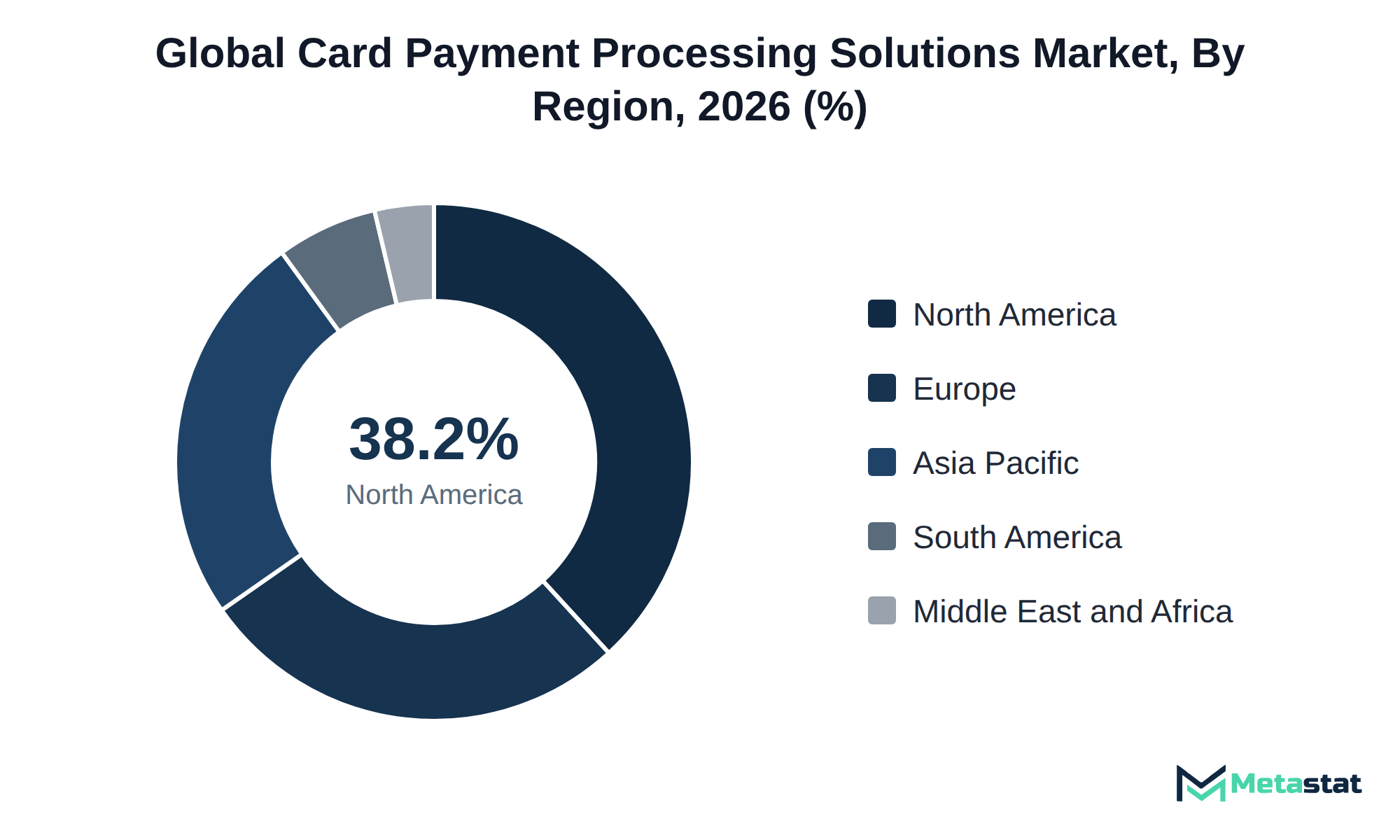
North America ranks a significant player in the Card Payment Processing Solutions market, with expectations to reach USD 42.2 billion by the end of 2033. The region's growth is driven by increased consumer preference for cashless transactions across industries including retail and food service. The presence of advanced technological infrastructure, particularly in the United States, supports the rapid implementation of payment processing solutions. The emphasis on enhancing digital payment security has led to wider adoption of these solutions among businesses of all sizes. The market's share represented 38.2% of global revenues in 2025. This strong position shows North America's importance to payment processing solutions.
With a share of 27.1% in the global market in 2025, Europe stands out due to its diverse industries driving demand for card payment processing solutions. Key sectors include retail, which requires robust payment systems, and food service and hospitality, both of which heavily rely on these solutions. Regulatory frameworks across European nations further influence market dynamics, promoting secure transactions and consumer protection. Countries like Germany, France, and the UK exhibit a high penetration of digital payment methods, supporting market growth. The market is projected to experience significant expansion, reflecting increasing adoption of advanced payment technologies throughout the region. This trend enhances the competitive landscape among service providers aiming to capture a larger share within the evolving card payment processing solutions market.
Asia-Pacific accounted for 24.7% of the global Card Payment Processing Solutions market in 2025. The growing e-commerce sector drives demand, with countries including China, India, and Japan leading in online retail activities. Increased smartphone penetration and digital wallet adoption further support this trend. Regulatory advancements in digital payments enhance security and streamline transactions, reflecting a regional emphasis on consumer protection and fraud prevention. In South Korea, innovative payment solutions and infrastructure developments create a competitive landscape, attracting investment from both local and international players. Australia exhibits a strong preference for debit and credit card transactions, aligning with consumer behavior trends. Southeast Asia shows rapid growth potential due to rising disposable incomes and urbanization, suggesting robust opportunities for market expansion.
Brazil and Argentina drive significant demand in the Card Payment Processing Solutions market, with both countries experiencing an increase in digital commerce and a growing preference for cashless transactions. Local economic conditions, including rising consumer spending and increased adoption of e-commerce platforms, drive growth in payment processing solutions. The market's share in South America is projected at 6.3% in 2025, reflecting the potential for expansion in this region. Infrastructure improvements, including enhanced internet connectivity and mobile penetration, further support the adoption of card payment solutions. Financial institutions and technology providers actively innovate to enhance user experience, which increases competitive dynamics in the market.
The Middle East and Africa region experiences unique dynamics within the Card Payment Processing Solutions market. Rapid growth in the e-commerce sector drives demand, especially in countries like Saudi Arabia and the UAE, where digital payment adoption accelerates. South Africa reflects increasing consumer preference for cashless transactions. Infrastructure improvements and investments in fintech enhance the accessibility of payment solutions, creating a conducive environment for market growth. The market share for this region in 2025 is estimated at 3.7%, indicating potential for further expansion. The emergence of local payment providers strengthens competition, influencing pricing and service offerings. Factors including increased mobile penetration and government initiatives toward digital economies enhance adoption rates, ensuring continued momentum in the market.
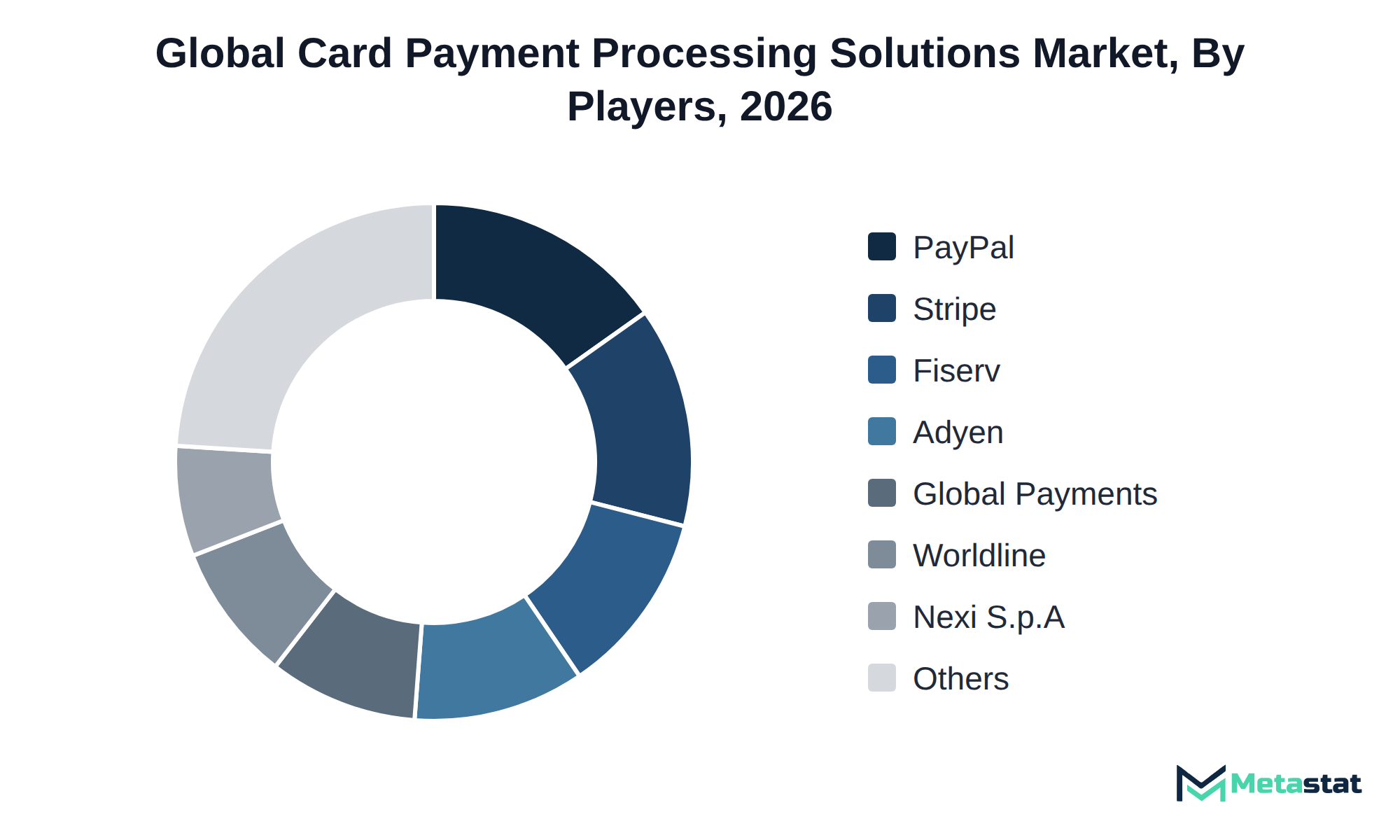
The Card Payment Processing Solutions market features a diverse range of companies that differentiate themselves through various strategic behaviors. Companies position themselves based on service offerings, pricing models, and technological capabilities, leading to a competitive environment that caters to different buyer preferences.
Buyers prioritize factors including price, service quality, customization options, and ecosystem integration when selecting payment processing solutions. For instance, PayPal Holdings, Inc. emphasizes integration and user-friendly experiences, appealing to small and medium enterprises. In contrast, Visa Inc. and Mastercard Incorporated focus on robust security features and extensive global reach, catering to large enterprises with complex needs.
Stripe, Inc. specializes in providing developer-friendly solutions that facilitate customization and integration into various platforms, making it attractive to tech-savvy businesses. Fiserv, Inc. centers its strategy around offering comprehensive services that encompass transaction processing, analytics, and fraud prevention, addressing the diverse needs of various end-use industries. Meanwhile, Adyen N.V. focuses on providing a unified payment platform that supports multiple payment methods, giving businesses the flexibility they require in a changing market.
Growth in the Card Payment Processing Solutions market depends on several key developments. Increased adoption of credit cards, projected to expand from USD 31.2 billion in 2026 to USD 62.9 billion by 2033, significantly drives overall market growth. The transition towards card-not-present transactions, expected to reach USD 62.2 billion by 2033, reflects the shift in consumer behavior towards online shopping, particularly in regions including North America and Europe. However, regulatory challenges and security concerns represent significant risks that could hinder growth. The small and medium enterprise segment, with a projected value of USD 48.3 billion by 2033, faces heightened scrutiny regarding compliance, limiting adoption rates. Overall, these developments and risks will shape the trajectory of the market in the coming years.
By Card Type: Credit Cards, Debit Cards, Prepaid Cards
By Transaction Environment: Card-present, Card-not-present
By Merchant Size: Large Enterprises, Small and Medium Enterprises
By End-use Industry: Retail, Food Service and Hospitality, Travel and Transportation, Healthcare, Media and Entertainment, Utilities and Telecommunications, Others (Education, Government, Professional Services)
The report strategically identifies and profiles the key market players and analyses their core competencies in each sub-segment of the Card Payment Processing Solutions market.
|
Report Attributes |
Details |
|
Study Period |
2021-2033 |
|
Base Year |
2025 |
|
Estimated Year |
2026 |
|
Forecast Period |
2026-2033 |
|
Historical Period |
2021-2025 |
|
Growth Rate |
CAGR 10.9% from 2026 to 2033 |
|
Revenue Unit |
USD billion |
|
Segmentation |
By Card Type, Transaction Environment, Merchant Size, End-use Industry, and Region |
|
By Region |
North America (By Card Type, Transaction Environment, Merchant Size, End-use Industry, and Country)
|
|
Europe (By Card Type, Transaction Environment, Merchant Size, End-use Industry, and Country)
|
|
|
Asia Pacific (By Card Type, Transaction Environment, Merchant Size, End-use Industry, and Country)
|
|
|
South America (By Card Type, Transaction Environment, Merchant Size, End-use Industry, and Country)
|
|
|
Middle East and Africa (By Card Type, Transaction Environment, Merchant Size, End-use Industry, and Country)
|
Find answers to common questions about this report
The Card Payment Processing Solutions market size was valued at USD 53.1 billion in 2025.
The market is projected to grow at a CAGR of 10.9% during the forecast period from 2026 to 2033.
The North America Card Payment Processing Solutions market size is projected to reach USD 42.2 billion by 2033.
Credit Cards lead the Card Payment Processing Solutions market with a projected value of USD 62.9 billion by 2033, reflecting significant demand compared to other card types.
Rapid growth in e-commerce and digital transactions drives increased demand for card payment processing solutions among retailers and service providers. High processing fees present a significant barrier for small and medium enterprises, limiting their ability to adopt advanced payment technologies.
North America holds the dominant share of the Card Payment Processing Solutions market, with a value of USD 42.2 billion projected for 2033, representing 38.2 percent of the total market.
High processing fees present a significant barrier for small and medium enterprises, limiting their ability to adopt advanced payment technologies. Supply chain disruptions lead to escalating talent costs, creating margin pressure and affecting profitability.
Rapid growth in e-commerce and increasing consumer preferences for contactless payments drive adoption of card payment processing solutions. Enhanced security features and the integration of advanced technologies further support this trend, making these solutions attractive to retailers and service providers.
The Card Payment Processing Solutions market is estimated to reach a valuation of USD 121.5 billion by 2033.
Key players operating in the Card Payment Processing Solutions market include Fiserv, Inc., Global Payments Inc., Stripe, Inc., Adyen N.V., PayPal Holdings, Inc., and Worldline SA.
The analysts below cover Banking & Finance research at Metastat Insights.
LEAD ANALYST
Utkarsh Khirodkar is a Lead Market Research Analyst at MetaStat Insight, specializing in market intelligence, technology sector assessments, and competitive strategy.

PRINCIPAL CONSULTANT - ENTERPRISE AI & EMERGING TECHNOLOGIES
Banking & Finance · Electronics and Semiconductor · Energy and Power · Healthcare IT · Information & Technology · Professional Services
Vijay Gunti is a Principal Consultant at MetaStat Insight, bringing over two decades of experience across enterprise digital transformation, technology strategy, and intelligent systems.
In the biological seed treatment space, registration timelines vary drastically between the European Union, Brazil, and North America. The MetaStat Insight research handled these cross-border regulatory barriers with genuine nuance, mapping commercialization pathways alongside historical field adoption rates. The segmentation between microbial strains and biochemical active ingredients was particularly well structured.
Our team was tracking whether regional recycling infrastructure could realistically absorb the growing volume of lithium iron phosphate batteries over the next decade. The report did a solid job separating announced hydrometallurgical plant capacity from active, permitted operational throughput. That distinction made the feedstock availability projections and regional recovery rate models far more credible than standard commercial overviews.
Tracking capacity expansion in single-use bioprocessing requires dependable data on raw material availability and cleanroom-grade polymer supply chains. The competitive landscape chapter gave a grounded evaluation of secondary component suppliers across North America and Asia-Pacific rather than simply reprinting press releases. Having that level of supplier benchmarking helped clarify dual-sourcing considerations for our clinical pipeline planning.
Explore related market intelligence reports worth reading alongside this one.