
LEAD ANALYST
Utkarsh Khirodkar is a Lead Market Research Analyst at MetaStat Insight, specializing in market intelligence, technology sector assessments, and competitive strategy.

DC Torque Tool Market Size, Share, By Tool Type (Electric Torque Wrench, Electric Impact Wrench, Electric Nutrunner, Electric Screwdriver, and Fixtured Tools), By Power Source (Corded and Cordless), By Industry (Automotive, Aerospace, Consumer Electronics, Appliances, Energy, Shipbuilding, and Other), Industry Analysis, Growth, Trends, and Forecast, 2026-2033
Report ID
MSI-4702
Published
April, 2026
Pages
314 Pages
Format
Report Details
Choose Your License
DC Torque Tool Market
Global DC Torque Tool market size is valued at USD 3,805.8 million in 2025 and projected to grow at a CAGR of 3.8% during the forecast period, reaching USD 5,129.0 million by 2033.
North America holds 29.3% in 2025 with US leading the market share in 2026.
Electric Torque Wrench segment account for a market share of 14.3% in 2025.
Key trends driving growth: Expansion of electric vehicle and advanced automotive production increases demand for high-accuracy DC torque tools in assembly lines along with growing focus on quality control and traceability in aerospace and industrial manufacturing strengthens adoption of digitally controlled torque solutions.
Opportunities include integration of IoT-enabled torque tools with Industry 4.0 platforms creates growth avenues in smart factories.
Key insight: Rising precision manufacturing standards and automation integration accelerate demand momentum in the Global DC Torque Tool Market.
The Global DC Torque Tool market is evolving as precision fastening becomes a core part of digitally connected manufacturing environments. DC torque tools are no longer limited to standalone tightening applications in conventional production lines. Manufacturers are increasingly adopting these tools as integrated assembly assets that support torque accuracy, angle monitoring, process validation, and data capture across high-value industrial operations. Rising focus on traceability, repeatability, and quality assurance is strengthening the role of DC torque tools in modern production ecosystems.
Advanced DC torque tools are increasingly being connected with manufacturing execution systems, plant-level software, and quality management platforms. Such integration allows fastening data to be monitored in real time, enabling better process control, stronger compliance, reduced rework, and improved audit readiness. Torque tools are gradually shifting from mechanical fastening devices to intelligent production instruments that support predictive maintenance, digital reporting, and closed-loop manufacturing control.
Beyond traditional automotive assembly, DC torque tools are seeing wider application across aerospace electronics, medical device manufacturing, battery module assembly, and renewable energy equipment production. Precision fastening in electric vehicle drivetrains, lightweight structures, and engineered materials is increasing the need for programmable torque strategies that support consistency and material protection. Integration with robotic assembly cells is also expanding, allowing automated fastening with high safety, speed, and process accuracy.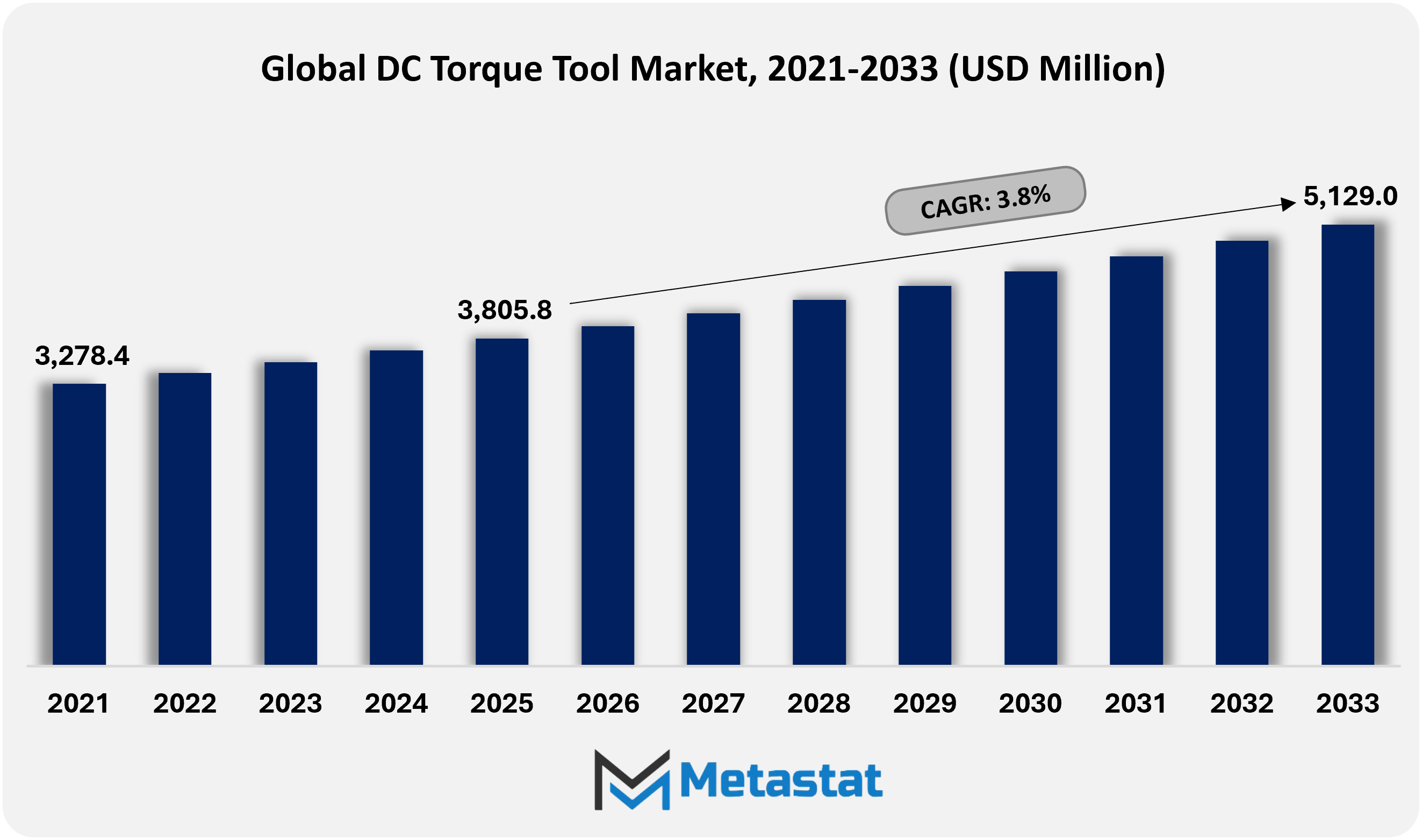
Expansion of electric vehicle production and advanced automotive manufacturing is increasing the need for high-accuracy fastening solutions across global assembly facilities. DC torque tools support critical applications in battery systems, lightweight vehicle structures, and safety-sensitive components where precision and repeatability are essential. Their adoption is rising across automated production lines as manufacturers work to improve throughput, reduce rework, and maintain fastening consistency in complex assembly operations.
Growing emphasis on quality control and traceability in aerospace and industrial manufacturing is strengthening adoption of digitally controlled torque systems. DC torque tools enable torque data recording, error-proofing, process validation, and centralized monitoring, supporting compliance across high-specification manufacturing environments. Such capabilities are becoming increasingly important in industries where fastening accuracy directly influences product reliability, operational safety, and lifecycle performance.
High initial investment remains a major challenge for widespread adoption of advanced DC torque systems, particularly among small and mid-sized manufacturers. Costs associated with tool acquisition, controller integration, calibration, software management, and ongoing maintenance can limit deployment in price-sensitive production environments. Budget constraints often lead manufacturers to prioritize other capital equipment upgrades ahead of digitally controlled fastening systems.
Availability of low-cost pneumatic and hydraulic fastening alternatives continues to restrict upgrade cycles in several regional markets. Many manufacturers continue using legacy systems owing to lower upfront cost, operator familiarity, and limited requirements for digital infrastructure. Such conditions slow the transition toward DC torque tools, especially across facilities where cost efficiency remains a stronger purchasing factor than data connectivity or traceability.
Integration of IoT-enabled torque tools with Industry 4.0 platforms is creating a strong opportunity across smart factory environments. Connected torque systems enable real-time analytics, cloud-based reporting, automated quality alerts, and centralized tool management. These capabilities improve operational transparency, support process optimization, and strengthen data-driven decision-making across digitally transformed manufacturing lines.
The Global DC Torque Tool market is classified based on Tool Type, Power Source, and Industry.
Electric Torque Wrench segment is valued at USD 563.9 million in 2026 and is projected to reach USD 769.3 million by 2033, at a CAGR of 4.5% during the forecast period.
Electric Torque Wrench holds an important position in the Global DC Torque Tool market, particularly in applications requiring controlled fastening and reliable torque delivery. Increasing use across automotive, aerospace, and industrial assembly environments is supporting steady segment expansion. Digital calibration, torque traceability, and process monitoring features are improving quality control performance, while integration with connected production systems is strengthening use in precision-driven assembly operations.
Electric Impact Wrench segment is valued at USD 692.7 million in 2026 and is projected to reach USD 820.6 million by 2033, at a CAGR of 2.5% during the forecast period.
Electric Impact Wrench remains relevant in the Global DC Torque Tool market for heavy-duty fastening applications that require high torque output and operational durability. Manufacturers are adopting these tools in industrial settings where productivity, tool strength, and fastening speed are critical. Improvements in motor efficiency, vibration control, and ergonomic design are supporting safer and more stable operation across demanding production environments.
Electric Nutrunner segment is valued at USD 1,044.2 million in 2026 and is projected to reach USD 1,436.1 million by 2033, at a CAGR of 4.7% during the forecast period.
Electric Nutrunner is a major product category in the Global DC Torque Tool market, supported by rising need for controlled torque and angle accuracy in advanced assembly processes. Smart nutrunners equipped with programmable controllers, data logging, and process validation features are becoming essential in high-precision production lines. Their use is increasing in lean manufacturing environments where reducing fastening errors and improving joint reliability are strategic priorities.
Electric Screwdriver segment is valued at USD 1,246.1 million in 2026 and is projected to reach USD 1,538.7 million by 2033, at a CAGR of 3.1% during the forecast period.
Electric Screwdriver represents a leading segment in the Global DC Torque Tool market, particularly across electronics, appliances, and other precision assembly industries. Compact design, torque adjustability, and operator-friendly handling make these tools suitable for delicate fastening applications. Growing use of digital screwdriving systems with torque recording and quality documentation functions is supporting segment growth across production environments that require repeatable fastening accuracy.
Fixtured Tools segment is valued at USD 403.5 million in 2026 and is projected to reach USD 564.2 million by 2033, at a CAGR of 4.9% during the forecast period.
Fixtured Tools play a critical role in the Global DC Torque Tool market, especially in automated and semi-automated assembly cells where high repeatability is required. Their stationary configuration supports consistent fastening performance in robotic and high-throughput manufacturing environments. Adoption is increasing across facilities seeking improved cycle control, reduced manual variability, and stronger long-term process stability through connected monitoring and predictive maintenance capabilities.
Corded segment is projected to reach USD 2,036.2 million by 2033, at a CAGR of 0.1% during the forecast period.
Corded DC torque tools continue to hold relevance in manufacturing environments that require uninterrupted power supply and stable tool performance across extended production cycles. These systems remain suitable for heavy-duty industrial operations where consistent torque delivery and continuous usage are important. Reliability, operational stability, and compatibility with fixed workstations are supporting ongoing use of corded tools in established production settings.
Cordless segment is projected to reach USD 3092.8 million by 2033, at a CAGR of 7.2% during the forecast period.
Cordless DC torque tools are expanding rapidly across the Global DC Torque Tool market as manufacturers seek greater mobility, ergonomic flexibility, and simplified workstation layouts. Advances in battery performance, charging efficiency, and runtime are improving usability across industrial assembly applications. Integration of wireless communication modules is further increasing their value, enabling real-time torque verification and centralized monitoring without restricting operator movement.
Automotive segment is projected to reach USD 1,743.8 million by 2033.
Automotive remains the leading industry for the Global DC Torque Tool market, supported by high-volume production, strict safety requirements, and growing electrification across vehicle platforms. DC torque tools are widely used in fastening applications involving battery modules, chassis systems, drivetrains, and structural assemblies. Their role in automated torque verification, process control, and fastening traceability is becoming increasingly important across modern automotive manufacturing lines.
Aerospace segment is projected to reach USD 615.5 million by 2033.
Aerospace is a high-value application area for the Global DC Torque Tool market owing to strict certification standards, complex assemblies, and strong emphasis on fastening precision. Manufacturers in this industry require highly controlled torque application to maintain structural integrity and long-term component reliability. Digitally controlled torque tools support compliance, traceability, and process consistency across aerospace production and maintenance environments.
Consumer Electronics & Appliances segment is projected to reach USD 923.2 million by 2033.
Consumer Electronics & Appliances is creating stable growth potential in the Global DC Torque Tool market through rising need for compact, accurate, and repeatable fastening solutions. High-volume assembly of miniaturized components requires tools that support precision, consistency, and low operator fatigue. Intelligent screwdriving and torque monitoring systems are gaining adoption as manufacturers focus on product quality, assembly speed, and digital documentation.
Energy segment is projected to reach USD 769.3 million by 2033.
Energy is emerging as an important end-use segment in the Global DC Torque Tool market, supported by investments in renewable installations, grid expansion, power generation equipment, and industrial energy infrastructure. Fastening accuracy is essential across these applications to maintain equipment safety, performance, and service reliability. Smart torque tools are helping improve maintenance quality, assembly compliance, and operational control across large-scale energy projects.
Shipbuilding segment is projected to reach USD 307.7 million by 2033.
Shipbuilding supports demand in the Global DC Torque Tool market through use of heavy-duty fastening systems across marine structures, onboard equipment, and large assembly installations. Production in this sector requires stable torque output, durable tool design, and performance reliability in harsh operating conditions. Increasing focus on calibration control and process monitoring is strengthening use of advanced torque tools in maritime construction environments.
Other segment is projected to reach USD 769.3 million by 2033.
Other industrial segments, including rail, construction equipment, and general industrial machinery, are contributing to expansion of the Global DC Torque Tool market. These industries are adopting connected fastening systems to improve assembly quality, reduce manual inconsistency, and strengthen production traceability. Rising automation levels and tightening performance standards are supporting broader demand for digitally controlled torque tools across diversified industrial operations.
Based on geography, the Global DC Torque Tool market is divided into North America, Europe, Asia-Pacific, South America, Middle East, and Africa.
North America DC Torque Tool Market is set to expand at a CAGR of 3.8% within the forecast period, reaching a market size (TAM) of USD 1,379.7 million by the end of 2033.
North America represents a significant market for DC torque tools, supported by widespread adoption of automated assembly systems across automotive, aerospace, electronics, and industrial manufacturing.
Quality assurance requirements and strict manufacturing standards across North America are accelerating demand for digitally controlled torque tools.
Asia-Pacific is positioned as a major growth region in the DC Torque Tool market owing to rapid expansion of electronics production, electric vehicle manufacturing, and industrial automation.
In the Asia Pacific, rising investments in smart factories and precision engineering open new avenues for DC torque device deployment throughout emerging business hubs.
Across the Middle East, Africa, and South America, gradual industrial diversification and infrastructure development toughen long-term demand for ability within the Global DC Torque Tool marketplace.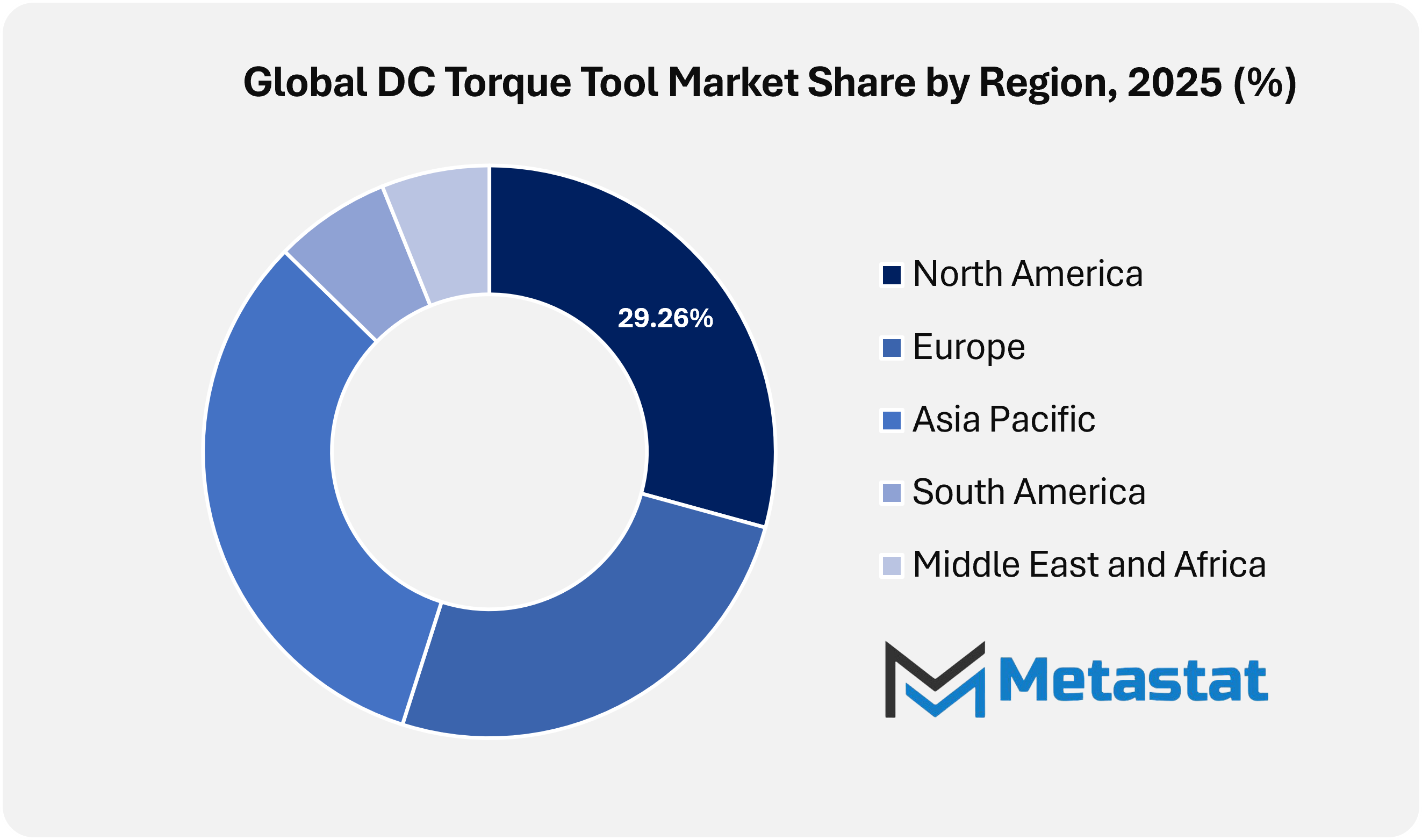
The Global DC Torque Tool market is becoming increasingly competitive as manufacturers place stronger focus on precision fastening, operator safety, process control, and digital traceability. Industries such as automotive, aerospace, industrial machinery, electronics, and energy are seeking fastening systems that deliver accurate torque, stable performance, and real-time data visibility. Such requirements are encouraging steady investment in connected torque tools that align with modern production strategies.
Leading companies are strengthening their market position through product innovation, software integration, ergonomic improvements, and expansion of intelligent fastening portfolios. Market participants are introducing corded and cordless DC torque tools with programmable settings, built-in error-proofing, advanced controllers, and monitoring capabilities designed for demanding assembly environments. Product differentiation is increasingly centered on accuracy, reliability, traceability, and ease of integration with factory systems.
Global players such as Atlas Copco AB, Apex Tool Group, LLC, Hilti Corporation, Desoutter Industrial Tools, Enerpac Tool Group, and Ingersoll Rand continue to compete through strong engineering capabilities, industrial relationships, and broad geographic presence. At the same time, specialized manufacturers are expanding their reach through targeted solutions for high-precision, compact, heavy-duty, or digitally enabled fastening applications. Competitive intensity is expected to remain steady as end users seek tools that support both operational productivity and quality assurance objectives.
Companies including HYTORC, ITH Bolting Technology, DEPRAG, ASG, Delta Regis Tools, Cleco Tools, Danikor, Estic Corporation, FIAM, Kolver Srl., Mountz Torque, Nitto Seiko, Norbar Torque Tools Ltd, and Weber Screwdriving Systems, Inc. are contributing to market development through application-focused product offerings. Their presence reflects growing demand for specialized torque solutions across diverse industrial use cases. Innovation in connected tooling, compact designs, energy efficiency, and process intelligence is expected to remain central to long-term competitive positioning.
Market size is forecast to rise from USD 3,805.8 million in 2025 to over USD 5,129.0 million by 2033.
The Global DC Torque Tool market is expected to maintain steady expansion over the forecast period as manufacturers continue aligning fastening operations with broader automation, quality, and digitalization goals. Increasing use of brushless motors, intelligent controllers, data-enabled monitoring, and connected assembly platforms is likely to strengthen the strategic role of DC torque tools across production environments. Over time, torque intelligence is expected to become a key part of smart manufacturing architecture, extending the value of these tools beyond fastening into process assurance and lifecycle management.
This research report categorizes the DC Torque Tool market based on key segments and regions, forecasts revenue growth, and analyses trends in each submarket. The report analyses the key growth drivers, opportunities, and challenges influencing the DC Torque Tool market. Recent market developments and competitive strategies such as expansion, product launch, partnership, merger, and acquisition have been included to draw the competitive landscape in the market.
The report strategically identifies and profiles the key market players and analyses their core competencies in each sub-segment of the DC Torque Tool market.
|
Report Attributes |
Details |
|
Study Period |
2021-2033 |
|
Base Year |
2025 |
|
Estimated Year |
2026 |
|
Forecast Period |
2026-2033 |
|
Historical Period |
2021-2025 |
|
Growth Rate |
CAGR 3.8% from 2026 to 2033 |
|
Revenue Unit |
USD million |
|
Sales Volume Unit |
Thousand Units |
|
Segmentation |
By Tool Type, Power Source, Industry, and Region |
|
By Region |
North America (By Tool Type, Power Source, Industry, and Country)
|
|
Europe (By Tool Type, Power Source, Industry, and Country)
|
|
|
Asia Pacific (By Tool Type, Power Source, Industry, and Country)
|
|
|
South America (By Tool Type, Power Source, Industry, and Country)
|
|
|
Middle East and Africa (By Tool Type, Power Source, Industry, and Country)
|
Find answers to common questions about this report
Top players operating in the DC Torque Tool industry include Aimco, Apex Tool Group, LLC, ASA Tools Enterprise Corp., ASG (Jergens), and Atlas Copco AB.
Global DC Torque Tool market is estimated to reach USD 5,129.0 million by 2033.
The Electric Screwdriver is the leading type segment in the Global market.
Asia Pacific region dominates the market.
High initial investment and maintenance cost of advanced DC torque systems limit penetration among small and mid-scale manufacturers will hamper the market growth within the forecast period.
Expansion of electric vehicle and advanced automotive production increases demand for high-accuracy DC torque tools in assembly lines and Growing focus on quality control and traceability in aerospace and industrial manufacturing strengthens adoption of digitally controlled torque solutions are key driving factors, boosting the market.
The Metastat Insights study shows that the Global DC Torque Tool market size was USD 3,805.8 million in 2025.
The Global DC Torque Tool market is expected to grow at a CAGR of 3.8% over the forecast period (2026-2033).
The Metastat Insights analysis shows that the North America DC Torque Tool market size is estimated to be USD 1379.7 million by 2033.
The analysts below cover Machinery & Equipment research at Metastat Insights.
LEAD ANALYST
Utkarsh Khirodkar is a Lead Market Research Analyst at MetaStat Insight, specializing in market intelligence, technology sector assessments, and competitive strategy.

INDUSTRY CONSULTANT - CHEMICALS & ADVANCED MATERIALS
Chemicals and Materials · Machinery & Equipment · Packaging
Amit Gadhekar Consultant for Chemicals and Materials at MetaStat Insight, directing sector-specific intelligence, research, and strategic consulting across global chemical and processing markets.

PRINCIPAL CONSULTANT - QUALITY SYSTEMS & COMPLIANCE
Electronics and Semiconductor · Machinery & Equipment · Professional Services
Omkar Phadtare is an Industry Consultant at MetaStat Insight, specializing in quality systems, regulatory compliance, and standards benchmarking to drive data-driven market intelligence and strategic industry research.

ENERGY & INFRASTRUCTURE INDUSTRY CONSULTANT
Automotive and Transportation · Electronics and Semiconductor · Energy and Power · Machinery & Equipment
Saurabh Vasant Ganvir consults for Energy & Infrastructure Industry at MetaStat Insight, specializing in renewable energy, solar EPC, and electric vehicle (EV) infrastructure markets.

LEAD CONSULTANT - COMMUNICATION, TELECOM, AND IT
Electronics and Semiconductor · Information & Technology · Machinery & Equipment · Professional Services
Ravindra Sathe Consultants for Communication, Telecom, and IT at MetaStat Insight. He leads the firm's industry research initiatives across telecommunications infrastructure, digital connectivity, enterprise networking, and emerging information technology domains.
Transitioning ultra-class mining haul trucks to alternative power requires concrete data on remote hydrogen refueling infrastructure economics. The report evaluated megawatt-scale electrolyzer installation expenses, onsite storage safety mandates, and heavy-duty fuel cell stack degradation under continuous duty cycles. That technical rigor helped our engineers benchmark realistic total operating cost horizons for off-highway fleet decarbonization.
Enterprise zero-trust network rollouts are often slowed down by multi-cloud transit latency and proprietary hardware retirement schedules. This study provided realistic total cost of ownership models comparing cloud-delivered security edge solutions against traditional hardware refreshes. The analysis of contract renewal lengths and software maintenance fees gave us clear visibility into enterprise replacement cycles over the next three to five years.
Scaling antibody-drug conjugate manufacturing hinges on contract manufacturing availability for high-potency active ingredients. The MetaStat Insight analysis looked closely at global cleanroom slot constraints, bioconjugation batch failure rates, and supply chain redundancies between the US, Europe, and India. The supplier capability matrix proved genuinely useful for our team when mapping secondary source options across our clinical pipeline.
Explore related market intelligence reports worth reading alongside this one.