
LEAD ANALYST
Utkarsh Khirodkar is a Lead Market Research Analyst at MetaStat Insight, specializing in market intelligence, technology sector assessments, and competitive strategy.

IoT Microcontroller Market By Product (8 Bit, 16 Bit, and 32 Bit), By Application (Industrial Automation, Smart Home Devices, Wearable Devices, Medical Devices, Telematics, Precision farming, and Others), By End Use (Consumer Electronics, Automotive, Healthcare, Industrial, Residential, and Others), By Industry Analysis, Size, Share, Growth, Trends, and Forecast, 2033
Report ID
MSI-4346
Published
October, 2025
Pages
255 Pages
Format
Report Details
Choose Your License
IoT Microcontroller Market
The global IoT microcontroller market will persist in reshaping the way industries engage with smart systems, revolutionizing the relationship between hardware effectiveness and digital smarts. Microcontrollers will no longer be mere control units as technology evolves; they will instead be the nervous system of networked devices functioning across various industries like healthcare, automotive, energy, and manufacturing. The sector will see increasing focus on maximizing performance with low energy consumption, allowing for intelligent operations without losing sustainability.
Global IoT microcontroller market valued at approximately USD 6.8 Billion in 2025, growing at a CAGR of around 7.6% through 2032, with potential to exceed USD 11.4 Billion.
8 Bit account for nearly 5.6% market revenues, driving innovation and expanding applications through intense research.
Key trends driving growth: Rising adoption of smart home and industrial automation systems., Growing demand for energy-efficient and low-power IoT devices.
Opportunities include Expanding deployment of IoT in healthcare, automotive, and smart city applications.
Key insight: The market is set to grow exponentially in value over the next decade, highlighting significant growth opportunities.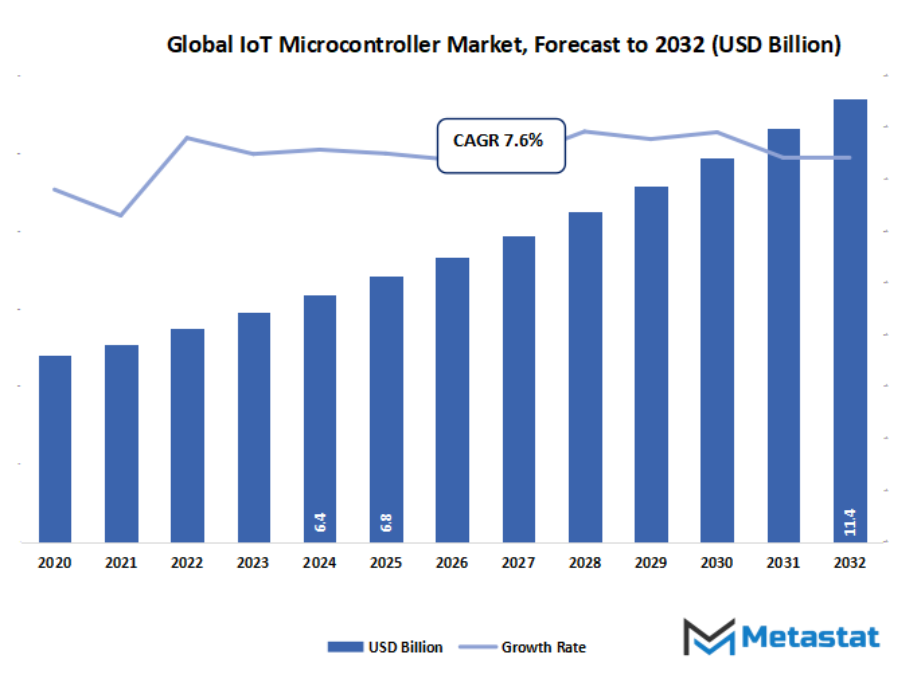
Can the integration of superior microcontrollers redefine the destiny of linked gadgets and smart ecosystems? As innovation accelerates, will the growing complexity of IoT networks push producers to rethink layout efficiency and safety frameworks? And amidst fast technological evolution, how will rising players navigate the stability among performance, electricity consumption, and cost to live competitive within the global IoT microcontroller market?
Over the next few years, the market for highly adaptable and secure IoT microcontrollers will increase due to the need for secure data handling in a more connected system. Microcontrollers will facilitate devices to talk to each other seamlessly, perform automated actions, and provide better user experience without any external human intervention. The emphasis will no longer be on just processing speeds but on intelligent adaptability, with microcontrollers being able to foresee user requirements through predictive computation and in-built learning features.
In addition, with the evolution of the global IoT microcontroller market, its function will not simply be in manufacturing and connectivity however will decide the way towns, households, and offices function. Smart infrastructure will notably rely on microcontrollers which can be able to running under dynamic situations at the same time as keeping records integrity and privateness. The future of this enterprise will hinge on innovation that mixes hardware and software program intelligence, making devices capable of questioning, learning, and speaking on their very own.
The global IoT microcontroller market is mainly classified based on Product, Application, End Use.
8 Bit: The 8-bit part of the market will still be contributing to low-power and price-touchy applications. These controllers can be hired in merchandise for which minimum computing functionality is adequate, like simple sensors, far off controls, and simple automation gadgets. Their power efficiency and lower cost will keep their location, specially in developing economies where small-scale IoT solutions will nonetheless be growing.
16 Bit: The 16-bit section of the global IoT microcontroller market might be renowned by means of its functionality-value balance. Such controllers will see big application in slight data handling IoT mid-stage packages. Their utilization might be based totally on clever meters, automobile manage structures, and small business tools, which will depend upon such microcontrollers for reliable overall performance and electricity performance.
32 Bit: The 32-bit phase will see excessive demand with the growing development of extra superior IoT systems. These controllers will discover their region in programs that require high processing velocity and high connectivity. The rising adoption of artificial intelligence, smart wearables, and sophisticated healthcare tracking structures will rely heavily on 32-bit microcontrollers for real-time records coping with and analysis.
Industrial Automation: The global IoT microcontroller market will experience business automation boom as factories will shift in the direction of related and smart systems. Microcontrollers will enable real-time verbal exchange, coordination of machines, and predictive renovation, on the way to result in advanced productivity and fewer downtimes.
Smart Home Devices: Smart domestic era will preserve revolutionizing present day living areas. In the market, microcontrollers will facilitate smooth integration of gadgets and automation, controlling functions which include electricity consumption, security, and luxury. Their effective processing of information and conversation will help flip houses more responsive and sustainable.
Wearable Devices: Wearable tool packages the usage of microcontrollers will develop as purchasers will call for extra personalized and health-oriented era. The market will provide compact, power-efficient controllers which can procedure biometric information, health tracking, and smooth synchronization with smartphones and cloud structures.
Medical Devices: Healthcare will more and more rely upon microcontrollers to force related tracking and diagnostic devices. In the market, scientific gadgets will advantage from expanded accuracy, wireless connectivity, and faster records transmission, supporting early disorder analysis and faraway patient tracking.
Telematics: In the market, telematics will be extra advanced, facilitating wise car verbal exchange systems. Microcontrollers will cope with navigation, tracking, and driver assistance systems, improving transportation to be safer and greater green as well as operating towards the introduction of clever.
Precision Farming: Precision farming turns into extra enormous as the demand for food global will growth. The market will fuel innovations in automatic irrigation, crop monitoring, and soil control. Microcontrollers will optimize farm output even as lowering waste and environmental degradation.
Others: Further makes use of microcontrollers will emerge in fields like power management, retail automation, and logistics. The global IoT microcontroller market will adjust to meet various desires as a way to remain adaptable throughout several industries.
Consumer Electronics: The global IoT microcontroller market might be substantially ruled by means of the customer electronics area. Smartphones, drugs, and connected devices will rely on state-of-the-art microcontrollers for faster response time, strength conservation, and more suitable user enjoy.
Automotive: In the automobile industry, the market will experience regular increase as more linked structures in vehicles could be integrated. Microcontrollers will allow capabilities consisting of infotainment, protection sensors, and independent driving era to make transportation clever and extra reliable.
Healthcare: Healthcare uses within the market will develop with the growing use of networked gadgets for analysis, remedy, and monitoring. The controllers will offer actual-time interplay among devices and medical experts for advanced affected person consequences and gadget effectiveness.
Industrial: The business area will adopt microcontrollers for controlling automation, robotics, and IoT-primarily based production approaches. The market will assist industries acquire predictive protection, operational performance, and stepped forward safety requirements.
Residential: In the residential area, the global IoT microcontroller market will offer for greater shrewd dwelling spaces. Microcontrollers will manage lighting fixtures, temperature, and safety systems via related devices, enabling greater convenience and power financial savings.
Others: Other quit-use packages will keep appearing as connectivity will develop across numerous sectors. The global IoT microcontroller market will provide tailor-made solutions for logistics, schooling, and smart infrastructure, defining a extra related and efficient.
|
Forecast Period |
2025-2032 |
|
Market Size in 2025 |
$6.8 Billion |
|
Market Size by 2032 |
$11.4 Billion |
|
Growth Rate from 2025 to 2032 |
7.6% |
|
Base Year |
2025 |
|
Regions Covered |
North America, Europe, Asia-Pacific, South America, Middle East & Africa |
Based on geography, the global IoT microcontroller market is divided into North America, Europe, Asia-Pacific, South America, and Middle East & Africa. North America is further divided in the U.S., Canada, and Mexico, whereas Europe consists of the UK, Germany, France, Italy, and Rest of Europe. Asia-Pacific is segmented into India, China, Japan, South Korea, and Rest of Asia-Pacific. The South America region includes Brazil, Argentina, and the Rest of South America, while the Middle East & Africa is categorized into GCC Countries, Egypt, South Africa, and Rest of Middle East & Africa.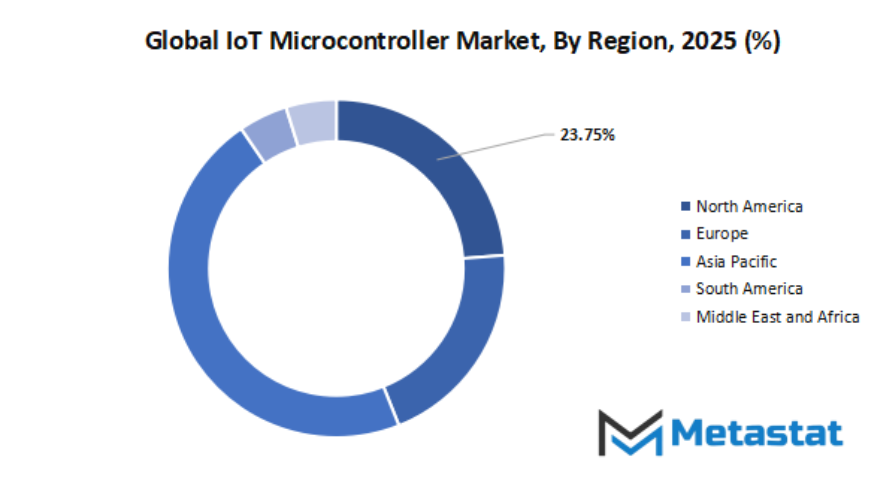
The global IoT microcontroller market has been advancing step by step as organizations globally preserve embracing clever technology to beautify performance, protection, and connectivity. Microcontrollers are critical in facilitating the Internet of Things (IoT), serving as the important unit that links devices, sensors, and systems. As corporations, towns, and homes end up increasingly connected, the want for IoT-capable gadgets has grown extensively. This increased reliance on networked technology will keep on providing room for growth and innovation in the world IoT microcontroller market.
The market has a mix of mature global corporations and potential local players. Every participant has its own technological prowess and innovations that preserve the industry advancing. Some of the most important players in the market are Acme Chip Technology, Ambiq Micro, Inc., Analog Devices, Inc., ARM Holdings, Broadcom Inc., CML Microcircuits, ELAN Microelectronics Corporation, Espressif Systems, Holtek Semiconductor Inc., Infineon Technologies, Intel Corporation, Microchip Technology Inc., Nordic Semiconductor, Nuvoton Technology Corporation, NXP Semiconductors, Renesas Electronics Corporation, Silicon Laboratories, STMicroelectronics, Texas Instruments Incorporated, and Toshiba Corporation. These firms are defining the destiny of IoT programs through ongoing product development, strategic partnerships, and technology innovation.
All these players are operating toward growing microcontrollers with improved strength efficiency, multiplied processing speeds, and improved connectivity functions. For instance, power-efficient chips have emerged as crucial to aid wearable sensors and battery-powered gadgets, whereas powerful microcontrollers are applied in business automation and related cars. Firms also are growing stepped forward statistics protection and processing to accommodate the needs of increasing IoT networks. As virtual transformation persists in industries like healthcare, car, and agriculture, those tendencies might be critical in building greater clever and sustainable answers.
The global IoT microcontroller market's competitive landscape will stay energetic and dynamic. Firms are certain to hold investing in research and improvement to release revolutionary answers that healthy the rising need for secure and low cost IoT structures. Alliances and collaborations among generation developers, tool producers, and software program companies may even increase the industry's development further. As IoT technology continues to spread, the market will expand further, creating new opportunities for both established companies and new entrants to re-imagine the way the world connects and functions.
Increased layout complexity and integration troubles with IoT networks: The global IoT microcontroller market will still enjoy demanding situations springing up from the growing complexity of designs and integration with wider IoT networks. With increasingly sophisticated connected gadgets, assuring easy conversation between sensors, processors, and cloud systems would require more coordination and innovation in hardware and software development.
Security dangers and data privacy in connected devices: The IoT Microcontroller Market Worldwide can be confronted with regular safety and privacy problems. With the wide variety of gadgets sending records growing to millions, cyber threats becomes a bigger chance. Manufacturers and developers will need to focus on incorporating state-of-the-art encryption, secure boot devices, and real-time risk detection technology to shield touchy records.
Growing use of IoT in fitness, vehicle, and intelligent city programs: The global IoT microcontroller market will see fantastic increase opportunities thru its integration with crucial industries which include healthcare, automotive, and smart towns. Healthcare will see linked scientific gadgets used to monitor patients and conduct far flung diagnostics. Microcontrollers will force sensible systems for protection and automation within the car enterprise. Smart towns, alternatively, will use IoT-sponsored infrastructure to pressure efficiencies in electricity, shipping, and waste control structures, so that you can be a revolutionizing generation for city making plans globally.
Market size is forecast to rise from USD 6.8 Billion in 2025 to over USD 11.4 Billion by 2032. IoT Microcontroller will maintain dominance but face growing competition from emerging formats.
Finally, the development of the marketplace will be characterised via its capacity to mix efficiency with mind, defining a destiny in which integrated systems react instinctively to human and environmental cues. The global IoT microcontroller market will for this reason go beyond being a thing of enterprise and grow to be a pressure driving the following wave of virtual transformation.
This research report categorizes the global IoT microcontroller market based on various segments and regions, forecasts revenue growth, and analyzes trends in each submarket. The report analyses the key growth drivers, opportunities, and challenges influencing the global IoT microcontroller market. Recent market developments and competitive strategies such as expansion, type launch, development, partnership, merger, and acquisition have been included to draw the competitive landscape in the market. The report strategically identifies and profiles the key market players and analyses their core competencies in each sub-segment of the global IoT microcontroller market.
Find answers to common questions about this report
Global IoT Microcontroller market is valued at $6.8 Billion in 2025.
Global IoT Microcontroller market is estimated to grow with a CAGR of 7.6% from 2025 to 2032.
Global IoT Microcontroller market is estimated to reach $11.4 Billion by 2032.
Top players operating in the IoT Microcontroller industry includes Acme Chip Technology, Ambiq Micro, Inc., Analog Devices, Inc., ARM Holdings, Broadcom Inc., and Others.
The analysts below cover Electronics and Semiconductor research at Metastat Insights.
LEAD ANALYST
Utkarsh Khirodkar is a Lead Market Research Analyst at MetaStat Insight, specializing in market intelligence, technology sector assessments, and competitive strategy.

PRINCIPAL CONSULTANT - ENTERPRISE AI & EMERGING TECHNOLOGIES
Banking & Finance · Electronics and Semiconductor · Energy and Power · Healthcare IT · Information & Technology · Professional Services
Vijay Gunti is a Principal Consultant at MetaStat Insight, bringing over two decades of experience across enterprise digital transformation, technology strategy, and intelligent systems.

PRINCIPAL CONSULTANT - QUALITY SYSTEMS & COMPLIANCE
Electronics and Semiconductor · Machinery & Equipment · Professional Services
Omkar Phadtare is an Industry Consultant at MetaStat Insight, specializing in quality systems, regulatory compliance, and standards benchmarking to drive data-driven market intelligence and strategic industry research.

ENERGY & INFRASTRUCTURE INDUSTRY CONSULTANT
Automotive and Transportation · Electronics and Semiconductor · Energy and Power · Machinery & Equipment
Saurabh Vasant Ganvir consults for Energy & Infrastructure Industry at MetaStat Insight, specializing in renewable energy, solar EPC, and electric vehicle (EV) infrastructure markets.

LEAD CONSULTANT - COMMUNICATION, TELECOM, AND IT
Electronics and Semiconductor · Information & Technology · Machinery & Equipment · Professional Services
Ravindra Sathe Consultants for Communication, Telecom, and IT at MetaStat Insight. He leads the firm's industry research initiatives across telecommunications infrastructure, digital connectivity, enterprise networking, and emerging information technology domains.
Evaluating calorific value requirements and air permit compliance across municipal waste facilities requires localized data. Metastat Insight structured their analysis around operational throughput capacity and feedstock composition variations in Latin America and Eastern Europe. Their competitive mapping of sorting equipment vendors helped clarify technology differences between optical separators and heavy media systems. The study provided an objective baseline during our capital expenditure reviews.
Decarbonizing industrial thermal processes hinges on refrigerant regulations and compressor efficiency limits. Metastat Insights delivered a thorough market analysis that evaluated natural refrigerants like CO2 and hydrocarbons against synthetic low-GWP alternatives. The breakdown of utility incentives and grid capacity constraints across key European manufacturing hubs offered valuable perspective. The follow-up conversation with their sector analysts addressed our specific questions on mechanical vapor recompression systems efficiently.
Assessing 200mm wafer transition schedules and substrate supply bottlenecks requires precise technical intelligence. MetaStat Insight supplied an actionable breakdown comparing planar and trench MOSFET architectures across automotive and industrial drive markets. The regional capacity estimates for Asia-Pacific foundries helped clarify lead-time uncertainties during our strategic planning session. When we needed additional clarification on high-purity raw material sourcing, their analyst team responded with helpful context within twenty-four hours.
Explore related market intelligence reports worth reading alongside this one.