
LEAD ANALYST
Utkarsh Khirodkar is a Lead Market Research Analyst at MetaStat Insight, specializing in market intelligence, technology sector assessments, and competitive strategy.

Wearable Patch Market Size, Share, By Type (Blood Glucose Patch, Heart Rate Patch & ECG Patch, Blood Pressure Patch, Temperature Patch, and Others,), By End-User (Hospital, Fitness and Sports, and Others), Industry Analysis, Growth, Trends, and Forecast, 2026-2033
Report ID
MSI-2288
Published
February, 2026
Pages
303 Pages
Format
Report Details
Choose Your License
Wearable Patch Market
A wearable patch helps to monitor blood glucose, heart rate & ECG, blood pressure, temperature, and more. Wearable patch sensors generate data continuously, without causing any interruptions to daily activity, and enhance self-monitoring compliance of the patient and improving the quality of patient care.
The rising prevalence and incidence of chronic diseases is booting the wearable patch market. For instance, according to the World Health Organization, the chronic disease had risen by 57% in 2020. According to the National Health Council, chronic diseases affect around 133 million Americans, representing more than 45% of the total population in 2018. According to the European Commission, Chronic diseases together account for over 86% of deaths in the European Union. Further, increasing regulatory approval of wearable patches is a key driving factor of the market. For instance, LifeSignals has received FDA clearance for its wireless LP1100 Life Signal Patch for enabling wearable healthcare monitoring devices. LP1100 Life Signal Patch is built on two solid technology. LP1100 LS Patch is a clinical-grade, two-lead ECG and heart rate monitoring patch, providing three days of monitoring with continuous wireless data transmission using two zinc-air batteries. However, the high cost of wearable sensor patches might hamper the market growth. The average price of a wearable sensor patch is around US$ 300 to US$ 4,500. Market players who cannot address the cost issue and are unable to offer high-quality products in emerging economies are expected to hinder the wearable patch market. Moreover, technological advancements in the wearable patch would provide lucrative opportunities for the market in the coming years.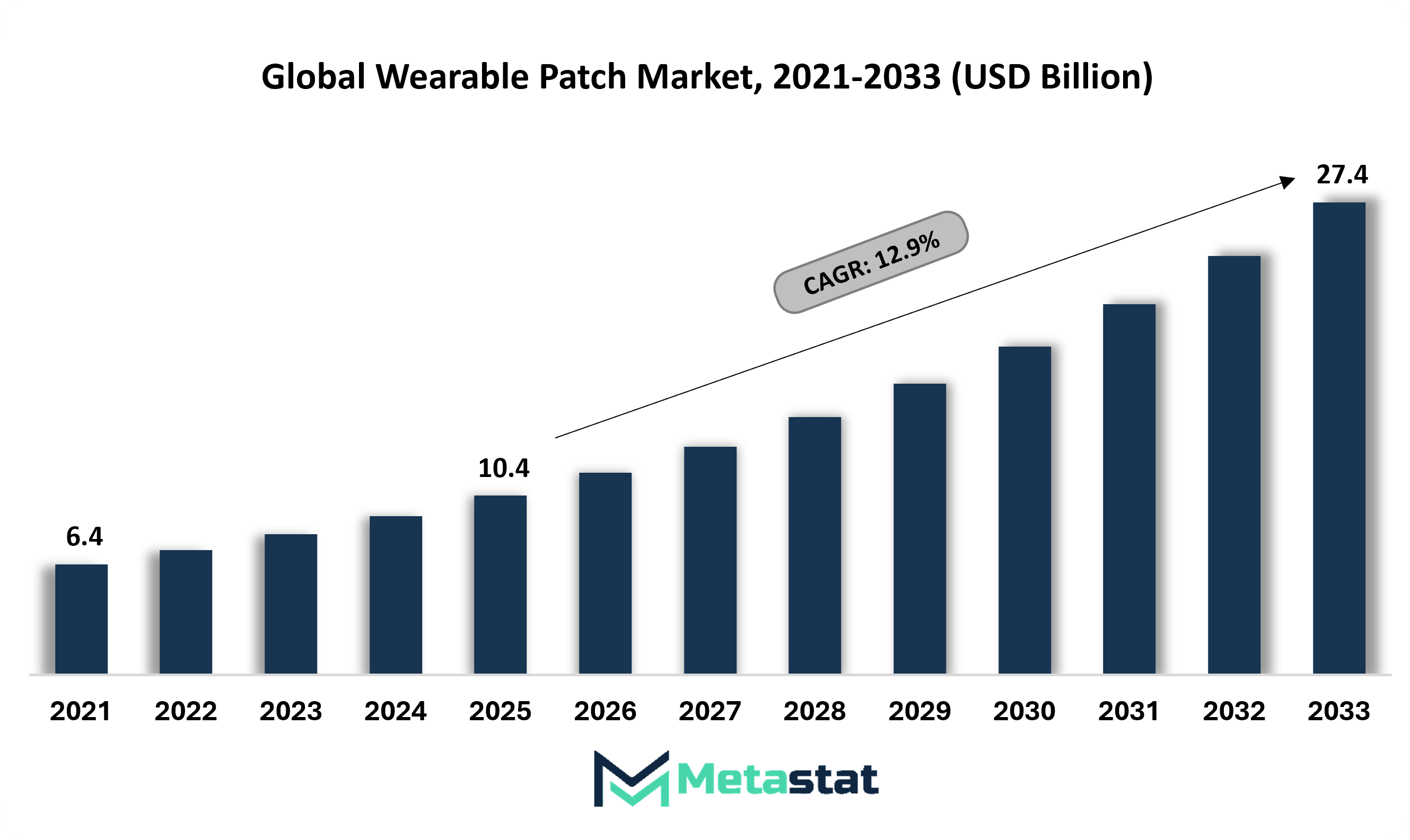
The global wearable patch market is mainly classified based on type and end-user. Type is further segmented into Blood Glucose Patch, Heart Rate Patch & ECG Patch, Blood Pressure Patch, Temperature Patch, and Others. By end-user, the market is divided into Hospital, Fitness and Sports, and Others.
Blood Glucose Patch segment is valued at USD 3.4 billion in 2026 and is projected to reach USD 8.4 billion by 2033, at a CAGR of 13.9% during the forecast period.
Based on type, the blood glucose patch was dominating the wearable patch market in 2020 owing to the rising prevalence and incidence of diabetes. For instance, According to the IDF Diabetes Atlas, in 2019, approximately 463 million people around the world live with diabetes. The global population with diabetes is expected to increase by 48% to 628.6 million people for the year 2045. According to Diabetes UK, more than five million people will have diabetes in the UK by 2025. Moreover, increasing regulatory approval for blood glucose patches is driving the market demand. For instance, Abbott has received the U.S. Food and Drug Administration (FDA) cleared for its FreeStyle Libre 2 integrated continuous glucose monitoring (iCGM) system for adults and children ages four and older with diabetes. iCGM system provides real-time alarms that measure glucose levels every minute, meeting the highest level of accuracy standards over 14 days. The FreeStyle Libre 2 system is the longest-lasting, self-applied iCGM sensor that eliminates the need for fingersticks.
By end-user, the market is divided into Hospital, Fitness and Sports, and Others.
Hospital segment is projected to reach USD 23.5 billion by 2033, at a CAGR of 12.7% during the forecast period.
Based on geography, the global wearable patch market is divided into North America, Europe, Asia-Pacific, South America, and Middle East & Africa. North America is further divided into the U.S., Canada, and Mexico, whereas Europe consists of the UK, Germany, France, Italy, and Rest of Europe. Asia-Pacific is segmented into India, China, Japan, South Korea, and Rest of Asia-Pacific. The South America region includes Brazil, Argentina, and the Rest of South America, while the Middle East & Africa is categorized into GCC Countries, Egypt, South Africa, and Rest of Middle East & Africa.
North America was dominating the wearable patch market in 2020 due to the rising prevalence of chronic diseases in North American regions. For instance, according to the Centers for Disease Control (CDC), in the U.S, diabetes had risen to an estimated 34.2 million in 2020. About 90% of people have Type 2 diabetes, and 8% of people with Type 1 diabetes, and 2% of people have rarer types of diabetes. In 2019, 48% of adults in the United States had some form of cardiovascular disease, and it is expected to be more than 130 million cases by 2035 in the U.S. Moreover, the development of new technologically advanced wearable patches is boosting the North American market. Engineers at the University of California San Diego have developed a soft, stretchy skin patch that tracks blood pressure and heart rate continuously while measuring the wearer’s levels of glucose as well as lactate, alcohol or caffeine. The new wearable patch can be worn on the neck.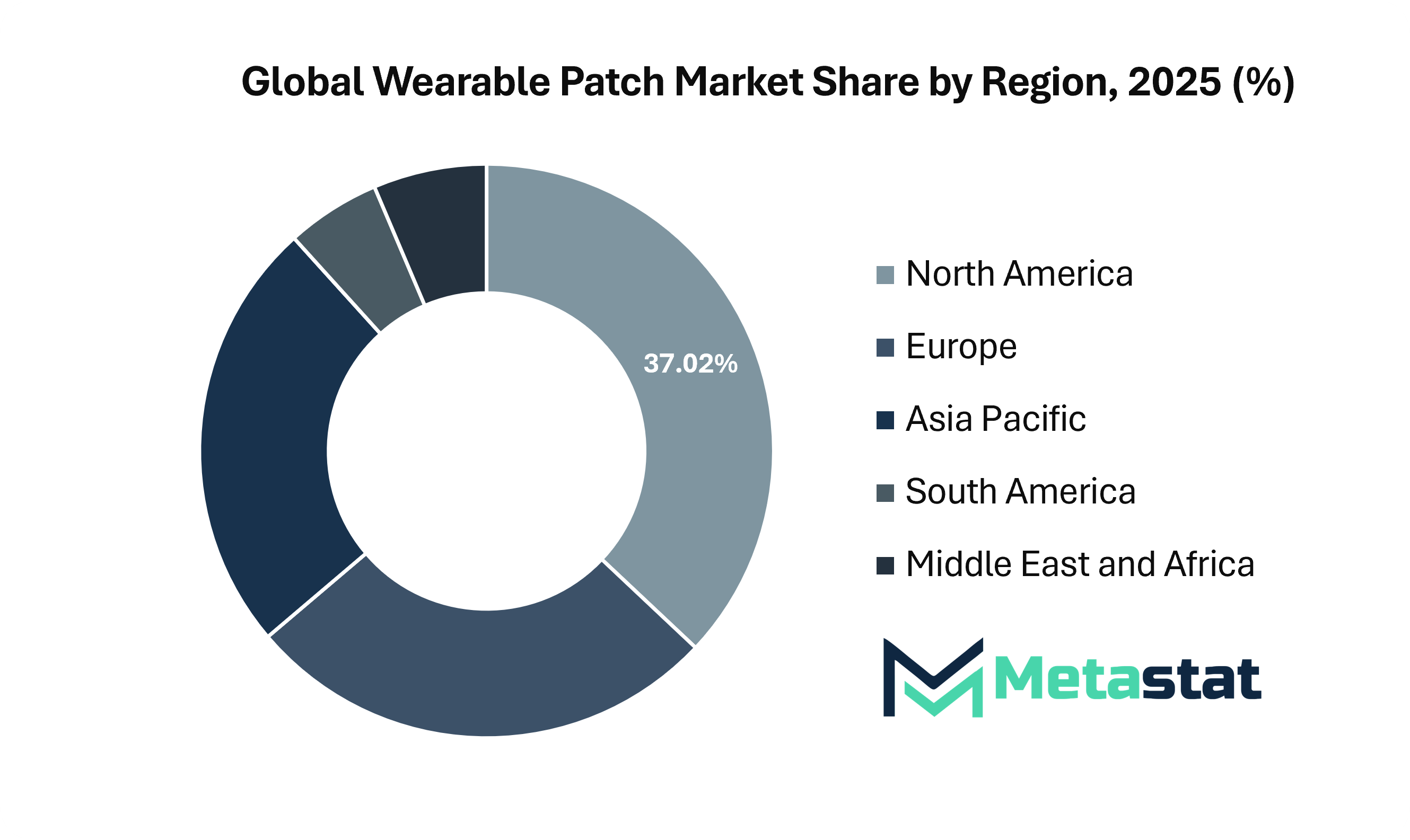
Key players operating in the wearable patch industry include VivaLNK, Inc, Cardiac Insight Inc, VitalConnect, LifeSignals, Inc, GENTAG, Inc, Abbott Laboratories, Koninklijke Philips N.V., L’Oreal Group, Sensium Healthcare Ltd, Qualcomm Technologies, Inc, and Leaf Healthcare, Inc.
Rising investment by the companies for the development of the wearable patch, the partnership between companies to expand their presence and revenue for the wearable patch, and commercialization of regulatory approved wearable patch are some of the strategies adopted by the major companies. For instance, on May 26, 2020, Royal Philips has received 510(k) clearance from the U.S. Food and Drug Administration (FDA) for its wearable biosensor to help manage confirmed and suspected COVID-19 patients in the hospital. The Philips Biosensor BX100 is designed to provide vital signs measurements, supporting surveillance of higher acuity patients moving from intensive care units into lower acuity general care areas of a hospital.
|
Report Attributes |
Details |
|
Study Period |
2021-2033 |
|
Base Year |
2025 |
|
Estimated Year |
2026 |
|
Forecast Period |
2026-2033 |
|
Historical Period |
2021-2025 |
|
Growth Rate |
CAGR 12.9% from 2026 to 2033 |
|
Revenue Unit |
USD billion |
|
Sales Volume Unit |
Thousand Units |
|
Segmentation |
By Type, End-User, and Region |
|
By Region |
North America (By Type, End-User, and Country)
|
|
|
Europe (By Type, End-User, and Country)
|
|
|
Asia Pacific (By Type, End-User, and Country)
|
|
|
South America (By Type, End-User, and Country)
|
|
|
Middle East and Africa (By Type, End-User, and Country)
|
Find answers to common questions about this report
Top players operating in the Wearable Patch industry includes VivaLNK, Inc, Cardiac Insight Inc, VitalConnect, LifeSignals, Inc, GENTAG, Inc, Abbott Laboratories, Koninklijke Philips N.V., L’Oreal Group, Sensium Healthcare Ltd, Qualcomm Technologies, Inc, and Leaf Healthcare, Inc.
The Wearable Patch market is estimated to reach a valuation of USD 27.4 billion by 2033.
According to Metastat Insights analysis, the North America Wearable Patch market size is estimated to reach USD 9.4 billion by 2033.
The Wearable Patch market is projected to grow at a CAGR of 12.9% during the forecast period from 2026 to 2033.
The Metastat Insights study reveals that the Wearable Patch market size was valued at USD 10.4 billion in 2025.
The analysts below cover Medical Devices research at Metastat Insights.
LEAD ANALYST
Utkarsh Khirodkar is a Lead Market Research Analyst at MetaStat Insight, specializing in market intelligence, technology sector assessments, and competitive strategy.

LEAD PRINCIPAL ANALYST, PHARMA AND HEALTHCARE
Food and Beverages · Healthcare · Healthcare IT · Medical Devices
Ajay Devgire is the Lead Healthcare Analyst at MetaStat Insight, leading strategic research and market intelligence initiatives across the global healthcare domain.

SENIOR RESEARCH ANALYST
Biotechnology · Food and Beverages · Medical Devices · Packaging
Snehal Pasalkar is a Research Analyst at MetaStat Insight, operating at the intersection of life sciences research, competitive strategy, and market intelligence.
Scaling antibody-drug conjugate manufacturing hinges on contract manufacturing availability for high-potency active ingredients. The MetaStat Insight analysis looked closely at global cleanroom slot constraints, bioconjugation batch failure rates, and supply chain redundancies between the US, Europe, and India. The supplier capability matrix proved genuinely useful for our team when mapping secondary source options across our clinical pipeline.
Floating offshore wind feasibility relies heavily on specialized installation vessel availability and port crane limits, which most broad renewable energy forecasts ignore. The report delivered a thorough analysis of dry dock capacity, mooring chain supply constraints, and raw material pricing trends for deepwater anchor installations. It served as a solid independent sanity check for our offshore project capital expenditure assumptions.
Assessing commercial microgrid software adoption requires looking past top-level installation numbers and examining utility interconnection queues. The research provided verifiable data on average permitting timelines, tariff structures, and battery storage integration costs across regional utility territories. That grounded perspective was valuable for our team when building five-year demand projections for industrial microgrid controllers.
Explore related market intelligence reports worth reading alongside this one.
Starting from
$2950