
LEAD ANALYST
Utkarsh Khirodkar is a Lead Market Research Analyst at MetaStat Insight, specializing in market intelligence, technology sector assessments, and competitive strategy.

Global Electric Bus (eBus) Charging Systems Market Size, Share, By Charging Technology (Plug-in Conductive Charging, Pantograph-Up Charging, Pantograph-Down Charging, Ground-Based Conductive Charging, Static Wireless Inductive Charging, and Dynamic Wireless Charging), By Charging Location (Bus Depots, Route Terminals and End-of-Line Stops, Intermediate Route Stops, Public and Shared Transit Charging Hubs, and Others (Maintenance Workshops, Temporary Charging Sites)), By Charging Power (Up to 50 kW, 51-150 kW, 151-350 kW, 351-600 kW, and Above 600 kW), Industry Analysis, Growth, Trends, and Forecast, 2026-2033
Report ID
MSI-5333
Published
September, 2026
Pages
255 Pages
Format
Historical
Base year
Forecast
Forecast period
Report Details
Market Valuation: Valued at $4.8 Million in 2025, projected to reach $26.2 Million by 2033 at a 23.5% CAGR.
Dominant Segment: The Plug-in Conductive Charging segment leads the market, driven by increasing demand for efficient charging solutions in urban areas, projected to grow from USD 2.6 million in 2026 to USD 10.3 million by 2033.
Geographic Lead: Asia Pacific, particularly China and India, is the fastest-growing region, spurred by government initiatives promoting electric mobility and sustainable transportation solutions.
What's Inside: The report provides a comprehensive analysis of the Electric Bus Charging Systems market, covering key segments by charging technology, location, and power, along with competitive insights and future forecasts.
Emerging Regional Demands: Rapid urbanization and environmental awareness in various regions are creating significant opportunities for electric bus charging infrastructure, particularly in developing markets.
Infrastructure Development: Investment in charging infrastructure, especially at bus depots and public transit hubs, is crucial for enhancing accessibility and supporting the growing electric bus fleet.
Choose Your License
Global Electric Bus (eBus) Charging Systems Market
The global Electric Bus (eBus) Charging Systems market was valued at USD 4.8 million in 2025 and is projected to reach USD 26.2 million by 2033, growing at a CAGR of 23.5% over the forecast period.
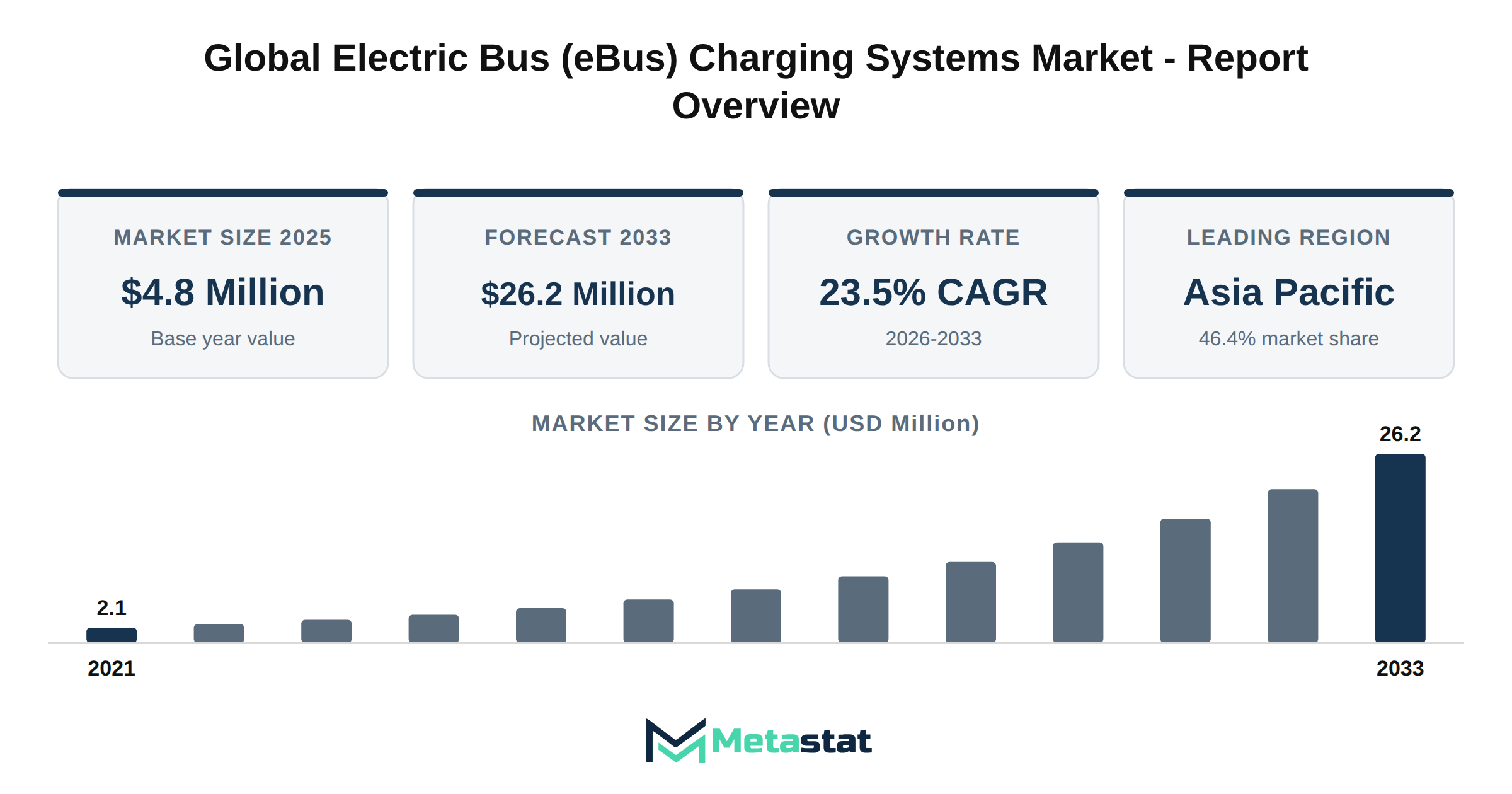
The Electric Bus (eBus) Charging Systems market is projected to expand from USD 4.8 million in 2025 to USD 26.2 million by 2033, reflecting a compound annual growth rate (CAGR) of 23.5%. This growth is driven by the global push for fleet electrification, which significantly enhances demand for sustainable transportation solutions. Urban transit networks increasingly adopt high-power pantograph charging to facilitate efficient electric bus operations, ensuring reliable service for public transit systems.
Charging infrastructure expansion at bus depots plays a critical role in supporting electric bus fleets. The forecasted increase in depot charging capacity from USD 3.3 million in 2026 to USD 13.4 million by 2033 highlights the importance of dedicated facilities for electric buses. Demand for plug-in conductive charging at these depots remains robust, driven by the need for accessible and efficient charging solutions that align with transit operators' operational requirements.
Opportunity charging at bus terminals and route stops is gaining traction, enabling electric buses to recharge during scheduled stops, thus minimizing downtime. The introduction of megawatt-scale charging systems caters to the next generation of electric buses, allowing for rapid and efficient energy transfer. Innovations in wireless and inductive charging technologies further enhance operational flexibility, providing effective charging experiences for transit operators.
Smart charging and load management systems are becoming essential in optimizing energy usage at electric bus depots. These technologies help mitigate grid capacity challenges associated with large-scale electric bus charging deployment. Investment trends in electric bus charging infrastructure highlight the commitment from various stakeholders, aiming to establish a reliable and efficient charging network that supports the growing fleet of electric buses.
Charging interoperability and standardization across electric bus fleets represent a critical factor in facilitating smoother operations. Public transit electrification policies support the increasing demand for electric bus charging systems, creating a favorable environment for investment and development. The cost reduction in electric bus charging systems contributes to lowering the total cost of ownership, making electric buses more attractive to transit agencies.
Energy management and renewable integration strategies in electric bus charging depots further enhance sustainability efforts within the market. Charging reliability and fleet uptime requirements are essential for transit operators, ensuring that electric buses remain operational and meet service commitments. Integrated depot designs for large electric bus fleets focus on maximizing efficiency and minimizing operational costs, enhancing the viability of electric bus initiatives.
The global trend toward fleet electrification drives significant growth in the Electric Bus (eBus) Charging Systems market. This shift aligns with sustainability goals and the transition to cleaner public transportation, prompting investments in charging infrastructure that support electric bus operations.
Expansion of depot charging infrastructure enhances the capability for electric bus fleets. This development focuses on installing high-capacity charging stations at bus depots, ensuring sufficient energy supply for fleet operations and facilitating quicker turnaround times.
Urban transit networks increasingly adopt high-power pantograph charging solutions. These systems enable rapid charging at bus stops, reducing downtime and improving service frequency, which directly benefits commuters and transit authorities.
Demand for plug-in conductive charging technology grows across electric bus depots. This charging method offers a reliable and efficient solution for fleet operators, ensuring that buses are adequately charged before deployment.
Opportunity charging at bus terminals and route stops gains traction, allowing for additional charging sessions during short layovers. This approach maximizes operational efficiency and extends the range of electric buses within urban environments.
The emergence of megawatt-scale charging systems supports the next generation of electric buses. These advanced solutions provide the necessary power to charge multiple buses simultaneously, addressing the increasing demand for electric public transport.
Innovations in wireless and inductive charging technology present new opportunities for electric bus operations. These systems eliminate the need for physical connections, enhancing convenience and operational flexibility for transit agencies.
Smart charging and load management systems play a crucial role in optimizing energy usage at electric bus depots. By balancing demand and supply, these technologies enhance the overall efficiency of charging operations.
Challenges related to grid capacity affect large-scale electric bus charging deployment. Ensuring adequate infrastructure and energy availability is essential for supporting the growing fleet of electric buses in urban areas.
Investment and funding trends highlight the increasing financial commitment to electric bus charging infrastructure. Public and private stakeholders recognize the potential returns associated with electrification efforts in public transportation.
Charging interoperability and standardization across electric bus fleets enhance operational efficiency. Establishing common protocols ensures compatibility between different charging systems, benefiting fleet operators and manufacturers alike.
Public transit electrification policies significantly influence charging demand in the market. Government initiatives and regulations promote the adoption of electric buses, driving the need for comprehensive charging solutions.
Cost reduction trends in electric bus charging systems impact the total cost of ownership for operators. Lower upfront and operational costs enhance the financial viability of transitioning from traditional diesel-powered buses to electric alternatives.
Energy management and renewable integration in electric bus charging depots align with global sustainability goals. Using renewable energy sources reduces the carbon footprint of electric bus operations, supporting environmental targets.
Charging reliability and fleet uptime requirements hold critical importance for transit operators. Ensuring that charging infrastructures are consistently operational is vital for maintaining service reliability and customer satisfaction.
Integrated depot design for large electric bus fleets facilitates efficient operations. This approach optimizes space and resources, promoting effective management of charging systems and vehicle maintenance.
Vehicle-to-grid opportunities present significant potential for electric bus charging networks. By allowing electric buses to return energy back to the grid, transit agencies enhance grid stability and generate additional revenue streams.
The potential for dynamic wireless charging on high-utilization bus routes presents an innovative solution for transit systems. This technology allows for continuous charging while buses operate, minimizing downtime and maximizing service capacity.
Competitive innovation in high-power electric bus charging systems shapes the market. Companies invest in research and development to improve charging efficiency, speed, and compatibility with diverse electric bus models.
Asia Pacific leads in the deployment of electric bus charging infrastructure, driven by rapid urbanization and government support for electric mobility. This region's commitment to electrification positions it because a key player in the global market.
The European electric bus charging market benefits from zero-emission transit mandates that promote the transition to electric vehicles. This regulatory environment encourages investments in charging infrastructure, enhancing market growth.
North American electric bus charging expansion occurs across transit and school bus fleets. Increasing adoption of electric vehicles in these segments reflects a growing commitment to sustainable transportation solutions.
Emerging electric bus charging opportunities in Latin America and the Middle East highlight the global interest in electrification. These regions explore new technologies and funding mechanisms to support electric mobility initiatives.
Charging hardware supply chain and power electronics capacity trends influence market dynamics. Ensuring an adequate supply of components is essential for meeting the increasing demand for electric bus charging solutions.
The future of automated and ultra-fast electric bus charging systems presents exciting possibilities for the market. Innovations in this area promise to enhance operational efficiency and user experience for transit operators and commuters.
Charging interoperability and standards will be vital for the future success of electric bus charging systems. Establishing unified protocols will streamline operations and facilitate broader adoption across diverse transit networks.
Grid capacity and load management considerations remain critical for scaling electric bus charging infrastructure. Addressing these challenges will ensure that the energy supply meets the demands of expanding electric bus fleets.
Depot electrification cost dynamics influence investment decisions for transit authorities. Understanding the financial implications of charging infrastructure development is essential for strategic planning and resource allocation.
Charging reliability and fleet uptime directly impact the operational success of transit agencies. Ensuring that charging infrastructures are dependable is critical for maintaining consistent service delivery.
Transit electrification policy developments play a significant role in shaping the market. Government regulations and incentives encourage the adoption of electric buses, driving demand for associated charging infrastructure.
Competitive technology benchmarking highlights the advancements made in electric bus charging systems. Ongoing innovation ensures that transit operators have access to state-of-the-art solutions that enhance efficiency and reduce costs.
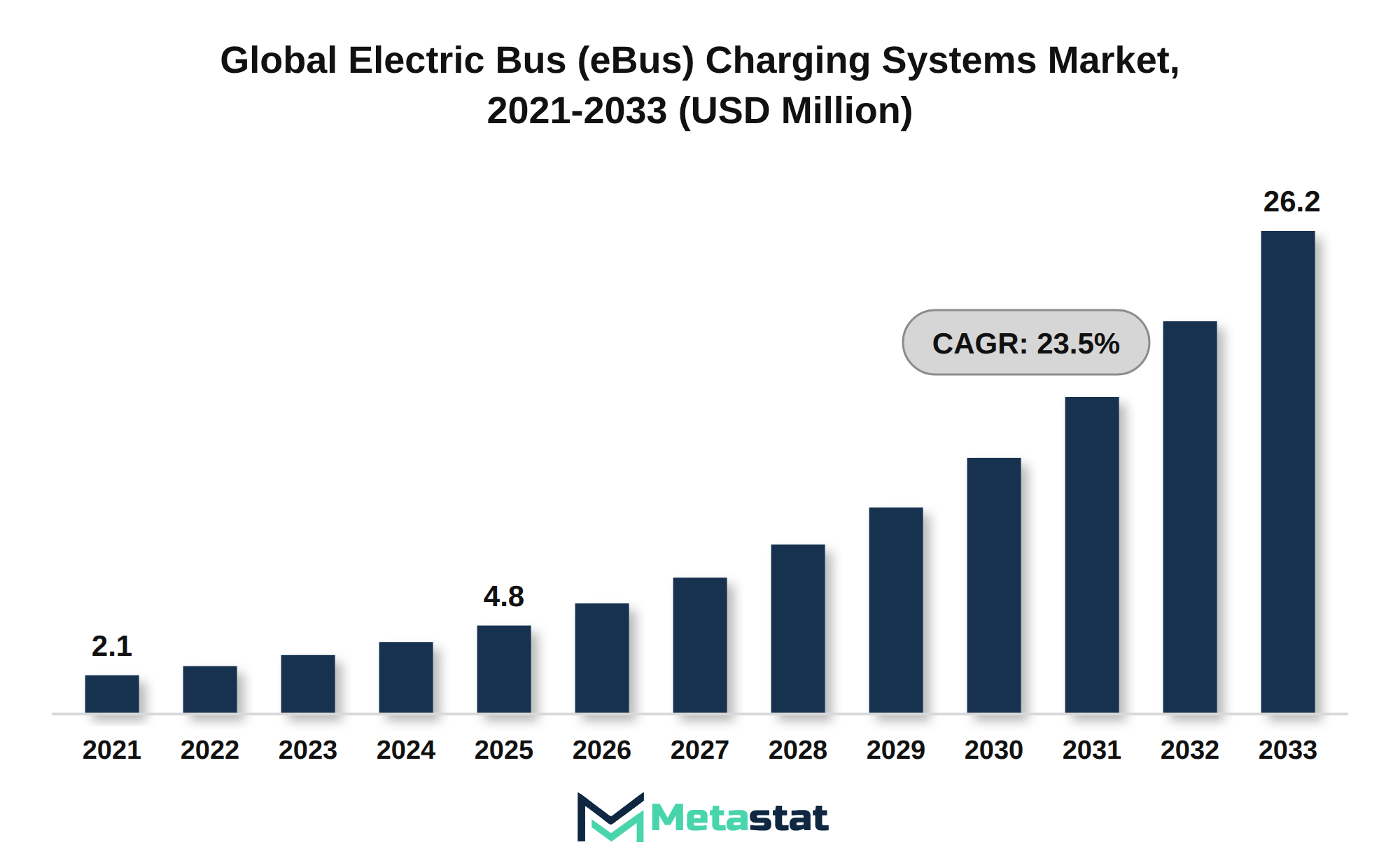
Rapid digital transformation drives substantial growth in the Electric Bus (eBus) Charging Systems market. Advancements in technology, including automation and software adoption, enhance efficiency and operational capabilities. Companies increasingly integrate digital solutions, optimizing processes and improving user experiences. This transformation arises from evolving consumer behaviors, emphasizing the need for streamlined and accessible charging infrastructures.
Investment in technological integration leads to improved infrastructure development and asset modernization. Enhanced digital capabilities allow for real-time monitoring and management of charging stations, resulting in better resource allocation and cost efficiency. This operational productivity provides a competitive edge among suppliers in the market, attracting additional capital investment.
The industry benefits from shifting demographic patterns, particularly urbanization. Growing urban populations generate increased demand for public transportation solutions, including electric buses. In response, municipalities prioritize the development of charging networks, effectively addressing the rising needs of urban mobility. This growth trajectory positions the Electric Bus (eBus) Charging Systems market for sustained expansion through improved technological frameworks and increased infrastructure investment.
Investment in infrastructure development significantly influences the Electric Bus (eBus) Charging Systems market. Expanding charging networks, including bus depots and public transit charging hubs, enhances accessibility and usability for electric bus fleets. Increased government and private sector funding for infrastructure upgrades creates a more robust ecosystem for electric vehicles, aligning with urbanization trends and sustainability goals.
Growing urban populations promote the need for efficient public transportation solutions, pushing stakeholders to prioritize electric bus deployment and support the necessary charging infrastructure. Enhanced charging capabilities streamline operations, leading to improved operational productivity and cost efficiencies in the transport sector.
Investment in advanced charging technologies, including plug-in conductive charging and pantograph systems, supports rapid market growth. Upgrading existing facilities and creating new charging locations enhances the overall charging experience for users. The anticipated growth in infrastructure directly aligns with the rising demand for electric buses, ensuring that the market expands in response to evolving consumer behaviors and preferences.
Infrastructure development establishes the foundation for the Electric Bus (eBus) Charging Systems market, enabling further advancements in technology and service offerings. This dynamic environment encourages competition and innovation, ultimately driving market growth and expanding revenue opportunities for industry participants.
Regulatory frameworks pose significant challenges within the Electric Bus (eBus) Charging Systems market. Compliance hurdles delay the implementation of charging infrastructure, ultimately impacting market growth. Various jurisdictions enforce differing standards for safety, performance, and environmental impact, complicating the development and deployment of charging systems. The legal mandates governing emissions and energy consumption further constrain operational flexibility and investment in new technologies.
Macroeconomic headwinds, including inflationary pressures and supply chain disruptions, hinder financial planning and procurement of necessary components. These economic factors increase capital investment requirements for charging infrastructure, limiting opportunities for smaller firms. Geopolitical instability contributes to uncertainty in resource availability, affecting production timelines and costs.
Infrastructure gaps create connectivity deficits that impede widespread adoption of eBus charging systems. Deployment bottlenecks arise when existing facilities cannot meet the demands of growing fleets. Skilled labor deficiencies exacerbate these challenges, because the industry struggles to attract and retain qualified professionals capable of managing advanced charging technologies. This talent gap increases operational overhead and complicates project execution.
Data security vulnerabilities and privacy concerns present additional risks. The integration of advanced technology in charging systems raises the stakes for potential cyberattacks and intellectual property theft. Market fragmentation complicates the competitive landscape, because numerous players vie for a share of an expanding but disjointed market. Cultural barriers and regional adoption resistors further delay widespread acceptance of electric buses and their supporting infrastructure, ultimately affecting demand for the Electric Bus (eBus) Charging Systems market.
The Electric Bus (eBus) Charging Systems market faces challenges stemming from geopolitical fragmentation, which influences international trade dynamics and creates barriers to cooperation among nations. Trade deficits and tariff friction complicate the procurement of essential components, leading to increased costs and delays in product development. These conditions particularly affect suppliers reliant on cross-border transactions, impacting their ability to deliver competitive solutions in a timely manner.
Technological disruptions further complicate the environment, where rapid advancements necessitate significant investment in research and development (R&D). Companies manage complex R&D integrations to remain competitive while addressing rising input cost structures associated with advanced technologies. This situation creates pressures on profit margins and necessitates careful planning to sustain operational viability.
Interoperability friction remains a critical issue for the market, driven by varying standards across regions that hinder integration of charging systems and vehicles. This lack of uniformity challenges manufacturers and operators, complicating their ability to achieve widespread adoption. Such barriers result in inefficiencies and deter investment in new infrastructure, ultimately slowing market growth.
Supply chain instability and logistics disruptions further exacerbate these challenges. The ongoing fluctuations in feedstock availability and pricing create uncertainty for manufacturers, while the need for skilled labor during workforce skill gaps limits operational efficiency. Talent retention pressures contribute to an environment where attracting and maintaining expertise becomes increasingly difficult.
Environmental lifecycle footprints and decarbonization mandates introduce additional complexities. Companies face mounting sustainability demands from consumers and regulators alike, which require innovative solutions and increased operational transparency. Addressing these expectations effectively not only enhances reputation but entails significant resource allocation and strategic planning.
Infrastructure gaps and retrofitting barriers impose constraints on the deployment of eBus charging systems, particularly in regions where existing facilities do not support advanced technologies. Implementation bottlenecks lead to delays in service availability, affecting customer satisfaction and overall market penetration. These challenges create a multifaceted environment where the Electric Bus (eBus) Charging Systems market navigates intricate dynamics to achieve sustained growth.
The Electric Bus (eBus) Charging Systems market experiences significant opportunities driven by emerging regional demands. Rapid urbanization and increasing environmental awareness in various regions create a strong push for sustainable transportation solutions. In Asia Pacific, particularly in China and India, government initiatives promoting electric mobility stimulate demand for eBus charging infrastructure. This trend aligns with global sustainability imperatives, prompting investments in green technologies and charging solutions.
Infrastructure modernization is essential for expanding market potential. Upgraded power grids and public charging networks facilitate the integration of electric buses into existing transit systems. Advanced charging technologies, including Plug-in Conductive Charging and Pantograph Charging, cater to diverse operational requirements and enhance charging efficiency. This modernization encourages adoption among transit agencies seeking to improve service offerings while adhering to eco-friendly compliance standards.
Geographical expansion of the Electric Bus (eBus) Charging Systems market continues due to urban planning initiatives aimed at reducing carbon emissions. Cities across North America and Europe are incorporating electric buses into their transit systems, creating demand for reliable charging solutions. This geographical diversification attracts investments from various stakeholders, enhancing competitive dynamics in the market.
Technological disruptions further influence market growth. Innovations in charging technology and smart grid integration streamline operations, reduce costs, and improve efficiency. The rise of digital procurement shifts among transit agencies emphasizes the need for accessible and user-friendly charging solutions. Consequently, manufacturers prioritize product integration and the development of next-generation charging systems that address specific market needs.
Strategic consolidation among players in the market enhances growth prospects. Mergers and acquisitions enable companies to leverage complementary technologies and expertise, leading to the development of comprehensive solutions. This consolidation supports cross-industry collaborations, encouraging innovations that drive market evolution and facilitate niche application growth.
The Electric Bus (eBus) Charging Systems market is central to green transformation initiatives, responding to evolving buying behaviors and commercial model transitions. Increased focus on environmental, social, and governance (ESG) criteria leads to stronger alignment among market participants toward sustainable practices. Supply chain localization and asset life-cycle extensions contribute to operational efficiency while ensuring compliance with eco-friendly regulations.
The Global Electric Bus (eBus) Charging Systems market is segmented based on Charging Technology, Charging Location, and Charging Power.
Plug-in Conductive Charging segment is valued at USD 2.6 million in 2026 and is projected to reach USD 10.3 million by 2033, at a CAGR of 21.7% during the forecast period. This growth results from several factors, including increasing demand for efficient charging solutions in the Electric Bus (eBus) Charging Systems market. High adoption rates of electric buses in urban areas, driven by environmental concerns and government initiatives, significantly influence demand for plug-in conductive charging technologies.
Technological maturation within the segment encourages innovation in charging infrastructure, enhancing user experience and operational efficiency. These advancements lower charging time, improve reliability, and reduce the overall cost of ownership for operators. The evolution of plug-in conductive charging solutions aligns with the increasing focus on sustainability within public transport systems, further supporting market expansion.
Investment in infrastructure and technological upgrades continues to drive the segment's growth. The development of smart grid technologies facilitates better energy management, allowing integration of electric buses into existing public transportation networks. This integration enhances operational dynamics, making electric buses a viable alternative to traditional fuel-powered vehicles.
Regulatory compliance standards and incentives play a crucial role in shaping market dynamics. Governments worldwide increasingly mandate emissions reduction targets, pushing transit authorities to adopt electric bus solutions. These policies drive demand for efficient charging systems, contributing to the overall growth of the Electric Bus (eBus) Charging Systems market.
Cost structures within the plug-in conductive charging segment show positive trends, with increased competition among suppliers leading to favorable pricing for end-users. While the segment expands, margin pressures influence operational practices, encouraging suppliers to enhance efficiency in manufacturing and logistics. Overall, these factors contribute to a resilient supply chain, positioning the plug-in conductive charging segment for sustained growth.
Growth within the Pantograph-Up Charging segment stems from increasing demand for efficient charging solutions in public transportation systems. Urban centers prioritize reducing emissions and adopting cleaner technologies, resulting in heightened adoption of electric buses. These dynamics promote the necessity for robust charging infrastructure, particularly through pantograph technology, which enables rapid charging and minimizes downtime for vehicles. The integration of pantograph systems facilitates efficient energy transfer, enhancing operational efficiency for transit authorities.
The segment is expected to reach USD 3.3 million by 2033, at a CAGR of 21.2% during the forecast period. Technological advancements contribute significantly to market expansion, driving innovations in charging speed and compatibility with various electric bus models. Increased investments in next-generation upgrades enhance the reliability and user experience of pantograph charging systems, attracting more transit operators to adopt this technology.
Regulatory compliance standards demanding lower emissions compel cities to transition toward electric fleets, indirectly boosting the Pantograph-Up Charging segment. Cost structures favoring operational savings through reduced fuel expenses further incentivize public transport authorities to invest in electric bus charging systems. Overall, the segment’s growth reflects strategic opportunity windows created by evolving consumer preferences, technological maturation, and heightened focus on sustainable transport solutions within the Electric Bus (eBus) Charging Systems market.
Demand for Pantograph-Down Charging systems within the Electric Bus (eBus) Charging Systems market stems from the need for efficient and high-capacity charging solutions. Operators prioritize fast charging technologies to minimize downtime and enhance service efficiency. Emerging trends in fleet electrification, particularly in urban environments, drive significant investment in infrastructure capable of supporting these advanced charging systems. With an increasing number of electric buses on the road, the urgency to implement faster charging solutions intensifies.
This segment is positioned for growth, reaching USD 6.8 million by 2033. Technological advancements enable the development of more efficient charging systems that integrate seamlessly into existing infrastructure. The sector benefits from the expansion of electric vehicle fleets and government initiatives promoting clean transportation. Regulatory compliance standards supporting the electrification of public transport further support market growth and attract investments.
Operators recognize the potential for Pantograph-Down Charging to enhance operational efficiency and reduce overall operational costs. By implementing these systems, fleet operators achieve shorter charging times and improved reliability of service. The market anticipates further evolution in charging technologies, leading to greater adoption and competitive advantages for those who invest strategically.
Growth in the Ground-Based Conductive Charging segment is supported by increasing investments in electric vehicle infrastructure, particularly in urban areas where high-density bus routes exist. This charging technology offers efficient energy transfer directly to the electric buses, reducing downtime and optimizing route efficiency. The technology appeals to transit authorities aiming to enhance fleet operational capabilities while meeting sustainability targets.
Electric Bus (eBus) Charging Systems market expansion is further fueled by advancements in charging technologies. Ground-Based Conductive Charging systems allow for high power transfer rates, accommodating the growing demand for quicker charging solutions driven by the evolution of urban transit systems. A CAGR of 25.2% during the forecast period reflects the mounting adoption of this charging method across various regions.
Demand for such innovative solutions is influenced by regulatory compliance and environmental policies promoting electric transportation. Transit agencies actively seek methods to reduce carbon footprints and comply with stringent emission regulations, aligning with broader global sustainability initiatives. Investments in this technology enhance public transit systems, improving customer satisfaction through increased service reliability and efficiency.
Continued development in the infrastructure surrounding Ground-Based Conductive Charging will attract significant capital investments. Stakeholders recognize the strategic opportunity windows presented by the Electric Bus (eBus) Charging Systems market. This segment not only addresses current market demands but positions itself for future advancements in electric bus technology, reinforcing its role in the evolving transportation landscape.
Technological advancements drive interest in Static Wireless Inductive Charging within the Electric Bus (eBus) Charging Systems market. This method enhances convenience by allowing electric buses to charge without physical connections, attracting operators focused on efficiency and reduced downtime. Adoption of this technology reflects a shift towards more flexible charging solutions, enabling buses to charge while in motion or at designated stops.
The segment benefits from growing demand for sustainable transportation solutions. Urban environments increasingly prioritize low-emission vehicles, pushing operators to seek innovative charging technologies. Consequently, Static Wireless Inductive Charging aligns with municipal goals for cleaner transportation, influencing investment decisions in infrastructure development.
Technological maturation plays a significant role in expanding this segment. Ongoing research and development efforts focus on increasing charging efficiency and reducing costs associated with installation and maintenance. Enhanced performance metrics support wider adoption among public and private operators, driving the need for reliable charging solutions.
Regulatory compliance standards significantly impact the market. Policies promoting electric vehicle adoption and setting emissions targets encourage investment in charging infrastructure, including Static Wireless Inductive Charging systems. Meeting these standards positions operators favorably in a competitive landscape, influencing purchasing decisions.
Overall, the Electric Bus (eBus) Charging Systems market emphasizes the importance of Static Wireless Inductive Charging. Strategic opportunities arise from technological advancements and regulatory support, highlighting the segment's potential for growth and long-term viability.
Adoption of Dynamic Wireless Charging technology within the Electric Bus (eBus) Charging Systems market reflects a response to the growing demand for efficient and flexible charging solutions. This technology enables buses to charge while in motion, eliminating downtime associated with conventional charging methods. Increased urbanization and the need for sustainable transport solutions drive interest in this innovative technology, particularly in densely populated areas where space for charging infrastructure is limited.
Technological maturation enhances the expansion of Dynamic Wireless Charging systems. Advancements in wireless charging efficiency and safety have improved the feasibility of this solution, encouraging stakeholders to invest. Manufacturers and transit authorities collaborate to integrate this technology into existing infrastructure, leading to increased operational efficiency and reduced total cost of ownership in the long term.
Regulatory compliance standards and government incentives supporting electric vehicle adoption positively influence market dynamics. Policies aimed at reducing emissions and promoting sustainable transport solutions create a favorable environment for the deployment of Dynamic Wireless Charging technology. Investments in research and development focused on improving power transfer efficiency and charging speed position this sub-segment for sustained growth within the Electric Bus (eBus) Charging Systems market.
Strategic opportunity windows arise from the potential for integration with smart city initiatives. These initiatives emphasize energy efficiency and pollution reduction, aligning closely with the operational benefits of Dynamic Wireless Charging systems. Growing interest in electrifying public transport ensures that this sub-segment remains a focal point for innovation and investment.
Valued at USD 3.3 million in 2026, the Bus Depots segment is projected to reach USD 13.4 million by 2033, with a compound annual growth rate (CAGR) of 22.4% during the forecast period. The increasing deployment of electric buses across various urban transit systems drives substantial investment in charging infrastructure at bus depots. This trend aligns with the broader shift toward sustainable public transportation solutions, where demand for efficient charging systems continues to grow.
Regulatory support for clean energy initiatives acts because a catalyst for market expansion, encouraging municipalities and transit authorities to prioritize electric bus adoption. The transition to electric buses emphasizes the importance of strategically located charging facilities, particularly in bus depots, to ensure operational efficiency. Investment in these facilities reflects a commitment to operational efficiency and environmental sustainability, crucial for meeting regulatory compliance standards.
Technological advancements in charging systems enhance the effectiveness of bus depots, enabling faster charging times and improved energy management. Innovations in charging technology, including high-capacity plug-in conductive systems, support the operational needs of urban transit agencies while addressing the growing demand for electric buses. These advancements contribute to improved end-use dynamics, facilitating higher utilization rates of electric buses within transit fleets.
Market players focusing on the Bus Depots segment emphasize the integration of next-generation technologies that streamline the charging process and optimize energy consumption. Collaboration among stakeholders, including technology providers and transit authorities, is essential in developing resilient supply chains while addressing any potential logistical vulnerabilities. The electric bus (eBus) charging systems market recognizes bus depots because essential hubs for supporting a sustainable urban transport network.
Significant growth in the Route Terminals and End-of-Line Stops segment is projected, driven by increasing urbanization and the demand for efficient public transportation solutions. This segment is expected to reach USD 6.1 million by 2033, at a CAGR of 24.2% during the forecast period. Adoption of electric buses enhances operational efficiency and reduces emissions, which aligns with environmental regulations and sustainability goals. The market experiences strong demand, attributed to municipalities and transit authorities modernizing aging infrastructures and improving service reliability. Investment in charging infrastructure at route terminals supports faster turnaround times for electric buses, enhancing overall service efficiency. With technological advancements, charging systems at these locations evolve to support higher power outputs and faster charging times, further encouraging adoption. The Electric Bus (eBus) Charging Systems market reflects strong growth prospects, influenced by these trends.
Continued investment in public transportation infrastructure drives demand for Electric Bus (eBus) Charging Systems, particularly within the Intermediate Route Stops segment. The growing necessity for efficient urban transport solutions leads to increased deployment of electric buses, encouraging the development of charging stations at intermediate route stops. This segment is projected to reach USD 3.1 million by 2033, reflecting the rising focus on reducing emissions and enhancing public transit efficiency.
Technological maturation in charging solutions enhances the viability of Intermediate Route Stops for electric buses. Innovations in charging technologies, coupled with strategic placement of charging infrastructure along routes, streamline operations and minimize downtime for electric buses. Stakeholders in the market align strategies to capitalize on the demand for such charging locations, which enable integration of electric buses into existing transit systems.
Growing awareness of environmental impacts drives investment and policy support for electric bus infrastructure. Regulatory compliance standards increasingly promote the adoption of electric buses and associated charging systems. By aligning with these standards, operators leverage incentives and funding opportunities, further boosting market expansion. The Intermediate Route Stops segment benefits from this supportive regulatory environment, enhancing its attractiveness to investors and operators.
Cost structures for establishing charging stations at Intermediate Route Stops largely depend on the technology and infrastructure choices made by operators. Pricing volatility in raw materials for construction and equipment impacts initial investments and subsequent operational costs. However, strategic partnerships and economies of scale mitigate these pressures, ensuring stakeholders remain competitive while expanding their charging networks within the Electric Bus (eBus) Charging Systems market.
Investment in public transport infrastructure significantly increases the demand for Public and Shared Transit Charging Hubs. This segment is projected to grow at a CAGR of 25.7% during the forecast period. Increasing urbanization and environmental initiatives emphasize the transition to electric buses, driving the need for efficient charging solutions within the public transit system. Integration of these charging hubs enables faster turnarounds for electric buses, enhancing operational efficiency for transit authorities.
Technological maturation in charging systems supports the development of more robust and efficient charging stations, attracting investment from both public and private sectors. Adoption of smart technologies for grid management and energy distribution optimizes the performance of these charging hubs. Policy support at various governmental levels accelerates the deployment of electric buses and their accompanying charging infrastructure, contributing to market expansion.
Consumer preferences increasingly favor eco-friendly public transport options, increasing demand for electric buses and their charging systems. The alignment of public transit agencies with sustainability goals drives investments in Public and Shared Transit Charging Hubs, enhancing the overall functionality of the Electric Bus (eBus) Charging Systems market. The relationship between regulatory compliance standards and technological advancements creates a strategic opportunity window for stakeholders in this segment.
Cost structures for establishing charging hubs are influenced by factors including equipment pricing and installation expenses, which directly affect overall profitability. Competitive dynamics in the market lead to pricing volatility, creating margin pressures for suppliers. Continuous innovation in charging technology, along with strategic partnerships among key players, strengthens the market's resilience and supports long-term growth.
Increasing interest in temporary charging solutions significantly impacts the Electric Bus (eBus) Charging Systems market. Maintenance workshops and temporary charging sites address the need for flexible charging options, particularly for operators seeking to optimize fleet operations and enhance efficiency. Adoption of these facilities aligns with rising demand for electric buses, facilitating the integration of charging infrastructure in various contexts.
Regulatory compliance and sustainability mandates drive the expansion of this sub-segment. Operators invest in maintenance workshops to ensure compliance with stringent environmental regulations while enhancing the longevity and performance of electric bus fleets. Temporary charging sites offer strategic solutions for operators with route variability, allowing for quick deployment in areas lacking permanent infrastructure.
Technological maturation significantly influences the development of these charging locations. Innovations in mobile charging solutions enhance the viability of temporary sites, enabling rapid deployment and operation. Consequently, the market for maintenance workshops and temporary charging sites is projected to expand, driven by the ongoing evolution of electric bus technology and the need for adaptable charging infrastructures.
Valued at USD 0.7 million in 2026, the Up to 50 kW segment is projected to reach USD 2.3 million by 2033, at a CAGR of 18.1% during the forecast period. Growing demand for lower-capacity charging solutions drives market expansion, particularly in regions with limited infrastructure investment. Increasing adoption of electric buses in urban areas fuels the need for efficient charging technologies that complement existing energy systems.
Technological maturation significantly influences segment dynamics, with advancements leading to improved efficiency and cost-effectiveness of charging systems. The introduction of next-generation upgrades enhances performance and reliability, attracting more stakeholders within the Electric Bus (eBus) Charging Systems market. End-use dynamics reflect a shift toward sustainable transportation options, further accelerating the adoption of electric buses equipped with compatible charging solutions.
Regulatory compliance standards and policies promote the adoption of electric buses, with many governments setting ambitious targets for reducing emissions. These initiatives influence the development of charging infrastructure that meets evolving requirements. Pricing volatility and margin pressures related to raw material sourcing and production processes present challenges. Strategic opportunity windows arise from an increasing emphasis on sustainability, encouraging investment in Up to 50 kW charging solutions.
Increasing adoption of Electric Bus (eBus) Charging Systems contributes to the growth of the 51-150 kW segment, which is estimated to reach USD 5.6 million by 2033, at a CAGR of 20.5% during the forecast period. This growth arises from the heightened focus on enhancing charging infrastructure to improve operational efficiency and reduce downtime for electric buses. The demand for efficient charging solutions aligns with the evolving requirements of public transportation, where operational reliability is critical.
Technological maturation in charging systems facilitates enhancements in power output and efficiency, creating a competitive atmosphere among providers within the segment. Next-gen upgrades and product evolution in power management technologies, coupled with the integration of smart charging solutions, significantly drive the market forward. End-use dynamics indicate that bus operators increasingly prioritize charging solutions that offer flexibility and scalability, aligning with their operational needs.
Regulatory compliance standards and policies supporting the transition to electric public transport systems exert pressure on stakeholders to invest in advanced charging technologies. The segment benefits from an overall cost structure that incentivizes investment in charging infrastructure due to the long-term operational savings associated with electric buses. Pricing volatility within raw material sourcing for charging systems presents challenges, yet strategic opportunity windows emerge, driven by technological advancements that lead to more efficient supply chains.
The 51-150 kW segment thrives within the Electric Bus (eBus) Charging Systems market, driven by the convergence of demand for efficient charging solutions, technological innovations, and robust regulatory frameworks. This environment positions the segment for substantial growth through 2033.
Growth in the 151-350 kW segment aligns with increasing demand for higher power charging solutions within the Electric Bus (eBus) Charging Systems market. This segment is projected to reach USD 9.2 million by 2033, driven by advancements in battery technology and the push for rapid charging capabilities. Adoption of this charging power range enhances the operational efficiency of electric buses, particularly in urban environments where quick turnaround times are crucial.
Technological maturation significantly influences segment expansion, with manufacturers focusing on enhancing charging infrastructure to accommodate greater power levels. Investments in this segment reflect shifting end-use dynamics, where transit authorities prioritize efficiency and reliability in electric bus operations. Regulatory compliance standards increasingly favor higher charging capacities, motivating operators to transition towards 151-350 kW solutions.
Pricing volatility associated with raw material sourcing and component manufacturing impacts the overall cost structure. Long-term contracts and strategic partnerships with suppliers contribute to mitigating these pressures. This segment's growth trajectory presents strategic opportunity windows for manufacturers and investors in the Electric Bus (eBus) Charging Systems market, emphasizing the importance of innovation and competitive differentiation.
Increasing requirements for high-efficiency charging solutions drive growth in the 351-600 kW segment of the Electric Bus (eBus) Charging Systems market. This segment supports faster charging times, aligning with evolving operational needs and demand for reduced downtime in electric bus fleets. The expected growth trajectory reflects a compound annual growth rate (CAGR) of 26.8% during the forecast period, highlighting significant market momentum.
Technological advancements in charging infrastructure enhance the capabilities of the 351-600 kW segment. Innovations in power electronics and charging management systems facilitate more efficient energy transfer, optimizing operational costs for transit operators. Enhanced charging power enables buses to complete their routes effectively, aligning with stricter regulatory compliance standards related to emissions and sustainability.
Investment in electric bus infrastructure complements the segment's growth. Government initiatives aimed at reducing carbon footprints support funding for charging stations designed to support higher power ratings. Transit authorities and operators increasingly prioritize partnerships with technology providers to ensure effective integration of advanced charging solutions, thus enhancing their service offerings.
Market dynamics continue to favor the adoption of the 351-600 kW segment. Rising operational demands from public transportation sectors position this segment because a vital contributor to the overall success of the Electric Bus (eBus) Charging Systems market, ensuring that fleet operators meet the needs of urban mobility while adhering to sustainability targets.
High demand for powerful charging solutions drives the evolution of the Above 600 kW segment within the Electric Bus (eBus) Charging Systems market. Increased electrification of public transport systems necessitates rapid charging capabilities that support the growing fleet of electric buses. Urban areas striving for sustainability focus on reducing emissions, which enhances the appeal of high-capacity charging options. Technological maturation in battery technology, coupled with advancements in charging infrastructure, supports adoption in this segment.
The emphasis on efficiency in operational costs influences investment in high-performance charging systems. Strategic opportunity windows arise due to municipalities seeking to improve energy management and reduce downtime for electric buses. Adoption of charging solutions exceeding 600 kW aligns with the push for enhanced service quality in public transportation, facilitating efficient operations. Downstream applications benefit from these advanced charging systems, ultimately supporting the broader objectives of urban mobility.
Regulatory compliance standards increasingly favor high-capacity charging systems, pushing manufacturers to innovate and meet stringent requirements. While these systems evolve, ongoing capital investments focus on enhancing charging infrastructure, strengthening the resilience of supply chains. The Above 600 kW segment represents a critical component of future public transport strategies, ensuring that the Electric Bus (eBus) Charging Systems market adapts to emerging demands and technological advancements.
Based on geography, the Global Electric Bus (eBus) Charging Systems market is divided into North America, Europe, Asia-Pacific, South America, Middle East, and Africa.
The North America Electric Bus (eBus) Charging Systems market is set to expand at a CAGR of 23.5% within the forecast period, reaching a market size (TAM) of USD 5.2 million by the end of 2033. This growth results from several factors, including increased investment in electric bus infrastructure across the United States, Canada, and Mexico. Regulatory support continues to drive the adoption of electric buses, with various policies favoring cleaner transportation solutions.
Emerging market front-runners including the United States lead the way with significant government initiatives promoting the adoption of electric vehicles. Local compliance mandates encourage municipalities to transition their public transport fleets to electric buses, enhancing the demand for Electric Bus (eBus) Charging Systems. Infrastructure modernization significantly enhances the availability of charging stations, ensuring that electric buses operate seamlessly across urban landscapes.
The market benefits from high-value replacement cycles, driven by aging diesel buses retiring and being replaced with electric alternatives. This transition generates incremental growth vectors because cities seek to invest in sustainable transport options. Local procurement dynamics, influenced by regional cultural nuances, create strong relationships between suppliers and transit authorities, streamlining the adoption process.
The North America Electric Bus (eBus) Charging Systems market reflects a robust response to changing transportation needs, driven by investment, regulatory frameworks, and the increasing focus on sustainability. The region's market dynamics position it favorably for continued growth in the coming years.
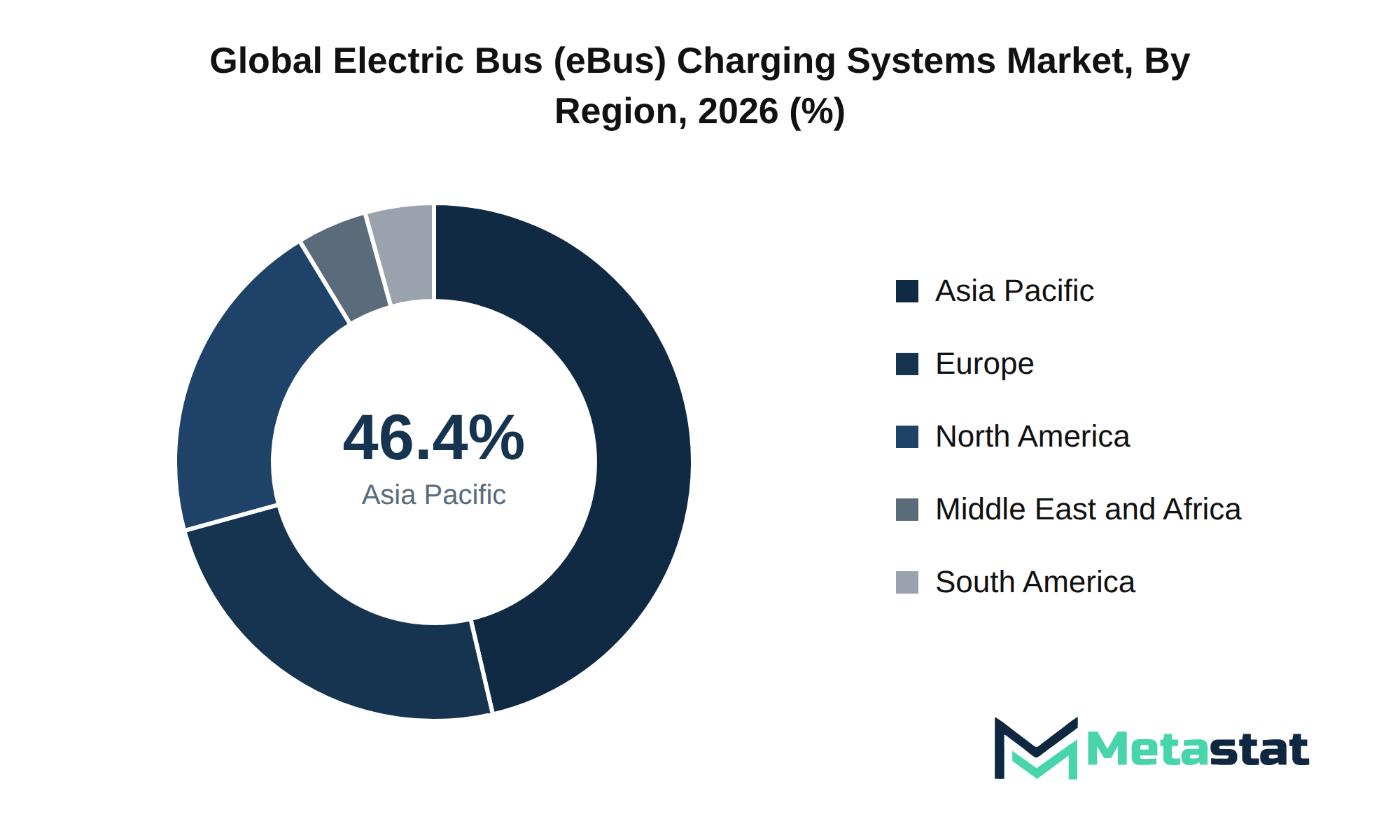
In Europe, the Electric Bus (eBus) Charging Systems market represents 24.4% of the global total in 2025. Key drivers behind this market growth include infrastructure modernization and the increasing emphasis on sustainable public transportation solutions. Countries including Germany, France, the UK, Italy, Spain, and Russia lead in the adoption of electric bus technologies, supported by government initiatives aimed at reducing carbon emissions and enhancing urban mobility.
The region benefits from a robust regulatory framework that promotes investment in electric mobility. Local compliance mandates push for the transition towards electric buses, contributing to heightened demand for charging systems. Emerging market front-runners in Europe effectively leverage localized manufacturing densities and nearshoring initiatives, enhancing supply chain efficiency while catering to regional needs.
Opportunities reside within underpenetrated territories where electric bus infrastructure remains in its nascent stages. Incremental growth vectors including high-value replacement cycles in aging public transport fleets drive further adoption of Electric Bus (eBus) Charging Systems. Geopolitical fragmentation and trade policy shifts influence market dynamics, compelling suppliers to adapt quickly to changing requirements.
Regional competitive landscapes highlight domestic market participants actively consolidating their presence through strategic partnerships and acquisitions. Localized procurement dynamics ensure that vendors align their offerings with cultural nuances and regional B2B buying behaviors, creating a conducive environment for market expansion. The combination of energy grid resiliency and local infrastructure readiness further supports the growth of the electric bus charging ecosystem in Europe.
The Asia-Pacific region represents a substantial share of the global Electric Bus (eBus) Charging Systems market, accounting for 46.4% in 2025. Rapid urbanization and government initiatives toward sustainable public transport drive adoption in countries like China, India, and Japan. The regional landscape features a strong push for electric vehicle infrastructure, with investments directed toward building effective charging networks. Demand for eBus charging technologies accelerates owing to the increasing number of electric buses entering service across major cities.
China leads the region with substantial investments in electric bus fleets and charging infrastructure. Local manufacturers focus on developing advanced charging technologies, particularly Plug-in Conductive Charging and Pantograph Charging systems. India follows with initiatives aimed at modernizing public transport systems, creating a supportive environment for Electric Bus (eBus) Charging Systems. The increasing emphasis on sustainability among consumers enhances demand for electric bus solutions.
Countries including South Korea and Australia contribute to market growth, driven by favorable regulatory frameworks and financial incentives. Infrastructure modernization efforts enhance the energy grid to support the growing electric bus sector. This regional development creates opportunities for domestic and international players to establish or expand their presence in the market.
Regional competitive dynamics shape the market landscape, with local vendors gaining traction through collaborations and partnerships. Increased emphasis on localized production reduces lead times and enhances supply chain resilience. Consequently, the Asia-Pacific region continues to emerge because a key player in the global Electric Bus (eBus) Charging Systems market.
The Electric Bus (eBus) Charging Systems market in South America faces several unique challenges and opportunities. Brazil and Argentina emerge because key players in the regional landscape, driven by increasing urbanization and a push for sustainable public transport solutions. Efforts to modernize charging infrastructure play a crucial role in enhancing the market's growth potential, enabling the adoption of electric buses in urban centers. Local compliance mandates surrounding environmental standards significantly influence infrastructure development, compelling municipalities to invest in cleaner technologies.
The market's growth trajectory remains supported by foreign direct investment (FDI) flows, facilitating the establishment of localized manufacturing capacities. Domestic vendors, alongside international partners, contribute to the expansion of eBus charging networks. High-value replacement cycles of aging public transport fleets present significant revenue opportunities, transforming opportunities into growth vectors. While the region continues to explore electric mobility, the Electric Bus (eBus) Charging Systems market is positioned for further development, responding to the increasing demand for efficient and accessible charging solutions.
Investment in the Electric Bus (eBus) Charging Systems market in the Middle East and Africa reflects a growing recognition of the importance of sustainable transportation solutions. Countries including Saudi Arabia and the UAE prioritize infrastructure development to support electric mobility initiatives. Demand for charging systems benefits from governmental policies aimed at reducing carbon emissions and enhancing public transportation networks.
South Africa's adoption of electric buses is influenced by increasing urbanization and the need for efficient public transport options. Initiatives promoting cleaner energy and electric vehicle infrastructure drive market growth. The region's share of the global market is projected at 4.4% in 2025, indicating a significant yet developing landscape for electric bus charging solutions.
Infrastructure modernization remains a core catalyst for market expansion. Strategic investments in charging infrastructure and localized manufacturing capabilities enhance the availability of Electric Bus (eBus) Charging Systems. Emerging domestic players contribute to the competitive environment, with a mix of established companies and new entrants addressing the unique demands of the region.
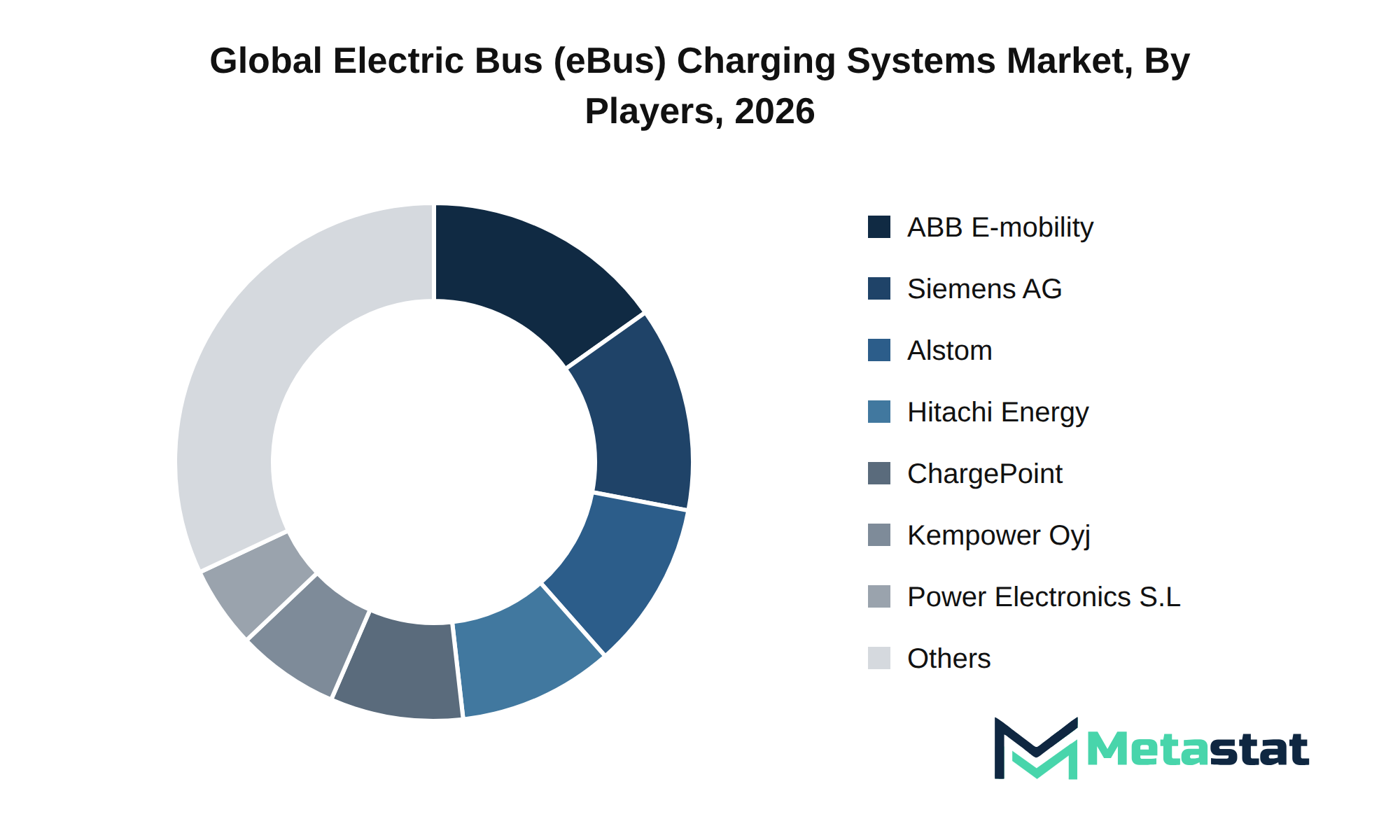
The Electric Bus (eBus) Charging Systems market features a diverse array of players engaged in various strategic initiatives to enhance their market positioning. Companies including Alstom SA, ABB E-mobility, and Siemens AG focus on product differentiation and innovation by developing advanced charging technologies. These firms invest significantly in research and development to establish proprietary technology moats that provide a competitive edge. Strategic alliances and joint ventures among these companies facilitate resource sharing and enhance their capabilities in delivering innovative solutions.
In addition, companies including Hitachi Energy Ltd. and ChargePoint, Inc. leverage established brand equity and customer retention strategies to maintain a strong foothold in the market. The competitive environment is influenced by significant barriers to entry, including technological expertise and high capital investment required for infrastructure development. New entrants face challenges in establishing themselves in a market characterized by established players with deep customer relationships and comprehensive product portfolios.
Future competitive dynamics in the Electric Bus (eBus) Charging Systems market will depend on the ability of companies to adapt to shifting consumer preferences and evolving regulatory landscapes. Firms are expected to explore new commercial models and pricing architectures, ensuring responsiveness to market demands. Companies including Schneider Electric SE and Wabtec Corporation / STEMMANN-TECHNIK GmbH are positioned to capitalize on these trends, contributing to the overall growth and evolution of the market.
Market size is forecast to rise from USD 4.8 million in 2025 to over USD 26.2 million by 2033. This growth reflects a compound annual growth rate (CAGR) of 23.5%, driven by several macroeconomic factors. Increased investment in electric vehicle infrastructure and growing government regulations favoring sustainable transportation lead to heightened demand for Electric Bus (eBus) Charging Systems market solutions.
The base case presents a clear trajectory from USD 4.8 million in 2025 to USD 26.2 million by 2033. A bullish scenario suggests accelerated growth due to rapid advancements in technology, enhanced consumer awareness, and favorable governmental policies supporting electric buses. A bearish outlook arises from geopolitical tensions, supply chain disruptions, or regulatory delays impacting investment and infrastructure expansion.
Consumer preferences shift toward cleaner transportation solutions, aligning with global sustainability goals. Advancements in technology integration and research and development commercialization timelines enhance market potential, creating new opportunities within the Electric Bus (eBus) Charging Systems market. Increased capital allocation to infrastructure commitments, along with strategic investments in high-growth areas, influence adoption rates and market penetration.
Ongoing regulatory evolution, compliance milestones, and policy enforcement horizons shape industry expectations and operational frameworks. Geopolitical realignments and evolving trade corridors impact supply chain dynamics, necessitating adaptation by market players. While the market matures, established companies focus on developing defensibility roadmaps and future growth recommendations to navigate emerging challenges and capitalize on unmet enterprise needs.
The report strategically identifies and profiles the key market players and analyses their core competencies in each sub-segment of the Electric Bus (eBus) Charging Systems market.
Report Attributes | Details |
Study Period | 2021-2033 |
Base Year | 2025 |
Estimated Year | 2026 |
Forecast Period | 2026-2033 |
Historical Period | 2021-2025 |
Growth Rate | CAGR 23.5% from 2026 to 2033 |
Revenue Unit | USD million |
Segmentation | By Charging Technology, Charging Location, Charging Power, and Region |
By Region | North America (By Charging Technology, Charging Location, Charging Power, and Country)
|
Europe (By Charging Technology, Charging Location, Charging Power, and Country)
| |
Asia Pacific (By Charging Technology, Charging Location, Charging Power, and Country)
| |
South America (By Charging Technology, Charging Location, Charging Power, and Country)
| |
Middle East and Africa (By Charging Technology, Charging Location, Charging Power, and Country)
|
Find answers to common questions about this report
The Electric Bus (eBus) Charging Systems market size was valued at USD 4.8 million in 2025, according to the Metastat Insights study.
The Electric Bus (eBus) Charging Systems market is projected to grow at a CAGR of 23.5% during the forecast period from 2026 to 2033.
The North America Electric Bus (eBus) Charging Systems market size is estimated to reach USD 5.2 million by 2033.
The Charging Technology segment leads the Electric Bus (eBus) Charging Systems market, with Plug-in Conductive Charging projected to reach USD 10.3 million by 2033, representing the highest growth within this category.
Rapid digital transformation and advancements in technology drive substantial growth in the Electric Bus (eBus) Charging Systems market. Increased investment in infrastructure development and the need for efficient public transportation solutions, particularly in urban areas, further support market expansion. Enhanced charging capabilities and the integration of digital solutions optimize user experiences and operational efficiencies.
Regulatory frameworks create compliance hurdles that delay the implementation of charging infrastructure, impacting market growth. macroeconomic headwinds, including inflation and supply chain disruptions, increase capital investment requirements and limit opportunities for smaller firms, further restraining market expansion.
Investment in infrastructure development significantly influences product adoption in the Electric Bus (eBus) Charging Systems market. Expanding charging networks, including bus depots and public transit charging hubs, enhances accessibility and usability, aligning with urbanization trends and sustainability goals. Enhanced charging capabilities streamline operations, improving operational productivity and cost efficiencies for electric bus fleets.
The Electric Bus (eBus) Charging Systems market is estimated to reach a valuation of USD 26.2 million by 2033.
Key players operating in the Electric Bus (eBus) Charging Systems market include Alstom SA, ABB E-mobility, Siemens AG, Hitachi Energy Ltd., ChargePoint, Inc., and Schneider Electric SE.
The Plug-in Conductive Charging segment is anticipated to grow at a CAGR of 21.7% from 2026 to 2033, reflecting advancements in charging infrastructure and technology.
The analysts below cover Automotive and Transportation research at Metastat Insights.
LEAD ANALYST
Utkarsh Khirodkar is a Lead Market Research Analyst at MetaStat Insight, specializing in market intelligence, technology sector assessments, and competitive strategy.

ENERGY & INFRASTRUCTURE INDUSTRY CONSULTANT
Automotive and Transportation · Electronics and Semiconductor · Energy and Power · Machinery & Equipment
Saurabh Vasant Ganvir consults for Energy & Infrastructure Industry at MetaStat Insight, specializing in renewable energy, solar EPC, and electric vehicle (EV) infrastructure markets.
Evaluating calorific value requirements and air permit compliance across municipal waste facilities requires localized data. Metastat Insight structured their analysis around operational throughput capacity and feedstock composition variations in Latin America and Eastern Europe. Their competitive mapping of sorting equipment vendors helped clarify technology differences between optical separators and heavy media systems. The study provided an objective baseline during our capital expenditure reviews.
Decarbonizing industrial thermal processes hinges on refrigerant regulations and compressor efficiency limits. Metastat Insights delivered a thorough market analysis that evaluated natural refrigerants like CO2 and hydrocarbons against synthetic low-GWP alternatives. The breakdown of utility incentives and grid capacity constraints across key European manufacturing hubs offered valuable perspective. The follow-up conversation with their sector analysts addressed our specific questions on mechanical vapor recompression systems efficiently.
Assessing 200mm wafer transition schedules and substrate supply bottlenecks requires precise technical intelligence. MetaStat Insight supplied an actionable breakdown comparing planar and trench MOSFET architectures across automotive and industrial drive markets. The regional capacity estimates for Asia-Pacific foundries helped clarify lead-time uncertainties during our strategic planning session. When we needed additional clarification on high-purity raw material sourcing, their analyst team responded with helpful context within twenty-four hours.
Explore related market intelligence reports worth reading alongside this one.
Starting from
$2950
Starting from
$2950
Starting from
$2950