
LEAD ANALYST
Utkarsh Khirodkar is a Lead Market Research Analyst at MetaStat Insight, specializing in market intelligence, technology sector assessments, and competitive strategy.

Enterprise Content Management Market Size, Share, By Deployment Model (On‑Premises, Cloud‑Based, and Hybrid), By Enterprise Size (Small Enterprise, Medium Enterprise, and Large Enterprises), By Application (Document Management, Workflow Management, Records Management, Digital Asset Management, and Others), By End-Use (BFSI, Retail, Consumer Goods, IT, ITeS, Telecommunications, Healthcare, Life Sciences, Manufacturing, Energy, Utilities, and Others), Industry Analysis, Growth, Trends, and Forecast, 2026-2033
Report ID
MSI-4707
Published
April, 2026
Pages
316 Pages
Format
Report Details
Choose Your License
Enterprise Content Management Market
Global Enterprise Content Management market size is valued at USD 52.3 billion in 2025 and projected to grow at a CAGR of 15.1% during the forecast period, reaching USD 160.9 billion by 2033.
North America accounted for 37.7% of the global market in 2025, with the United States leading the regional market.
The On-Premises segment accounted for 42.4% of the global market in 2025.
Key trends driving growth: Regulatory compliance, audit readiness, and records retention requirements along with enterprise digitization, hybrid work collaboration, and process automation priorities.
Opportunities include AI-enabled content intelligence, intelligent capture, and automated classification at scale.
Key insight: Digital governance priorities and AI-led automation redefine content lifecycle strategy across the Global Enterprise Content Management market.
The global Enterprise Content Management market is evolving from a document-centric software category into a strategic information management layer within enterprise software environments. Over the forecast period, the market will move beyond archiving and workflow routing toward broader capabilities such as content governance, process orchestration, enterprise search, and secure collaboration across complex digital ecosystems.
Enterprises are increasingly positioning content platforms as core digital infrastructure rather than passive repositories. Modern ECM solutions are being integrated with analytics, AI, ERP, CRM, and collaboration tools to improve information access, automate classification, and strengthen governance. In highly regulated sectors such as BFSI and healthcare, these platforms are supporting retention management, audit readiness, and secure content lifecycle control.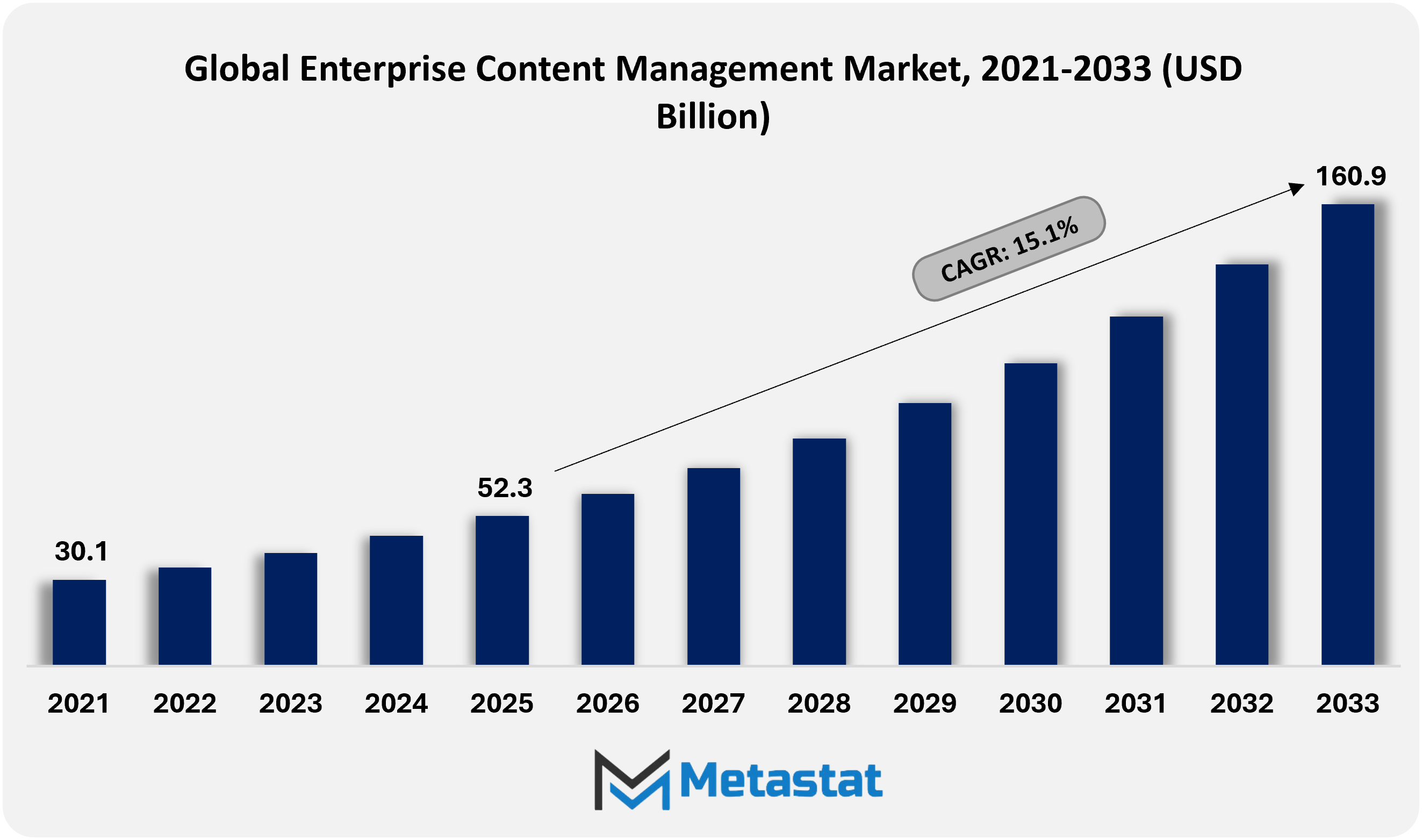
Regulatory compliance, audit readiness, and records retention requirements.
Rising regulatory requirements across BFSI, healthcare, government, and manufacturing are strengthening demand in the global Enterprise Content Management market. Organizations require structured governance frameworks that support audit trails, secure archiving, retention policies, and defensible disposal. Growing scrutiny around data handling and cross-border information flows will further increase reliance on centralized content management platforms.
Enterprise digitization, hybrid work collaboration, and process automation priorities
Ongoing enterprise digitization initiatives are accelerating adoption in the global Enterprise Content Management market. Hybrid work models require secure document access, version control, and collaboration across distributed teams. At the same time, process automation programs are integrating ECM platforms with workflow engines to reduce manual approvals, improve efficiency, and support business continuity across geographically dispersed operations.
Complex migrations, integration burden, and change management friction
Legacy system migration will remain a major challenge for the global Enterprise Content Management market. Large organizations often face difficulties related to data mapping, fragmented archives, inconsistent metadata, and integration with ERP, CRM, and custom applications. Deployment timelines will be extended by user resistance, process redesign requirements, and the need for structured change management and training.
Data privacy, security concerns, and governance gaps across repositories
Heightened cybersecurity risks are increasing scrutiny across the global Enterprise Content Management market. Disconnected repositories and unmanaged storage practices create governance gaps and reduce visibility over sensitive enterprise information. Strong encryption, role-based access controls, monitoring, and policy enforcement are becoming essential to support privacy compliance and reduce the risk of unauthorized access or data leakage.
AI-enabled content intelligence, intelligent capture, and automated classification at scale
AI-enabled content intelligence is creating major growth opportunities in the global Enterprise Content Management market. Advanced tools can improve document discovery, automate metadata tagging, classify content, and extract relevant information from contracts, invoices, correspondence, and other enterprise records. Intelligent capture and automated classification reduce manual effort, improve retrieval speed, and enhance enterprise-wide knowledge utilization.
The Global Enterprise Content Management market is classified based on Deployment Model, Enterprise Size, Application, and End-Use.
On‑Premises segment is valued at USD 25.5 billion in 2026 and is projected to reach USD 46.6 billion by 2033, at a CAGR of 9% during the forecast period.
On-Premises deployment will remain relevant in the global Enterprise Content Management market among organizations that require full control over infrastructure, data governance, and compliance-sensitive environments. Adoption will remain strong in institutions handling confidential information, where dedicated infrastructure, customized integration, and direct oversight support security and operational control.
Cloud‑Based segment is valued at USD 25.7 billion in 2026 and is projected to reach USD 87.2 billion by 2033, at a CAGR of 19.1% during the forecast period.
Cloud-Based solutions in the global Enterprise Content Management market will expand rapidly owing to scalability, subscription flexibility, and remote accessibility. Enterprises seeking cost efficiency and faster deployment are increasingly adopting cloud platforms that support collaboration, continuous updates, AI-enabled indexing, and integration across multiple business functions.
Hybrid segment is valued at USD 8.9 billion in 2026 and is projected to reach USD 27.1 billion by 2033, at a CAGR of 17.3% during the forecast period.
Hybrid deployment will gain strong momentum in the Global Enterprise Content Management market through the balanced use of on-premises infrastructure and cloud capabilities. Enterprises pursuing flexibility can retain sensitive data within internal environments while using cloud modules for collaboration, analytics, and workflow automation. This model supports phased modernization and reduces disruption to existing legacy systems.
Small and Medium Enterprise (SMEs) segment is projected to reach USD 68.5 billion by 2033, at a CAGR of 17.4% during the forecast period.
Small and Medium Enterprises will increase their participation in the Global Enterprise Content Management market owing to cost-effective subscription models, lower implementation complexity, and easier access to cloud-based tools. Digital documentation, centralized content storage, and automated approval workflows are helping SMEs improve operational efficiency while supporting scalable business growth.
Large Enterprises segment is projected to reach USD 92.4 billion by 2033, at a CAGR of 13.6% during the forecast period.
Large Enterprises will continue to represent a major share of the Global Enterprise Content Management market owing to their high document volumes, multi-location operations, and strict governance requirements. These organizations are investing in enterprise-wide platforms that support advanced security, compliance monitoring, analytics, and integration with core business systems to improve visibility and control across global operations.
Document Management segment is projected to reach USD 42.8 billion by 2033.
Document Management remains a core application area in the Global Enterprise Content Management market, supported by growing demand for secure storage, structured retrieval, and intelligent indexing. AI-assisted tagging, search functionality, and digital conversion of paper-based records are improving accessibility while helping organizations manage expanding content volumes more efficiently.
Workflow Management segment is projected to reach USD 44.5 billion by 2033.
Workflow Management is gaining importance in the Global Enterprise Content Management market as organizations seek to automate approvals, document routing, and process monitoring. Integrated workflow tools improve transparency, reduce manual intervention, and strengthen accountability by providing real-time visibility into content movement across departments and business functions.
Records Management segment is projected to reach USD 29.9 billion by 2033.
Records Management continues to play a critical role in the Global Enterprise Content Management market, particularly in industries with strict compliance and retention obligations. Automated lifecycle tracking, secure archival systems, and policy-based disposal mechanisms are helping organizations manage legal, financial, and operational records with greater control and consistency.
Digital Asset Management segment is projected to reach USD 30.2 billion by 2033.
Digital Asset Management is expanding within the Global Enterprise Content Management market owing to the rising volume of multimedia content used across marketing, training, product design, and brand communications. Centralized asset libraries with version control, rights management, and metadata organization are supporting faster content access and better coordination across teams.
Others segment is projected to reach USD 13.6 billion by 2033.
Other application areas in the Global Enterprise Content Management market include knowledge portals, e-discovery platforms, and collaborative content environments. These solutions are gaining traction as organizations seek stronger visibility into unstructured information and broader support for enterprise-wide digital transformation initiatives.
BFSI segment is projected to grow at a CAGR of 14.2% during the forecast period.
BFSI remains a major end-use segment in the Global Enterprise Content Management market owing to high documentation intensity, regulatory oversight, and the need for secure content governance. Financial institutions are adopting ECM solutions to strengthen archival control, support audit readiness, improve claims and loan documentation workflows, and reduce compliance risk.
Retail & Consumer Goods segment is projected to grow at a CAGR of 15% during the forecast period.
Retail & Consumer Goods adoption in the Global Enterprise Content Management market is increasing through growing needs for supplier documentation, product content management, pricing records, and marketing asset coordination. ECM platforms help improve visibility across omnichannel operations while supporting faster access to critical documents across distributed retail networks.
IT & ITeS segment is projected to grow at a CAGR of 16.5% during the forecast period.
IT & ITeS organizations are expanding their use of ECM platforms to manage project files, service contracts, knowledge repositories, and internal process documentation. Integration with collaboration tools and business applications supports more structured information exchange across global delivery centers and improves service execution efficiency.
Telecommunications segment is projected to grow at a CAGR of 16.2% during the forecast period.
Telecommunications companies are using ECM solutions to manage subscriber records, compliance documentation, infrastructure files, and service-related content across high-volume operating environments. Automation capabilities are helping improve processing speed, reduce administrative burden, and strengthen continuity across network and customer service operations.
Healthcare & Life Sciences segment is projected to grow at a CAGR of 17.7% during the forecast period.
Healthcare & Life Sciences will record strong growth in the Global Enterprise Content Management market owing to rising demand for secure document handling, clinical content tracking, digital health record integration, and regulatory compliance support. Controlled access, secure storage, and structured workflows are becoming increasingly important across healthcare delivery and research environments.
Manufacturing segment is projected to grow at a CAGR of 14.7% during the forecast period.
Manufacturing companies are adopting ECM solutions to manage production manuals, quality documents, supplier agreements, and technical records across complex operations. Better access to structured documentation supports product lifecycle management, improves operational accuracy, and strengthens coordination across facilities and supply chains.
Energy & Utilities segment is projected to grow at a CAGR of 13.7% during the forecast period.
Energy & Utilities organizations are increasing ECM adoption to support asset documentation, compliance reporting, maintenance records, and long-term infrastructure planning. Digital content platforms improve inspection readiness, strengthen information access across field and office teams, and support more efficient document governance across critical assets.
Others segment is projected to grow at a CAGR of 11.4% during the forecast period.
Other end-use sectors in the Global Enterprise Content Management market include education, government administration, and professional services. These sectors are adopting ECM platforms to improve digital recordkeeping, automate document-heavy workflows, and strengthen governance across high-volume administrative environments.
Based on geography, the Global Enterprise Content Management market is divided into North America, Europe, Asia-Pacific, South America, Middle East, and Africa.
North America Enterprise Content Management Market is set to expand at a CAGR of 15.1% within the forecast period, reaching a market size (TAM) of USD 51.6 billion by the end of 2033.
North America will maintain a leading position in the Enterprise Content Management market owing to strong enterprise software adoption, strict regulatory requirements, and high investments in digital transformation.
In Europe, rising demand for compliance-driven automation, process optimization, and AI-enabled enterprise workflows is supporting steady growth in the Intelligent Automation market.
Asia Pacific is emerging as a high-growth region in the Enterprise Content Management market owing to expanding digital transformation programs, rising enterprise software spending, and rapid modernization across developing economies.
Across the Middle East, Africa, and South America, growing government digitization applications and improving corporation IT infrastructure reinforce long-term potentialities for Enterprise Content Management adoption.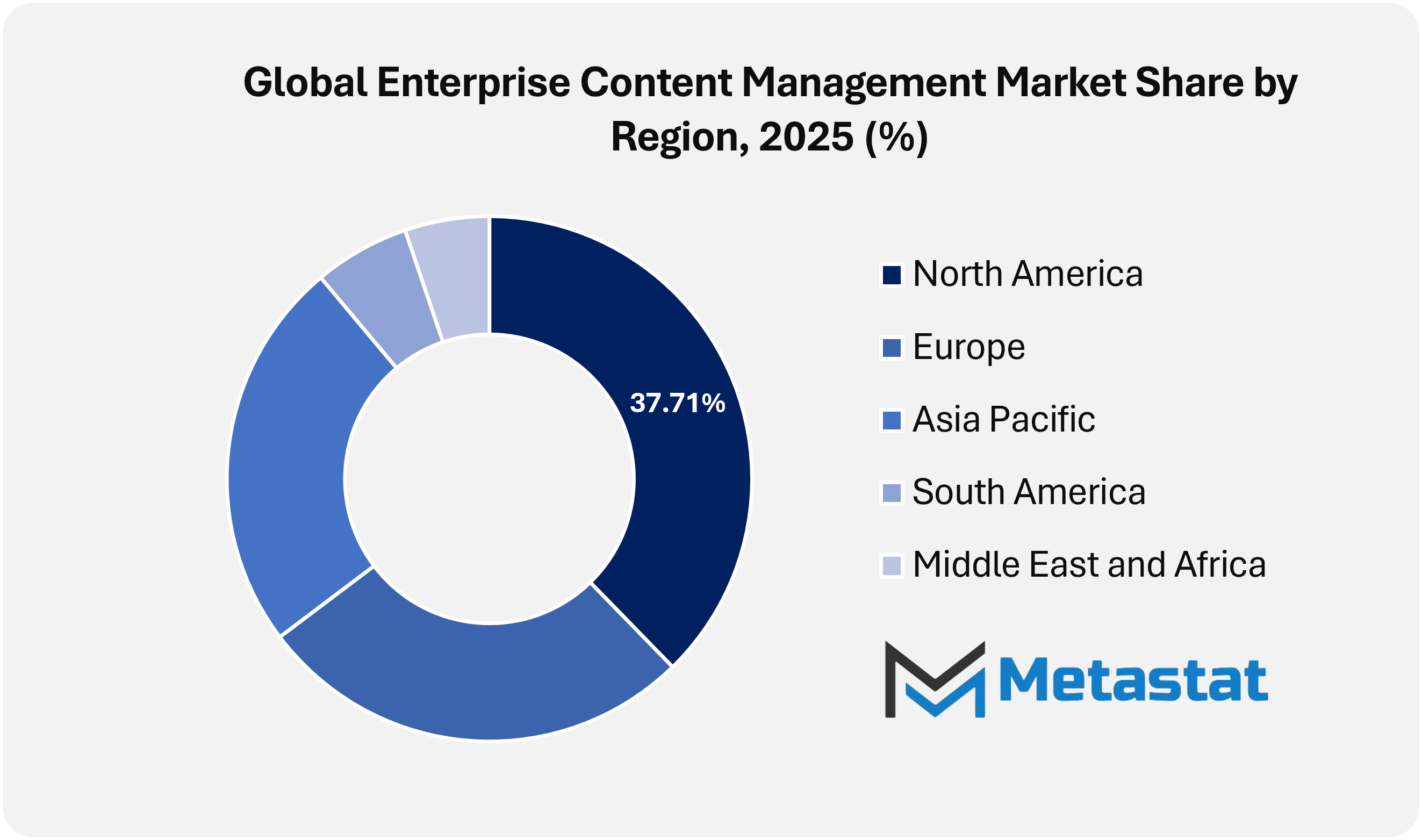
The Global Enterprise Content Management market is expanding steadily as organizations manage increasing volumes of digital content alongside stricter compliance and governance requirements. Enterprises today handle a wide range of content including emails, contracts, invoices, customer data, images, and internal documentation across multiple systems and geographies. Enterprise Content Management platforms are enabling centralized control by consolidating this content into structured environments that support secure storage, advanced search, controlled access, and seamless sharing. Increased focus on productivity improvement, workflow efficiency, and data security continues to drive adoption across industries such as BFSI, healthcare, government, manufacturing, and retail.
The competitive environment is being reshaped by rapid cloud adoption and the transition toward hybrid deployment models. Organizations are increasingly shifting from traditional on-premises systems to cloud-based platforms owing to scalability, remote accessibility, and lower infrastructure overhead. At the same time, hybrid models are gaining traction in sectors requiring high data sensitivity and regulatory compliance. Automation capabilities embedded within Enterprise Content Management platforms are streamlining document workflows, compliance tracking, and records retention processes. Artificial intelligence and machine learning are further enhancing value through automated classification, metadata tagging, and intelligent data extraction, reducing manual effort and improving operational accuracy.
The Global Enterprise Content Management market features a strong competitive landscape with a mix of established technology leaders and specialized solution providers continuously expanding their capabilities. Key players include OpenText Corporation, Hyland Software, Inc., IBM Corporation, Crown Information Management, Box, Inc., Laserfiche, Inc., M-Files Corporation, DocuWare GmbH, Newgen Software Technologies Limited, Sitecore Holding II A/S, Objective Corporation Limited, ELO Digital Office GmbH, Xerox Corporation, Canon Inc., Oracle Corporation, SAP SE, HCL Technologies Limited, Egnyte, Inc., Atlassian Corporation Plc, OpenKM, S.L., iManage LLC, NetDocuments, Inc., Veeva Systems Inc., Konica Minolta Business Solutions India Pvt. Ltd., d.velop AG, Upland Software, Inc., Square 9 Softworks, Inc., Ricoh Company, Ltd., KnowledgeLake, and Crownpeak Technology, Inc. These companies are actively investing in product innovation, AI integration, cloud capabilities, partnerships, and geographic expansion to strengthen their presence across both developed and emerging markets.
Adoption among small and medium enterprises is increasing significantly as cost-effective subscription models and cloud-based deployment reduce entry barriers. While large enterprises have historically dominated the market owing to higher budgets and complex document management needs, SMEs are now accelerating adoption through scalable and easy-to-deploy solutions. Integration with collaboration tools and enterprise applications such as ERP and CRM systems is further enhancing platform value and usability. Over the forecast period, the Global Enterprise Content Management market will remain closely aligned with enterprise digital transformation initiatives, with organizations prioritizing secure content access, regulatory compliance, workflow automation, and efficient data governance as critical business objectives.
Market size is forecast to rise from USD 52.3 billion in 2025 to over USD 160.9 billion by 2033.
Future market development will be shaped by data sovereignty requirements, privacy regulations, AI governance standards, and broader enterprise modernization efforts. Vendors are expected to invest in localized hosting models, policy-based governance controls, intelligent automation, and transparent AI capabilities for classification, retrieval, and decision support. Over time, ECM will evolve into a core digital infrastructure layer that supports secure information flow, regulatory alignment, and enterprise-wide knowledge utilization.
This research report categorizes the Enterprise Content Management market based on key segments and regions, forecasts revenue growth, and analyses trends in each submarket. The report analyses the key growth drivers, opportunities, and challenges influencing the Enterprise Content Management market. Recent market developments and competitive strategies such as expansion, product launch, partnership, merger, and acquisition have been included to draw the competitive landscape in the market.
The report strategically identifies and profiles the key market players and analyses their core competencies in each sub-segment of the Enterprise Content Management market.
|
Report Attributes |
Details |
|
Study Period |
2021-2033 |
|
Base Year |
2025 |
|
Estimated Year |
2026 |
|
Forecast Period |
2026-2033 |
|
Historical Period |
2021-2025 |
|
Growth Rate |
CAGR 15.1% from 2026 to 2033 |
|
Revenue Unit |
USD billion |
|
Segmentation |
By Deployment Model, Enterprise Size, Application, End-Use, and Region |
|
By Region |
North America (By Deployment Model, Enterprise Size, Application, End-Use, and Country)
|
|
Europe (By Deployment Model, Enterprise Size, Application, End-Use, and Country)
|
|
|
Asia Pacific (By Deployment Model, Enterprise Size, Application, End-Use, and Country)
|
|
|
South America (By Deployment Model, Enterprise Size, Application, End-Use, and Country)
|
|
|
Middle East and Africa (By Deployment Model, Enterprise Size, Application, End-Use, and Country)
|
Find answers to common questions about this report
Top players operating in the Enterprise Content Management industry include OpenText Corporation, Hyland Software, Inc., IBM Corporation, Crown Information Management, Box, Inc., Laserfiche, Inc., and M-Files Corporation.
Global Enterprise Content Management market is estimated to reach USD 160.9 billion by 2033.
Complex migrations, integration burden, and change management friction will hamper the market growth within the forecast period.
Regulatory compliance, audit readiness, and records retention requirements and Enterprise digitization, hybrid work collaboration, and process automation priorities are key driving factors, boosting the market.
The Metastat Insights analysis shows that the North America Enterprise Content Management market size is estimated to be USD 51.6 billion by 2033.
The Metastat Insights study shows that the Global Enterprise Content Management market size was USD 52.3 billion in 2025.
The On‑Premises is the leading type segment in the Global market.
The Global Enterprise Content Management market is expected to grow at a CAGR of 15.1% over the forecast period (2026-2033).
The analysts below cover Information & Technology research at Metastat Insights.
LEAD ANALYST
Utkarsh Khirodkar is a Lead Market Research Analyst at MetaStat Insight, specializing in market intelligence, technology sector assessments, and competitive strategy.

PRINCIPAL CONSULTANT - ENTERPRISE AI & EMERGING TECHNOLOGIES
Banking & Finance · Electronics and Semiconductor · Energy and Power · Healthcare IT · Information & Technology · Professional Services
Vijay Gunti is a Principal Consultant at MetaStat Insight, bringing over two decades of experience across enterprise digital transformation, technology strategy, and intelligent systems.

LEAD CONSULTANT - COMMUNICATION, TELECOM, AND IT
Electronics and Semiconductor · Information & Technology · Machinery & Equipment · Professional Services
Ravindra Sathe Consultants for Communication, Telecom, and IT at MetaStat Insight. He leads the firm's industry research initiatives across telecommunications infrastructure, digital connectivity, enterprise networking, and emerging information technology domains.
Ambulatory surgical centers have very different purchasing cycles for robotic-assisted surgery platforms than major hospital networks. The MetaStat Insight study focused squarely on capital expenditure depreciation, procedural reimbursement pathways, and surgeon training overhead. That operational clarity made it much simpler to validate multi-year procedure growth forecasts against actual ambulatory center adoption patterns.
When planning edge sensor rollouts across refinery environments, generic IoT reports typically miss the harsh-environment certification bottlenecks. MetaStat Insight gave an objective evaluation of ATEX and Class 1 Division 2 hardware availability, along with realistic five-year maintenance cycle cost projections. The comparison of wireless mesh versus private cellular backhaul helped our team pressure-test network reliability models for remote processing facilities.
In the biological seed treatment space, registration timelines vary drastically between the European Union, Brazil, and North America. The MetaStat Insight research handled these cross-border regulatory barriers with genuine nuance, mapping commercialization pathways alongside historical field adoption rates. The segmentation between microbial strains and biochemical active ingredients was particularly well structured.
Explore related market intelligence reports worth reading alongside this one.