Global Automotive Headlight Bulb Market Size, Share, By Light Source Technology (Halogen, Xenon / HID, LED Retrofit Bulbs), By Vehicle Type (Passenger Cars, Light Commercial Vehicles, Medium & Heavy Commercial Vehicles, Motorcycles & Scooters, Others (Three-Wheelers, ATVs / UTVs, Specialty Vehicles)), By Sales Channel (OEM and Aftermarket), Industry Analysis, Growth, Trends, and Forecast, 2026-2033
Report ID
MSI-4943
Published
August 17, 2026
Pages
308 Pages
Format
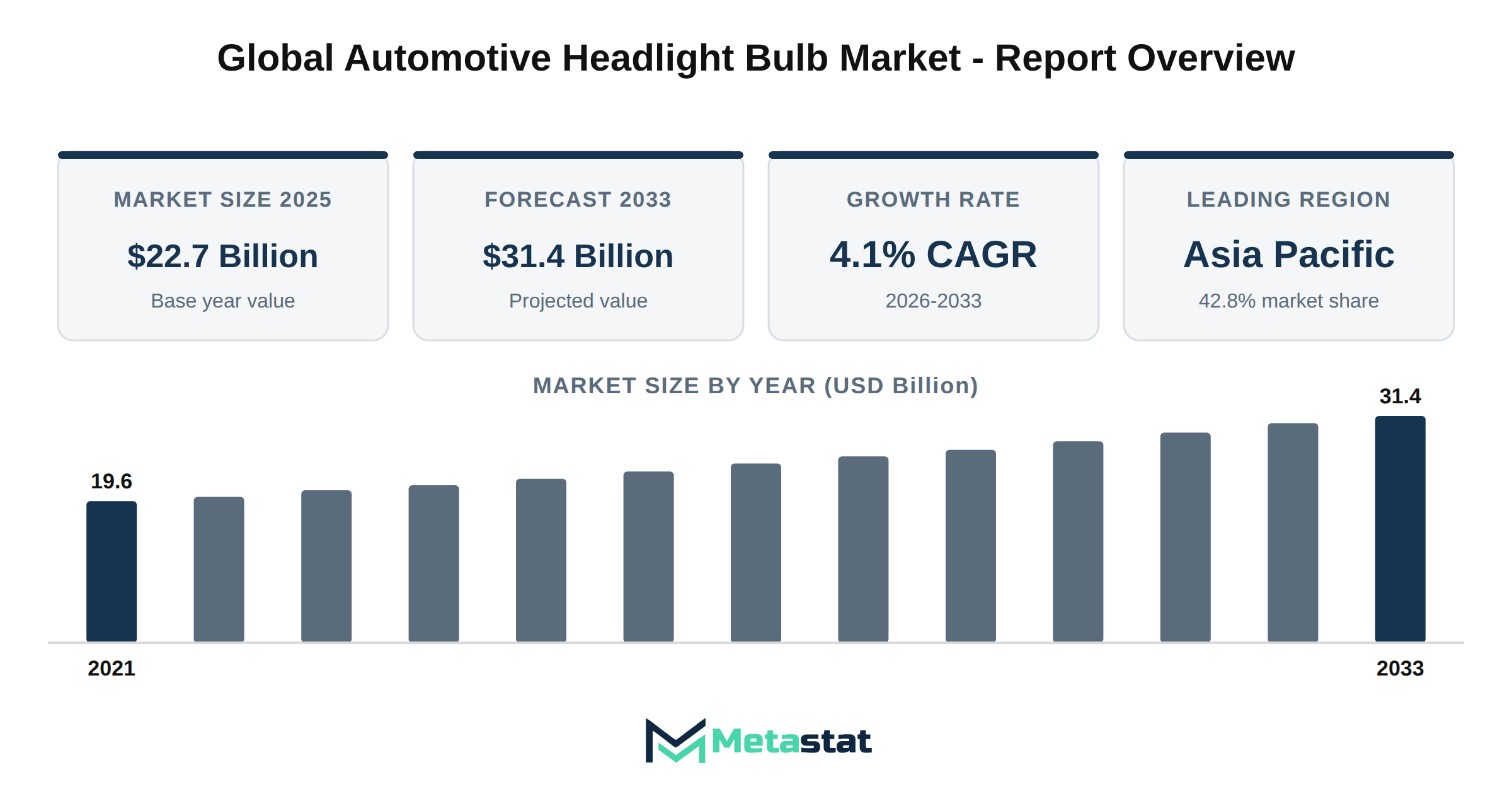
Market Size 2021
$19.6 Billion
Historical
Market Size 2025
$22.7 Billion
Base year
Market Size 2033
$31.4 Billion
Forecast
CAGR 2025-2033
4.1%
Forecast period
Report Details
Comprehensive Market Analysis And Insights
Market Overview
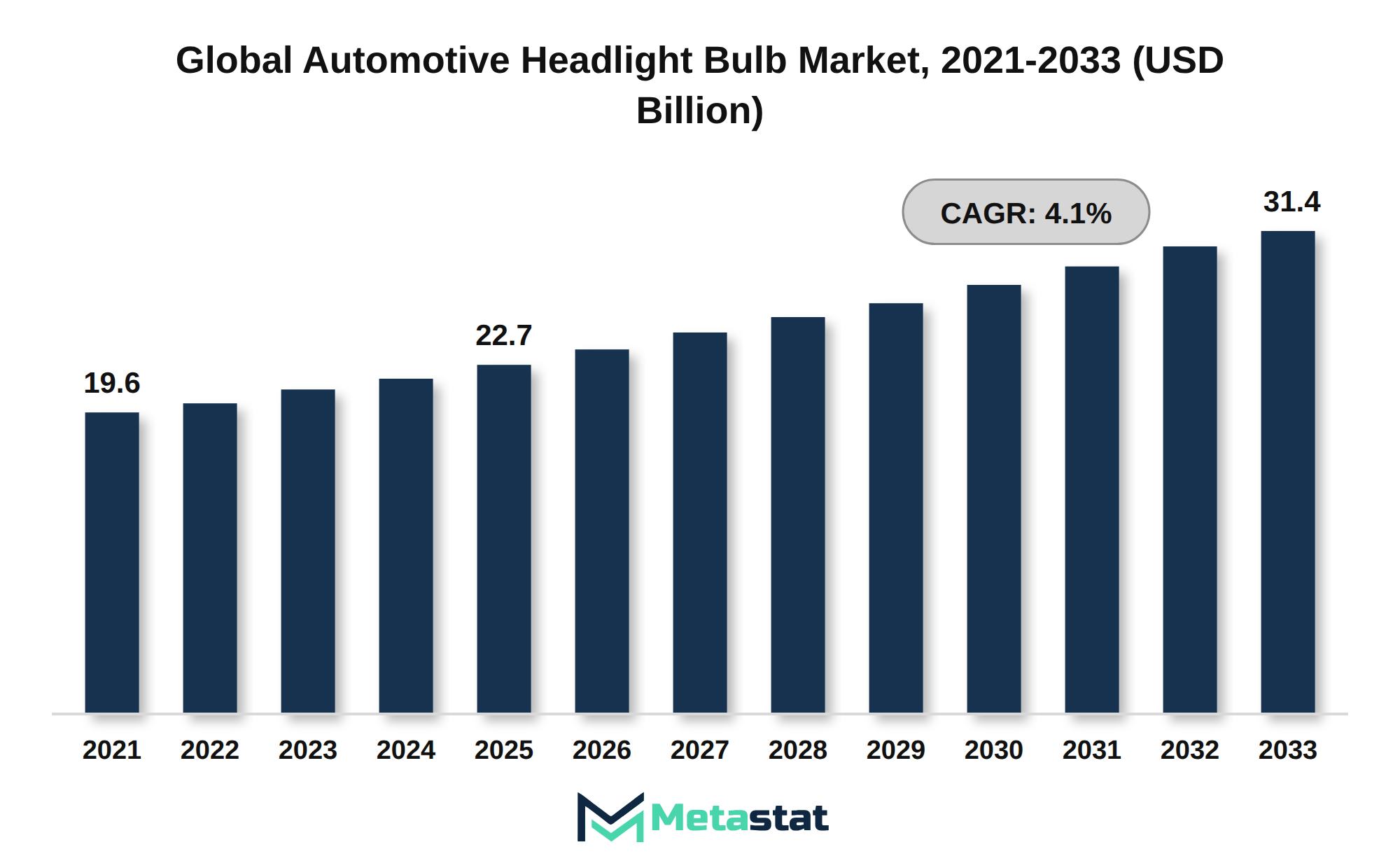
The global Automotive Headlight Bulb market was valued at USD 22.7 billion in 2025 and is projected to reach USD 31.4 billion by 2033, growing at a CAGR of 4.1% over the forecast period.
The Automotive Headlight Bulb market reached USD 22.7 billion in 2025, following a historical value of USD 19.6 billion in 2021. The market is projected to grow significantly, with an estimated value of USD 31.4 billion by 2033. This growth reflects a compound annual growth rate (CAGR) of 4.1% from 2026 to 2033.
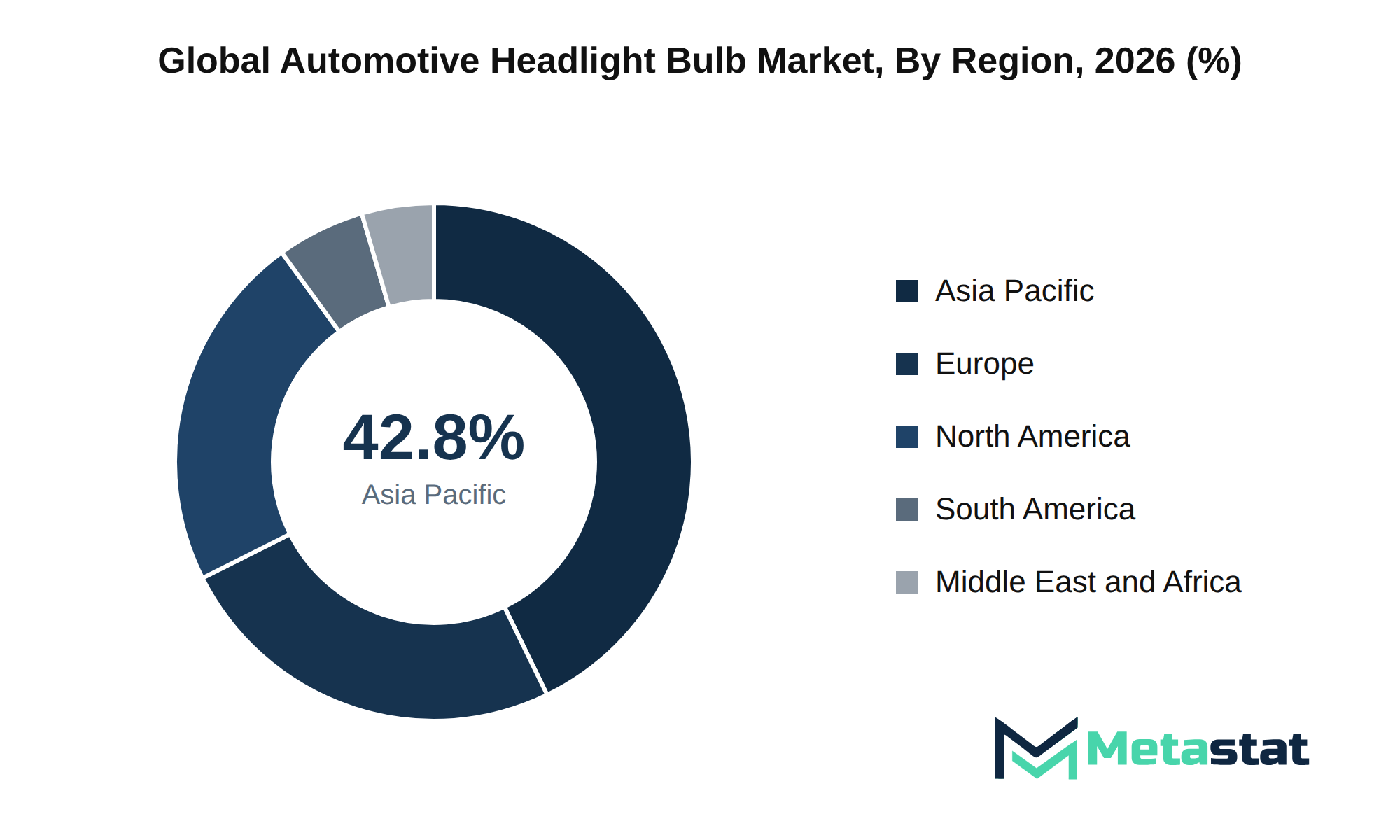
Regional distribution of the market shows Asia Pacific holding the largest share at 42.8%, followed by Europe at 24.8% and North America at 22.4%. South America and the Middle East and Africa represent smaller shares, accounting for 5.5% and 4.5%, respectively. By 2033, North America is expected to generate a value of USD 6.7 billion, maintaining its growth trajectory.
The market segments into various light source technologies, including Halogen, Xenon / HID, and LED Retrofit Bulbs. Halogen technology, while currently substantial, is projected to decrease from USD 13.4 billion in 2026 to USD 11.9 billion by 2033. In contrast, LED Retrofit Bulbs are anticipated to experience growth, reaching USD 16.3 billion by 2033.
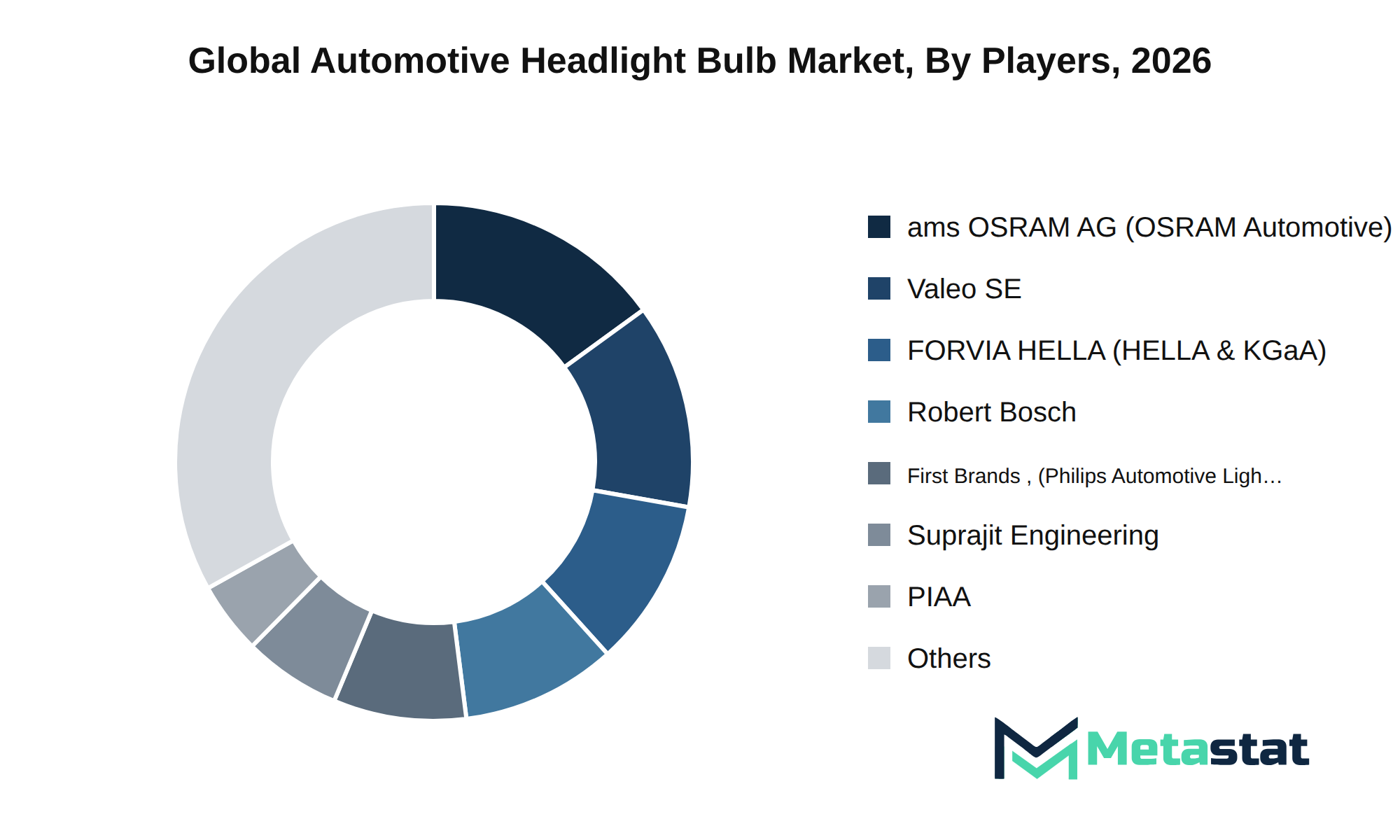
Competition in the Automotive Headlight Bulb market involves several key players, including ams OSRAM AG, First Brands Group, LLC, FORVIA HELLA, Robert Bosch GmbH, Valeo SE, and Suprajit Engineering Limited. These companies influence the market's dynamic environment through innovation and product differentiation, responding to evolving consumer preferences and regulatory standards.
The Automotive Headlight Bulb market experiences significant transformations driven by evolving consumer preferences and technological advancements. Demand for high-efficiency lighting solutions, including LED retrofit bulbs, is rising. These products offer longer lifespans and lower energy consumption compared to traditional halogen bulbs. The shift towards LED technology reflects a broader trend within the automotive sector, focusing on energy efficiency and sustainability.
Regulatory compliance plays a critical role in shaping the market landscape. Stricter regulations regarding vehicle emissions and energy consumption compel manufacturers to innovate and adapt their product offerings. This environment encourages competition among industry players striving to meet compliance standards while enhancing performance attributes. Continuous investment in research and development is crucial for companies aiming to maintain a competitive edge in this dynamic market.
The supply chain landscape faces challenges due to geopolitical risks and inflationary pressures. Fluctuating raw material costs and supply chain disruptions hinder production timelines and increase operational costs. Manufacturers explore alternative sourcing strategies to mitigate these risks while ensuring product quality and availability. This proactive approach enhances resilience within the supply chain and supports market stability.
The future strategic outlook for the Automotive Headlight Bulb market emphasizes innovation and customer-centric approaches. Companies are expected to allocate capital towards developing next-generation lighting technologies that align with consumer demands for safety and efficiency. Investment in infrastructure and production capabilities will facilitate growth and enhance market penetration. Overall, the market exhibits a trajectory of gradual expansion, driven by technological advancements and evolving consumer expectations.
Market Dynamics
Capital investment drives headlight bulb innovation
The Automotive Headlight Bulb market experiences growth driven by increased capital investment across various sectors. Investments in infrastructure development and technological integration play a crucial role in enhancing production capabilities and improving product offerings. Strong economic performance, particularly in emerging markets, directly impacts the demand for automobiles, subsequently boosting the need for advanced headlight bulb technologies.
Technological advancements, particularly in light source technology including LED Retrofit Bulbs, contribute significantly to product innovation. Enhanced performance and energy efficiency of these bulbs attract consumers seeking improved vehicle safety and sustainability. The market's growth trajectory is further supported by rising consumer awareness regarding vehicle lighting and its impact on safety standards.
Investment in research and development drives innovation in the Automotive Headlight Bulb market. Companies focus on developing new products that align with evolving consumer preferences and regulatory requirements. Increased funding for R&D initiatives has the potential to yield innovative solutions, improving the overall market for headlight bulbs.
While global markets continue to rebound, capital investment in the automotive sector is projected to strengthen. This environment enables manufacturers to explore new market opportunities and expand their product portfolios. Overall, robust capital investment drives advancements in technology and product development, reinforcing growth in the Automotive Headlight Bulb market over the forecast period.
The integration of advanced technologies significantly influences the Automotive Headlight Bulb market. Enhanced automation and the adoption of artificial intelligence streamline production processes, leading to increased efficiency and reduced costs. This integration supports manufacturers in responding swiftly to evolving consumer demands, ultimately driving market growth. Digitization of legacy processes enables companies to optimize operations, improve product quality, and accelerate time-to-market for new innovations.
The rise of smart automotive technologies increases demand for high-performance headlight solutions. Modern vehicles incorporate advanced lighting systems that enhance safety and visibility. This shift reflects changing consumer behaviors and buying preferences, particularly among younger demographics who prioritize both aesthetics and functionality in automotive features. Suppliers investing in research and development to create innovative lighting solutions position themselves advantageously within the market.
The market benefits from growing investments in infrastructure development and asset modernization. Upgraded facilities and enhanced network capabilities expand production capacity and improve supply chain resilience. This modernization aligns with global trends favoring sustainable and energy-efficient automotive lighting solutions, appealing to environmentally conscious consumers. The Automotive Headlight Bulb market experiences growth driven by technological advancements shaping both production and consumer preferences.
Regulatory compliance limits market flexibility
The Automotive Headlight Bulb market faces significant constraints due to stringent regulatory compliance requirements. These regulations necessitate extensive testing and certification processes, delaying product launches and increasing operational costs. Suppliers and manufacturers absorb these costs, which affects profit margins and overall market competitiveness.
Macroeconomic factors including inflationary pressures exert further strain on the market. Increased costs of raw materials and components result in higher prices for end consumers, leading to reduced demand for new vehicles equipped with advanced headlight technologies. This dynamic influences the purchasing decisions of consumers and fleet operators.
Supply chain disruptions stemming from geopolitical instability significantly impact the availability of critical components for headlight production. This situation creates bottlenecks that hinder the timely delivery of products to market, complicating compliance with regulatory timelines. The cumulative effect of these challenges stifles innovation and limits growth opportunities within the Automotive Headlight Bulb market.
The Automotive Headlight Bulb market experiences challenges from geopolitical tensions that disrupt supply chains and affect access to raw materials. Trade deficits and tariff friction exacerbate these issues, leading to increased costs for manufacturers and potential shortages in critical components. These factors complicate the procurement process, creating barriers for firms attempting to maintain production efficiency.
Technological disruptions contribute to market instability, driven by rapid advancements that necessitate complex research and development integrations. Firms face pressures to innovate while managing rising input costs and pricing compression. This situation creates a challenging environment where maintaining profit margins becomes increasingly difficult.
The need for compliance with tightening global regulatory standards introduces additional overhead that firms navigate. Evolving legal liabilities around environmental issues and sustainability demands shape operational strategies, forcing companies to invest in new technologies while addressing skill gaps in the workforce. These pressures contribute to a volatile market, complicating the ability of firms to meet downstream demands effectively.
In light of these challenges, market players develop strategies to enhance resilience. Addressing supply chain vulnerabilities and adapting to shifting demands play crucial roles in ensuring long-term success in the Automotive Headlight Bulb market. Companies that effectively manage these complexities position themselves favorably in a competitive marketplace.
Emerging regional demands drive market growth
Market opportunity
Growth in the Automotive Headlight Bulb market stems from emerging regional demands, particularly in Asia Pacific, where increasing vehicle production and rising disposable incomes create significant opportunities. The demand for headlight bulbs in this region reflects a strong push towards modern vehicle technologies and improved safety standards, prompting manufacturers to innovate and expand their product offerings. Geographical expansion in developing economies enhances market penetration, leading to increased revenue streams.
Modernization of infrastructure across various regions drives the need for advanced automotive components, including headlight bulbs. Investments in transportation infrastructure align with the growing trend of vehicle electrification, creating higher demand for energy-efficient lighting solutions. Technological disruptions, including the rise of LED retrofit bulbs, position the market favorably to meet contemporary consumer preferences for sustainability and efficiency.
Digital transformation and evolving buying behaviors influence purchasing patterns in the Automotive Headlight Bulb market. The shift towards digital procurement models enables suppliers to reach customers more efficiently, enhancing competitiveness. Strategic consolidation among key players creates partnerships that encourage innovations and streamline operations. This consolidation allows firms to diversify their product portfolios and invest in niche applications, including smart lighting systems.
Environmental sustainability imperatives shape the market landscape, driven by consumers and businesses prioritizing eco-friendly solutions. Manufacturers aligning their products with green transformations enhance their market appeal, creating a competitive advantage. Asset life-cycle extensions through maintenance upgrades and retrofitting solutions contribute to long-term customer satisfaction and loyalty, ensuring consistent demand within the market.
Overall, the Automotive Headlight Bulb market is poised for growth driven by these multifaceted opportunities. Stakeholders who capitalize on emerging demands, technological advancements, and sustainable practices will likely strengthen their market position and achieve significant success in the coming years.
Market Segmentation Analysis
The Global Automotive Headlight Bulb market is segmented based on Light Source Technology, Vehicle Type, and Sales Channel.
By Light Source Technology, the market is further segmented into:
Halogen
Xenon / HID
LED Retrofit Bulbs
Halogen
Valued at USD 13.4 billion in 2026, the Halogen segment is projected to reach USD 11.9 billion by 2033, reflecting a CAGR of -1.6% during the forecast period. This decline in valuation stems from various factors influencing demand dynamics in the Automotive Headlight Bulb market. Traditional halogen bulbs, while still prevalent, face increasing competition from LED and xenon technologies, which offer greater energy efficiency and durability. Shifting consumer preferences towards these advanced lighting solutions drive manufacturers to innovate and adapt their product offerings.
Technological maturation influences this segment's evolution. Halogen technology, having reached its peak, experiences fewer advancements compared to LED and HID counterparts. Regulatory compliance standards increasingly favor energy-efficient lighting options, further constraining the growth of halogen bulbs. Manufacturers navigate this landscape by enhancing the features of their halogen products to maintain market relevance.
Cost structures associated with halogen production involve raw material sourcing and manufacturing processes that contribute to pricing volatility. While halogen bulbs remain cost-effective compared to advanced alternatives, fluctuations in raw material prices impact profit margins. Despite these challenges, opportunities exist for strategic investments aimed at optimizing production efficiencies and enhancing product appeal within the Automotive Headlight Bulb market.
Xenon / HID
Xenon / HID segment is estimated to reach USD 3.1 billion by 2033, at a CAGR of -1.9% during the forecast period. The declining growth rate results from a shift in consumer preferences toward more energy-efficient technologies, particularly LED retrofit bulbs. Automotive manufacturers increasingly focus on LED solutions due to their longer lifespan and lower energy consumption, which influences purchasing decisions across various vehicle types. OEMs and aftermarket suppliers face pressure to enhance product offerings to meet rising regulatory standards for energy efficiency and sustainability, impacting the demand for Xenon / HID products.
Technological maturation in the segment leads to increased competition. Innovations in LED technology directly affect the attractiveness of Xenon / HID lighting options, presenting challenges for manufacturers relying on traditional light sources. Meanwhile, cost structures around Xenon / HID production remain under scrutiny due to fluctuations in raw material prices and production costs, impacting profit margins. Suppliers in the segment adapt to these evolving dynamics to maintain relevance in the wider Automotive Headlight Bulb market.
LED Retrofit Bulbs
In the Automotive Headlight Bulb market, the LED Retrofit Bulbs segment demonstrates a strong growth trajectory driven by increasing consumer demand for energy-efficient lighting solutions. Factors including heightened awareness of environmental sustainability and governmental initiatives promoting energy-efficient technologies fuel this demand. While consumers seek to enhance their vehicles with modern lighting solutions, adoption rates of LED technology have surged among automotive manufacturers and aftermarket suppliers.
Growth of this segment is expected to be supported by advancements in LED technology, including improved brightness and color rendering, which enhance vehicle safety and aesthetics. These innovations attract both vehicle manufacturers and consumers, leading to a steady increase in market penetration. The segment's growth is driven by a growing trend toward vehicle customization, where LED Retrofit Bulbs serve because a popular upgrade.
LED Retrofit Bulbs segment is expected to reach USD 16.3 billion by 2033. This significant figure highlights the anticipated expansion within the Automotive Headlight Bulb market, reflecting the ongoing shift towards LED solutions. Regulatory compliance standards play a role in promoting LED adoption, because stricter emissions regulations encourage the shift from traditional halogen bulbs to more efficient alternatives.
Challenges remain, including pricing volatility and margin pressures linked to raw material sourcing. However, the strategic opportunity windows arising from technological maturation and evolving consumer preferences present avenues for capital investment. The upcoming years will likely feature continuous innovations and enhancements in LED technologies, further reinforcing their position within the Automotive Headlight Bulb market.
By Vehicle Type, the market is further segmented into:
Passenger cars represent a significant segment within the Automotive Headlight Bulb market, driven primarily by consumer preferences for enhanced visibility and safety features. Rising demand for energy-efficient lighting technologies has pushed manufacturers to innovate, resulting in a shift towards LED retrofit bulbs. These advanced lighting solutions provide improved illumination while consuming less power, appealing to environmentally conscious consumers.
Technological maturation plays a critical role in segment dynamics, with ongoing advancements in LED and Xenon/HID technologies enhancing performance and longevity. The focus on next-generation upgrades fuels competition among manufacturers, encouraging continuous product evolution and the introduction of high-performance options tailored to specific consumer needs.
Regulatory compliance standards increasingly influence design and manufacturing processes, pushing companies to align their products with stringent safety and environmental regulations. This regulatory landscape creates challenges and opportunities, because compliance results in higher production costs. Nevertheless, adherence to these standards enhances consumer trust, positively impacting sales.
Consumption shifts in the automotive sector demonstrate a growing preference for advanced lighting solutions amid a backdrop of heightened safety awareness among drivers. Consumers prioritize features including adaptive lighting and improved glare control, driving demand for innovative headlight technologies. This trend is expected to support market growth, with manufacturers keenly focusing on delivering advanced products to meet evolving consumer expectations.
Strategic opportunity windows exist for players seeking to capture market share through investments in R&D and partnerships with automotive manufacturers. Enhanced supply chain resilience remains vital, because fluctuations in raw material sourcing and logistics vulnerabilities present ongoing challenges. Companies that successfully navigate these complexities while remaining agile and responsive will likely strengthen their competitive positioning in the market.
Light Commercial Vehicles
Demand for headlight bulbs in light commercial vehicles is influenced by multiple factors, including increased adoption of these vehicles for logistics and transport applications. The rising focus on safety and efficiency in commercial fleets drives investment in advanced lighting technology. Enhanced visibility during night operations and adverse weather conditions supports demand for high-performance headlight solutions.
Technological maturation supports segment expansion. Innovations in LED and Xenon lighting technologies result in longer lifespan and higher performance, leading to greater acceptance among manufacturers and fleet operators. The continuous evolution of automotive regulations regarding safety standards increases the need for compliance among vehicle manufacturers, positioning upgraded lighting systems because a critical requirement.
Consumption shifts towards eco-friendly and energy-efficient lighting systems reflect a growing awareness of sustainability among businesses. The demand for cost-effective solutions, combined with the regulatory push for reduced carbon footprints, drives the adoption of LED retrofit bulbs. These trends align with the overall dynamics of the Automotive Headlight Bulb market, enhancing opportunities for manufacturers focused on next-generation upgrades.
Competitive pressures within the segment lead to margin challenges, because manufacturers strive to balance innovation with cost efficiency. Suppliers face heightened expectations regarding product quality and performance, necessitating investments in raw material sourcing and supply chain resilience. These dynamics create strategic opportunity windows for companies positioned to leverage advances in lighting technology while managing pricing volatility.
Medium & Heavy Commercial Vehicles
Growth in medium and heavy commercial vehicles relies on several primary demand drivers, including increased logistics activity and rising freight transport. These vehicles require reliable lighting solutions to ensure safety and efficiency during operations, especially in challenging environments. The ongoing expansion of e-commerce significantly influences the demand for these vehicles, driving the need for enhanced visibility during night-time operations.
Technological maturation within the automotive headlight bulb market influences the adoption of advanced lighting systems, including LED retrofit bulbs, in medium and heavy commercial vehicles. These systems offer longer lifespans and lower energy consumption compared to traditional halogen options. The transition toward environmentally-friendly technologies aligns with regulatory compliance standards that many regions enforce, promoting the use of energy-efficient lighting solutions.
Cost structures and pricing volatility present challenges specific to the medium and heavy commercial vehicles segment. Fluctuations in raw material prices impact overall manufacturing costs, affecting profit margins for suppliers. Strategic opportunity windows arise from investments in innovative lighting technologies and partnerships with vehicle manufacturers, enhancing competitiveness in the market.
End-use dynamics within the segment indicate a significant shift towards aftermarket solutions, driven by increasing vehicle maintenance and upgrade requirements. Consumption patterns show a preference for higher-quality lighting systems that improve visibility and safety in harsh driving conditions. This trend reflects a willingness among operators to invest in high-quality products for enhanced performance.
Logistics vulnerabilities persist in the supply chain due to dependency on specific materials and components. Suppliers navigate these challenges by diversifying their sourcing strategies and developing resilient supply chains that withstand disruptions. Strategic investments in inventory management and supplier relationships support sustainability and competitiveness within the market.
Motorcycles & Scooters
Demand for headlight bulbs in the Motorcycles & Scooters segment aligns with the rising popularity of two-wheeled vehicles for both commuting and recreational purposes. Urbanization trends and increasing fuel prices drive consumers toward motorcycles and scooters due to cost-effective transportation options. This shift contributes to a growing interest in enhancing vehicle safety and visibility, further fueling the demand for high-quality headlight bulbs.
Technological advancements play a significant role in product evolution within this segment. Manufacturers focus on developing energy-efficient lighting solutions that offer superior brightness and longevity. The integration of LED technologies enhances performance while reducing energy consumption, appealing to environmentally conscious consumers. This transition satisfies market demand and aids in regulatory compliance, resulting from more regions enforcing stringent lighting standards.
Consumer preferences shift towards durability and performance in headlight bulbs, prompting manufacturers to innovate continuously. Competitive pressures motivate companies to invest in research and development, resulting in advanced products that meet diverse consumer needs. Enhanced product offerings position players to capture market share effectively while catering to the expanding motorcycle and scooter user base.
Regulatory compliance standards increasingly dictate the specifications and performance of automotive lighting. Various regions emphasize safety regulations, compelling manufacturers to adopt next-generation upgrades to their products. Compliance ensures that headlight bulbs provide optimal visibility under different conditions, affirming their importance in the overall safety of motorcycles and scooters.
Overall, the Motorcycles & Scooters segment represents a strategic opportunity for investment and growth within the Automotive Headlight Bulb market. Manufacturers focusing on innovation and meeting evolving consumer demands position themselves competitively while contributing to the industry's overall expansion. The emphasis on safety, efficiency, and compliance shapes this segment's trajectory.
Demand for headlight bulbs in the Others (Three-Wheelers, ATVs / UTVs, Specialty Vehicles) segment arises from increasing recreational activities and the growing popularity of off-road vehicles. Consumer interest in outdoor adventures drives demand for specialized lighting solutions, enhancing safety and visibility in diverse conditions. Advancements in technology contribute to product evolution, enabling manufacturers to create more efficient and durable lighting options that align with consumer preferences.
Regulatory compliance regarding safety standards influences purchasing decisions within this segment. Consumers prioritize products that meet stringent regulations, ensuring both reliability and performance. Evolving regulations shape market offerings, compelling manufacturers to innovate and adapt their products to maintain compliance while meeting consumer expectations.
Strategic opportunity windows arise from the increasing popularity of electric and hybrid vehicles, presenting avenues for growth in the Automotive Headlight Bulb market. Manufacturers focusing on these emerging trends find potential in developing energy-efficient lighting solutions, capturing the interest of environmentally conscious consumers. Innovations in raw material sourcing and sustainable production methods play a crucial role in enhancing brand loyalty and market share.
By Sales Channel, the market is further segmented into:
OEM
Aftermarket
OEM
In the OEM sales channel, primary demand drivers include the increasing focus on vehicle safety and the rising adoption of advanced lighting systems. Original Equipment Manufacturers prioritize high-quality lighting solutions to enhance visibility and safety for consumers. Technological maturation in LED and Xenon/HID light sources supports segment expansion. Enhanced performance characteristics and durability of these lighting technologies align with rigorous automotive standards, attracting buyers looking for reliable solutions.
Next-gen upgrades in vehicle design frequently incorporate innovative lighting technologies, improving aesthetics and functionality for manufacturers. Product evolution emphasizes energy efficiency and longer lifespans, addressing growing consumer environmental awareness. Downstream applications in passenger cars and commercial vehicles generate consistent demand for high-quality headlight bulbs, reflecting diverse end-use dynamics across various vehicle types.
Regulatory compliance standards increasingly influence production processes. OEMs face stringent requirements regarding safety and environmental impact, prompting investments in compliant technologies. This focus on certification impacts cost structures, supporting competition among suppliers striving to meet these standards while maintaining profitability.
Pricing volatility in raw materials, including glass and various metals, introduces margin pressures for manufacturers. Supply chain resilience becomes crucial to mitigating risks associated with material shortages or price fluctuations. Disruptive alternatives, including emerging laser lighting technologies, present substitution risks. Strategic opportunity windows arise owing to OEMs seeking to balance innovation with cost containment, driving investments in research and development to ensure competitiveness in the evolving Automotive Headlight Bulb market.
Aftermarket
Sub-segment Aftermarket (By Sales Channel)
Adoption of automotive headlight bulbs in the aftermarket is driven by several factors, including the increasing number of vehicles on the road, rising consumer awareness regarding vehicle safety, and the growing trend of vehicle customization. These factors contribute to the demand for replacement bulbs, particularly among vehicle owners seeking enhanced visibility and aesthetic appeal. The segment continues to expand due to advancements in technology, including the development of energy-efficient LED bulbs that offer longer lifespans and lower power consumption compared to traditional lighting solutions.
Product evolution within the aftermarket focuses on providing innovative solutions that cater to diverse consumer preferences. The introduction of smart lighting technologies, which adjust brightness based on ambient conditions, exemplifies the market's shift toward enhanced functionality. Regulatory compliance standards regarding vehicle lighting systems are influencing consumer choices, leading to increased demand for products that meet safety and environmental requirements.
Price volatility remains a critical aspect affecting the aftermarket. Fluctuations in raw material costs influence pricing strategies, impacting profitability for suppliers. The competitive landscape intensifies because manufacturers strive to maintain market share while managing cost structures effectively. Strategic opportunity windows arise for companies that invest in research and development to offer innovative solutions, thereby differentiating themselves in a crowded marketplace. The resilience of the supply chain is key, ensuring that suppliers meet demand consistently while navigating potential disruptions.
Shifts in consumption trends, driven by changing consumer preferences toward sustainable products, create opportunities for manufacturers to align their offerings accordingly. Technological obsolescence poses challenges, compelling companies to innovate continuously to remain relevant. In this dynamic environment, building strong relationships with distributors and retailers strengthens market reach and enhances consumer engagement. Overall, the aftermarket segment of the automotive headlight bulb market demonstrates significant growth potential, shaped by technological advancements and evolving consumer preferences.
By Region
Based on geography, the Global Automotive Headlight Bulb market is divided into North America, Europe, Asia-Pacific, South America, Middle East, and Africa.
North America
North America Automotive Headlight Bulb Market is set to expand at a CAGR of 4.1% within the forecast period, reaching a market size (TAM) of USD 6.7 billion by the end of 2033. The region accounts for 22.4% of the global market share in 2025, reflecting a strong demand for automotive headlight bulbs driven by growing vehicle ownership rates and safety regulations. Key countries within this region, including the United States, Canada, and Mexico, demonstrate increasing trends towards modernization and replacement cycles, further fueling market growth.
In North America, the demand for LED retrofit bulbs has surged due to their energy efficiency and longer lifespan compared to traditional halogen options. The shift towards LED technology highlights consumer preferences for high-performance lighting solutions, prompting manufacturers to enhance product offerings in this segment. Increased focus on infrastructure modernization aligns with the rising adoption rates of advanced automotive technologies, contributing to the overall expansion of the market.
Competition within the market intensifies owing to domestic and international players striving for market share through innovations and strategic partnerships. Companies including ams OSRAM AG, First Brands Group, and FORVIA HELLA have established strong footholds, capitalizing on regional procurement dynamics and localized manufacturing capabilities. The landscape reflects varied procurement behaviors, with businesses prioritizing quality and compliance to meet local regulations.
Europe
The Automotive Headlight Bulb market in Europe holds a share of 24.8% in 2025. Key countries including Germany, France, the UK, Italy, Spain, and Russia contribute to this positioning through advanced automotive technologies and regulatory compliance that drive innovation in headlight solutions.
Growth in this market results from a combination of factors, including a robust automotive industry and a strong emphasis on safety standards. European manufacturers focus on developing energy-efficient lighting solutions, aligning with environmental regulations that promote reduced energy consumption and emissions.
The presence of established domestic players, along with emerging market entrants, contributes to a competitive landscape that encourages innovation and adoption of new technologies. Initiatives related to localized manufacturing and procurement enhance the ability of companies to respond quickly to changing consumer demands and preferences, ensuring a steady supply of high-quality products.
Replacement cycles for automotive headlight bulbs in Europe occur frequently due to stringent vehicle safety inspections and consumer preferences for upgraded lighting technology. This cycle presents opportunities for growth, driven by consumers seeking enhanced visibility and aesthetics in their vehicles.
Geopolitical stability within the region supports cross-border trade, while ongoing investments in infrastructure modernization facilitate smoother logistics and distribution networks. Such developments enable companies to optimize their operations and expand market presence effectively.
Adoption rates of advanced light source technologies, including LED retrofit bulbs, are gaining traction among consumers who prioritize performance and longevity. This trend positions the market favorably for sustained growth and innovation in the coming years.
Asia-Pacific
The Asia Pacific region holds a share of the Automotive Headlight Bulb market, accounting for 42.8% in 2025. Rapid urbanization and rising disposable incomes in countries including China, India, and Southeast Asia drive demand for automotive headlight technology. The proliferation of passenger cars and light commercial vehicles in these markets supports growth, driven by consumers increasingly prioritizing safety and visibility features.
Japan and South Korea are experiencing advancements in automotive lighting technology, including the adoption of LED solutions that enhance energy efficiency and longevity. Infrastructure modernization across the region contributes to the replacement cycle of existing headlight systems. The strong presence of major automotive manufacturers in Asia Pacific creates a competitive landscape, encouraging local firms to innovate and expand their offerings.
Emerging consumer preferences for high-quality lighting solutions create opportunities for premium segment growth. Local procurement dynamics and regional resource availability sustain manufacturing capabilities within the market. Strategic foreign direct investment flows facilitate technological collaborations, allowing companies to enhance product development and operational efficiencies.
South America
South America represents a crucial area in the Automotive Headlight Bulb market, with significant potential for growth. Brazil and Argentina are the primary markets within the region, driven by increasing vehicle ownership and modernization of automotive infrastructure. The market's share in 2025 is projected at 5.5%, reflecting steady demand for headlight bulbs across various segments.
Consumer preferences in South America lean towards energy-efficient lighting solutions, which encourages the adoption of LED retrofit bulbs. The transition from traditional halogen bulbs to advanced technologies contributes to the market's evolution. Local manufacturers pursue opportunities to optimize supply chains and enhance competitive positioning through localized production.
Investment in road infrastructure positively impacts the demand for automotive headlight bulbs. Consumers seek reliable lighting solutions for enhanced safety. The market benefits from growth in vehicle types, ranging from passenger cars to light commercial vehicles, driven by improving economic conditions.
Regional players focus on establishing partnerships and expanding their distribution networks to capture emerging market opportunities. With a commitment to innovation and compliance with local regulations, these companies shape the competitive landscape in South America.
Middle East and Africa
The Automotive Headlight Bulb market in the Middle East and Africa accounts for a share of 4.5% of the global market in 2025. Significant demand arises from countries including Saudi Arabia, UAE, and South Africa, where infrastructure modernization and urbanization trends drive consumer interest. Local markets exhibit varying adoption rates, influenced by factors including vehicle type preferences and economic conditions.
The emergence of localized manufacturing capacities supports market growth, enabling suppliers to respond effectively to regional preferences. In Saudi Arabia and the UAE, high-value replacement cycles for automotive components present opportunities for market expansion. South Africa's automotive sector, characterized by its diverse vehicle landscape, contributes to evolving customer needs and preferences in headlight solutions.
Competitive dynamics in the region include domestic players alongside established international brands. Strategic entry barriers, including regulatory compliance and supply chain considerations, shape the market environment. Vendor consolidation trends highlight the importance of partnerships for improving market reach and operational efficiency.
Overall, incremental growth vectors arise from the connection of regional resource availability, energy grid resiliency, and localized procurement dynamics, creating an environment conducive to the Automotive Headlight Bulb market development.
Competitive Landscape and Strategic Insights
The Automotive Headlight Bulb market experiences significant activity from various key players focusing on strategic consolidation, partnerships, and product differentiation. Companies including ams OSRAM AG (OSRAM Automotive), Robert Bosch GmbH, and Valeo SE invest in advanced technologies to enhance their product offerings and establish a competitive edge. These companies emphasize research and development to drive innovation in light source technologies, including LED retrofit bulbs and Xenon/HID options.
Strategic alliances and joint ventures play a crucial role in shaping the competitive dynamics within the market. Partnerships between established manufacturers like FORVIA HELLA (HELLA GmbH & Co. KGaA) and emerging players enhance market access and promote collaboration on new technologies. Value chain integration among suppliers including Suprajit Engineering Limited - Phoenix Lamps Division and Lumax Auto Technologies Limited enables more efficient procurement processes and helps optimize operational costs.
The Automotive Headlight Bulb market anticipates challenges from potential new entrants and startup disruptions. Companies like PIAA Corporation and ELTA Automotive Ltd. (Lucas Automotive) leverage brand equity and customer retention strategies to maintain their market positions against emerging competitors. Intellectual property portfolios and technological defensibility serve because barriers to entry, ensuring established players safeguard their innovations effectively.
Overall, the competitive outlook in the Automotive Headlight Bulb market indicates ongoing advancements in technology and strategic initiatives that will shape the future growth landscape.
Forecast and Future Outlook
Market size is forecast to rise from USD 22.7 billion in 2025 to over USD 31.4 billion by 2033. The automotive headlight bulb market experiences continuous changes due to macroeconomic conditions, including shifts in consumer preferences, technological advancements, and regulatory developments. The anticipated increase in market size reflects a growing demand for enhanced vehicle lighting solutions, driven by trends including vehicle electrification and the integration of smarter lighting technologies.
The base case scenario indicates a steady growth rate at a 4.1% CAGR during the forecast period. In a bullish scenario, significant investments in next-generation technologies could accelerate growth, enhancing the adoption of advanced lighting systems. Economic downturns or prolonged supply chain disruptions could lead to slower growth rates, impacting overall market dynamics.
Strategic capital allocation towards infrastructure commitments and R&D initiatives plays a crucial role in shaping the future of the market. Companies prioritizing innovation and compliance with evolving regulations secure competitive advantages. Addressing unmet enterprise needs and identifying high-growth pockets facilitates market penetration and expansion opportunities.
Geopolitical realignments and changes in trade corridors influence global supply chain configurations, which, in turn, affect pricing and availability of components. Companies in the automotive headlight bulb market navigate these complexities while aligning their strategies with shifting consumer demands and regulatory requirements. Continuous monitoring of market trends and proactive adaptation to structural consumption shifts remains vital for stakeholders aiming to capitalize on the growth potential within this sector.
The report strategically identifies and profiles the key market players and analyses their core competencies in each sub-segment of the Automotive Headlight Bulb market.
Report Attributes
Details
Study Period
2021-2033
Base Year
2025
Estimated Year
2026
Forecast Period
2026-2033
Historical Period
2021-2025
Growth Rate
CAGR 4.1% from 2026 to 2033
Revenue Unit
USD billion
Segmentation
By Light Source Technology, Vehicle Type, Sales Channel, and Region
By Region
North America (By Light Source Technology, Vehicle Type, Sales Channel, and Country)
United States
Canada
Mexico
Europe (By Light Source Technology, Vehicle Type, Sales Channel, and Country)
Germany
France
UK
Italy
Spain
Russia
Rest of the Europe
Asia Pacific (By Light Source Technology, Vehicle Type, Sales Channel, and Country)
China
Japan
India
South Korea
Australia
Southeast Asia
Rest of Asia Pacific
South America (By Light Source Technology, Vehicle Type, Sales Channel, and Country)
Brazil
Argentina
Rest of South America
Middle East and Africa (By Light Source Technology, Vehicle Type, Sales Channel, and Country)
Saudi Arabia
UAE
South Africa
Rest of Middle East and Africa
What Report Provides
Key Company Market Share, Revenue and Ranking for the Automotive Headlight Bulb Market
Key Market Leaders and Their Competitive Positioning
Full In-Depth Analysis of the Parent Industry
Industry Statistics and Important Changes in Market Dynamics
Segmentation Details of the Automotive Headlight Bulb Market
Historical, Ongoing, and Projected Market Analysis
Assessment of Niche Industry Developments and Trends
Key Strategies of Major Players in the Market
End of Report Overview
Frequently Asked Questions
Find answers to common questions about this report
The Automotive Headlight Bulb market size was valued at USD 22.7 billion in 2025.
The Automotive Headlight Bulb market is projected to grow at a CAGR of 4.1% during the forecast period from 2026 to 2033.
The North America Automotive Headlight Bulb market size is estimated to reach USD 6.7 billion by 2033.
The LED Retrofit Bulbs segment leads the Automotive Headlight Bulb market, with a projected value of USD 16.3 billion by 2033. This figure surpasses the other segments, including Halogen and Xenon / HID.
Key drivers for the Automotive Headlight Bulb market include increased capital investment in infrastructure and technology, which enhances production capabilities and product offerings. Technological advancements, particularly in light source technology, attract consumers seeking improved vehicle safety and sustainability, while rising consumer awareness regarding vehicle lighting further supports market growth.
Asia Pacific holds the dominant share of the Automotive Headlight Bulb market, accounting for 42.8 percent in 2025. This region's significant share surpasses that of North America and Europe, which hold 22.4 percent and 24.8 percent, respectively.
The Automotive Headlight Bulb market faces constraints from stringent regulatory compliance requirements, which increase operational costs and delay product launches. macroeconomic factors including inflation and supply chain disruptions due to geopolitical tensions hinder production efficiency and affect profit margins. These challenges limit growth opportunities within the market.
Increased capital investment across sectors and strong economic performance in emerging markets favor product adoption in the Automotive Headlight Bulb industry. Technological advancements, particularly in light source technology, enhance performance and energy efficiency, attracting consumers who prioritize vehicle safety and sustainability. Rising consumer awareness regarding vehicle lighting further supports this trend.
The Automotive Headlight Bulb market is estimated to reach a valuation of USD 31.4 billion by 2033.
Key players operating in the Automotive Headlight Bulb market include ams OSRAM AG (OSRAM Automotive), First Brands Group, LLC (Philips Automotive Lighting), FORVIA HELLA (HELLA GmbH & Co. KGaA), Robert Bosch GmbH, Valeo SE, and PIAA Corporation.
Europe Courier, Express and Parcel (CEP) Market Growth, 2033
Europe Courier, Express and Parcel (CEP) market size is valued at USD 95.8 billion in 2025 and projected to reach USD 125.5 billion by 2033.
Europe Courier, Express and Parcel (CEP) market, Europe Courier, Express and Parcel (CEP) Market, Europe Courier, Express and Parcel (CEP) Market Size, Europe Courier, Express and Parcel (CEP) Market Share, Europe Courier, Express and Parcel (CEP) Market Analysis, Europe Courier, Express and Parcel (CEP) Market Growth, Europe Courier, Express and Parcel (CEP) Market Trends, Europe Courier, Express and Parcel (CEP) Market Research Report, Europe Courier, Express and Parcel (CEP) Market Forecast, Europe Courier, Express and Parcel (CEP), Europe Courier, Express and Parcel (CEP) Market Research, Europe Courier, Express and Parcel (CEP) Industry, Europe Courier, Express and Parcel (CEP) Industry Report, Europe Courier, Express and Parcel (CEP) Market Data, Europe Courier, Express and Parcel (CEP) Statistics, Europe Courier, Express and Parcel (CEP) Market Statistics, Europe Courier, Express and Parcel (CEP) Industry Trends, Europe Courier, Express and Parcel (CEP) Market Report, Europe Courier, Express and Parcel (CEP) Market Trends, Europe Courier, Express and Parcel (CEP) Market News, Europe Courier, Express and Parcel (CEP) Forecasts, Europe Courier, Express and Parcel (CEP) Market Intelligence Report, Europe Courier, Express and Parcel (CEP) Market Outlook, Europe Courier, Express and Parcel (CEP) Market Segmentation, Europe Courier, Express and Parcel (CEP) Market Drivers, Europe Courier, Express and Parcel (CEP) Market Restraints, Europe Courier, Express and Parcel (CEP) Market Opportunities, Europe Courier, Express and Parcel (CEP) Market CAGR, Europe Courier, Express and Parcel (CEP) Suppliers, Europe Courier, Express and Parcel (CEP) Manufacturers, Europe Courier, Express and Parcel (CEP) Market by Region, Europe Courier, Express and Parcel (CEP) B2B Segment, Europe Courier, Express and Parcel (CEP) B2C Segment, Europe Courier, Express and Parcel (CEP) C2C Segment, Europe Courier, Express and Parcel (CEP) Domestic Destination, Europe Courier, Express and Parcel (CEP) International Destination, Europe Courier, Express and Parcel (CEP) Courier Services, Europe Courier, Express and Parcel (CEP) Express Services, Europe Courier, Express and Parcel (CEP) Parcel Services, Europe Courier, Express and Parcel (CEP) Services End User, Europe Courier, Express and Parcel (CEP) Wholesale and Retail Trade End User, Europe Courier, Express and Parcel (CEP) Manufacturing End User, Europe Courier, Express and Parcel (CEP) Construction and Utilities End User