
Global Cables and Connector Market
Global Cables and Connector Market Size, Share, By Type (Cables and Connectors), By Connector Type (PCB Connectors, Circular/Rectangular Connectors, Fiber Optic Connectors, IO Connectors), By Cable Type (Coaxial Cable/Electronic Wire, Fiber Optics Cable, Power Cable, Signal and Control Cable, Telecom and Data Cable), By Application (Automotive, Commercial, Oil & Gas, Military & Defense, Energy & Power), Industry Analysis, Growth, Trends, and Forecast, 2026-2033
MSI-4988
August 20, 2026
Updated
300 Pages
Historical
Base year
Forecast
Forecast period
Report Details
Comprehensive Market Analysis And Insights
Market Overview
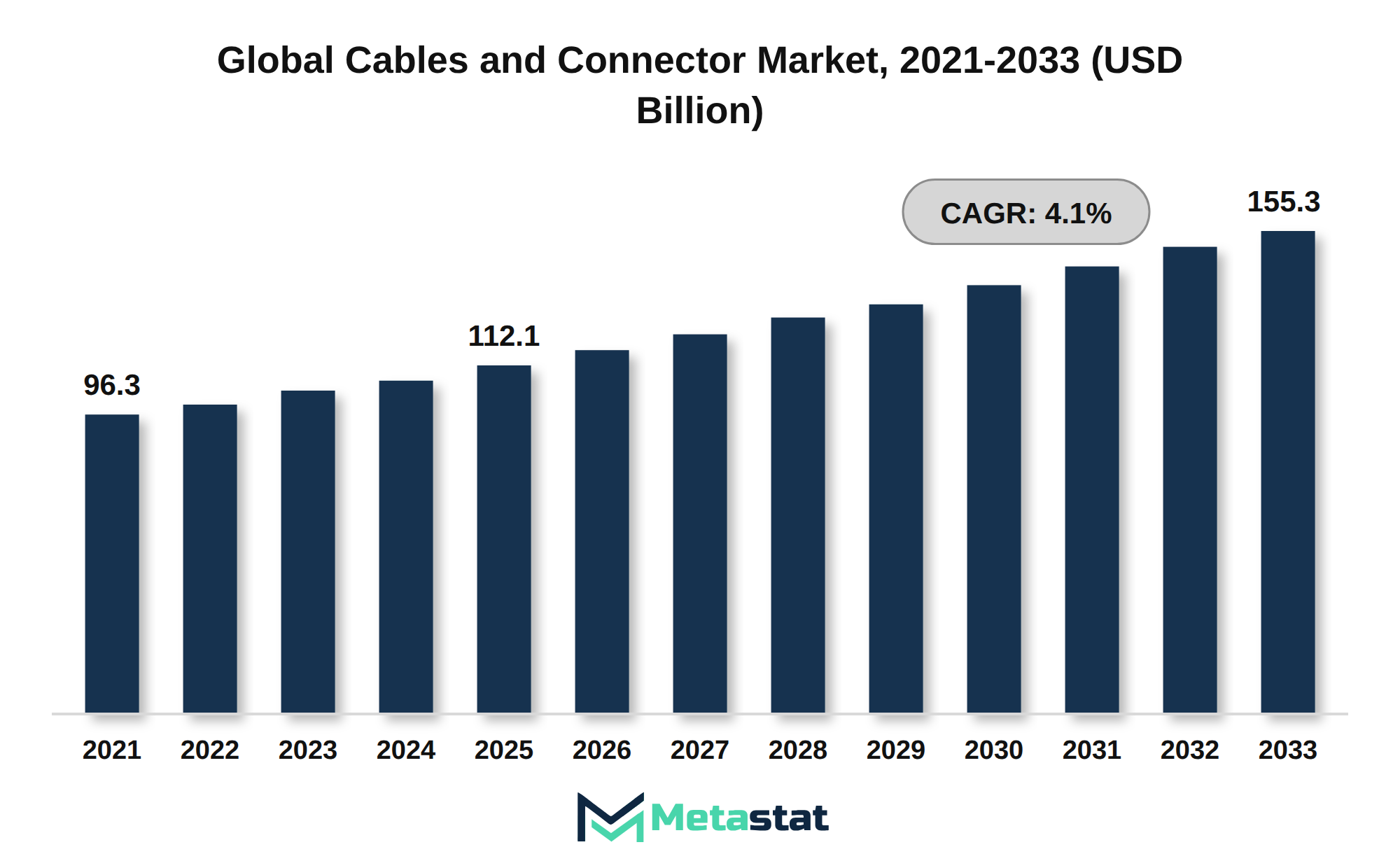
The global Cables and Connector market was valued at USD 112.1 billion in 2025 and is projected to reach USD 155.3 billion by 2033, growing at a CAGR of 4.1% over the forecast period.
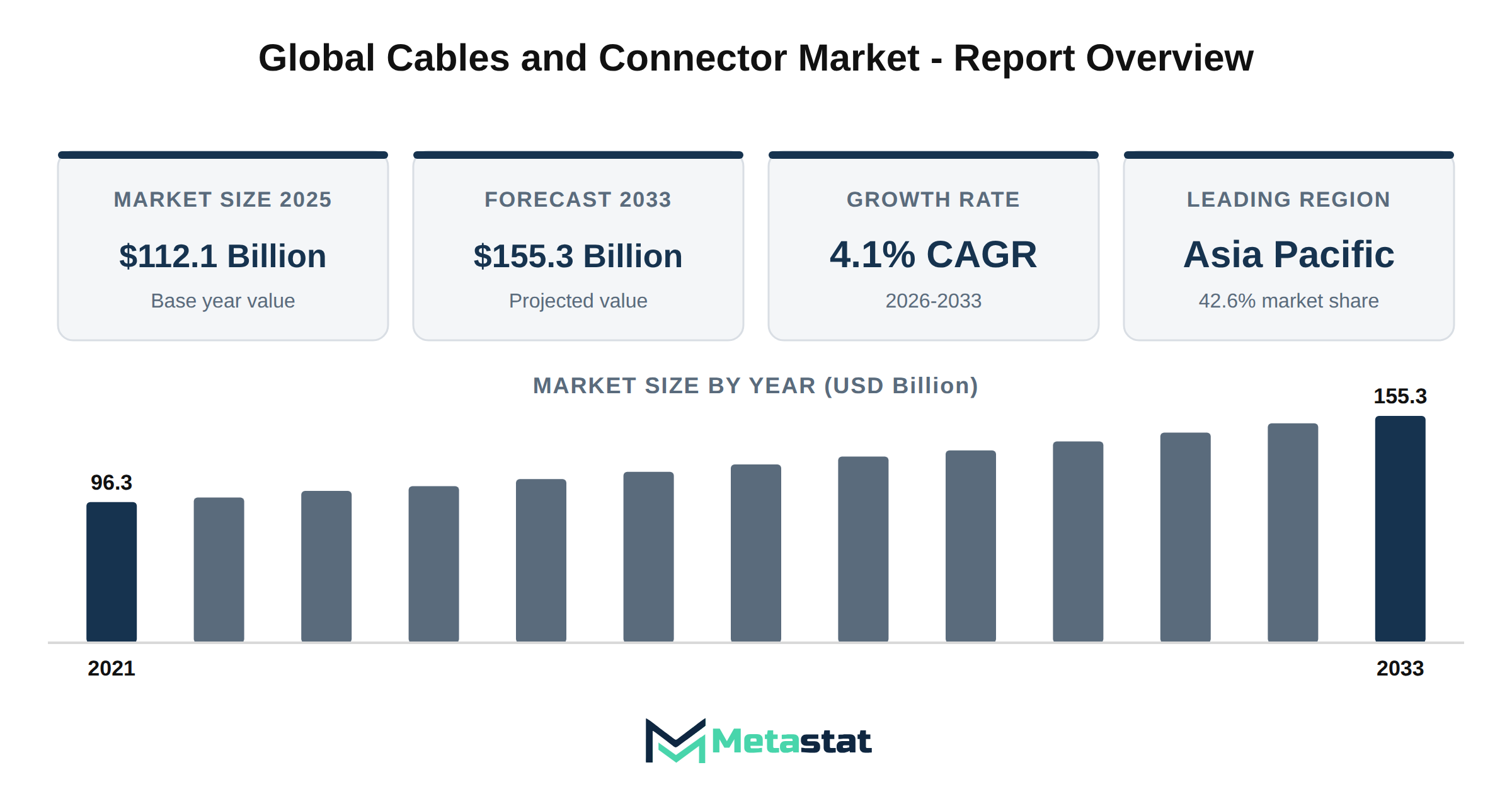
The global Cables and Connector market achieved a valuation of USD 112.1 billion in 2025. Historical data indicates steady growth, with market values of USD 96.3 billion in 2021, USD 99.5 billion in 2022, USD 104 billion in 2023, and USD 107.2 billion in 2024. The market is projected to expand to USD 155.3 billion by 2033, reflecting a compound annual growth rate (CAGR) of 4.1% from 2026 to 2033.
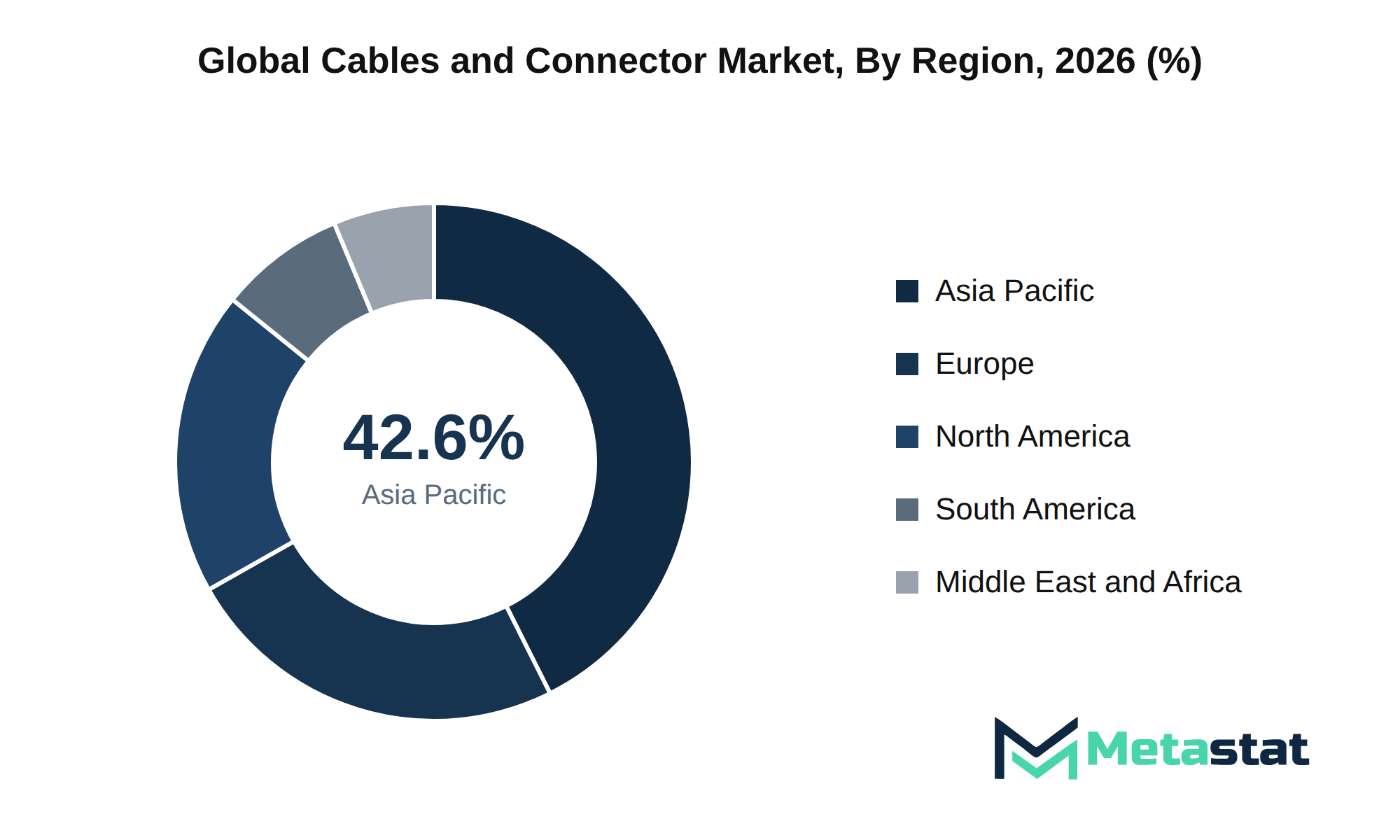
Regionally, the market distribution includes North America at 19%, Europe at 24.2%, Asia Pacific leading with 42.6%, South America at 7.9%, and the Middle East and Africa at 6.3%. The Asia Pacific region holds the largest share, driven by robust demand from various industries, including telecommunications, automotive, and consumer electronics. This demand results from increased infrastructure development and technological advancements in these sectors.
In terms of market segments, Cables account for a significant portion, with a forecast value of USD 36.4 billion by 2033, growing from USD 28.5 billion in 2026, representing a CAGR of 3.6%. Connectors are set to reach USD 43.1 billion by the same year, with a CAGR of 4%. Diverse applications across various sectors, including automotive and industrial, fuel this growth, reflecting the increasing need for reliable connectivity solutions.
Technological advancements and innovative product development shape the Cables and Connector market. Emerging trends in automation and connectivity drive demand for advanced connectors and high-performance cables, particularly in the automotive and telecommunications sectors. Companies focus on research and development to enhance product capabilities and meet evolving consumer expectations, which supports long-term market growth.
The Cables and Connector market is influenced by various factors, including regulatory compliance and standards that shape product development and market entry strategies. Companies operating within the market face challenges related to geopolitical risks, which disrupt supply chains and affect pricing strategies. Organizations actively monitor these frameworks to mitigate risks and ensure compliance, resulting in increased operational stability and market resilience.
Research and development trajectories within the market focus on next-generation innovations that enhance product capabilities and performance. Investment in sustainable transformation reflects a commitment to environmental responsibility, aligning with global decarbonization efforts. This trend supports circular economy dynamics that promote resource efficiency and minimize waste throughout the product lifecycle, enhancing long-term sustainability.
The supply chain landscape for the market is complex, with logistics architecture designed to optimize sourcing and distribution. Companies adopt various strategies to navigate market fragmentation, ensuring competitive positioning and customer satisfaction. M&A dynamics contribute to market consolidation, enabling firms to enhance their value chains and expand their capabilities, which strengthens their competitive edge.
Capital allocation remains a vital consideration, particularly in light of infrastructure investments aimed at supporting growth initiatives. Organizations strategically balance CapEx and OpEx realities to maintain operational efficiency while pursuing expansion opportunities. Macroeconomic headwinds, including inflationary pressures and currency volatility, require adaptive strategies to sustain profitability and market share, influencing investment decisions across the sector.
The future strategic outlook for the Cables and Connector market emphasizes the importance of corporate imperatives that align with evolving customer expectations. High-value recommendations focus on leveraging technological advancements and driving innovation to support market growth. Companies that prioritize these areas position themselves to capitalize on emerging opportunities and navigate the challenges ahead, reinforcing their market presence.
Market Dynamics
Capital investment environments drive market growth
Investment in infrastructure development significantly influences the growth of the Cables and Connector market. Economic indicators, including GDP growth and venture funding, enhance the capital landscape for various industries. Increased private and public spending power contributes to the demand for cables and connectors, which are essential components in manufacturing, energy, and telecommunications sectors.
Digital transformation trends accelerate the need for advanced connectivity solutions. Industries prioritize automation and technological integration to improve operational efficiency, resulting in higher consumption of cables and connectors. This shift supports market expansion, driving revenue growth across diverse applications.
Investment in the modernization of existing infrastructure creates additional demand. Upgrading facilities and enhancing network capabilities require robust connectivity solutions, further propelling growth in the market. The emphasis on sustainability and resource stewardship encourages investments in high-performance cables and connectors that align with environmental goals.
Emerging technologies drive digital transformation
The Cables and Connector market experiences growth driven by the rapid advancement and adoption of emerging technologies. Automation, artificial intelligence, and software integration enhance operational efficiencies, leading to increased demand for specialized cables and connectors. Industries including telecommunications, automotive, and industrial manufacturing prioritize technology integration to streamline processes and optimize productivity. This transition results in heightened demand for high-performance connectivity solutions that meet the requirements of modern applications.
Digital transformation initiatives contribute to a shift in consumer behavior, influencing purchasing decisions across various sectors. The growing emphasis on smart technologies, Internet of Things applications, and data-driven solutions accelerates the adoption of innovative cables and connectors. Companies invest in modernizing their infrastructure and enhancing their technological capabilities. This investment creates significant opportunities for growth and diversification within the market.
With the increasing importance of software adoption and digitizing legacy processes, participants in the Cables and Connector market focus on developing products that align with these trends. The integration of advanced materials and designs enhances the performance and reliability of connectivity solutions, catering to the evolving demands of end-users. This evolution supports revenue growth and creates a competitive environment that drives innovation and encourages investment in new technologies.
Regulatory compliance and geopolitical instability
The Cables and Connector market faces significant hurdles from regulatory compliance and geopolitical instability, impacting operational efficiency and investment potential. Compliance with stringent regulations imposes additional costs and operational complexities, particularly for manufacturers requiring certification for their products. This situation creates a barrier for new entrants seeking to establish a foothold in the market, limiting innovation and competition.
Geopolitical instability, characterized by trade tensions and fluctuating international relations, disrupts supply chains critical to the production of cables and connectors. Such instability leads to uncertainty in sourcing materials, increasing costs and delaying project timelines. These disruptions result in a lack of availability of key components, hampering growth and raising prices for end consumers.
The combination of regulatory requirements and geopolitical challenges constrains investment in infrastructure projects, which remain vital for expanding the Cables and Connector market. Companies operating in this space navigate this complex environment, balancing compliance with the demand for timely delivery and cost-effectiveness. In this context, firms face escalating operational costs that limit profitability and hinder expansion plans.
Ultimately, the combination of regulatory compliance issues and geopolitical instability poses a substantial restraint on the market, affecting growth trajectories and shaping competitive dynamics. Companies adapt to these challenges to sustain their market positions and capitalize on emerging opportunities in the evolving environment.
Geopolitical disruptions impact supply chains
The Cables and Connector market encounters challenges stemming from geopolitical fragmentation and trade deficits. Increasing tensions between nations lead to tariff friction, disrupting the flow of components and materials. This disruption contributes to rising costs, forcing suppliers to adjust pricing strategies while maintaining competitive margins. Such volatility affects production timelines, leading to delays and uncertainty in delivery schedules.
Technological disruptions pose significant challenges. Rapid advancements in technology necessitate complex research and development integrations, which require substantial capital investment. Companies face pressure to innovate while managing interoperability issues between emerging technologies and existing systems. Complications arise when integrating new components with legacy infrastructure, limiting potential for upgrades and expansions.
The market struggles with supply chain instability due to logistics disruptions and feedstock volatility. Fluctuations in raw material availability create uncertainty in production planning, adversely impacting operational efficiency. Increased input costs further exacerbate margin pressures, making it challenging for companies to sustain profitability while meeting consumer demands.
Workforce skill gaps present another critical obstacle. While the industry transitions to more advanced technologies, talent retention pressures complicate difficulties in finding adequately skilled personnel. Companies invest in training programs to upskill existing employees, diverting resources from innovation and growth initiatives.
Environmental demands add another layer of complexity. The market faces heightened scrutiny regarding sustainability mandates, pushing companies to reduce environmental footprints. Compliance overhead associated with tightening global regulatory standards pressures organizations to adapt quickly, creating potential bottlenecks in production and affecting overall market dynamics.
Emerging regional demands drive market expansion
The Cables and Connector market experiences substantial opportunities driven by emerging regional demands. Rapid industrialization in Asia Pacific fuels an increased need for advanced connectivity solutions, providing significant market potential. The region's growing electronics sector, particularly in China and India, creates strong demand for cables and connectors, aligning with the industry's projected growth trajectory.
Infrastructure modernization initiatives across various regions enhance market accessibility. Investments in telecommunications networks, especially in developing economies, stimulate demand for reliable and efficient connectivity products. Digital transformation across industries emphasizes the necessity for high-performance cables and connectors, enabling businesses to adapt to evolving technological landscapes.
Geographical expansion strategies pursued by key players further support market growth. Companies increasingly establish operations in high-demand regions, optimizing their supply chains to cater to local preferences and requirements. This strategic localization approach aids in meeting the specific needs of diverse markets while enhancing customer engagement and satisfaction.
Technological disruptions play a vital role in shaping the market landscape. The advent of next-generation innovations, including smart connectivity solutions and IoT applications, influences product development, creating opportunities for firms to introduce innovative cables and connectors. These advancements drive efficiency and performance improvements across various applications, including automotive, commercial, and industrial sectors.
Increasing sustainability imperatives and ESG-driven alignments drive a shift towards eco-friendly products in the Cables and Connector market. Consumers and businesses prioritize environmentally responsible solutions, compelling manufacturers to innovate and adapt their offerings. This focus on sustainability aligns with market trends and positions companies for long-term success.
Downstream market diversification strategies enable firms to broaden their product portfolios and tap into niche applications. Expanding into specialized markets allows companies to capture additional revenue streams while addressing specific customer needs. Such diversification enhances competitive positioning within the Cables and Connector market.
The interaction of these factors creates a robust framework for growth, reinforcing the Cables and Connector market's outlook. Strategic consolidation, cross-industry mergers, and M&A initiatives enhance market dynamics, promoting collaboration and resource sharing among industry players. This collaborative environment enables companies to improve their capabilities and expand their reach, strengthening the market's growth potential.
Market Segmentation Analysis
The Global Cables and Connector market is segmented based on Type, Connector Type, Cable Type, and Application.
By Type, the market is further segmented into:
- Cables
- Connectors
Cables
Cables segment is valued at USD 28.5 billion in 2026 and is projected to reach USD 36.4 billion by 2033, at a CAGR of 3.6% during the forecast period. Primary demand drivers for this segment include the increasing need for high-performance cables in various applications, including telecommunications and automotive industries. Technological maturation within cable manufacturing facilitates the production of more efficient and durable cables, enhancing adoption across multiple sectors.
Product evolution continues to shape the cables segment, with next-generation upgrades addressing the growing demands for data transfer speeds and connectivity. End-use dynamics highlight a significant consumption shift towards fiber optics cables, driven by expanding telecommunications networks and rising internet usage. Regulatory compliance standards, influenced by environmental factors, prompt manufacturers to enhance sustainability and efficiency of their products, further supporting market growth.
Cost structures in the cables segment experience fluctuations influenced by raw material sourcing and pricing volatility in commodities. Strategic opportunity windows arise from innovation in cable technology, driving investment in research and development. Overall, these elements contribute to the strategic outlook for the cables segment within the Cables and Connector market, reinforcing long-term demand and adaptation to consumer demands.
Connectors
Growth in the Connectors segment aligns closely with advancements in technology and increasing demand for high-quality connections across various applications. The surge in electronic devices and the proliferation of the Internet of Things (IoT) drive significant demand for connectors in sectors including automotive and industrial automation. Enhanced connectivity requirements in devices place a premium on high-performance connectors, leading to rapid adoption in the market.
Investment in research and development contributes to segment expansion by enabling innovative connector designs suited for emerging technologies. The development of next-generation connectors, characterized by improved efficiency and reliability, positions the segment for continued growth. Increasing automation in industries necessitates advanced connector solutions, shaping end-use dynamics and influencing overall market demand.
Pricing volatility in raw materials poses a challenge, affecting production costs and profit margins for manufacturers. Fluctuations in material availability and pricing exert pressure on operational strategies, necessitating agile responses from suppliers. Despite cost pressures, the strategic opportunity window for the Connectors segment remains strong, driven by ongoing evolution in product demands and the need for compliance with regulatory standards.
The Connectors segment is projected to reach USD 43.1 billion by 2033, at a CAGR of 4% during the forecast period. Robust demand coupled with continuous technological advancements strengthens the Connectors segment's position within the broader Cables and Connector market. Manufacturers strive to enhance their competitive edge through innovation and strategic partnerships.
By Connector Type, the market is further segmented into:
- PCB Connectors
- Circular/Rectangular Connectors
- Fiber Optic Connectors
- IO Connectors
- Others
PCB Connectors
Valued at USD 11.6 billion in 2026, the PCB Connectors segment is projected to reach USD 14.5 billion by 2033, reflecting a CAGR of 3.2% during the forecast period. Demand for PCB connectors stems from their critical role in various applications, particularly in sectors including automotive, telecommunications, and consumer electronics. The growing complexity of electronic circuits drives a need for connectors that provide reliable performance in compact spaces, increasing their adoption across multiple industries.
Technological advancements contribute to the evolution of PCB connectors. The shift towards miniaturized and multifunctional devices has accelerated the integration of advanced materials and manufacturing techniques. This trend leads to improved efficiency and performance, aligning with the increasing expectations of end-users. The rise of IoT devices and smart technologies increases the demand for high-density interconnect solutions, positioning PCB connectors because essential components in modern electronic systems.
Financial pressures from rising raw material costs impact pricing strategies within the segment. Manufacturers face challenges related to sourcing high-quality materials while maintaining competitive pricing. Such dynamics influence profit margins and compel suppliers to innovate in production processes and material selection. In response, companies are exploring partnerships and strategic alliances to strengthen supply chain resilience, ensuring a steady flow of materials while mitigating cost volatility.
The regulatory landscape continually shapes the PCB connectors segment. Compliance with international standards enhances product quality and safety, resulting in greater market acceptance. Manufacturers that adhere to these certifications position themselves favorably against competitors, building customer trust and loyalty. While end-users increasingly prioritize compliance, suppliers are incentivized to invest in quality assurance and product development, contributing to the overall growth of the Cables and Connector market.
Circular/Rectangular Connectors
Circular/Rectangular Connectors represent a significant portion of the Cables and Connector market, driven primarily by increasing demand in various industries including automotive and telecommunications. Technological maturation and next-generation upgrades in connectivity solutions further support segment expansion. The transition to more compact and efficient devices pushes manufacturers to innovate, enhancing product evolution within this sub-segment.
Regulatory compliance standards and certifications, particularly pertaining to safety and environmental impact, shape the operational landscape for producers. Such certifications impose additional costs, influencing pricing volatility and margin pressures. Adherence to these standards attracts investment from companies aiming to enhance their market positioning.
The Circular/Rectangular Connectors segment is projected to reach USD 34.5 billion by 2033, at a CAGR of 5.4% during the forecast period. This growth reflects robust adoption of these connectors across diverse applications, including energy and power sectors, where reliability and efficiency are critically demanded. Consequently, end-use dynamics shift towards solutions that offer enhanced performance and durability.
Supply chain resilience becomes crucial, driven by raw material sourcing challenges and logistics vulnerabilities. Disruptive alternatives and technological obsolescence require constant innovation and agility from manufacturers to maintain market relevance. Strategic capital investments in research and development position companies to capitalize on emerging trends and consumer preferences within the Cables and Connector market.
Fiber Optic Connectors
Fiber Optic Connectors play a critical role in the growing demand for high-speed data transmission and connectivity solutions. This segment aligns with the increasing adoption of advanced telecommunications and internet infrastructure, driven by the surge in data consumption across various industries. Organizations shifting towards digital transformation create a need for reliable and efficient fiber optic connections. The segment is expected to reach USD 47.3 billion by 2033, highlighting its significance within the broader Cables and Connector market.
Technological advancements in fiber optic technology, including innovations in connector design and materials, contribute to enhanced performance and ease of installation. Manufacturers focus on developing next-generation products that cater to the evolving requirements of sectors including telecommunications, data centers, and industrial automation. This evolution improves efficiency and satisfies the demand for high-bandwidth applications.
End-use dynamics further support the expansion of the Fiber Optic Connectors segment. Industries including telecommunications, automotive, and healthcare increasingly rely on fiber optics for operational needs. The demand for high-speed internet and connectivity solutions drives increased investments in fiber optic infrastructure. Regulatory compliance and standards related to data transmission and network efficiency reinforce the necessity of adopting these connectors, ensuring alignment with governmental policies and industry regulations.
Supply chain resilience remains a key consideration for manufacturers in the fiber optic sector. Sourcing raw materials for production faces challenges due to fluctuating prices and availability, impacting overall cost structures. Strategic opportunities arise from addressing these supply chain vulnerabilities through improved logistics and partnerships with reliable suppliers. The Fiber Optic Connectors segment demonstrates strong growth potential, driven by technological maturation, evolving end-use applications, and strategic investments in infrastructure.
IO Connectors
Growth in the IO Connectors segment is projected to reach a CAGR of 4% during the forecast period. Increasing demand for high-speed data transmission across various applications drives this expansion. The evolution of technology, particularly in the telecommunication and automotive sectors, fuels the adoption of IO connectors. Enhanced connectivity requirements in consumer electronics and industrial automation create significant market opportunities. Regulatory compliance related to safety and performance standards influences the design and manufacturing processes of IO connectors, ensuring adherence to quality benchmarks. The market remains competitive, with several key players investing in research and development to innovate and improve product offerings. Strategic partnerships and collaborations among manufacturers enhance market penetration and drive revenue growth. The IO Connectors segment plays a critical role in the overall Cables and Connector market, contributing significantly to its projected increase in value.
Others
Demand for "Others" in the Connector Type segment stems from various applications across industries. The advancement of technology and continuous innovation drives a shift toward more integrated and versatile connectivity solutions. Industries including telecommunications, automotive, and consumer electronics increasingly adopt connectors that meet their specific requirements, leading to growth in this sub-segment.
Regulatory compliance standards influence product development and design specifications, ensuring safety and performance in connector applications. Stricter regulations lead to higher quality standards, pushing manufacturers to enhance their offerings. This results in increased production costs and potential pricing volatility, affecting profit margins for suppliers.
Technological maturation shapes product evolution. Innovations in materials and manufacturing processes enhance the performance and reliability of connectors within the market. Downstream applications benefit from these advancements, resulting in improved efficiency and functionality across various sectors.
Strategic opportunity windows arise owing to industry players seeking to capitalize on emerging trends, including the Internet of Things (IoT) and smart technologies. The demand for connectors that support these advancements continues to grow, prompting investment in research and development to create next-generation products. This focus positions the market for sustained growth, driven by ongoing capital investment in technologically advanced solutions.
By Cable Type, the market is further segmented into:
- Coaxial Cable/Electronic Wire
- Fiber Optics Cable
- Power Cable
- Signal and Control Cable
- Telecom and Data Cable
- Others
Coaxial Cable/Electronic Wire
Valued at USD 21.2 billion in 2026, the Coaxial Cable/Electronic Wire segment is projected to reach USD 28.7 billion by 2033, at a CAGR of 4.4% during the forecast period. Increased demand for high-speed data transmission drives adoption, particularly in telecommunications and broadcasting sectors. The expansion of broadband infrastructure and the proliferation of connected devices increase the need for reliable coaxial cables and electronic wires, enhancing market growth.
Technological maturation influences the evolution of this segment. Advancements in manufacturing processes and materials contribute to improved performance characteristics, including signal integrity and durability. Innovation in product offerings, including enhanced coaxial cable designs and electronic wire solutions, supports downstream applications across various industries, including automotive and industrial sectors.
End-use dynamics indicate a shift towards greater efficiency and reliability in electronic connectivity solutions. Increased focus on regulatory compliance and industry standards influences procurement decisions, with manufacturers prioritizing certifications that ensure quality and performance. Fluctuations in raw material costs impact pricing strategies, creating margin pressures that companies navigate through cost optimization efforts.
Strategic opportunity windows arise from market consolidation and collaboration among key players. Investment in infrastructure upgrades, particularly in urban and rural areas, presents significant growth potential. Organizations aim to enhance connectivity and support emerging technologies, positioning the Coaxial Cable/Electronic Wire segment for sustained growth within the broader Cables and Connector market.
Fiber Optics Cable
Continuous advancements in telecommunications and data transmission significantly drive demand for Fiber Optics Cable. Industries reliant on high-speed internet and efficient networking solutions increasingly prefer fiber optics due to superior bandwidth and minimal signal loss compared to traditional copper cables. The growing necessity for enhanced connectivity supports the expansion of this segment within the Cables and Connector market.
Technological maturation significantly influences the performance and adoption of fiber optics technology. Innovations, including improved manufacturing processes and enhanced materials, have led to greater reliability and cost-effectiveness. This aspect attracts investments from various sectors, including telecommunications and automotive, further propelling the segment's growth.
The Fiber Optics Cable segment is estimated to reach USD 45.4 billion by 2033, at a CAGR of 3.8% during the forecast period. Regulatory compliance standards regarding data transmission speeds and network reliability drive industries to transition towards fiber optics. The increasing demand for high-speed internet across residential and commercial applications underlines the importance of this segment in meeting contemporary connectivity requirements.
Heightened competition among providers stimulates innovation and price competitiveness, impacting cost structures and overall market dynamics. While demand for efficient data transmission escalates, companies in the Cables and Connector market strive to improve their fiber optic offerings to gain market share and meet consumer expectations.
Power Cable
Demand for Power Cables experiences sustained growth, driven by the increasing need for energy transmission and distribution in various sectors. Factors contributing to this demand include a rising focus on renewable energy projects and the expansion of electrical infrastructure in emerging economies. The energy and power sector prioritizes reliable and efficient power cable solutions, influencing investments in high-quality materials that enhance durability and performance.
Technological advancements continue to play a crucial role in shaping the Power Cable segment. Developments in materials science allow for improved electrical conductivity and resistance to environmental factors, resulting in longer-lasting products. Ongoing enhancements in manufacturing processes support the production of cables that meet stringent regulatory compliance standards, increasing their acceptance in diverse applications.
The Power Cable segment is projected to reach USD 18.7 billion by 2033. Increased demand from end-use sectors, including automotive and industrial applications, reflects a shift towards electrification and automation. Rising demand drives manufacturers to innovate and develop next-generation power cable solutions capable of accommodating higher voltage levels and enhanced safety features.
Price volatility in raw materials presents challenges impacting cost structures within the segment. Manufacturers face pressure to balance quality and affordability, impacting profit margins. Strategic opportunity windows arise from investments in sustainable practices and materials, allowing companies to differentiate themselves from competitors while aligning with global sustainability goals.
Overall, the Power Cable segment within the Cables and Connector market is positioned for growth, supported by technological maturation, regulatory developments, and evolving end-use dynamics. Capital investment in the segment remains strong, with stakeholders recognizing the importance of resilient supply chains and innovative product offerings to meet the demands of a rapidly changing energy landscape.
Signal and Control Cable
Growing applications across various industries drive the demand for Signal and Control Cables. Their utilization in automation and control systems enhances the functionality and reliability of equipment in the automotive, industrial, and telecommunications sectors. Regulatory compliance standards, including safety and performance certifications, enhance the appeal of these cables. Innovations in cable technology stimulate market expansion by improving performance characteristics and enabling better integration with advanced systems.
The Signal and Control Cable segment is projected to grow at a CAGR of 4.7% during the forecast period. This growth reflects a shift towards automation and smarter technologies, leading to increased usage in machinery and vehicles. Key participants in the Cables and Connector market invest in research and development to refine products, addressing both performance and efficiency. The market's adaptability to emerging technologies supports continued demand from industries focused on enhancing operational capabilities.
Cost structures associated with raw materials and production processes influence pricing strategies for Signal and Control Cables. Fluctuations in material costs lead to pricing volatility, impacting profit margins for manufacturers. Despite these pressures, the segment maintains resilience through strategic sourcing and innovation in production techniques. Investment in next-generation upgrades aligns with user expectations for high-performance products, positioning the segment favorably in the competitive environment.
Telecom and Data Cable
Telecom and Data Cable serves because a crucial component in the expanding realm of digital communication and data transmission. Increasing demand for high-speed internet services and mobile connectivity drives substantial interest in this segment. Ongoing advancements in network infrastructure, particularly with the rollout of 5G technology, create a favorable environment for telecom and data cable adoption. Enhanced data transmission capacities and improved bandwidth efficiency support various applications, including residential, commercial, and industrial sectors.
End-use dynamics highlight the vital role of telecom and data cables across diverse industries, with significant consumption in telecommunications, data centers, and enterprise environments. The ongoing shift toward digitalization, remote working, and cloud computing necessitates robust and reliable cabling solutions to facilitate communication and connectivity. Regulatory compliance standards and certifications further influence the market, ensuring quality and safety while providing assurance to consumers and businesses alike.
Investment in next-generation upgrades, including fiber optic technology, positions telecom and data cable because a strategic opportunity within the broader Cables and Connector market. Organizations focus on enhancing their infrastructure capabilities, which aligns with the growing demand for high-performance data transmission solutions. These developments create a competitive landscape where companies adapt their offerings to meet evolving market needs.
Demand for the "Others" category within the Cable Type segmentation reflects a diverse range of applications across various industries. The segment's growth aligns with increasing demand for specialized cables designed for unique operational requirements. Technological maturation facilitates the development of innovative cable solutions, ensuring compatibility with advanced systems in sectors including telecommunications, industrial automation, and consumer electronics.
Next-generation upgrades in infrastructure, particularly in smart technology and renewable energy systems, increase the demand for specialized cables. End-use dynamics highlight a shift toward greater customization, leading to the evolution of products that meet specific client needs. Regulatory compliance standards further influence product design, resulting from manufacturers working to align with stringent safety and performance regulations.
Pricing volatility remains a critical factor, affecting the cost structures for manufacturers operating in this segment. Margin pressures arise from fluctuations in raw material costs, necessitating strategic sourcing and supply chain resilience. Disruptive alternatives, including wireless technologies, present challenges. The continued reliance on cable infrastructure in various applications sustains market relevance.
Strategic opportunity windows for growth lie in enhancing product offerings while addressing substitution risks. Capital investments in research and development cultivate innovation, ensuring that the segment adapts to evolving market demands. Overall, the Cables and Connector market benefits from a comprehensive approach to product development, driven by emerging technologies and shifting consumption patterns.
By Application, the market is further segmented into:
- Automotive
- Commercial
- Oil & Gas
- Military & Defense
- Energy & Power
- Others
Automotive
Valued at USD 117 billion in 2026, the automotive application segment is projected to reach USD 155.3 billion by 2033, achieving a CAGR of 4.1% during the forecast period. Growth in the automotive sector stems from increasing demand for advanced safety features, connectivity, and electrification of vehicles. Factors driving this evolution include the integration of smart technologies and the transition towards electric and hybrid vehicles, which require specialized cables and connectors to support high-performance demands.
Consumption shifts within the automotive industry towards more efficient and lightweight materials directly influence the development of advanced cables and connectors. Regulatory compliance standards focusing on vehicle safety and environmental impacts prompt manufacturers to innovate and upgrade product offerings consistently. This dynamic environment encourages investment in next-generation upgrades and enhances competitive positioning in the market.
Strategic opportunity windows arise from the growing emphasis on electric vehicles (EVs) and autonomous driving technologies, which require robust electrical systems and superior connectivity solutions. Significant capital investment in infrastructure and technology enables manufacturers to capture a larger share of the automotive market. The market evolves, driven by the need for improved performance, reliability, and sustainability across automotive applications.
Commercial
Increasing demand for connectivity solutions within commercial applications drives significant expansion in the Cables and Connector market. Factors including the growth of smart buildings and the integration of IoT devices enhance the need for efficient data transmission systems. Rapid urbanization and the rise of e-commerce contribute to demand, necessitating robust infrastructure development across various sectors.
Technological advancements in cabling and connectivity solutions promote the adoption of next-generation products. Innovations including high-speed data cables and advanced connectors enhance performance and reliability, appealing to businesses seeking competitive advantages. Government focus on digital transformation and regulatory compliance influences purchasing decisions, encouraging investments in modern infrastructure.
Pressure on cost structures and pricing volatility affects market dynamics. Companies strive to balance quality and affordability, resulting in increased competition and innovation. In response, manufacturers explore strategic partnerships and collaborations to enhance product offerings and distribution capabilities, ensuring that they meet evolving consumer demands.
Raw material sourcing and supply chain resilience remain critical considerations for stakeholders in the market. Fluctuation of raw material prices influences production costs, compelling manufacturers to adopt more efficient sourcing strategies. Awareness of environmental impacts drives the development of sustainable practices in material selection and production processes.
Strategic opportunity windows arise owing to businesses seeking to capitalize on emerging technologies and consumption shifts. The growing emphasis on renewable energy and electric vehicles prompts increased demand for specialized cabling solutions. Evolving end-use dynamics present significant growth potential for companies operating in the Cables and Connector market.
Oil & Gas
Investment in the Oil & Gas sector increasingly influences the demand for cables and connectors. The sector's reliance on advanced technologies for exploration and drilling necessitates high-performance connectivity solutions. Continuous exploration and production activities require robust cables to withstand harsh environments, ensuring safety and efficiency. Regulatory compliance drives the adoption of certified products, enhancing operational integrity and supporting long-term demand in the market.
Technological maturation within the industry generates interest in next-generation connectors designed for enhanced durability and performance. Companies strive for operational efficiency while product evolution focuses on materials that resist corrosion and environmental damage. This trend emphasizes the significance of high-quality cables and connectors that support energy transition initiatives, further stimulating growth in the Cables and Connector market.
Consumption shifts towards integrated solutions that promote sustainability and reduce environmental impact shape demand dynamics. Strategic opportunities arise from the growing need for digitalization and automation in oil and gas operations. Awareness of supply chain resilience strengthens sourcing strategies, enabling better management of raw material availability and logistics vulnerabilities. The investment outlook remains positive, driven by the need for modernization and infrastructure upgrades within the sector.
Military & Defense
In the Military & Defense application segment, strong demand arises from the need for high-performance cables and connectors that meet stringent operational requirements. Increased investments in defense technology and modernization of military infrastructure drive the segment's growth. Continuous advancements in communication systems, including secure and reliable data transmission, enhance the relevance of specialized cable and connector solutions. The market benefits from the integration of next-generation technologies designed for advanced weapon systems and tactical communication devices, supporting long-term demand.
Regulatory compliance standards play a crucial role in shaping product specifications for military applications. Adherence to these standards ensures that cables and connectors perform reliably in various environmental conditions and operational challenges. Manufacturers focusing on compliance and certification position themselves strategically within the Cables and Connector market, enhancing their competitive edge.
Strategic opportunities arise from the ongoing evolution of military capabilities, necessitating upgraded and innovative cable and connector solutions. Investment in research and development drives product evolution, addressing the changing needs of defense applications. Resilience within the supply chain becomes critical, particularly in raw material sourcing and logistics management, to mitigate risks associated with disruptions, reinforcing the segment's position.
Overall, the Military & Defense segment reflects a robust landscape of demand driven by technological advancements and stringent operational requirements. This segment remains crucial for manufacturers aiming to capitalize on growth opportunities within the Cables and Connector market, increasing investment across the value chain.
Energy & Power
Growth in the Energy & Power application segment benefits from increasing investments in renewable energy and infrastructure development. The shift towards cleaner energy sources creates demand for advanced cables and connectors that support high-voltage and efficient power transmission. Technological maturation contributes to the enhancement of products, ensuring they meet stringent regulatory compliance standards and performance expectations. Emerging technologies, including smart grids and energy storage systems, drive the evolution of cables and connectors, offering opportunities for manufacturers to develop innovative solutions.
End-use dynamics in the energy sector emphasize the importance of reliable and efficient connections for both generation and distribution. Consumption shifts towards sustainable energy solutions require robust cable and connector systems that withstand extreme environmental conditions. Pricing volatility in raw materials, influenced by supply chain challenges, impacts overall cost structures and pressures profit margins. Supply chain resilience remains crucial, with companies focusing on local sourcing and strategic partnerships to mitigate risks associated with logistics vulnerabilities.
In the context of the Cables and Connector market, strategic opportunity windows arise from the urgent need for modernization in energy infrastructure. The demand for next-generation upgrades in existing systems fuels investment in this segment. Disruptive alternatives, including wireless power transmission, present challenges and opportunities resulting from the market adapting to technological advancements and evolving consumer preferences.
Interest in the "Others" application segment within the Cables and Connector market reflects diverse demands across various industries. This segment addresses unique requirements that do not fit traditional categories, including specialized industrial applications and emerging technologies. Growing use of advanced manufacturing techniques increases adoption among companies seeking to enhance operational efficiencies.
Technological maturation plays a critical role in driving interest in this segment. Innovations in materials and processes contribute to developing solutions tailored to specific industry needs, enabling businesses to leverage more reliable and efficient connectivity options. Enhanced performance metrics in these products lead to increased demand from end-users focused on optimizing their operational capabilities.
Regulatory compliance standards continue to impact this segment due to industries striving for adherence to evolving policies. Companies investing in compliance-focused solutions benefit from improved operational legitimacy, while those that neglect these standards risk facing challenges in market access. Ongoing shifts in consumption patterns further influence the demand landscape, because customers increasingly seek tailored solutions that integrate seamlessly with existing systems.
Strategic opportunity windows arise from a growing recognition of the need for adaptability in connectivity solutions. Businesses that explore innovative approaches to product evolution in this segment position themselves advantageously within the market. Supply chain resilience, strengthened by effective raw material sourcing, enhances the stability of this segment, allowing players to respond effectively to fluctuations in demand.
By Region
Based on geography, the Global Cables and Connector market is divided into North America, Europe, Asia-Pacific, South America, Middle East, and Africa.
North America
The North America Cables and Connector market is set to expand at a CAGR of 4.1% within the forecast period, reaching a market size (TAM) of USD 36.1 billion by the end of 2033. This region accounted for 19.0% of the global market in 2025, reflecting robust demand driven by various sectors, including automotive, telecommunications, and energy. The continued emphasis on infrastructure modernization and the push for improved connectivity across industries fuel growth in the market.
In the United States, Canada, and Mexico, supply chain regionalization and localized manufacturing densities play a critical role in shaping market dynamics. Investment in domestic production capabilities aligns with nearshoring initiatives, promoting resilience against global supply chain disruptions. Regional competitive landscapes highlight the presence of several market participants, driving innovation and enhancing procurement strategies tailored to local needs.
Geographic regulatory frameworks and compliance mandates further influence the market's growth trajectory. The evolving landscape of local trade policies impacts cross-border trade corridors, necessitating strategic adjustments by market participants. The ongoing trend of foreign direct investment (FDI) flows into North America enhances the potential for geographic expansion, contributing to the overall health of the Cables and Connector market.
Europe
Europe accounts for a significant 24.2% share of the global Cables and Connector market in 2025. The region benefits from robust demand across several industries, particularly in automotive, energy, and telecommunications sectors. In Germany, France, the UK, Italy, and Spain, ongoing infrastructure modernization and technological advancements create substantial growth opportunities for manufacturers and suppliers.
Local compliance mandates and regulatory frameworks influence procurement decisions in Europe, leading to increased investments in high-quality, innovative solutions. Emerging market front-runners within the region focus on enhancing connectivity and expanding production capabilities. The presence of established players, including Amphenol Corporation and TE Connectivity Limited, creates a competitive landscape that drives innovation and efficiency.
Localized manufacturing and nearshoring initiatives are gaining traction, supporting a shift towards sustainable supply chains and localized procurement dynamics. This focus aligns with regional energy grid resiliency efforts and enhances local infrastructure readiness. Supplier consolidation trends among domestic market leaders further strengthen market competitiveness, positioning Europe because a crucial player in the Cables and Connector market.
Asia-Pacific
The Asia-Pacific region holds a significant position in the Cables and Connector market, representing a 42.6% share of the global market in 2025. Rapid industrialization and expansion of telecommunications networks across countries including China, Japan, and India contribute to the increasing demand for cables and connectors. Enhanced investments in infrastructure modernization, particularly in South Korea and Australia, support the need for advanced connectivity solutions. Localized procurement dynamics and cultural nuances influence B2B buying behaviors, resulting in strategic purchasing decisions among regional firms.
Emerging market front-runners within Asia-Pacific benefit from robust supply chain regionalization and localized manufacturing densities. Countries like India and Southeast Asia experience growth opportunities driven by foreign direct investment flows and geographic expansion windows. High-value replacement cycles in existing infrastructure further stimulate demand for innovative cable types and connectors. The presence of domestic market participants, along with vendor consolidation trends, creates a competitive environment that promotes incremental growth vectors within the market.
South America
The Cables and Connector market in South America is characterized by a growing demand for advanced connectivity solutions, particularly in Brazil and Argentina. This demand arises from increased investment in infrastructure and modernization efforts aimed at enhancing telecommunications and energy sectors. Local manufacturers play a vital role in supplying products that meet emerging needs, stimulating further market growth.
Regional competitive dynamics display a blend of established domestic players and international firms seeking to penetrate the South American market. Key industry participants contribute to the evolving landscape by adapting their offerings to align with local preferences and regulatory standards. Cultural nuances significantly influence B2B buying behaviors, necessitating tailored approaches to procurement.
South America offers potential for expansion, focusing on unserved territories and high-value replacement cycles. Enhanced energy grid resiliency and investments in local infrastructure position the market favorably for incremental growth. The evolving landscape encourages foreign direct investment (FDI) flows aimed at enhancing localized manufacturing capabilities and supporting cross-border trade corridors.
Middle East and Africa
The Middle East and Africa represent a developing region within the Cables and Connector market, contributing 6.3% to the global market share in 2025. This region experiences growing demand for advanced infrastructure, particularly in Saudi Arabia and the UAE, where investments in smart cities and energy projects drive adoption of high-quality cables and connectors. South Africa's expanding economy further encourages upgrades in telecommunications and energy sectors, enhancing the need for robust connectivity solutions.
Emerging markets within the region focus on local manufacturing and procurement, which strategically addresses supply chain regionalization while creating competitive landscapes. Geopolitical dynamics influence trade policies and operational frameworks, creating challenges and opportunities. The increasing push for foreign direct investment reinforces infrastructure readiness, enabling growth in sectors reliant on cables and connectors.
Market participants observe localized buying behaviors shaped by cultural nuances and varied compliance mandates. The competitive environment in the Middle East and Africa remains characterized by domestic and international vendors, each vying for market share through innovative solutions and strategic partnerships. Incremental growth vectors emerge from the ongoing modernization of energy grids, signaling favorable conditions for expansion across the Cables and Connector market.
Competitive Landscape and Strategic Insights
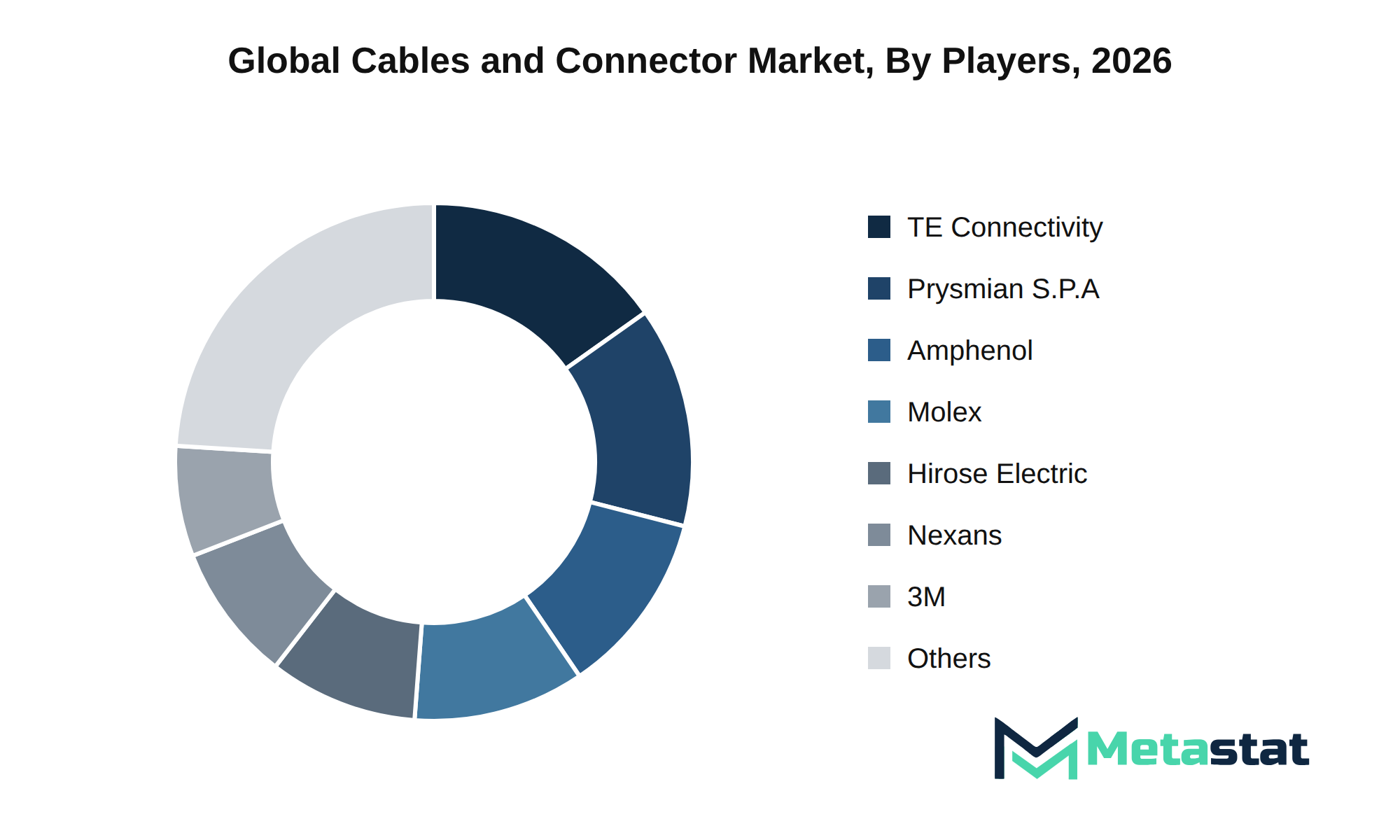
The competitive landscape in the Cables and Connector market reflects a dynamic relationship among established players and emerging entrants. Companies including Amphenol Corporation, Molex Inc., and TE Connectivity Limited leverage advanced technologies and strong brand equity, positioning themselves effectively in various market segments. These firms invest significantly in research and development to enhance their product offerings, resulting in a diverse range of connectors and cables tailored to specific applications.
Strategic alliances and partnerships drive market expansion, with companies like Huawei Technologies Co. Ltd. and Nexans collaborating across industries to enhance their global reach. This strategy boosts market presence and facilitates the integration of innovative technologies into product lines. The presence of intellectual property portfolios among leading players fortifies competitive edges, ensuring technological defensibility in the evolving landscape.
Barriers to entry in the market remain significant, with established firms maintaining procurement leverage and supply chain dominance. The threat of new entrants influences competitive strategies, compelling existing players to optimize commercial models and pricing architectures. Overall, the competitive outlook for the Cables and Connector market indicates significant growth driven by ongoing innovation and strategic positioning among key industry participants.
Forecast and Future Outlook
Market size is forecast to rise from USD 112.1 billion in 2025 to over USD 155.3 billion by 2033. The base case scenario indicates a growth rate of 4.1% CAGR during this period. Factors influencing the market include the integration of next-generation technologies, which address evolving consumer demands and enhance product capabilities. Ongoing maturation of core industries results in shifting consumption patterns, presenting opportunities for innovation and development.
Macroeconomic conditions and global supply chain dynamics affect strategic capital allocations and infrastructure commitments across various regions. Regulatory evolution and compliance milestones shape the operational landscape for companies operating in the Cables and Connector market. Geopolitical realignments and changes in trade corridors influence market access and competitiveness, requiring businesses to adapt to new trade environments.
Emerging white-space opportunities arise from unmet enterprise needs in sectors including automotive, energy, and telecommunications. High-growth pockets within these industries drive investment and R&D efforts, enabling companies to capture evolving market demands. Executive-level strategic imperatives focus on growth recommendations and defensibility roadmaps that align with future market trajectories.
Cables and Connector Market Key Segments
By Type:
- Cables
- Connectors
By Connector Type:
- PCB Connectors
- Circular/Rectangular Connectors
- Fiber Optic Connectors
- IO Connectors
- Others
By Cable Type:
- Coaxial Cable/Electronic Wire
- Fiber Optics Cable
- Power Cable
- Signal and Control Cable
- Telecom and Data Cable
- Others
By Application:
- Automotive
- Commercial
- Oil & Gas
- Military & Defense
- Energy & Power
- Others
By Region:
- North America
- Europe
- Asia-Pacific
- South America
- Middle East and Africa
Key Global Cables and Connector Industry Players
- Amphenol Corporation
- Molex Inc.
- Hirose Electric Co., Ltd.
- TE Connectivity Limited
- Prysmian S.P.A.
- 3M Company
- Nexans
- Huawei Technologies Co. Ltd.
- AVX Corporation
- AMETEK Inc.
- HARTING Technology Group
- Leoni AG
- Aptiv PLC
- Yazaki Corporation
- Sumitomo Electric Industries, Ltd.
- Prysmian S.p.A.
- Belden Inc.
- Japan Aviation Electronics Industry, Ltd.
- Foxconn Interconnect Technology Limited
- J.S.T. Mfg. Co., Ltd.
- Phoenix Contact GmbH & Co. KG
- HUBER+SUHNER AG
- Rosenberger Hochfrequenztechnik GmbH & Co. KG
- Samtec, Inc.
- CommScope Holding Company, Inc.
- Huawei Technologies Co., Ltd.
- LS Cable & System Ltd.
- Radiall S.A.
- Volex plc
- Carlisle Interconnect Technologies
- Cinch Connectivity Solutions
- Fischer Connectors SA
Report Coverage
The report strategically identifies and profiles the key market players and analyses their core competencies in each sub-segment of the Cables and Connector market.
|
Report Attributes |
Details |
|
Study Period |
2021-2033 |
|
Base Year |
2025 |
|
Estimated Year |
2026 |
|
Forecast Period |
2026-2033 |
|
Historical Period |
2021-2025 |
|
Growth Rate |
CAGR 4.1% from 2026 to 2033 |
|
Revenue Unit |
USD billion |
|
Segmentation |
By Type, Connector Type, Cable Type, Application, and Region |
|
By Region |
North America (By Type, Connector Type, Cable Type, Application, and Country)
|
|
Europe (By Type, Connector Type, Cable Type, Application, and Country)
|
|
|
Asia Pacific (By Type, Connector Type, Cable Type, Application, and Country)
|
|
|
South America (By Type, Connector Type, Cable Type, Application, and Country)
|
|
|
Middle East and Africa (By Type, Connector Type, Cable Type, Application, and Country)
|
What Report Provides
- Company Market Share, Revenue and Ranking for the Cables and Connector Market
- Key Market Leaders and Their Strategic Positioning
- Full In-Depth Analysis of the Cables and Connector Industry
- Historical, Ongoing and Projected Market Analysis
- Segmentation Details of the Cables and Connector Market
- Assessment of Niche Industry Developments and Trends
- Key Strategies of Major Players in the Market
- Competitive Benchmarking and Strategic Recommendations
Frequently Asked Questions
Find answers to common questions about this report
The Cables and Connector market size was valued at USD 112.1 billion in 2025, according to the Metastat Insights study.
The Cables and Connector market is projected to grow at a CAGR of 4.1% during the forecast period from 2026 to 2033.
The North America Cables and Connector market size is estimated to reach USD 36.1 billion by 2033.
The Connectors segment leads the Cables and Connector market, with a projected value of USD 43.1 billion by 2033. This figure surpasses the Cables segment, which is expected to reach USD 36.4 billion in the same year.
Investment in infrastructure development, economic growth, and the push for digital transformation drive the Cables and Connector market. Increased spending in manufacturing, energy, and telecommunications sectors enhances demand for advanced connectivity solutions, while the emphasis on sustainability encourages investments in high-performance cables and connectors.
Asia Pacific holds the dominant share of the Cables and Connector market, accounting for 42.6% in 2025. This region's significant share reflects its extensive industrial base and high demand for connectivity solutions.
The Cables and Connector market faces significant hurdles from regulatory compliance and geopolitical instability, which impact operational efficiency and investment potential. Compliance with stringent regulations raises costs, while geopolitical tensions disrupt supply chains, leading to increased prices and delays. These factors constrain investment in infrastructure projects, limiting market growth.
Investment in infrastructure development, digital transformation trends, and the emphasis on sustainability significantly favor product adoption in the Cables and Connector market. Increased private and public spending enhances demand, while advancements in technology and smart applications drive the need for high-performance connectivity solutions across various industries.
The Cables and Connector market is estimated to reach a valuation of USD 155.3 billion by 2033.
Key players in the Cables and Connector market include Amphenol Corporation, Molex Inc., TE Connectivity Limited, Prysmian S.P.A., 3M Company, Nexans, and Yazaki Corporation.
Choose Your License
Global Cables and Connector Market
Related Reports
Explore related market intelligence reports worth reading alongside this one.
Global Low-voltage Ceramic Capacitor Market
Starting from
$2950