Global Executive B2B Conferences and Curated Business Events Market
Global Executive B2B Conferences and Curated Business Events Market Size, Share, By Event Type (Executive Conferences and Summits, Leadership Forums and Roundtables, Corporate Meetings and Leadership Retreats, Industry Congresses and Professional Conferences, Workshops and Masterclasses, Networking and Peer-Exchange Events, Awards and Recognition Events), By Primary Attendee Access Model (Open Registration, Application or Qualification-Based, Invitation-Only, Hosted-Buyer or Pre-Matched Meeting, Membership or Community-Gated, Internal / Company-Only), By Delivery Mode (In-Person, Virtual, Hybrid), By Industry Vertical (Technology and Telecommunications, BFSI, Healthcare and Life Sciences, Energy and Utilities, Manufacturing and Industrial, Retail and Consumer, Travel, Hospitality and Transportation, Professional and Business Services, Government and Public Sector), Industry Analysis, Growth, Trends, and Forecast, 2026-2033
Report ID
MSI-4917
Published
August 13, 2026
Pages
279 Pages
Format
Market Size 2021
$563.4 Billion
Historical
Market Size 2025
$777.7 Billion
Base year
Market Size 2033
$1,516.3 Billion
Forecast
CAGR 2025-2033
8.7%
Forecast period
Report Details
Comprehensive Market Analysis And Insights
Market Overview
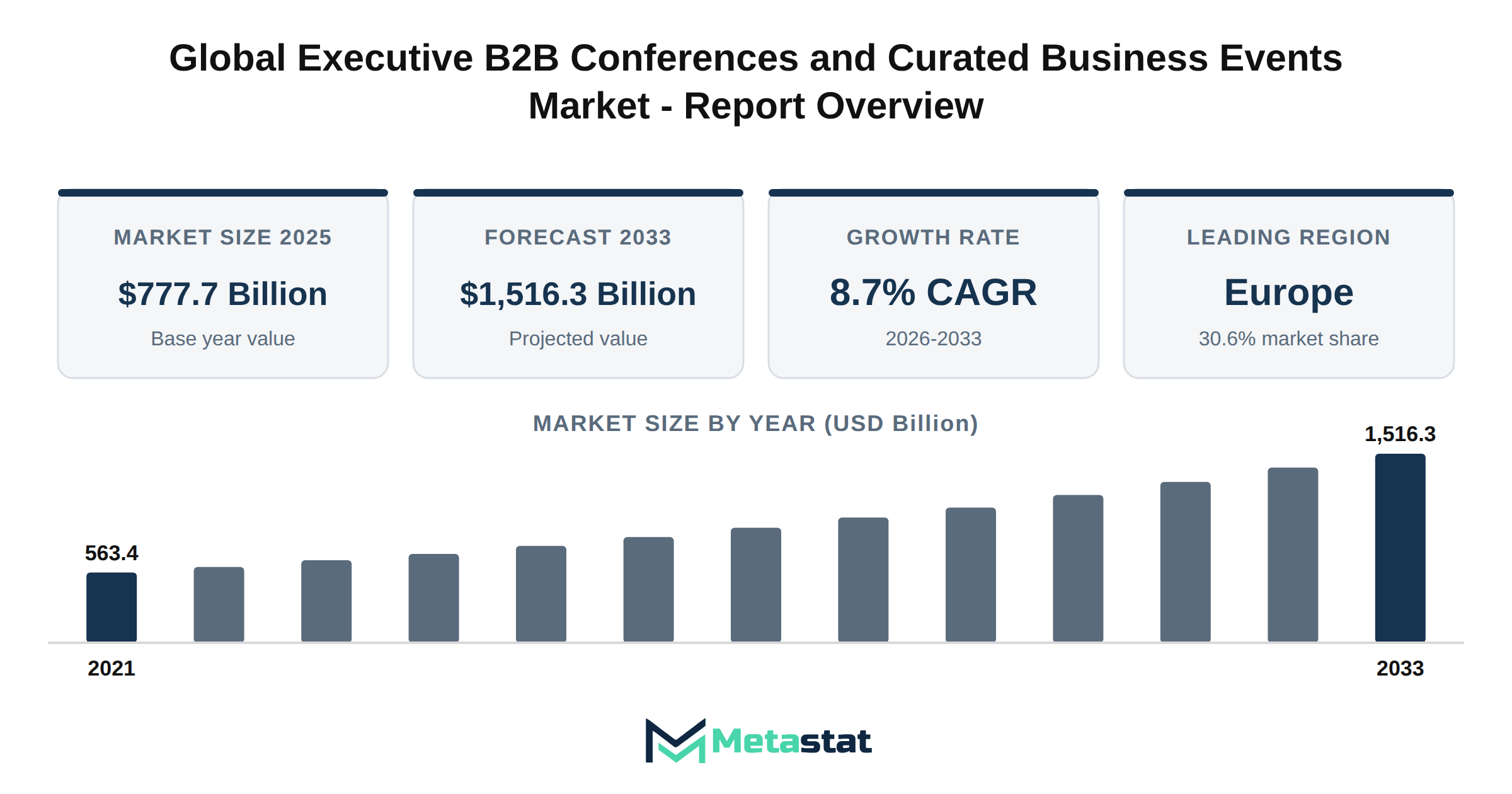
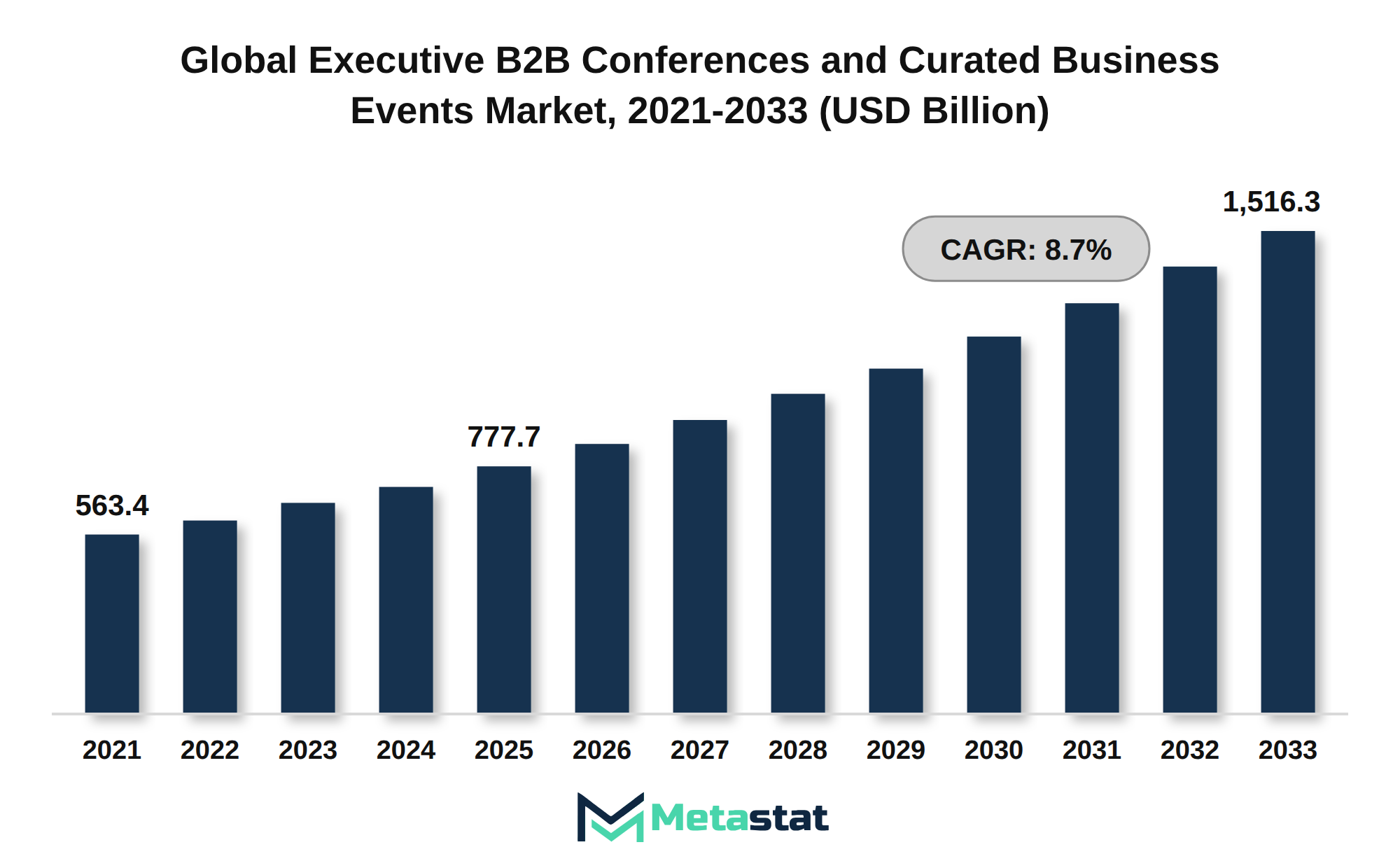
The global Executive B2B Conferences and Curated Business Events market was valued at USD 777.7 billion in 2025 and is projected to reach USD 1,516.3 billion by 2033, growing at a CAGR of 8.7% over the forecast period.
The Executive B2B Conferences and Curated Business Events market reached a valuation of USD 777.7 billion in 2025, driven by evolving attendee expectations and increasing demand for high-level engagements. The market is projected to grow significantly, with an estimated value of USD 1,516.3 billion by 2033, reflecting a compound annual growth rate (CAGR) of 8.7% during the forecast period from 2026 to 2033. This growth is primarily driven by the rising need for networking opportunities and knowledge sharing among business leaders across various industries.
Attendee personas and seniority mapping have become crucial for event organizers. Understanding the demographics and preferences of senior executives facilitates the design of targeted experiences. Data-driven insights indicate that attendees increasingly prioritize high-value content and relevant discussions, which in turn influence their engagement levels. Event formats, including executive conferences and leadership forums, align closely with these expectations, improving participant satisfaction and retention.
Executive engagement behavior analysis shows a shift towards more personalized interactions at events. Attendees express a preference for curated experiences that offer tailored networking opportunities and access to industry leaders. This trend necessitates a reevaluation of sponsorship models, where sponsors prioritize packages that demonstrate clear return on investment (ROI) through measurable engagement metrics. The alignment of sponsor priorities with attendee expectations drives the development of innovative sponsorship strategies in the market.
Speaker value proposition assessment highlights the importance of selecting industry thought leaders who provide valuable insights and promote meaningful discussions. Evaluating speakers based on their relevance to the audience and the potential to enhance event content improves the overall experience. Competitor event proposition benchmarking further informs organizers about positioning strategies, enabling them to differentiate their offerings in a crowded marketplace.
Content-to-audience commercial fit remains a critical aspect of event success. Regulatory compliance and geopolitical risk frameworks influence the type of content presented at events. The ongoing dynamics of disruption and research and development trajectories shape the topics that engage attendees. Trends in sustainable transformation, decarbonization, and circular economy dynamics influence the themes explored within the market.
The supply chain landscape continues to evolve, affecting logistics architecture and sourcing strategies for event organizers. Market fragmentation has led to various business models within the industry, creating opportunities for mergers and acquisitions that enhance operational capabilities. Understanding value chain dynamics is essential for optimizing procurement processes and improving the customer journey.
Capital allocation and infrastructure investments play significant roles in shaping the future of the market. Increased focus on capital expenditures (CapEx) and operational expenditures (OpEx) in response to macroeconomic headwinds, inflationary pressures, and currency volatility influences strategic decision-making. The corporate imperative for innovation and adaptability drives high-value recommendations for stakeholders.
Understanding attendee personas and seniority mapping indicates that the Executive B2B Conferences and Curated Business Events market attracts a diverse range of professionals. High-ranking executives and decision-makers frequently participate, bringing significant influence over procurement and strategic initiatives. This demographic shift emphasizes the importance of tailoring event content to meet the expectations of senior attendees.
The evolution of attendee expectations highlights a growing demand for personalized and engaging experiences. Participants increasingly seek interactive formats that facilitate meaningful networking and knowledge sharing. Event planners innovate their offerings to ensure alignment with contemporary preferences.
Analysis of executive engagement behavior indicates a shift towards more participative roles in discussions and decision-making processes. Executives favor events that not only provide insights but allow them to contribute to conversations, enhancing their value perception of the events they attend. This behavior shapes the strategic approach of organizers, who prioritize content that encourages active participation.
In terms of sponsor priorities, benchmarking indicates a focus on return on investment (ROI) metrics. Sponsors increasingly seek quantifiable results from their participation, including lead generation and brand visibility. This trend shapes how event packages are structured, urging organizers to offer clear value propositions that align with sponsors' objectives.
The speaker value proposition assessment emphasizes the need for high-quality content delivered by industry leaders. Engaging speakers enhance the prestige of events, attracting larger audiences and increasing attendance rates. Organizers prioritize securing thought leaders who provide valuable insights and stimulate discussions relevant to current market trends.
Competitor event proposition benchmarking highlights the importance of differentiation in the market. With numerous events vying for attention, organizers adopt unique themes, innovative formats, and niche focuses to stand out. This competitive dynamic drives continuous improvement and adaptation within the industry.
Content-to-audience commercial fit remains crucial for maintaining relevance in the Executive B2B Conferences and Curated Business Events market. Regulatory compliance and an understanding of geopolitical risks are essential factors that shape event planning and execution. Organizers increasingly account for these elements to mitigate potential disruptions and ensure successful outcomes.
Future strategic outlooks highlight the significance of sustainable transformation and decarbonization initiatives. Organizations increasingly prioritize environmentally responsible practices, influencing event design and execution. This trend encourages a culture of sustainability within the market, driving innovation and collaboration towards circular economy dynamics.
With ongoing market fragmentation and evolving M&A dynamics, companies within the Executive B2B Conferences and Curated Business Events market navigate complex value chains and customer journey dynamics. Capital allocation and infrastructure investments play critical roles in shaping the landscape, impacting operational strategies and market positioning.
Macroeconomic headwinds, including inflationary pressures and currency volatility, present challenges that require strategic agility. Organizations within the market adapt their approaches to ensure resilience against these economic factors, focusing on long-term sustainability and growth. High-value recommendations emerge from this analysis, guiding stakeholders towards informed decision-making in an increasingly complex environment.
Market Dynamics
Economic growth drives increased event attendance
The Executive B2B Conferences and Curated Business Events market benefits from robust economic growth, which enhances corporate spending on events and networking opportunities. A growing GDP facilitates higher capital investment, leading organizations to allocate resources toward leadership forums and industry conferences. This trend reflects a strategic focus on expanding market reach and enhancing brand visibility.
Increased economic stability encourages businesses to invest in executive conferences and curated events, driven by essential platforms for knowledge sharing and collaboration. The market experiences heightened demand from sectors including technology, healthcare, and finance, where networking is crucial for securing partnerships and gaining insights into industry trends. Consequently, companies prioritize participation in these events to stay competitive and drive innovation.
Higher disposable income among potential attendees further drives the market. While individual spending increases, professionals are more inclined to engage in events that offer networking, learning, and professional development. This behavior reflects a shift toward valuing face-to-face interactions and the benefits that derive from them, positioning the market for continued growth through 2033.
Technological integration enhances growth in the Executive B2B Conferences and Curated Business Events market. Increasing adoption of advanced technologies including automation, artificial intelligence, and data analytics streamlines event planning, improves personalized attendee experiences, and enhances engagement through interactive platforms. The shift towards digital formats, including virtual and hybrid events, expands accessibility for attendees across various geographical locations, encouraging broader participation and knowledge exchange.
Investment in software solutions for event management allows organizers to optimize operations and enhance the overall attendee experience. By digitizing legacy processes, firms reduce manual workloads, leading to improved efficiency and reduced operational costs. Enhanced communication tools enable connections between attendees, speakers, and organizers, resulting in more dynamic interactions and valuable networking opportunities. These factors contribute to the overall value proposition of events, driving demand within the market.
The Executive B2B Conferences and Curated Business Events market benefits significantly from the integration of innovative technologies that create immersive experiences. Virtual reality and augmented reality applications enhance presentations and workshops, providing attendees with unique opportunities to interact with content in engaging ways. Organizations increasingly prioritize technology investment, resulting in an evolving landscape of event experiences that supports robust market expansion.
Macroeconomic headwinds restrict market growth
Current macroeconomic headwinds create challenges for the Executive B2B Conferences and Curated Business Events market. High inflation levels lead to increased operating costs, which affect the pricing structures of event organizers. These financial pressures result in reduced budgets for event attendance, limiting participation from key stakeholders. Economic uncertainty further discourages companies from investing in conferences and events, impacting their marketing strategies and networking opportunities.
Adverse geopolitical conditions contribute to fluctuating market conditions, complicating international participation in events. Travel restrictions and heightened security concerns deter potential attendees from various regions. The market faces challenges related to resource scarcity, particularly in the availability of venues and services necessary to host large-scale events. This scarcity drives up costs, compounding the operational constraints on event organizers.
Fragmentation within the market further exacerbates these issues, driven by diverse regional preferences and cultural barriers that hinder standardization. Certain markets experience slower adoption rates due to varying levels of economic development. This inconsistency creates a situation where event organizers struggle to maintain profitability, ultimately affecting the overall growth potential of the Executive B2B Conferences and Curated Business Events market.
Geopolitical fragmentation limits global collaboration
Geopolitical fragmentation significantly impacts the Executive B2B Conferences and Curated Business Events market by creating barriers to international participation and collaboration. Increasing trade deficits and tariff friction among nations complicate the planning and execution of cross-border events, leading to higher operational costs and reduced attendee numbers. Industries that rely on global networks, including technology, finance, and healthcare, face heightened scrutiny and challenges that deter investment in large-scale conferences and curated events.
Technological disruptions further exacerbate these challenges. Rapid advancements create a continuous need for integration and adaptation within event formats and delivery modes. Issues related to interoperability and the integration of new technologies complicate the event experience for attendees and organizers alike. Such complexities result in increased compliance overhead and evolving legal liabilities, adding further uncertainty for stakeholders in the market.
Rising input cost structures and margin pressures create financial strain on event organizers. The need for enhanced security measures due to cybersecurity risks and data vulnerabilities necessitates further investment, diverting resources from other crucial aspects of event planning. Talent retention pressures and workforce skill gaps contribute to operational difficulties, impacting the overall quality and effectiveness of events.
Environmental sustainability demands impose another layer of complexity. The market faces increasing scrutiny regarding its environmental lifecycle footprints and decarbonization mandates, compelling organizers to prioritize sustainable practices. Infrastructure gaps and retrofitting barriers hinder the implementation of these initiatives, limiting the market's ability to adapt to changing demands for greener solutions.
The Executive B2B Conferences and Curated Business Events market contends with multifaceted challenges rooted in geopolitical fragmentation, technological disruptions, and sustainability imperatives that shape the future of industry events.
Emerging trends in digital transformation
The Executive B2B Conferences and Curated Business Events market experiences significant opportunities driven by the rise of digital transformation. Organizations increasingly prioritize digital engagement strategies to enhance attendee experiences and broaden event reach. The integration of advanced technologies including artificial intelligence and data analytics allows event organizers to customize experiences, creating a more relevant and engaging environment for participants. This shift promotes higher attendance rates and stronger participant interaction, thus positively impacting revenue generation.
Emerging regional demands further contribute to market growth. Various regions, particularly in Asia Pacific and North America, display a growing appetite for innovative business events tailored to specific industry needs. The increasing emphasis on personalized experiences among attendees prompts organizers to adapt their offerings, reinforcing the importance of localized content and thematic relevance. Such adaptations attract a diverse audience, expanding the market's potential.
Infrastructure modernization facilitates larger gatherings and more complex event formats. Upgraded venues equipped with modern technology provide optimal settings for hybrid events, which blend in-person and virtual formats. This flexibility caters to evolving attendee preferences, allowing for broader participation and greater accessibility. Expanding infrastructure capabilities positions the market to accommodate a wide range of event types and sizes.
Strategic consolidation within the industry enhances competitive positioning. Mergers and acquisitions among key players create synergies that streamline operations and enhance service offerings. This dynamic fuels innovation, enabling companies to leverage combined resources in delivering advanced experiences. The resulting increased efficiency and expanded reach improve the overall market, creating opportunities for growth.
While organizations adapt to changing buying behaviors, the market experiences a shift toward digital procurement processes. Event organizers increasingly adopt online platforms to streamline registration and enhance communication with potential attendees. This transition aligns with broader digital trends seen across various sectors, confirming the importance of maintaining agility in reaching target audiences and ensuring successful event execution.
The Executive B2B Conferences and Curated Business Events market stands poised for substantial growth, driven by technological advancements, evolving regional demands, and strategic industry maneuvers. These elements collectively shape the market landscape, offering diverse opportunities for stakeholders to innovate while meeting the expectations of a changing attendee base.
Market Segmentation Analysis
The Global Executive B2B Conferences and Curated Business Events market is segmented based on Event Type, Primary Attendee Access Model, Delivery Mode, and Industry Vertical.
By Event Type, the market is further segmented into:
Executive Conferences & Summits
Leadership Forums & Roundtables
Corporate Meetings & Leadership Retreats
Industry Congresses & Professional Conferences
Workshops & Masterclasses
Networking & Peer-Exchange Events
Awards & Recognition Events
Others (Executive Briefings, Business Dinners)
Executive Conferences & Summits
Valued at USD 206 billion in 2026, the Executive Conferences & Summits segment is projected to reach USD 381.4 billion by 2033, at a CAGR of 9.2% during the forecast period. Growth in this segment derives from the increasing demand for high-level networking opportunities among business leaders, which drives organizations to invest in exclusive and valuable events. The rising emphasis on knowledge sharing and collaboration among industries further fuels segment expansion, positioning executive conferences because vital components in strategic planning and decision-making processes.
Technological advancements enhance event delivery, with innovative solutions providing efficient experiences for attendees. Hybrid formats, combining in-person and virtual participation, broaden accessibility and accommodate diverse attendee preferences. Organizations are adopting these new delivery methods to ensure engagement and reach broader audiences, reinforcing the relevance of executive conferences within the evolving landscape of business events.
While organizations prioritize leadership development, executive conferences serve because platforms for encouraging dialogue among industry leaders and enabling collaboration. Demand shifts toward more personalized experiences, prompting event organizers to tailor agendas and curate content that meets the specific needs of attendees. This trend highlights the importance of understanding attendee personas and delivering value through relevant programming, ensuring that the segment adapts to changing expectations.
Pricing dynamics within the segment indicate a trend towards premium offerings that reflect the quality and exclusivity of the events. Organizations invest more in higher-value experiences, leading to pricing volatility influenced by factors including location, speaker quality, and sponsorship opportunities. Price sensitivity varies across different industries, affecting demand and shaping event strategies.
Overall, the Executive B2B Conferences and Curated Business Events market experiences significant growth potential through the Executive Conferences & Summits segment. The strategic emphasis on high-caliber networking and tailored content positions this segment because a fundamental aspect of organizational engagement and leadership development, contributing to the overall expansion of the market.
Leadership Forums & Roundtables
Growth in the Leadership Forums & Roundtables segment draws from increasing demand for strategic discussions among industry leaders. The emphasis on collaboration and networking drives organizations to invest in events that enable these engagements. This segment is estimated to reach USD 180 billion by 2033, at a CAGR of 9.6% during the forecast period. Enhanced focus on leadership dynamics and effective decision-making processes influences the rise of forums and roundtables, where participants share best practices and insights.
Technological advancements contribute to the segment's evolution, enabling effective virtual participation and hybrid formats. These innovations support a broader reach, attracting a diverse audience across various industries. The ongoing shift towards digital platforms enhances accessibility, encouraging participation from professionals who otherwise remain excluded. Regulatory compliance shapes the event landscape, driven by companies prioritizing adherence to health and safety standards during in-person gatherings.
Pricing strategies within this segment reflect the high value placed on curated content and exclusive access to knowledgeable speakers. Organizations are willing to invest in premium experiences that yield practical insights, thereby sustaining demand growth. Overall, the Leadership Forums & Roundtables segment significantly influences the broader Executive B2B Conferences and Curated Business Events market, emphasizing the need for continuous engagement and knowledge exchange among industry leaders.
Corporate Meetings & Leadership Retreats
Significant growth in the Corporate Meetings & Leadership Retreats segment reflects increasing demand for face-to-face interactions among corporate leaders. This demand arises from organizations emphasizing relationship-building and strategic networking to enhance collaboration and decision-making. Companies prioritize high-impact gatherings that enable productive discussions, knowledge sharing, and innovative idea generation, reinforcing the segment's relevance in the broader Executive B2B Conferences and Curated Business Events market.
The Corporate Meetings & Leadership Retreats segment is expected to reach USD 207.1 billion by 2033. Expansion of this segment aligns with growing corporate investment in leadership development and team cohesion. Organizations recognize that effective leadership is critical in navigating complex market dynamics, driving the need for tailored retreats that develop leadership skills and strategic alignment.
Technological advancements contribute to the evolution of delivery methods for corporate meetings and retreats. Hybrid and virtual formats provide flexibility and accessibility, appealing to a wider range of attendees. Incorporating innovative technologies enhances engagement and interactivity during these events, enabling organizations to create memorable experiences that connect with participants.
Regulatory compliance and industry standards shape the structure and execution of corporate gatherings. Companies increasingly focus on creating inclusive environments that adhere to best practices in diversity and sustainability. This shift influences event planning and execution, ensuring that meetings align with organizational values and societal expectations.
The importance of establishing strong strategic partnerships drives segment expansion. Collaboration between event organizers and industry leaders facilitates enhanced event offerings, including speaker line-ups and tailored content that address specific challenges faced by attendees. These partnerships enable organizations to leverage valuable insights and resources, enriching the overall experience.
In response to evolving business needs and attendee preferences, the market continues to refine its offerings. Organizations actively seek to differentiate their corporate meetings and retreats through unique themes, innovative formats, and targeted content. This dynamic promotes continuous improvement and adaptation, ensuring the segment remains aligned with the strategic objectives of participating organizations.
Industry Congresses & Professional Conferences
Increasing demand for knowledge sharing and networking opportunities drives growth in the Industry Congresses & Professional Conferences segment. Businesses prioritize events that promote learning, collaboration, and innovation. This trend results from adaptation to rapidly changing market dynamics and technological advancements, compelling organizations to engage with industry experts and peers. Key sectors including technology, healthcare, and finance increasingly leverage these conferences to gain insights that inform strategic decisions.
The Industry Congresses & Professional Conferences segment is projected to grow at a CAGR of 8% during the forecast period. The emphasis on specialized content and expert-led discussions enhances the appeal of these events, encouraging greater participation among executives and decision-makers. Organizations recognize the value of face-to-face interactions in building relationships and establishing trust, leading to sustained interest in attending these events.
Technological advancements in event delivery, including virtual and hybrid formats, expand accessibility and broaden audience reach. This flexibility attracts a wider range of participants, including those unable to travel due to geographic or economic constraints. The integration of advanced technologies enhances the overall experience, providing tools for networking, engagement, and post-event follow-up, which further incentivizes participation.
Cost structures associated with attending Industry Congresses & Professional Conferences remain a consideration for organizations. However, the potential return on investment from networking opportunities and knowledge acquisition often justifies the expense. Companies increasingly assess the benefits in relation to their strategic goals, highlighting the importance of these events in driving growth and innovation within the Executive B2B Conferences and Curated Business Events market.
Workshops & Masterclasses
Growth in the Workshops & Masterclasses segment derives from increasing demand for specialized skill development and hands-on training. Corporations seek to enhance employee capabilities, driving interest in workshops that address current industry trends and best practices. Educational institutions and organizations prioritize these events to support professional development and continuous learning among their members. The market observes a shift towards blended learning environments that combine traditional in-person training with online resources, enhancing accessibility and engagement.
Technological maturation supports the expansion of this segment by enabling the development of interactive and immersive training experiences. Virtual platforms facilitate knowledge sharing and collaboration among professionals, expanding the reach of workshops and masterclasses. This evolution creates opportunities for tailored content delivery and personalized learning pathways, aligning with the diverse needs of attendees.
Consumption shifts towards experiential learning models influence the demand for workshops and masterclasses. Participants increasingly value practical knowledge and networking opportunities, which these events effectively provide. Organizations recognize the importance of investing in employee training to maintain a competitive edge in their respective industries, contributing to a dynamic market.
Regulatory compliance standards and industry certifications play a significant role in shaping the workshops and masterclasses segment. Attendees frequently seek events that enhance their credentials and demonstrate adherence to professional standards. This focus on compliance encourages collaboration between industry leaders and educational organizers, ensuring that workshop content remains relevant and up-to-date.
Investment in strategic opportunity windows remains crucial for stakeholders within the market. Organizations that adapt to the evolving landscape and capitalize on emerging trends are likely to experience sustained growth. This segment holds significant potential for capturing new audiences and addressing the increasing demand for specialized training solutions.
Networking & Peer-Exchange Events
Networking & Peer-Exchange Events represent a vital aspect of the Executive B2B Conferences and Curated Business Events market, promoting collaboration and knowledge sharing among professionals. A heightened focus on relationship building drives demand in this segment, driven by organizations seeking dynamic environments for engagement and networking opportunities.
Adoption of these events accelerates owing to the increasing necessity for businesses to adapt to evolving market conditions and technological advancements. Networking events facilitate the exchange of innovative ideas, enhancing collaboration across various industries. The integration of digital platforms and tools supports broader participation, improving the overall experience for attendees.
Segment expansion receives a boost from the growing emphasis on peer learning and shared experiences, particularly within sectors including technology and finance. Organizations recognize the value of building connections that promote business growth and improve industry standards. Enhanced and diversified event formats, including hybrid models that combine in-person and virtual participation, cater to varying preferences and accessibility, further propelling market growth.
Technological maturation and the rise of next-generation upgrades in event management platforms simplify planning and execution, ensuring effective interactions during events. This evolution in technology, including advanced networking applications, enhances attendee engagement and facilitates meaningful connections among participants. Consequently, these advancements align with the strategic opportunity windows within the Executive B2B Conferences and Curated Business Events market.
Consumption shifts toward more interactive and engaging networking experiences reflect changing attendee preferences. The focus on personalization and customized experiences has become more pronounced, with organizations investing in event strategies that prioritize attendee satisfaction and engagement. Regulatory compliance standards regarding safety and participant well-being shape event planning and execution, influencing the design of Networking & Peer-Exchange Events.
Cost structures within the segment face pressures due to rising expectations for high-quality experiences in competitive market dynamics. This environment necessitates efficient budget allocation and innovative approaches to deliver value. Strategic capital investment remains crucial for organizations aiming to enhance their event offerings, ensuring sustainability and continued relevance within the market.
Networking & Peer-Exchange Events illustrate the evolving nature of the Executive B2B Conferences and Curated Business Events market, highlighting the importance of adaptability, technological integration, and attendee-centric approaches for successful outcomes.
Awards & Recognition Events
Recognition of excellence through Awards & Recognition Events creates a competitive spirit among organizations. This segment thrives on the increasing emphasis on brand visibility and corporate reputation, driving companies to invest significantly in such events. Attendees seek opportunities to celebrate achievements and network with industry peers, enhancing the importance of these events.
Growing interest in employee recognition and engagement contributes to the popularity of these events. Organizations recognize that acknowledging outstanding performance not only motivates employees but strengthens company culture. This shift towards creating a positive work environment directly impacts the demand for Awards & Recognition Events.
Technological advancements in event management further enhance the execution of Awards & Recognition Events. The integration of virtual and hybrid formats allows organizations to reach wider audiences and increase participation. This adaptability positions the segment favorably within the Executive B2B Conferences and Curated Business Events market.
Strategic partnerships with sponsors and media outlets raise the profile of these events, attracting high-caliber participants and attendees. Collaborations with influential industry figures expand the marketing reach and credibility of the events, establishing a strong foundation for sustained growth.
Investment in innovative event formats and customization options has positioned Awards & Recognition Events because a significant driver of engagement. The segment’s ability to evolve in response to changing preferences ensures its relevance and appeal, further establishing its place within the broader market.
Others (Executive Briefings, Business Dinners)
Growth in the Others (Executive Briefings, Business Dinners) sub-segment benefits from an increasing emphasis on personalized interactions and high-level discussions among industry leaders. Businesses prioritize these intimate settings to create strategic alliances and enhance decision-making processes. This shift towards more tailored events accelerates adoption among organizations seeking to deepen relationships with key stakeholders and clients.
Technological advancements contribute to segment evolution, with digital tools facilitating communication and engagement during these gatherings. Enhanced networking platforms and virtual meeting technologies create opportunities for businesses to extend their reach, ensuring wider participation without geographical constraints. The demand for exclusive access to influential figures drives the need for innovative event formats, prompting organizers to adapt to evolving preferences.
Cost structures remain a critical consideration within this sub-segment. While high-quality events often require significant investment, the potential for high returns through strengthened partnerships and collaborations justifies these expenditures. Effective pricing strategies enhance participant engagement and satisfaction, establishing a framework for sustained growth in this niche of the Executive B2B Conferences and Curated Business Events market.
Strategic opportunity windows arise from shifting consumption patterns, with companies increasingly valuing the benefits derived from exclusive gatherings over traditional larger-scale events. This trend highlights the importance of maintaining flexibility in event planning and execution. By aligning with market demands, businesses position themselves effectively to capture emerging opportunities within the Executive B2B Conferences and Curated Business Events market.
By Primary Attendee Access Model, the market is further segmented into:
Open Registration
Application or Qualification-Based
Invitation-Only
Hosted-Buyer or Pre-Matched Meeting
Membership or Community-Gated
Internal / Company-Only
Open Registration
Valued at USD 282.8 billion in 2026, the Open Registration segment is projected to reach USD 454.9 billion by 2033, with a CAGR of 7% during the forecast period. This segment benefits from increasing accessibility, enabling a wider audience to participate in executive conferences and curated business events. Growing interest in professional development and networking opportunities fuels adoption across various industries, including technology, healthcare, and finance.
Segment expansion results from several factors, including the rise of digital marketing strategies and social media outreach, which attract a diverse range of attendees. The incorporation of advanced technologies enhances the attendee experience, providing virtual and hybrid options that cater to varying preferences. Shifts in consumer behavior, emphasizing flexibility and convenience, contribute to the growing success of open registration events.
Regulatory compliance standards impact the segment by establishing guidelines that organizers follow to ensure safety and accessibility for all participants. Competitive cost structures exist, with organizers balancing pricing strategies that reflect the quality of experiences offered. Overall, the Open Registration segment represents a dynamic area within the Executive B2B Conferences and Curated Business Events market, demonstrating strong potential for continued growth driven by evolving market demands and attendee preferences.
Application or Qualification-Based
Significant interest in exclusive access and tailored content drives growth in the Application or Qualification-Based segment of the Executive B2B Conferences and Curated Business Events market. This segment, estimated to reach USD 227.4 billion by 2033, at a CAGR of 10.4% during the forecast period, reflects a shift towards more curated experiences that prioritize relevant networking opportunities and information sharing among high-level professionals.
Increasing competition in various industries necessitates companies to invest in targeted events that align with specific business goals and interests. Organizations recognize the need for strategic interactions and collaborations, propelling demand within the segment. This trend is particularly evident in sectors including technology, healthcare, and finance, where leaders engage in discussions that shape industry standards and innovations.
Technological maturation enhances the participant experience in this segment. Advanced event management solutions streamline registration processes and improve engagement through personalized content delivery. Companies adopting these tools benefit from improved operational efficiency and participant satisfaction, further driving market growth.
End-use dynamics within the Application or Qualification-Based segment highlight a growing preference for exclusive content and networking opportunities that facilitate meaningful connections. Organizations increasingly seek events providing access to industry leaders, creating an environment conducive to collaboration, idea exchange, and strategic partnerships.
Investment in this segment aligns with broader market trends emphasizing quality over quantity. While stakeholders prioritize high-value interactions, the potential for revenue generation through sponsorships and partnerships expands significantly. This focus on quality positions the segment for sustained growth in the evolving landscape of the Executive B2B Conferences and Curated Business Events market.
Invitation-Only
Invitation-Only access models within the Executive B2B Conferences and Curated Business Events market focus on exclusivity and personalized engagement. These events attract high-profile professionals and decision-makers, creating a unique environment for networking and knowledge exchange. The segment is expected to reach USD 333.6 billion by 2033, reflecting robust demand among organizations seeking targeted interactions with industry leaders.
Primary demand drivers include the need for curated discussions on industry trends and challenges, where participants benefit from insights that directly impact their strategic decisions. Companies increasingly recognize the value of hosting invitation-only events to create deeper connections, build trust, and encourage collaborations among attendees. This trend highlights a shift towards creating highly tailored experiences that yield higher engagement and retention rates.
Technological maturation influences the segment. Innovations in event management platforms enable organizers to facilitate effective registration, enhance attendee experiences, and manage logistics. These advancements support the growth of invitation-only events by streamlining operations and improving overall efficiency, allowing organizers to focus on delivering high-quality content.
Market competition intensifies within the invitation-only segment, driven by firms investing in creative strategies to differentiate their events. Organizations recognize the potential to leverage unique themes, distinguished speakers, and interactive formats to enhance attendee experiences. This competitive environment drives innovation and encourages continuous improvement in event offerings, contributing to an evolving market that adapts to changing attendee preferences.
Alongside these factors, regulatory compliance standards and policies influence market dynamics. Firms navigate evolving regulations that impact event planning, attendee privacy, and data management. Adhering to these standards not only mitigates risks but enhances the reputation of organizations, making them more attractive hosts for invitation-only events.
The Invitation-Only segment within the Executive B2B Conferences and Curated Business Events market thrives on exclusivity, technological advancements, and a focus on personalized experiences. While organizations adapt to new challenges and opportunities, this segment is poised for growth, reinforcing its importance in the broader landscape of business events.
Hosted-Buyer or Pre-Matched Meeting
Hosted-Buyer or Pre-Matched Meeting segment represents a growing niche within the Executive B2B Conferences and Curated Business Events market. This segment is projected to grow at a CAGR of 11.4% during the forecast period. Increased emphasis on personalized networking experiences drives demand for such events, enabling businesses to connect with pre-qualified buyers and streamline the engagement process. This trend aligns with the rising need for targeted interactions that enhance business opportunities and create meaningful relationships.
Strategic partnerships with industry stakeholders enhance the attractiveness of Hosted-Buyer or Pre-Matched Meetings. Promoting collaboration between event organizers and key sectors provides a platform for valuable insights and industry trends. The growing focus on tailored experiences influences attendee preferences, leading to a shift in how events are structured and marketed. Organizations prioritizing these types of meetings position themselves to capture a competitive edge in the expanding market.
Investment in technology that supports these meetings, including advanced matchmaking software and data analytics, reinforces the growth trajectory. Enhanced logistical capabilities and real-time data utilization improve attendee experiences, contributing to higher satisfaction rates. Businesses increasingly recognize the value of curated interactions. The Hosted-Buyer or Pre-Matched Meeting segment is anticipated to grow, ultimately contributing to the overall expansion of the Executive B2B Conferences and Curated Business Events market.
Membership or Community-Gated
Growing interest in exclusive networking opportunities fuels the Membership or Community-Gated sub-segment within the Executive B2B Conferences and Curated Business Events market. This segment attracts organizations seeking to create a sense of belonging among attendees through curated experiences. Increased demand for tailored content, industry insights, and peer interactions strengthens the focus on exclusive access models.
The Membership or Community-Gated segment thrives on ensuring valuable connections among participants, enhancing participant engagement and retention. Organizations prioritize the creation of tailored environments that enable meaningful interactions, driving demand for such exclusive access models. The ability to engage with industry leaders and influencers within a controlled setting increases the appeal of this segment.
Shifts toward personalized experiences reflect changing attendee preferences, emphasizing the need for organizations to adapt their offerings. Attendees seek more than just information; they yearn for connections that promote collaboration and innovation. This evolving landscape within the market highlights the importance of targeted outreach and strategic brand positioning.
Ongoing investments in technology and platform enhancements will support the segment's growth, allowing organizers to provide effective experiences. The emphasis on digital tools, community-building features, and interactive engagement strategies positions the Membership or Community-Gated sub-segment because a significant player in the broader market. Organizations that adopt these advancements will likely capture a competitive edge in attracting and retaining attendees.
Internal / Company-Only
Exclusive access to Internal / Company-Only events creates a focused environment conducive to strategic discussions and decision-making. Organizations recognize the value of creating tailored events that align with specific corporate objectives and facilitate deeper engagement among key stakeholders. This access model drives participation from senior executives and decision-makers, enhancing the quality of interactions and knowledge sharing.
Specific attributes including confidentiality and personalized agendas support the appeal of Internal / Company-Only events. These features are important to companies aiming to build internal capabilities while addressing challenges unique to their operations. The presence of top-level executives at these events ensures that vital insights are shared, directly influencing company strategies and operational efficiencies.
Increased investment in technology and data analytics enhances event planning and execution, allowing organizations to deliver effective experiences. This trend aligns with overall growth in the Executive B2B Conferences and Curated Business Events market, where companies seek to leverage innovative solutions to maximize engagement and return on investment. Organizations prioritizing Internal / Company-Only events effectively position themselves to capitalize on strategic opportunities and build long-term relationships with key stakeholders.
By Delivery Mode, the market is further segmented into:
In-Person
Virtual
Hybrid
In-Person
Sub-segment In-Person (By Delivery Mode)
Valued at USD 520.4 billion in 2026, the In-Person segment is projected to reach USD 894.6 billion by 2033, at a CAGR of 8% during the forecast period. Factors including the desire for face-to-face interactions and relationship building drive demand in this segment of the Executive B2B Conferences and Curated Business Events market. The need for immersive experiences and networking opportunities drives participants to prefer in-person engagements over virtual alternatives. This trend is influenced by businesses seeking to establish deeper connections and encourage collaboration in a shared physical space.
In-person events allow for dynamic exchanges of ideas, enhancing participant engagement and satisfaction. The growing emphasis on experiential learning and knowledge sharing contributes to the segment's expansion. Organizations leverage in-person formats to deliver tailored content and create memorable experiences, positioning themselves strategically within the market.
Technological advancements in event management and production enhance the quality of in-person events. Innovative solutions facilitate efficient registration processes, attendee engagement, and real-time feedback collection. These technological improvements support the operational efficiency of in-person gatherings, reinforcing their appeal to businesses aiming for meaningful interactions.
Demand for in-person events spans various industries, including technology, healthcare, and financial services, each recognizing the value of collaboration and personal connection. While businesses navigate complex market landscapes, the emphasis on building relationships through in-person interactions becomes increasingly significant. Overall, the In-Person segment is expected to experience growth within the broader Executive B2B Conferences and Curated Business Events market.
Virtual
Growth in the Virtual segment of the Executive B2B Conferences and Curated Business Events market reflects a significant shift towards online engagement, driven by advancements in digital technologies. This transition allows companies to reach wider audiences without geographical limitations, enhancing participation rates for various events. Virtual events offer cost-effective solutions, reducing expenses related to travel and venue logistics, benefiting both organizers and attendees.
The Virtual segment is estimated to reach USD 197.1 billion by 2033, at a CAGR of 7.8% during the forecast period. Increasing dependence on remote communication tools supports the adoption of virtual formats, accommodating evolving preferences for flexible participation. The segment experiences growth through heightened demand for hybrid models that combine in-person interaction with virtual access, catering to diverse attendee needs.
Technological maturation plays an important role in the evolution of virtual events. Enhanced video conferencing capabilities and interactive platforms significantly improve participant experiences. While businesses prioritize effective communication and knowledge sharing, this segment's relevance within the Executive B2B Conferences and Curated Business Events market continues to expand. Organizations that embrace these innovations position themselves competitively, adapting to changing market dynamics and participant expectations.
Hybrid
Interest in versatile event formats drives growth in the Hybrid segment of the Executive B2B Conferences and Curated Business Events market. This segment combines the benefits of in-person interactions with the flexibility of virtual participation, attracting a diverse audience. Increasing technological maturation facilitates integration of digital platforms, enhancing user experience and engagement. The segment is projected to reach USD 424.6 billion by 2033, reflecting significant expansion aligned with changing preferences for networking and knowledge exchange. Adoption of hybrid formats caters to organizations seeking to maximize participation while accommodating geographical and logistical constraints. Innovations in virtual event technologies support interactive features, enabling deeper connections among attendees. Strategic investments in hybrid capabilities by event organizers enhance competitive positioning, ensuring relevance in an evolving market. Overall, the Hybrid segment exemplifies how the Executive B2B Conferences and Curated Business Events market adapts to meet the demands of modern audiences, driving sustainable growth.
By Industry Vertical, the market is further segmented into:
Technology & Telecommunications
BFSI
Healthcare & Life Sciences
Energy & Utilities
Manufacturing & Industrial
Retail & Consumer
Travel, Hospitality & Transportation
Professional & Business Services
Government & Public Sector
Others (Real Estate, Media & Entertainment)
Technology & Telecommunications
Technological advancements significantly influence the demand for Executive B2B Conferences and Curated Business Events within the Technology & Telecommunications sector. Increasing adoption of digital solutions creates a need for industry professionals to engage in discussions about innovative technologies, emerging trends, and strategic partnerships. This engagement drives attendance at conferences and events focused on technology and telecommunications.
Technologies, particularly in the fields of artificial intelligence, cloud computing, and 5G, create a dynamic environment that necessitates ongoing education and networking opportunities. Professionals in the sector prioritize events that enable knowledge sharing and collaboration among industry leaders, thereby enhancing competitive positioning.
Investment in next-generation upgrades further advances the segment. Organizations allocate resources to attend events focused on technological maturation and product evolution, ensuring they stay abreast of the latest advancements. This focus on continuous improvement and adaptation supports operational efficiencies and drives revenue growth.
Industry compliance with regulatory standards and certifications acts because a catalyst for attendance at curated business events. Executives seek insights into best practices and compliance requirements, ensuring their organizations align with industry regulations. Such events provide valuable resources for navigating complex compliance landscapes.
Pricing volatility and margin pressures within the sector necessitate strategic investment in conferences that offer valuable insights into market trends and competitive strategies. Attending these events allows companies to identify strategic opportunity windows and white-space analysis, facilitating informed decision-making.
Overall, the Technology & Telecommunications segment within the Executive B2B Conferences and Curated Business Events market thrives due to technological advancements, compliance demands, and a strong focus on networking and collaboration.
BFSI
Investment in the BFSI sector serves because a primary demand driver for the Executive B2B Conferences and Curated Business Events market. Financial institutions prioritize networking opportunities, knowledge sharing, and strategic partnerships, which drive participation in industry-specific events. Adoption of advanced technologies within the BFSI vertical enhances the desire for forums that focus on innovative solutions and regulatory changes. These dynamics contribute to the segment's expansion, because organizations seek to adapt to an evolving financial landscape.
Technological maturation within the BFSI sector influences the types of events being held. Next-gen upgrades cater to the need for insights into digital transformation, risk management, and cybersecurity trends. The focus on regulatory compliance standards ensures that events address the latest guidelines impacting the financial industry. These factors lead to increased attendance, driving growth in both participant engagement and sponsorship opportunities.
Consumption shifts highlight a growing emphasis on virtual and hybrid event formats, allowing broader access to industry leaders and experts. This transformation supports the engagement of global audiences who require flexible participation options. The Executive B2B Conferences and Curated Business Events market benefits from this trend, ensuring that stakeholders remain connected despite geographical barriers.
Investment in high-quality content and experienced speakers directly impacts the perceived value of BFSI events. Organizations prioritize events that deliver pertinent insights and networking opportunities. Strategic opportunity windows emerge when prominent topics including fintech innovation, regulatory updates, and investment strategies are presented. By focusing on these areas, the market positions itself to attract greater participation from key industry players.
Cost structures within the BFSI sector require careful consideration, because organizations assess their event budgets. Pricing volatility presents challenges, particularly concerning sponsorship levels and participant fees. By delivering robust return on investment through targeted event programming, event organizers mitigate margin pressures, ensuring sustainable growth within the BFSI segment.
Supply chain resilience remains crucial in maintaining the quality and effectiveness of BFSI events. Disruptive alternatives, including online platforms, have emerged, reshaping traditional event formats. Technological obsolescence poses risks for event organizers who fail to adapt to new preferences. Strategic alignment with industry trends facilitates meaningful interactions, reinforcing the importance of tailored offerings in this competitive market segment.
Healthcare & Life Sciences
Growing participation in the Healthcare & Life Sciences sector significantly influences demand for events focused on this industry. Key drivers include the increasing need for knowledge sharing, collaboration, and networking among professionals. The complexity of regulations and advancements in medical technology create a heightened urgency for stakeholders to engage in discussions that shape the future of healthcare delivery.
Event types including Executive Conferences & Summits and Leadership Forums & Roundtables play a crucial role in facilitating dialogue among healthcare leaders. These events provide platforms for stakeholders to exchange insights on the latest trends, innovations, and policy changes impacting the sector. Increased focus on patient outcomes and value-based care models drives organizations to seek collaborative opportunities through curated business events.
Technological maturation within healthcare, including telemedicine and digital health innovations, increases the need for knowledge-sharing events. Professionals in the industry increasingly recognize the necessity of staying informed about emerging technologies that impact patient care and operational efficiencies. This evolving landscape influences the design and content of events tailored to the healthcare and life sciences community.
Regulatory compliance standards further shape event content, ensuring that discussions align with the latest legal and ethical guidelines. Organizations expect educational programs at conferences to address pressing issues related to compliance, funding, and market access. This emphasis on regulatory awareness enhances the value of participation in the Executive B2B Conferences and Curated Business Events market.
Investment in healthcare-focused events reflects broader industry trends. Companies allocate resources to ensure their representatives attend influential forums to gain insights and establish relationships. The growing recognition of networking opportunities at these events acts because a catalyst for participation, reinforcing the importance of engagement in shaping future industry directions.
Energy & Utilities
Investment in the Energy & Utilities sector drives considerable interest in Executive B2B Conferences and Curated Business Events. A focus on sustainability and new energy solutions emphasizes the importance of information exchange among industry leaders. Increased collaboration between stakeholders in this sector enhances knowledge sharing and drives innovation and adaptation to regulatory changes.
Adoption of advanced technologies significantly influences event participation within this segment. Digital transformation initiatives create demand for conferences that address the latest trends and best practices. This environment encourages organizations to seek out events that highlight technological advancements and enable strategic partnerships.
Market dynamics reflect a heightened sensitivity to regulatory compliance standards, which have become crucial for businesses in the Energy & Utilities space. Attendees actively engage in events that feature discussions around compliance strategies, risk management, and policy updates, aligning their operations with evolving legal frameworks.
Strategic opportunity windows emerge owing to companies within this segment seeking to enhance their market positions. Robust networking opportunities at events enable firms to connect with potential partners and suppliers, broadening their operational capabilities. This trend contributes to the overall growth of the Executive B2B Conferences and Curated Business Events market.
Pricing volatility in the energy sector affects the cost structures for events, influencing attendance and sponsorship decisions. Firms look for events that provide valuable insights into market conditions and operational efficiencies. Understanding these fluctuations assists stakeholders in making informed decisions regarding their participation in industry events.
Long-term capital investment outlooks for the Energy & Utilities sector create a favorable environment for event organizers. Increased funding for infrastructure projects and sustainability initiatives leads to a demand for conferences that address investment strategies and project management best practices. This focus on growth and innovation positions the segment for continued expansion.
Manufacturing & Industrial
Demand for events within the Manufacturing & Industrial sector aligns closely with the need for innovation-driven solutions and networking opportunities. This sector experiences ongoing transformation due to technological advancements, which drive companies to explore new methodologies and strategies. Increased investment in automation and smart manufacturing creates a fertile ground for conferences that focus on these emerging trends.
Organizations within this sector recognize the value of collaboration and knowledge-sharing through curated business events. These gatherings facilitate discussions on best practices, regulatory compliance, and evolving industry standards, contributing to improved operational efficiencies. Such interactions help participants navigate challenges including pricing volatility and margin pressures, which are essential for maintaining a competitive edge.
Factors including enhanced supply chain resilience and effective raw material sourcing strategies shape the dynamics of participation in the Executive B2B Conferences and Curated Business Events market. Companies consistently seek platforms to address substitution risks and disruptive alternatives that challenge traditional business models. This focus generates significant opportunities for growth and expansion within the sector.
Technological maturation influences the sector's trajectory. Organizations pursue next-gen upgrades that align with market demands. Downstream applications of innovations enhance productivity and sustainability, prompting increased attendance at specialized events. The alignment of strategic opportunity windows with industry shifts underlines the importance of these conferences in creating meaningful industry connections and insights.
Retail & Consumer
In the Retail & Consumer segment of the Executive B2B Conferences and Curated Business Events market, strong demand arises from the need for businesses to adapt to shifting consumer preferences and behaviors. Organizations increasingly rely on specialized conferences and events to gain insights into market trends and create networking opportunities with industry peers. The integration of technology within retail and consumer events enhances engagement and enriches participant experiences, contributing to the sector's expansion.
With a growing emphasis on experiential marketing and brand engagement, firms in this sector leverage curated business events to create memorable interactions with their customers. Engaging content and dynamic formats attract attendees, driving participation and value creation for both organizers and participants. The combination of in-person and virtual formats allows companies to reach wider audiences, catering to diverse attendee preferences.
Increased competition within the retail and consumer landscape pushes businesses to seek innovative ways to connect with their target markets. By investing in tailored events that highlight product offerings and industry developments, organizations enhance visibility and build lasting relationships. The integration of data analytics to measure event success and attendee satisfaction further strengthens the link between event participation and business growth.
Regulatory compliance and sustainability remain critical considerations for companies in the retail and consumer sector. Adherence to evolving regulations influences event planning and execution, ensuring that businesses align with best practices. The focus on sustainability shapes event content and formats, impacting participant expectations and influencing overall success within the market.
Overall, the Retail & Consumer segment experiences significant growth driven by evolving market dynamics and strategic investments in events that cater to the unique needs of businesses. The ongoing transformation in consumer behavior necessitates heightened engagement through targeted events, emphasizing the importance of this segment within the broader Executive B2B Conferences and Curated Business Events market.
Travel, Hospitality & Transportation
Growth within the Travel, Hospitality & Transportation vertical stems from increasing demand for tailored experiences and networking opportunities. This segment thrives on the complexities of event management, where organizations seek to create immersive experiences for attendees, enhancing engagement and satisfaction. Rising importance of face-to-face interactions in a digital age prompts businesses to organize events that promote relationship building and collaboration.
Segment expansion hinges on the integration of technology into event planning and execution. Innovations including mobile event apps, virtual reality experiences, and data analytics provide organizers with tools to enhance attendee engagement and improve operations. Emphasis on next-gen upgrades increases the capacity for more sophisticated event formats, catering to evolving preferences of attendees.
End-use dynamics reflect a shift towards experiential learning and value-driven content, encouraging organizations within the market to prioritize relevant topics and interactive formats. This shift creates an environment where attendees actively participate, driving higher satisfaction levels and repeat attendance. Consumption shifts towards personalized content and immersive experiences influence how organizations structure their events, reinforcing the need for flexibility and adaptability in event design.
Regulatory compliance standards and certifications play a crucial role in shaping segment dynamics, prompting organizations to prioritize safety and professionalism in their events. Stricter guidelines regarding event safety and environmental considerations influence planning processes, compelling companies to adopt sustainable practices and transparent communication with attendees.
Capital investment outlook remains optimistic, fueled by growing corporate budgets allocated for events aimed at promoting engagement and collaboration. While businesses recognize the strategic value of well-executed events, investment in sophisticated planning tools and technologies becomes increasingly essential, setting the stage for sustained growth within the Travel, Hospitality & Transportation vertical of the Executive B2B Conferences and Curated Business Events market.
Professional & Business Services
Investment priorities within the Professional & Business Services sector drive significant interest in curated business events, reflecting a clear trend toward enhancing networking opportunities and promoting collaboration among industry leaders. The demand for tailored experiences aligns closely with the evolving needs of professional service providers seeking to establish valuable connections and share insights on best practices. These events facilitate knowledge exchange, enabling organizations to remain competitive in a rapidly changing marketplace.
Technological advancements play a crucial role in shaping the content and format of events within this sector. The integration of digital tools enhances engagement, allowing for interactive sessions, real-time feedback, and dynamic discussions. This evolution in event delivery caters to diverse participant preferences, further driving attendance and participation in the Executive B2B Conferences and Curated Business Events market.
Regulatory compliance and industry certifications significantly influence the agenda of events in Professional & Business Services. Organizations prioritize events that address compliance updates, best practices, and strategies for navigating changing regulations. Such focus ensures that attendees remain informed and equipped to adjust their operations in response to regulatory shifts, ultimately impacting their business resilience and adaptability.
Cost structures and pricing volatility present challenges for organizers within this segment. Balancing high-quality content delivery with competitive pricing requires strategic planning and investment. Successful navigation of these challenges enhances event attractiveness, drawing increased participation and sponsorship opportunities. Consequently, the Professional & Business Services segment exhibits strong growth potential, contributing to the overall expansion of the market.
Strategic opportunity windows emerge owing to organizations seeking to leverage partnerships and collaborations, presenting a unique chance for event organizers to tailor content and experiences to meet the specific demands of the Professional & Business Services sector. This focus on specialized content enhances event relevance, ensuring sustained interest and engagement among participants in the Executive B2B Conferences and Curated Business Events market.
Government & Public Sector
Investment in the Government & Public Sector emphasizes the importance of collaboration between various departments and agencies. This sector often seeks to enhance operational efficiencies through curated business events that enable knowledge sharing and networking opportunities among public officials and industry leaders. The demand for tailored conferences ensures that government representatives access insights on policy development, regulatory compliance, and best practices in public administration.
Emerging trends in digital transformation influence how government entities engage with stakeholders. Virtual and hybrid event formats provide flexibility, enabling participation from diverse geographic locations. These formats allow government officials to connect with constituents and industry experts, contributing to informed decision-making processes. The segmentation of events into focused topics facilitates targeted discussions on pressing issues affecting public policy and community engagement.
Regulatory compliance standards play a critical role in shaping the agenda for events within this segment. Governments prioritize discussions on emerging regulations, ensuring that all stakeholders remain informed about changes in legislation that impact operational frameworks. This proactive approach creates a culture of transparency and accountability in public service, further driving attendance at relevant conferences.
Investment in technology upgrades within the public sector enhances the effectiveness of events. Next-gen tools streamline processes for event organization and participant engagement, while data analytics provide insights into attendee preferences and feedback. This technological maturation positions government entities to adapt their event strategies to the evolving needs of their audiences.
Strategic opportunity windows arise due to government bodies seeking to address challenges through collaborative forums. Engaging with private sector partners allows for the exchange of innovative solutions that address societal issues including healthcare, education, and infrastructure development. This aligns with the broader goals of the Executive B2B Conferences and Curated Business Events market, reinforcing the value of interdisciplinary collaboration.
Others (Real Estate, Media & Entertainment)
Sub-segment Others (Real Estate, Media & Entertainment) (By Industry Vertical)
Interest in the Real Estate, Media, and Entertainment sectors contributes significantly to the Executive B2B Conferences and Curated Business Events market. These industries prioritize networking opportunities, making conferences a vital aspect of business operations. Professionals engage in events to connect with peers, share insights, and explore market trends.
Real estate professionals seek to enhance their market presence through strategic partnerships formed during conferences. In the media and entertainment sectors, the focus on innovative content and engagement strategies dictates the need for networking opportunities that enable collaboration. Event formats tailored for these verticals encourage idea exchange and stimulate business growth.
Technological advancements shape the event landscape, with digital tools enabling broader participation and enhanced interaction. These innovations position the market favorably, driven by organizations continuously adapting to the changing landscape of professional interactions. A shift toward hybrid formats has emerged, accommodating diverse preferences for attendance while optimizing engagement.
Regulatory compliance and industry standards influence event planning and execution, ensuring adherence to legal frameworks. This focus on compliance reinforces the importance of well-organized conferences that align with industry expectations and build credibility among stakeholders. Overall, these dynamics within the Real Estate, Media, and Entertainment segments contribute to the continued expansion of the market.
By Region
Based on geography, the Global Executive B2B Conferences and Curated Business Events market is divided into North America, Europe, Asia-Pacific, South America, Middle East, and Africa.
North America
North America stands out because a significant contributor to the Executive B2B Conferences and Curated Business Events market, with a projected market size of USD 409.4 billion by the end of 2033. The region is set to expand at a CAGR of 8.7% within the forecast period. This expansion is fueled by robust demand for diverse event formats across sectors including technology, finance, and healthcare.
The region's cultural nuances influence B2B buying behaviors, leading to a preference for in-person engagement and networking opportunities. Countries like the United States, Canada, and Mexico exhibit strong adoption rates, driven by a combination of advanced infrastructure and high-value replacement cycles. Local compliance mandates and regulatory frameworks further shape the market dynamics, ensuring that events align with industry standards.
Investment in localized manufacturing and expansion of supply chain regionalization contribute to enhancing the market landscape. These factors position North America because a mature market, yet opportunities for growth through strategic entry barriers and foreign direct investment flows remain prominent. The regional competitive landscape features several domestic market participants that drive innovation and expansion initiatives throughout the market.
Europe
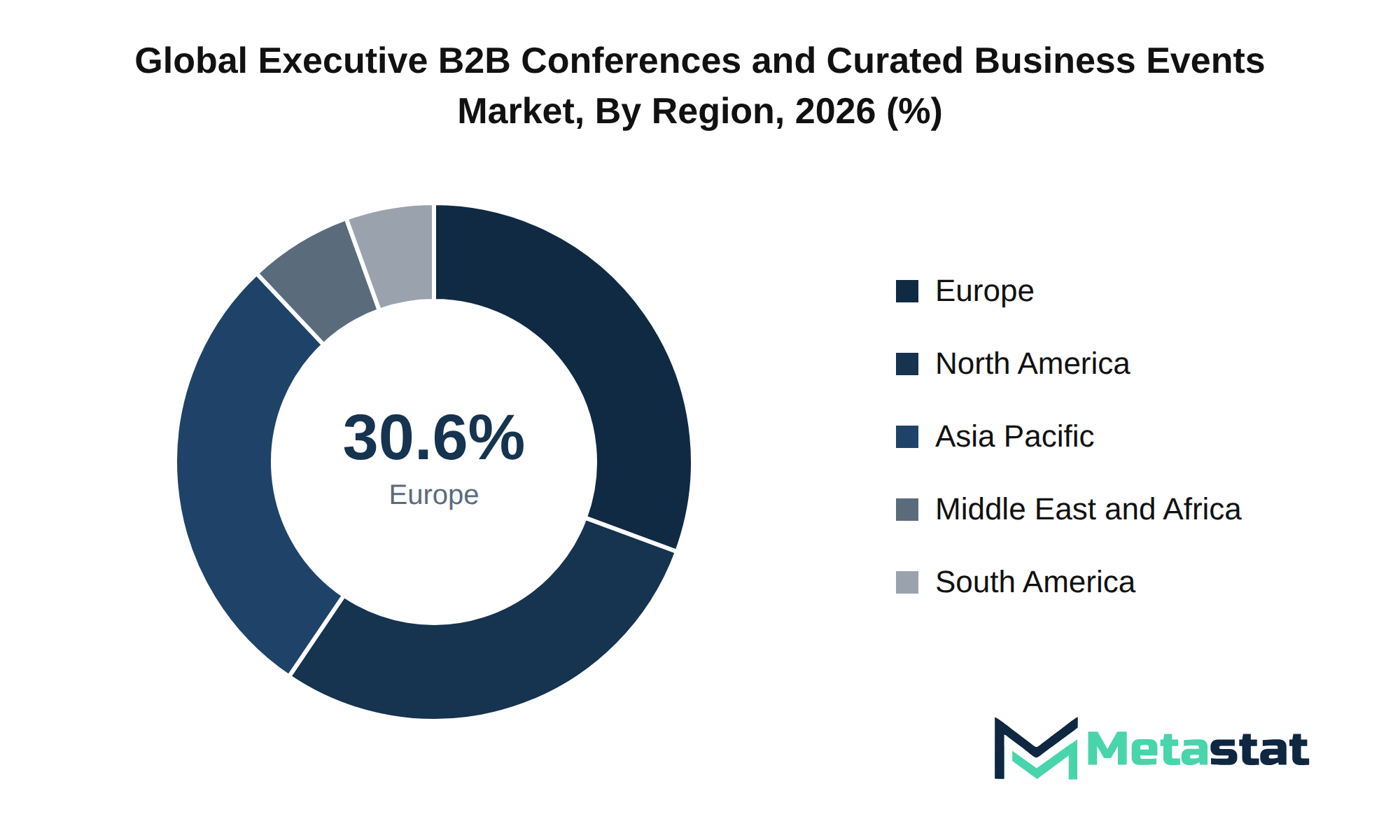
Europe captured 30.6% of the Executive B2B Conferences and Curated Business Events market in 2025. Countries including Germany, France, the UK, Italy, Spain, and Russia contribute to this robust market through diverse event formats, including executive conferences, leadership forums, and corporate meetings. The focus on high-profile gatherings to facilitate networking and knowledge sharing drives increasing demand across various sectors.
Investment in infrastructure modernization plays a critical role in enhancing the effectiveness of curated business events. Improved venues and technological advancements in communication ensure that events remain engaging and relevant within the European context. The established presence of domestic market participants supports a competitive environment, encouraging vendors to innovate and optimize their offerings.
Cultural nuances and regional B2B buying behaviors shape the approach to event organization in Europe. Understanding local preferences and compliance requirements enables organizers to tailor events that appeal to attendees. The market experiences steady growth, with event organizers focusing on high-value replacement cycles and incremental growth vectors to retain and expand their audience base.
Geopolitical factors influence the market dynamics. Regional fragmentation encourages localized procurement dynamics, while cross-border trade corridors facilitate collaboration among companies across different European nations. This interconnectedness enhances opportunities for growth within the Executive B2B Conferences and Curated Business Events market.
Asia-Pacific
Asia-Pacific represents a growing share of the Executive B2B Conferences and Curated Business Events market, accounting for 28.5% in 2025. The region benefits from rapid economic growth, increased corporate investments, and a growing middle class, leading to heightened demand for business events. Countries including China and India emerge because front-runners, driven by expanding industries and a growing emphasis on networking and collaboration among businesses. Technological adoption in South Korea and Japan facilitates innovative event formats and enhances attendee experiences.
Infrastructure modernization in Australia and Southeast Asia supports the growth of the market by improving connectivity and access to venues. The presence of diverse industries creates an environment ripe for various event types, including executive conferences, industry congresses, and leadership forums. Local buyer behavior reflects cultural nuances, favoring personalized and high-value interactions that cater to specific business needs.
Regional competitive dynamics involve a mix of established players and new entrants, driving vendor consolidation trends and localized procurement strategies. The growth of domestic market participants highlights the importance of understanding regional demands and aligning offerings with local preferences. Overall, Asia-Pacific presents a range of opportunities for stakeholders in the Executive B2B Conferences and Curated Business Events market, driven by investment and evolving market conditions.
South America
South America represents a smaller share of the Executive B2B Conferences and Curated Business Events market, accounting for 5.5% in 2025. Countries like Brazil and Argentina play vital roles in driving attendance and participation in various events, including corporate meetings and leadership retreats. The region's diverse economic landscape creates unique opportunities for tailored event offerings that cater to local industries, including agriculture, tourism, and energy.
Investment in infrastructure continues to enhance the overall event experience. Improved transportation networks and venue availability contribute to increased attendance at business events, stimulating growth in the market. Local demand for conferences and summits reflects the necessity for knowledge exchange and networking opportunities among regional businesses.
Emerging market front-runners in South America, particularly Brazil, demonstrate a commitment to hosting high-profile executive conferences. This focus on leadership forums and roundtables facilitates the exchange of insights on best practices and industry trends. The market's evolution aligns with a broader trend of strengthening regional business ties, indicating significant potential for growth.
Localized procurement dynamics and cultural nuances influence B2B buying behaviors in South America. Organizations prioritize events that align with local customs and business practices, leading to increased participation. This cultural alignment creates a conducive environment for networking and relationship-building, further driving event attendance.
Strategic entry barriers, including regulatory frameworks and compliance mandates, impact the market landscape. International companies seeking to expand operations in South America navigate these complexities, which delay market entry but ultimately enhance the competitive landscape. Overall, the Executive B2B Conferences and Curated Business Events market in South America is poised for incremental growth driven by evolving regional dynamics.
Middle East and Africa
The market in the Middle East and Africa shows potential for growth driven by increasing interest in Executive B2B Conferences and Curated Business Events. Countries including Saudi Arabia and the UAE exhibit rising demand for high-profile events, particularly within the technology and energy sectors. Investment in local infrastructure development enhances the ability to host international events, creating opportunities for market expansion.
Local compliance mandates and cultural nuances in the region shape B2B buying behaviors, affecting event formats and engagement strategies. The presence of domestic companies in sectors including healthcare and finance influences the competitive landscape, driving innovation and diversification in event offerings. The growth of event types like Leadership Forums and Corporate Meetings reflects evolving business dynamics and networking needs.
The region demonstrates an underpenetrated territory ripe for investment. Emerging trends in localized procurement and supply chain regionalization support the demand for curated business events. Continued foreign direct investment is expected to enhance the market's attractiveness, promoting further growth in the Executive B2B Conferences and Curated Business Events market.
Competitive Landscape and Strategic Insights
The Executive B2B Conferences and Curated Business Events market experiences significant strategic consolidation driven by companies aiming to enhance their reach and service offerings. Firms including Access Intelligence LLC and Arena International Events Group focus on expanding their portfolios through strategic alliances and joint ventures, allowing them to tap into new customer segments and geographical markets.
Pricing architectures in this market exhibit diversity, with companies like Bloomberg L.P. and C5 Group Inc. implementing tiered pricing models based on attendee access and service levels. This approach enables different customer segments to engage with the events, enhancing overall brand equity and customer retention strategies.
Product differentiation is essential, with firms like Gartner, Inc. and Forrester Research, Inc. investing in proprietary technology and R&D pipelines to create unique event experiences. Hybrid delivery modes, increasingly adopted by companies including Informa Connect Limited and Hyve Group, cater to varying customer preferences, enabling greater participation and engagement.
Barriers to entry in the market remain significant due to established players holding strong brand equity and extensive customer relationships. New entrants face challenges in competing with established companies that leverage their supply chain dominance and procurement leverage to enhance operational efficiencies. The future competitive outlook indicates a continued focus on strategic growth vectors, with firms evaluating their technological defensibility and intellectual property portfolios to secure their positions in the market.
Forecast and Future Outlook
Forecast and Future Outlook
Market size is forecast to rise from USD 777.7 billion in 2025 to over USD 1,516.3 billion by 2033. This growth reflects a compound annual growth rate (CAGR) of 8.7%. The base case scenario indicates steady growth driven by increasing demand for Executive B2B Conferences and Curated Business Events, attributed to companies prioritizing networking and knowledge-sharing opportunities.
In a bullish scenario, factors including favorable economic conditions, heightened corporate investment in events, and advancements in technology could further accelerate growth. Conversely, in a bearish outlook, potential economic downturns, increased virtual competition, and geopolitical tensions could hinder market expansion.
While downstream demand evolves, companies prioritize strategic capital allocation and infrastructure commitments to enhance their event offerings. Key sectors like technology, healthcare, and finance are expected to drive growth, capturing high-value opportunities within the Executive B2B Conferences and Curated Business Events market. Regulatory changes and compliance milestones influence operational strategies, ensuring that stakeholders adapt effectively to emerging requirements.
Strategic imperatives guide companies in navigating structural consumption shifts and integrating next-generation technologies, enhancing the overall attendee experience. Continuous innovation and responsiveness to unmet enterprise needs create high-growth pockets, positioning market players competitively within the evolving environment.
Executive B2B Conferences and Curated Business Events Market Key Segments
By Event Type:
Executive Conferences & Summits
Leadership Forums & Roundtables
Corporate Meetings & Leadership Retreats
Industry Congresses & Professional Conferences
Workshops & Masterclasses
Networking & Peer-Exchange Events
Awards & Recognition Events
Others (Executive Briefings, Business Dinners)
By Primary Attendee Access Model:
Open Registration
Application or Qualification-Based
Invitation-Only
Hosted-Buyer or Pre-Matched Meeting
Membership or Community-Gated
Internal / Company-Only
By Delivery Mode:
In-Person
Virtual
Hybrid
By Industry Vertical:
Technology & Telecommunications
BFSI
Healthcare & Life Sciences
Energy & Utilities
Manufacturing & Industrial
Retail & Consumer
Travel, Hospitality & Transportation
Professional & Business Services
Government & Public Sector
Others (Real Estate, Media & Entertainment)
By Region:
North America
Europe
Asia-Pacific
South America
Middle East and Africa
Key Global Executive B2B Conferences and Curated Business Events Industry Players
The report strategically identifies and profiles the key market players and analyses their core competencies in each sub-segment of the Executive B2B Conferences and Curated Business Events market.
Report Attributes
Details
Study Period
2021-2033
Base Year
2025
Estimated Year
2026
Forecast Period
2026-2033
Historical Period
2021-2025
Growth Rate
CAGR 8.7% from 2026 to 2033
Revenue Unit
USD billion
Segmentation
By Event Type, Primary Attendee Access Model, Delivery Mode, Industry Vertical, and Region
By Region
North America (By Event Type, Primary Attendee Access Model, Delivery Mode, Industry Vertical, and Country)
United States
Canada
Mexico
Europe (By Event Type, Primary Attendee Access Model, Delivery Mode, Industry Vertical, and Country)
Germany
France
UK
Italy
Spain
Russia
Rest of the Europe
Asia Pacific (By Event Type, Primary Attendee Access Model, Delivery Mode, Industry Vertical, and Country)
China
Japan
India
South Korea
Australia
Southeast Asia
Rest of Asia Pacific
South America (By Event Type, Primary Attendee Access Model, Delivery Mode, Industry Vertical, and Country)
Brazil
Argentina
Rest of South America
Middle East and Africa (By Event Type, Primary Attendee Access Model, Delivery Mode, Industry Vertical, and Country)
Saudi Arabia
UAE
South Africa
Rest of Middle East and Africa
What Report Provides
Company Market Share, Revenue and Ranking for the Executive B2B Conferences and Curated Business Events Market
Key Market Leaders in the Executive B2B Conferences and Curated Business Events Market
Full In-Depth Analysis of the Parent Industry Dynamics
Industry Statistics Relevant to the Executive B2B Conferences Market
Important Changes in Market Trends and Dynamics
Segmentation Details of the Executive B2B Conferences Market
Historical, Ongoing, and Projected Market Analysis
Key Strategies of Major Players in the Market
End of Report Overview
Frequently Asked Questions
Find answers to common questions about this report
The Executive B2B Conferences and Curated Business Events market size was valued at USD 777.7 billion in 2025, according to the Metastat Insights study.
The Executive B2B Conferences and Curated Business Events market is projected to grow at a CAGR of 8.7% during the forecast period from 2026 to 2033.
The North America Executive B2B Conferences and Curated Business Events market size is estimated to reach USD 409.4 billion by 2033.
The segment of Executive Conferences & Summits leads the Executive B2B Conferences and Curated Business Events market, with a projected value of USD 381.4 billion by 2033. This segment demonstrates a compound annual growth rate of 9.2 percent during the forecast period.
Robust economic growth enhances corporate spending on events, driving demand in the Executive B2B Conferences and Curated Business Events market. Increased GDP facilitates higher capital investment, leading organizations to prioritize participation in these essential platforms for networking, knowledge sharing, and collaboration. Technological integration further supports market growth by streamlining event planning and enhancing attendee experiences.
Europe holds the dominant share of the Executive B2B Conferences and Curated Business Events market, representing 30.6 percent of the total market in 2033.
Current macroeconomic headwinds, including high inflation and economic uncertainty, restrict the Executive B2B Conferences and Curated Business Events market growth. Increased operating costs and reduced budgets limit participation from key stakeholders, while geopolitical fragmentation complicates international collaboration and planning, further impacting attendance and profitability.
Robust economic growth enhances corporate spending on events and networking opportunities, driving product adoption. Increased disposable income among professionals encourages participation in conferences that offer valuable networking and learning experiences. Technological integration, including automation and data analytics, streamlines event planning and enhances attendee engagement, further supporting market adoption.
The Executive B2B Conferences and Curated Business Events market is estimated to reach a valuation of USD 1,516.3 billion by 2033.
Key players in the Executive B2B Conferences and Curated Business Events market include Access Intelligence LLC, Arena International Events Group, Bloomberg L.P., C5 Group Inc., Clarion Events Ltd., and Informa Connect Limited.
Choose Your License
Global Executive B2B Conferences and Curated Business Events Market
Industrial Inspection and Technical Services Outsourcing
Industrial Inspection and Technical Services Outsourcing market size is valued at USD 35.2 billion in 2025 and projected to reach USD 60.1 billion by 2033.
Industrial Inspection and Technical Services Outsourcing market, Industrial Inspection and Technical Services Outsourcing Market Size, Industrial Inspection and Technical Services Outsourcing Market Share, Industrial Inspection and Technical Services Outsourcing Market Analysis, Industrial Inspection and Technical Services Outsourcing Market Growth, Industrial Inspection and Technical Services Outsourcing Market Trends, Industrial Inspection and Technical Services Outsourcing Market Research Report, Industrial Inspection and Technical Services Outsourcing Market Forecast, Industrial Inspection and Technical Services Outsourcing, Industrial Inspection and Technical Services Outsourcing Market Research, Industrial Inspection and Technical Services Outsourcing Industry, Industrial Inspection and Technical Services Outsourcing Industry Report, Industrial Inspection and Technical Services Outsourcing Market Data, Industrial Inspection and Technical Services Outsourcing Statistics, Industrial Inspection and Technical Services Outsourcing Market Statistics, Industrial Inspection and Technical Services Outsourcing Industry Trends, Industrial Inspection and Technical Services Outsourcing Market Report, Industrial Inspection and Technical Services Outsourcing Market Trends, Industrial Inspection and Technical Services Outsourcing Market News, Industrial Inspection and Technical Services Outsourcing Forecasts, Industrial Inspection and Technical Services Outsourcing Market Intelligence Report, Industrial Inspection and Technical Services Outsourcing market outlook, Industrial Inspection and Technical Services Outsourcing market segmentation, Industrial Inspection and Technical Services Outsourcing market drivers, Industrial Inspection and Technical Services Outsourcing market restraints, Industrial Inspection and Technical Services Outsourcing market opportunities, Industrial Inspection and Technical Services Outsourcing market CAGR, Industrial Inspection and Technical Services Outsourcing suppliers, Industrial Inspection and Technical Services Outsourcing manufacturers, North America Industrial Inspection and Technical Services Outsourcing market, Asia Pacific Industrial Inspection and Technical Services Outsourcing market, Europe Industrial Inspection and Technical Services Outsourcing market, Industrial Inspection and Technical Services Outsourcing market competitive landscape, Industrial Inspection and Technical Services Outsourcing market key players, Third-Party Inspection and Vendor Surveillance market, Non-Destructive Testing and Examination market, Asset Integrity and Mechanical Integrity Management market, Quality Assurance and Quality Control market, Oil and Gas Industrial Inspection and Technical Services Outsourcing market, Power Generation and Utilities Industrial Inspection and Technical Services Outsourcing market.
Language Services Market Size, Share, Trends, 2033
Global Language Services market size: USD 79.7 billion in 2025, forecast USD 146.5 billion by 2033 at a 7.9% CAGR, with segment and regional analysis.
Language Services market, Language Services Market Size, Language Services Market Share, Language Services Market Analysis, Language Services Market Growth, Language Services Market Trends, Language Services Market Research Report, Language Services Market Forecast, Language Services, Language Services Market Research, Language Services Industry, Language Services Industry Report, Language Services Market Data, Language Services Statistics, Language Services Market Statistics, Language Services Industry Trends, Language Services Market Report, Language Services Market Trends, Language Services Market News, Language Services Forecasts, Language Services Market Intelligence Report, Language Services market 2033, Language Services market outlook, Language Services market segmentation, Language Services market drivers, Language Services market restraints, Language Services market opportunities, Language Services market CAGR, Language Services suppliers, Language Services manufacturers, Language Services market by region, North America Language Services market, Asia Pacific Language Services market, Europe Language Services market, Language Services market competitive landscape, Language Services market key players, Translation Services market, Localization Services market, Interpretation Services market, Multilingual Content Management Services market, Cloud-based Language Services market, Machine Translation market, Generative AI Translation market, Healthcare Language Services market.
Real Estate Valuation Services Market Size, Share, 2033
Real Estate Valuation Services market size is valued at USD 14.2 billion in 2025 and projected to reach USD 21 billion by 2033, growing at a CAGR of 5%.
Real Estate Valuation Services market, Real Estate Valuation Services Market Size, Real Estate Valuation Services Market Share, Real Estate Valuation Services Market Analysis, Real Estate Valuation Services Market Growth, Real Estate Valuation Services Market Trends, Real Estate Valuation Services Market Research Report, Real Estate Valuation Services Market Forecast, Real Estate Valuation Services, Real Estate Valuation Services Market Research, Real Estate Valuation Services Industry, Real Estate Valuation Services Industry Report, Real Estate Valuation Services Market Data, Real Estate Valuation Services Statistics, Real Estate Valuation Services Market Statistics, Real Estate Valuation Services Industry Trends, Real Estate Valuation Services Market Report, Real Estate Valuation Services Market Trends, Real Estate Valuation Services Market News, Real Estate Valuation Services Forecasts, Real Estate Valuation Services Market Intelligence Report, Real Estate Valuation Services Market 2033, Real Estate Valuation Services Market Outlook, Real Estate Valuation Services Market Segmentation, Real Estate Valuation Services Market Drivers, Real Estate Valuation Services Market Restraints, Real Estate Valuation Services Market Opportunities, Real Estate Valuation Services Market CAGR, Real Estate Valuation Services Suppliers, Real Estate Valuation Services Manufacturers, Real Estate Valuation Services Market by Region, North America Real Estate Valuation Services Market, Asia Pacific Real Estate Valuation Services Market, Europe Real Estate Valuation Services Market, Real Estate Valuation Services Market Competitive Landscape, Real Estate Valuation Services Market Key Players, Property Appraisal and Valuation Market, Portfolio and Fund Valuation Services, Financial Reporting and Tax Valuation Market, Lending and Mortgage Security Valuation, Transaction and Due Diligence Valuation, Banks and Financial Institutions Valuation Services, Institutional Investors and Asset Managers Valuation Services, Corporates, REITs and Property Developers Valuation Services
Multi-family and HOA Property Management Software Market Size, Share, and Forecast 2033
Multi-family and HOA Property Management Software market size is valued at USD 2,519.4 million in 2025 and projected to reach USD 4,265.8 million by 2033.
Multi-family and HOA Property Management Software market, Multi-family and HOA Property Management Software Market Size, Multi-family and HOA Property Management Software Market Share, Multi-family and HOA Property Management Software Market Analysis, Multi-family and HOA Property Management Software Market Growth, Multi-family and HOA Property Management Software Market Trends, Multi-family and HOA Property Management Software Market Research Report, Multi-family and HOA Property Management Software Market Forecast, Multi-family and HOA Property Management Software, Multi-family and HOA Property Management Software Market Research, Multi-family and HOA Property Management Software Industry, Multi-family and HOA Property Management Software Industry Report, Multi-family and HOA Property Management Software Market Data, Multi-family and HOA Property Management Software Statistics, Multi-family and HOA Property Management Software Market Statistics, Multi-family and HOA Property Management Software Industry Trends, Multi-family and HOA Property Management Software Market Report, Multi-family and HOA Property Management Software Market Trends, Multi-family and HOA Property Management Software Market News, Multi-family and HOA Property Management Software Forecasts, Multi-family and HOA Property Management Software Market Intelligence Report, Multi-family and HOA Property Management Software market 2033, Multi-family and HOA Property Management Software market outlook, Multi-family and HOA Property Management Software market segmentation, Multi-family and HOA Property Management Software market drivers, Multi-family and HOA Property Management Software market restraints, Multi-family and HOA Property Management Software market opportunities, Multi-family and HOA Property Management Software market CAGR, Multi-family and HOA Property Management Software suppliers, Multi-family and HOA Property Management Software manufacturers, Multi-family and HOA Property Management Software market by region, North America Multi-family and HOA Property Management Software market, Asia Pacific Multi-family and HOA Property Management Software market, Europe Multi-family and HOA Property Management Software market, Multi-family and HOA Property Management Software market competitive landscape, Multi-family and HOA Property Management Software market key players, Accounting and Financial Management Multi-family and HOA Property Management Software, Leasing and Resident Management Multi-family and HOA Property Management Software, Maintenance and Work Order Management Multi-family and HOA Property Management Software, Community Governance and Communication Multi-family and HOA Property Management Software, Cloud Multi-family and HOA Property Management Software, Hybrid Deployment Multi-family and HOA Property Management Software, On-Premises Multi-family and HOA Property Management Software, Third-Party Property Management Companies Multi-family and HOA Property Management Software, Multifamily Owners and Operators Multi-family and HOA Property Management Software, HOA and Condominium Management Companies Multi-family and HOA Property Management Software, Self-Managed Associations and Boards Multi-family and HOA Property Management Software.