
LEAD ANALYST
Utkarsh Khirodkar is a Lead Market Research Analyst at MetaStat Insight, specializing in market intelligence, technology sector assessments, and competitive strategy.

Global Industrial Coating Equipment Market Size, Share, By Equipment Type (Spray Guns, Spray Booths, Conveyors, and Others), By Technology (Powder Coating, Liquid Coating, UV Curing, and Electron Beam Curing), By Substrate (Metal, Plastic, Wood, and Glass), By End-Use Industry (Automotive, Aerospace, Construction, Electronics, Oil, Gas, and Others), Industry Analysis, Growth, Trends, and Forecast, 2026-2033
Report ID
MSI-4595
Published
April, 2026
Pages
320 Pages
Format
Report Details
Choose Your License
Global Industrial Coating Equipment Market
Global Industrial Coating Equipment market size is valued at USD 23.4 billion in 2025 and projected to grow at a CAGR of 5.3% during the forecast period, reaching USD 35.4 billion by 2033.
North America holds a 28.8% market share in 2025, with the U.S. leading the regional market.
Spray Guns segment accounts for a 27.3% market share in 2025.
Key trends driving growth: Rising adoption of automated and high-throughput finishing lines in manufacturing, along with increasing need for uniform coating quality, transfer efficiency, and material waste reduction.
Opportunities include the expansion of smart, energy-efficient, and digitally monitored coating systems for Industry 4.0 production environments.
Key insight: Automation-led production expansion across manufacturing sectors is accelerating demand for advanced industrial coating equipment worldwide.
The Global Industrial Coating Equipment market plays a vital role in modern manufacturing processes, where surface finishing, protection, and durability remain essential to product performance and lifecycle cost. Industrial coating equipment supports the application of protective and decorative coatings across materials such as metal, plastic, wood, and glass. Manufacturers rely on these systems to ensure corrosion resistance, improved surface performance, thermal insulation, and enhanced visual appearance of industrial products.
Rapid industrial expansion across emerging economies has created strong demand for advanced coating systems capable of handling large production volumes while maintaining consistent coating thickness and quality. Manufacturing sectors increasingly require equipment that reduces overspray, improves transfer efficiency, and supports automated production environments. These operational priorities have accelerated the adoption of robotic spray systems, enclosed spray booths, and integrated conveyor-based coating lines across large-scale manufacturing facilities.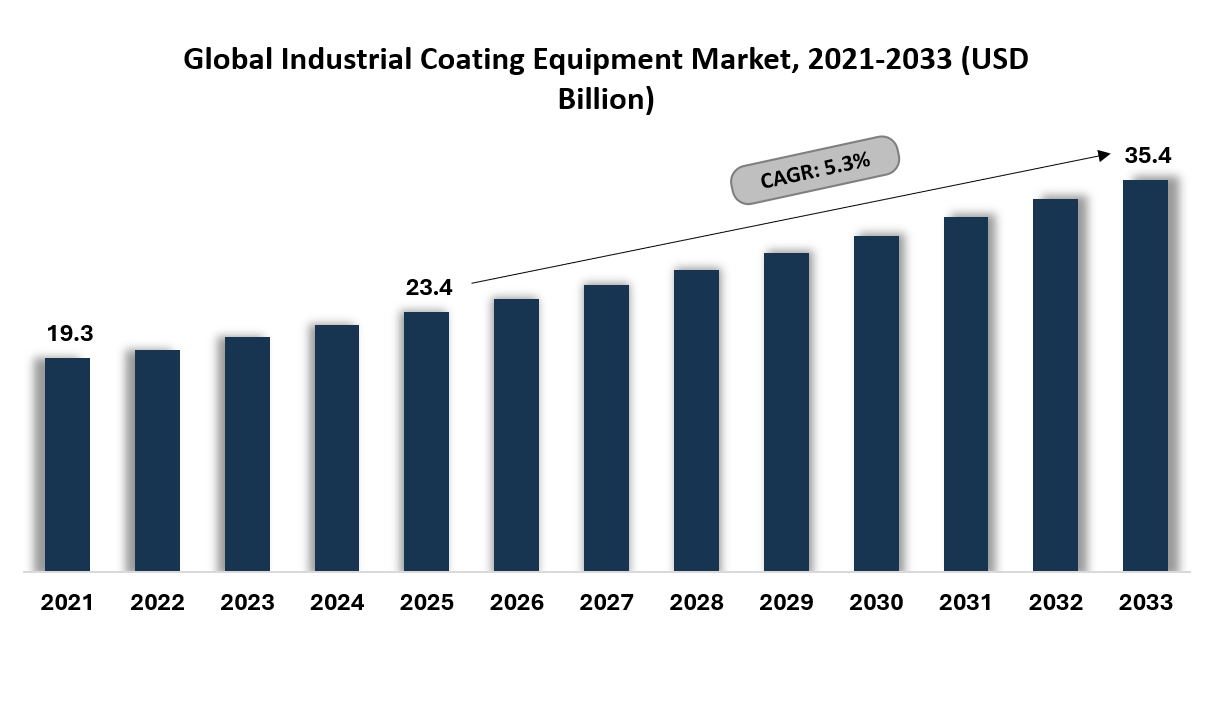
Rising adoption of automated and high-throughput finishing lines in manufacturing.
Manufacturers across automotive, aerospace, and electronics industries continue to scale production capacity, creating strong demand for integrated coating systems that operate within automated production lines. Advanced spray technologies and robotic coating systems help manufacturers achieve consistent surface finishing across high-volume production batches.
Increasing need for uniform coating quality, transfer efficiency, and material waste reduction
Operational efficiency remains a key priority in modern production environments. Companies increasingly seek coating equipment that improves material utilization, reduces overspray, and minimizes waste. These improvements help lower production costs while maintaining high coating performance, thereby strengthening demand across the Global Industrial Coating Equipment market.
High capital cost associated with integrated coating lines, robotics, and curing systems
Installation of advanced industrial coating equipment often requires significant upfront investment. Large, automated coating lines involve the integration of spray systems, curing chambers, ventilation systems, and material-handling infrastructure, which can create financial barriers for small and mid-sized manufacturers.
Stringent environmental and worker-safety compliance requirements for emissions and overspray control
In addition, environmental regulations governing volatile organic compound emissions and workplace safety standards continue to shape equipment design and operating practices. Manufacturers operating in regulated industries comply with strict environmental requirements, which can increase equipment complexity and operational costs in the Global Industrial Coating Equipment market.
Expansion of smart, energy-efficient, and digitally monitored coating systems for Industry 4.0 production environments
Growing adoption of connected manufacturing technologies is creating new opportunities within the Global Industrial Coating Equipment market. Equipment manufacturers are introducing coating systems equipped with digital monitoring tools, automated process controls, and real-time analytics that help optimize coating performance and maintain consistent production quality.
The Global Industrial Coating Equipment market is classified based on Equipment Type, Technology, Substrate, and End-Use Industry.
Spray Guns segment is valued at USD 6.7 billion in 2026 and is projected to reach USD 8.6 billion by 2033, at a CAGR of 3.5% during the forecast period.
Spray guns remain one of the widely used equipment categories in the Global Industrial Coating Equipment market owing to their versatility, precision, and ability to handle a wide range of coating materials. These systems are widely deployed across automotive production lines and industrial manufacturing facilities where accurate coating application is required.
Spray Booths segment is valued at USD 6.8 billion in 2026 and is projected to reach USD 10.8 billion by 2033, at a CAGR of 6.8% during the forecast period.
Spray booths play an essential role in maintaining controlled environments for coating processes. Spray booths help prevent contamination, improve worker safety, and ensure consistent coating conditions. Demand for advanced spray booths continues to rise owing to stricter environmental regulations and workplace safety requirements.
Conveyors segment is valued at USD 5.8 billion in 2026 and is projected to reach USD 9.1 billion by 2033, at a CAGR of 6.6% during the forecast period.
Conveyor systems support automated material handling within coating lines. Conveyor systems enable manufacturers to move components efficiently through key coating stages such as surface preparation, coating application, curing, and inspection. Growing adoption of automated manufacturing lines is driving demand for integrated conveyor-based coating solutions.
Others segment is valued at USD 5.3 billion in 2026 and is projected to reach USD 6.9 billion by 2033, at a CAGR of 4% during the forecast period.
Additional equipment categories support specialized coating processes across a wide range of industrial activities. Equipment such as curing ovens, mixing units, filtration systems, and inspection tools plays an important supporting role in the Global Industrial Coating Equipment market. Technological upgrades focused on automation, precision monitoring, temperature control, and operational efficiency improve overall coating workflow reliability.
Powder Coating segment is projected to reach USD 12.5 billion by 2033, at a CAGR of 4.4% during the forecast period.
Powder coating technology continues to gain traction across industrial applications owing to its strong finish quality, reduced solvent usage, and high material utilization. Equipment used in powder coating supports efficient application, improved adhesion, and lower environmental impact across metal components, appliances, automotive parts, and industrial products. Advancements in electrostatic spray systems, curing technologies, and powder recovery units are further strengthening the segment outlook.
Liquid Coating segment is projected to reach USD 14.8 billion by 2033, at a CAGR of 4.8% during the forecast period.
Liquid coating technology remains a widely adopted solution across industries requiring flexibility in coating formulation, finish appearance, and application performance. Equipment designed for liquid coating supports accurate spray control, efficient fluid delivery, and compatibility with a wide range of substrates and coating materials. Ongoing improvements in atomization, viscosity control, and drying efficiency are helping manufacturers maintain finish quality and operational productivity.
UV Curing segment is projected to reach USD 5.3 billion by 2033, at a CAGR of 7.7% during the forecast period.
UV curing equipment is gaining wider adoption in industrial finishing processes that require fast curing speed, reduced production time, and improved line efficiency. These systems enable rapid hardening of coatings under ultraviolet exposure, making them suitable for electronics, wood finishing, packaging, and other fast-cycle applications. Rising focus on productivity enhancement and energy-efficient curing methods continues to support demand for UV curing technologies.
Electron Beam Curing segment is projected to reach USD 2.9 billion by 2033, at a CAGR of 8.1% during the forecast period.
Electron beam curing technology is emerging as a specialized solution for industrial applications requiring solvent-free coating processes, deep curing performance, and high process efficiency. Equipment used in electron beam curing supports rapid coating hardening without the need for excessive thermal exposure, making it valuable in advanced and high-precision manufacturing environments. Increasing interest in sustainable and high-performance coating solutions will support segment growth.
Metal segment is projected to reach USD 17.5 billion by 2033.
Metal remains the leading substrate category for industrial coating equipment owing to its extensive usage across automotive, machinery, construction, aerospace, and industrial component manufacturing. Coating systems designed for metal surfaces help improve corrosion resistance, abrasion protection, and long-term durability under demanding operating conditions. Strong industrial demand for protective and performance-oriented coatings continues to support equipment deployment across metal processing applications.
Plastic segment is projected to reach USD 9.3 billion by 2033.
Plastic substrates require coating systems capable of delivering strong adhesion, surface protection, and decorative finishing without damaging heat-sensitive materials. Equipment used for plastic coating supports applications across consumer goods, automotive interiors, electronics housings, and industrial components. Advancements in precision spraying, controlled curing, and low-temperature coating processes are helping manufacturers improve finish quality across plastic-based products.
Wood segment is projected to reach USD 5.4 billion by 2033.
Wood coating equipment supports furniture manufacturing, cabinetry, flooring, doors, panels, and other interior and architectural applications that require consistent finishing quality and surface protection. These systems help improve appearance, moisture resistance, scratch protection, and coating uniformity across wood products. Growing demand for automated wood finishing lines and higher production efficiency is supporting market growth within this substrate segment.
Glass segment is projected to reach USD 3.3 billion by 2033.
Glass coating applications require specialized equipment capable of delivering precision, cleanliness, and finish consistency across decorative, protective, and functional coating processes. Equipment used for glass substrates supports applications in automotive glazing, construction glass, electronics, and specialty industrial products. Rising need for improved surface performance, optical quality, and controlled coating environments is supporting adoption across glass manufacturing operations.
Automotive segment is projected to grow at a CAGR of 5% during the forecast period.
Automotive manufacturing remains a major end-use segment for industrial coating equipment owing to strong requirements for corrosion resistance, surface aesthetics, and high-throughput finishing operations. Vehicle producers rely on advanced coating systems for body components, structural parts, wheels, interior elements, and specialty finishes. Increasing automation within vehicle production lines continues to strengthen demand for robotic and precision-controlled coating equipment.
Aerospace segment is projected to grow at a CAGR of 6.3% during the forecast period.
Aerospace applications require high-performance coating equipment capable of delivering precision, consistency, and compliance with strict technical standards. Coating systems used in aerospace manufacturing support protection against corrosion, temperature variation, chemical exposure, and structural wear across aircraft components and assemblies. Rising focus on component reliability, lightweight materials, and surface performance continues to support demand within this segment.
Construction segment is projected to grow at a CAGR of 4.8% during the forecast period.
Construction-related manufacturing supports steady demand for coating equipment used on structural steel, metal profiles, pipes, panels, machinery, and protective infrastructure components. Coating systems in this segment help improve weather resistance, corrosion protection, and surface durability across materials exposed to demanding external conditions. Ongoing infrastructure development and industrial fabrication activity continue to support equipment adoption.
Electronics segment is projected to grow at a CAGR of 7.3% during the forecast period.
Electronics manufacturing increasingly depends on advanced coating equipment for insulation, moisture protection, chemical resistance, and precision surface treatment across sensitive components. Coating systems used in this segment support printed circuit boards, connectors, housings, and miniature electronic parts that require controlled application and rapid curing. Rising electronics production and increasing miniaturization trends are supporting demand for highly precise coating technologies.
Oil & Gas segment is projected to grow at a CAGR of 4% during the forecast period.
Oil & Gas operations require industrial coating equipment for applications involving pipelines, storage systems, drilling equipment, valves, and structural components exposed to harsh environments. Coating systems help improve corrosion resistance, chemical protection, and equipment life across upstream, midstream, and downstream operations. Demand remains supported by the need for durable protective coatings in energy infrastructure and heavy industrial assets.
Others segment is projected to grow at a CAGR of 4.4% during the forecast period.
Other end-use industries, including marine, heavy machinery, industrial equipment, and general fabrication, continue to contribute to demand for industrial coating equipment. These sectors require coating systems that improve surface durability, operational life, and finish consistency across a broad variety of industrial products. Broader industrial modernization and expansion of automated finishing capabilities will support long-term segment demand.
Based on geography, the Global Industrial Coating Equipment market is divided into North America, Europe, Asia-Pacific, South America, Middle East, and Africa.
North America Industrial Coating Equipment Market is set to expand at a CAGR of 5.3% within the forecast period, reaching a market size (TAM) of USD 9.2 billion by the end of 2033.
Strong presence of automobile and aerospace manufacturing centers assisting steady demand for advanced coating structures within the North America Industrial Coating Equipment market.
Europe Industrial Coating Equipment market is supported by strong automotive, aerospace, machinery, and industrial manufacturing activity, creating steady demand for advanced coating systems across the region.
Rapid expansion of manufacturing hubs throughout China, India, and Southeast Asia developing robust equipment demand inside the Asia Pacific Industrial Coating Equipment market.
Industrial improvement across electricity, creation, and production sectors is steadily growing adoption of business finishing technology within rising markets across Middle East, Africa, and South America.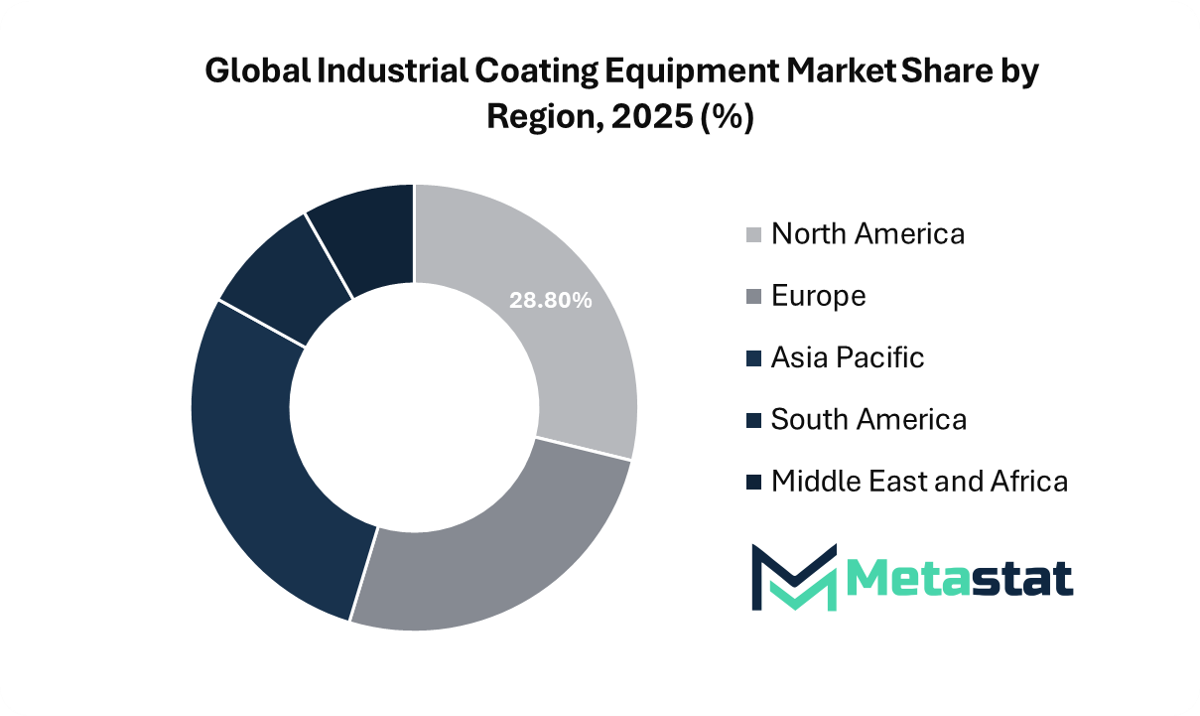
The global industrial coating equipment market will expand steadily as manufacturing industries place greater emphasis on surface protection, durability, and finishing quality. Coating equipment plays a critical role in applying paints, powders, and protective layers to metal, plastic, and other industrial materials. These coatings help prevent corrosion, reduce wear, and improve the overall appearance of products used across automotive, aerospace, construction, and electronics sectors. Rising industrial activity across these sectors is increasing the need for efficient coating technologies that deliver consistent results while reducing material waste and operating costs.
Technological advancement will remain a major factor shaping the market. Companies are developing equipment that offers higher precision, faster application, and improved process control during coating operations. Automated spray systems, electrostatic coating machines, and advanced curing technologies support manufacturers in maintaining uniform finishes while reducing manual intervention. Industries are also placing greater focus on environmental performance, which is encouraging adoption of equipment designed to reduce overspray, lower emissions, and optimize coating material consumption. These trends support production efficiency while helping manufacturers meet environmental compliance requirements.
Several prominent companies contribute to the development and supply of industrial coating equipment across global markets. Leading participants include Nordson Corporation, Graco Inc., J. Wagner GmbH, Gema Switzerland GmbH, Binks, Sames, Anest Iwata Corporation, SATA GmbH & Co. KG, and Dürr AG. These companies specialize in advanced spray systems, powder coating technologies, and automated finishing solutions that support high-volume manufacturing environments. Continued investment in product development and strategic partnerships will strengthen their market position.
Other notable participants include WIWA Wilhelm Wagner GmbH & Co. KG, Krautzberger GmbH, Walther Spritz- und Lackiersysteme GmbH, Larius S.r.l., Asahi Sunac Corporation, Global Finishing Solutions, Cefla Finishing, Deimco Finishing Inc., RTT Finishing Solutions, and Rohner Finishing Systems. In addition, SEHON Innovative Lackieranlagen und -Technik GmbH, Euroimpianti S.r.l., Venjakob Maschinenbau GmbH & Co. KG, Robert Bürkle GmbH, and Giardina Group continue to expand their product portfolios and improve coating line performance for industrial customers. Their efforts support the growing demand for reliable coating equipment that meets the needs of modern manufacturing facilities worldwide.
Market size is forecast to rise from USD 23.4 billion in 2025 to over USD 35.4 billion by 2033.
The Global Industrial Coating Equipment market is expected to witness steady expansion during the forecast period, supported by increasing production capacity and the adoption of advanced finishing technologies across manufacturing industries. Rising demand for corrosion protection, improved product durability, and high-quality surface finishing will remain key factors supporting equipment adoption across multiple end-use sectors.
By Equipment Type:
By Technology:
By Substrate:
By End-Use Industry:
This research report categorizes the Industrial Coating Equipment market based on key segments and regions, forecasts revenue growth, and analyses trends in each submarket. The report analyses the key growth drivers, opportunities, and challenges influencing the Industrial Coating Equipment market. Recent market developments and competitive strategies such as expansion, product launch, partnership, merger, and acquisition have been included to draw the competitive landscape in the market.
The report strategically identifies and profiles the key market players and analyses their core competencies in each sub-segment of the Industrial Coating Equipment market.
|
Report Attributes |
Details |
|
Study Period |
2021-2033 |
|
Base Year |
2025 |
|
Estimated Year |
2026 |
|
Forecast Period |
2026-2033 |
|
Historical Period |
2021-2025 |
|
Growth Rate |
CAGR 5.3% from 2026 to 2033 |
|
Revenue Unit |
USD billion |
|
Sales Volume Unit |
Thousand Units |
|
Segmentation |
By Equipment Type, Technology, Substrate, End-Use Industry, and Region |
|
By Region |
North America (By Equipment Type, Technology, Substrate, End-Use Industry, and Country)
|
|
Europe (By Equipment Type, Technology, Substrate, End-Use Industry, and Country)
|
|
|
Asia Pacific (By Equipment Type, Technology, Substrate, End-Use Industry, and Country)
|
|
|
South America (By Equipment Type, Technology, Substrate, End-Use Industry, and Country)
|
|
|
Middle East and Africa (By Equipment Type, Technology, Substrate, End-Use Industry, and Country)
|
Find answers to common questions about this report
Global Industrial Coating Equipment market is estimated to reach USD 35.4 billion by 2033.
High capital cost associated with integrated coating lines, robotics, and curing systems will hamper the market growth within the forecast period.
The Global Industrial Coating Equipment market is expected to grow at a CAGR of 5.3% over the forecast period (2026-2033).
The Spray Guns is the leading type segment in the Global market.
North America region dominates the market.
Rising adoption of automated and high-throughput finishing lines in manufacturing and Increasing need for uniform coating quality, transfer efficiency, and material waste reduction are key driving factors, boosting the market.
Top players operating in the Industrial Coating Equipment industry include Nordson Corporation, Graco Inc., J. Wagner GmbH, Gema Switzerland GmbH, Binks, Sames, and Anest Iwata Corporation.
The Metastat Insights analysis shows that the North America Industrial Coating Equipment market size is estimated to be USD 9.2 billion by 2033.
The Metastat Insights study shows that the Global Industrial Coating Equipment market size was USD 23.4 billion in 2025.
The analysts below cover Machinery & Equipment research at Metastat Insights.
LEAD ANALYST
Utkarsh Khirodkar is a Lead Market Research Analyst at MetaStat Insight, specializing in market intelligence, technology sector assessments, and competitive strategy.

INDUSTRY CONSULTANT - CHEMICALS & ADVANCED MATERIALS
Chemicals and Materials · Machinery & Equipment · Packaging
Amit Gadhekar Consultant for Chemicals and Materials at MetaStat Insight, directing sector-specific intelligence, research, and strategic consulting across global chemical and processing markets.

PRINCIPAL CONSULTANT - QUALITY SYSTEMS & COMPLIANCE
Electronics and Semiconductor · Machinery & Equipment · Professional Services
Omkar Phadtare is an Industry Consultant at MetaStat Insight, specializing in quality systems, regulatory compliance, and standards benchmarking to drive data-driven market intelligence and strategic industry research.

ENERGY & INFRASTRUCTURE INDUSTRY CONSULTANT
Automotive and Transportation · Electronics and Semiconductor · Energy and Power · Machinery & Equipment
Saurabh Vasant Ganvir consults for Energy & Infrastructure Industry at MetaStat Insight, specializing in renewable energy, solar EPC, and electric vehicle (EV) infrastructure markets.

LEAD CONSULTANT - COMMUNICATION, TELECOM, AND IT
Electronics and Semiconductor · Information & Technology · Machinery & Equipment · Professional Services
Ravindra Sathe Consultants for Communication, Telecom, and IT at MetaStat Insight. He leads the firm's industry research initiatives across telecommunications infrastructure, digital connectivity, enterprise networking, and emerging information technology domains.
Floating offshore wind feasibility relies heavily on specialized installation vessel availability and port crane limits, which most broad renewable energy forecasts ignore. The report delivered a thorough analysis of dry dock capacity, mooring chain supply constraints, and raw material pricing trends for deepwater anchor installations. It served as a solid independent sanity check for our offshore project capital expenditure assumptions.
Assessing commercial microgrid software adoption requires looking past top-level installation numbers and examining utility interconnection queues. The research provided verifiable data on average permitting timelines, tariff structures, and battery storage integration costs across regional utility territories. That grounded perspective was valuable for our team when building five-year demand projections for industrial microgrid controllers.
Ambulatory surgical centers have very different purchasing cycles for robotic-assisted surgery platforms than major hospital networks. The MetaStat Insight study focused squarely on capital expenditure depreciation, procedural reimbursement pathways, and surgeon training overhead. That operational clarity made it much simpler to validate multi-year procedure growth forecasts against actual ambulatory center adoption patterns.
Explore related market intelligence reports worth reading alongside this one.
Starting from
$2950