
LEAD ANALYST
Utkarsh Khirodkar is a Lead Market Research Analyst at MetaStat Insight, specializing in market intelligence, technology sector assessments, and competitive strategy.

India Burger Restaurants Market Size, Share, By Type (Global QSR Burger Chains, India-Origin QSR Burger Chains, Premium Gourmet, Fast-Casual Burger Brands, Cafe, Casual Dining Brands with Burger-Led Menus, Delivery-First, Cloud Kitchen Burger Brands, Kiosk, Street-Format Burger Chains, and Franchise-Led Regional Burger Chains), By Sales Channel (Dine-In Orders, Takeaway, Pick-Up Orders, Home Delivery Orders, Drive-Thru, and Others (Event, Corporate, and Bulk Ordering), Industry Analysis, Growth, Trends, and Forecast, 2026-2033
Report ID
MSI-4591
Published
April, 2026
Pages
320 Pages
Format
Report Details
Choose Your License
India Burger Restaurants Market
The India Burger Restaurants market size was valued at USD 1,818 million in 2025 and projected to grow at a CAGR of 7.0% during the forecast period, reaching USD 3,131.2 million by 2033.
Global QSR Burger Chains segment accounts for a market share of 24.6% in 2025.
Key trends driving growth: Rising inclination toward fast-casual dining supported by expanding urban working populations, Increased penetration of online delivery platforms accelerating order frequency.
Opportunities include rapid expansion of gourmet, premium, and plant-based burger concepts across Indian urban clusters.
Key insight: India Burger Restaurants market advances through urban youth demand and localization strategies while balancing health trends and price sensitivity.
The India Burger Restaurants market is expected to evolve beyond menu innovation and outlet expansion, influencing urban consumption behavior, leisure choices, and social dining patterns over the coming years. Burger consumption in India is shifting from a purely transactional habit toward an experience-led format where ambience and personalization increasingly shape consumer expectations alongside pricing and portion size.
Dining spaces will increasingly reflect lifestyle choices rather than conventional quick-service layouts. Restaurants can be designed to host informal conferences, solo eating, digital work classes, and network gatherings, permitting burger stores to function as hybrid social zones. Technology will increasingly integrate into operations through predictive ordering, hyper-local menu customization, and data-led kitchen planning, even though these modifications will remain diffused to keep a comfortable eating temper rather than a tech-heavy sense.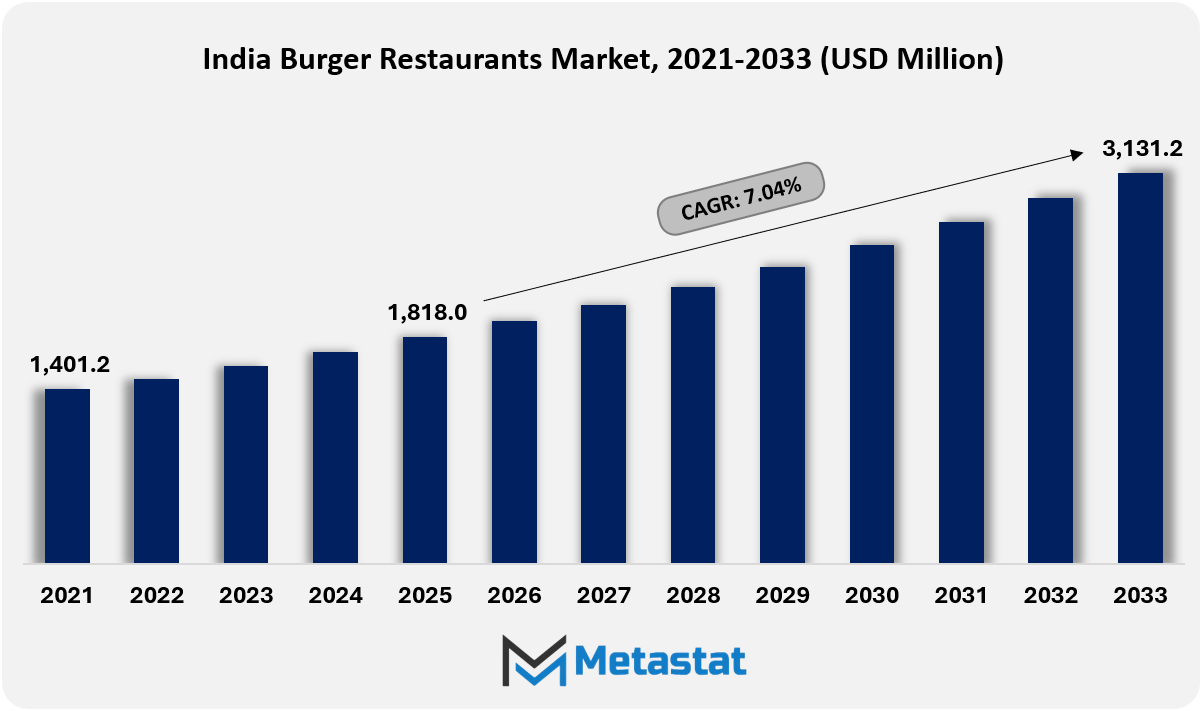
Rising inclination toward fast-casual dining supported by expanding urban working populations.
Urbanization and workforce participation will continue reshaping dining conduct throughout metropolitan facilities. The India Burger Restaurants market gains momentum through fast-casual formats offering quick service, standardized taste, and controlled pricing. Busy schedules encourage common out of doors food, while organized chains offer predictable quality, modern interiors, and menu consistency aligned with present day way of life patterns.
Increased penetration of online delivery platforms accelerating order frequency
Platform-pushed discounts, real-time tracking, and integrated price systems inspire repeated ordering. The India Burger Restaurants market benefits from data-led promotions, optimized shipping logistics, and prolonged provider reach past physical stores, supporting better transaction volumes without proportional growth of storefront infrastructure.
Escalating raw material and operating costs impacting profit margins
Cost inflation throughout substances, packaging, leases, and labor will vicinity sustained stress on operational performance. Volatile commodity prices lessen margin predictability, specifically for meat, dairy, and edible oils. Without powerful cost manage, pricing flexibility narrows, proscribing the capability of burger-focused chains to preserve profitability throughout competitive urban locations.
Growing health concerns around processed meat consumption limiting frequent visits
Health-aware consumer segments increasingly associate burgers with high calories and processed ingredients. Nutritional consciousness campaigns and dietary shifts influence eating frequency, especially amongst more youthful professionals. Such perceptions gradual repeat visits and inspire moderation, prompting restaurants to reconsider portion sizes, ingredient sourcing, and conversation techniques targeted on balance and transparency.
Rapid expansion of gourmet, premium, and plant-based burger concepts across global urban clusters
Menu innovation will free up new demand corridors through premium ingredients, artisanal preparation, and plant-based alternatives. The India Burger Restaurants market stands located to attract affluent urban purchasers in search of differentiated experiences. Ethical sourcing, sustainable packaging, and international flavor integration will help logo elevation and lengthy-term relevance within aggressive foodservice landscapes.
The India Burger Restaurants market is classified based on Type and Sales Channel.
Global QSR Burger Chains segment is estimated at USD 478.2 million in 2026 and is projected to reach USD 655.3 million by 2033, at a CAGR of 4.6% during the forecast period.
Global QSR burger chains inside the India Burger Restaurants marketplace will retain expanding through standardized menus, aggressive pricing, and large-scale delivery networks. Urban customers will desire consistent taste and speedy delivery. Technology-led ordering systems, automation in kitchens, and statistics-pushed menu localization will shape long-time period competitiveness across metropolitan and rising town clusters.
India-Origin QSR Burger Chains segment is estimated at USD 350.4 million in 2026 and is projected to reach USD 528.9 million by 2033, at a CAGR of 6.1% during the forecast period.
India-origin QSR burger chains will gain momentum via domestically stimulated flavors and vegetarian-focused innovation. Local sourcing and adaptive pricing structures will guide deeper penetration throughout tier-2 and tier-3 cities. Cultural familiarity combined with scalable franchise fashions will improve positioning within the Indian Burger Restaurants marketplace in the coming years.
Premium Gourmet and Fast-Casual Burger Brands segment is estimated at USD 260 million in 2026 and is projected to reach USD 481.6 million by 2033, at a CAGR of 9.2% during the forecast period.
Premium gourmet and fast-casual burger brands will emphasize aspect transparency, artisanal education, and curated dining reports. Consumer choice shifts in the direction of quality-focused dining will support a higher rate of acceptance. Limited outlet density paired with strong brand storytelling will define growth trajectories across the affluent city wallet.
Cafe and Casual Dining Brands with Burger-Led Menus segment is estimated at USD 196.7 million in 2026 and is projected to reach USD 301.5 million by 2033, at a CAGR of 6.3% during the forecast period.
Cafe and casual dining brands with burger-led menus will combine burgers into broader lifestyle eating formats. Extended stay time, social seating layouts, and beverage pairings will beautify the average order cost. Menu flexibility will allow adaptation to seasonal demand without diluting brand identity.
Delivery-First and Cloud Kitchen Burger Brands segment is estimated at USD 316.3 million in 2026 and is projected to reach USD 706.4 million by 2033, at a CAGR of 12.2% during the forecast period.
Delivery-first and cloud kitchen burger manufacturers will rely upon optimized logistics and data-led menu engineering. Lower overhead systems will permit rapid experimentation throughout pricing and codecs. Expansion via hyperlocal coverage zones will beef up presence inside digitally driven consumption styles.
Kiosk and Street-Format Burger Chains segment is estimated at USD 153.1 million in 2026 and is projected to reach USD 199.1 million by 2033, at a CAGR of 3.8% during the forecast period.
Kiosk and street-format burger chains will deal with affordability and speed-driven consumption. Compact footprints near transit hubs and business clusters will pressure quantity-led overall performance. Simplified menus and high operational turnover will preserve relevance across fee-touchy demographics.
Franchise-Led Regional Burger Chains segment is estimated at USD 189.5 million in 2026 and is projected to reach USD 258.3 million by 2033, at a CAGR of 4.5% during the forecast period.
Franchise-led nearby burger chains will leverage local entrepreneurship and align with local flavor. Flexible possession models will encourage rapid rollout throughout smaller towns. Brand loyalty rooted in local familiarity will aid ongoing community expansion within the India Burger Restaurants market.
Dine-In Orders segment is projected to reach USD 1,019.5 million by 2033, at a CAGR of 3.7% during the forecast period.
Dine-in orders will retain importance through experiential eating and social intake conduct. Interior design, service high-quality, and menu presentation will affect footfall restoration. Premiumization strategies will focus on consistency, hygiene visibility, and consistent in-store engagement.
Takeaway and Pick-Up Orders segment is projected to reach USD 579.9 million by 2033, at a CAGR of 5.8% during the forecast period.
Takeaway and pick-up orders will benefit from time-efficient intake styles. Dedicated counters and app-primarily based scheduling will lessen wait times. Price-sensitive purchasers will want bundled services designed for quick meal occasions.
Home Delivery Orders segment is projected to reach USD 1,210.5 million by 2033, at a CAGR of 12% during the forecast period.
Home delivery orders will remain the primary revenue stream, driven by platform integration and promotional campaigns. Predictive calls for making plans will enhance operational efficiency.
Drive-Thru segment is projected to reach USD 210.4 million by 2033, at a CAGR of 9.8% during the forecast period.
Drive-via formats will see slow adoption close to highways and suburban corridors. Speed-centric carrier fashions will entice commuter visitors. Limited menu customization will help with faster order processing and predictable throughput.
Others (Event, Corporate, and Bulk Ordering) segment is projected to reach USD 110.8 million by 2033, at a CAGR of 1% during the forecast period.
Event, corporate, and bulk ordering channels will support volume stability during non-peak hours. Customized menus and advance scheduling will strengthen institutional relationships. Reliability and standardized quality will remain central to repeat contracts.
Based on geography, the India Burger Restaurants market is divided into North India, West India, South India, East India and Central India.
North India Burger Restaurants Market is set to expand at a CAGR of 7.0% within the forecast period, reaching a market size (TAM) of USD 811.3 million by the end of 2033.
North India: High urban density, strong mall and high-street ecosystems, and rising app-based food ordering support strong demand for burger restaurants in North India.
West India: Large metro markets such as Mumbai, Pune, and Ahmedabad, along with strong QSR penetration and premium dining demand, support substantial burger restaurant market growth.
South India: IT corridor expansion, organized retail growth, and a strong delivery-first consumer base create sustained demand for burger restaurant formats.
East India: Emerging urban consumption centers, improving delivery coverage, and growing mall-based foodservice presence are fostering gradual growth in burger restaurant demand.
Central India: Rising tier-2 city dining culture and franchise-led QSR expansion are supporting steady adoption of burger restaurant formats in Central India.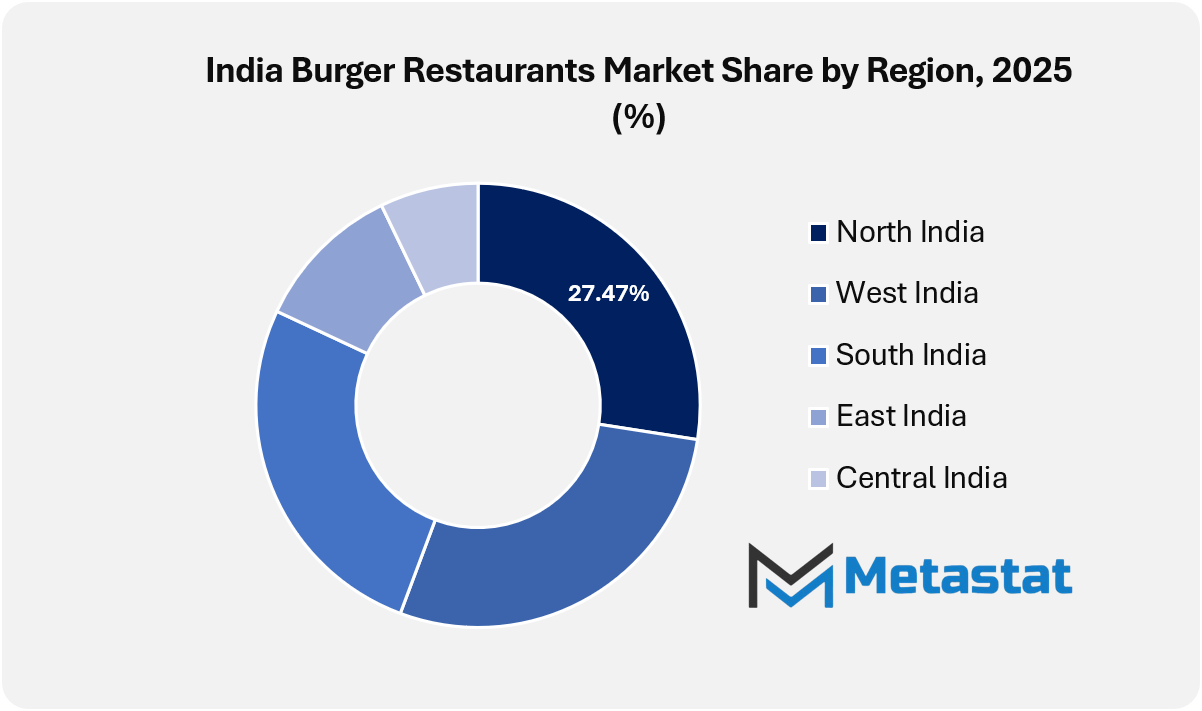
The India Burger Restaurants marketplace has grown into an energetic space shaped by changing food habits, urban lifestyles, and a strong appetite for quick, flavorful meals. Burgers are no longer visible best as an occasional Western snack. They have determined a regular area in normal eating, among younger purchasers and operating experts. Easy availability via dine-in shops, takeaways, and food delivery apps will help retain customers. Brands are paying close attention to nearby taste alternatives, pricing sensitivity, and component sizes, which helps burgers fit naturally into India’s casual dining culture.
Large global chains play a visible role in shaping the market. McDonald’s India and Burger King India have constructed a robust reputation via low-cost menus, extensive reach, and regular branding. Wendy’s, operated in India through Rebel Foods, has taken a cloud kitchen-led technique that aligns properly with transport-pushed consumption. Carl’s Jr. India and Popeyes India upload in addition range by means of offering bold flavors and differentiated menu styles. These international brands bring standardized operations and marketing strength, placing benchmarks for exceptional pace and scale throughout the segment.
Alongside them, homegrown brands have created a strong identity by means of mixing burgers with Indian flavors and avenue-style appeal. Burger Singh, Jumbo King, Wat-a-Burger, Good Flippin’ Burgers, and Biggies Burger cognizance on familiar spices, value pricing, and short provider. Brands like Burger Farm, Burgrill, Burger Monk, Burger Seigneur, Burger Haven, Boss Burger, Burger Bytes, Snakkers, BurgerMan, Burger Bro, Burger Bros, MBA Burgerwala, Louis Burger, and The Burger Company show how local chains will grow via building loyal nearby followings. These gamers regularly rely upon compact formats and shipping-friendly kitchens, which maintain fees controlled and attain bendy.
Premium and niche players also contribute to the market via targeting customers seeking out gourmet or experimental options. Leon’s, Aku’s the Brrgrr Co., Burger Craft, Burgerama, ZORKO, Big Smokin’ Burgers, Ajay’s Cafe, One Bite, The Burger Junction, FunBytes, and Burger House are raising awareness on quality components, creative recipes, and one-of-a-kind branding. Their presence highlights how client expectancies are expanding past primary fast meals toward more customized experiences. Social media visibility and word-of-mouth will continue to be important for such manufacturers.
Overall, the Indian burger restaurant market shows strong diversity, with global giants and local innovators growing side by side. Competition will drive brands to refine menus, improve service, and adopt better delivery strategies. As consumer spending on quick-service food continues to rise, both established names and emerging players will find room to expand, making burgers a permanent part of India's modern food landscape.
Market size is forecast to rise from USD 1,818 million in 2025 to over USD 3,131.2 million by 2033.
Workforce dynamics can even redefine the sector. Training models will prioritize hospitality storytelling, operational versatility, and logo illustration at the store degree. Employees will increasingly serve as brand ambassadors rather than only service staff. Over time, burger restaurants may be positioned as urban cultural touchpoints that replicate changing customer identities, evolving meals ethics, and current social behavior. In that panorama, the India Burger Restaurants market will be evaluated now not simplest for commercial presence however for its capacity to align with how India will choose to dine, gather, and express itself.
By Type:
By Sales Channel:
This research report categorizes the Burger Restaurants market based on key segments and regions, forecasts revenue growth, and analyses trends in each submarket. The report analyses the key growth drivers, opportunities, and challenges influencing the Burger Restaurants market. Recent market developments and competitive strategies such as expansion, product launch, partnership, merger, and acquisition have been included to draw the competitive landscape in the market.
The report strategically identifies and profiles the key market players and analyses their core competencies in each sub-segment of the Burger Restaurants market.
|
Report Attributes |
Details |
|
Study Period |
2021-2033 |
|
Base Year |
2025 |
|
Estimated Year |
2026 |
|
Forecast Period |
2026-2033 |
|
Historical Period |
2021-2025 |
|
Growth Rate |
CAGR 7.0% from 2026 to 2033 |
|
Revenue Unit |
USD million |
|
Segmentation |
By Type, Sales Channel, and Region |
|
By Type |
|
|
By Sales Channel |
|
Find answers to common questions about this report
The Metastat Insights study shows that the India Burger Restaurants market size was USD 1,818 million in 2025.
Top players operating in the Burger Restaurants industry includes McDonald’s India, Burger King India, Wendy’s (Rebel Foods), Carl’s Jr. India, Burger Singh, and Jumbo King.
The India Burger Restaurants market is likely to grow at a CAGR of 7.0% over the forecast period (2026-2033).
The Metastat Insights analysis shows that the North India Burger Restaurants market size is estimated to be USD 811.3 million by 2033.
Escalating raw material and operating costs impacting profit margins will hamper market growth within the forecast period.
Rising inclination toward fast-casual dining supported by expanding urban working populations and Increased penetration of online delivery platforms accelerating order frequency are key driving factors, boosting the market.
India Burger Restaurants market is estimated to reach USD 3,131.2 million by 2033.
West India region dominates the market.
The Global QSR Burger Chains is the leading type segment in the India market.
The analysts below cover Food and Beverages research at Metastat Insights.
LEAD ANALYST
Utkarsh Khirodkar is a Lead Market Research Analyst at MetaStat Insight, specializing in market intelligence, technology sector assessments, and competitive strategy.

LEAD PRINCIPAL ANALYST, PHARMA AND HEALTHCARE
Food and Beverages · Healthcare · Healthcare IT · Medical Devices
Ajay Devgire is the Lead Healthcare Analyst at MetaStat Insight, leading strategic research and market intelligence initiatives across the global healthcare domain.

SENIOR RESEARCH ANALYST
Biotechnology · Food and Beverages · Medical Devices · Packaging
Snehal Pasalkar is a Research Analyst at MetaStat Insight, operating at the intersection of life sciences research, competitive strategy, and market intelligence.
Tracking ceramic matrix composite adoption in high-bypass aero engines requires strict attention to material qualification cycles and FAA airworthiness testing milestones. The MetaStat Insight team provided a detailed timeline of silicon carbide fiber manufacturing capacity and commercial foundry lead times. Having clear visibility into upstream thermal barrier coating supply helped us stress-test our long-term component procurement strategy.
Transitioning ultra-class mining haul trucks to alternative power requires concrete data on remote hydrogen refueling infrastructure economics. The report evaluated megawatt-scale electrolyzer installation expenses, onsite storage safety mandates, and heavy-duty fuel cell stack degradation under continuous duty cycles. That technical rigor helped our engineers benchmark realistic total operating cost horizons for off-highway fleet decarbonization.
Enterprise zero-trust network rollouts are often slowed down by multi-cloud transit latency and proprietary hardware retirement schedules. This study provided realistic total cost of ownership models comparing cloud-delivered security edge solutions against traditional hardware refreshes. The analysis of contract renewal lengths and software maintenance fees gave us clear visibility into enterprise replacement cycles over the next three to five years.
Explore related market intelligence reports worth reading alongside this one.