
LEAD ANALYST
Utkarsh Khirodkar is a Lead Market Research Analyst at MetaStat Insight, specializing in market intelligence, technology sector assessments, and competitive strategy.

India Footwear Market Size, Share, By Type (Athletic Footwear, Casual Footwear, Formal Footwear, Sandals and Floaters, Flip-Flops and Slippers, Boots and Outdoor Footwear, Ethnic and Traditional Footwear, Work and Safety Footwear, Premium and Luxury Footwear), By End User (Men, Women, Kids), By Distribution Channel (Online Retail, Department Stores, Specialty Stores, Supermarkets, Brand Outlets), By Region (North India, West India, South India, East India, Central India, North East India), Industry Analysis, Growth, Trends, and Forecast, 2026-2033
Report ID
MSI-5239
Published
September, 2026
Pages
308 Pages
Format
Historical
Base year
Forecast
Forecast period
Report Details
Market Valuation: Valued at $26.4 Billion in 2025, projected to reach $41.7 Billion by 2033 at a 5.9% CAGR.
Dominant Segment: Athletic footwear leads the India Footwear market with a 24.7% share, driven by increasing health consciousness and participation in sports activities among consumers.
Geographic Lead: The South India region is projected to show the fastest growth, fueled by rising urbanization and disposable incomes that enhance consumer purchasing power.
What's Inside: The report provides comprehensive coverage of market segmentation by type, end user, and distribution channel, along with competitive analysis and growth forecasts through 2033.
Emerging Demand: The rapid growth of online retail channels is reshaping consumer purchasing behaviors, with e-commerce expected to expand from USD 8 billion in 2026 to USD 14.2 billion by 2033.
Choose Your License
India Footwear Market
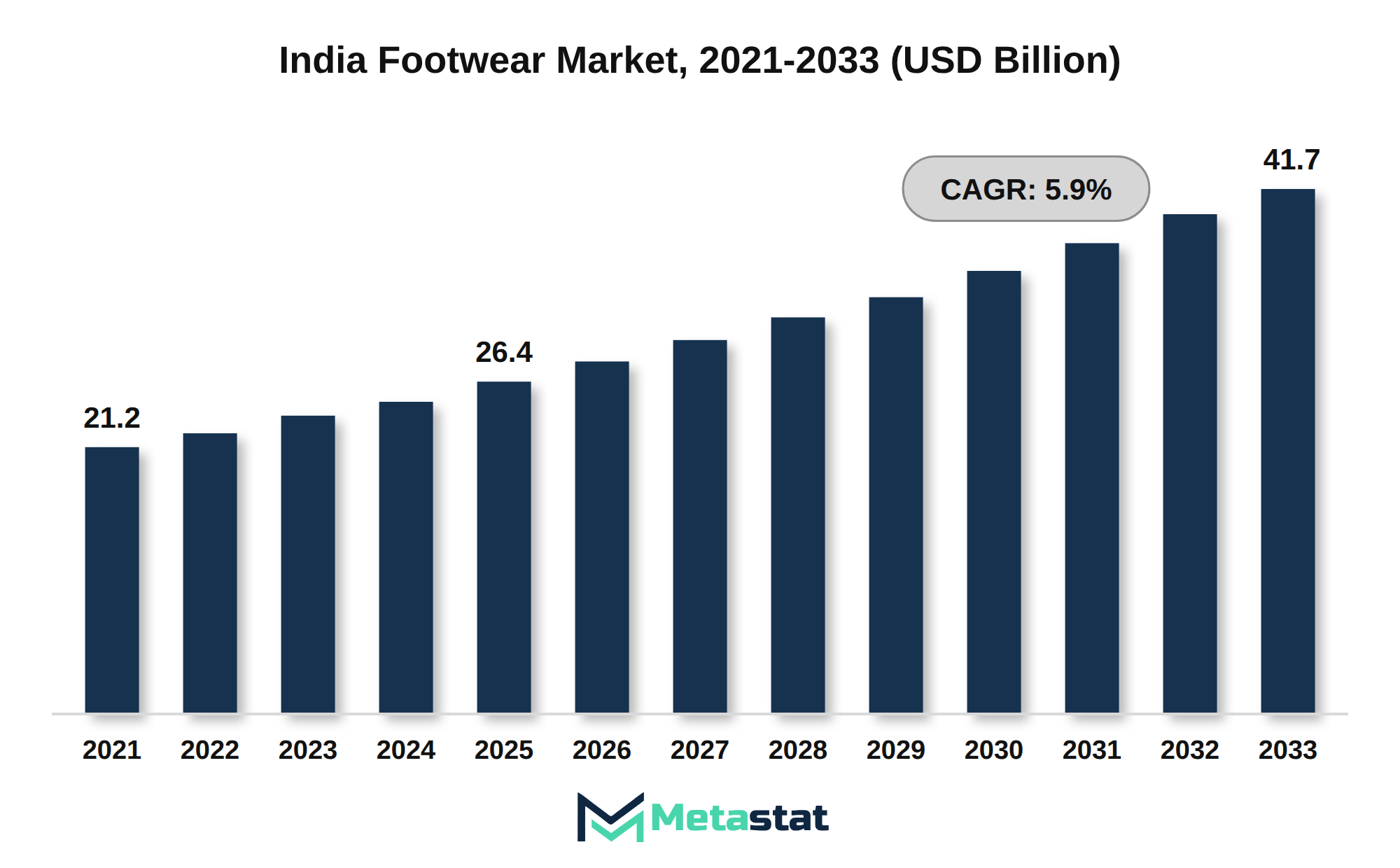
The India Footwear market was valued at USD 26.4 billion in 2025 and is projected to reach USD 41.7 billion by 2033, growing at a CAGR of 5.9% over the forecast period.
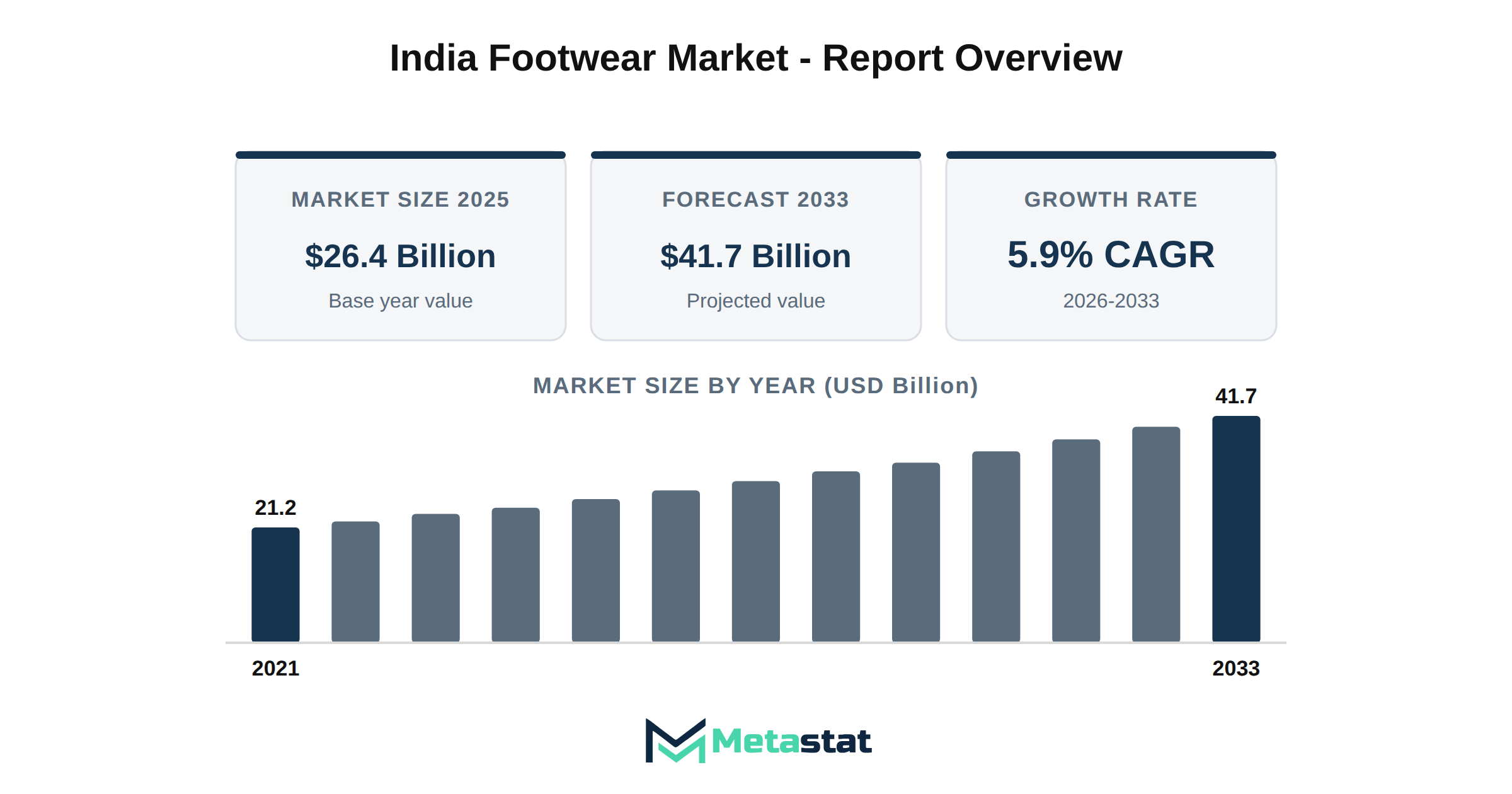
The India Footwear market reached USD 26.4 billion in 2025, reflecting a growth trajectory from USD 21.2 billion in 2021. Projections indicate a significant increase, with an estimated value of USD 41.7 billion by 2033, reflecting a compound annual growth rate (CAGR) of 5.9%. The market's expansion is driven by rising disposable incomes, increasing urbanization, and a growing preference for branded products among consumers.
In the footwear segment, athletic footwear holds the largest market share at 24.7%, followed by casual footwear at 23.1%. Formal footwear contributes 10.7%, while sandals and floaters account for 10.4%. Flip-flops and slippers represent 8.8%, and boots and outdoor footwear contribute 4.6%. Ethnic and traditional footwear holds a 6.4% share, while work and safety footwear, premium and luxury footwear, and other sustainable options make up the remaining market segments.
Demand across different customer segments remains diverse. Men's footwear is projected to grow from USD 14.4 billion in 2026 to USD 20.4 billion by 2033, exhibiting a CAGR of 5.2%. Women's footwear is anticipated to reach USD 16.5 billion in the same timeframe, while kids' footwear is expected to grow to USD 4.8 billion.
The rise of e-commerce has significantly influenced consumer behavior in the India Footwear market. Online retail, valued at USD 8 billion in 2026, is expected to reach USD 14.2 billion by 2033, with a CAGR of 8.5%. This shift towards online channels reflects changing shopping preferences, particularly among younger demographics.
Pricing strategies in the online footwear segment demonstrate a strong emphasis on value, mid-premium, and premium offerings. Price sensitivity among consumers affects promotional strategies, leading to competitive pricing benchmarks across various e-commerce platforms. Brands increasingly adopt digital positioning strategies to differentiate themselves in a crowded marketplace.
Social commerce and influencer marketing play vital roles in shaping preferences for footwear brands. Performance marketing initiatives focus on customer acquisition, employing search, social, and video marketing strategies to enhance brand visibility and engagement. The integration of personalized experiences through AI-driven product discovery significantly enhances customer satisfaction and loyalty in the online footwear retail landscape.
The India Footwear market exhibits a significant shift toward e-commerce, with online retail representing a growing channel for footwear sales. Consumer preferences reflect a pronounced trend toward convenience and accessibility, with a notable increase in online purchasing behaviors among various demographic segments. This transition drives brands to adapt their strategies for digital engagement, ensuring they meet evolving customer expectations.
Growing demand for footwear through e-commerce platforms stems from increased internet penetration and smartphone usage. Consumers increasingly seek an efficient online shopping experience, propelling brands to enhance their digital presence. The market observes a robust trend of personalized shopping experiences, with customers valuing tailored recommendations based on their preferences.
Targeting specific customer segments enhances the effectiveness of marketing strategies. Brands focus on distinct demographics, including Gen Z, Millennials, and families, tailoring products and messaging to connect with each group. This segmentation builds brand loyalty and encourages repeat purchases.
Demographic factors significantly influence online purchasing decisions, with lifestyle choices shaping preferences for types of footwear. Younger consumers prioritize style and trends, while older demographics gravitate toward comfort and utility. Brands recognize these differences, adjusting their offerings to cater to varying needs.
Gen Z and Millennials exhibit a strong inclination toward trendy and sustainable footwear options. These consumers prioritize brands that align with their values, particularly those emphasizing eco-friendliness and ethical manufacturing practices. This trend compels brands to communicate their sustainability efforts effectively.
The market displays distinct demand patterns across men's, women's, and kids' footwear categories, with varying preferences influencing purchasing behavior. Men's footwear appeals typically focus on functionality and style, while women gravitate toward fashionable options. Kids' footwear emphasizes durability and comfort, reflecting parental considerations.
Consumer preferences for footwear segments vary significantly based on price sensitivity. Value-conscious consumers prioritize affordability, while mid-premium and premium segments reflect an inclination toward quality and brand prestige. Brands strategically position themselves within these segments to capture diverse consumer interests.
Pricing strategies play a crucial role in the market, with brands employing various approaches to cater to different consumer segments. Dynamic pricing, promotional discounts, and bundled offers are prevalent tactics aimed at enhancing competitiveness and driving sales.
Price sensitivity among consumers influences discounting strategies, with brands frequently implementing promotional campaigns to attract customers. Seasonal sales and special offers effectively enhance visibility, encouraging consumers to make purchases during peak shopping periods.
Price benchmarking against competitors remains crucial for brands seeking to maintain a competitive edge. Regular analysis of pricing across various e-commerce platforms allows brands to adjust their strategies and optimize pricing in response to market trends.
Effective digital positioning strategies leverage social media, influencer collaborations, and targeted advertising to enhance brand visibility. Brands increasingly invest in creating engaging content that connects with their target audience, building brand loyalty and encouraging social sharing.
Establishing a clear value proposition enables brands to differentiate themselves in a crowded marketplace. Brands emphasize unique selling points, including innovative designs, sustainability, and superior customer service, to attract and retain customers.
The choice between marketplace and direct-to-consumer (D2C) strategies influences brand positioning and customer engagement. While marketplaces offer extensive reach, D2C strategies allow brands to cultivate direct relationships with customers, enhancing brand loyalty.
Leading e-commerce platforms like Amazon, Flipkart, Myntra, and Ajio adopt diverse positioning strategies to cater to footwear consumers. Each platform emphasizes unique offerings, including exclusive brand partnerships, promotional campaigns, and user experience enhancements, driving competitive differentiation.
Social commerce gains traction in the market, with brands leveraging influencer marketing to engage younger audiences. Collaborations with influencers drive brand awareness and authenticity, encouraging consumers to explore and purchase featured products.
Performance marketing strategies focus on measurable outcomes, with brands utilizing data analytics to optimize customer acquisition efforts. Targeted advertising and retargeting campaigns enhance conversion rates, driving efficient customer acquisition.
Search engine optimization, social media advertising, and video marketing are crucial strategies for engaging consumers in the digital space. Brands invest in creating compelling content that captures attention and encourages interaction across various channels.
Understanding customer acquisition costs, conversion rates, and lifetime value benchmarks informs strategic decision-making. Brands analyze these metrics to refine marketing strategies and enhance overall profitability.
Personalization enhances the online shopping experience, with brands employing AI-driven solutions to recommend products based on individual preferences. This approach builds customer satisfaction and drives repeat purchases.
Omnichannel retail strategies facilitate a cohesive shopping experience, integrating online and offline channels. Consumers increasingly seek flexibility in purchasing options, leading brands to adopt strategies that bridge the gap between digital and physical retail.
Regional demand exhibits variation across India, with distinct consumer preferences influencing purchasing behaviors. Brands recognize the importance of tailoring offerings to meet local demands, capitalizing on opportunities in various geographic markets.
Growth opportunities flourish in Tier 2 and Tier 3 cities, where increasing internet access and disposable income drive footwear demand. Brands targeting these markets expand their reach and capitalize on emerging consumer segments.
Category trends reflect evolving consumer preferences, with casual and sports footwear gaining significant traction. Brands adapt their product lines to align with these trends, ensuring they remain relevant in a dynamic market.
Private labels and digital-native brands reshape the competitive landscape, offering consumers affordable alternatives without compromising quality. This shift compels established brands to innovate and enhance their value propositions.
Growing awareness of sustainability influences consumer preferences, with eco-friendly footwear options gaining popularity. Brands emphasizing sustainable practices and materials connect with environmentally conscious consumers, enhancing brand loyalty.
Online reviews and ratings significantly impact purchasing decisions, with consumers relying on social proof to evaluate products. Brands prioritize customer feedback, enhancing their offerings based on consumer insights.
Effective product assortment strategies ensure brands cater to diverse consumer needs. Brands optimize their merchandising approaches, offering a wide range of styles and sizes to enhance customer satisfaction.
Innovative sizing and fit technologies address common challenges in online footwear retail, reducing return rates. Brands invest in solutions that enhance the accuracy of fit, ensuring a positive customer experience.
Effective last-mile delivery strategies enhance customer satisfaction, with brands focusing on timely and efficient service. Streamlined returns and reverse logistics processes further improve the overall shopping experience for consumers.
Brands prioritize customer retention strategies to build loyalty and encourage repeat purchases. Engaging with customers through loyalty programs and personalized communications enhances long-term relationships.
Looking forward, brands focus on innovative growth strategies to capitalize on market opportunities. Investments in technology, customer engagement, and sustainability initiatives position brands for success in an evolving environment.
The India Footwear market experiences increased demand driven by shifting demographic patterns. The growing urban population, along with rising disposable incomes, influences purchasing behavior towards premium and fashionable footwear. The younger generation's inclination towards athleisure and casual styles enhances the appeal of various footwear segments, including athletic and casual categories.
Aging populations contribute to an evolving market landscape, with older consumers seeking comfort and functionality in their footwear choices. This demographic shift results in greater demand for specialized footwear, including ergonomic and supportive options. Manufacturers align product offerings with these preferences to capture a larger share of the market.
Changing lifestyles and the influence of social media play significant roles in shaping consumer preferences. The increasing focus on health and wellness encourages consumers to invest in quality athletic footwear, thereby driving sales in this segment. The combination of demographic shifts and changing consumer behaviors positions the market for significant growth through 2033.
The India Footwear market benefits from advancements in technology, enhancing operational efficiency and customer engagement. Automation and artificial intelligence streamline manufacturing processes, leading to reduced production costs and improved product quality. Digital transformation allows brands to adopt innovative sales strategies, including personalized marketing and real-time inventory management, which drive consumer satisfaction and loyalty. These technological initiatives provide a competitive edge among players in the market, enabling them to respond swiftly to changing consumer preferences.
Increased adoption of e-commerce platforms facilitates broader market access, allowing manufacturers to reach a wider customer base. Enhanced online shopping experiences, powered by data analytics and customer insights, attract diverse demographics, including younger consumers who prefer direct digital interactions. The emphasis on technological integration positions the India Footwear market for sustained growth, driven by companies leveraging advanced tools to optimize supply chains and enhance customer engagement.
Investments in research and development further contribute to innovation-led product diversification within the market. Companies develop proprietary technologies and sustainable materials, catering to evolving consumer demands for eco-friendly options. This focus on sustainability and innovation strengthens brand positioning, driving long-term loyalty and revenue growth in the competitive landscape of the India Footwear market.
The India Footwear market faces significant challenges stemming from regulatory compliance, which creates hurdles for manufacturers. Increasing legal mandates often result in higher production costs, impacting profit margins across the industry. Manufacturers absorb these costs while navigating complex compliance frameworks, which affects operational efficiency and strategic investments.
Macroeconomic headwinds, including inflationary pressures, contribute to rising operating expenses. Increased material and labor costs combined with stringent regulations impede market growth, making it difficult for smaller companies to compete. Supply chain disruptions, exacerbated by geopolitical instability and resource scarcity, constrain production timelines and product availability.
The market encounters technological obsolescence, where outdated manufacturing techniques hinder competitiveness. Substitution risks arise, with consumers gravitating towards alternative offerings that promise better value or sustainability. Consequently, industry players adapt quickly to evolving preferences to maintain market relevance.
Infrastructure gaps and connectivity deficits present barriers to efficient distribution, limiting reach in underdeveloped regions. These issues are compounded by skilled labor deficiencies, further restricting growth potential. Regional adoption resistors, including cultural barriers and varying consumer preferences, challenge uniform market penetration across diverse demographics.
Overall, these factors collectively contribute to market fragmentation and slow demand growth, resulting in a maturation cycle for the industry. The combination of these constraints necessitates strategic adaptation for companies looking to thrive in the India Footwear market.
The India Footwear market encounters significant challenges stemming from geopolitical tensions that contribute to supply chain instability. These tensions disrupt trade flows and logistics, impacting the availability of essential feedstocks and components. Increased tariffs and trade deficits exacerbate these issues, leading to higher costs and delays in production schedules. Volatility in supply chains constrains manufacturers' ability to meet demand efficiently, affecting revenue potential across various segments.
Rising input costs, driven by fluctuating prices of raw materials and components, contribute to margin pressures within the market. This situation necessitates strategic adjustments in pricing models, often resulting in reduced profit margins for companies. Firms within the India Footwear market face the dual challenge of maintaining competitive pricing while managing operational costs effectively.
Technological disruptions further complicate the landscape, introducing complexities in research and development integrations. Companies grapple with interoperability friction among varying technological standards, hindering innovation and product development timelines. These challenges impact the market's ability to respond rapidly to changing consumer preferences, affecting overall growth trajectories.
The combination of these factors creates an environment where talent retention pressures and workforce skill gaps become increasingly pronounced. Addressing these skill gaps requires investment in training and development, which adds to operational overheads for businesses. Consequently, the India Footwear market navigates these multifaceted challenges to sustain growth and capitalize on opportunities.
The India Footwear market experiences significant opportunities driven by the rapid growth of online retail channels. Digital transformation reshapes consumer purchasing behaviors, reflecting shoppers' increasing preference for the convenience of online platforms for their footwear needs. The shift towards e-commerce aligns with rising internet penetration and smartphone adoption across the country, facilitating easier access to a broader range of products.
This growth in online retail contributes to an expanding market, with a projected increase in value from USD 8 billion in 2026 to USD 14.2 billion by 2033, representing a compound annual growth rate (CAGR) of 8.5%. Retailers and brands investing in robust online strategies enhance customer engagement and streamline operations, ultimately driving sales and profitability.
Online retail channels allow for targeted marketing and personalized shopping experiences, catering to the evolving preferences of consumers. Embracing this digital transformation enables companies in the India Footwear market to diversify their product offerings and adapt to niche market demands, ensuring competitiveness in a rapidly changing marketplace.
The India Footwear market is segmented based on Type, End User, Distribution Channel, and Region.
Valued at USD 7 billion in 2026, the Athletic Footwear segment is projected to reach USD 10.8 billion by 2033, reflecting a CAGR of 6.5% during the forecast period. Growth in this segment arises from increasing health consciousness among consumers, driving demand for functional and performance-oriented footwear. The surge in participation in sports activities and fitness regimes across diverse demographics fuels adoption across various age groups, particularly among younger consumers.
Technological advancements play a critical role in developing innovative athletic footwear, improving performance features including cushioning, breathability, and durability. Brands leverage these advancements to enhance user experience, aligning products with evolving consumer preferences. The integration of smart technologies, including fitness tracking capabilities, positions athletic footwear favorably in a competitive market. This evolution in product offerings encourages brand loyalty and repeat purchases.
Distribution channels significantly impact growth dynamics in the market. Online retail emerges because a prominent avenue for sales, offering convenience and a wide variety of options for consumers. The rise in digital shopping habits complements the segment's expansion, with brands investing in e-commerce platforms to enhance accessibility. Retailers focus on optimizing the online shopping experience, ensuring a smooth transition from traditional retail to digital platforms.
Shifts in consumer behavior towards sustainability influence product development in the Athletic Footwear segment. Eco-friendly materials and sustainable practices appeal to environmentally conscious consumers, prompting brands to adopt greener manufacturing processes. This trend opens strategic opportunity windows, enabling brands to differentiate themselves in a crowded marketplace. The market adapts to these consumption shifts, aligning product strategies with the increasing demand for sustainable options.
Cost structures and pricing strategies in the segment contribute to its competitive landscape. Manufacturers face pressures related to raw material sourcing and production costs, leading to pricing volatility. Brands implement cost management strategies to maintain profitability while offering competitive prices. The balancing act between quality and affordability remains essential, influencing consumer purchasing decisions and brand positioning within the India Footwear market.
Growth in the Casual Footwear segment of the India Footwear market is projected to reach USD 10 billion by 2033, achieving a CAGR of 6.4% during the forecast period. Increased urbanization and changing fashion trends drive the demand for casual footwear, particularly among younger consumers seeking comfort and style. This segment benefits from advancements in material technology, enhancing durability and aesthetic appeal, which attracts both women and men.
Growing online retail channels significantly impact sales, with digital platforms offering a wide variety of options for consumers. The segment has become more accessible, allowing brands to engage with customers directly and tailor offerings to meet specific preferences. The rise of social media and influencer marketing fuels brand awareness, encouraging consumers to explore new styles and brands.
Shifts in consumer behavior toward casual and comfortable footwear reflect broader lifestyle changes. Increased participation in leisure activities and casual work environments drives demand for versatile footwear. Brands focusing on innovation and sustainability find opportunities to capture market share, addressing environmentally conscious consumers with eco-friendly options.
Cost pressures affect the Casual Footwear segment due to fluctuating raw material prices and supply chain challenges. Manufacturers adapt by optimizing production processes and sourcing materials strategically. This adaptability positions the segment for sustained growth, despite external pressures, ensuring it meets the evolving preferences of consumers in the India Footwear market.
Growth in the Formal Footwear segment is driven by increasing consumer inclination towards professionalism and workplace attire, reinforced by evolving fashion trends and rising disposable incomes. This segment is expected to reach USD 3.5 billion by 2033. The demand for formal footwear is particularly influenced by the expansion of corporate sectors and the rising number of professionals seeking versatile and stylish options for office wear.
Adoption rates reflect a significant shift, because consumers increasingly view formal footwear because a fashion statement rather than just functional items. This evolving perception supports segment growth and stimulates innovation among manufacturers, leading to enhanced product designs and comfort features. The market observes substantial investment in research and development to create advanced materials that offer greater durability and comfort, addressing end-user expectations.
Changes in consumer behavior, particularly in urban areas with a growing middle class, contribute to a sustained focus on formal footwear. Increased participation in corporate and formal events necessitates stylish choices, further propelling demand. Marketing strategies emphasizing quality and design strongly appeal within the target demographic, enhancing market reach and consumer loyalty.
Price volatility remains a challenge, particularly with fluctuating raw material costs impacting profit margins. Manufacturers often respond by optimizing production processes and exploring cost-effective sourcing strategies. Strategic collaborations with retail partners enhance distribution efficiency and broaden market access, ensuring that consumers encounter formal footwear lines in retail environments that align with their purchasing habits.
This segment is positioned for further expansion within the India Footwear market, leveraging opportunities presented by evolving workplace dynamics and consumer preferences for quality and style. Engaging marketing campaigns, coupled with innovative designs, will likely play a crucial role in maintaining momentum within this competitive segment.
Demand for sandals and floaters in the India Footwear market is driven by the growing preference for comfort and casual wear among consumers. Increasing awareness of outdoor activities and lifestyle trends further fuels this demand. The segment is projected to grow at a CAGR of 5.3% during the forecast period. Innovations in materials, including lightweight and breathable fabrics, enhance product offerings, aligning with evolving consumer preferences.
Market expansion is supported by the rising adoption of online retail channels, allowing brands to reach a broader audience with various styles and price points. The convenience offered by e-commerce platforms is a key factor in the buying decision for many consumers. The segment benefits from a diverse range of products appealing to different demographics, including men, women, and children.
Regulatory compliance regarding safety and environmental standards impacts market dynamics. Brands that align with sustainable practices gain a competitive edge and appeal to environmentally conscious consumers. Pricing volatility stemming from raw material sourcing affects margins; however, brands that effectively manage these pressures emerge stronger, building loyalty and repeat business.
Through strategic marketing and product development, companies in the sandals and floaters segment are well-positioned to capitalize on the growing demand within the market. Innovations in design and functionality attract consumers, ensuring the segment's relevance in a competitive environment. Increased investment in marketing and consumer engagement will enhance growth opportunities.
Flip-flops and slippers hold a noteworthy position within the India Footwear market, characterized by unique demand drivers. Consumer preferences for comfort and casual wear drive significant demand for these products, particularly in warmer climates where ventilation and ease of use are essential. This segment benefits from a demographic shift, with younger consumers favoring casual footwear for everyday use, further enhancing its appeal.
Trends influencing the expansion of this segment include an increasing focus on lifestyle-oriented products. Consumers increasingly seek fashionable designs that align with their daily activities, from beach outings to casual gatherings. Manufacturers invest in innovative materials and production techniques to create more durable and eco-friendly options, responding to a growing demand for sustainability in footwear.
Technological advancements contribute to the evolution of flip-flops and slippers, allowing for the integration of features like cushioned footbeds and ergonomic designs. These enhancements improve consumer experience and expand the target market, appealing to a broader audience. The introduction of new designs and limited editions further stimulates interest among fashion-conscious consumers, enhancing market competitiveness.
Shifts in consumption patterns point toward a rising preference for online shopping, magnified by the convenience it provides. E-commerce platforms increasingly serve because primary distribution channels, allowing brands to reach wider audiences while effectively managing inventory costs. This trend reinforces the position of flip-flops and slippers because essential components of many consumers' wardrobes.
Regulatory compliance plays a role in shaping the segment, with manufacturers adhering to safety and environmental standards in production processes. This ensures that products meet consumer expectations while aligning with broader sustainability goals. Continuous investment in raw material sourcing and supply chain resilience strengthens the market's ability to respond to fluctuating demand and maintain competitiveness.
Strategic opportunity windows arise for brands that prioritize innovative designs and sustainable practices. This focus attracts environmentally conscious consumers who prioritize eco-friendly products. The evolving landscape of consumer preferences presents significant growth potential for the flip-flops and slippers segment in the India Footwear market, further enhancing its relevance in the overall footwear industry.
Growth in the Boots and Outdoor Footwear sub-segment arises from evolving consumer preferences toward functional and durable footwear for outdoor activities. Increased participation in outdoor sports, hiking, and adventure tourism fuels demand, leading to a noticeable shift in consumer behavior. This trend is supported by rising awareness of health and fitness, driving the search for footwear that enhances performance during outdoor activities.
Technological advancements contribute to the evolution of this sub-segment, with significant improvements in materials and manufacturing processes. Enhanced waterproofing, breathability, and cushioning technologies improve comfort and performance, attracting consumers seeking reliable footwear for varied terrains. Continuous product evolution responds to the changing needs of outdoor enthusiasts.
Adoption of sustainable materials in production processes aligns with the growing consumer preference for eco-friendly options. Brands prioritizing sustainability gain competitive advantages in the market, appealing to environmentally conscious consumers. Regulatory compliance with environmental standards influences decision-making in the production of Boots and Outdoor Footwear.
Pricing volatility presents challenges for manufacturers, influenced by fluctuating costs of raw materials. Effective management of production costs is crucial for maintaining competitive pricing while ensuring profitability. Market players face margin pressures due to these cost fluctuations, requiring strategic pricing strategies to balance affordability with quality.
Strategic opportunity windows arise from the increasing emphasis on outdoor lifestyles. Companies exploring collaborations with adventure tourism operators or investing in targeted marketing campaigns tap into the expanding consumer base. The market is positioned for growth, supported by the evolving landscape of outdoor activities and the demand for high-performance footwear.
Demand for ethnic and traditional footwear arises from cultural practices and the growing preference for traditional attire, especially during festivals and weddings. Increased consumer awareness regarding sustainable materials influences purchasing decisions, with customers showing a preference for eco-friendly footwear options. Manufacturers focus on integrating traditional designs with modern aesthetics to attract younger demographics, thereby expanding market reach.
The segment benefits from technological advancements that enhance product quality and design capabilities. Craftsmanship holds significant importance, with skilled artisans contributing to unique offerings that appeal to consumers seeking authenticity. Marketing strategies emphasizing heritage and craftsmanship connect effectively, driving brand loyalty among consumers.
Shifts toward online retail channels facilitate access to a broader customer base, with e-commerce platforms enabling brands to present their collections effectively. This transition aligns with the overall growth dynamics of the India Footwear market, where digital transformation enhances consumer experience and engagement.
Competitive pressures prompt brands to innovate continuously, introducing limited edition collections and collaborations that capture consumer interest. These strategic initiatives contribute to the long-term viability of the segment, ensuring relevance amid changing fashion trends and consumer preferences.
Demand for Work and Safety Footwear arises from the increasing focus on employee safety in various industries. This segment addresses the requirements for protective gear, particularly in sectors including construction, manufacturing, and warehousing. Strict regulatory compliance standards shape the development of this footwear, ensuring that products meet safety certifications. Companies produce footwear designed with durable materials and advanced safety features, enabling workers to perform tasks effectively while minimizing injury risks.
The market experiences a shift toward innovative designs, incorporating ergonomic features and materials that enhance comfort and performance. End-use dynamics reflect an emphasis on durability and functionality, driving consumption shifts toward multi-functional footwear that supports various workplace environments. Strategic opportunity windows arise from the growing construction and industrial sectors, which increase the demand for specialized Work and Safety Footwear.
Supply chain resilience influences the availability of these products, with manufacturers focusing on raw material sourcing and logistics strategies to mitigate potential vulnerabilities. The landscape includes competition among established players and new entrants aiming to capture market share with innovative designs and pricing strategies. Continuous investment in research and development enhances product evolution, positioning the market favorably for growth in the coming years.
Consumer preferences in the Premium and Luxury Footwear segment reflect a shift towards high-quality materials and craftsmanship. This trend results from increasing disposable incomes and a growing awareness of fashion and personal branding among consumers. The market benefits from rising demand for products that signify status and lifestyle choices, particularly among affluent individuals.
Brand loyalty is significant in this sub-segment, with established players leveraging their reputations to attract discerning customers. These brands focus on enhancing product offerings through collaborations with designers and influencers, thereby expanding their reach. This strategy drives sales and creates a sense of exclusivity among consumers.
Technological advancements contribute to product evolution, with brands incorporating innovative designs and sustainable materials. This evolution aligns with changing consumer expectations regarding environmental responsibility. The market responds to these dynamics by emphasizing eco-friendly practices, appealing to environmentally conscious buyers.
Pricing strategies remain vital in navigating the competitive environment. Companies face pressures related to raw material costs, leading to the need for effective pricing models that maintain margins while attracting customers. Strategic pricing enables brands to position themselves competitively while emphasizing quality and luxury.
Future growth opportunities lie in expanding distribution channels, particularly online platforms, which facilitate access to a wider audience. The market is projected to embrace digital transformation, with brands investing in direct-to-consumer models and enhancing online shopping experiences. By capitalizing on these trends, the Premium and Luxury Footwear segment positions itself for sustained growth within the India Footwear market.
Consumer preferences increasingly reflect a shift towards sustainable and eco-friendly products within the India Footwear market. This trend arises from heightened awareness of environmental issues and the desire for products that align with personal values. The segment benefits from an expanding base of environmentally conscious consumers keen on reducing their ecological footprint, driving demand for footwear made from recycled and biodegradable materials.
Regulatory compliance standards play a crucial role in shaping this segment, encouraging innovation and prompting brands to adopt sustainable practices. Increased scrutiny and expectations from consumers push manufacturers to prioritize environmentally friendly processes and materials, further driving segment expansion. Strategic opportunity windows arise for companies investing in sustainable technologies and practices, creating potential for enhanced brand loyalty and increased market share.
Technological maturation facilitates advancements in sustainable footwear production methods, enabling brands to offer innovative products that appeal to eco-conscious consumers. Product evolution focuses on integrating sustainable materials without compromising comfort or style, helping to attract a broader audience. These dynamics position the segment favorably for growth within the overall market, because consumers increasingly prioritize sustainability in their purchasing decisions.
Investment in sustainability initiatives enhances the competitive landscape, with brands seeking to differentiate themselves through eco-friendly offerings. This shift influences consumer behavior and encourages collaboration among industry stakeholders to advance sustainability practices. Ongoing consumption shifts reflect a growing preference for footwear that contributes positively to the environment, highlighting the importance of sustainable practices in the evolving India Footwear market.
Valued at USD 14.4 billion in 2026, the Men segment is projected to reach USD 20.4 billion by 2033, at a CAGR of 5.2% during the forecast period. Key demand drivers for this segment include an increasing focus on fashion among male consumers and the rising availability of a diverse range of products catering to their preferences. Athletic footwear, casual wear, and formal shoes represent significant categories within the segment, reflecting varied lifestyle choices.
Consumer behavior is shifting towards online shopping, enhancing accessibility and convenience. This trend contributes to growth in the online retail distribution channel, projected to expand significantly from USD 8 billion in 2026 to USD 14.2 billion by 2033. The influence of social media and celebrity endorsements shapes consumer preferences, driving demand for trendy and fashionable footwear.
Segment expansion relies on technological advancements that improve product performance and comfort, including innovations in materials and manufacturing processes. Emerging trends like sustainable footwear gain traction, reflecting changing consumer values. Such developments create strategic opportunity windows for brands focusing on eco-friendly options, promoting growth within the India Footwear market.
Growth of the Women segment contributes significantly to the overall expansion of the India Footwear market. This segment is estimated to reach USD 16.5 billion by 2033, at a CAGR of 6.6% during the forecast period. Increasing disposable incomes and evolving fashion trends drive demand for a diverse range of footwear styles among women. A strong emphasis on comfort, coupled with an inclination towards aesthetics, significantly shapes consumer preferences. The rise of online retail channels facilitates easier access to a broader selection, enhancing market penetration. Women prioritize not only style but functionality in their footwear choices, influencing product development and marketing strategies across the industry.
New product launches featuring innovative materials and sustainable practices appeal to environmentally conscious consumers. Brands that emphasize inclusivity and cater to various foot shapes and sizes attract a wider customer base. This trend aligns with the growing awareness of health and wellness, prompting women to seek footwear that supports their lifestyle. While the market evolves, competition intensifies among brands to capture the attention of this vital consumer segment. The connection between traditional styles and contemporary designs fuels ongoing product evolution, ensuring that the Women segment remains a key driver for growth within the India Footwear market.
Growth in the Kids segment reflects increasing awareness among parents regarding the importance of proper footwear for children. This segment is projected to reach USD 4.8 billion by 2033. Factors contributing to expansion include rising disposable income, urbanization, and an increasing population of young children. Parents prioritize comfort, style, and brand reputation when selecting footwear for kids, leading to heightened competition among manufacturers in the India Footwear market.
The emergence of e-commerce platforms enhances accessibility and convenience, significantly impacting purchasing decisions. Online retail channels are expanding rapidly, allowing consumers to compare products and prices easily. Consequently, brands that establish a strong online presence are likely to gain a competitive edge. Innovations including lightweight materials and ergonomic designs align with the preferences of modern parents.
Shifts in consumption patterns reveal an increasing inclination towards durable and stylish options, reflecting broader trends in consumer behavior. The market is witnessing a shift towards sustainable and eco-friendly materials, aligning with growing environmental consciousness among consumers. Regulatory standards related to product safety and quality further influence design and production processes, compelling brands to maintain high manufacturing standards.
Strategic investment in marketing campaigns targeting parents and children creates brand loyalty and drives sales. While the market evolves, companies that adapt to changing consumer expectations, integrate technology into product offerings, and emphasize sustainability are likely to capture market share. The dynamics within the Kids segment in the India Footwear market remain promising, with potential for sustained growth driven by consumer preferences and innovative offerings.
Valued at USD 8 billion in 2026, the online retail segment is projected to reach USD 14.2 billion by 2033, reflecting a CAGR of 8.5% during the forecast period. Increasing adoption of e-commerce platforms significantly influences growth in this segment. Growing smartphone penetration and improved internet accessibility facilitate online shopping, leading to a rise in consumer engagement and convenience. Evolving consumer preferences prioritize the ability to shop anytime and access diverse footwear options, further driving online retail growth in the India Footwear market.
Investment in technology enhances user experience, resulting in an uptick in sales through online channels. Retailers leverage data analytics and personalized marketing strategies to optimize offerings and improve customer satisfaction. Increased competition among online platforms necessitates innovative strategies, creating a dynamic environment where brands continuously upgrade their digital presence. While the market evolves, regulatory compliance concerning online transactions and consumer protection remains a critical factor affecting operational strategies in the online retail segment.
Pricing volatility associated with raw material sourcing influences the cost structures of online footwear retailers. Nevertheless, effective inventory management and streamlined supply chains create opportunities for enhancing margins. The online retail segment's resilience against traditional retail challenges positions it favorably for sustained growth in the India Footwear market.
Growth of the Department Stores segment reflects changing consumer shopping habits in the India Footwear market. Customers increasingly prefer the convenience of purchasing footwear from department stores, which offer a variety of brands and styles in a single location. This shift aligns with the broader retail trend towards integrated shopping experiences, stimulating demand and enhancing foot traffic within these establishments.
Department Stores segment is estimated to reach USD 3.8 billion by 2033, at a CAGR of 3.5% during the forecast period. Factors driving growth include strategic collaborations between footwear brands and department stores, aimed at expanding product visibility and accessibility. Enhanced marketing efforts within department stores have contributed to increased consumer awareness and purchasing decisions, fueling segment expansion.
Consumer preferences for quality and value influence purchasing behavior, prompting brands to offer competitive pricing and attractive promotions within department stores. The segment benefits from its ability to adapt to changing fashion trends and consumer demands, allowing for rapid inventory turnover and the introduction of next-gen products. This adaptability positions department stores because significant players in the competitive landscape of the market.
The market faces challenges related to pricing volatility and margin pressures. Fluctuations in raw material costs impact pricing strategies, necessitating careful management to maintain profitability. Retailers focus on optimizing supply chain efficiency to mitigate these pressures and ensure the timely availability of products, enhancing the overall customer experience within department stores.
Technological advancements play a crucial role in shaping the retail environment within department stores. Innovations including digital displays and interactive kiosks enhance customer engagement and streamline the shopping experience. This technological maturation aligns with evolving consumer expectations and builds loyalty among shoppers, further strengthening the Department Stores segment's position in the India Footwear market.
Growth within specialty stores drives the India Footwear market, reflecting changing consumer preferences towards personalized shopping experiences. Specialty stores offer curated selections and dedicated customer service, attracting consumers seeking unique footwear options. This segment is expected to reach USD 7.9 billion by 2033, supported by rising demand for specialized products that cater to individual tastes and lifestyle choices.
Adoption of specialty stores benefits from the increasing trend of experiential retail, where customers seek engaging shopping environments. Enhanced product displays and knowledgeable staff facilitate informed purchasing decisions, strengthening brand loyalty. The segment expansion relies on effective merchandising strategies that highlight product quality and diversity, appealing to the discerning buyer.
Technological maturation within the retail sector enhances the operational efficiency of specialty stores. Integration of advanced point-of-sale systems and inventory management solutions streamlines the supply chain, ultimately benefiting consumers through improved product availability and service. The resulting enhanced customer experience contributes positively to overall market dynamics.
End-use dynamics indicate that consumers increasingly prioritize quality and durability over price when selecting footwear. Specialty stores meet this demand by offering high-quality products that align with contemporary fashion trends. Consumption shifts towards premium and sustainable footwear further influence the segment, positioning specialty stores because key players in the evolving landscape of the India Footwear market.
Strategic opportunity windows arise from the increasing awareness of health and wellness, prompting consumers to invest in ergonomic and supportive footwear. Specialty stores capitalize on this trend by promoting products that prioritize comfort and functionality, aligning with consumer expectations for both style and performance. This alignment strengthens the competitive position of specialty stores in the marketplace.
Increasing consumer preference for convenience drives the growth of the Supermarkets segment within the India Footwear market. This segment is projected to grow at a CAGR of 2% during the forecast period. The accessibility of footwear products in supermarkets enhances consumer purchasing behavior, leading to higher sales volumes. The competitive pricing strategies employed by supermarkets contribute to attracting price-sensitive customers seeking value for money. The expansion of supermarket chains across urban and semi-urban areas facilitates greater market penetration, allowing for wider distribution of footwear brands.
Promotional strategies, including discounts and bundled offers, enhance consumer interest in purchasing footwear through supermarkets. This segment benefits from the growing trend of impulse buying, where consumers make unplanned purchases while visiting supermarkets. The ongoing emphasis on enhancing in-store shopping experiences attracts foot traffic and boosts sales in the segment.
Overall, the Supermarkets segment capitalizes on the evolving dynamics of consumer behavior within the India Footwear market, positioning itself because a key channel for footwear distribution that aligns with modern shopping trends.
Consumer engagement with brand outlets in the India Footwear market highlights a growing preference for personalized shopping experiences. Shoppers increasingly seek direct interactions with brands, allowing them to assess product quality and style. This shift towards brand-centric purchasing reflects rising disposable incomes and an expanding middle class, influencing footwear consumption patterns. While consumer awareness about brand and product authenticity rises, brand outlets serve because critical touchpoints for establishing trust and brand loyalty.
Segment expansion is driven by targeted marketing strategies and exclusive in-store promotions. Footwear brands focus on creating immersive shopping experiences, integrating technology including virtual try-ons to enhance customer interaction. This technological maturation creates a more engaging retail environment, directly influencing purchase decisions. Marketers leverage social media to drive foot traffic to these outlets, establishing brand recognition and stimulating consumer interest.
Consumption shifts towards more fashion-forward and lifestyle-oriented products impact brand outlet strategies. The evolving landscape necessitates that brands adapt their offerings to meet changing consumer preferences and trends. Special collections and limited-edition launches at brand outlets attract consumers seeking unique footwear options, further enhancing the outlets' role in the market. Regulatory compliance standards related to product quality and safety influence brand strategies, ensuring that offerings meet consumer expectations.
Strategic opportunity windows for investment in brand outlets arise from ongoing demand for premium footwear. Increased focus on sustainability and ethical practices prompts brands to communicate these values through their retail strategies, appealing to environmentally conscious consumers. Continuous analysis of pricing structures is essential, because fluctuating raw material costs exert margin pressures within the segment. Overall, brand outlets remain integral to the India Footwear market, driving engagement and shaping consumer purchase behavior.
Changing consumer preferences towards unique and personalized footwear options drive demand within the Others segment of the India Footwear market. This segment includes sustainable and eco-friendly footwear, which aligns with increasing environmental consciousness among consumers. Market players focus on innovative designs and materials to capture the attention of environmentally aware customers. This shift facilitates the emergence of niche brands catering to specific consumer segments, enhancing market diversity and strengthening long-term demand.
Technological advancements play a crucial role in the growth of this segment. Enhanced manufacturing techniques enable brands to introduce next-generation products that meet evolving consumer expectations. Collaborations between established brands and emerging designers contribute to product evolution, creating a dynamic market environment. Retail strategies leveraging social media and influencer marketing significantly impact consumer engagement, promoting brand visibility and accessibility within the market.
Supply chain resilience becomes essential for businesses operating in this segment, particularly in sourcing raw materials aligned with sustainability goals. Compliance with regulatory standards regarding eco-friendly production processes strengthens brand reputation and consumer trust. Fluctuating raw material costs pressure margins, prompting brands to adopt efficient operational strategies. Overall, the Others segment of the market presents strategic opportunity windows for companies willing to innovate and adapt, reinforcing the segment's position in the competitive landscape.
Valued at USD 7.5 billion in 2026, the North India segment is projected to reach USD 10.9 billion by 2033, at a CAGR of 5.5% during the forecast period. This segment benefits from a growing consumer base, particularly in urban areas, where increased disposable income drives demand for various footwear types. Preferences for fashionable yet comfortable footwear contribute significantly to the expansion of the segment, with athletic and casual footwear gaining considerable traction.
Investment in product innovation and the introduction of next-generation materials enhance appeal across demographics. Retail strategies focusing on online and specialty stores support customer engagement and accessibility within the India Footwear market. Rising health awareness prompts greater interest in athletic footwear, reflecting a broader trend towards active lifestyles.
Regulatory compliance around quality and environmental standards plays a critical role in shaping product offerings within this segment. Manufacturers aligning with these standards enhance their market competitiveness, capitalizing on the growing consumer emphasis on sustainability. Continuous adaptation to consumer preferences and market dynamics ensures the North India segment remains a vital contributor to the overall growth of the India Footwear market.
Growth in the West India segment relies on increasing consumer demand driven by lifestyle changes and evolving fashion trends. Valued at USD 10.8 billion by 2033, this segment reflects a CAGR of 6.3% during the forecast period. The popularity of athletic and casual footwear contributes significantly to market expansion, aligning with shifting consumer preferences toward comfort and style. The region's diverse population enhances demand for various footwear types, particularly ethnic and traditional designs that connect with local heritage.
Technological maturation within the footwear sector drives innovation, leading to the introduction of next-generation materials and designs that appeal to discerning consumers. Enhanced online retail channels facilitate accessibility to the India Footwear market, allowing brands to reach wider audiences. The anticipated growth in online sales channels supports heightened competition among suppliers aiming to capture market share.
Cost structures for producers face pressures due to fluctuating raw material prices and supply chain vulnerabilities. Manufacturers actively seek sustainable sourcing solutions to mitigate these impacts while maintaining product quality. Regulatory compliance standards increasingly influence production processes, driving brands to adapt to eco-friendly practices that align with consumer expectations. Strategic investment in product evolution and modernization presents opportunities for competitive differentiation, propelling growth within the West India segment of the India Footwear market.
Increasing demand for fashionable and comfortable footwear drives growth in South India. The region's diverse population presents a variety of styles and preferences, influencing market dynamics. Rising disposable incomes among consumers contribute significantly to increased spending on footwear, enhancing the market's overall growth potential.
The South India segment is projected to reach USD 10.4 billion by 2033. The growth of e-commerce platforms facilitates consumer access to a wide range of footwear options. Shifts towards online shopping trends prompt manufacturers to enhance their digital presence, creating opportunities for innovative marketing strategies.
The adoption of sustainable and eco-friendly materials aligns with growing environmental consciousness among consumers. Brands in the India Footwear market increasingly emphasize ethical sourcing and production practices, appealing to environmentally aware buyers.
Competitive pricing strategies among footwear manufacturers facilitate market expansion in South India. Implementing cost-effective production techniques enhances brand competitiveness, ensuring affordability while maintaining quality standards. Such strategies appeal to budget-conscious consumers while building brand loyalty.
Technological advancements play a crucial role in product evolution, with manufacturers integrating smart technologies into footwear design. Innovations including moisture-wicking materials, shock-absorbing soles, and ergonomic designs enhance user experience and performance, driving consumer preference.
Overall, South India's footwear market reflects significant growth potential, shaped by diverse consumer demands, technological advancements, and evolving shopping behaviors, aligning with broader trends in the India Footwear market.
Projected growth in East India segment reflects an expanding consumer base and evolving preferences for diverse footwear options. East India segment is projected to grow at a CAGR of 5.4% during the forecast period. Rising disposable incomes and increasing urbanization contribute significantly to the demand for various types of footwear, including athletic and casual styles. The market demonstrates a notable shift towards online retail channels, driven by convenience and accessibility, making it a crucial component in meeting consumer demands. Technological advancements in footwear design enhance product offerings, leading to improved performance and comfort, which attracts a wider range of consumers. The focus on sustainability and eco-friendly materials in product development serves because a key factor in appealing to environmentally conscious customers. Competitive pricing strategies adopted by local manufacturers further enhance market penetration, making quality footwear accessible to a larger audience. The combination of these factors positions the East India segment for significant growth within the broader India Footwear market.
Increasing demand for diverse footwear options highlights the evolving consumer landscape in Central India. This region exhibits a growing interest in fashion-forward designs and functional footwear, spurred by urbanization and rising disposable incomes. Shifts in consumer lifestyle trends drive preferences towards casual and athletic footwear, creating ample opportunities for market players to innovate and introduce targeted offerings. The emphasis on online retail channels enhances accessibility, enabling brands to reach a wider audience and cater to the rising expectations of tech-savvy consumers.
Regulatory compliance standards regarding product quality and safety influence manufacturers to invest in sustainable materials and ethical production processes. This focus aligns with global trends and meets the increasing demand for eco-friendly options among consumers. Central India's unique cultural heritage supports the adoption of traditional and ethnic footwear. This segment benefits from a loyal customer base that values authenticity and craftsmanship, further contributing to the dynamic nature of the India Footwear market.
Market players navigate pricing volatility and margin pressures driven by fluctuating raw material costs. Strategic investments in supply chain resilience and logistics optimization are essential for maintaining competitiveness. Central India presents strategic opportunity windows for brands looking to capitalize on emerging trends and cater to evolving consumer preferences. The interaction of these factors shapes the market's trajectory, creating a competitive environment that encourages innovation and growth.
Rising consumer awareness regarding footwear quality significantly influences the market in North East India. Enhanced focus on sustainable and eco-friendly options caters to environmentally conscious consumers, thereby driving demand. The adoption of innovative designs and technology enhances product appeal, particularly among younger demographics seeking trendy choices. Increasing local production supports affordability while improving accessibility to diverse footwear options.
Changing cultural dynamics and fashion influences contribute to evolving preferences within the region, prompting brands to introduce styles that reflect local identities. The expansion of online retail channels facilitates broader reach, offering convenience and a wider variety for consumers. Strategic collaborations and marketing initiatives focusing on regional tastes strengthen brand presence, enhancing competitive positioning in the India Footwear market.
The pursuit of quality and comfort within footwear products reflects shifting consumer priorities, influencing purchasing decisions across demographics. Attention to pricing structures ensures competitiveness, with brands adapting to avoid margin pressures while maintaining product quality. Overall, the North East India segment presents a promising opportunity for growth within the broader India Footwear market.
The India Footwear market features significant activity among key players, with various strategies shaping competitive dynamics. Companies pursue mergers, acquisitions, and strategic consolidations to enhance market presence and operational efficiency. Collaborations and partnerships within the industry contribute to shared resources and combined strengths, creating a more formidable competitive environment.
Product differentiation emerges because a critical focus, with firms investing in research and development to innovate footwear designs and materials. This emphasis on unique offerings enhances brand equity, attracting diverse consumer segments. Pricing strategies reflect market demand trends, with retailers adjusting their models to optimize sales across various distribution channels.
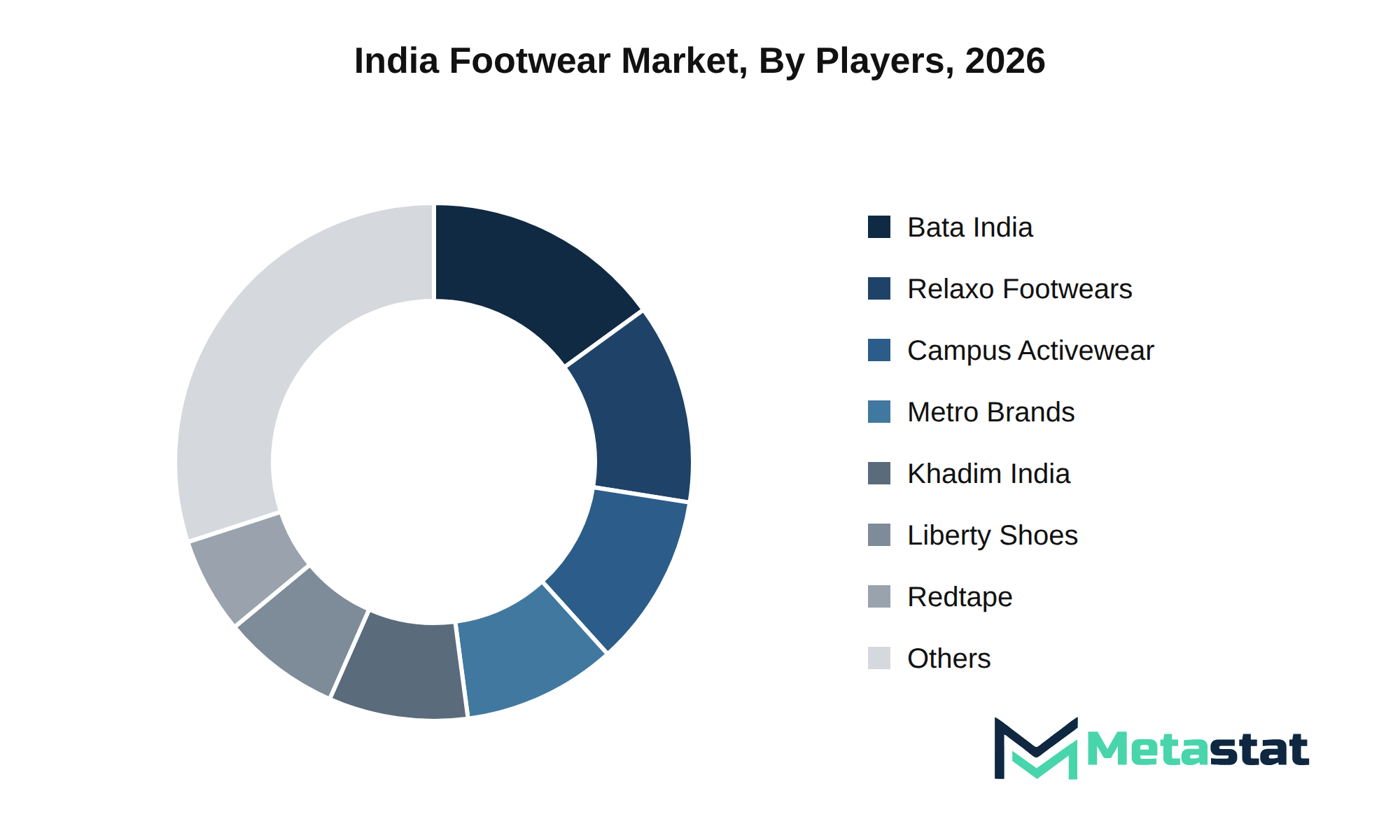
Customer retention strategies are vital for maintaining market share. Firms leverage brand loyalty and switching costs to strengthen their positions. The presence of established players like Bata India Limited, Relaxo Footwears Limited, and Campus Activewear Limited influences new entrants' ability to penetrate the market, establishing barriers that protect existing brands.
Looking ahead, the future competitive outlook indicates a robust environment driven by innovation, strategic partnerships, and evolving consumer preferences. The India Footwear market is expected to continue expanding, with companies adapting to market demands while striving for sustainable growth.
Market size is forecast to rise from USD 26.4 billion in 2025 to over USD 41.7 billion by 2033. The base case anticipates growth at a 5.9% compound annual growth rate (CAGR), reflecting the improving economic environment and increasing consumer spending. Should macroeconomic conditions strengthen further, the bull case suggests potential for accelerated growth driven by heightened consumer confidence and discretionary spending. Conversely, in a bear case scenario, economic challenges, including rising inflation and supply chain disruptions, could hinder growth rates below the base case expectations.
The India Footwear market experiences shifts in downstream demand due to changing consumer preferences, particularly towards sustainable and eco-friendly products. A structural transformation in consumption patterns emerges, driven by consumers becoming more health-conscious, gravitating towards athletic and casual footwear. The integration of next-generation technology into production processes enhances efficiency, leading to innovations in product design and functionality. This technological advancement coincides with a maturation phase in the core industry, requiring companies to adapt swiftly to maintain competitive advantages.
Regulatory evolution and compliance milestones play significant roles in shaping market dynamics. Upcoming policies focused on sustainability and safety standards create both challenges and opportunities for manufacturers. Geopolitical realignments and evolving trade corridors influence supply chain strategies, prompting companies to reassess their operational frameworks. Strategic capital allocation directives, driven by commitments to infrastructure improvements, facilitate expanded production capacities and distribution networks.
Emerging white-space opportunities present avenues for growth, particularly in the online retail segment, which is projected to experience robust expansion. Companies that successfully identify and address unmet enterprise needs within the market position themselves favorably against competitors. In this evolving environment, executive-level strategic imperatives focus on building defensibility through innovation, outreach, and market penetration.
The report strategically identifies and profiles the key market players and analyses their core competencies in each sub-segment of the Footwear market.
Report Attributes | Details |
Study Period | 2021-2033 |
Base Year | 2025 |
Estimated Year | 2026 |
Forecast Period | 2026-2033 |
Historical Period | 2021-2025 |
Growth Rate | CAGR 5.9% from 2026 to 2033 |
Revenue Unit | USD billion |
Segmentation | By Type, End User, Distribution Channel, Region, and Region |
Find answers to common questions about this report
The India Footwear market size was valued at USD 26.4 billion in 2025.
The Footwear market is projected to grow at a CAGR of 5.9% during the forecast period from 2026 to 2033.
Athletic Footwear leads the India Footwear market with a value of USD 7 billion in 2026, representing the highest share among all segments. This segment's growth reflects increasing consumer preference for performance-oriented footwear.
Key drivers for the India Footwear market include shifting demographic patterns, including a growing urban population and rising disposable incomes, which influence demand for premium footwear. the younger generation's preference for athleisure and casual styles enhances the appeal of various footwear segments, contributing to robust market growth through 2033.
The India Footwear market faces challenges from regulatory compliance, rising production costs, and supply chain disruptions due to geopolitical tensions. These factors hinder operational efficiency and profit margins, complicating market growth and limiting competitiveness, particularly for smaller companies.
Increased demand in the India Footwear market is driven by shifting demographic patterns, urbanization, and rising disposable incomes. The younger generation's preference for athleisure styles and the aging population's focus on comfort create diverse consumer needs, favoring product adoption across various footwear segments.
The Footwear market is estimated to reach a valuation of USD 41.7 billion by 2033.
Key players operating in the India Footwear Market include Bata India Limited, Relaxo Footwears Limited, Metro Brands Limited, Khadim India Limited, Liberty Shoes Limited, Woodland, Nike India Pvt. Ltd., and PUMA Sports India Pvt. Ltd.
Athletic footwear is expected to grow from USD 7 billion in 2026 to USD 10.8 billion by 2033, with a CAGR of 6.5%.
West India is projected to reach USD 10.8 billion by 2033, with a CAGR of 6.3%.
The analysts below cover Consumer Goods research at Metastat Insights.
LEAD ANALYST
Utkarsh Khirodkar is a Lead Market Research Analyst at MetaStat Insight, specializing in market intelligence, technology sector assessments, and competitive strategy.
Tracking capacity expansion in single-use bioprocessing requires dependable data on raw material availability and cleanroom-grade polymer supply chains. The competitive landscape chapter gave a grounded evaluation of secondary component suppliers across North America and Asia-Pacific rather than simply reprinting press releases. Having that level of supplier benchmarking helped clarify dual-sourcing considerations for our clinical pipeline planning.
When evaluating distributed energy resource management systems, standard research summaries tend to gloss over the operational differences between front-of-the-meter utility deployments and behind-the-meter industrial sites. The MetaStat Insight report addressed those distinctions directly, especially regarding software interoperability standards and grid interconnection backlogs. The five-year market sizing across regional transmission organizations provided actionable context for our grid modernization strategy.
Most industry reports on warehouse automation bundle autonomous mobile robots and fixed conveyor installations into the same top-level numbers, which complicates advisory work. This study split the market cleanly by payload tiers, navigation technology, and fleet management software layers. The regional forecast for Western Europe gave our team defensible adoption benchmarks when evaluating capital allocation for logistics clients, saving us days of secondary data scrubbing.
Explore related market intelligence reports worth reading alongside this one.