
LEAD ANALYST
Utkarsh Khirodkar is a Lead Market Research Analyst at MetaStat Insight, specializing in market intelligence, technology sector assessments, and competitive strategy.

Marketing Services Market Size, Share, By Service Type (Digital Marketing, Performance Marketing, Social Media Marketing, Search Engine Optimization, Search Engine Marketing, Public Relations, Communications, Creative Production, Content Production, Brand Strategy, Consulting, Email Marketing Services, Lifecycle Marketing Services, and Others), By Delivery Model (Project-based, Retainer-based, and Others), By Organization Size (Large Enterprises, Small Enterprises and Medium Enterprises, By End-User Vertical (Retail, E-Commerce, Consumer Packaged Goods, BFSI, Healthcare, Life Sciences, Telecommunications, Media, Entertainment, Travel, Hospitality, and Others), Industry Analysis, Growth, Trends, and Forecast, 2026-2033
Report ID
MSI-4680
Published
April, 2026
Pages
315 Pages
Format
Report Details
Choose Your License
Marketing Services Market
Global Marketing Services market size is valued at USD 444.9 billion in 2025 and projected to grow at a CAGR of 5.1% during the forecast period, reaching USD 661.9 billion by 2033.
North America holds 35.5% in 2025 with US leading the market share in 2026.
Digital Marketing and Performance Marketing segment account for a market share of 24.6% in 2025.
Key trends driving growth: Acceleration of digital media and performance-led customer acquisition, Rising adoption of data analytics, automation, and marketing technology stacks.
Opportunities include growth in AI-enabled personalization and content operations across omni-channel journeys.
Key insight: Data-centric transformation and performance accountability are reshaping competitive dynamics in the Global Marketing Services Market.
The global marketing services market is evolving at the convergence of creativity, data infrastructure, and commercial strategy within the wider advertising and communications industry. Over the forecast period, service providers will operate less as traditional campaign executors and more as integrated growth partners, supporting product positioning, customer journey design, and revenue optimization. Brand communication is no longer confined to isolated media channels and is increasingly extending across connected commerce ecosystems where media buying, analytics, content production, and performance optimization function in coordinated cycles.
Enterprises are increasingly evaluating marketing partners not only on campaign creativity, but also on their ability to interpret first-party data, automate personalization, and align brand narratives with shifting consumer sentiment. Service portfolios are expanding toward customer experience orchestration, retail media management, influencer intelligence, and AI-assisted creative production. Agencies, consultancies, and technology-led service providers are investing in proprietary platforms and strategic alliances to improve measurement accuracy and attribution transparency, gradually reducing the distinction between these competitive groups.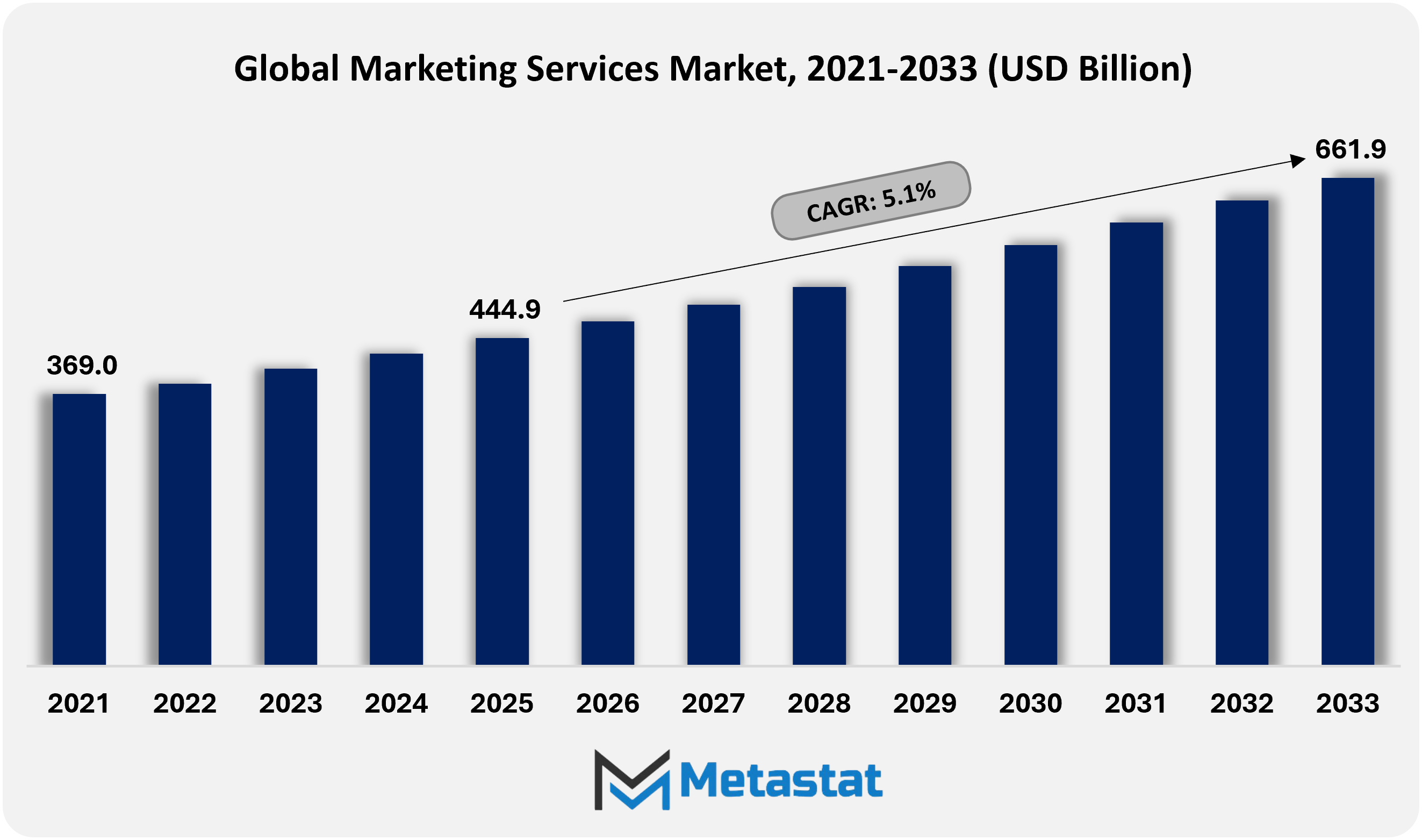
Acceleration of digital media and performance-led customer acquisition.
The continued expansion of digital media is reshaping the global marketing services market through measurable, performance-led customer acquisition models. Brands are allocating higher budgets toward paid search, social commerce, connected TV, and affiliate ecosystems where attribution frameworks support informed spending decisions. Rising focus on return on investment is encouraging service providers to refine conversion tracking, optimize funnels, and align creative execution with revenue outcomes, strengthening demand for accountable and data-backed marketing solutions.
Rising adoption of data analytics, automation, and marketing technology stacks
Advanced analytics platforms, workflow automation, and integrated marketing technology stacks are improving operational efficiency across the global marketing services market. Predictive modeling, customer segmentation engines, and real-time dashboards are enhancing decision-making speed and campaign accuracy. Service providers are integrating customer data platforms with automation tools to streamline lead nurturing, reduce manual workloads, and improve lifecycle management, supporting scalable delivery models across industries.
Higher privacy regulation and signal-loss impacting targeting and measurement
Stricter privacy regulations, third-party cookie deprecation, and consent-based data governance are creating structural constraints across the global marketing services market. Signal loss across browsers and mobile ecosystems is reducing targeting precision and limiting attribution visibility. These compliance pressures are forcing service providers to redesign measurement models, strengthen data strategies, and invest in privacy-centric technology infrastructure, increasing delivery complexity and compliance costs.
Fragmented martech ecosystems and integration complexity increasing delivery risk
Fragmented martech environments continue to create execution risks across the global marketing services market. Multiple vendors, incompatible data formats, and siloed reporting systems complicate integration efforts and weaken campaign coordination. Service providers require stronger technical capabilities to unify analytics, automation, and content management platforms into cohesive workflows. Failure to streamline architecture increases costs, delays deployment, and reduces campaign consistency across channels.
Growth in AI-enabled personalization and content operations across omni-channel journeys
Artificial intelligence is creating strong opportunities for scalable personalization across touchpoints in the global marketing services market. Machine learning models can analyze behavioral signals to tailor messaging, creative formats, and delivery timing across web, mobile, retail media, and immersive platforms. Automated content operations are also improving production speed while maintaining brand consistency, giving organizations a stronger competitive edge in synchronized customer engagement.
The Global Marketing Services market is segmented based on Service Type, Delivery Model, Organization Size, and End-User Vertical.
Digital Marketing and Performance Marketing segment is valued at USD 114.9 billion in 2026 and is projected to reach USD 169.6 billion by 2033, at a CAGR of 5.7% during the forecast period.
Digital Marketing and Performance Marketing is gaining strategic importance in the global marketing services market through deeper use of analytics, predictive modeling, and automated bidding systems. These capabilities are strengthening audience targeting, budget allocation, and conversion visibility across channels. Stronger attribution frameworks are also improving accountability, enabling service providers to optimize campaigns continuously and deliver measurable commercial outcomes for clients across multiple industries.
Social Media Marketing segment is valued at USD 64 billion in 2026 and is projected to reach USD 97.1 billion by 2033, at a CAGR of 6.1% during the forecast period.
Social Media Marketing is advancing through immersive content formats, community-led engagement models, and AI-enabled campaign optimization. Platform-specific storytelling, influencer collaboration, and real-time sentiment analysis are helping brands refine positioning and improve audience responsiveness. Within the global marketing services market, stronger social listening and creator ecosystem management are supporting reputation building, loyalty development, and sustained digital visibility.
Search Engine Optimization and Search Engine Marketing segment is valued at USD 75.6 billion in 2026 and is projected to reach USD 110.7 billion by 2033, at a CAGR of 5.6% during the forecast period.
Search Engine Optimization and Search Engine Marketing remain essential within the global marketing services market as brands continue to prioritize discoverability, traffic quality, and conversion efficiency. Providers are strengthening capabilities in technical audits, keyword intelligence, paid search optimization, and intent-based content mapping to improve digital visibility. Evolving search behavior, including voice search and AI-assisted discovery, is also pushing firms to adopt more adaptive and performance-driven search strategies.
Public Relations and Communications segment is valued at USD 35.0 billion in 2026 and is projected to reach USD 40.5 billion by 2033, at a CAGR of 2.1% during the forecast period.
Public Relations and Communications continues to hold relevance in the global marketing services market through its role in reputation management, stakeholder engagement, and corporate messaging alignment. Service providers are adopting media intelligence tools, crisis preparedness frameworks, and data-backed communication planning to improve message consistency and public trust. Measurable reputation analytics and integrated communication strategies are becoming increasingly important for clients operating in highly visible and regulated sectors.
Creative and Content Production segment is valued at USD 67.6 billion in 2026 and is projected to reach USD 91.8 billion by 2033, at a CAGR of 4.5% during the forecast period.
Creative and Content Production remains a core pillar of the global marketing services market, supported by rising demand for high-volume, multi-format, and platform-specific content. Service providers are adopting digital production workflows, modular content design, and AI-assisted asset development to improve turnaround time and consistency. These capabilities are helping brands deliver relevant messaging across channels while maintaining stronger creative alignment and measurable engagement performance.
Brand Strategy and Consulting segment is valued at USD 46.8 billion in 2026 and is projected to reach USD 64.1 billion by 2033, at a CAGR of 4.6% during the forecast period.
Brand Strategy and Consulting is strengthening its role in the global marketing services market as organizations seek clearer positioning, sharper differentiation, and stronger long-term brand equity. Service providers are supporting clients through market intelligence, cultural insight mapping, scenario planning, and competitive benchmarking. Stronger integration between strategic advisory and execution support is also helping brands align identity, messaging, and growth priorities more effectively across markets.
Email and Lifecycle Marketing Services segment is valued at USD 33.2 billion in 2026 and is projected to reach USD 49.2 billion by 2033, at a CAGR of 5.8% during the forecast period.
Email and Lifecycle Marketing Services continues to generate value in the global marketing services market through retention-focused engagement, behavioral automation, and personalized communication planning. Providers are leveraging customer journey mapping, churn prediction models, and trigger-based workflows to improve conversion, repeat purchase, and long-term customer value. Stronger lifecycle analytics is also enabling more precise segmentation and better orchestration of communication touchpoints.
Others segment is valued at USD 30 billion in 2026 and is projected to reach USD 39 billion by 2033, at a CAGR of 3.8% during the forecast period.
Other service categories in the global marketing services market include experiential campaigns, affiliate marketing support, marketing technology integration, and specialized advisory offerings. These services are gaining relevance as clients seek flexible support models aligned with specific campaign goals, operational requirements, and sector needs. Expansion of niche capabilities such as privacy advisory, AI governance consulting, and retail media support is also broadening the competitive scope of the market.
Project-based segment is projected to reach USD 337 billion by 2033, at a CAGR of 4.3% during the forecast period.
Project-based delivery remains an important engagement model in the global marketing services market, particularly for clients seeking defined campaign scopes, milestone-driven execution, and outcome-specific contracts. This model supports better budgeting visibility and allows organizations to engage external partners for targeted initiatives without long-term commitments. Clear scope definition and performance benchmarking remain essential for maintaining accountability and delivery efficiency under this model.
Retainer-based segment is projected to reach USD 281 billion by 2033, at a CAGR of 5.8% during the forecast period.
Retainer-based delivery is gaining traction in the global marketing services market as clients increasingly prefer continuous strategic oversight, ongoing creative support, and long-term performance monitoring. This model enables service providers to work more closely with clients, respond faster to market changes, and optimize campaigns over time. Recurring contractual relationships also support stronger revenue visibility for firms and deeper integration into client growth strategies.
Others segment is projected to reach USD 43.8 billion by 2033, at a CAGR of 7.9% during the forecast period.
Alternative delivery models in the global marketing services market include hybrid structures, subscription-led service arrangements, and performance-linked compensation frameworks. These models are appealing to organizations seeking greater flexibility, scalable support, and stronger alignment between fees and outcomes. Their adoption is increasing as clients demand commercial structures that better reflect campaign complexity, performance expectations, and evolving digital requirements.
Large Enterprises segment is projected to reach USD 413.8 billion by 2033.
Large enterprises represent a major demand base in the global marketing services market owing to their need for integrated omnichannel strategies, enterprise-level analytics, and multi-market brand management. These organizations typically require centralized governance, sophisticated measurement systems, and large-scale execution capabilities across business units and geographies. Service providers supporting this segment benefit from higher-value contracts, deeper strategic involvement, and long-term transformation mandates.
Small and Medium Enterprises (SMEs) segment is projected to reach USD 248.2 billion by 2033.
Small and medium enterprises are becoming increasingly important in the global marketing services market as digital channels reduce barriers to visibility and customer acquisition. These organizations are seeking cost-efficient automation tools, localized targeting strategies, and measurable campaign outcomes that support business growth without excessive complexity. Flexible pricing, bundled service offerings, and scalable advisory support are particularly attractive within this segment.
Retail and E-Commerce segment is projected to grow at a CAGR of 6% during the forecast period.
Retail and e-commerce companies are major users of marketing services owing to their strong dependence on personalization, conversion optimization, and omnichannel customer engagement. Providers serving this vertical are focusing on performance media, customer analytics, loyalty marketing, and retail media activation to strengthen acquisition and retention outcomes. Integration of commerce data with campaign strategy is also improving targeting precision and promotional efficiency across channels.
Consumer Packaged Goods segment is projected to grow at a CAGR of 5% during the forecast period.
Consumer packaged goods companies continue to invest in marketing services to strengthen brand recall, category visibility, and consumer engagement across highly competitive markets. Service demand in this vertical is supported by the need for multi-channel promotion, influencer-led awareness, packaging communication alignment, and demand stimulation across digital and offline environments. Stronger analytics and campaign tracking are also improving brand performance measurement within this segment.
BFSI segment is projected to grow at a CAGR of 4.6% during the forecast period.
BFSI organizations rely on marketing services to support trust-building, product awareness, and compliant customer acquisition across complex financial categories. Service providers in this vertical are increasingly focused on digital onboarding campaigns, audience segmentation, and communication strategies aligned with regulatory requirements. Data security, message credibility, and lifecycle engagement remain central to campaign effectiveness in this segment.
Healthcare and Life Sciences segment is projected to grow at a CAGR of 5.8% during the forecast period.
Healthcare and life sciences companies are using marketing services to strengthen educational outreach, patient engagement, and professional communication within tightly regulated environments. Demand in this segment is rising for services that combine content precision, compliance awareness, and digital engagement tools. Service providers that can support transparent communication, targeted awareness campaigns, and privacy-conscious delivery models are well positioned.
Telecommunications segment is projected to grow at a CAGR of 4.6% during the forecast period.
Telecommunications companies are increasingly using marketing services to support subscriber acquisition, churn reduction, and service upselling in competitive markets. Providers are helping firms execute bundling campaigns, personalize retention strategies, and improve customer communication through analytics-led targeting. High customer volumes and frequent service interactions make this a significant vertical for performance-focused marketing services.
Media and Entertainment segment is projected to grow at a CAGR of 5.5% during the forecast period.
Media and entertainment companies are using marketing services to increase audience engagement, improve content discoverability, and strengthen monetization across digital platforms. Campaign strategies often combine audience analytics, cross-platform promotion, influencer partnerships, and immersive creative formats to support stronger viewership and fan interaction. Speed, relevance, and content-led engagement remain central to service demand in this segment.
Travel and Hospitality segment is projected to grow at a CAGR of 5.9% during the forecast period.
Travel and hospitality companies are adopting marketing services to strengthen booking conversions, promote destinations, and improve loyalty program performance in a highly seasonal environment. Providers are supporting this vertical through dynamic pricing communication, personalized outreach, content-led brand building, and campaign timing informed by demand forecasting. Digital engagement and customer retention remain critical priorities across this segment.
Others segment is projected to grow at a CAGR of 3.4% during the forecast period.
Other end-user verticals in the global marketing services market include education, automotive, energy, and professional services, each with distinct communication requirements and campaign goals. Service providers are tailoring delivery models, analytics frameworks, and creative strategies to match industry-specific buying journeys and regulatory conditions. This diversity of demand is expanding the market’s application base and supporting broader service specialization.
Based on geography, the Global Marketing Services market is divided into North America, Europe, Asia-Pacific, South America, Middle East, and Africa.
North America Marketing Services Market is set to expand at a CAGR of 5.1% within the forecast period, reaching a market size (TAM) of USD 224.7 billion by the end of 2033.
North America drives the Marketing Services Market via sturdy virtual advertising expenditure led with the aid of most important agencies and era-driven marketing campaign optimization.
Europe holds a significant position in the marketing services market, supported by established brand portfolios, strong digital adoption, and increasing emphasis on privacy-compliant marketing execution.
North America speeds up the Marketing Services Market with superior records analytics adoption and performance-focused emblem strategies throughout aggressive industries.
Asia Pacific affords possibilities inside the Marketing Services Market owing to rapid growth of e-commerce ecosystems and rising virtual purchaser engagement.
Asia Pacific offers growth capability within the Marketing Services Market pushed via growing SME participation in online branding and cell-first marketing investments.
Across the Middle East, Africa, and South America, the Marketing Services Market gains traction from expanding net penetration, growing children demographics, and rising localized content material strategies.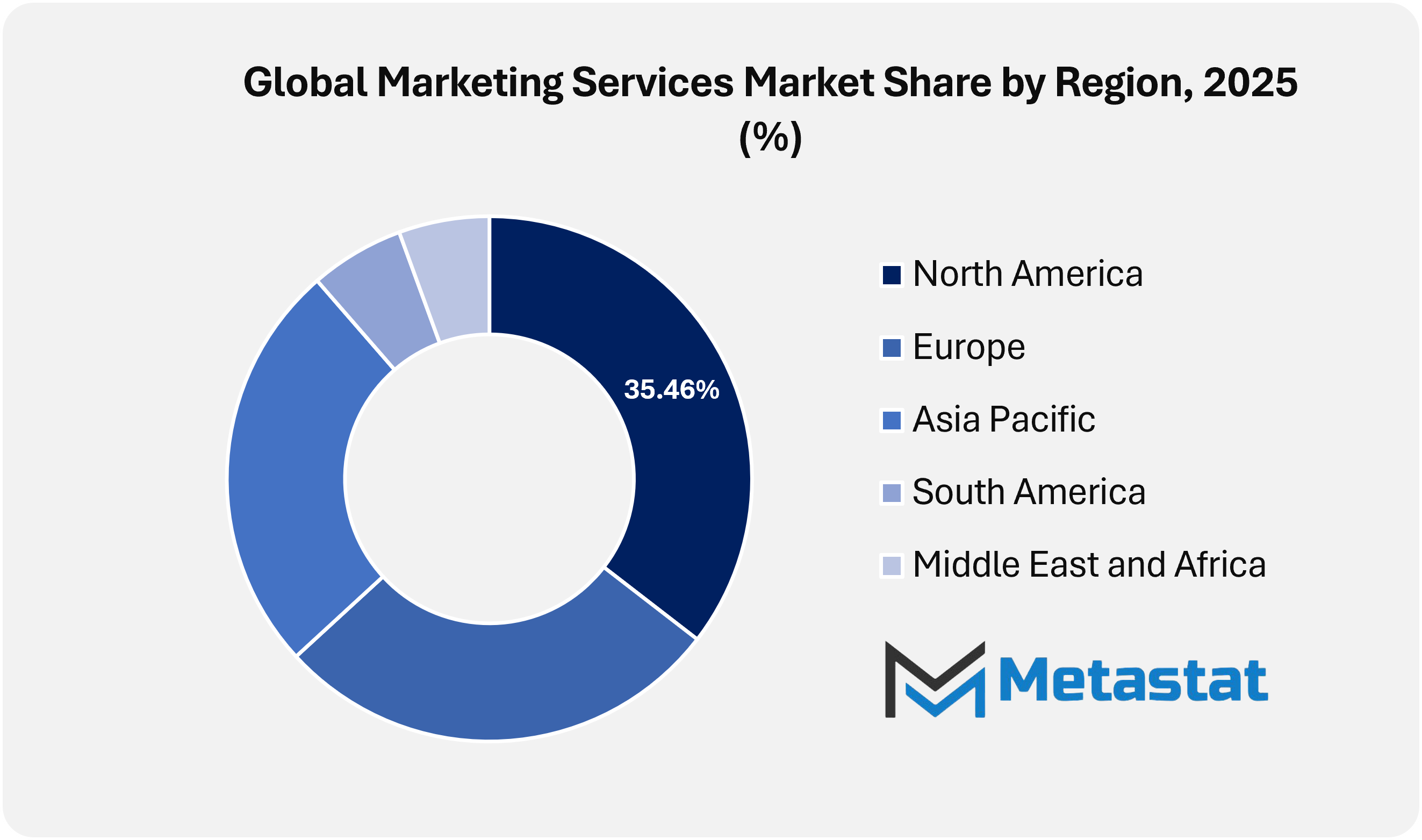
The global marketing services market remains highly competitive as brands seek measurable, technology-enabled, and creatively differentiated ways to engage customers across channels. Service providers are broadening their offerings beyond traditional advertising to include analytics, customer experience design, retail media support, marketing automation, and performance optimization. Competitive advantage increasingly depends on a firm’s ability to combine strategic advisory, execution depth, data capabilities, and outcome accountability within a unified service model.
Large global holding groups continue to maintain a strong position in the market through broad service portfolios, international delivery networks, and longstanding client relationships. Companies such as WPP plc, Publicis Groupe S.A., Omnicom Group Inc., Dentsu Group Inc., and Havas SA offer integrated capabilities across media, branding, public relations, content, and digital transformation support. Their scale, talent depth, and technology investments allow them to compete effectively across multinational accounts and complex campaign environments.
Consulting-led and technology-driven firms are also reshaping the market by combining marketing services with analytics, automation, customer data management, and operational transformation. Companies including Accenture plc, Capgemini SE, Deloitte Touche Tohmatsu Limited, International Business Machines Corporation, Infosys Limited, Tata Consultancy Services Limited, Cognizant Technology Solutions Corporation, HCL Technologies Limited, Wipro Limited, eClerx Services Limited, and EXL Service Holdings, Inc. are expanding their role from advisory support into execution, experience design, and martech-enabled delivery.
Specialist digital agencies and performance-focused firms add further intensity to competition through agile delivery models, niche expertise, and stronger emphasis on measurable campaign outcomes. Companies such as VML, Merkle, Inc., Digitas Inc., Media.Monks B.V., Concentrix Corporation, Disruptive Advertising, and Ignite Visibility are strengthening their market position through digital performance, content strategy, customer engagement, and rapid execution capabilities. This mix of holding groups, consultancies, and specialist firms is steadily redefining how marketing services are delivered across industries.
Market size is forecast to rise from USD 444.9 billion in 2025 to over USD 661.9 billion by 2033.
Capital allocation within the Global Marketing Services market will increasingly more want companies capable of subscription-primarily based advisory fashions in place of assignment-primarily based billing. Long-time period retainers anchored in overall performance accountability turns into popular exercise. As digital commerce deepens and brand loyalty grows extra fragile, advertising service companies will function themselves now not merely as communicators but as architects of sustained commercial relevance.
This research report categorizes the Marketing Services market based on key segments and regions, forecasts revenue growth, and analyses trends in each submarket. The report analyses the key growth drivers, opportunities, and challenges influencing the Marketing Services market. Recent market developments and competitive strategies such as expansion, product launch, partnership, merger, and acquisition have been included to draw the competitive landscape in the market.
The report strategically identifies and profiles the key market players and analyses their core competencies in each sub-segment of the Marketing Services market.
|
Report Attributes |
Details |
|
Study Period |
2021-2033 |
|
Base Year |
2025 |
|
Estimated Year |
2026 |
|
Forecast Period |
2026-2033 |
|
Historical Period |
2021-2025 |
|
Growth Rate |
CAGR 5.1% from 2026 to 2033 |
|
Revenue Unit |
USD billion |
|
Segmentation |
By Service Type, Delivery Model, Organization Size, End-User Vertical, and Region |
|
By Region |
North America (By Service Type, Delivery Model, Organization Size, End-User Vertical, and Country)
|
|
Europe (By Service Type, Delivery Model, Organization Size, End-User Vertical, and Country)
|
|
|
Asia Pacific (By Service Type, Delivery Model, Organization Size, End-User Vertical, and Country)
|
|
|
South America (By Service Type, Delivery Model, Organization Size, End-User Vertical, and Country)
|
|
|
Middle East and Africa (By Service Type, Delivery Model, Organization Size, End-User Vertical, and Country)
|
Find answers to common questions about this report
Top players operating in the Marketing Services industry include WPP plc, Publicis Groupe S.A., Omnicom Group Inc., Wipro Limited, and Dentsu Group Inc.
Higher privacy regulation and signal-loss impacting targeting and measurement will hamper the market growth within the forecast period.
Global Marketing Services market is estimated to reach USD 661.9 billion by 2033.
The Digital Marketing and Performance Marketing is the leading type segment in the Global market.
North America region dominates the market.
Acceleration of digital media and performance-led customer acquisition and Rising adoption of data analytics, automation, and marketing technology stacks are key driving factors, boosting the market.
The Global Marketing Services market is expected to grow at a CAGR of 5.1% over the forecast period (2026-2033).
The Metastat Insights analysis shows that the North America Marketing Services market size is estimated to be USD 224.7 billion by 2033.
The Metastat Insights study shows that the Global Marketing Services market size was USD 444.9 billion in 2025.
The analysts below cover Professional Services research at Metastat Insights.
LEAD ANALYST
Utkarsh Khirodkar is a Lead Market Research Analyst at MetaStat Insight, specializing in market intelligence, technology sector assessments, and competitive strategy.

PRINCIPAL CONSULTANT - ENTERPRISE AI & EMERGING TECHNOLOGIES
Banking & Finance · Electronics and Semiconductor · Energy and Power · Healthcare IT · Information & Technology · Professional Services
Vijay Gunti is a Principal Consultant at MetaStat Insight, bringing over two decades of experience across enterprise digital transformation, technology strategy, and intelligent systems.

PRINCIPAL CONSULTANT - QUALITY SYSTEMS & COMPLIANCE
Electronics and Semiconductor · Machinery & Equipment · Professional Services
Omkar Phadtare is an Industry Consultant at MetaStat Insight, specializing in quality systems, regulatory compliance, and standards benchmarking to drive data-driven market intelligence and strategic industry research.

LEAD CONSULTANT - COMMUNICATION, TELECOM, AND IT
Electronics and Semiconductor · Information & Technology · Machinery & Equipment · Professional Services
Ravindra Sathe Consultants for Communication, Telecom, and IT at MetaStat Insight. He leads the firm's industry research initiatives across telecommunications infrastructure, digital connectivity, enterprise networking, and emerging information technology domains.
Transitioning ultra-class mining haul trucks to alternative power requires concrete data on remote hydrogen refueling infrastructure economics. The report evaluated megawatt-scale electrolyzer installation expenses, onsite storage safety mandates, and heavy-duty fuel cell stack degradation under continuous duty cycles. That technical rigor helped our engineers benchmark realistic total operating cost horizons for off-highway fleet decarbonization.
Enterprise zero-trust network rollouts are often slowed down by multi-cloud transit latency and proprietary hardware retirement schedules. This study provided realistic total cost of ownership models comparing cloud-delivered security edge solutions against traditional hardware refreshes. The analysis of contract renewal lengths and software maintenance fees gave us clear visibility into enterprise replacement cycles over the next three to five years.
Scaling antibody-drug conjugate manufacturing hinges on contract manufacturing availability for high-potency active ingredients. The MetaStat Insight analysis looked closely at global cleanroom slot constraints, bioconjugation batch failure rates, and supply chain redundancies between the US, Europe, and India. The supplier capability matrix proved genuinely useful for our team when mapping secondary source options across our clinical pipeline.
Explore related market intelligence reports worth reading alongside this one.
Starting from
$2950