Metal Forgings for Oil and Gas Market Size, Share, By Type (Open-Die Forgings, Closed-Die Forgings, Seamless Rolled Ring Forgings, and Upset Forgings), By Products (Flanges, Fittings, Shafts, Blocks, Hubs, and Others), By Application (Downhole Forgings, Subsea Forgings, and Surface Forgings), Industry Analysis, Growth, Trends, and Forecast, 2026-2033
Report ID
MSI-4611
Published
April 14, 2026
Pages
320 Pages
Format
Report Details
Comprehensive Market Analysis And Insights
Market Overview
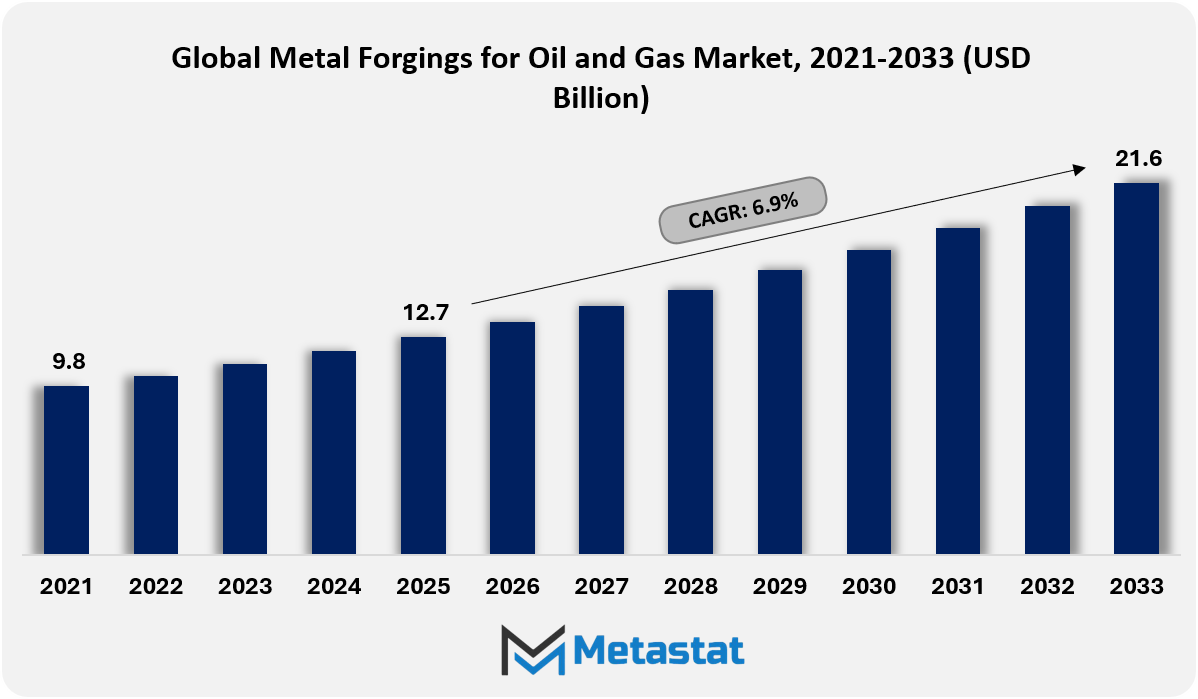
The Global Metal Forgings for Oil and Gas market size was valued at USD 12.7 billion in 2025 and projected to grow at a CAGR of 6.9% during the forecast period, reaching USD 21.6 billion by 2033.
Global Metal Forgings for Oil and Gas Market: Comprehensive Data-Driven Market Analysis and Strategic Outlook
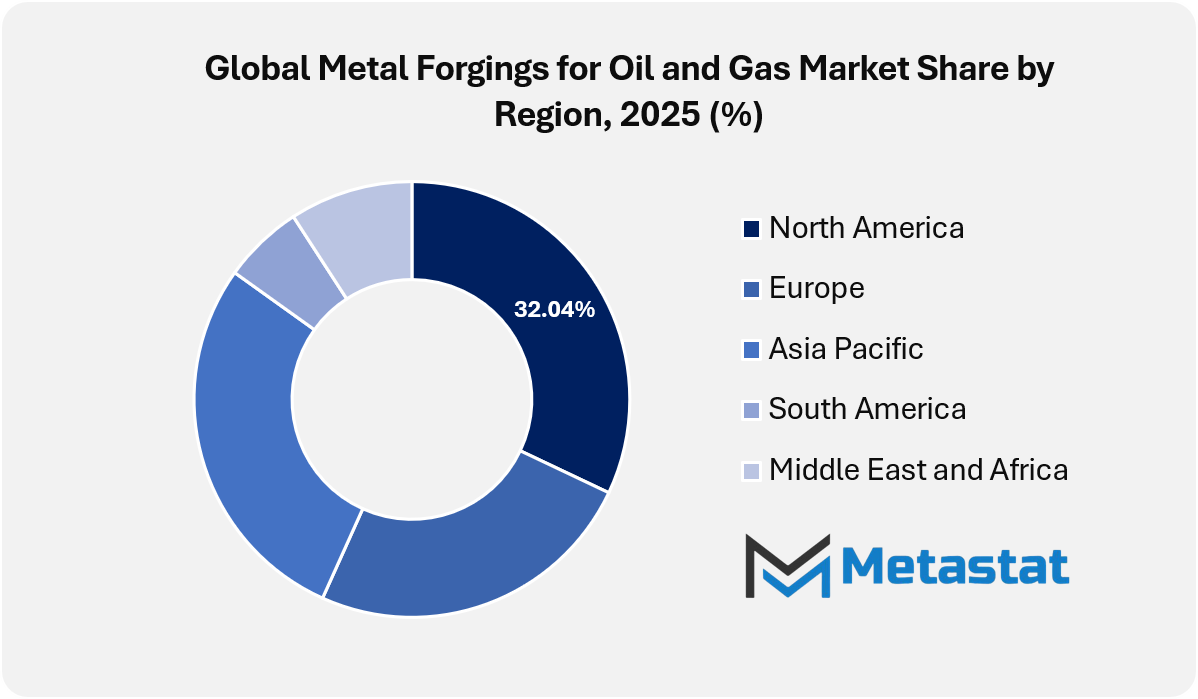
North America held 32.0% of the global market in 2025, with the U.S. leading regional demand.
The Open-Die Forgings segment accounted for 27.4% of the market in 2025.
Key trends driving growth include ongoing investments in oil and gas exploration, production, and pipeline infrastructure, along with rising demand for high-strength and durable components that support operational safety and reliability.
Opportunities include rising demand for corrosion-resistant and high-performance alloy forgings in deepwater and unconventional projects.
Key insight: Rising upstream investment and pipeline expansion continue to anchor demand for high-strength metal forgings across oil and gas infrastructure.
The Global Metal Forgings for Oil and Gas market and its industry ecosystem are entering a phase where technical specialization, operational resilience, and commercial relevance are gaining greater importance beyond conventional supply-side narratives. Over the coming years, forged components designed for drilling systems, pressure control equipment, and subsea infrastructure are expected to attract stronger demand owing to their role in supporting complex extraction environments, including ultra-deepwater and high-temperature fields. Demand patterns are likely to align with engineering requirements related to durability, fatigue resistance, and precision tolerances, encouraging manufacturers to adopt advanced metallurgical practices.
Future development in the Global Metal Forgings for Oil and Gas market is expected to remain closely linked with digital manufacturing frameworks. Smart forging lines, predictive quality monitoring, and data-driven defect reduction strategies are projected to influence procurement decisions among upstream operators and equipment manufacturers. This shift is likely to reshape supplier evaluation, with traceability, simulation-backed design validation, and lifecycle performance data gaining priority over volume-led contracts.
Market Dynamics
Growth Drivers:
Ongoing investments in oil and gas exploration, production, and pipeline infrastructure.
Sustained capital flows toward offshore fields, shale reserves, and cross-border pipeline networks continue to support expansion in the Global Metal Forgings for Oil and Gas market. Infrastructure modernization and capacity additions across producing regions are driving consistent demand for forged components designed for high-pressure operating environments and extended service cycles.
Demand for high-strength and durable components to ensure operational safety and reliability.
Operational hazard discount remains a central priority across upstream and midstream sectors, growing choice for solid elements supplying superior fatigue resistance and cargo tolerance. High-strength forgings improve equipment stability under extreme temperatures and pressures, strengthening operator confidence in uninterrupted production and long-term asset integrity.
Restraints and Challenges:
Volatility in crude oil prices affecting capital expenditure in oil and gas projects.
Fluctuating crude benchmarks introduce uncertainty within assignment planning and procurement schedules. Budget revisions and deferred investments regularly disrupt order volumes for solid products. Market participants face planning challenges during prolonged price volatility, limiting short-term visibility for suppliers tied to exploration and production spending cycles.
Stringent quality standards and certification requirements increasing production complexity.
Compliance with global material standards and inspection protocols increases manufacturing complexity for forging suppliers. Advanced checking out, documentation, and traceability necessities increase operational costs. Smaller producers face entry barriers, while larger manufacturers allocate significant resources to maintain approvals required across critical oil and gas applications.
Opportunities:
Rising demand for corrosion-resistant and high-performance alloy forgings in deepwater and unconventional projects.
Growth in deepwater drilling and unconventional resource development is encouraging the adoption of alloy forgings engineered for corrosive, high-pressure environments. Specialized materials support longer equipment life under harsh operating conditions. This performance-driven trend is strengthening long-term prospects for the Global Metal Forgings for Oil and Gas market.
Market Segmentation Analysis
The Global Metal Forgings for Oil and Gas market is segmented by Type, Product, and Application.
By Type, the market is further segmented into:
Open-Die Forgings
Open-Die Forgings segment is estimated at USD 3.7 billion in 2026 and is projected to reach USD 5.5 billion by 2033, at a CAGR of 5.8% during the forecast period.
Open-Die Forgings will support large-scale oil and gas equipment manufacturing through flexible shaping capabilities and strong structural performance. Production processes enable customized dimensions for heavy components used in drilling and processing systems. Adoption is expected to rise with infrastructure expansion, where adaptability and grain integrity remain important procurement considerations.
Closed-Die Forgings
Closed-Die Forgings segment is estimated at USD 3.2 billion in 2026 and is projected to reach USD 5 billion by 2033, at a CAGR of 6.5% during the forecast period.
Closed-Die Forgings are expected to gain momentum owing to demand for high-precision components with consistent geometry. Controlled tooling improves mechanical performance in critical oilfield equipment. Future deployment will remain strong in volume-production settings that require repeatability, reduced material waste, and improved surface finish, supporting efficiency goals across energy-sector supply chains.
Seamless Rolled Ring Forgings
Seamless Rolled Ring Forgings segment is estimated at USD 5.2 billion in 2026 and is projected to reach USD 8.8 billion by 2033, at a CAGR of 7.7% during the forecast period.
Seamless Rolled Ring Forgings will play a vital role in pressure-intensive oil and gas applications. Their circular grain flow improves fatigue resistance in valves, bearings, and connectors. Market preference is expected to strengthen owing to their reliability under rotational stress, supporting longer service life across offshore and onshore installations.
Upset Forgings
Upset Forgings segment is estimated at USD 1.4 billion in 2026 and is projected to reach USD 2.4 billion by 2033, at a CAGR of 7.9% during the forecast period.
Upset Forgings address the requirement for localized strength enhancement in oil and gas components. Axial force concentration improves load-bearing capacity in fasteners and connectors. Utilization is expected to increase with more complex drilling operations, where compact components must withstand high tensile and compressive forces over extended operating cycles.
By Products, the market is divided into:
Flanges
Flanges segment is projected to reach USD 6.7 billion by 2033, at a CAGR of 6.4% during the forecast period.
Flanges remain essential connection components in pipelines and processing units. Forged construction supports leak resistance under high-pressure and high-temperature conditions. Future demand will align with pipeline network expansion, refinery upgrades, and compliance-driven replacement cycles, reinforcing the importance of dimensional accuracy and metallurgical consistency.
Fittings
Fittings segment is projected to reach USD 5.6 billion by 2033, at a CAGR of 6.8% during the forecast period.
Forged fittings will support directional flow control and structural continuity within oil and gas systems. High-strength metallurgy will reduce the risk of failure under fluctuating pressure. Future growth will reflect increased adoption of complex pipeline layouts, where durability, corrosion resistance, and long-term performance will influence purchasing strategies.
Shafts
Shafts segment is projected to reach USD 2.2 billion by 2033, at a CAGR of 7.3% during the forecast period.
Shafts enable torque transmission in drilling rigs, pumps, and compressors. Uniform grain flow improves fatigue resistance under continuous rotation. Future requirements will emphasize precise balancing and material stability, supporting automation-led equipment design and higher operational efficiency across upstream and midstream applications.
Blocks
Blocks segment is projected to reach USD 2.5 billion by 2033, at a CAGR of 6.5% during the forecast period.
Blocks serve as core components in heavy oil and gas machinery. Solid structural integrity will support machining into customized forms. Future relevance will expand with modular tool design trends, where high-load tolerances and machining flexibility will support faster deployment and less maintenance downtime.
Hubs
Hubs segment is projected to reach USD 1.9 billion by 2033, at a CAGR of 7.8% during the forecast period.
Hubs connect rotating elements within energy equipment assemblies. Higher mechanical strength reduces wear under cyclic stress. Adoption is expected to increase with the modernization of drilling systems, where compact yet robust components support higher power density and extended operating reliability.
Others
Others segment is projected to reach USD 2.8 billion by 2033, at a CAGR of 7.8% during the forecast period.
Other forged products meet specialized oil and gas requirements, including connectors, couplings, and custom-engineered components. Tailored production supports project-specific specifications. Requirement for these products is expected to increase with unconventional exploration activity, encouraging innovation in forging techniques and alloy selection for specific operating challenges.
By Application, the market is further divided into:
Downhole Forgings
Downhole Forgings segment is projected to reach USD 6.6 billion by 2033.
Downhole forgings must withstand extreme pressures, temperatures, and corrosive environments during drilling operations. High structural strength reduces failure risk at critical depths. Growth will be supported by deep-well development, which places greater emphasis on metallurgical precision and performance assurance under prolonged exposure conditions.
Subsea Forgings
Subsea Forgings segment is projected to reach USD 5.2 billion by 2033.
Subsea forgings will support offshore infrastructure through exceptional resistance to pressure and corrosion. Structural reliability will continue to be important for underwater installations. Future growth will follow offshore energy investments, where long service intervals and minimal maintenance access will increase the value of high-integrity forged components.
Surface Forgings
Surface Forgings segment is projected to reach USD 9.8 billion by 2033.
Surface forgings contribute to processing units, storage systems, and transportation infrastructure. Forged durability will support continuous operation under variable loads. Future expansion will align with refinery upgrades and onshore facility development, driving demand for standardized components that meet increasing safety and efficiency requirements.
By Region:
Based on geography, the Global Metal Forgings for Oil and Gas market is segmented into North America, Europe, Asia-Pacific, South America, and Middle East & Africa.
North America Metal Forgings for Oil and Gas Market is set to expand at a CAGR of 6.9% within the forecast period, reaching a market size (TAM) of USD 6.4 billion by the end of 2033.
In North America, sustained investment in shale exploration and unconventional drilling supports steady demand for high-strength metal forgings used in critical oil and gas equipment.
North America also maintains stringent safety and performance standards across upstream and midstream operations, encouraging adoption of precision-engineered metal forgings.
In Asia-Pacific, expanding refining capacity and cross-border pipeline projects are creating strong opportunities for steel forgings used in valves, flanges, and pressure equipment.
Asia-Pacific offers strong growth potential through rising offshore exploration activity and increasing domestic energy consumption across emerging economies.
Across the Middle East, Africa, and South America, large-scale oilfield development, infrastructure upgrades, and national energy security initiatives sustain long-term demand for durable steel forgings in oil and gas operations.
Competitive Landscape and Strategic Insights
The Global Metal Forgings for Oil and Gas market plays a critical role in supporting energy infrastructure, where strength, safety, and long service life are essential. Forged components are used across drilling, exploration, transportation, and refining operations, where they must perform under high pressure and extreme temperatures. Demand remains connected to upstream and midstream investments, pipeline expansion, and equipment upgrades across mature and emerging electricity markets. Manufacturers remain focused on consistency, material quality, and delivery reliability to meet stringent industry standards while managing costs and lead times.
Several established companies shape the competitive structure of this market through deep manufacturing expertise and broad product portfolios. Bharat Forge Ltd., ELLWOOD City Forge Group, Scot Forge, FRISA, Farinia Group (Setforge), Ring Mill S.P.A., and Galperti Group supply massive solid rings, flanges, and custom elements utilized in critical oil and gas operations. ULMA Forged Solutions, Special Flanges S.p.A., Metalfar, Vilmar S.p.A., Texas Flange, and Paramount Forge support global projects through a mix of standard and engineered solutions designed for harsh operating conditions.
The Global Metal Forgings for Oil and Gas market plays a constant role in supporting power infrastructure, where electricity, protection, and long service life are essential every day. Forged components guide drilling, exploration, shipping, and refining operations, coping with high strain and extreme temperatures without failure. Demand remains connected to upstream and midstream investments, pipeline expansion, and equipment upgrades across mature and emerging electricity markets. Manufacturers' attention on consistency, fabric quality, and dependable output to meet strict enterprise standards while handling fees and delivery timelines.
Several installed corporations form the aggressive structure of this market through deep production experience and huge product portfolios. Bharat Forge Ltd., ELLWOOD City Forge Group, Scot Forge, FRISA, Farinia Group, Ring Mill S.p.A., and Galperti Group supply large, forged rings, flanges, and custom components used in critical oil and gas operations. ULMA Forged Solutions, Special Flanges S.P.A., Metalfar, Vilmar S.P.A., Texas Flange, and Paramount Forge help international projects through a mix of well-known and engineered solutions designed for harsh field conditions.
Forecast and Future Outlook
Market size is forecast to rise from USD 12.7 billion in 2025 to over USD 21.6 billion by 2033.
Beyond direct oilfield applications, forged products serving this market are expected to gain relevance across adjacent energy segments. Hydrogen transport systems, carbon capture infrastructure, and geothermal installations are likely to adopt similar forging specifications owing to shared pressure and safety requirements. Such convergence is probably to blur conventional enterprise obstacles, positioning forging specialists at the intersection of multiple energy pathways. Over time, the Global Metal Forgings for Oil and Gas market is expected to evolve into a technically anchored segment where engineering credibility, compliance depth, and adaptive manufacturing capabilities define long-term relevance beyond immediate project cycles.
Metal Forgings for Oil and Gas Market Key Segments:
By Type:
Open-Die Forgings
Closed-Die Forgings
Seamless Rolled Ring Forgings
Upset Forgings
By Products:
Flanges
Fittings
Shafts
Blocks
Hubs
Others
By Application:
Downhole Forgings
Subsea Forgings
Surface Forgings
Key Global Metal Forgings for Oil and Gas Industry Players
This research report categorizes the Metal Forgings for Oil and Gas market based on key segments and regions, forecasts revenue growth, and analyses trends in each submarket. The report analyses the key growth drivers, opportunities, and challenges influencing the Metal Forgings for Oil and Gas market. Recent market developments and competitive strategies such as expansion, product launch, partnership, merger, and acquisition have been included to draw the competitive landscape in the market.
The report strategically identifies and profiles the key market players and analyses their core competencies in each sub-segment of the Metal Forgings for Oil and Gas market.
Report Attributes
Details
Study Period
2021-2033
Base Year
2025
Estimated Year
2026
Forecast Period
2026-2033
Historical Period
2021-2025
Growth Rate
CAGR 6.9% from 2026 to 2033
Revenue Unit
USD billion
Segmentation
By Type, Products, Application, and Region
By Region
North America (By Type, Products, Application, and Country)
United States
Canada
Mexico
Europe (By Type, Products, Application, and Country)
Germany
France
UK
Italy
Spain
Russia
Rest of Europe
Asia Pacific (By Type, Products, Application, and Country)
China
Japan
India
South Korea
Australia
Southeast Asia
Rest of Asia Pacific
South America (By Type, Products, Application, and Country)
Brazil
Argentina
Rest of South America
Middle East and Africa (By Type, Products, Application, and Country)
Saudi Arabia
UAE
South Africa
Rest of Middle East and Africa
WHAT REPORT PROVIDES
Key Company Market Share and Revenue
Key Market Leaders
Full In-Depth Analysis of the Parent Industry
Industry Statistics
Important Changes in Market and Its Dynamics
Segmentation Details of the Market
Historical, On-Going, and Projected Market Analysis
Assessment of Niche Industry Developments
Market Share Analysis
Key Strategies of Major Players
Company Profiles of Key Players
Unique Selling Propositions of Leading Market Players
Emerging Segments and Regional Growth Potential
Key Strategic Recommendations
Competitive Benchmarking
Import-Export Trade Statistics
End of Report Overview
Frequently Asked Questions
Find answers to common questions about this report
Global Metal Forgings for Oil and Gas market is estimated to reach USD 21.6 billion by 2033.
Volatility in crude oil prices affecting capital expenditure on oil and gas projects will hamper market growth within the forecast period.
Seamless Rolled Ring Forgings are the leading type segment in the global market.
North America region dominates the market.
The Metastat Insights analysis shows that the North America Metal Forgings for Oil and Gas market size is estimated to be USD 6.4 billion by 2033.
Top players operating in the Metal Forgings for Oil and Gas industry include Bharat Forge Ltd., ELLWOOD City Forge Group, Scot Forge, FRISA, Farinia Group (Setforge), and Ring Mill S.p.A., Galperti Group.
The Global Metal Forgings for Oil and Gas market is likely to grow at a CAGR of 6.9% over the forecast period (2026-2033).
Ongoing investments in oil and gas exploration, production, and pipeline infrastructure. and Demand for high-strength and durable components to ensure operational safety and reliability. are key driving factors, boosting the market.
The Metastat Insights study shows that the Global Metal Forgings for Oil and Gas market size was USD 12.7 billion in 2025.
Global Well Stimulation market size: USD 9.1 billion in 2025, forecast USD 15.1 billion by 2033 at a 6.6% CAGR. Segment, region and competitor analysis.
Well Stimulation market, Well Stimulation Market Size, Well Stimulation Market Share, Well Stimulation Market Analysis, Well Stimulation Market Growth, Well Stimulation Market Trends, Well Stimulation Market Research Report, Well Stimulation Market Forecast, Well Stimulation, Well Stimulation Market Research, Well Stimulation Industry, Well Stimulation Industry Report, Well Stimulation Market Data, Well Stimulation Statistics, Well Stimulation Market Statistics, Well Stimulation Industry Trends, Well Stimulation Market Report, Well Stimulation Market Trends, Well Stimulation Market News, Well Stimulation Forecasts, Well Stimulation Market Intelligence Report, Well Stimulation market 2033, Well Stimulation market outlook, Well Stimulation market segmentation, Well Stimulation market drivers, Well Stimulation market restraints, Well Stimulation market opportunities, Well Stimulation market CAGR, Well Stimulation suppliers, Well Stimulation manufacturers, Well Stimulation market by region, North America Well Stimulation market, Asia Pacific Well Stimulation market, Europe Well Stimulation market, Well Stimulation market competitive landscape, Well Stimulation market key players, Hydraulic Fracturing Well Stimulation, Matrix Acidizing Well Stimulation, Offshore Well Stimulation, Onshore Well Stimulation, Shale Well Stimulation, Tight Oil and Gas Well Stimulation, Carbonate Well Stimulation, Sandstone Well Stimulation, Coalbed Methane Well Stimulation, Conventional Reservoirs Well Stimulation, International Oil Companies Well Stimulation, National Oil Companies Well Stimulation, Independent Oil & Gas Operators Well Stimulation, Oilfield Service Companies Well Stimulation
Lighting as a Service (LaaS) Market Size, Share, 2033
Global Lighting because a Service (LaaS) market size: USD 10.7 billion in 2025, forecast USD 101.9 billion by 2033 at a 32.5% CAGR. Segment and regional data.
Lighting as a Service (LaaS) market, Lighting as a Service (LaaS) Market Size, Lighting as a Service (LaaS) Market Share, Lighting as a Service (LaaS) Market Analysis, Lighting as a Service (LaaS) Market Growth, Lighting as a Service (LaaS) Market Trends, Lighting as a Service (LaaS) Market Research Report, Lighting as a Service (LaaS) Market Forecast, Lighting as a Service (LaaS), Lighting as a Service (LaaS) Market Research, Lighting as a Service (LaaS) Industry, Lighting as a Service (LaaS) Industry Report, Lighting as a Service (LaaS) Market Data, Lighting as a Service (LaaS) Statistics, Lighting as a Service (LaaS) Market Statistics, Lighting as a Service (LaaS) Industry Trends, Lighting as a Service (LaaS) Market Report, Lighting as a Service (LaaS) Market Trends, Lighting as a Service (LaaS) Market News, Lighting as a Service (LaaS) Forecasts, Lighting as a Service (LaaS) Market Intelligence Report, Lighting as a Service (LaaS) Market Outlook, Lighting as a Service (LaaS) Market Segmentation, Lighting as a Service (LaaS) Market Drivers, Lighting as a Service (LaaS) Market Restraints, Lighting as a Service (LaaS) Market Opportunities, Lighting as a Service (LaaS) Market CAGR, Lighting as a Service (LaaS) Suppliers, Lighting as a Service (LaaS) Manufacturers, Lighting as a Service (LaaS) Market by Region, North America Lighting as a Service (LaaS) Market, Asia Pacific Lighting as a Service (LaaS) Market, Europe Lighting as a Service (LaaS) Market, Lighting as a Service (LaaS) Market Competitive Landscape, Lighting as a Service (LaaS) Market Key Players, Indoor Lighting as a Service (LaaS) Market, Outdoor Lighting as a Service (LaaS) Market, Commercial Lighting as a Service (LaaS) Market, Industrial Lighting as a Service (LaaS) Market, LED Lighting as a Service (LaaS) Market, Software & Communication Systems in Lighting as a Service (LaaS) Market.
Global Hydrocarbon market size was USD 447.7 billion in 2025 and is projected to reach USD 641.7 billion by 2033, growing at a CAGR of 4.6%. Full analysis.
Global Energy market size was USD 2,057.1 billion in 2025 and is projected to reach USD 4,845.7 billion by 2033, growing at a CAGR of 11.3%. Full analysis.
Energy market, Energy Market Size, Energy Market Share, Energy Market Analysis, Energy Market Growth, Energy Market Trends, Energy Market Research Report, Energy Market Forecast, Energy, Energy Market Research, Energy Industry, Energy Industry Report, Energy Market Data, Energy Statistics, Energy Market Statistics, Energy Industry Trends, Energy Market Report, Energy Market Trends, Energy Market News, Energy Forecasts, Energy Market Intelligence Report, Energy market 2033, Energy market outlook, Energy market segmentation, Energy market drivers, Energy market restraints, Energy market opportunities, Energy market CAGR, Energy suppliers, Energy manufacturers, Energy market by region, North America Energy market, Asia Pacific Energy market, Europe Energy market, Energy market competitive landscape, Energy market key players, Oil Energy market, Natural Gas Energy market, Solar Energy market, Wind Energy market, Residential Energy market, Commercial Buildings Energy market, Energy market investment analysis, Energy market supply chain, Energy market regulatory environment, Global Energy market trends.