
LEAD ANALYST
Utkarsh Khirodkar is a Lead Market Research Analyst at MetaStat Insight, specializing in market intelligence, technology sector assessments, and competitive strategy.

India Battery Energy Storage System Market Size, Share, By Battery Type (Lithium-ion Battery, Lead Acid Battery, Flow Battery, and Others), By Energy Capacity Range (Below 100 MWh, 101 to 500 MWh, Above 500 MWh), By End-User Application (Residential, Commercial, Industrial, and Utility), By Region (South India, North India, West India, and East India), Industry Analysis, Growth, Trends, and Forecast, 2026-2033
Report ID
MSI-4647
Published
April, 2026
Pages
312 Pages
Format
Report Details
Choose Your License
India Battery Energy Storage System Market
India Battery Energy Storage System market size is valued at USD 815.6 million in 2025 and projected to grow at a CAGR of 21.6% during the forecast period, reaching USD 3,924.7 million by 2033.
Lithium-ion Battery segment accounts for a market share of 71.9% in 2025.
Key trends driving growth: Strong government initiatives promoting renewable integration increase deployment of battery energy storage systems across utility-scale power networks and rising electricity demand from urbanization and industrial growth pushes utilities toward advanced energy storage for grid reliability.
Opportunities include expansion of solar and wind capacity across multiple Indian states creates growing requirement for long-duration energy storage solutions and development of domestic battery manufacturing under national energy programs encourages investment across battery energy storage value chain.
Key insight: Rapid renewable capacity expansion across India accelerates demand for grid-scale energy storage solutions supporting stable power supply and energy transition.
The India Battery Energy Storage System Market is moving beyond traditional grid backup and renewable balancing toward deeper integration across energy management networks. Future deployment will focus on decentralized power architecture, with storage systems operating alongside rooftop solar installations, microgrids, and commercial energy hubs. Urban expansion and rising electricity demand are encouraging utilities and private operators to deploy large-scale battery clusters that manage voltage fluctuations and stabilize regional grids during periods of variable supply. In the coming years, energy planners will prioritize systems capable of responding within seconds to grid disturbances, strengthening intelligence across transmission networks.
Technological refinement will shape the next phase of the India Battery Energy Storage System Market. Manufacturers and power developers are investing in advanced lithium-ion chemistries, sodium-based batteries, and hybrid storage configurations that combine multiple technologies within a single platform. These systems support long-duration storage requirements for renewable energy parks located in remote regions. Energy operators are also integrating predictive analytics, artificial intelligence, and smart dispatch platforms to monitor battery performance and schedule power release based on real-time demand conditions. These developments are transforming storage facilities into active energy management assets rather than passive infrastructure.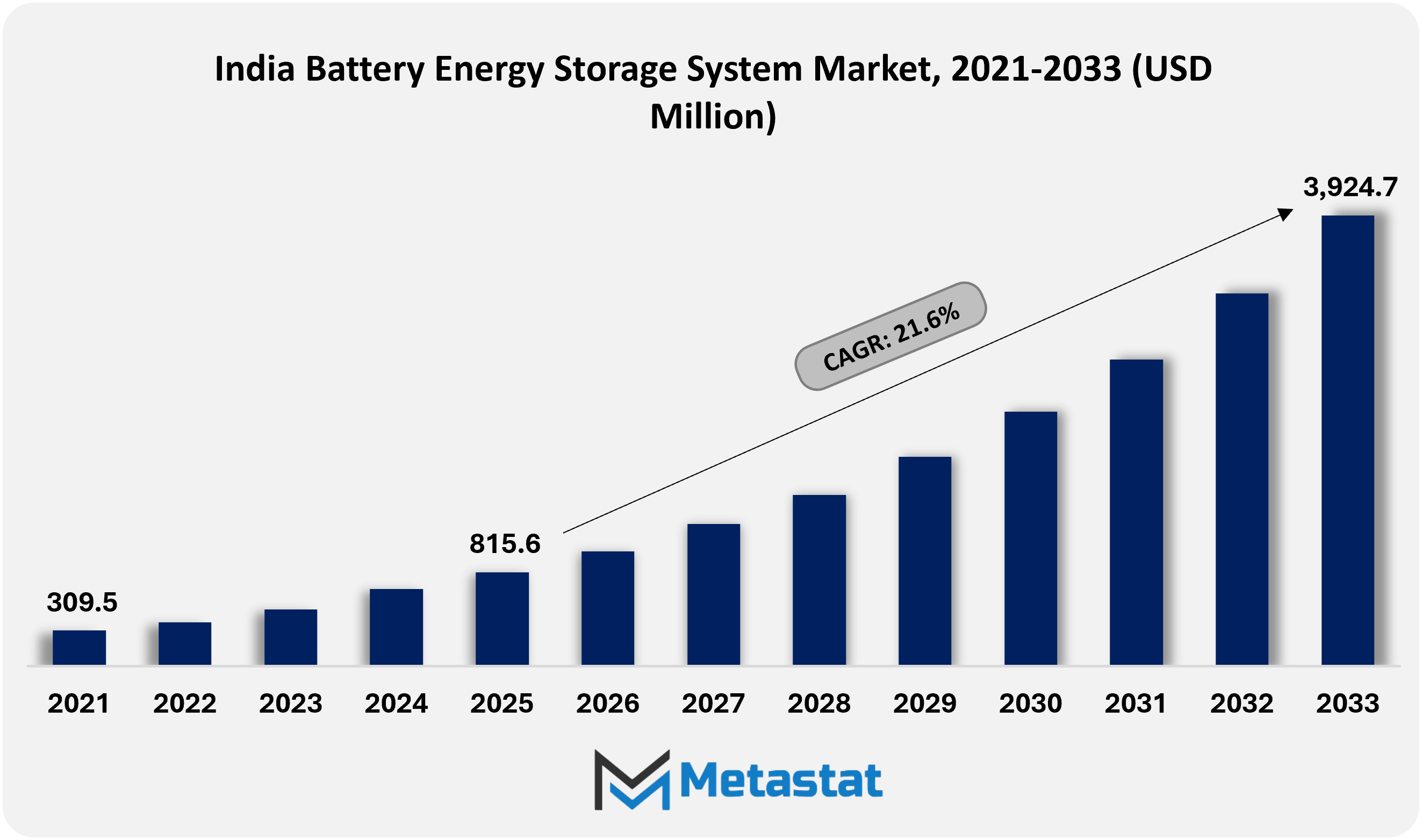
Supportive policy frameworks introduced by national energy authorities are strengthening large-scale renewable integration across India’s power infrastructure. Financial incentives, storage-linked tenders, grid modernization programs, and regulatory support for clean energy expansion are encouraging wider deployment of storage technologies. The India Battery Energy Storage System Market is gaining steady momentum through strategic public investment aimed at building resilient power networks.
Rapid urban expansion, manufacturing growth, and digital infrastructure development are generating consistent electricity demand across major economic regions. Utility providers require stronger supply management during peak consumption periods. Energy storage deployment supports load balancing, frequency stabilization, and backup power availability. The India Battery Energy Storage System Market is expanding in response to the growing need for reliable grid performance.
The substantial capital required for grid-scale storage infrastructure creates financial pressure for smaller project developers. Expenditure on battery modules, system integration, land acquisition, safety systems, and maintenance facilities restricts participation among emerging energy companies. The India Battery Energy Storage System Market will face a slower pace of adoption in capital-constrained investment segments.
Continued reliance on overseas supply chains for lithium-ion cells, cathode materials, and battery management electronics raises procurement costs for domestic storage projects. International price volatility, currency fluctuations, and logistics expenses influence project budgeting and investment decisions. The India Battery Energy Storage System Market remains exposed to cost sensitivity until domestic manufacturing capacity scales further.
Accelerated renewable energy installations across solar parks, wind corridors, and hybrid clean energy projects are increasing the need for reliable storage capacity to manage intermittent power generation. Long-duration battery technologies support energy shifting during non-generation periods. The India Battery Energy Storage System Market will benefit from strong alignment with renewable capacity expansion.
The India Battery Energy Storage System market is classified based on Battery Type, Energy Capacity Range, End-User Application, and Region.
Lithium-ion Battery segment is valued at USD 719.2 million in 2026 and is projected to reach USD 2,935.7 million by 2033, at a CAGR of 22.3% during the forecast period.
Lithium-ion battery adoption continues to gain strong momentum across India’s power storage infrastructure. High energy density, longer lifecycle, and rapid charging capability support large-scale deployment. Renewable integration projects, especially solar parks and grid stabilization applications, are encouraging sustained investment in lithium-ion systems across India’s energy transition initiatives.
Lead Acid Battery segment is valued at USD 137.1 million in 2026 and is projected to reach USD 408.2 million by 2033, at a CAGR of 16.9% during the forecast period.
Lead acid battery technology retains a presence in the India Battery Energy Storage System Market owing to its affordability and established supply chain. Industrial backup systems, telecom infrastructure, and smaller storage installations continue to adopt lead acid batteries, supported by mature manufacturing ecosystems. Replacement demand from aging battery banks supports moderate growth across distributed storage deployments and backup power applications.
Flow Battery segment is valued at USD 90.0 million in 2026 and is projected to reach USD 380.7 million by 2033, at a CAGR of 22.9% during the forecast period.
Flow battery development is gaining attention in the India Battery Energy Storage System Market owing to benefits such as longer operational life and scalable capacity expansion. Large grid storage applications benefit from stable discharge cycles and lower degradation rates. Research programs and pilot installations are supporting gradual commercialization, particularly for renewable balancing and long-duration energy storage.
Others segment is valued at USD 53.9 million in 2026 and is projected to reach USD 200.2 million by 2033, at a CAGR of 20.6% during the forecast period.
Emerging battery technologies are contributing to gradual diversification within the India Battery Energy Storage System Market. Sodium-ion, zinc-air, and hybrid storage chemistries are attracting pilot-scale experimentation led by research institutions and private developers. Technology diversification supports long-duration storage capability, improved safety characteristics, and localized manufacturing opportunities aligned with national energy security goals.
Below 100 MWh segment is projected to reach USD 1,998.5 million by 2033, at a CAGR of 20.8% during the forecast period.
Energy storage projects below 100 MWh support distributed grid applications across the India Battery Energy Storage System Market. Small-scale solar integration, rural electrification programs, microgrids, and backup power requirements are driving installations. Commercial buildings, telecom towers, and community solar projects are increasingly adopting compact storage systems that improve localized energy resilience.
101 to 500 MWh segment is projected to reach USD 1,220.6 million by 2033, at a CAGR of 21.9% during the forecast period.
The 101 to 500 MWh range represents mid-scale deployment within the India Battery Energy Storage System Market. Renewable power producers are integrating storage units for load balancing, peak demand management, and frequency regulation. Industrial corridors and urban distribution networks are deploying medium-capacity systems to improve grid reliability across high-consumption zones.
Above 500 MWh segment is projected to reach USD 705.7 million by 2033, at a CAGR of 23.3% during the forecast period.
Projects above 500 MWh represent the expansion segment of the India Battery Energy Storage System Market. Utility-scale solar and wind integration requires high-capacity storage to manage intermittency and stabilize transmission networks. National grid modernization programs are encouraging mega-scale installations that support long-duration discharge capability across major renewable energy clusters.
Residential segment is projected to reach USD 306.1 million by 2033.
Residential adoption is generating emerging demand within the India Battery Energy Storage System Market through rooftop solar integration and backup power systems. Urban households facing grid interruptions are exploring compact storage units that improve electricity reliability. Rising awareness of clean energy consumption is supporting battery adoption, strengthening household energy independence and energy management.
Commercial and Industrial segment is projected to reach USD 867.4 million by 2033.
Commercial and industrial users are generating significant demand within the India Battery Energy Storage System Market through energy cost optimization strategies. Manufacturing facilities, data centers, office complexes, and logistics hubs are deploying storage systems for peak load management and power continuity. Electricity tariff volatility is encouraging adoption of storage units that support operational stability and energy efficiency.
Utility segment is projected to reach USD 2,751.2 million by 2033.
Utility operators remain the principal contributors to the India Battery Energy Storage System Market through large-scale grid balancing initiatives. Renewable energy expansion across the national power mix requires advanced storage infrastructure to support frequency regulation and transmission stability. Government-backed auctions and storage procurement programs are accelerating deployment across multiple state distribution networks.
South India segment is projected to grow at a CAGR of 21.5% during the forecast period.
South India demonstrates strong growth potential in the India Battery Energy Storage System Market owing to high solar and wind power capacity across Tamil Nadu, Karnataka, Telangana, and Andhra Pradesh. Renewable integration challenges are increasing demand for grid storage solutions that support stable electricity supply across rapidly expanding clean energy projects.
North India segment is projected to grow at a CAGR of 21.6% during the forecast period.
North India is witnessing growing adoption in the India Battery Energy Storage System Market driven by rising urban electricity demand across Delhi, Haryana, Punjab, and Uttar Pradesh. Industrial expansion, data infrastructure growth, and renewable additions are encouraging deployment of storage projects that support peak demand management and grid reliability.
West India segment is projected to grow at a CAGR of 21.8% during the forecast period.
West India holds strategic importance in the India Battery Energy Storage System Market through strong renewable development across Maharashtra, Gujarat, and Rajasthan. Large solar parks, industrial zones, and export-oriented manufacturing clusters are increasing demand for energy storage systems that support grid stability, renewable integration, and energy security.
East India segment is projected to grow at a CAGR of 21.1% during the forecast period.
East India presents emerging opportunities in the India Battery Energy Storage System Market through rising electrification programs and renewable project development across Odisha, West Bengal, Jharkhand, and Bihar. Transmission upgrades and grid strengthening are supporting gradual battery storage adoption to improve reliable power delivery across growing industrial and urban centers.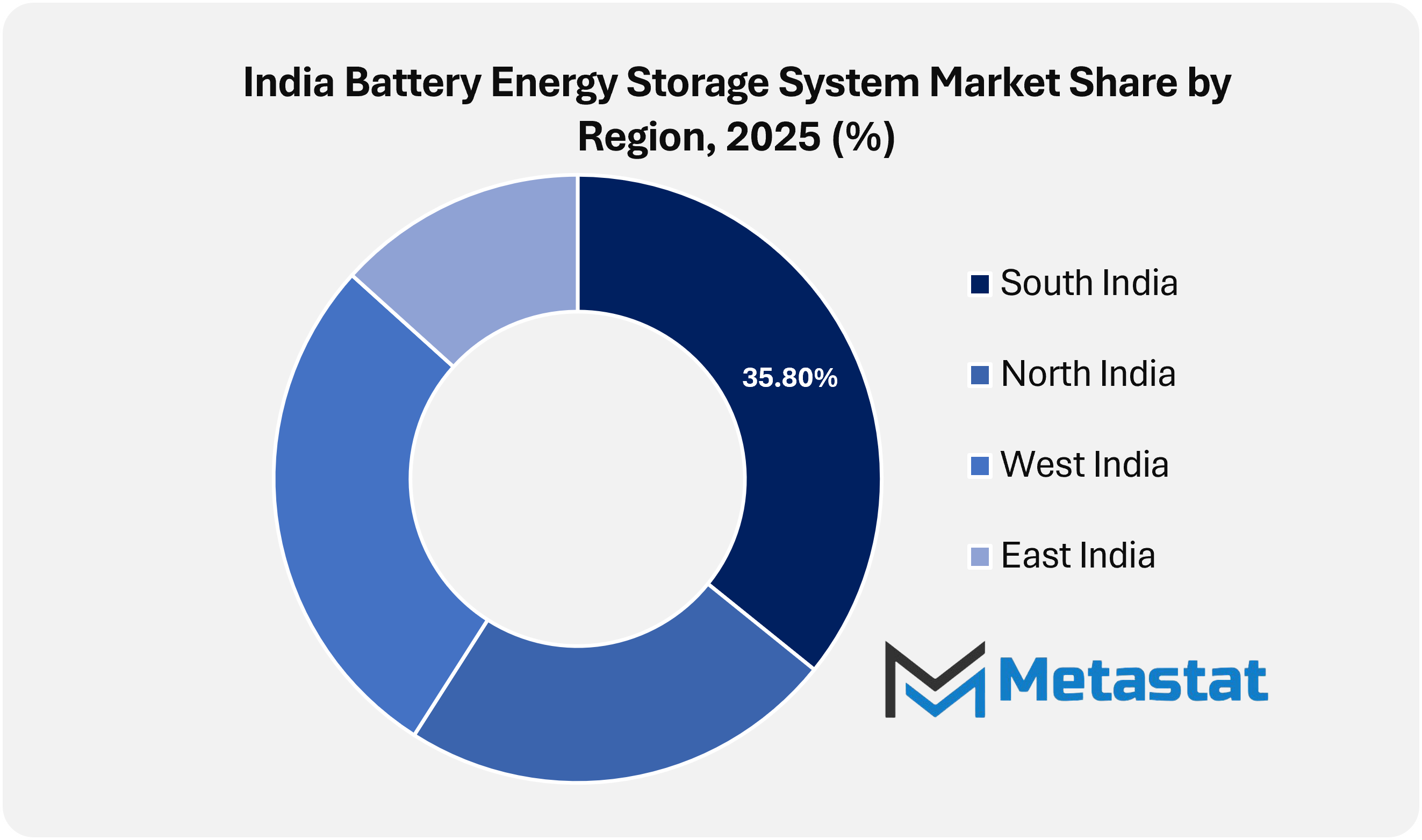
India Battery Energy Storage System Market is gaining strong attention as the country increases its focus on clean energy and reliable power supply. Renewable sources such as solar and wind are expanding rapidly across India, though their output remains variable. Battery energy storage systems therefore play a critical role in storing surplus electricity and supplying it during periods of peak demand. These systems help improve grid stability, reduce power outages, and support the expansion of renewable energy projects. Rising electricity consumption across urban and rural areas is positioning battery storage solutions as an essential part of the country’s evolving energy infrastructure.
Government support and policy initiatives are also strengthening market growth. India has established ambitious renewable energy targets, and energy storage is becoming vital for balancing the grid during fluctuations in renewable power generation. Utility providers and private companies are investing in storage systems to manage peak demand and maintain stable electricity supply. Battery storage is also supporting electric vehicle charging infrastructure and industrial backup power systems. Ongoing technology improvement and gradual battery cost reduction will encourage wider adoption across multiple sectors.
The market also benefits from the presence of several established companies actively developing and supplying energy storage solutions. Key India Battery Energy Storage System industry players include Exide Industries Ltd., Delta Electronics, Inc., Toshiba Corporation, Tata Power, Waaree Energies Ltd., Cummins Inc., Fluence Energy, LLC, HBL Engineering Limited, EnerTech UPS, and Atlas Copco Group. These companies focus on battery manufacturing, grid storage systems, and advanced energy management solutions. Many are also forming partnerships and expanding research efforts to improve battery performance, safety, and lifecycle.
Competition among these companies will accelerate innovation and strengthen the overall market. Businesses are developing improved lithium-ion batteries, smarter monitoring systems, and large-scale storage solutions for renewable energy plants. India’s ongoing power infrastructure modernization will increase adoption of battery energy storage systems across utilities, industrial facilities, and distributed energy projects. Rising electricity demand and continued investment will support steady market development in the coming years.
Market size is forecast to rise from USD 815.6 million in 2025 to over USD 3,924.7 million by 2033.
Policy direction is expected to support pilot programs focused on alternative battery chemistries, recycling frameworks, and domestic component manufacturing. Such initiatives will gradually strengthen a resilient supply chain that supports local production of cells, modules, and system controllers. With technological innovation aligning with infrastructure planning, the India Battery Energy Storage System Market is likely to move beyond traditional utility applications and contribute to a broader energy transition across the country.
This research report categorizes the India Battery Energy Storage System market based on key segments and regions, forecasts revenue growth, and analyses trends in each submarket. The report analyses the key growth drivers, opportunities, and challenges influencing the India Battery Energy Storage System market. Recent market developments and competitive strategies such as expansion, product launch, partnership, merger, and acquisition have been included to draw the competitive landscape in the market.
The report strategically identifies and profiles the key market players and analyses their core competencies in each sub-segment of the India Battery Energy Storage System market.
|
Report Attributes |
Details |
|
Study Period |
2021-2033 |
|
Base Year |
2025 |
|
Estimated Year |
2026 |
|
Forecast Period |
2026-2033 |
|
Historical Period |
2021-2025 |
|
Growth Rate |
CAGR 21.6% from 2026 to 2033 |
|
Revenue Unit |
USD million |
|
Market Volume Unit |
MWh |
|
Segmentation |
By Battery Type, Energy Capacity Range, End-User Application, and Region |
|
By Battery Type |
|
|
By Energy Capacity Range |
|
|
By End-User Application |
|
|
By Region |
|
Find answers to common questions about this report
Top players operating in the Battery Energy Storage System industry include Exide Industries Ltd., Delta Electronics, Inc., Toshiba Corporation, Tata Power, and Waaree Energies Ltd.
India Battery Energy Storage System market is estimated to reach USD 3,924.7 million by 2033.
High upfront investment associated with large-scale battery storage infrastructure limits adoption among smaller energy developers will hamper the market growth within the forecast period.
The Lithium-ion Battery is the leading type of segment in the India market.
Strong government initiatives promoting renewable integration increase deployment of battery energy storage systems across utility-scale power networks and rising electricity demand from urbanization and industrial growth pushes utilities toward advanced energy storage for grid reliability are key driving factors, boosting the market.
South India region dominates the market.
The India Battery Energy Storage System market is expected to grow at a CAGR of 21.6% over the forecast period (2026-2033).
The Metastat Insights study shows that the India Battery Energy Storage System market size was USD 815.6 million in 2025.
The analysts below cover Energy and Power research at Metastat Insights.
LEAD ANALYST
Utkarsh Khirodkar is a Lead Market Research Analyst at MetaStat Insight, specializing in market intelligence, technology sector assessments, and competitive strategy.

PRINCIPAL CONSULTANT - ENTERPRISE AI & EMERGING TECHNOLOGIES
Banking & Finance · Electronics and Semiconductor · Energy and Power · Healthcare IT · Information & Technology · Professional Services
Vijay Gunti is a Principal Consultant at MetaStat Insight, bringing over two decades of experience across enterprise digital transformation, technology strategy, and intelligent systems.

ENERGY & INFRASTRUCTURE INDUSTRY CONSULTANT
Automotive and Transportation · Electronics and Semiconductor · Energy and Power · Machinery & Equipment
Saurabh Vasant Ganvir consults for Energy & Infrastructure Industry at MetaStat Insight, specializing in renewable energy, solar EPC, and electric vehicle (EV) infrastructure markets.
Most industry reports on warehouse automation bundle autonomous mobile robots and fixed conveyor installations into the same top-level numbers, which complicates advisory work. This study split the market cleanly by payload tiers, navigation technology, and fleet management software layers. The regional forecast for Western Europe gave our team defensible adoption benchmarks when evaluating capital allocation for logistics clients, saving us days of secondary data scrubbing.
Analyzing the transition from natural gas to green hydrogen in iron ore reduction requires realistic infrastructure timelines. Meta stat insight supplied a detailed regional assessment of DRI plant conversion costs and scrap metal availability in North America and Western Europe. Their report carefully examined pellet quality specs and electrical grid access constraints without making oversimplified market assumptions. The research material served as a practical reference during internal technology roadmap discussions.
Integrating zero-trust access controls across legacy electronic health record systems involves complex compliance overhead. Team produced an analysis that clearly separated identity governance and administration tools from privileged access management platforms. Their evaluation of HIPAA and GDPR compliance features across cloud native solutions gave our architecture group clear baseline criteria. The custom data request regarding biometric authentication adoption in hospital networks was returned promptly with clear documentation.
Explore related market intelligence reports worth reading alongside this one.