
LEAD ANALYST
Utkarsh Khirodkar is a Lead Market Research Analyst at MetaStat Insight, specializing in market intelligence, technology sector assessments, and competitive strategy.

Global Biorefinery Market Size, Share, By Type (First Generation, Second Generation, and Third Generation), By Feedstock (Starch Crops, Sugar Crops, Energy Crops, Organic Residues, Agricultural Residues, and Multi-feedstock), By Product (Energy Driven and Material Driven), By Technology (Industrial Biotechnology, Physico-Chemical, and Thermochemical), Industry Analysis, Growth, Trends, and Forecast, 2026-2033
Report ID
MSI-4758
Published
May, 2026
Pages
315 Pages
Format
Report Details
Choose Your License
Biorefinery Market
Global Biorefinery market size is valued at USD 175.3 billion in 2025 and projected to grow at a CAGR of 9.2% during the forecast period, reaching USD 354.3 billion by 2033.
North America holds 29.1% in 2025 with US leading the market share in 2026.
First Generation segment account for a market share of 38.9% in 2025.
Key trends driving growth: Increasing demand for renewable energy and sustainable alternatives to fossil-based products, along with supportive government policies and incentives promoting bio-based industries and circular economy.
Opportunities include advancements in conversion technologies enabling production of high-value biochemicals and integrated bioproduct portfolios.
Key insight: The Global Biorefinery Market is expanding steadily as governments and industries accelerate transition toward low-carbon manufacturing and renewable resource utilization.
The Global Biorefinery Market plays a strategic role in converting biomass into fuels, electricity, chemicals, and value-added materials through integrated processing systems. These facilities use agricultural crops, residues, forestry waste, municipal biomass, and multi-feedstock inputs to replace fossil-derived products across multiple industries.
Energy producers, chemical manufacturers, and governments are increasing investments in cleaner production models that improve feedstock efficiency and reduce emissions. Advances in enzymatic conversion, gasification, fermentation, and thermochemical technologies are improving industrial viability. With rising global sustainability commitments, the Biorefinery Market will witness strong long-term expansion.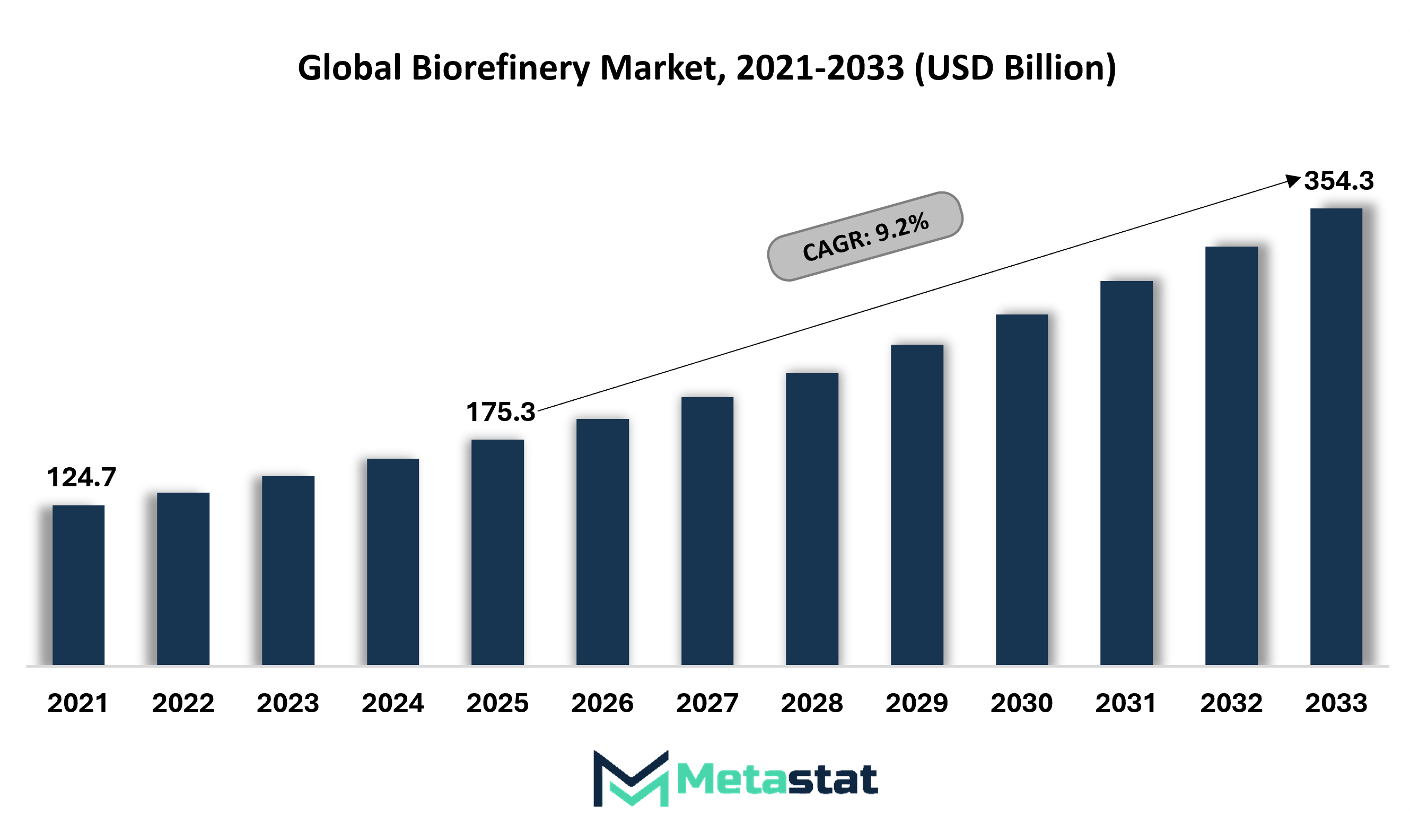
Increasing demand for renewable energy and sustainable alternatives to fossil-based products.
Rising fuel prices, emission concerns, and industrial sustainability goals are creating stronger demand for renewable fuels, green chemicals, and bio-based materials. Future production networks will prioritize cleaner input streams, efficient resource cycles, and lower-carbon pathways. Consumer preference for responsible products will reinforce long-term market growth.
Supportive government policies and incentives promoting bio-based industries and circular economy
Tax benefits, production incentives, blending mandates, research funding, and emission reduction programs are encouraging industrial investment across bio-based industries. Future policy frameworks will reward waste recovery, carbon savings, and domestic resource utilization. Stable regulation will improve financing access and support faster project commissioning across regions.
High capital investment and technological complexity in establishing biorefinery infrastructure
Large-scale plants require significant investment in processing units, storage systems, utilities, and advanced conversion equipment. Complex engineering stages increase construction timelines and operating risk. Future development will rely on modular facilities, lower-cost equipment, skilled technical labor, and stronger collaboration among developers, lenders, and technology providers.
Feedstock supply variability and logistics challenges impacting consistent production
Seasonal crop cycles, weather shifts, transport delays, and storage losses can disrupt raw material availability. Irregular feedstock quality will reduce output performance and planning accuracy. Future supply chains will require digital tracking, local sourcing hubs, resilient transport links, and better preservation strategies to maintain stable operations.
Advancements in conversion technologies enabling production of high-value biochemicals and integrated bioproduct portfolios
Improved enzymes, gasification systems, fermentation techniques, and catalytic processes are creating routes for premium chemicals, specialty ingredients, and multiple revenue streams. Future facilities will integrate fuels, energy, materials, and nutrient recovery within single sites. Integrated portfolios will improve margins and attract wider commercial partnerships.
The Global Biorefinery market is classified based on Type, Feedstock, Product, and Technology.
First Generation segment is valued at USD 74.4 billion in 2026 and is projected to reach USD 114.9 billion by 2033, at a CAGR of 6.4% during the forecast period.
First Generation commercial progress will remain linked to the conversion of corn, wheat, sugarcane, and vegetable oils into fuels and chemicals. Mature supply chains will support stable expansion, while process upgrades will improve yield, water management, and cost efficiency. Regional policy support will encourage capacity growth across agriculture-led economies.
Second Generation segment is valued at USD 76.7 billion in 2026 and is projected to reach USD 160.2 billion by 2033, at a CAGR of 11.1% during the forecast period.
Future investment in the Second Generation segment will favor crop straw, wood waste, husk, bagasse, and residue conversion. Strong interest will rise from waste reduction goals and circular production targets. Advanced pretreatment systems will improve output levels, while rural collection networks will strengthen raw material movement efficiency.
Third Generation segment is valued at USD 40.1 billion in 2026 and is projected to reach USD 79.1 billion by 2033, at a CAGR of 10.2% during the forecast period.
Third Generation production will gain wider attention owing to high productivity potential and limited land-use pressure. Marine and freshwater cultivation systems will support fuels, proteins, pigments, and specialty chemicals. Automation, controlled nutrient use, and carbon capture integration will improve commercial readiness during the coming years.
Starch & Sugar Crops segment is projected to reach USD 110.4 billion by 2033, at a CAGR of 10.1% during the forecast period.
Reliable feedstock demand for Starch & Sugar Crops will continue through established farming networks and easier processing routes. Ethanol, biochemicals, and fermentation products will benefit from predictable quality levels. Precision farming tools will raise crop output, while sustainability standards will guide responsible land and water management.
Energy Crops segment is projected to reach USD 66.3 billion by 2033, at a CAGR of 10.2% during the forecast period.
Dedicated biomass crops such as switchgrass, miscanthus, and fast-growing grasses will attract long-term contracts under the Energy Crops segment. Marginal land-use potential will support feedstock planning without heavy pressure on food systems. Breeding programs will enhance yield strength, drought tolerance, and harvesting efficiency.
Organic & Agricultural Residues segment is projected to reach USD 105.5 billion by 2033, at a CAGR of 8.6% during the forecast period.
Organic & Agricultural Residue streams, including straw, manure, food waste, and forestry leftovers, will become valuable industrial inputs. Reduced disposal costs will support adoption. Collection hubs, drying systems, and sorting technologies will improve material consistency, creating stronger economics for large-scale conversion plants.
Multi-feedstock segment is projected to reach USD 72.1 billion by 2033, at a CAGR of 8% during the forecast period.
Multi-feedstock facilities using varied raw materials will gain strategic importance amid shifting crop cycles and seasonal supply changes. Feedstock diversity will reduce sourcing risk and downtime. Smart monitoring systems will optimize blending ratios, storage planning, and conversion performance across facilities.
Energy Driven segment is projected to reach USD 203.5 billion by 2033.
Energy Driven output will include ethanol, biodiesel, renewable gas, and sustainable aviation fuel. Decarbonization targets will drive clean fuel demand from transport and industrial sectors. Integration with storage and logistics networks will improve market reach, while scale advantages will improve pricing competitiveness.
Material Driven segment is projected to reach USD 150.7 billion by 2033.
Material Driven pathways will expand into bioplastics, solvents, fibers, resins, and specialty ingredients. Consumer preference for greener products will support premium demand. Research partnerships will improve product performance, enabling broader use across packaging, textiles, and manufacturing sectors.
Industrial Biotechnology segment is projected to grow at a CAGR of 10% during the forecast period.
Enzyme systems, microbes, and fermentation routes will transform biomass into valuable outputs with lower waste generation. Precision biology tools will improve conversion speed and selectivity. Continuous processing lines will increase productivity, supporting wider industrial acceptance and stronger profit potential.
Physico-Chemical segment is projected to grow at a CAGR of 7.4% during the forecast period.
Mechanical separation, hydrolysis, extraction, and catalytic upgrading techniques will remain critical for mixed biomass handling. Hybrid facilities combining multiple unit operations will unlock better resource utilization. Improved catalysts and cleaner solvents will strengthen output quality and reduce operating cost pressure.
Thermochemical segment is projected to grow at a CAGR of 9.4% during the forecast period.
Gasification, pyrolysis, and liquefaction routes will gain momentum for difficult-to-process residue streams. High-temperature conversion will produce syngas, bio-oil, and renewable heat for industrial users. Modular plant design will support distributed deployment near feedstock sources, reducing transport burden and improving viability.
Based on geography, the Global Biorefinery market is divided into North America, Europe, Asia-Pacific, South America, Middle East, and Africa.
North America benefits from strong ethanol capacity, renewable diesel investments, and supportive decarbonization incentives.
The presence of advanced agricultural supply chains and leading technology developers continues to support regional growth.
Europe will remain a key market for biorefineries, supported by strong decarbonization policies, renewable fuel mandates, circular economy targets, and rising demand for bio-based chemicals.
Asia Pacific presents strong opportunities through rising energy demand, agricultural residue availability, and expanding government clean fuel programs
China, India, Japan, and Southeast Asia are increasing investments in biomass conversion, waste valorization, and bio-based manufacturing capacity.
Across the Middle East, Africa, and South America, demand is supported by sugarcane resources, biofuel export potential, waste management needs, and growing diversification beyond fossil-based industries.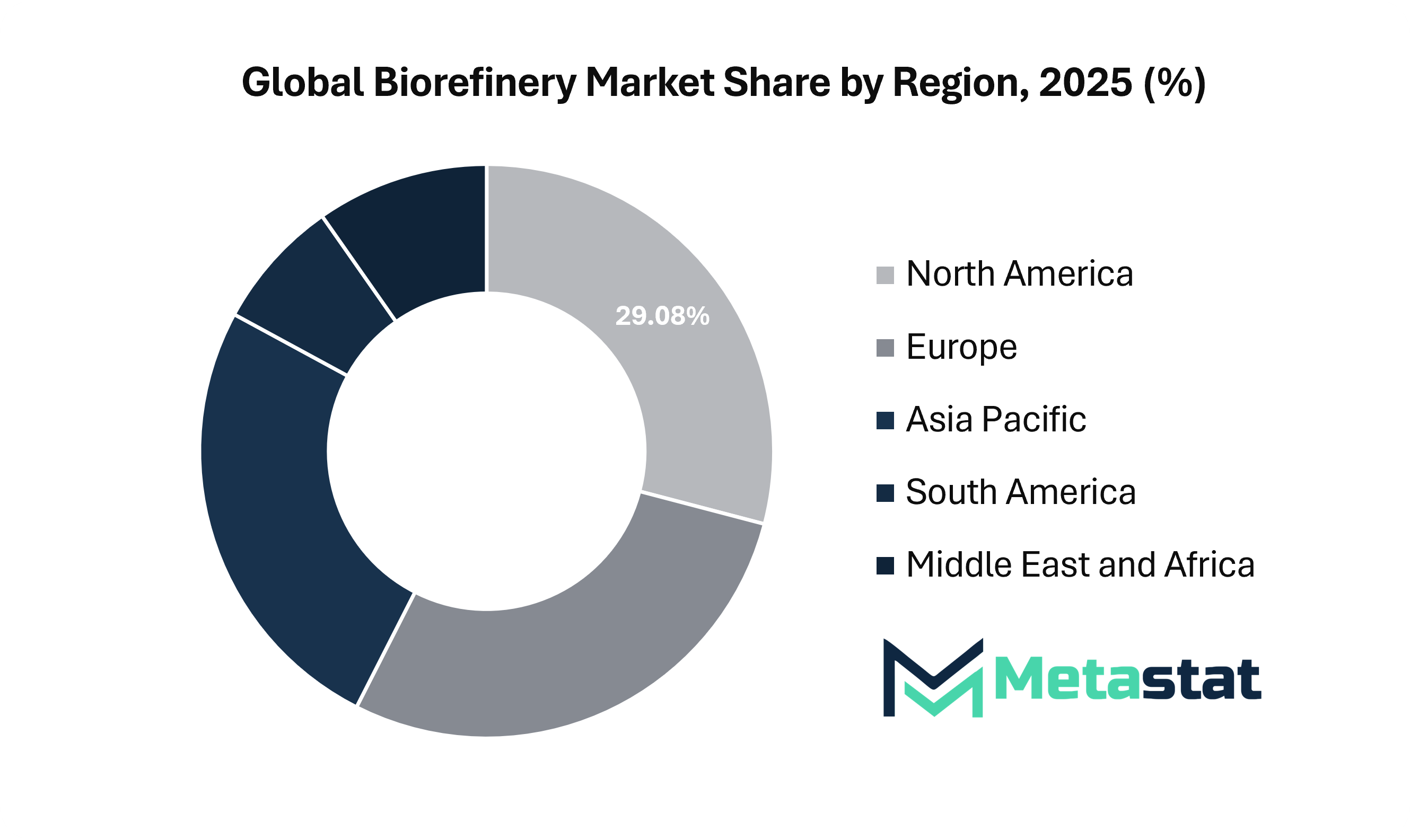
The Global Biorefinery Market is gaining steady attention as industries prioritize cleaner fuels, improved material efficiency, and lower waste generation. Companies are investing in plants that convert biomass into energy, chemicals, and useful inputs for manufacturing. UPM-Kymmene Corporation, Borregaard ASA, Eni S.p.A., PTT Global Chemical Public Company Limited, TotalEnergies SE, and St1 Nordic Oy are shaping market progress through research, supply partnerships, and production expansion. Verbio SE, AGRANA Beteiligungs-AG, CropEnergies AG, and POET, LLC also support ethanol and renewable output, helping widen commercial use across multiple sectors.
Green Plains Inc., Neste Oyj, Aemetis, Inc., LanzaJet, Inc., Valero Energy Corporation, Darling Ingredients Inc., Chevron Renewable Energy Group, Inc., World Energy, LLC, and bp p.l.c. are expanding renewable fuel pathways for aviation, road transport, and industrial applications. These firms will focus on feedstock security, process efficiency, and lower carbon intensity. Raízen S.A. and Wilmar International Limited add competitive strength through farming networks, logistics capabilities, and production scale. Their combined efforts will improve supply stability and support the shift from fossil-based fuels across regional markets.
India is also building a stronger position in this field through Godavari Biorefineries Limited, Universal Biofuels Private Limited, and Praj Industries Limited. These companies support domestic blending targets, plant engineering, and export opportunities. GranBio Investimentos S.A., Chempolis Oy, Licella Holdings Ltd, and Ensyn are known for conversion technologies that use residues, wood waste, and mixed biomass. Better technology will raise yields, reduce losses, and create additional income opportunities for farmers, mills, and processors operating across changing commodity cycles.
LanzaTech Global, Inc., Axens SA, and XCF Global Inc. highlight how innovation is reshaping business models through gas fermentation, licensing, engineering services, and cleaner fuel systems. Competition among major producers will support better pricing, faster scale-up, and more dependable delivery for customers. Investors will continue to assess policy support, raw material access, and transport-sector demand before funding new sites. The market outlook remains positive as governments and buyers seek cleaner options compatible with existing engines, pipelines, and industrial facilities.
Market size is forecast to rise from USD 175.3 billion in 2025 to over USD 354.3 billion by 2033.
The Global Biorefinery Market is expected to benefit from net-zero targets, rising renewable fuel demand, and broader adoption of circular production systems. Future demand is likely to favor flexible multi-feedstock plants, advanced bio-based chemicals, and digitally optimized low-emission operations.
This research report categorizes the Biorefinery market based on key segments and regions, forecasts revenue growth, and analyses trends in each submarket. The report analyses the key growth drivers, opportunities, and challenges influencing the Biorefinery market. Recent market developments and competitive strategies such as expansion, product launch, partnership, merger, and acquisition have been included to draw the competitive landscape in the market.
The report strategically identifies and profiles the key market players and analyses their core competencies in each sub-segment of the Biorefinery market.
|
Report Attributes |
Details |
|
Study Period |
2021-2033 |
|
Base Year |
2025 |
|
Estimated Year |
2026 |
|
Forecast Period |
2026-2033 |
|
Historical Period |
2021-2025 |
|
Growth Rate |
CAGR 9.2% from 2026 to 2033 |
|
Revenue Unit |
USD billion |
|
Segmentation |
By Type, Feedstock, Product, Technology, and Region |
|
By Region |
North America (By Type, Feedstock, Product, Technology, and Country)
|
|
Europe (By Type, Feedstock, Product, Technology, and Country)
|
|
|
Asia Pacific (By Type, Feedstock, Product, Technology, and Country)
|
|
|
South America (By Type, Feedstock, Product, Technology, and Country)
|
|
|
Middle East and Africa (By Type, Feedstock, Product, Technology, and Country)
|
Find answers to common questions about this report
Global Biorefinery market is estimated to reach USD 354.3 billion by 2033.
High capital investment and technological complexity in establishing biorefinery infrastructure will hamper the market growth within the forecast period.
Increasing demand for renewable energy and sustainable alternatives to fossil-based products and supportive government policies and incentives promoting bio-based industries and circular economy are key driving factors, boosting the market.
The First Generation is the leading type segment in the Global market.
North America region dominates the market.
Top players operating in the Biorefinery industry includes UPM-Kymmene Corporation, Borregaard ASA, Eni S.p.A., PTT Global Chemical Public Company Limited, TotalEnergies SE, St1 Nordic Oy, and Verbio SE.
The Metastat Insights analysis shows that the North America Biorefinery market size is estimated to be USD 89.6 billion by 2033.
The Global Biorefinery market is expected to grow at a CAGR of 9.2% over the forecast period (2026-2033).
The Metastat Insights study shows that the Global Biorefinery market size was USD 175.3 billion in 2025.
The analysts below cover Energy and Power research at Metastat Insights.
LEAD ANALYST
Utkarsh Khirodkar is a Lead Market Research Analyst at MetaStat Insight, specializing in market intelligence, technology sector assessments, and competitive strategy.

PRINCIPAL CONSULTANT - ENTERPRISE AI & EMERGING TECHNOLOGIES
Banking & Finance · Electronics and Semiconductor · Energy and Power · Healthcare IT · Information & Technology · Professional Services
Vijay Gunti is a Principal Consultant at MetaStat Insight, bringing over two decades of experience across enterprise digital transformation, technology strategy, and intelligent systems.

ENERGY & INFRASTRUCTURE INDUSTRY CONSULTANT
Automotive and Transportation · Electronics and Semiconductor · Energy and Power · Machinery & Equipment
Saurabh Vasant Ganvir consults for Energy & Infrastructure Industry at MetaStat Insight, specializing in renewable energy, solar EPC, and electric vehicle (EV) infrastructure markets.
Analyzing the transition from natural gas to green hydrogen in iron ore reduction requires realistic infrastructure timelines. Meta stat insight supplied a detailed regional assessment of DRI plant conversion costs and scrap metal availability in North America and Western Europe. Their report carefully examined pellet quality specs and electrical grid access constraints without making oversimplified market assumptions. The research material served as a practical reference during internal technology roadmap discussions.
Integrating zero-trust access controls across legacy electronic health record systems involves complex compliance overhead. Team produced an analysis that clearly separated identity governance and administration tools from privileged access management platforms. Their evaluation of HIPAA and GDPR compliance features across cloud native solutions gave our architecture group clear baseline criteria. The custom data request regarding biometric authentication adoption in hospital networks was returned promptly with clear documentation.
Evaluating calorific value requirements and air permit compliance across municipal waste facilities requires localized data. Metastat Insight structured their analysis around operational throughput capacity and feedstock composition variations in Latin America and Eastern Europe. Their competitive mapping of sorting equipment vendors helped clarify technology differences between optical separators and heavy media systems. The study provided an objective baseline during our capital expenditure reviews.
Explore related market intelligence reports worth reading alongside this one.