
LEAD ANALYST
Utkarsh Khirodkar is a Lead Market Research Analyst at MetaStat Insight, specializing in market intelligence, technology sector assessments, and competitive strategy.

Global Music Copyright Market Size, Share, By Service Type (Music Publishing, Music Licensing, Royalty Collection and Distribution, Others), By Rights and Licensing Type (Performance Rights, Mechanical Rights, Synchronization Rights, Print and Reproduction Rights, Other Rights), By Genre (Classical Music, Contemporary and Popular Music), By Publisher Type (Major and Major-Affiliated Music Publishers, Independent Music Publishers), Industry Analysis, Growth, Trends, and Forecast, 2026-2033
Report ID
MSI-5260
Published
September, 2026
Pages
261 Pages
Format
Historical
Base year
Forecast
Forecast period
Report Details
Market Valuation: Valued at $20.2 Billion in 2025, projected to reach $31.2 Billion by 2033 at a 5.6% CAGR.
Dominant Segment: The Music Licensing segment leads the market, driven by the increasing demand for licensed music across platforms such as film, television, and streaming services. This shift towards digital distribution is creating substantial revenue opportunities for rights holders.
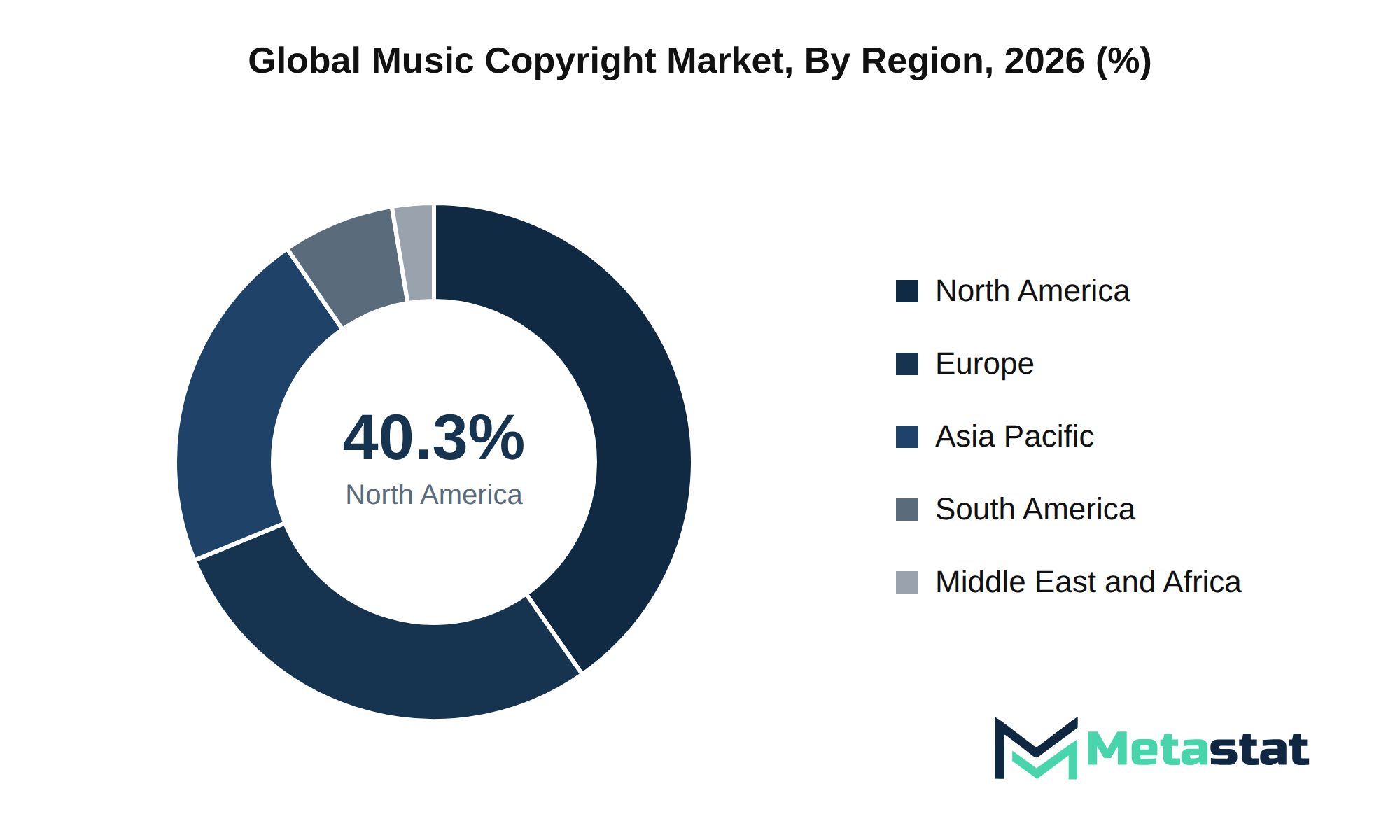
Geographic Lead: North America is the leading region, accounting for 40.3% of the market share and projected to reach USD 12.6 billion by 2033. The presence of major industry players and strong demand for music services fuel this growth.
What's Inside: The report provides a comprehensive analysis of the Music Copyright market, including segments by service type, rights and licensing type, genre, and publisher type. It offers insights into competitive dynamics, market trends, and a forecast window from 2026 to 2033.
Emerging Regional Demands: The market is experiencing growth opportunities in Europe and Asia Pacific, reflecting increased consumer engagement and interest in music copyright services. Infrastructure modernization in these regions enhances operational efficiency and market responsiveness.
Regulatory Compliance Complexities: Compliance challenges significantly hinder market growth, as intricate legal frameworks complicate licensing processes for publishers and creators. These complexities increase operational costs and limit monetization efficiency.
Choose Your License
Global Music Copyright Market
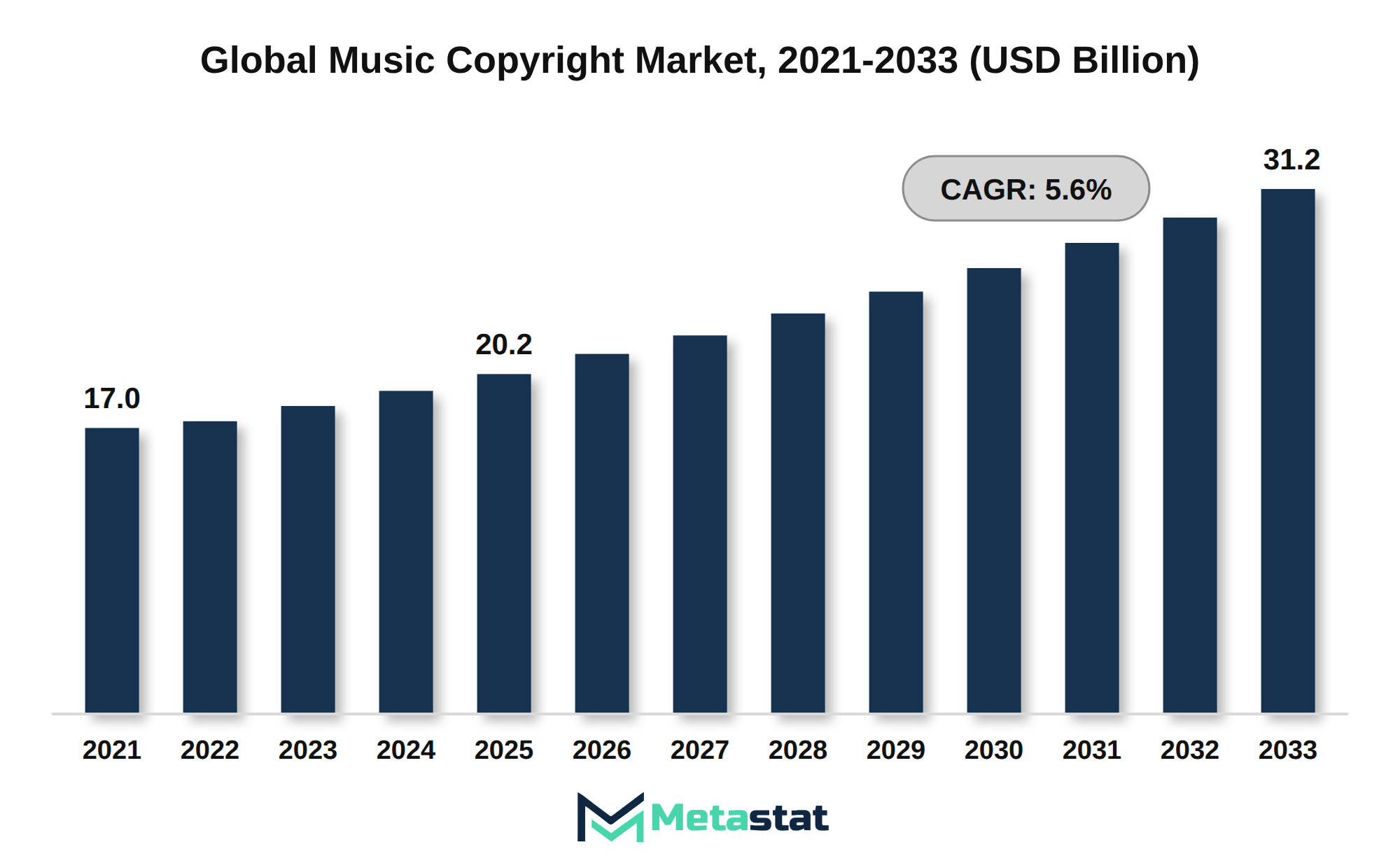
The global Music Copyright market was valued at USD 20.2 billion in 2025 and is projected to reach USD 31.2 billion by 2033, growing at a CAGR of 5.6% over the forecast period.
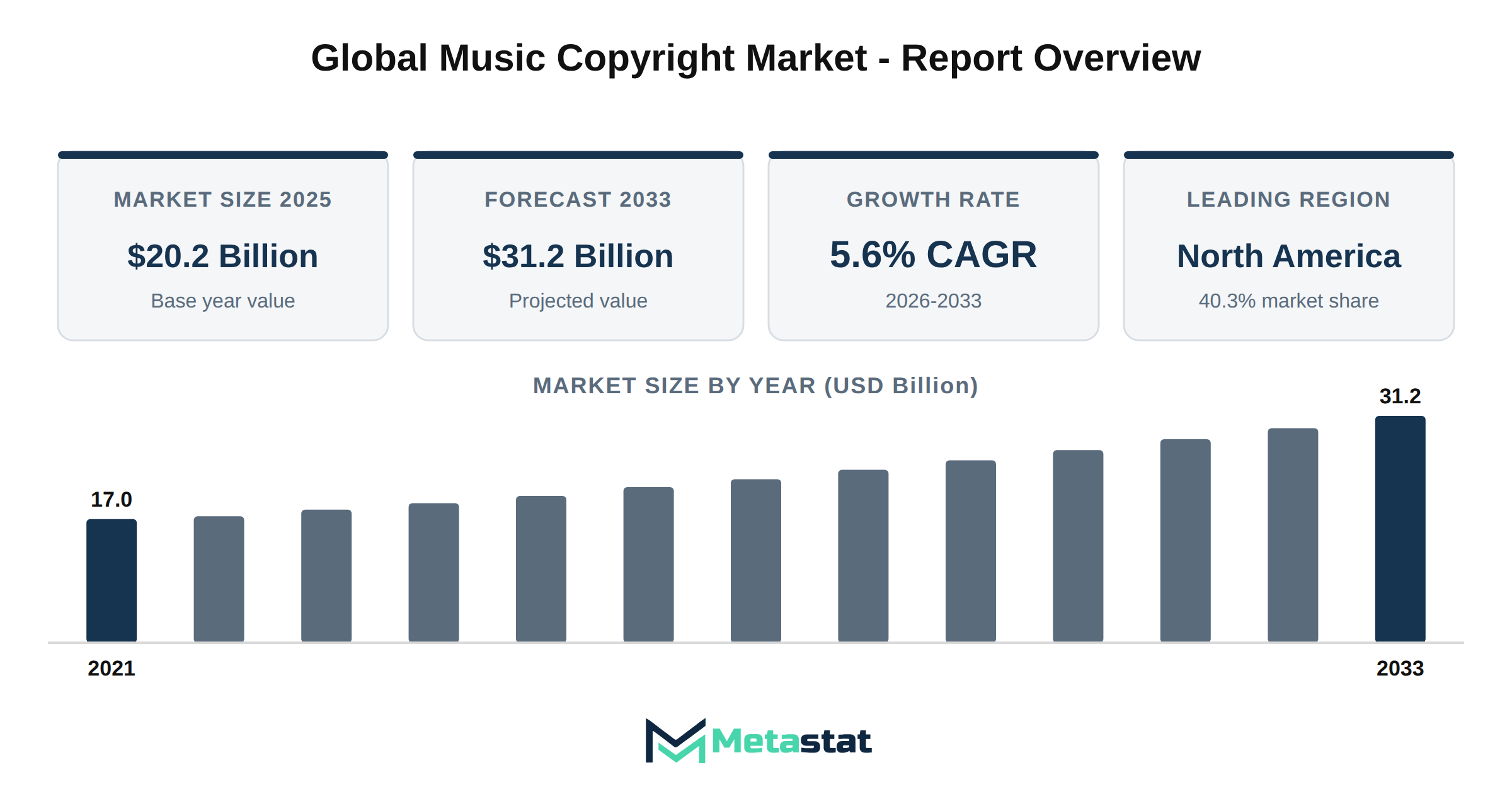
The global Music Copyright market has experienced significant growth, with a base value of USD 20.2 billion in 2025. By 2033, the market is projected to reach USD 31.2 billion, reflecting a compound annual growth rate (CAGR) of 5.6%. Revenue streams and valuation models in this sector have evolved due to advancements in technology and changes in consumer behavior. Music licensing and royalty distribution have benefited from the expansion of streaming services, creating new opportunities for revenue generation and rights management.
Synchronization rights have gained traction, especially across film, television, and digital advertising. This segment contributes substantially to overall market growth, driven by increasing demand for music integration in various media formats. The integration of blockchain technology and smart contracts offers promising prospects for transparent music rights management, enhancing trust and efficiency in transactions. Regulatory developments and legal challenges in cross-border copyright enforcement shape the operational landscape, impacting how rights holders navigate international markets.
The influence of social media platforms and user-generated content has significantly impacted music licensing demand, creating new avenues for artists and rights holders to monetize their work. Trends in private equity and institutional investment in music catalog acquisitions reflect growing interest in the monetization potential of music rights. Competitive dynamics among major publishers and independent rights holders drive innovation and strategic partnerships, leading to enhanced service offerings and market penetration.
Artificial intelligence plays a critical role in copyright monitoring and infringement detection, leading to more effective management of music rights and ensuring compliance. Regional market opportunities vary significantly, with international royalty collection frameworks presenting unique challenges and advantages. Addressing these regional variations allows stakeholders to optimize strategies and capitalize on emerging trends within the music copyright ecosystem.
The evolution of global revenue streams and valuation models in the Music Copyright market reflects a shift towards diverse monetization strategies. Traditional revenue sources, including physical sales, have diminished, while digital streaming, licensing, and synchronization rights have gained prominence. This transformation prompts stakeholders to explore innovative valuation models, aligning with changing content consumption patterns.
The impact of streaming expansion on music licensing and royalty distribution is profound. With the rise of platforms like Spotify and Apple Music, artists and rights holders benefit from increased exposure and revenue opportunities. However, challenges in equitable royalty distribution persist, necessitating ongoing adaptations within the market to ensure fair compensation for creators.
Synchronization rights experience growth driven by demand across film, television, and digital advertising. Increased investment in audiovisual content has heightened the need for licensed music, creating lucrative opportunities for rights holders. This trend highlights the importance of effective negotiations and understanding market dynamics to capitalize on emerging revenue streams.
Blockchain technology and smart contracts play a crucial role in enhancing transparency in music rights management. By streamlining the tracking of rights ownership and automating royalty payments, these innovations address longstanding issues of inefficiency and opacity in the market. Their adoption contributes to a more trustworthy environment for artists and rights holders alike.
Regulatory developments and legal challenges in cross-border copyright enforcement shape the operational landscape for the market. Variations in international copyright laws complicate the enforcement of rights, requiring stakeholders to navigate a complex web of regulations. Ongoing discussions among policymakers and industry leaders aim to harmonize these frameworks, creating a more cohesive global approach to copyright protection.
The influence of social media platforms and user-generated content significantly impacts music licensing demand. Platforms like TikTok and YouTube have created new avenues for artists to reach audiences while raising questions about copyright compliance and licensing agreements. This dynamic environment prompts ongoing evolution in licensing strategies to accommodate the growing prominence of user-generated content.
Private equity and institutional investment trends in music catalog acquisitions are on the rise. Investors recognize the long-term value of music assets, driving increased acquisition activity among major and independent rights holders. This influx of capital enables catalog owners to enhance their portfolios and explore new revenue opportunities within the market.
Competitive dynamics among major publishers and independent rights holders shape the market landscape. Major players leverage extensive resources and distribution networks, while independent publishers focus on niche markets and personalized services. This competition drives innovation in service offerings, ensuring that both segments remain relevant in an evolving industry.
Artificial intelligence integration in copyright monitoring and infringement detection enhances the efficiency of rights management. AI technologies automate the identification of unauthorized use of copyrighted material, reducing the burden on rights holders. This advancement supports more effective enforcement and helps safeguard the interests of artists and publishers in the market.
Regional market opportunities and variations in international royalty collection frameworks present unique challenges and advantages for stakeholders. Different countries exhibit diverse regulatory environments, affecting the efficiency and effectiveness of royalty collection. Understanding these regional nuances is essential for rights holders aiming to optimize revenue potential on a global scale.
Investment in the Music Copyright market is influenced by macro-economic factors including interest rates and GDP growth. Increased capital investment enables music publishers and licensing companies to expand their operations and enhance service offerings. This growth reflects the strong relationship between economic stability and investment in creative sectors, which has seen heightened interest from venture funding and public-private spending. Improving economic conditions create increased funding opportunities for stakeholders in the market, allowing for innovation and the development of new revenue streams.
Digital transformation plays a crucial role in shaping the market. Technological integration, including automation and software adoption, enables music copyright firms to streamline processes and enhance operational efficiency. The move towards digitizing legacy processes supports quicker access to musical works and improves rights management capabilities. This technological advancement attracts new entrants into the market, increasing competition and driving further growth.
Shifting consumer behaviors contribute to the expansion of the market. Changing demographics, including the rise of younger audiences consuming music through digital platforms, create new opportunities for revenue generation. Evolving consumer preferences prompt companies to adapt their offerings to meet the demand for diverse genres and formats, ultimately increasing market penetration. The Music Copyright market is well-positioned to capitalize on these trends, driving sustained growth through increased engagement and investment in music-related services.
Digital transformation significantly influences the Music Copyright market by streamlining processes and improving operational efficiency. The integration of advanced technologies, including artificial intelligence and automation, reshapes copyright management and licensing practices, facilitating faster royalty collection and distribution. This shift supports businesses in adapting to evolving consumer preferences and technological advancements, ultimately driving growth in the market.
Increased digitalization leads to enhanced data analytics capabilities, allowing stakeholders to gain valuable insights into music consumption patterns and licensing opportunities. Understanding these trends enables better decision-making for music publishers, independent music publishers, and rights management organizations, contributing to revenue growth. A more informed approach to copyright management is expected to benefit the market.
The transition to digital platforms encourages innovative business models that cater to the changing landscape of music consumption. Services including streaming and on-demand access to music content create new revenue streams, driving demand for copyright services. Leveraging technology and adapting to market changes positions stakeholders to capitalize on emerging opportunities within the Music Copyright market.
Compliance hurdles present a significant restraint within the Music Copyright market. Intricate legal frameworks governing copyright laws lead to challenges for both publishers and creators, complicating the process of obtaining necessary licenses. This complexity increases operational costs for stakeholders while limiting their ability to efficiently monetize content.
Macroeconomic headwinds, including inflationary pressures and resource scarcity, further complicate the environment. Rising costs of living and materials push operational expenses higher, which reduces profit margins for companies involved in the market. Such economic conditions restrict investment and expansion opportunities for firms, slowing growth rates.
Technological obsolescence introduces additional risks. Rapid advancements in digital technologies create continual pressure for companies to upgrade their systems to maintain competitiveness. Firms that fail to adapt to changing technological standards struggle to protect intellectual property effectively, impacting market position.
Market saturation presents a challenging environment for new entrants. A crowded marketplace with numerous players, including major and independent music publishers, creates intense competition. This saturation limits growth opportunities for smaller companies seeking to gain a foothold in the Music Copyright market.
Geopolitical instability and cultural barriers further constrain the market. Variations in copyright laws and enforcement across regions create uncertainties for international operations. Companies navigate differing regulations, complicating licensing agreements and hindering the flow of music across borders, impacting overall market dynamics.
Geopolitical fragmentation introduces complexities within the Music Copyright market, influencing trade flows and creating barriers to international collaboration. Various regions implement differing copyright laws and enforcement mechanisms, resulting in inconsistent legal frameworks that complicate compliance for companies operating across borders. This fragmentation restricts market access and raises operational costs for businesses aiming to align with diverse regulatory environments.
Trade deficits and tariff friction compound these challenges, affecting cost structures and pricing strategies for market participants. Tariffs imposed on cross-border transactions lead to rising expenses, impacting profit margins and pricing models. Companies involved in music publishing and licensing are particularly vulnerable, owing to fluctuations in trade agreements that alter the competitive landscape.
Technological disruptions shape the market. Rapid advancements in digital platforms create new opportunities but simultaneously challenge existing business models. Companies face pressures to adapt their offerings to remain relevant, often requiring significant investments in research and development. Complex R&D integrations strain resources, particularly for smaller entities competing against larger firms with more extensive capabilities.
Intellectual property protection deficits present additional hurdles. Weak enforcement of copyright laws in certain regions undermines the value of creative works, leading to increased piracy and revenue loss for rights holders. This situation necessitates ongoing investments in cybersecurity measures to protect against data vulnerabilities, further straining resources.
The evolving landscape of consumer demands influences market dynamics. Shifts toward streaming services and digital consumption require companies to rethink their distribution strategies and revenue models. The market faces saturation in several segments, challenging companies to differentiate themselves in fierce competition. This competitive pressure often leads to pricing compression, impacting overall market profitability.
The Music Copyright market experiences opportunities driven by emerging regional demands across various continents. North America remains a key contributor, accounting for 40.3 percent of the total market share. With a projected value of USD 12.6 billion by 2033, the region demonstrates a compound annual growth rate of 5.6 percent. Europe and Asia Pacific, holding shares of 28.5 percent and 21.6 percent respectively, are poised for growth, reflecting increasing consumer engagement and heightened interest in music copyright services.
Infrastructure modernization plays a critical role in enabling the growth of the market. Investments in the digital ecosystem enhance the efficiency of copyright management, allowing companies to respond swiftly to changing market dynamics. These advancements facilitate the development of new distribution channels, which in turn create opportunities for various players in the industry to explore innovative approaches to licensing and royalty collection.
Geographical expansion into untapped markets presents a significant opportunity for stakeholders. Countries in South America and the Middle East and Africa illustrate the potential for market penetration. The increasing adoption of digital platforms in these regions promotes greater awareness of copyright issues and encourages local talent to engage with global distribution systems.
Technological disruptions, including blockchain and artificial intelligence, generate significant advancements in the Music Copyright market. These innovations streamline processes related to rights management and ensure more accurate royalty distribution. Companies that leverage these technologies position themselves to gain a competitive edge, ultimately enhancing their market presence.
Digital transformation reshapes traditional business models, prompting a shift towards more sustainable practices. The incorporation of eco-friendly initiatives and compliance with evolving environmental standards presents an opportunity for companies to align with consumer values. This trend drives the growing demand for green transformations in the industry, influencing corporate strategies and encouraging stronger loyalty among consumers.
Strategic consolidation through cross-industry mergers enables companies to expand their service offerings and capitalize on new revenue streams. M&A initiatives allow stakeholders to combine resources, enhancing operational efficiency and creating robust market capabilities. This collaborative approach drives innovation across the Music Copyright market and promotes a dynamic competitive environment.
Changing buying behaviors and digital procurement shifts contribute to the ongoing evolution of the market. While organizations increasingly adopt digital platforms for procurement, traditional sales methods adapt to accommodate new purchasing trends. This transition encourages stakeholders to enhance their digital presence and develop solutions that align with the evolving needs of consumers.
The Global Music Copyright market is segmented based on Service Type, Rights and Licensing Type, Genre, and Publisher Type.
Valued at USD 9.7 billion in 2026, the Music Publishing segment demonstrates a growth trajectory, projected to reach USD 13.8 billion by 2033, at a CAGR of 5.2% during the forecast period. Demand for music publishing services arises from the increasing need for content protection and rights management, particularly due to the rise of digital platforms that distribute music globally. These platforms stimulate demand for licensing agreements, creating opportunities for music publishers to expand their portfolios and enhance revenue streams.
Technological advancements play a significant role in shaping this segment, with next-generation digital tools improving the efficiency of royalty collection and distribution processes. Enhanced analytics capabilities enable publishers to track performance more accurately, leading to more effective monetization strategies. The proliferation of streaming services further fuels the growth of the Music Copyright market by increasing the volume of content that requires licensing and publishing agreements.
Adoption of music publishing services is influenced by evolving consumption patterns, particularly among younger demographics who increasingly prefer digital music over physical formats. This shift necessitates a more sophisticated approach to rights management to ensure that creators receive fair compensation for their work. Regulatory compliance remains a critical factor, with publishers navigating various copyright laws to protect their interests and those of their artists. Strong growth prospects in the Music Publishing segment arise from strategic investment opportunities, including partnerships with technology firms and collaborations with emerging artists.
These initiatives enable publishers to tap into new distribution channels and expand their reach. Overall, the segment's expansion is supported by a favorable investment outlook, driven by the increasing value placed on intellectual property in the digital economy.
Growth in the Music Licensing segment reflects the increasing demand for licensed music across various platforms, including film, television, streaming services, and advertising. This shift towards digital distribution drives revenue owing to more creators and producers seeking to use music legally, ensuring proper royalty payments to artists and copyright holders. The segment is estimated to reach USD 11 billion by 2033, at a CAGR of 6% during the forecast period.
The rising popularity of streaming services significantly influences the expansion of the Music Licensing segment. Platforms including Spotify, Apple Music, and YouTube generate substantial revenues through licensing agreements, creating a lucrative market for rights holders. This trend encourages publishers and artists to explore diverse revenue streams through licensing, resulting in increased investment in music production and distribution.
Technological advancements accelerate the evolution of music licensing, enabling more efficient tracking and management of rights. Digital platforms facilitate easier access to licenses, ensuring that artists receive fair compensation. The emergence of next-gen licensing solutions streamlines the process of obtaining and managing music rights, which supports growth in the market.
Shifts in consumption patterns drive demand within the Music Licensing segment. Younger audiences increasingly favor on-demand content, leading to greater reliance on licensed music in user-generated content, social media, and live streaming. This behavior creates a need for comprehensive licensing solutions that accommodate diverse content creators while protecting artists' rights.
Regulatory compliance remains a critical factor shaping the Music Licensing landscape. Ongoing discussions about copyright laws and international agreements impact how licenses are structured and priced. While legislation evolves, stakeholders in the market adapt to maintain compliance while maximizing revenue potential.
Growth in the Royalty Collection and Distribution segment derives from increasing digital content consumption and the need for comprehensive rights management solutions. The rise of streaming platforms drives demand for efficient royalty collection processes, ensuring accurate and timely payments to artists and rights holders. Technological advancements streamline the tracking and distribution of royalties, enhancing efficiency within the operational framework.
Regulatory compliance standards play a significant role in shaping market dynamics, necessitating robust systems for effective rights management. The segment experiences pricing volatility, influenced by user engagement trends on various platforms, which directly affects revenue streams. Continued investment in technological maturation supports the segment's expansion, enabling players to adapt to evolving consumer preferences.
The Royalty Collection and Distribution segment is projected to reach USD 4.8 billion by 2033. Strategic opportunity windows arise from shifts in consumption patterns and industry consolidation, prompting suppliers to innovate further. The market benefits from an increasing focus on transparency and fairness in revenue distribution, contributing to a more sustainable ecosystem for all stakeholders.
Growth in the Others segment reflects diversification within the Music Copyright market, catering to unique service demands beyond traditional categories. This segment benefits from increased digitalization, driving demand for various monetization strategies that address niche markets. The expansion of streaming services and platforms contributes to revenue diversification, creating opportunities for innovative approaches to copyright management.
Investment in new technologies enhances service offerings, allowing providers to adapt and respond to evolving consumer preferences. Emerging business models focus on user-generated content and platforms, enabling broader engagement with copyright holders. These dynamics support growth, with the Others segment projected to grow at a compound annual growth rate (CAGR) of 4.6% during the forecast period.
Technological advancements enable improved tracking and management of rights, ensuring that creators receive appropriate compensation for their work. Enhanced regulatory frameworks play a critical role in shaping market engagement, promoting adherence to copyright laws and standards. The combination of technology and compliance builds trust among stakeholders, reinforcing the foundation for sustained growth in the market.
While competition intensifies, companies that invest in strategic partnerships and innovative solutions capture market share effectively. Organizations focusing on customer-centric approaches and value-added services enhance their competitive position. Pursuing strategic opportunity windows becomes essential for maximizing the potential of the Others segment within the broader Music Copyright market.
Valued at USD 8.2 billion in 2026, the Performance Rights segment is projected to reach USD 11.8 billion by 2033, at a CAGR of 5.4% during the forecast period. Growth in this segment is driven by increasing consumption of music across various media platforms, necessitating proper licensing and rights management. Demand for performance rights is influenced by live events, broadcasting, and streaming services requiring clearances for public performances of music. This environment creates a substantial increase in the adoption of performance rights agreements by artists and music publishers, ensuring legal compliance while enhancing revenue streams.
Technological advancements play a critical role in the expansion of the Performance Rights segment. Platforms employing advanced analytics and data management facilitate efficient tracking of music usage, enabling accurate royalty payments and distributions. These technological enhancements lead to a more transparent and streamlined process for rights holders, encouraging wider participation in the music copyright market. The regulatory environment surrounding copyright protection supports growth, with increased enforcement of rights aiding in the acknowledgment and enforcement of performance rights globally.
Demand for Mechanical Rights in the Music Copyright market derives from the growing consumption of recorded music and the rise of digital platforms. The increasing prevalence of streaming services and digital downloads fuels the need for licensing agreements that ensure copyright holders receive appropriate compensation for their works. An expanding array of distribution channels, including online platforms, enhances the requirement for proper licensing, reinforcing the market's foundation.
Adoption of Mechanical Rights licensing reflects the shift in music consumption patterns, where traditional sales models evolve towards digital formats. The transition has led rights holders to seek more effective protection mechanisms to secure revenue streams in a rapidly changing environment. With the anticipated growth of this segment, the market is set to experience a compound annual growth rate (CAGR) of 5.7% during the forecast period.
Regulatory developments and compliance standards play a significant role in shaping the market dynamics, because enforcement of copyright laws strengthens the position of rights holders. Increased awareness among consumers and businesses regarding intellectual property rights further contributes to the demand for Mechanical Rights. This heightened awareness drives ongoing investment in the segment, positioning it for continued growth.
The Mechanical Rights segment is estimated to reach USD 8.4 billion by 2033, at a CAGR of 5.7% during the forecast period. The combination of emerging technologies and evolving market dynamics creates strategic opportunity windows for stakeholders, enabling them to capitalize on the growing demand for licensed music content.
Growth in the synchronization rights segment stems from the increasing use of music across various digital platforms, including streaming services, video games, and social media. This heightened demand results from the need for engaging audiovisual content, prompting brands to seek licensed music to enhance marketing efforts. Advancements in technology facilitate easier access to music libraries, allowing content creators to efficiently obtain synchronization licenses. The emergence of innovative distribution channels further expands market reach, creating opportunities for artists and publishers.
Valued at USD 6.3 billion by 2033, the segment attracts significant interest from entertainment companies aiming to leverage original soundtracks and popular tracks to boost audience engagement. The integration of music in advertising campaigns and interactive media presents a strategic opportunity for growth, driving investment in this area. Shifting consumer preferences toward personalized experiences increase the demand for unique musical content, reinforcing the role of synchronization rights within the broader music copyright market.
Print and Reproduction Rights segment is projected to grow at a CAGR of 4.9% during the forecast period. This growth is driven by increasing consumption of printed materials, including sheet music and printed lyrics, by educational institutions and musicians. Traditional and digital educational environments increasingly demand access to printed resources, resulting in higher licensing revenues for rights holders. Advancements in print technology enhance the quality and accessibility of printed products, appealing to a broader audience and encouraging market expansion.
The segment experiences a robust demand for licensing agreements, fueled by a rise in activities related to music reproduction in various mediums, including books, magazines, and educational materials. Publishers and music educators significantly benefit from the revenue generated through licensing, which supports further investment in content creation and distribution. The Music Copyright market is set to experience sustained growth, driven by the demand for quality printed materials, alongside strategic partnerships among publishers and educational institutions.
Market dynamics are influenced by evolving copyright regulations, which impact how Print and Reproduction Rights are managed. Stricter compliance standards increase the need for clear licensing processes, reinforcing the importance of this segment within the broader Music Copyright market. The potential for expanding digital platforms complements the traditional print sector, offering new avenues for rights holders to monetize their works through both printed and digital formats.
Interest in the Other Rights segment within the Music Copyright market stems from the growing need for comprehensive protection of various intellectual property rights. Demand arises from artists and content creators who seek to ensure their work receives appropriate recognition and compensation. Licensing opportunities expand due to the proliferation of digital platforms, providing creators with more avenues for monetization.
Technological maturation plays a critical role in shaping the Other Rights segment. Innovations in digital distribution and blockchain technology facilitate more efficient tracking and enforcement of rights. Such advancements support creators in managing their intellectual property more effectively, enhancing transparency across the value chain.
Regulatory compliance standards increasingly impact the segment, necessitating that creators and publishers adhere to evolving legal frameworks to protect their rights. This compliance builds confidence among stakeholders in the Music Copyright market, encouraging further investment and participation.
Cost structures and pricing volatility present ongoing challenges for stakeholders operating in the Other Rights segment. The need for legal expertise and administrative resources to navigate complex licensing agreements strains budgets, influencing investment decisions. Strategic opportunity windows arise because stakeholders recognize the benefits of improving their rights management capabilities.
The Other Rights segment experiences significant dynamics driven by consumption shifts in the entertainment landscape. The rise of on-demand content consumption alters the competitive environment, emphasizing the necessity for robust rights management strategies. The market adapts to meet the evolving needs of consumers and creators alike.
Overall, the Other Rights segment contributes to the broader growth trajectory of the Music Copyright market, driven by increasing recognition of intellectual property rights and an expanding digital landscape. Focused investment in rights management solutions positions stakeholders to capitalize on emerging opportunities within this segment.
Valued at USD 3.7 billion in 2026, the Classical Music segment is projected to reach USD 5.1 billion by 2033, at a CAGR of 4.8% during the forecast period. Demand for classical music content has shown resilience, driven by a renewed interest in orchestral performances and educational initiatives within schools and universities. This growing appreciation for classical music encourages collaboration between composers and digital platforms, enhancing visibility and accessibility of classic repertoires.
Technological advancements stimulate this segment through digital distribution channels, enabling wider audience reach. The rise in streaming services dedicated to classical music contributes to audience expansion and increased revenue streams for rights holders. Educational institutions increasingly incorporate classical music into curricula, promoting appreciation among younger generations, which supports long-term demand within the market.
Price stability within this segment results from the established nature of classical music compositions, which often entail predictable licensing models. However, competition from contemporary genres and alternative music formats presents a challenge, necessitating innovative strategies from publishers to maintain relevance. Opportunities arise through partnerships with streaming platforms, enabling exclusive content and promotional campaigns that engage wider audiences.
Investment in next-generation upgrades, including high-definition audio formats and immersive experiences, enhances the appeal of classical music. This segment continues to adapt, maintaining significance within the broader Music Copyright market while aligning with evolving consumer preferences.
Growing interest in Contemporary and Popular Music significantly influences the Music Copyright market. This segment is estimated to reach USD 23.2 billion by 2033, at a CAGR of 5.8% during the forecast period. Rising consumption of digital media and streaming platforms drives demand, leading to enhanced revenue opportunities for artists and publishers alike. The shift toward online platforms for music consumption creates an expanding user base, resulting in increased licensing agreements and royalties. Key players within the market actively pursue innovative strategies to cater to this changing consumer behavior, capitalizing on technological advancements to streamline distribution processes.
Investment in marketing and promotional activities further enhances visibility for artists, translating into increased market share for publishers specializing in Contemporary and Popular Music. Regulatory frameworks governing digital rights management evolve in response to market dynamics, ensuring fair compensation for creators while maintaining a competitive environment. This segment's growth reflects broader trends in content consumption, with audiences increasingly favoring contemporary genres, thereby positioning it because a vital contributor to the overall growth of the Music Copyright market.
Interest in the Other Music Repertoires segment reflects a growing appreciation for diverse musical genres, driving demand in the Music Copyright market. The expansion of streaming platforms facilitates access to various musical styles, enabling consumers to explore and support lesser-known artists. This trend contributes to the segment's expected value of USD 3 billion by 2033.
Technological advancements in music distribution and promotion play a crucial role in boosting visibility for artists within this segment. Enhanced algorithms on streaming services recommend music based on user preferences, encouraging listeners to discover and engage with different repertoires. Increased exposure results in higher consumption rates, ultimately influencing revenue growth.
Financial investment in marketing and promotional activities emphasizes the importance of reaching broader audiences. Utilizing social media and digital marketing strategies enables artists to connect directly with fans, enhancing engagement and loyalty. This approach strengthens the market presence of various repertoires and leads to sustained revenue streams.
Valued at USD 14.5 billion in 2026, the Major and Major-Affiliated Music Publishers segment is projected to reach USD 20.9 billion by 2033, at a CAGR of 5.4% during the forecast period. Key drivers for growth within this segment include the increasing demand for diverse music content across various platforms. The rise of digital streaming services significantly influences revenue generation, driven by these platforms expanding their music libraries and seeking to provide comprehensive offerings to attract consumers.
Investment in technology by major publishers enables enhanced distribution and licensing capabilities, allowing more efficient management of music rights and royalties. This technological maturation supports the broader objectives of publishers, enabling quicker adaptation to changing market dynamics and consumer preferences. The ongoing evolution of digital music consumption patterns drives demand for high-quality music content, reinforcing the reliance on major and major-affiliated publishers to deliver this content.
Regulatory changes impacting licensing and copyright enforcement contribute to the segment's expansion, with publishers increasingly navigating complex legal frameworks to safeguard their intellectual property. The growing emphasis on compliance with these standards creates opportunities for major publishers to enhance their value propositions through improved rights management and legal support services.
Consumer preferences shift toward on-demand music experiences. Major and major-affiliated publishers will continue to play a critical role in shaping the Music Copyright market. Strategic partnerships with emerging artists and content creators further establish these publishers because key players in driving innovation within the market, positioning them to capitalize on new revenue streams.
Independent music publishers contribute significantly to the Music Copyright market, driven by a rise in independent artists and their growing need for copyright protection. This segment, estimated to reach USD 10.3 billion by 2033, at a CAGR of 6% during the forecast period, benefits from a shift in consumer preferences toward unique and diverse musical offerings. The increasing digitization of music consumption supports independent publishers, enabling them to leverage online platforms for distribution and promotion.
The segment expansion reflects a broader acceptance of independent music within mainstream media, leading to enhanced opportunities for licensing and revenue generation. Continuous technological advancements allow independent publishers to engage with audiences more effectively and streamline operations. While regulatory frameworks evolve, compliance becomes crucial for navigating the complexities of copyright law, particularly in digital spaces.
Investment in marketing and promotional strategies enhances visibility and drives demand for the unique catalog of independent music. This segment's growth aligns with the key trends in the music industry, emphasizing originality and innovation. The increasing importance of copyright enforcement strengthens the role of independent music publishers in safeguarding intellectual property and ensuring fair compensation for artists.
Based on geography, the Global Music Copyright market is divided into North America, Europe, Asia-Pacific, South America, Middle East, and Africa.
North America represents a significant portion of the Music Copyright market, holding a share of 40.3% in 2025. This region is expected to experience strong growth, expanding at a CAGR of 5.6% within the forecast period, reaching a market size of USD 12.6 billion by the end of 2033.
The presence of major industry players in the United States, Canada, and Mexico drives competition and innovation within the market. Established companies leverage advanced technologies and strategic partnerships to enhance their offerings, thus attracting a diverse clientele. Strong demand for services including music publishing and licensing emerges, reflecting changing consumer preferences and increased digital consumption.
Infrastructure modernization supports market growth, driven by advancements in technology that streamline processes related to copyright management and distribution. A focus on localized manufacturing dynamics and regional resource availability supports the development of new services and products tailored to meet the specific needs of the North American market.
Geographic regulatory frameworks in this region create a conducive environment for compliance and intellectual property protection. Local compliance mandates align with international standards, enhancing confidence among creators and publishers. Increased foreign direct investment flows further support market expansion, providing additional resources for growth and innovation.
Cultural nuances and regional B2B buying behaviors influence procurement dynamics, impacting how companies approach partnerships and vendor selection. The combination of these factors positions North America because a frontrunner in the Music Copyright market, reflecting a mature and evolving environment that emphasizes growth and competition.
With a projected share of the global Music Copyright market at 28.5% in 2025, Europe serves because a significant region for growth and innovation. Countries within this region, including Germany, France, the UK, Italy, Spain, and Russia, exhibit strong cultural ties to music, influencing both consumption patterns and licensing frameworks. The extensive presence of major music publishers and independent labels increases competition, driving advancements in service types including Music Publishing and Music Licensing.
Germany, a leading market player, benefits from robust domestic music production and a strong live music scene, enhancing its demand for various rights including Performance and Mechanical Rights. France and the UK follow suit, demonstrating strong adoption rates for Music Copyright solutions driven by their rich artistic heritage and developed digital infrastructure. The growing popularity of streaming services further increases demand for synchronization rights, because music integration into multimedia content becomes increasingly common.
Market expansion in Europe benefits from supportive regulatory frameworks, which facilitate local compliance and encourage investment in the creative economy. Emerging opportunities arise from cross-border trade corridors that promote collaboration among music publishers and content creators. Localized procurement dynamics allow for tailored solutions that align with regional preferences and cultural nuances, thereby enhancing the overall market environment.
In addition, the focus on high-value replacement cycles in technology and infrastructure modernization supports incremental growth vectors across the region. The competitive environment includes both domestic leaders and global companies, creating a diverse ecosystem of service providers. This dynamic encourages innovation and adaptation, ensuring the market remains responsive to evolving consumer demands and technological advancements.
Asia Pacific contributes 21.6% to the Music Copyright market in 2025. The rapid growth of digital platforms in countries like China, Japan, and India drives demand for enhanced copyright management solutions and licensing agreements. Local content creation and music streaming services play important roles in this expansion, with several platforms emerging to cater to diverse consumer preferences.
Investment in infrastructure modernization supports the market's growth. Countries including South Korea and Australia are enhancing their technological frameworks, enabling better royalty collection systems and efficient distribution channels. These advancements facilitate smoother operations for music publishers and rights holders, promoting increased market activity.
Emerging market front-runners, particularly India and Southeast Asia, highlight underpenetrated territories with vast potential. The increasing appetite for international music and the local production of diverse genres create opportunities for music copyright holders. This dynamic encourages global players to invest in these regions, boosting both competition and revenue streams.
Localized procurement dynamics and cultural nuances shape B2B buying behaviors in Asia Pacific. Companies operating in the market align their strategies with regional preferences, building stronger relationships with local music publishers and creators. This tailored approach enhances market penetration and contributes to sustainable growth within the region.
Overall, Asia Pacific's Music Copyright market is expected to experience substantial growth through 2033, driven by technological advancements, investment in infrastructure, and a growing emphasis on local content creation. The evolving environment presents both challenges and opportunities, necessitating adaptive strategies from players within the market.
In South America, the Music Copyright market displays a growing interest, primarily driven by expanding digital music consumption and increased awareness of copyright issues. Brazil and Argentina, because key players in the region, show rising demand for music licensing and publishing services. Adoption of streaming platforms within these countries contributes to overall growth in the market.
Infrastructure modernization efforts within Brazil and Argentina support market expansion by facilitating easier access to music distribution channels. Local compliance mandates regarding copyright laws enhance the regulatory framework, encouraging music creators and businesses to engage with formal copyright processes. The cultural significance of music within South American societies fuels demand for copyright services, allowing artists to gain recognition and monetize their work effectively.
The competitive landscape in South America features both local and international players, with domestic market leaders focusing on tailored services for regional consumers. Strategic entry barriers remain moderate, providing opportunities for new entrants to capture market share. South America presents an appealing prospect for investment and growth within the Music Copyright market, with a share of 7.00% of the global market in 2025.
The Music Copyright market in the Middle East and Africa demonstrates unique characteristics that influence its development. This region accounts for a modest share of the global market, standing at 2.6% in 2025. Saudi Arabia, the UAE, and South Africa represent the primary countries driving growth within the market. Increased digitalization and a rise in streaming platforms facilitate greater access to music, enhancing copyright awareness among consumers and creators.
Infrastructure modernization across the region plays a critical role in shaping the market. Investments in technology and communication networks enhance access to music distribution channels, enabling both established and emerging artists to reach wider audiences. Local compliance mandates and regulatory frameworks regarding copyright protection contribute to an evolving marketplace that attracts foreign direct investment.
The competitive landscape presents a mix of domestic market participants and international players. Companies operating in this space focus on localized procurement dynamics and cultural nuances to adapt to regional buying behaviors. Establishing strong relationships with local publishers and leveraging regional expertise enhances operational effectiveness, creating a sustainable growth trajectory for market participants.
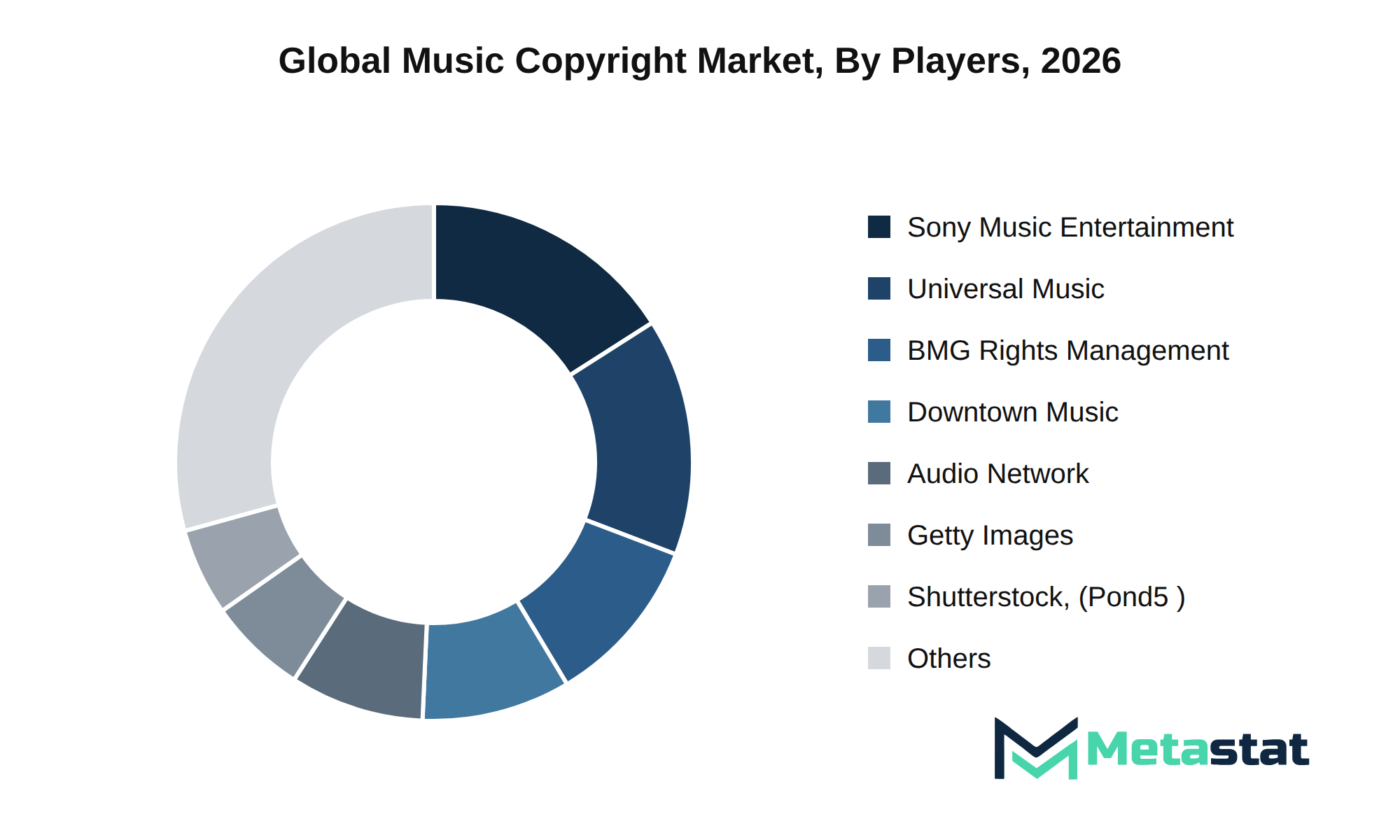
The Music Copyright market features a diverse range of players actively pursuing various strategic behaviors to strengthen their market position. Mergers and acquisitions serve because a prevalent tactic for consolidation among companies, allowing them to build larger portfolios and expand their reach. Firms like Getty Images Inc. and BMG Rights Management GmbH demonstrate this approach, enhancing their competitive edge through strategic partnerships and resource sharing.
Pricing architectures and commercial models evolve continuously to adapt to market demands. Companies including Sony Music Entertainment and Universal Music Group N.V. leverage their established brand equity to offer differentiated pricing strategies, catering to a broad spectrum of clients across different segments. This strategic focus on customer retention increases loyalty and raises switching costs for clients.
Investment in research and development sustains a competitive advantage in the market. Firms like Downtown Music Holdings and Audio Network Limited invest in proprietary technology and innovative solutions, creating unique offerings that differentiate their services from competitors. This commitment to R&D underpins their long-term growth prospects and positions them favorably against potential new entrants.
Strategic alliances and joint ventures, particularly among independent music publishers including Wise Music Group Ltd. and Concord, promote collaboration in the industry while enhancing their market presence. These partnerships enable access to new markets, allowing participants to expand their operational capabilities and share resources effectively.
Market size is forecast to rise from USD 20.2 billion in 2025 to over USD 31.2 billion by 2033. This projection reflects a compound annual growth rate (CAGR) of 5.6%. The base case scenario indicates steady growth driven by increasing digital consumption, evolving regulations, and heightened awareness of copyright issues among content creators and consumers.
In the bullish case, robust advancements in technology integration, including blockchain for rights management and AI for content creation, could significantly enhance operational efficiencies and revenue streams within the Music Copyright market. Such developments are expected to expedite adoption rates among stakeholders, resulting in faster growth beyond the base projections.
Conversely, in a bearish scenario, economic downturns or geopolitical tensions could lead to reduced investment in creative industries and lower consumer spending on content, adversely affecting the market's trajectory. Regulatory challenges and compliance hurdles pose risks to growth, particularly for independent publishers and smaller entities within the market.
Overall, the Music Copyright market faces a changing environment influenced by technological evolution, regulatory advancements, and shifting consumer behaviors that will shape its future direction.
The report strategically identifies and profiles the key market players and analyses their core competencies in each sub-segment of the Music Copyright market.
Report Attributes | Details |
Study Period | 2021-2033 |
Base Year | 2025 |
Estimated Year | 2026 |
Forecast Period | 2026-2033 |
Historical Period | 2021-2025 |
Growth Rate | CAGR 5.6% from 2026 to 2033 |
Revenue Unit | USD billion |
Segmentation | By Service Type, Rights and Licensing Type, Genre, Publisher Type, and Region |
By Region | North America (By Service Type, Rights and Licensing Type, Genre, Publisher Type, and Country)
|
Europe (By Service Type, Rights and Licensing Type, Genre, Publisher Type, and Country)
| |
Asia Pacific (By Service Type, Rights and Licensing Type, Genre, Publisher Type, and Country)
| |
South America (By Service Type, Rights and Licensing Type, Genre, Publisher Type, and Country)
| |
Middle East and Africa (By Service Type, Rights and Licensing Type, Genre, Publisher Type, and Country)
|
Find answers to common questions about this report
The Music Copyright market size was valued at USD 20.2 billion in 2025.
The Music Copyright market is projected to grow at a CAGR of 5.6% during the forecast period from 2026 to 2033.
The North America Music Copyright market size is estimated to reach USD 12.6 billion by 2033.
The Music Publishing segment leads the Music Copyright market, with a projected value of USD 13.8 billion by 2033. This segment's growth reflects a compound annual growth rate of 5.2 percent from 2026 to 2033.
Key drivers for the Music Copyright market include macro-economic factors including GDP growth and interest rates, which influence investment levels. Digital transformation enhances operational efficiency and increases competition, while shifting consumer behaviors create new revenue opportunities through digital platforms. These elements collectively support sustained growth in the market.
North America holds the dominant share of the Music Copyright market, accounting for USD 12.6 billion in 2033, which represents 40.3 percent of the total market.
Compliance hurdles and intricate legal frameworks restrain growth in the Music Copyright market by complicating the licensing process and increasing operational costs for stakeholders. Macroeconomic pressures, including inflation and resource scarcity, restrict investment and expansion opportunities, further slowing growth rates. Technological obsolescence and market saturation challenge companies' competitiveness and limit opportunities for new entrants.
Increased investment in the Music Copyright market is driven by macroeconomic stability, which supports growth in creative sectors. Digital transformation enhances operational efficiency and enables companies to adapt to evolving consumer preferences, creating new revenue streams and opportunities for product adoption.
The Music Copyright market is estimated to reach a valuation of USD 31.2 billion by 2033.
Key players operating in the Music Copyright market include Getty Images Inc., Shutterstock, Inc. (Pond5 Inc.), FM LLC (Musicbed), Audio Network Limited, BMG Rights Management GmbH, Downtown Music Holdings, and Sony Music Entertainment.
The analysts below cover Information & Technology research at Metastat Insights.
LEAD ANALYST
Utkarsh Khirodkar is a Lead Market Research Analyst at MetaStat Insight, specializing in market intelligence, technology sector assessments, and competitive strategy.

PRINCIPAL CONSULTANT - ENTERPRISE AI & EMERGING TECHNOLOGIES
Banking & Finance · Electronics and Semiconductor · Energy and Power · Healthcare IT · Information & Technology · Professional Services
Vijay Gunti is a Principal Consultant at MetaStat Insight, bringing over two decades of experience across enterprise digital transformation, technology strategy, and intelligent systems.

LEAD CONSULTANT - COMMUNICATION, TELECOM, AND IT
Electronics and Semiconductor · Information & Technology · Machinery & Equipment · Professional Services
Ravindra Sathe Consultants for Communication, Telecom, and IT at MetaStat Insight. He leads the firm's industry research initiatives across telecommunications infrastructure, digital connectivity, enterprise networking, and emerging information technology domains.
Assessing commercial microgrid software adoption requires looking past top-level installation numbers and examining utility interconnection queues. The research provided verifiable data on average permitting timelines, tariff structures, and battery storage integration costs across regional utility territories. That grounded perspective was valuable for our team when building five-year demand projections for industrial microgrid controllers.
Ambulatory surgical centers have very different purchasing cycles for robotic-assisted surgery platforms than major hospital networks. The MetaStat Insight study focused squarely on capital expenditure depreciation, procedural reimbursement pathways, and surgeon training overhead. That operational clarity made it much simpler to validate multi-year procedure growth forecasts against actual ambulatory center adoption patterns.
When planning edge sensor rollouts across refinery environments, generic IoT reports typically miss the harsh-environment certification bottlenecks. MetaStat Insight gave an objective evaluation of ATEX and Class 1 Division 2 hardware availability, along with realistic five-year maintenance cycle cost projections. The comparison of wireless mesh versus private cellular backhaul helped our team pressure-test network reliability models for remote processing facilities.
Explore related market intelligence reports worth reading alongside this one.