
LEAD ANALYST
Utkarsh Khirodkar is a Lead Market Research Analyst at MetaStat Insight, specializing in market intelligence, technology sector assessments, and competitive strategy.

Southeast Asia Gaming Market Size, Share, By Platform (Mobile Games, PC Games and Console Games), By Genre (Action & Shooter, Role-Playing Games (RPG & MMORPG), Multiplayer Online Battle Arena (MOBA), Strategy, Casual & Puzzle, Sports & Racing, Simulation and Adventure), By Monetization Model (Free-to-Play (In-App Purchase), Free-to-Play (Advertising), Premium / One-Time Purchase, Subscription-Based and Paid and Recurring Content (DLC/Season Pass)), By Region (Indonesia, Thailand, Vietnam, Philippines, Malaysia, Singapore and Rest of Southeast Asia (Myanmar, Cambodia, Laos and Brunei)), Industry Analysis, Growth, Trends, and Forecast, 2026-2033
Report ID
MSI-5165
Published
September, 2026
Pages
291 Pages
Format
Historical
Base year
Forecast
Forecast period
Report Details
Choose Your License
Southeast Asia Gaming Market
The Southeast Asia Gaming market was valued at USD 5,543.4 million in 2025 and is projected to reach USD 7,530.8 million by 2033, growing at a CAGR of 3.9% over the forecast period.
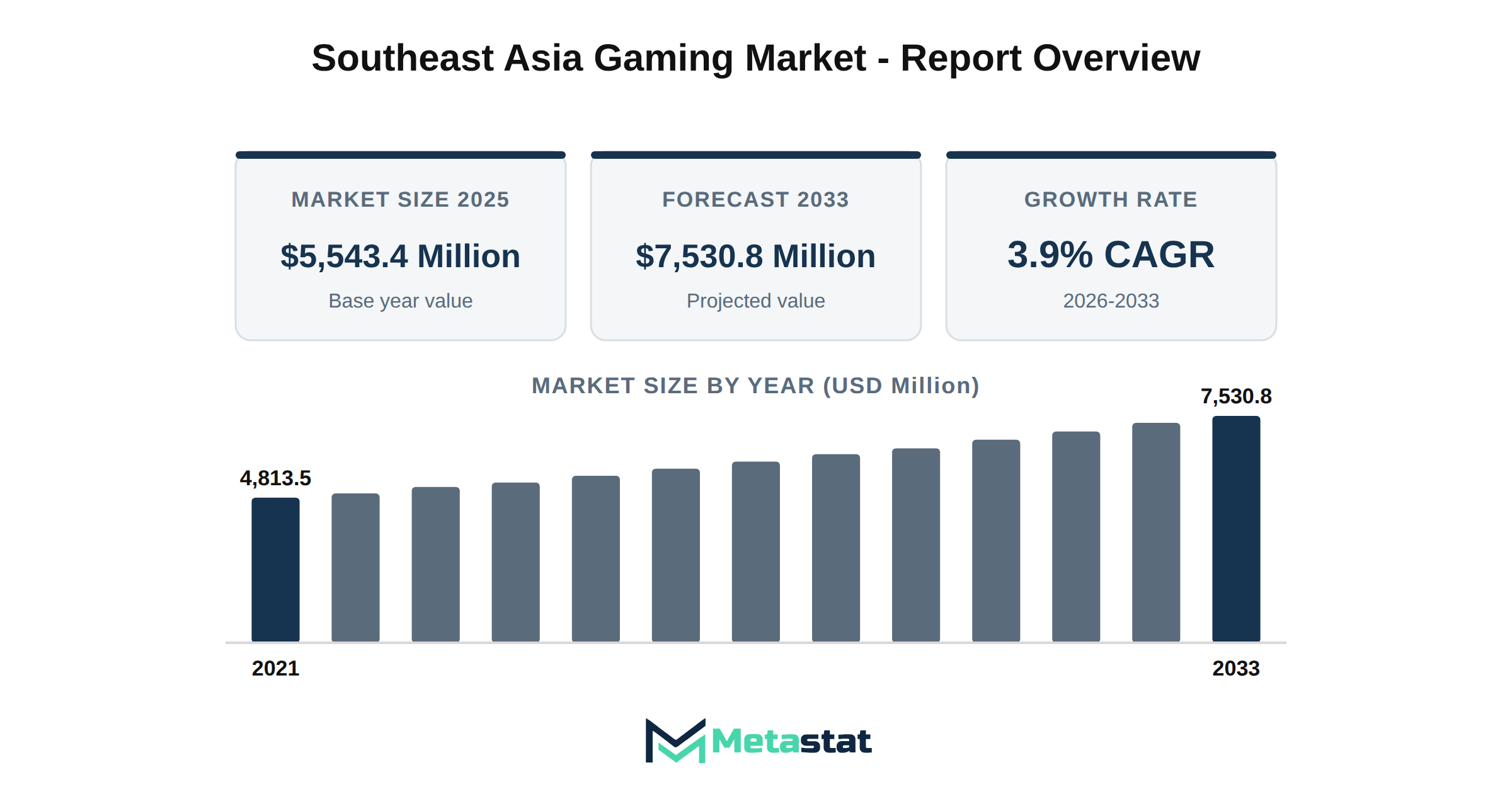
The Southeast Asia Gaming market reached a value of USD 5,543.4 million in 2025, reflecting strong growth from USD 4,813.5 million in 2021. The market is projected to expand to USD 7,530.8 million by 2033, registering a compound annual growth rate (CAGR) of 3.9% during the forecast period from 2026 to 2033. This growth trajectory highlights the increasing popularity of gaming across various platforms and genres within the region.
Mobile games dominate the market, accounting for 70.4% of the total share, while PC games and console games hold 19.8% and 9.8%, respectively. The mobile gaming sector is expected to grow significantly from USD 4,091 million in 2026 to USD 5,535.1 million in 2033, reflecting a CAGR of 4.4%. This segment's expansion is driven by rising smartphone penetration and enhanced mobile internet connectivity across Southeast Asia.
In addition to platform growth, genre diversification contributes significantly to the market's dynamics. Action and shooter games are expected to grow from USD 1,226 million in 2026 to USD 1,644 million in 2033, with a CAGR of 4.3%. Role-playing games (RPG and MMORPG) will see substantial growth, reaching USD 1,543.8 million by 2033, supported by an expanding gamer base seeking immersive experiences.
The monetization models within the Southeast Asia Gaming market reflect a shift towards free-to-play strategies. The free-to-play (in-app purchase) model is projected to increase from USD 3,338.9 million in 2026 to USD 4,556.1 million in 2033, achieving a CAGR of 4.5%. This shift indicates significant consumer preference for accessible gaming experiences, driving revenue growth through in-game purchases.
Regulatory compliance plays a crucial role in shaping the Southeast Asia Gaming market. Governments implement stricter regulations to ensure consumer protection and data privacy, while gaming companies adapt to these requirements. Compliance with regulations requires significant investment in technology and processes, impacting operational costs but enhancing consumer trust and fostering long-term growth.
Market fragmentation persists throughout the gaming sector. Numerous players operate across various platforms and monetization models, resulting in a highly competitive environment. This fragmentation presents challenges for new entrants seeking to establish a foothold while creating opportunities for innovation and differentiation among existing players, driving market evolution.
Inflationary pressures affect consumer spending patterns in the gaming market. Rising prices for goods and services influence disposable income, leading to changes in gaming habits. Companies closely monitor these shifts to adjust pricing strategies and marketing approaches, ensuring alignment with consumer behavior and maintaining revenue streams.
Next-generation innovation remains a driving force within the Southeast Asia Gaming market. Advances in technology, including augmented reality and virtual reality, reshape user experiences and create new avenues for engagement. Investment in research and development is essential for companies aiming to maintain a competitive edge and meet evolving consumer expectations, enhancing their market positioning.
Capital allocation strategies significantly impact growth trajectories in the gaming market. Companies focusing on strategic investments in technology and talent position themselves favorably against competitors. Allocating resources effectively toward innovative projects enhances market presence and financial performance, supporting sustainable growth.
The future strategic outlook for the Southeast Asia Gaming market appears positive, with a projected value of USD 7,530.8 million by 2033. Companies that leverage emerging technologies and adapt to changing consumer preferences thrive in this dynamic environment, reinforcing their competitive advantage.
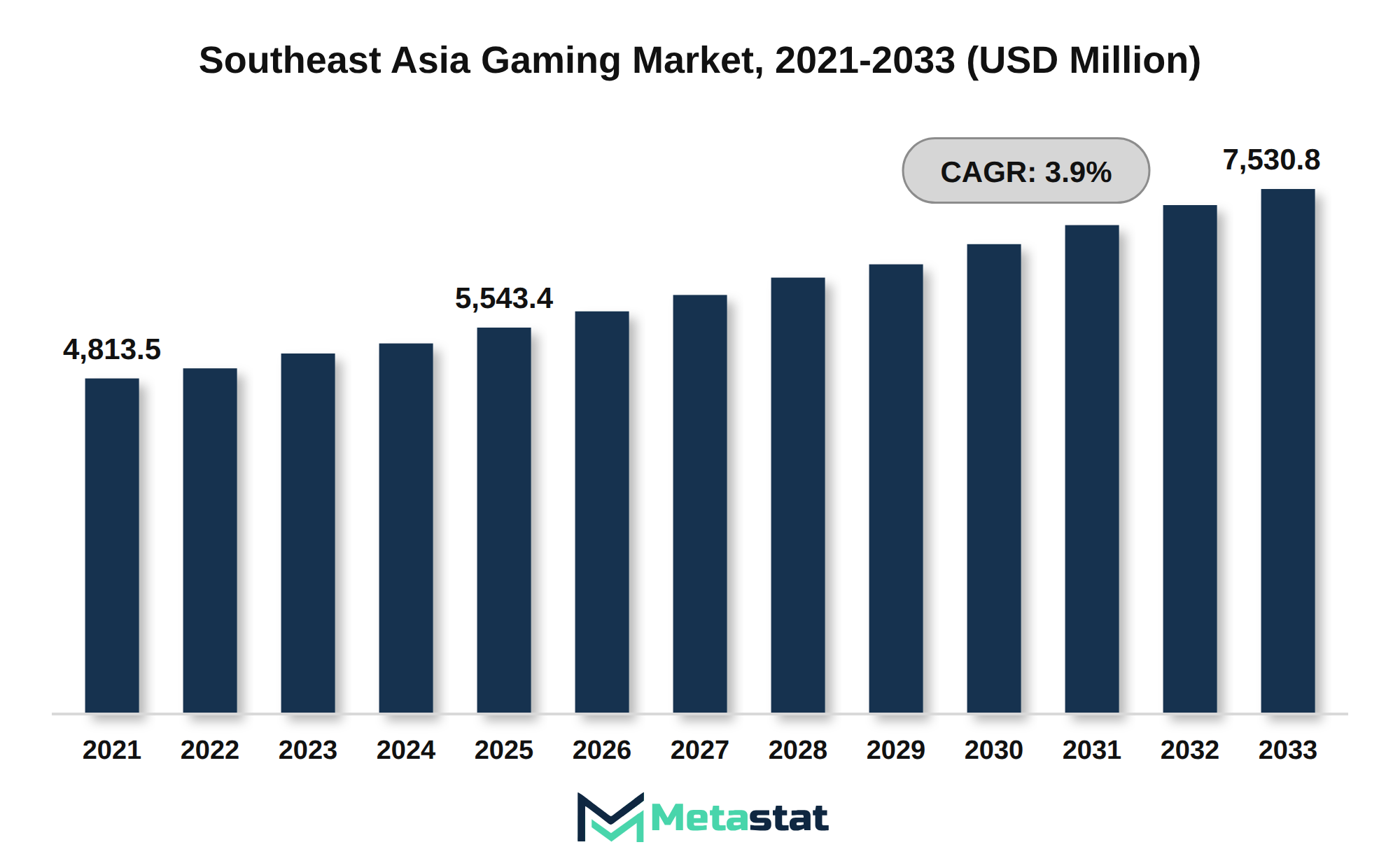
The Southeast Asia Gaming market experiences significant growth driven by macro-economic factors, including GDP growth and venture funding. Countries in the region continue to invest heavily in technological infrastructure, enhancing the market's appeal to developers and consumers alike. Increased public-private spending power creates an environment conducive to innovation and digital transformation, attracting many gaming companies.
Enhanced economic stability, along with rising disposable incomes, influences consumer behavior, leading to higher demand for gaming products across various platforms. The shift towards mobile gaming highlights changing preferences, with mobile games accounting for 70.4 percent of the market share. This trend correlates with increased urbanization and lifestyle changes, resulting in a larger audience seeking entertainment through gaming.
Investments in digital transformation and technological integration further fuel growth within the market. Companies adopting automation and artificial intelligence streamline operations and improve user experiences. Such advancements contribute to the overall expansion of the Southeast Asia Gaming market, establishing it because a key player within the global gaming industry.
Investment in digital transformation significantly impacts the Southeast Asia Gaming market. Increased adoption of technologies, including automation and artificial intelligence, improves operational efficiency and enhances user engagement. Companies integrate software solutions that simplify processes, enabling swift responses to evolving consumer demands.
Shifting consumer behaviors fuel demand for innovative gaming experiences. The rise of mobile gaming, driven by the proliferation of smartphones and improved internet connectivity, attracts a diverse audience, including younger players and those in emerging markets. This demographic shift encourages game developers to create engaging content that appeals to varied preferences.
Continued investment in infrastructure development supports market expansion. Enhanced digital capabilities and robust network infrastructure facilitate engaging gaming experiences, attracting both local and international players. Upgraded facilities and modernized assets improve the overall competitiveness of the Southeast Asia Gaming market.
Increased venture funding and public-private partnerships further drive growth. These financial resources enable companies to invest in research and development, leading to innovative products and services. A strong capital investment environment enhances the market’s ability to adapt to industry changes and technological advancements.
The Southeast Asia Gaming market faces significant constraints due to regulatory compliance hurdles that impact the industry's operational landscape. The complex legal framework surrounding gaming regulations introduces challenges for developers and publishers, particularly in navigating varying compliance requirements across different nations. These disparities result in increased costs associated with legal consultation, implementation of compliance measures, and potential delays in product launches.
Macroeconomic headwinds further complicate the market dynamics. Inflationary pressures contribute to rising operational costs, impacting profitability margins for gaming companies. High capital investment requirements hinder new entrants from capturing market share, driven by established players maintaining a competitive edge through substantial financial backing.
Supply chain disruptions pose additional challenges, affecting the timely delivery of gaming products and resources necessary for development. Geopolitical instability within the region exacerbates these supply issues, leading to uncertainty in market conditions and investor confidence. Such instability slows down the momentum for growth in the Southeast Asia Gaming market.
The presence of cultural barriers and regional adoption resistors limits market expansion. Variations in gaming preferences and acceptance across different demographics create fragmentation, complicating marketing strategies and product offerings. Companies investing in targeted content development face difficulties in connecting with diverse consumer bases, ultimately impacting sales potential.
The market contends with challenges related to technological obsolescence and substitution risks. The rapid evolution of gaming technology necessitates continuous innovation and adaptation by companies. Firms that fail to keep pace with emerging technologies risk losing relevance, while alternatives to traditional gaming models attract consumer interest. This dynamic places additional pressure on existing market players to remain agile.
Overall, these factors collectively restrain the growth potential of the Southeast Asia Gaming market, necessitating strategic approaches to navigate the complexities of compliance, economic influences, and competitive pressures.
The Southeast Asia Gaming market encounters challenges stemming from geopolitical fragmentation, which results in trade deficits and tariff friction. These factors disrupt the smooth flow of goods and services, impacting the overall market dynamics. Companies face increased costs and uncertainties in sourcing components, leading to operational inefficiencies. Volatility in feedstock and components affects production timelines and profit margins, forcing players to adjust their strategies.
Technological disruptions further complicate the environment, driven by rapid advancements in gaming technology that necessitate complex research and development integrations. Firms grapple with interoperability friction while striving to ensure compatibility across various gaming platforms. This challenge often leads to increased development time and costs, impeding timely market entry for new products. Evolving legal liabilities surrounding data privacy and cybersecurity introduce further compliance overhead, placing additional strains on resources.
The Southeast Asia Gaming market navigates rising input cost structures due to inflationary pressures and workforce skill gaps. Talent retention pressures arise owing to firms competing for skilled labor in a tightening employment market. Automation displacements enable efficiency but result in workforce disruptions. Environmental sustainability demands add another layer of complexity, requiring investments in greener technologies and practices.
Infrastructure gaps and retrofitting barriers hinder the implementation of new gaming technologies, impacting market growth potential. Intellectual property protection deficits contribute to market uncertainties, deterring investment in innovative gaming solutions. Finally, shifting downstream demands and market saturation create substitution vector pressures, compelling companies to refine their offerings to maintain competitive advantage. These multifaceted challenges necessitate strategic foresight and adaptability to thrive in the evolving Southeast Asia Gaming market.
The Southeast Asia Gaming market presents significant opportunities stemming from the ongoing digital transformation across the region. Technological advancements enhance user experiences and expand access to gaming platforms, particularly in mobile gaming, which commands a 70.4% market share. The rise of mobile connectivity and affordable smartphones facilitates broader audience engagement, especially among younger demographics. This shift drives demand for innovative game designs, leading to increased investment in next-generation gaming experiences.
Infrastructure modernization contributes to the market's growth trajectory. Enhanced internet connectivity and the expansion of cloud gaming services serve because crucial enablers for rich gaming experiences. These developments allow developers to offer immersive content, catering to evolving consumer preferences. Consequently, the market is projected to achieve a compound annual growth rate of 3.9% from 2025 to 2033, reflecting sustained interest and participation in gaming activities.
Emerging regional demands for diverse gaming genres, including Action & Shooter and Role-Playing Games, create ample opportunities for game developers. The shift towards free-to-play monetization models, with growth from USD 3,338.9 million in 2026 to USD 4,556.1 million by 2033, indicates a lucrative landscape for developers to capitalize on in-app purchases and advertising strategies. The Southeast Asia Gaming market is well-positioned to benefit from these trends, creating a dynamic environment for future growth.
The Southeast Asia Gaming market is segmented based on Platform, Genre, Monetization Model, and Region.
Valued at USD 4,091 million in 2026, the Mobile Games segment is projected to reach USD 5,535.1 million by 2033, at a CAGR of 4.4% during the forecast period. Increasing smartphone penetration across Southeast Asia significantly enhances accessibility to mobile gaming platforms, contributing to strong demand. The shift towards mobile-first gaming experiences aligns with consumer preferences for convenience and engagement, driving higher adoption rates among diverse demographics.
Technological advancements in mobile gaming infrastructure, including 5G connectivity, create a conducive environment for developing more immersive and interactive gaming experiences. Enhanced graphics and real-time multiplayer functionalities facilitate consumer engagement, attracting a broader audience. The escalating trend of in-app purchases within mobile games signifies a strong monetization model, allowing developers to capitalize on user engagement effectively.
Consumer consumption patterns demonstrate a preference for free-to-play models, with significant growth expected in in-app purchases, fueling revenue generation for developers. The evolving competitive landscape within the Southeast Asia Gaming market drives innovation in game design and delivery, prompting companies to invest in unique gaming experiences to differentiate their offerings. Strategic partnerships with regional distributors enhance market penetration, increasing the reach of mobile gaming titles.
The Mobile Games segment in the Southeast Asia Gaming market presents strong growth potential driven by technological maturation, consumer demand, and strategic industry dynamics. Continued investment in mobile gaming infrastructure and innovative monetization strategies will further enhance the segment's position in the market.
Growth within the PC Games segment of the Southeast Asia Gaming market is supported by increasing player engagement and advancements in technology. Gamers seek immersive experiences, driving demand for high-quality graphics and engaging gameplay. This trend influences consumer preferences and the development of new titles, compelling developers to invest in next-generation upgrades. The rise of competitive gaming and eSports further increases interest in PC gaming, attracting a diverse player base.
Investment in online multiplayer capabilities enhances community interaction, creating a robust gaming ecosystem. The segment is expected to see a strong presence of role-playing games and action genres, appealing to both casual and dedicated gamers. The increasing availability of high-speed internet connectivity strengthens the appeal of PC games, enabling online experiences and expanding the player base.
PC Games segment is estimated to reach USD 1,393.2 million by 2033, at a CAGR of 3% during the forecast period. While developers focus on innovative gameplay mechanics and storytelling, both retention and acquisition of players improve. Changing consumption habits toward gaming because a primary entertainment source create opportunities for sustained growth in the market.
Pricing strategies play a significant role in consumer decisions, with free-to-play models gaining traction. These models often attract new players, allowing them to engage with games at minimal upfront cost. In-game purchases and content expansions subsequently generate additional revenue streams for developers, enhancing the profitability of the segment in the Southeast Asia Gaming market.
Demand for Console Games within the Southeast Asia Gaming market reflects a growing consumer preference for immersive and interactive gaming experiences. This interest is driven by advancements in technology, which enhance gameplay quality and accessibility. Increased ownership of gaming consoles and the popularity of exclusive titles significantly contribute to consumer engagement.
Console Games segment is expected to reach USD 602.5 million by 2033. The expansion of this segment benefits from the rise of next-gen console upgrades, improving graphical performance and user experiences. The introduction of innovative gaming peripherals further stimulates interest, allowing players to explore new genres and formats.
Investment in marketing and promotional strategies by game developers strengthens brand loyalty and consumer retention. This approach appeals particularly well to younger audiences, who prioritize social connectivity through multiplayer features. Evolving consumer behaviors towards multiplayer and online gaming experiences reinforce demand in the market.
Price volatility in the gaming console market influences consumer purchasing decisions, alongside the ongoing transition to digital distribution models. Such trends drive shifts in consumption patterns, driven by gamers focusing on both initial purchase and long-term value through downloadable content and subscription services. These dynamics highlight strategic opportunity windows for developers to align their offerings with consumer expectations.
Valued at USD 1,226 million in 2026, the Action & Shooter segment is projected to reach USD 1,644 million by 2033, at a CAGR of 4.3% during the forecast period. This growth is driven by increasing consumer interest in immersive gaming experiences and high-quality graphics. The appeal of competitive gameplay among users in the Southeast Asia Gaming market increases demand for new releases and expansions within this genre.
Technological maturation enhances gameplay mechanics and graphics, attracting a broader demographic. Adoption of next-gen consoles boosts the segment, driven by gamers seeking enhanced performance and features. Major gaming titles in the Action & Shooter genre continually evolve, integrating advanced features and engaging narratives, leading to sustained consumer interest and engagement.
Investment in innovative game design, along with partnerships between developers and streaming platforms, enhances the segment's visibility. Espoused by esports popularity, the Action & Shooter segment experiences expanded downstream applications within competitive gaming markets. This trend reflects consumption shifts, with gamers increasingly engaging in multiplayer battles and tournaments.
The Southeast Asia Gaming market reflects strong growth prospects for the Action & Shooter segment, driven by changing consumer preferences and technological advancements. Strategic investments in gaming infrastructure are expected to further support market expansion, catering to the rising demand for high-quality gaming experiences.
Growing consumer interest in immersive storytelling and character-driven experiences enhances the Role-Playing Games (RPG & MMORPG) segment within the Southeast Asia Gaming market. This segment is estimated to reach USD 1,543.8 million by 2033, at a CAGR of 4.4% during the forecast period. Advances in technology improve gameplay dynamics, attracting new players and keeping existing users engaged through innovative features and expanding content offerings.
The rising popularity of mobile gaming significantly influences the RPG & MMORPG segment, driven by players prioritizing convenience and accessibility. Increasing smartphone penetration and improvements in mobile internet infrastructure enable users to access these games anytime and anywhere, further driving growth within the segment. Enhanced graphics, engaging narratives, and community-building elements improve player retention, creating a solid ecosystem within the market.
Player preferences shift toward social interaction and multiplayer experiences, with RPGs providing platforms for collaboration and competition. The rise of free-to-play models enables wider audience reach, lowering barriers to entry for new gamers. Developers focus on monetization strategies that incorporate in-app purchases and expansions, maximizing revenue potential while delivering satisfying gameplay experiences.
Investment in game development continues to rise, with studios allocating resources to create high-quality content and next-gen updates. This pattern encourages competition among developers in the Southeast Asia Gaming market, pushing them to innovate and refine their offerings. Such strategic initiatives provide opportunities for growth, establishing a dynamic environment for RPGs that drives the overall market forward.
Forecasts indicate the Multiplayer Online Battle Arena (MOBA) segment is projected to reach USD 1,430.8 million by 2033. This growth stems from a surge in player engagement and the increasing popularity of eSports across Southeast Asia. Rising internet penetration and improved mobile connectivity support accessibility, allowing gamers to participate in competitive multiplayer environments. The introduction of innovative gameplay mechanics and regular content updates enhances user experience, driving sustained interest in this genre.
Investment in game development focused on MOBA titles accelerates market expansion. Key players innovate by integrating cross-platform capabilities, creating an inclusive gaming community. This trend attracts diverse demographics, including younger audiences who seek social interaction within gaming environments. The balance between in-game purchases and free content models influences user retention and revenue generation.
Increased competition among developers leads to the creation of unique gameplay experiences, reinforcing the demand for high-quality titles. Consumer preferences shift towards interactive and collaborative elements, and the MOBA segment adapts by introducing features that promote teamwork and strategy. These developments position the segment favorably within the broader Southeast Asia Gaming market, reinforcing its trajectory for future growth.
Growth in the Strategy segment reflects an increasing consumer preference for complex gameplay that emphasizes tactical decision-making and competitive engagement. Enhanced gaming experiences arise from technological advancements that facilitate intricate game design and online multiplayer capabilities. The focus on immersive strategies within gaming titles attracts a diverse audience, significantly contributing to the segment's development. Market dynamics display a shift toward mobile platforms, driven by a rising number of players engaging with strategy games on smartphones and tablets. The popularity of in-game purchases within free-to-play models further fuels revenue, enhancing monetization opportunities in this segment. Valued at USD 1,226 million in 2026, the Strategy segment is projected to grow at a CAGR of 3.7% during the forecast period. Consumer engagement in eSports and competitive gaming creates a robust ecosystem for Strategy titles, augmenting their visibility and reach. Industry stakeholders emphasize the importance of community-building and player interaction, driving further market penetration and adoption. Such factors strengthen the Strategy segment's position within the Southeast Asia Gaming market, influenced by evolving user demands and preferences.
Engagement with Casual & Puzzle games has surged across various demographics, reflecting a shift in consumer behavior favoring accessible and entertaining options. The proliferation of mobile devices significantly influences this trend, allowing players to enjoy these games anytime and anywhere. This portability aligns with lifestyle changes that emphasize convenience and instant gratification.
Innovation in game design and technology enhances user experience, creating deeper connections with players. Regular updates and the introduction of new features sustain player interest, ensuring continued engagement. The blend of simplicity and challenging gameplay attracts a diverse audience, from casual players to more dedicated gamers, creating a broad consumer base.
Monetization strategies focusing on free-to-play models facilitate wider access, enabling players to engage without upfront costs. These models capitalize on in-app purchases, generating sustained revenue streams. This financial structure supports the development of new content and features, enhancing the overall value of offerings within the Southeast Asia Gaming market.
Competition within the Casual & Puzzle segment encourages ongoing innovation and product evolution. Companies continually seek to differentiate their offerings, leading to a dynamic market environment. Strategic partnerships and collaborations emerge, enhancing game quality and reach, ultimately driving growth within the market.
The intersection of consumer demand, technological advancement, and innovative monetization strategies positions the Casual & Puzzle segment for continued relevance and expansion within the Southeast Asia Gaming market. This segment not only meets the current preferences of players but adapts to future trends, ensuring its significant role in the gaming ecosystem.
In the dynamic environment of the Southeast Asia Gaming market, the Sports & Racing segment exhibits a promising trajectory, driven by evolving consumer preferences and advancements in technology. An increasing number of players engage with sports and racing titles, stimulated by immersive gameplay experiences and realistic graphics. This segment leverages the popularity of real-world sports, enhancing its appeal through partnerships with sporting organizations and events.
Technological maturation accelerates the development of next-generation upgrades, allowing for enhanced realism and interactivity in sports and racing games. The growth of online multiplayer features encourages community engagement, creating a competitive spirit among players. This heightened level of interaction contributes to sustained interest and retention within the segment.
Consumer behavior reflects a shift towards mobile gaming, with players favoring platforms that provide convenience and accessibility. This trend has prompted developers to prioritize mobile-optimized experiences in the Sports & Racing category, ensuring compatibility across various devices. The embrace of in-game monetization strategies, particularly through free-to-play models with in-app purchases, supports revenue generation while maintaining player engagement.
Despite its growth, the segment faces challenges, including pricing volatility and margin pressures that influence cost structures. Strategic opportunity windows arise for developers to innovate and adapt to changing market dynamics, emphasizing the importance of agile development practices. While the Southeast Asia Gaming market evolves, the Sports & Racing segment capitalizes on these trends, enhancing its relevance within the broader gaming ecosystem.
Interest in Simulation games has surged within the Southeast Asia Gaming market, driven by technological advancements in graphics and game design, facilitating immersive experiences that engage players. The increasing availability of high-performance gaming devices supports this trend, allowing developers to create more complex simulations that appeal to gamers seeking realism. Innovations in augmented and virtual reality technology enhance gameplay, providing avenues for deeper player engagement and interaction.
Developers actively explore various themes and scenarios, resulting in a diverse range of offerings that cater to different player preferences. This diversification encourages broader appeal, attracting not only traditional gamers but casual players looking for engaging content. The evolution of user-generated content platforms enables players to contribute their own narratives, increasing community involvement and expanding the market's reach.
Regulatory compliance remains a crucial consideration, with developers addressing age ratings and content guidelines to ensure accessibility while maintaining creative integrity. This awareness aligns with growing consumer expectations for transparency and ethical considerations in gaming, influencing purchasing decisions. Ultimately, these dynamics create a favorable environment for growth, positioning Simulation games because a vital component of the Southeast Asia Gaming market.
Consumer interest in Adventure games within the Southeast Asia Gaming market is influenced by the desire for exploration and narrative depth. Developers focus on delivering engaging storylines and immersive environments, appealing to players seeking unique experiences. Innovations in game design, coupled with advances in graphics and sound, enhance the quality of these games, attracting more players to engage with this genre.
Adoption of Adventure games benefits from the expansion of mobile gaming platforms, enabling wider accessibility. Gamers increasingly access these titles on smartphones and tablets, transforming the way this genre is experienced. The market environment supports various monetization strategies, allowing developers to explore multiple revenue streams, including in-app purchases and episodic content.
Strategic partnerships among publishers and distributors strengthen the presence of Adventure games in the market. Collaborations with streaming platforms and social media promote game visibility, helping to attract new players. Expansions into emerging markets within Southeast Asia enhance growth opportunities for Adventure games, creating a broader user base.
Technological advancements drive the genre forward, with next-gen upgrades optimizing performance and user experience. Enhanced graphics capabilities and faster processing power allow developers to create more intricate and engaging worlds. Strong demand for immersive experiences positions Adventure games favorably, aligning with market trends focused on high-quality content delivery.
Engagement with the Others (Card/Board, Rhythm/Music) segment reflects a distinctive trend in the Southeast Asia Gaming market, driven by the rise in mobile and casual gaming. Players exhibit a strong inclination towards games that incorporate familiar physical elements, including card and board games, blended with innovative digital experiences. This integration enhances user interaction and establishes a sense of nostalgia, appealing to a broad audience.
Technological advancements play a crucial role in shaping this segment. The introduction of augmented reality (AR) and virtual reality (VR) elements creates immersive environments, enriching gameplay experiences and attracting a wider demographic. The evolution of gaming platforms allows for the integration of music-based games, further broadening the appeal of this genre.
Changing consumption patterns, driven by younger, tech-savvy users, significantly influence market dynamics. The popularity of social features within games promotes community engagement, encouraging competitive play among friends and enhancing retention rates. This social aspect becomes a key factor in user acquisition and growth within the segment.
Investment in strategic partnerships and collaborations with music and entertainment companies enhances the market positioning of titles within this genre. By leveraging established brands and franchises, developers capture greater attention and strengthen their market presence. This approach accelerates game adoption and encourages user loyalty, ultimately contributing to long-term growth.
In the Southeast Asia Gaming market, the Others (Card/Board, Rhythm/Music) segment reflects a dynamic blend of traditional and modern gaming experiences. Ongoing innovations and engagement strategies will shape its trajectory, ensuring sustained interest and participation.
Valued at USD 3,338.9 million in 2026, the Free-to-Play (In-App Purchase) segment is projected to reach USD 4,556.1 million by 2033, at a CAGR of 4.5% during the forecast period. This growth stems from increasing consumer engagement with mobile and online gaming platforms, further propelled by the popularity of in-game purchases. Gamers appreciate the flexibility offered by this monetization model, which allows access to content without upfront costs. Additional demand drivers include a growing base of smartphone users, enhanced internet connectivity, and the proliferation of affordable gaming content. Adoption of Free-to-Play (In-App Purchase) strategies enhances revenue potential for developers while offering players a low-risk entry point to gaming experiences. Competition intensifies because developers invest in quality content and innovative features to retain user interest and maximize in-game spending. The Southeast Asia Gaming market is characterized by rapid technological advancements, leading to improved game quality and user experience, which supports segment growth. The evolving landscape requires constant updates and new content to maintain player engagement, driving ongoing product evolution. Increased awareness of this model among consumers, coupled with the growing popularity of esports and online multiplayer formats, establishes a strong foundation for continued expansion. The segment's growth reflects a shift towards consumption patterns emphasizing convenience, accessibility, and value for gamers.
Growth in the Free-to-Play (Advertising) segment reflects evolving consumer preferences for accessible gaming experiences without upfront costs. This cost-effective approach attracts a diverse player base, driving engagement across demographics. The segment is projected to reach USD 1,355.5 million by 2033, expanding at a CAGR of 3.2% during the forecast period. Factors influencing this growth include increased smartphone penetration and the rise of social media platforms that facilitate game promotion and user interaction. The success of in-game advertising campaigns enhances revenue potential, allowing developers to monetize user engagement effectively. Advertisers benefit from targeted marketing strategies that reach specific audiences, thereby improving return on investment. The Southeast Asia Gaming market demonstrates strong potential, with advertisers investing in this monetization model to capitalize on the growing user base and sustained gameplay.
Consumer preferences for premium gaming experiences drive growth in the Premium / One-Time Purchase segment of the Southeast Asia Gaming market. This segment is expected to reach USD 790.7 million by 2033, reflecting the increasing willingness to invest in high-quality game titles without ongoing costs. Players seek immersive and engaging content, leading to a shift towards premium offerings that deliver substantial value.
Technological maturation influences the evolution of the gaming landscape, enabling developers to create content that meets rising consumer expectations. Enhanced graphics, innovative gameplay mechanics, and compelling narratives contribute to the attractiveness of premium titles. The demand for one-time purchases increases owing to consumers perceiving better value in complete gaming experiences rather than ongoing microtransactions.
Regulatory compliance and industry standards shape the operational environment for game developers and publishers. Adhering to local regulations ensures that premium titles meet the necessary criteria for distribution, building trust among consumers and facilitating market entry. These dynamics impact pricing structures, enabling publishers to set competitive prices that align with consumer perceptions of value.
Increased competition among game developers encourages innovation and accelerates product evolution within the segment. While new titles emerge, consumer loyalty becomes crucial, with premium games often creating dedicated player bases. The growing interest in high-quality gaming experiences supports sustained investment in the development of premium titles, reinforcing the segment's expansion.
The Southeast Asia Gaming market presents strategic opportunity windows for developers focused on the Premium / One-Time Purchase model. Identifying and capitalizing on consumer trends, including preferences for particular genres or gameplay styles, enhances market positioning. Investment in marketing strategies that communicate the unique value of premium titles drives segment growth.
Consumer engagement with subscription-based gaming experiences is projected to grow at a CAGR of 2.9% during the forecast period. This growth stems from a rising preference for ongoing content access and a shift towards flexible payment models, aligning with current consumer spending habits. The market benefits from increased adoption of subscription services by gaming companies aiming to offer diverse content and continuous updates, enhancing player retention and engagement. Subscription-based models attract consumers seeking value and convenience, particularly in a landscape where free-to-play options dominate. This dynamic presents strategic opportunities for developers to capture a segment of the audience willing to invest in premium gaming experiences. The Southeast Asia Gaming market reflects these trends, because more players gravitate towards subscriptions for exclusive content and features, supporting forecasted growth across multiple gaming genres.
Consumer engagement with Paid and Recurring Content (DLC/Season Pass) reflects a growing trend of users seeking additional value and extended gameplay experiences. This segment thrives on the desire for enhanced content, including new levels, characters, and cosmetics, which attract players willing to invest in their gaming experience. The increasing adoption of next-gen gaming technology supports the expansion of this segment, driven by advanced graphics and gameplay mechanics that increase the perceived value of additional content.
The Southeast Asia Gaming market experiences shifts in consumer preferences toward subscription models and season passes, which provide ongoing access to new content and exclusive features. This trend aligns with the broader movement towards monetization strategies that focus on retaining players and increasing their lifetime value. Regulatory compliance standards play an essential role in shaping how developers approach monetization, ensuring transparency in transactions and protecting consumer interests.
Innovation within the gaming industry drives the evolution of Paid and Recurring Content, increasing competition among developers to create compelling offerings. Emerging technologies and platforms facilitate new types of content delivery, allowing for smooth integration of downloadable content into existing games. Strategic opportunity windows arise for companies to capture market share by adapting to changing player expectations and enhancing user experiences through continuous content updates.
While the market progresses, pricing volatility and margin pressures associated with content production will influence developers' strategies. Companies will balance the cost structures of developing high-quality content with consumer demand for affordability, impacting their long-term profitability. The Southeast Asia Gaming market remains dynamic, with players actively seeking diverse gaming experiences that align with evolving trends and expectations.
Valued at USD 1,706.1 million in 2026, the Indonesian gaming segment is projected to reach USD 2,348.1 million by 2033, at a CAGR of 4.7% during the forecast period. Increasing smartphone penetration and internet accessibility drive demand for mobile gaming, positioning Indonesia because a prominent player in the Southeast Asia Gaming market. The popularity of action and role-playing games fuels engagement, particularly among younger demographics. Emerging trends in in-app purchases and advertising models enhance revenue streams for game developers. Investment in local game development studios strengthens the content ecosystem, enabling tailored experiences for Indonesian gamers. The market benefits from an active gaming community that participates in esports and streaming events, further boosting visibility and player engagement. Regulatory support from the government fosters a conducive environment for growth, encouraging international partnerships and collaboration.
Growth in the Thailand gaming segment is driven by a rising interest in mobile gaming and the increasing availability of high-quality content. With a projected value of USD 1,129.6 million by 2033, the segment experiences a compound annual growth rate (CAGR) of 2.4% during the forecast period. The penetration of smartphones and improved internet infrastructure facilitates robust engagement among gamers, with a significant portion of the population actively participating in mobile gaming experiences. This trend encourages developers to invest in innovative titles that cater to this audience.
Shifts in consumption patterns indicate a growing preference for multiplayer experiences and social gaming, reflecting the evolving structure of the Thai gaming community. Developers are increasingly focusing on in-game monetization strategies, including free-to-play models that incorporate in-app purchases, which align well with consumer expectations. This strategic shift enhances revenue generation while improving player engagement, positioning the Thailand segment favorably within the overall market framework. The emphasis on creating interactive and immersive experiences further drives participation, contributing to a strong gaming culture across the region.
Valued at USD 1,204.9 million by 2033, the Vietnam gaming segment experiences significant growth driven by rising disposable income and the increasing popularity of mobile gaming. High smartphone penetration and affordable internet access facilitate a wider audience for mobile games, particularly among younger demographics. This adoption of mobile gaming creates a favorable environment for developers and publishers to introduce innovative gaming experiences tailored to local preferences.
Technological advancements play a critical role in the segment's expansion, enabling developers to create more immersive experiences through improved graphics and gameplay mechanics. The demand for next-generation upgrades strengthens the competitive landscape within the Southeast Asia Gaming market, emphasizing the need for ongoing investment in research and development. These advancements enhance user engagement and overall satisfaction, fueling further growth in the segment.
Shifts in consumption patterns indicate a growing preference for free-to-play models supported by in-app purchases, making them attractive options for both gamers and developers. This shift aligns with overall trends observed in Southeast Asia, where monetization strategies evolve to meet user expectations while maximizing revenue potential. Increased competition among game developers contributes to a dynamic gaming ecosystem that benefits consumers through diverse gaming options.
Vietnam's gaming segment anticipates challenges related to regulatory compliance and evolving policies, which introduce new cost structures and pricing pressures. Strategic opportunity windows exist for companies willing to navigate these challenges effectively. Capital investment in the local gaming industry enhances supply chain resilience, ensuring that game developers deliver high-quality products consistently.
Recent trends in the Philippines gaming market highlight significant growth opportunities driven by increasing internet penetration and smartphone adoption. This segment is projected to grow at a CAGR of 4.7% during the forecast period. An expanding base of mobile gamers facilitates a shift towards mobile gaming platforms, reflecting the broader trend in the Southeast Asia Gaming market. The integration of advanced technologies including augmented reality (AR) and virtual reality (VR) in gaming experiences enhances user engagement and retention, leading to increased revenue potential.
Demand for action and shooter games continues to rise, driven by competitive gaming and esports popularity, attracting younger demographics. The advancement of monetization models, particularly free-to-play with in-app purchases, significantly impacts revenue streams and consumer accessibility. Regulatory compliance, including data protection and age restrictions, shapes the operational framework within which companies develop and distribute gaming content. Adapting to these standards while maintaining innovative approaches serves because a catalyst for growth in this segment.
While consumer preferences evolve, the gaming environment in the Philippines transforms with a strong focus on multiplayer online experiences. Collaborations between gaming companies and streaming platforms enhance visibility and engagement, creating a robust ecosystem for content creators and players alike. The outlook for the Philippines gaming segment remains positive, with investment in next-generation upgrades and product evolution contributing to sustained expansion in the Southeast Asia Gaming market.
Consumer engagement in the Malaysia gaming segment reflects a growing appetite for immersive gaming experiences. The rise of mobile technology and increased internet accessibility significantly influence player preferences, shifting focus toward mobile gaming platforms. This trend aligns with broader regional patterns within the Southeast Asia Gaming market, where mobile games account for a growing share. Continuous advancements in mobile hardware and software enhance user experiences, allowing for more sophisticated game designs and interactivity.
Investment in local game development emerges because a critical catalyst for segment expansion. Malaysian developers increasingly create content tailored to local cultural themes, appealing to domestic audiences while promoting national identity. This localized approach drives player retention and attracts international interest, leading to partnerships that enhance the global presence of Malaysian games.
Technological maturation within the region accelerates the adoption of next-gen gaming technologies, including augmented reality (AR) and virtual reality (VR). These technologies promise to transform gameplay experiences, drawing in a broader audience and boosting engagement rates. The integration of these innovations positions Malaysia because a competitive player in the evolving landscape of the Southeast Asia Gaming market.
Regulatory compliance standards continue to shape the gaming environment. Policymakers focus on ensuring fair play and protecting consumer rights. While regulations evolve, developers face both challenges and opportunities, impacting pricing structures and market strategies. Effective compliance enhances consumer trust, potentially leading to increased spending and sustained market growth.
Overall, the market outlook for Malaysia's gaming segment reflects a combination of local cultural engagement, technological advancements, and regulatory frameworks. These factors create a dynamic environment for growth, making Malaysia a significant contributor to the overall Southeast Asia Gaming market.
Interest in gaming continues to expand in Singapore, driven by a young, tech-savvy population that embraces mobile and online gaming. The increasing penetration of smartphones and affordable internet access has led to substantial engagement with mobile games, which dominate the local market. Gamers in Singapore prioritize high-quality graphics, immersive experiences, and innovative gameplay, spurring developers to enhance product offerings and cater to evolving consumer preferences.
With a strong gaming culture, esports events and community initiatives play a significant role in the segment's growth. These events develop local talent and attract international attention, promoting competitive gaming because a legitimate career path. The presence of major gaming companies further strengthens market dynamics, providing resources and investment for next-generation upgrades and technological advancements. Through continuous innovation and engagement, Singapore remains a crucial player in the Southeast Asia Gaming market.
Local regulations regarding online gaming and data protection enhance consumer confidence, ensuring a secure gaming environment. Strategic partnerships between developers, publishers, and local businesses enhance market resilience, optimizing supply chains and addressing any potential disruptions. Overall, the Singapore gaming segment demonstrates robust potential, driven by strong demand, community engagement, and technological maturation.
Consumer engagement in the Rest of Southeast Asia (Myanmar, Cambodia, Laos, Brunei, Timor-Leste) illustrates a growing interest in gaming experiences tailored to local tastes and preferences. Regional players focus on adapting content and monetization strategies to align with cultural nuances, thereby enhancing appeal.
Technological maturation facilitates broader access to gaming platforms, enabling users to experience a diverse range of genres and monetization models. Free-to-Play offerings, particularly those incorporating local themes, attract significant player engagement, transforming the gaming landscape.
Adoption of mobile gaming continues to drive growth in this segment, supported by affordable smartphone penetration and improved internet connectivity across the region. The market responds to evolving consumer preferences, striving for innovative gameplay and compelling narratives.
Regulatory compliance standards shape the development and distribution of gaming content, leading to increased scrutiny of in-game purchases and advertising strategies. This evolving landscape ensures a focus on consumer protection while maintaining a competitive environment for developers.
Investment opportunities arise from the need for enhanced gaming infrastructure, encouraging collaboration between local and international developers. This strategic alignment supports the growth of the Southeast Asia Gaming market, enabling new ventures and partnerships.
Overall, the Rest of Southeast Asia segment captures emerging trends through localized content, technological advancements, and a commitment to consumer satisfaction. These factors contribute significantly to the evolution of the gaming ecosystem in the region.
The Southeast Asia Gaming market experiences dynamic competition among various players, with notable strategies including mergers and acquisitions, strategic alliances, and product differentiation. Companies including Activision Blizzard, Inc. and Electronic Arts Inc. focus on expanding their portfolios through targeted acquisitions, enhancing their market presence. Strategic partnerships, especially among regional players like Asiasoft Corporation Public Company Limited and Garena Online Private Limited, enable resource sharing and market penetration.
Product differentiation serves because a key strategy in the market, with firms like Epic Games, Inc. and KRAFTON, Inc. investing heavily in research and development. This focus on innovation results in unique gaming experiences, building brand loyalty and customer retention. The market sees significant barriers to entry, because established players leverage intellectual property portfolios and technological advancements to maintain competitive advantages.
Future competitive outlook suggests ongoing consolidation among players, driven by the need for enhanced supply chain dominance and procurement leverage. The Southeast Asia Gaming market will likely see an increase in strategic growth vectors, focusing on customer engagement and brand equity dynamics. This evolving landscape creates opportunities for both established companies and new entrants to navigate emerging opportunities effectively.
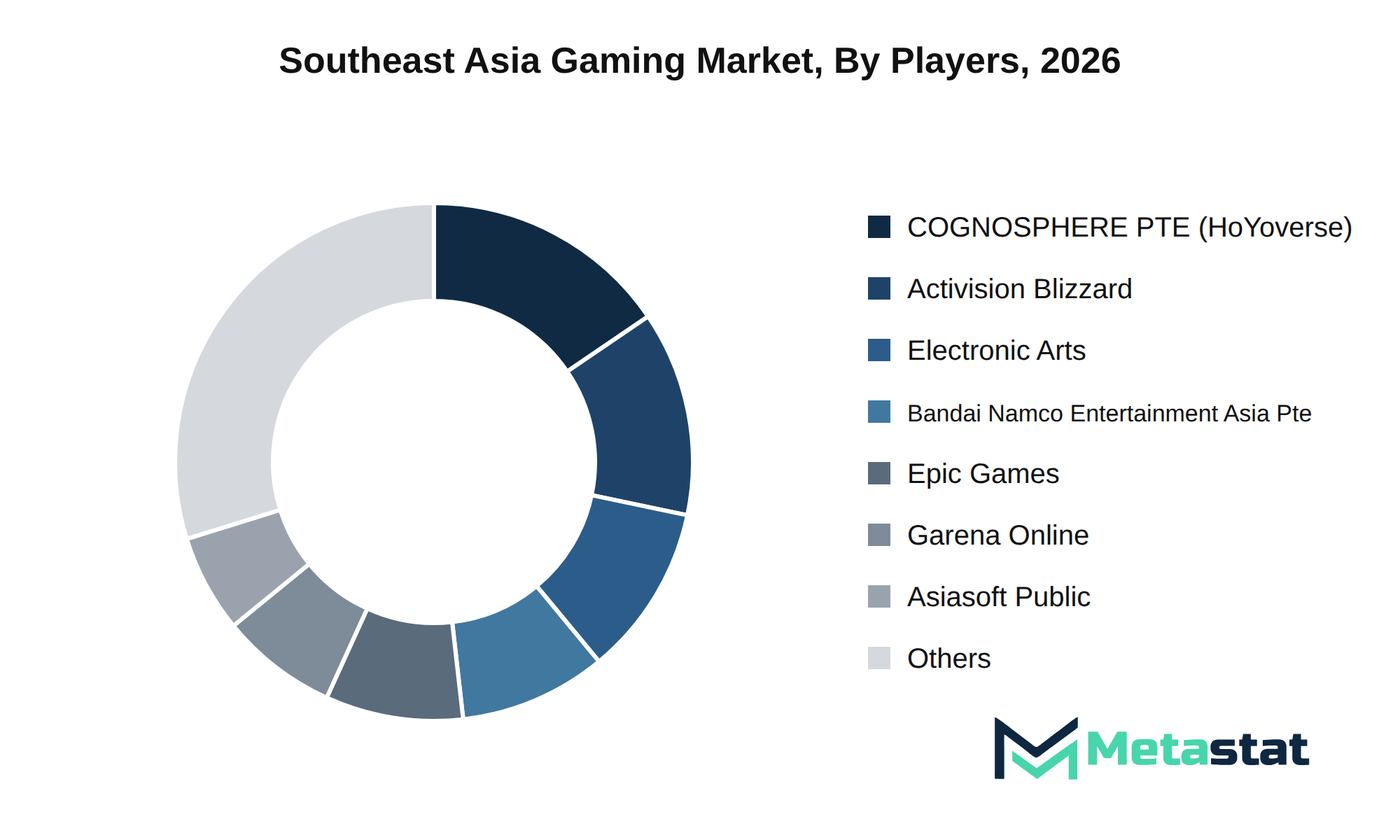
Market size is projected to rise from USD 5,543.4 million in 2025 to over USD 7,530.8 million by 2033. The base case reflects growth at a 3.9% CAGR, driven by various macroeconomic factors. A bull case scenario indicates accelerated growth fueled by innovation and increased consumer spending, while a bear case scenario suggests stagnation resulting from economic downturns and regulatory challenges.
Shifts in downstream demand will influence the Southeast Asia Gaming market significantly. Increased adoption of next-generation technologies, including cloud gaming and augmented reality, enhances user experiences. The integration of these technologies into existing platforms leads to faster product life cycles and heightened R&D commercialization timelines.
Regulatory evolution timelines, including compliance milestones and policy enforcement horizons, will impact market dynamics. Countries with progressive regulatory frameworks attract investments and drive innovation, while regions with stringent regulations experience slower growth.
Geopolitical realignments and evolving trade corridors will shape the competitive landscape. Supply chain shifts towards local sourcing promote resilience and reduce dependency on international suppliers. This trend creates emerging white-space opportunities in the Southeast Asia Gaming market.
Strategic capital allocation directives play a crucial role in determining the market's future. Investments in infrastructure and capital expenditures support the development of gaming ecosystems. Identifying unmet enterprise needs and high-growth pockets guides executives in making informed decisions to enhance their market positions.
The report strategically identifies and profiles the key market players and analyses their core competencies in each sub-segment of the Gaming market.
Report Attributes | Details |
Study Period | 2021-2033 |
Base Year | 2025 |
Estimated Year | 2026 |
Forecast Period | 2026-2033 |
Historical Period | 2021-2025 |
Growth Rate | CAGR 3.9% from 2026 to 2033 |
Revenue Unit | USD million |
Segmentation | By Platform, Genre, Monetization Model, Region, and Region |
Find answers to common questions about this report
The Southeast Asia Gaming market size was valued at USD 5,543.4 million in 2025, according to the Metastat Insights study.
The Southeast Asia Gaming market is projected to grow at a CAGR of 3.9% during the forecast period from 2026 to 2033.
Mobile Games lead the Southeast Asia Gaming market, with a projected value of USD 5,535.1 million by 2033, representing a significant share of 70.4% in the regional distribution.
Key drivers for the Southeast Asia Gaming market include GDP growth, increased venture funding, and heavy investments in technological infrastructure. Rising disposable incomes and a shift towards mobile gaming enhance demand, attracting a diverse audience and encouraging innovation within the industry.
The Southeast Asia Gaming market faces significant constraints due to regulatory compliance hurdles, complex legal frameworks, and macroeconomic headwinds. Inflationary pressures and high capital investment requirements increase operational costs, while cultural barriers and technological obsolescence further complicate market expansion. These factors collectively restrain growth potential, requiring strategic approaches to navigate compliance and competitive pressures.
Significant factors favoring product adoption in the Southeast Asia Gaming market include increased disposable incomes and enhanced economic stability, which drive consumer demand for gaming products. The rise of mobile gaming, supported by improved internet connectivity and smartphone proliferation, attracts a diverse audience, further promoting adoption across various demographics.
The Gaming market is estimated to reach a valuation of USD 7,530.8 million by 2033.
Key players in the Southeast Asia Gaming Market include Activision Blizzard, Inc, Bandai Namco Entertainment Asia Pte Ltd, Electronic Arts Inc, Epic Games, Inc, Garena Online Private Limited, NetEase, Inc, Riot Games, Inc, and Tencent Holdings Limited.
Indonesia leads the Southeast Asia Gaming market, accounting for a significant share due to its rapid smartphone adoption and growing gaming infrastructure.
Mobile gaming in Southeast Asia is projected to grow at a CAGR of 4.4% through 2033, highlighting the increasing preference for mobile platforms among gamers.
The analysts below cover Information & Technology research at Metastat Insights.
LEAD ANALYST
Utkarsh Khirodkar is a Lead Market Research Analyst at MetaStat Insight, specializing in market intelligence, technology sector assessments, and competitive strategy.

PRINCIPAL CONSULTANT - ENTERPRISE AI & EMERGING TECHNOLOGIES
Banking & Finance · Electronics and Semiconductor · Energy and Power · Healthcare IT · Information & Technology · Professional Services
Vijay Gunti is a Principal Consultant at MetaStat Insight, bringing over two decades of experience across enterprise digital transformation, technology strategy, and intelligent systems.

LEAD CONSULTANT - COMMUNICATION, TELECOM, AND IT
Electronics and Semiconductor · Information & Technology · Machinery & Equipment · Professional Services
Ravindra Sathe Consultants for Communication, Telecom, and IT at MetaStat Insight. He leads the firm's industry research initiatives across telecommunications infrastructure, digital connectivity, enterprise networking, and emerging information technology domains.
Evaluating secondary resin quality across post-consumer packaging streams requires reliable technical segmentation. MetaStat Insight delivered an objective assessment that distinguished between extrusion-grade flake pricing and optical sorting throughput limitations across Western Europe. The competitive positioning breakdown for licensed depolymerization technology providers answered several questions during our feedstock feasibility audit. Their team clarified regional trade restrictions on mixed plastic scrap quickly when our team submitted follow-up requests.
Evaluating sovereign cloud deployments for core banking platforms demands a clear view of data residency regulations and migration exit strategies. MetaStat Insight delivered an exhaustive review of regional latency tolerances, mainframe decommission milestones, and third-party vendor concentration risk. The regulatory compliance mapping across European and Asian financial jurisdictions gave our team a dependable baseline for multi-cloud infrastructure discussions.
Replacing petrochemical surfactants with bio-based alternatives requires realistic timelines on industrial precision fermentation scaling. The market research broke down commercialization timelines, feedstock sugar price sensitivities, and regional cosmetic ingredient regulatory approvals in Europe and East Asia. That supplier readiness mapping gave our formulations team reliable context when comparing renewable chemical sourcing roadmaps.
Explore related market intelligence reports worth reading alongside this one.
Starting from
$2950