
LEAD ANALYST
Utkarsh Khirodkar is a Lead Market Research Analyst at MetaStat Insight, specializing in market intelligence, technology sector assessments, and competitive strategy.

North America Steel Fabrication Market Size and Share, By Service Type (Cutting, Welding, Machining, Bending, and Others), By Material Type (Carbon Steel, Alloy Steel, Stainless Steel, and Others), By End-User Industry (Construction, Automotive, Aerospace, Energy, Manufacturing, and Others), Industry Analysis, Growth, Trends, and Forecast, 2026-2033
Report ID
MSI-4565
Published
February, 2026
Pages
311 Pages
Format
Report Details
Choose Your License
North America Steel Fabrication Market
The North America Steel Fabrication market size was valued at USD 20.3 billion in 2025. The market is projected to grow from USD 21.6 billion in 2026 to USD 33.2 billion by 2033, exhibiting a CAGR of 6.3% during the forecast period.
The North America Steel Fabrication market was valued at USD 20.3 billion in 2025 and is projected to reach USD 33.2 billion by 2033, registering a CAGR of 6.3% during the forecast period.
United States accounted for 85.1% share of the North America market in 2025 and remained the leading country market through 2033.
Cutting accounted for a 28.7% market share in 2025.
Key trends driving growth: Large-scale infrastructure renewal across transportation, energy, and public utilities increases demand for fabricated steel components.
Key opportunities include the growing adoption of prefabricated and modular construction methods that elevates demand for precision steel fabrication.
Key insight: North America steel fabrication growth advances through infrastructure modernization and industrial expansion while efficiency-driven fabrication models unlock future value amid cost and labor challenges.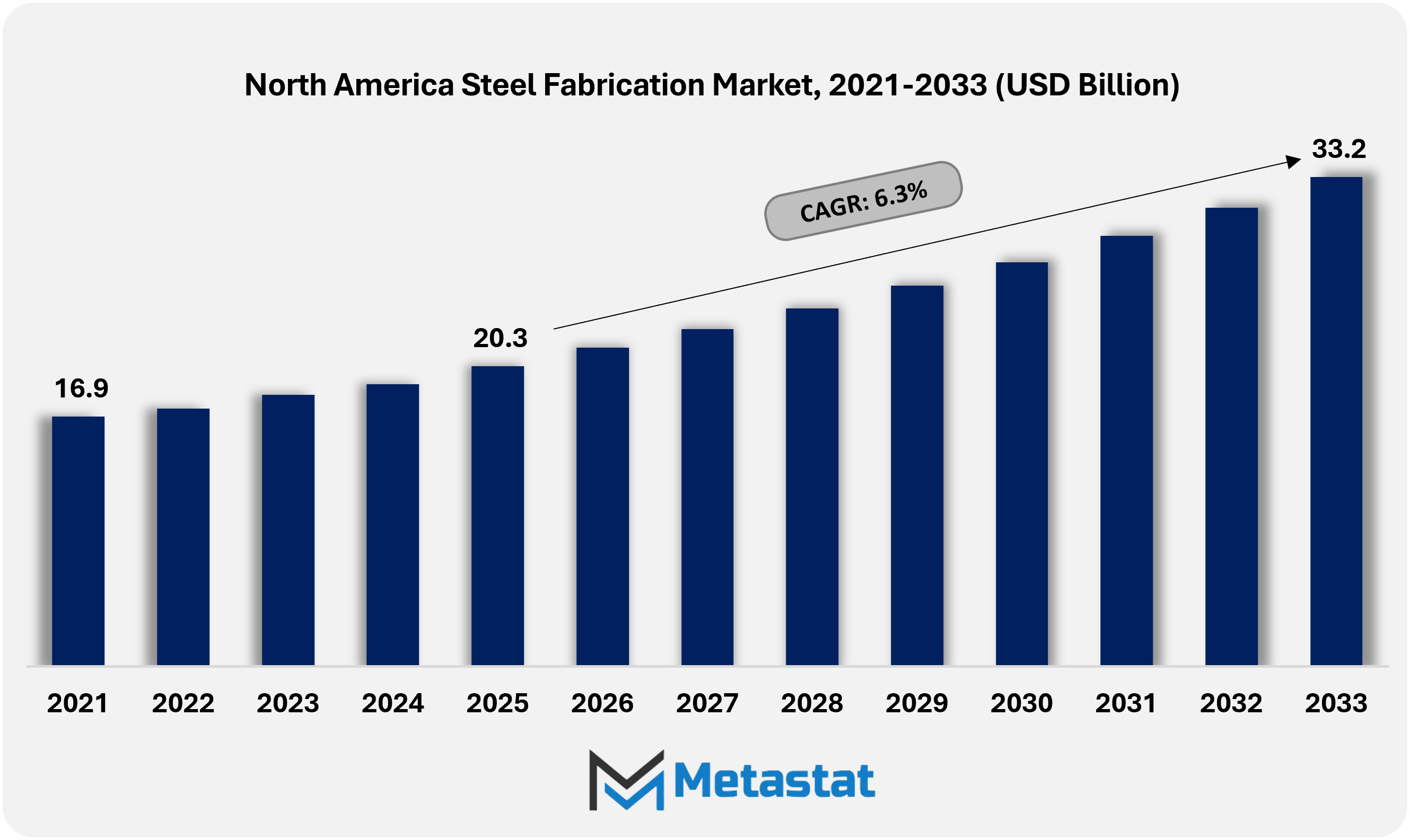
The North America steel fabrication market within the industrial manufacturing industry will move beyond traditional supply narratives and enter a phase shaped by structural recalibration rather than volume expansion. Construction companies across the region will increasingly align operations with complex project execution encompassing transportation corridors, energy transition facilities, advanced manufacturing plants and defense-related infrastructure. Contract portfolios shift toward longer-cycle projects, demanding precision engineering, digital coordination and higher accountability throughout the construction phases.
The operational focus will be shifted towards a modular fabrication model where pre-engineered steel assemblies will be produced offsite and integrated at project locations with minimal disruption. Such methods would be suitable for dense urban redevelopment areas and remote industrial establishments, providing predictability in scheduling and quality control. Fabricators will adopt advanced simulation tools, digital twins and automated cutting systems to meet the demands of modern structural designs. Workforce strategies will also evolve with companies investing in multi-skilled technicians capable of operating hybrid manual-digital fabrication environments.
Large-scale infrastructure renewal across transportation corridors, power grids, and public utility networks will propel long-term requirements within the North America steel fabrication market. Government-backed spending programs will prioritize bridges, transit systems, and transmission assets, supporting repeat orders for fabricated steel products designed for durability, code compliance, and extended service life.
Expansion of industrial real estate, hyperscale data centers, logistics hubs, and advanced manufacturing facilities will support steady consumption patterns in the North America steel fabrication market. Future-focused development strategies will favor structural steel owing to strength, scalability, and fast installation cycles, supporting sustained construction activity across urban and industrial zones.
Volatile steel pricing trends and volatile raw material supply margins will continue to create financial uncertainty for fabricators operating in the North America steel fabrication market. Forward-looking procurement planning will remain complex, as fluctuations in input costs will put pressure on contract pricing, profitability forecasts and long-term investment decisions in manufacturing operations.
Shortage of skilled labor coupled with rising wage pressure will limit operational efficiency in the North America steel fabrication market. Manufacturing facilities will face challenges maintaining optimal capacity utilization, while limited availability of certified welders, machinists and structural manufacturing specialists will result in extended project timelines.
The adoption of prefabricated and modular construction technologies will increase the demand for precision-engineered steel solutions in the North American steel fabrication market. Future building models will emphasize off-site construction, dimensional accuracy and short construction cycles, establishing advanced manufacturing capabilities as a key competitive advantage.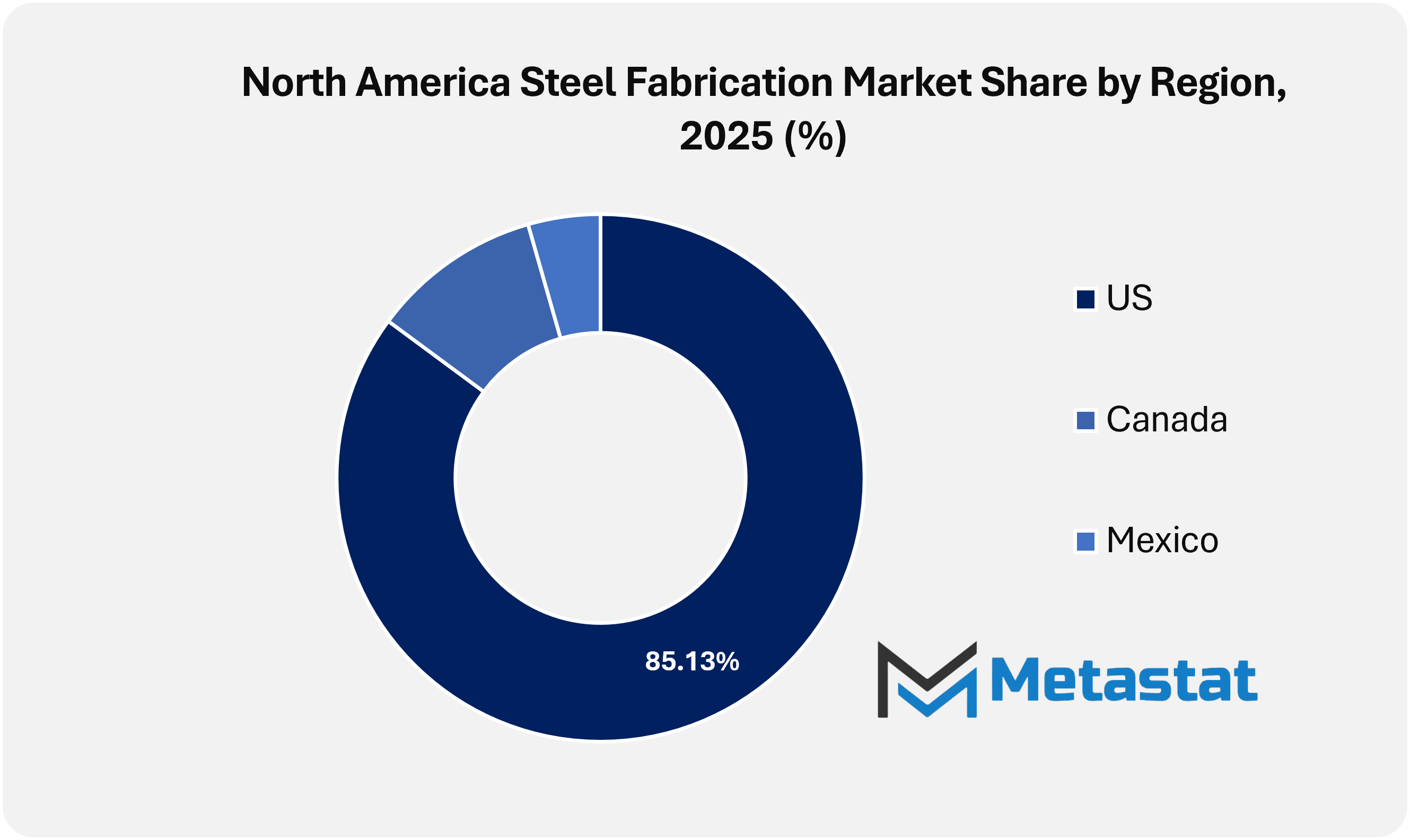
The North America Steel Fabrication market is segmented by Service Type, Material Type, and End-User Industry.
Cutting segment is valued at USD 6.2 billion in 2026 and is projected to reach USD 9.8 billion by 2033, at a CAGR of 6.8% during the forecast period.
Cutting services will advance through automation, laser-based systems and data-controlled processes that will support higher accuracy and lower material loss. Demand will increase from infrastructure and transportation projects requiring similar outputs. In future operations, priority will be given to speed, stability and integration with digital production lines to meet evolving industrial specifications.
Welding segment is valued at USD 6.5 billion in 2026 and is projected to reach USD 10.3 billion by 2033, at a CAGR of 6.3% during the forecast period.
Welding services will experience transformation through robotic systems and advanced joining technologies that support strength and durability. Adoption will increase in areas requiring structural integrity under high stress. Future-focused facilities will emphasize precise controls, reduced defects, and compliance with safety regulations that support long-term performance requirements.
Machining segment is valued at USD 4.1 billion in 2026 and is projected to reach USD 6.6 billion by 2033, at a CAGR of 7.0% during the forecast period.
Machining services will gain relevance through computer-guided tools supporting complex geometries and tight tolerances. Industrial customers will be looking for components optimized for advanced manufacturing needs. Future demand will focus on efficiency, repeatability and scalability, enabling manufacturing units to support evolving design standards and production volumes.
Bending segment is valued at USD 2.5 billion in 2026 and is projected to reach USD 3.4 billion by 2033, at a CAGR of 4.9% during the forecast period.
Bending services will expand with higher capacity equipment supporting flexible design requirements. Infrastructure and industrial projects will increase the demand for precision formed components. Future operations will prioritize programmable systems that enable faster turnaround, less waste, and consistent output supporting larger construction and manufacturing infrastructure.
Others segment is valued at USD 2.3 billion in 2026 and is projected to reach USD 3.2 billion by 2033, at a CAGR of 5.1% during the forecast period.
Other services will include surface treatment, assembly and finishing activities supporting value-added manufacturing. Demand will increase from customers seeking integrated solutions. Future growth will depend on service bundling, quality assurance and customization while supporting streamlined procurement and better project coordination.
Carbon Steel segment is projected to reach USD 14.6 billion by 2033, at a CAGR of 6.1% during the forecast period.
The use of carbon steel will remain strong due to cost efficiency and structural reliability. Construction and industrial applications will sustain demand. Future adoption will focus on improved coatings and processing technologies that support durability, corrosion resistance and extended lifecycle performance in large-scale projects.
Alloy Steel segment is projected to reach USD 8.8 billion by 2033, at a CAGR of 7.0% during the forecast period.
Demand for alloy steel will increase through applications requiring increased strength and thermal resistance. Automotive and industrial equipment manufacturing will drive growth. Future material developments will support lighter structures, improved performance and compatibility with advanced manufacturing technologies meeting strict engineering standards.
Stainless Steel segment is projected to reach USD 7.0 billion by 2033, at a CAGR of 6.7% during the forecast period.
Adoption of stainless steel will expand due to corrosion resistance and hygiene benefits. Energy and aerospace applications will support usage growth. Future demand will be consistent with sustainability goals, recycling standards and performance reliability supporting long-term operational efficiency in critical industries.
Others segment is projected to reach USD 2.7 billion by 2033, at a CAGR of 4.4% during the forecast period.
Other material categories will include specialty metals supporting specific applications. Demand will emerge from innovation-driven sectors requiring tailored assets. Future material adoption will focus on adaptability, performance optimization and alignment with emerging regulatory and environmental expectations.
Construction segment is projected to reach USD 12.7 billion by 2033 with a share of 37.6% in 2025.
Construction will remain a primary demand driver through infrastructure upgrades and urban growth. Steel fabrication will support the structural framework and modular design. Future activity will focus on speed, accuracy and sustainability supporting large public and private development initiatives.
Automotive segment is projected to reach USD 7.4 billion by 2033 with a share of 22.2% in 2025.
Automotive demand will increase through lightweight design trends and electric vehicle production. Fabricated steel components will support safety and efficiency standards. Manufacturing of the future will focus on precision parts, scalable output, and integration with automated assembly environments.
Aerospace segment is projected to reach USD 5.3 billion by 2033 with a share of 15.5% in 2025.
Aerospace demand will depend on high-performance manufactured components supporting safety-critical applications. Precision and quality of materials will remain central. Future growth will be in line with advanced design requirements, strict compliance norms and increased production efficiency across supply chains.
Energy segment is projected to reach USD 3.9 billion by 2033 with a share of 11.8% in 2025.
Demand for the energy sector will increase through renewable projects and grid expansion. Steel construction will support the structural and equipment requirements. Future focus will be on sustainability, environmental resistance and reliability supporting long-term energy infrastructure development.
Manufacturing segment is projected to reach USD 2.8 billion by 2033 with a share of 8.5% in 2025.
Industrial automation and capacity expansion will strengthen manufacturing demand. Fabricated steel components will enable machinery and facility upgrades. Future requirements will emphasize customization, efficiency, and compatibility with smart manufacturing systems.
Others segment is projected to reach USD 1.1 billion by 2033 with a share of 4.5% in 2025.
Other end-user industries will contribute through specialized tools and emerging applications. Technological diversification will increase demand. Future partnerships will depend on flexible manufacturing capabilities supporting emerging industrial use cases and performance expectations.
The North America steel fabrication market continues to hold a strong position across production, infrastructure upgrades, energy projects, and manufacturing activity. Steel fabrication supports buildings, bridges, industrial facilities, and transportation networks, reinforcing regional economic development. Increasing investments in business areas and public infrastructure will pressure fabricators to scale operations, adopt modern-day production technology and attention on quicker shipping timelines. The increasing emphasis on sustainability, safety standards and efficient fabric utilization in industries will even benefit the marketplace growth.
Industry players across North America will focus on improving manufacturing accuracy and reducing waste through automation and digital planning tools. Companies including O’Neal Manufacturing Services, Mayville Engineering Company, Inc., Kapco Metal Stamping, and Standard Iron & Wire Works, LLC will support their positions by supplying customized fabrication solutions tailored to project needs. EVS Metals, Inc., Global Fabrication II, LLC, and FabTech US will maintain to amplify talents in cutting, welding and forming to serve numerous give up users. Operational efficiency and consistent quality will stay the key elements shaping competitive advantage.
Large-scale suppliers and service providers will play a vital role in supporting complex manufacturing requirements. Kloeckner Metals Corporation, Reliance, Inc., Schuff Steel Company and American Structural Corporate will leverage extensive distribution networks and integrated service models to meet growing demand. SteelFab, Inc. and High Steel Structures LLC will be active in structural steel projects involving commercial buildings and large infrastructure works. These companies will benefit from long-term contracts and repeat business driven by reliable performance and technical reliability.
Specialized fabricators will also contribute to speed to market through specialized expertise and flexible production capabilities. Swanton Welding & Machining and Steel, LLC will support areas requiring precision manufacturing and heavy-duty components. Across the market, collaboration with construction firms, engineers and project developers will shape the future growth path. North America steel fabrication will move forward with a strong focus on innovation, workforce skills development and reliable supply chains, supporting sustained demand across multiple industries.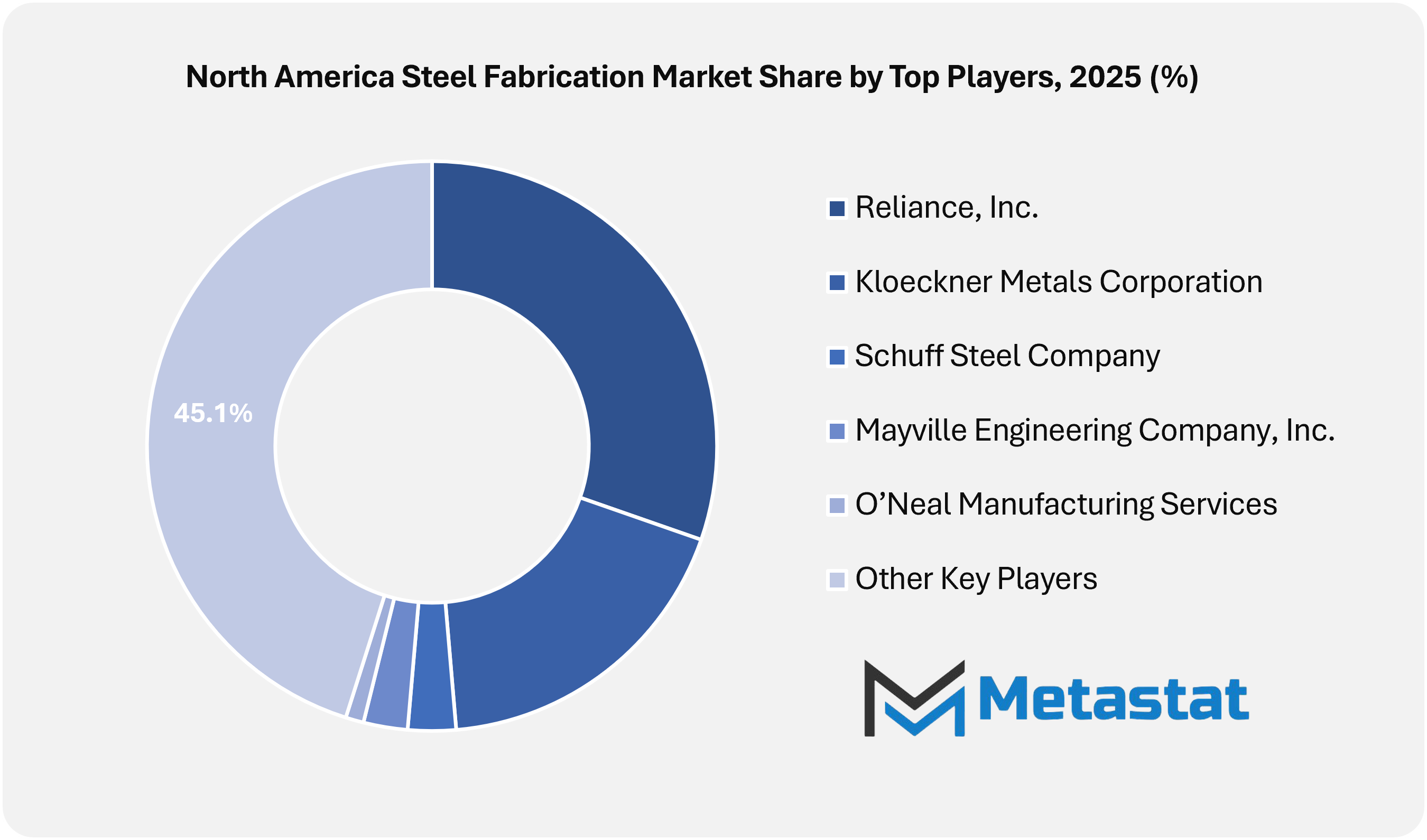
Market size is forecast to rise from USD 20.3 billion in 2025 to over USD 33.2 billion by 2033.
The North America steel fabrication market will largely reflect consolidation among medium-sized players seeking efficiency and technological expansion. Strategic partnerships with engineering firms, logistics providers and construction technology platforms will reshape the competitive landscape. Market participation will reward firms able to translate design intent into executable steel solutions rather than competing on output alone. In the coming years, success in the North America steel fabrication market will depend on execution intelligence, project adaptability and structural expertise rather than detail metrics.
This research report categorizes the North America Steel Fabrication market based on key segments and regions, forecasts revenue growth, and analyses trends in each submarket. The report analyses the key growth drivers, opportunities, and challenges influencing the Steel Fabrication market. Recent market developments and competitive strategies such as expansion, type launch, development, partnership, merger, and acquisition have been included to draw the competitive landscape in the market.
The report strategically identifies and profiles the key market players and analyses their core competencies in each sub-segment of the Steel Fabrication market.
|
Report Attributes |
Details |
|
Study Period |
2021-2033 |
|
Base Year |
2025 |
|
Estimated Year |
2026 |
|
Forecast Period |
2026-2033 |
|
Historical Period |
2021-2025 |
|
Growth Rate |
CAGR 6.3% from 2026 to 2033 |
|
Revenue Unit |
USD billion |
|
Segmentation |
By Service Type, Material Type, End-User Industry, and Region |
|
By Service Type |
|
|
By Material Type |
|
|
By End-User Industry |
|
|
By Region |
North America (By Service Type, Material Type, End-User Industry, and Country)
|
Find answers to common questions about this report
The Metastat Insights study shows that the North America Steel Fabrication market size was USD 20.3 billion in 2025.
The North America Steel Fabrication market is likely to grow at a CAGR of 6.3% over the forecast period (2026-2033).
The Metastat Insight analysis shows that the North America Steel Fabrication market size is estimated to be USD 33.2 billion by 2033.
The Welding is the leading type of segment in the North America market.
Large-scale infrastructure renewal across transportation, energy, and public utilities increases requirements for fabricated steel components, supporting market expansion.
Volatile steel prices and fluctuating raw material supply margins create cost uncertainty for fabricators to hamper market growth within the forecast period.
North America Steel Fabrication market is estimated to reach USD 33.2 billion by 2033.
Top players operating in the Steel Fabrication industry includes O’Neal Manufacturing Services, Mayville Engineering Company, Inc., Kapco Metal Stamping, Standard Iron & Wire Works,LLC, and EVS Metal,Inc
The analysts below cover Machinery & Equipment research at Metastat Insights.
LEAD ANALYST
Utkarsh Khirodkar is a Lead Market Research Analyst at MetaStat Insight, specializing in market intelligence, technology sector assessments, and competitive strategy.

INDUSTRY CONSULTANT - CHEMICALS & ADVANCED MATERIALS
Chemicals and Materials · Machinery & Equipment · Packaging
Amit Gadhekar Consultant for Chemicals and Materials at MetaStat Insight, directing sector-specific intelligence, research, and strategic consulting across global chemical and processing markets.

PRINCIPAL CONSULTANT - QUALITY SYSTEMS & COMPLIANCE
Electronics and Semiconductor · Machinery & Equipment · Professional Services
Omkar Phadtare is an Industry Consultant at MetaStat Insight, specializing in quality systems, regulatory compliance, and standards benchmarking to drive data-driven market intelligence and strategic industry research.

ENERGY & INFRASTRUCTURE INDUSTRY CONSULTANT
Automotive and Transportation · Electronics and Semiconductor · Energy and Power · Machinery & Equipment
Saurabh Vasant Ganvir consults for Energy & Infrastructure Industry at MetaStat Insight, specializing in renewable energy, solar EPC, and electric vehicle (EV) infrastructure markets.

LEAD CONSULTANT - COMMUNICATION, TELECOM, AND IT
Electronics and Semiconductor · Information & Technology · Machinery & Equipment · Professional Services
Ravindra Sathe Consultants for Communication, Telecom, and IT at MetaStat Insight. He leads the firm's industry research initiatives across telecommunications infrastructure, digital connectivity, enterprise networking, and emerging information technology domains.
Integrating zero-trust access controls across legacy electronic health record systems involves complex compliance overhead. Team produced an analysis that clearly separated identity governance and administration tools from privileged access management platforms. Their evaluation of HIPAA and GDPR compliance features across cloud native solutions gave our architecture group clear baseline criteria. The custom data request regarding biometric authentication adoption in hospital networks was returned promptly with clear documentation.
Evaluating calorific value requirements and air permit compliance across municipal waste facilities requires localized data. Metastat Insight structured their analysis around operational throughput capacity and feedstock composition variations in Latin America and Eastern Europe. Their competitive mapping of sorting equipment vendors helped clarify technology differences between optical separators and heavy media systems. The study provided an objective baseline during our capital expenditure reviews.
Decarbonizing industrial thermal processes hinges on refrigerant regulations and compressor efficiency limits. Metastat Insights delivered a thorough market analysis that evaluated natural refrigerants like CO2 and hydrocarbons against synthetic low-GWP alternatives. The breakdown of utility incentives and grid capacity constraints across key European manufacturing hubs offered valuable perspective. The follow-up conversation with their sector analysts addressed our specific questions on mechanical vapor recompression systems efficiently.
Explore related market intelligence reports worth reading alongside this one.
Starting from
$2950