
LEAD ANALYST
Utkarsh Khirodkar is a Lead Market Research Analyst at MetaStat Insight, specializing in market intelligence, technology sector assessments, and competitive strategy.

Global Oil and Gas Engines Market Size, Share, By Engine Type (Gas Engines, Diesel Engines, and Dual-Fuel Engines), By Fuel Type (Diesel, Natural Gas, Propane, and Others), By Power Output (Low Power (<500 HP), Medium Power (500-2000 HP), and High Power (>2000 HP), By End-User (Oil Exploration Companies, Oilfield Services, Gas Processing Plants, and Others), Industry Analysis, Growth, Trends, and Forecast, 2026-2033
Report ID
MSI-4596
Published
April, 2026
Pages
320 Pages
Format
Report Details
Choose Your License
Oil and Gas Engines Market
Global Oil and Gas Engines market size is valued at USD 158.7 million in 2025 and projected to grow at a CAGR of 7.2% during the forecast period, reaching USD 276.6 million by 2033.
North America holds 29.9% in 2025 with US leading the market share.
Gas Engines segment accounts for a market share of 38.5% in 2025.
Key trends driving growth: Expansion of Natural Gas Compression and Pipeline Infrastructure, along with Rising Power Demand Across Drilling, Production, and Remote Oilfield Operations.
Opportunities include Adoption of Dual-Fuel, Low-Emission, and Digitalized Engine Systems Across Oil and Gas Operations.
Key insight: Rising industrial energy demand and modernization of upstream operations continue to strengthen adoption of high-efficiency engines across global oil and gas production sites.
The Global Oil and Gas Engines market represents a critical part of energy infrastructure supporting drilling, exploration, production, and midstream transportation activities. These engines provide reliable mechanical power for pumps, compressors, generators, and drilling rigs operating across remote oilfields and offshore production facilities. Rising need for dependable power solutions across upstream and midstream operations continues to support growth in the Global Oil and Gas Engines market.
Growth in the Oil and Gas Engines market remains closely linked to rising oil and gas production activities, pipeline development projects, and increasing power requirements across industrial economies. Operators rely on high-performance engines capable of operating under demanding conditions, including high temperatures, remote locations, and continuous heavy-duty workloads. Such operating requirements are supporting adoption of advanced gas engines and dual-fuel systems that improve efficiency and reduce fuel consumption.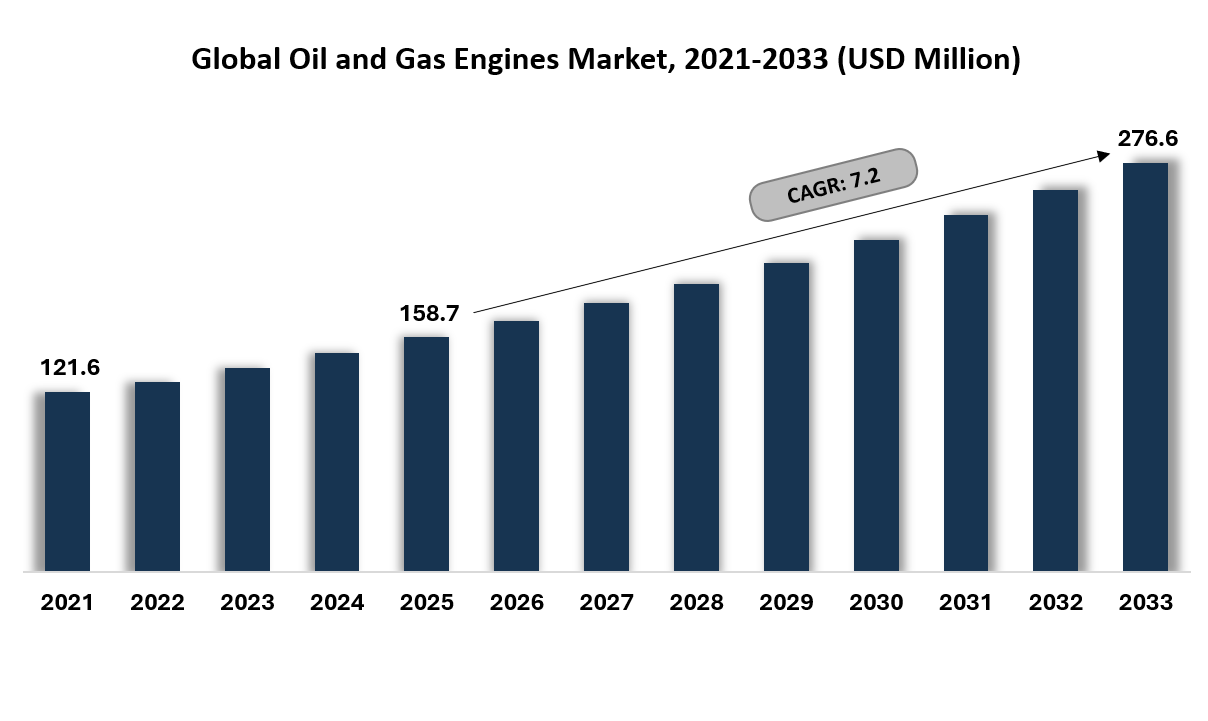
Expansion of Natural Gas Compression and Pipeline Infrastructure.
Expansion of natural gas transportation networks across major producing regions continues to strengthen the Global Oil and Gas Engines market. Compression stations depend on high-performance engines to maintain pressure across pipelines and ensure efficient transmission of natural gas over long distances. Ongoing pipeline construction and network modernization are creating sustained demand for reliable gas engine solutions.
Rising Power Demand Across Drilling, Production, and Remote Oilfield Operations
Oil and gas extraction sites often operate in remote locations with limited access to grid-connected power. The Global Oil and Gas Engines market benefits from rising need for dependable engine systems capable of supporting drilling rigs, pumping units, and processing equipment. These engines provide the mechanical and electrical power required for uninterrupted field operations.
Stringent Emission Compliance and Decarbonization Pressure on Combustion-Based Assets
Environmental regulations are becoming stricter across the energy and industrial sectors, creating compliance pressure for combustion-based equipment. The Global Oil and Gas Engines market is facing growing need to reduce carbon emissions and improve combustion efficiency. Meeting these requirements often involves additional investment in emission-control systems, engine redesign, and monitoring technologies.
High Maintenance, Fuel Efficiency, and Lifecycle Cost Challenges in Aging Engine Fleets
Many oilfield operations continue to rely on aging engine fleets that require frequent maintenance to sustain performance. The Global Oil and Gas Engines market faces challenges related to higher fuel consumption, increased servicing needs, and rising lifecycle costs associated with older equipment. Operators often face difficult replacement decisions when balancing capital spending against long-term operating efficiency.
Adoption of Dual-Fuel, Low-Emission, and Digitalized Engine Systems Across Oil and Gas Operations
Advancements in engine design are creating strong opportunities across the Global Oil and Gas Engines market. Dual-fuel engines capable of operating on diesel and natural gas offer improved efficiency, lower emissions, and greater operational flexibility. Increasing adoption of digital monitoring and low-emission engine platforms is helping operators improve field performance while supporting environmental compliance goals.
The Global Oil and Gas Engines market is classified based on Engine Type, Fuel Type, Power Output, and End-User.
Gas Engines segment is valued at USD 65.5 million in 2026 and is projected to reach USD 109.3 million by 2033, at a CAGR of 7.6% during the forecast period.
Rising power demand across production fields will support wider use of gas-based engine systems. Gas engines enable efficient fuel utilization across drilling, compression, and pipeline operations while aligning with growing natural gas availability in key hydrocarbon-producing regions. Adoption of gas engines is supported by cleaner combustion profiles, stable output, and compatibility with existing gas infrastructure.
Diesel Engines segment is valued at USD 71.9 million in 2026 and is projected to reach USD 104.2 million by 2033, at a CAGR of 5.4% during the forecast period.
Diesel engines will retain strong relevance across heavy-duty drilling, transport, and pumping operations. Field operators require durable engine systems capable of delivering dependable performance under harsh environmental conditions and long operating cycles. Diesel engines remain important for remote operations where fuel flexibility, reliability, and established service networks support continued deployment.
Dual-Fuel Engines segment is valued at USD 32.5 million in 2026 and is projected to reach USD 63.2 million by 2033, at a CAGR of 9.9% during the forecast period.
Dual-fuel engines allow operators to switch between diesel and gaseous fuels based on site conditions and fuel availability. These systems support fuel cost optimization, improved combustion control, and greater operational continuity across diverse field environments. Demand for dual-fuel engines is increasing as operators prioritize efficiency, flexibility, and lower-emission operation.
Diesel segment is projected to reach USD 101.1 million by 2033, at a CAGR of 5.2% during the forecast period.
Diesel remains a dependable fuel source for engines operating across drilling rigs, pumping systems, and field transport fleets. High energy density supports long operating hours and reliable performance in demanding applications. Diesel use remains significant across remote sites where alternative fuel infrastructure is limited.
Natural Gas segment is projected to reach USD 117.7 million by 2033, at a CAGR of 8.3% during the forecast period.
Expansion of gas extraction projects and pipeline infrastructure is supporting wider use of natural gas as a primary engine fuel. Cleaner combustion characteristics make natural gas suitable for operators seeking lower emission profiles across production and compression activities. Natural gas-fueled engine systems are gaining traction across regions with expanding gas supply networks.
Propane segment is projected to reach USD 19.7 million by 2033, at a CAGR of 5.6% during the forecast period.
Propane-based fuel solutions are attracting attention in specialized field applications requiring stable combustion and portable fuel supply. Ease of storage and transport supports use across remote production zones and mobile power applications. Propane adoption will grow gradually across smaller operations and distributed energy environments.
Others segment is projected to reach USD 38.2 million by 2033, at a CAGR of 10.8% during the forecast period.
Alternative fuels such as bio-based fuels and synthetic blends are emerging in pilot and limited deployment stages across energy extraction sites. Ongoing engine testing and fuel trials are supporting long-term emission reduction strategies and greater fuel diversification. Alternative fuel options will support future sustainability initiatives across hydrocarbon production infrastructure.
Low Power (<500 HP) segment is projected to reach USD 66.5 million by 2033.
Low-power engines support light operational equipment used in maintenance activity, monitoring stations, and auxiliary systems near production zones. Compact design enables easier deployment across dispersed field locations and smaller installations. Low-power engines remain valuable for secondary operations requiring reliable and consistent power generation.
Medium Power (500-2000 HP) segment is projected to reach USD 126.2 million by 2033.
Medium-power engines play a central role in compressors, pumping systems, and mid-scale drilling activity across oil and gas infrastructure. Balanced output and operational efficiency make these engines suitable for standard field applications without excessive fuel use. Medium-power engines will account for a significant share of installations across mature and developing oilfields.
High Power (>2000 HP) segment is projected to reach USD 83.9 million by 2033.
High-power engines are essential for large-scale extraction activity requiring substantial mechanical output. These engines support major compressors, offshore drilling equipment, and heavy transport systems across complex field environments. Investment in deepwater and large-capacity exploration projects will support demand for engines above 2000 HP.
Oil Exploration Companies segment is projected to grow at a CAGR of 5.8% during the forecast period.
Oil exploration companies continue to invest in reliable power systems for drilling rigs, seismic survey operations, and heavy extraction equipment. Engine performance has a direct effect on field productivity, equipment uptime, and project continuity. Exploration companies remain major adopters of large-scale engine systems supporting upstream expansion.
Oilfield Services segment is projected to grow at a CAGR of 7.6% during the forecast period.
Oilfield service providers require mobile and engine-powered equipment across drilling, maintenance, stimulation, and field logistics operations. Reliability and operating efficiency are essential for supporting project timelines and reducing unplanned downtime. Oilfield service companies will expand engine deployment across pumping fleets, fracturing units, and heavy service vehicles.
Gas Processing Plants segment is projected to grow at a CAGR of 8.8% during the forecast period.
Gas processing plants rely on efficient engine systems for compression, pumping, and plant-level power supply. Stable engine performance supports uninterrupted operations and effective handling of rising natural gas throughput. Gas processing facilities will increase demand for high-efficiency engines as processing capacity expands.
Others segment is projected to grow at a CAGR of 6.2% during the forecast period.
Other end users include pipeline operators, storage terminal operators, and energy logistics companies involved in fuel movement across large networks. Engine-powered systems support compression, pumping, and transportation functions across these infrastructures. End users continue to generate steady demand for durable and application-specific engine technologies.
Based on geography, the Global Oil and Gas Engines market is divided into North America, Europe, Asia-Pacific, South America, Middle East, and Africa.
North America Oil and Gas Engines Market is set to expand at a CAGR of 7.2% within the forecast period, reaching a market size (TAM) of USD 71.1 million by the end of 2033.
Modernization of pipeline compression infrastructure in Canada and the United States helps the deployment of high-efficiency engines inside the North American market.
Increasing oil and gas exploration investments in China and India create new operational possibilities in Asia Pacific market.
Large hydrocarbon reserves and ongoing oilfield improvement initiatives throughout the Middle East, Africa, and South America hold to create lengthy-term demand for reliable engine structures, strengthening the Oil and Gas Engines market across these strength-rich regions.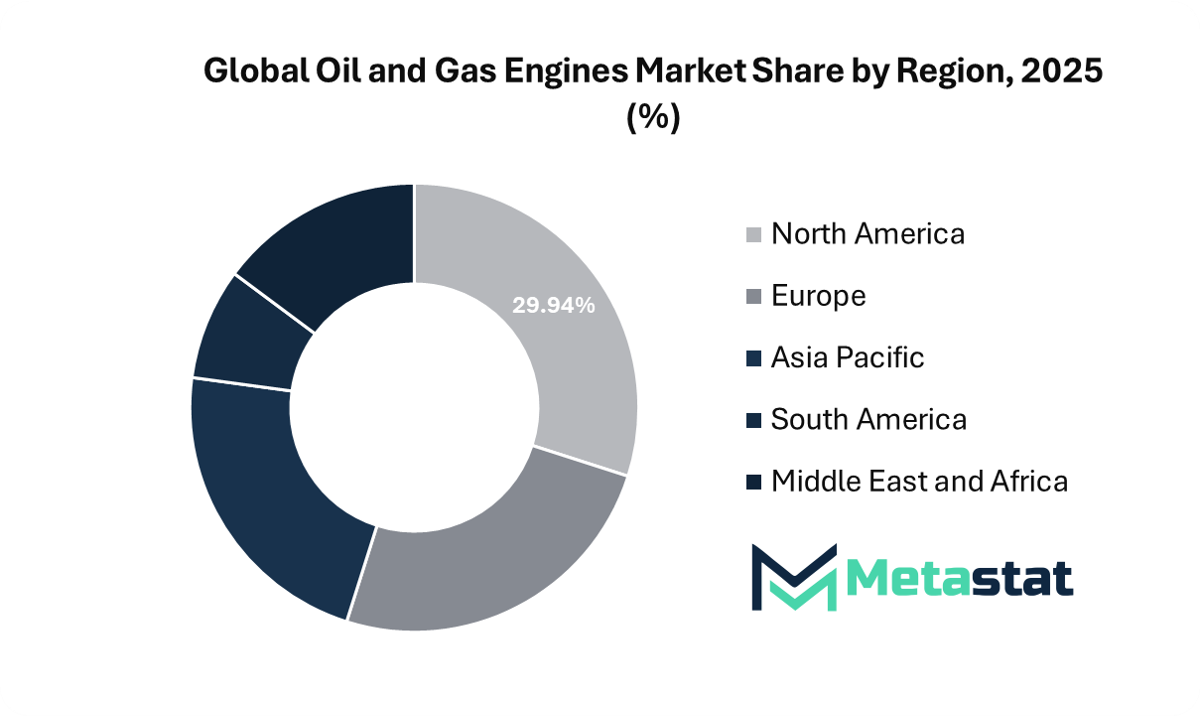
The Global Oil and Gas Engines market will remain closely associated with energy production activities across upstream, midstream, and downstream operations. Engines play a critical role in powering drilling rigs, compressors, pumps, and other heavy equipment used across oil and gas fields. Rising exploration activity, increasing power requirements, and ongoing expansion of pipeline infrastructure continue to support demand for reliable industrial engine systems. Companies operating in oil and gas environments require equipment that performs consistently under harsh operating conditions, which is supporting steady adoption of high-performance engines designed for durability, efficiency, and continuous operation.
Technological advancement is shaping how engines are designed and deployed across oil and gas operations. Manufacturers are focusing on improving fuel efficiency, reducing emissions, and strengthening engine reliability. Many operators are also seeking engines capable of running on different fuel sources, including natural gas, associated gas, and diesel, depending on field conditions. Digital monitoring systems, predictive maintenance tools, and remote performance tracking are helping operators manage equipment more efficiently and reduce unplanned downtime. These developments are supporting safer operations and improved cost control across demanding field environments.
The market also reflects strong participation from established engineering companies with deep experience in industrial power systems. Key Global Oil and Gas Engines industry participants include Caterpillar Inc., Cummins Inc., Rolls-Royce plc, Bergen Engines AS, Origin Engines, Scania CV AB, DEUTZ AG, Société Internationale des Moteurs Baudouin, and Guangxi Yuchai Machinery Co., Ltd. Additional participants such as IHI Power Systems Co., Ltd., Kubota Engine America Corporation, and Soar Power Group also support the industry through specialized engine solutions and power technologies designed for heavy industrial applications.
Competition among these companies is centered on engine performance, reliability, and adaptability across diverse operating conditions. Many manufacturers are investing in research and development to introduce engines that comply with stricter environmental standards while maintaining the high output required across oil and gas operations. Partnerships with energy companies, expansion of service networks, and strong after-sales support will shape market competition. As energy projects expand across multiple regions, demand for dependable engine systems will remain steady, creating continued opportunities for companies serving the global oil and gas engines market.
Market size is forecast to rise from USD 158.7 million in 2025 to over USD 276.6 million by 2033.
The Global Oil and Gas Engines market is expected to maintain steady expansion during the forecast period, supported by rising energy demand and ongoing investment in hydrocarbon infrastructure. Oilfield operations require dependable mechanical power for drilling rigs, compressors, pumping systems, and related equipment, which continues to strengthen demand for high-performance engine platforms. Greater focus on fuel flexibility, lower emissions, and digitalized engine management is expected to shape future market development.
By Engine Type:
By Fuel Type:
By Power Output:
By End-User:
This research report categorizes the Oil and Gas Engines market based on key segments and regions, forecasts revenue growth, and analyses trends in each submarket. The report analyses the key growth drivers, opportunities, and challenges influencing the Oil and Gas Engines market. Recent market developments and competitive strategies such as expansion, product launch, partnership, merger, and acquisition have been included to draw the competitive landscape in the market.
The report strategically identifies and profiles the key market players and analyses their core competencies in each sub-segment of the Oil and Gas Engines market.
|
Report Attributes |
Details |
|
Study Period |
2021-2033 |
|
Base Year |
2025 |
|
Estimated Year |
2026 |
|
Forecast Period |
2026-2033 |
|
Historical Period |
2021-2025 |
|
Growth Rate |
CAGR 7.2% from 2026 to 2033 |
|
Revenue Unit |
USD million |
|
Sales Volume Unit |
Units |
|
Segmentation |
By Engine Type, Fuel Type, Power Output, End-User, and Region |
|
By Region |
North America (By Engine Type, Fuel Type, Power Output, End-User, and Country)
|
|
Europe (By Engine Type, Fuel Type, Power Output, End-User, and Country)
|
|
|
Asia Pacific (By Engine Type, Fuel Type, Power Output, End-User, and Country)
|
|
|
South America (By Engine Type, Fuel Type, Power Output, End-User, and Country)
|
|
|
Middle East and Africa (By Engine Type, Fuel Type, Power Output, End-User, and Country)
|
Find answers to common questions about this report
Top players operating in the Oil and Gas Engines industry include Caterpillar Inc., Cummins Inc., Rolls-Royce plc, Bergen Engines AS, Origin Engines, and Scania CV AB.
The Global Oil and Gas Engines market is expected to grow at a CAGR of 7.2% over the forecast period (2026-2033).
Stringent Emission Compliance and Decarbonization Pressure on Combustion-Based Assets will hamper the market growth within the forecast period.
Global Oil and Gas Engines market is estimated to reach USD 276.6 million by 2033.
Expansion of Natural Gas Compression and Pipeline Infrastructure and Rising Power Demand Across Drilling, Production, and Remote Oilfield Operations are key driving factors, boosting the market.
North America region dominates the market.
The Gas Engines is the leading type segment in the Global market.
The Metastat Insights analysis shows that the North America Oil and Gas Engines market size is estimated to be USD 71.1 million by 2033.
The Metastat Insights study shows that the Global Oil and Gas Engines market size was USD 158.7 million in 2025.
The analysts below cover Energy and Power research at Metastat Insights.
LEAD ANALYST
Utkarsh Khirodkar is a Lead Market Research Analyst at MetaStat Insight, specializing in market intelligence, technology sector assessments, and competitive strategy.

PRINCIPAL CONSULTANT - ENTERPRISE AI & EMERGING TECHNOLOGIES
Banking & Finance · Electronics and Semiconductor · Energy and Power · Healthcare IT · Information & Technology · Professional Services
Vijay Gunti is a Principal Consultant at MetaStat Insight, bringing over two decades of experience across enterprise digital transformation, technology strategy, and intelligent systems.

ENERGY & INFRASTRUCTURE INDUSTRY CONSULTANT
Automotive and Transportation · Electronics and Semiconductor · Energy and Power · Machinery & Equipment
Saurabh Vasant Ganvir consults for Energy & Infrastructure Industry at MetaStat Insight, specializing in renewable energy, solar EPC, and electric vehicle (EV) infrastructure markets.
Assessing commercial microgrid software adoption requires looking past top-level installation numbers and examining utility interconnection queues. The research provided verifiable data on average permitting timelines, tariff structures, and battery storage integration costs across regional utility territories. That grounded perspective was valuable for our team when building five-year demand projections for industrial microgrid controllers.
Ambulatory surgical centers have very different purchasing cycles for robotic-assisted surgery platforms than major hospital networks. The MetaStat Insight study focused squarely on capital expenditure depreciation, procedural reimbursement pathways, and surgeon training overhead. That operational clarity made it much simpler to validate multi-year procedure growth forecasts against actual ambulatory center adoption patterns.
When planning edge sensor rollouts across refinery environments, generic IoT reports typically miss the harsh-environment certification bottlenecks. MetaStat Insight gave an objective evaluation of ATEX and Class 1 Division 2 hardware availability, along with realistic five-year maintenance cycle cost projections. The comparison of wireless mesh versus private cellular backhaul helped our team pressure-test network reliability models for remote processing facilities.
Explore related market intelligence reports worth reading alongside this one.