
LEAD ANALYST
Utkarsh Khirodkar is a Lead Market Research Analyst at MetaStat Insight, specializing in market intelligence, technology sector assessments, and competitive strategy.

Global PCIe Retimer Market Size, Share, By PCIe Generation (PCIe 3.x, PCIe 4.x, PCIe 5.x, PCIe 6.x), By Device Type (Servers, Storage Systems, Networking Devices, Workstations, Accelerated Computing Systems, Gaming Consoles), By Lane Width (x4, x8, x16), By Application (Data Centers, Telecommunications, Consumer Electronics, Automotive, Industrial), Industry Analysis, Growth, Trends, and Forecast, 2026-2033
Report ID
MSI-5412
Published
October, 2026
Pages
302 Pages
Format
Historical
Base year
Forecast
Forecast period
Report Details
Market Valuation: Valued at $357.8 Million in 2025, projected to reach $938 Million by 2033 at a 12.8% CAGR.
Dominant Segment: The PCIe 5.x segment leads the market, driven by rising demand for increased bandwidth in data centers and enterprise applications, with a projected value of USD 428.4 million by 2033.
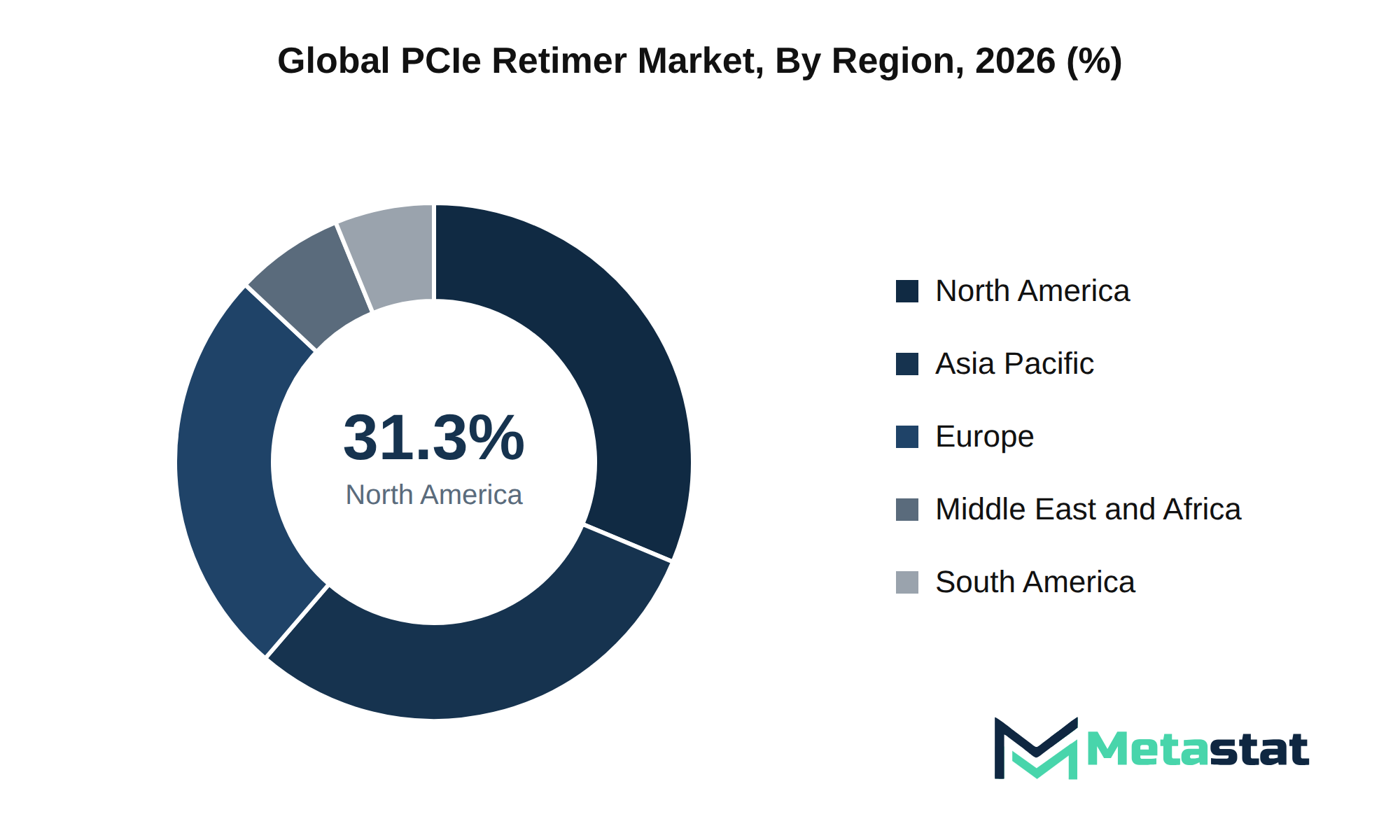
Geographic Lead: North America is the leading region, holding 31.3% of the market share in 2025, with the US expected to dominate further in 2026 due to significant investments in data center infrastructure.
What's Inside: The report provides a comprehensive analysis of the PCIe Retimer market, including competitive coverage, detailed segmentation by PCIe generation, device type, lane width, and application, along with a forecast window extending to 2033.
Emerging Opportunities: The transition to PCIe 6.x technology presents a significant growth opportunity, with an expected CAGR of 22.6%, driven by demand for high-speed data transfer in advanced computing applications.
High-throughput Demands: The increasing demand for high-throughput solutions in automotive safety systems and infotainment applications is reshaping the competitive landscape, leading to greater investment in advanced PCIe Retimer technologies.
Choose Your License
Global PCIe Retimer Market
The global PCIe Retimer market was valued at USD 357.8 million in 2025 and is projected to reach USD 938 million by 2033, growing at a CAGR of 12.8% over the forecast period.
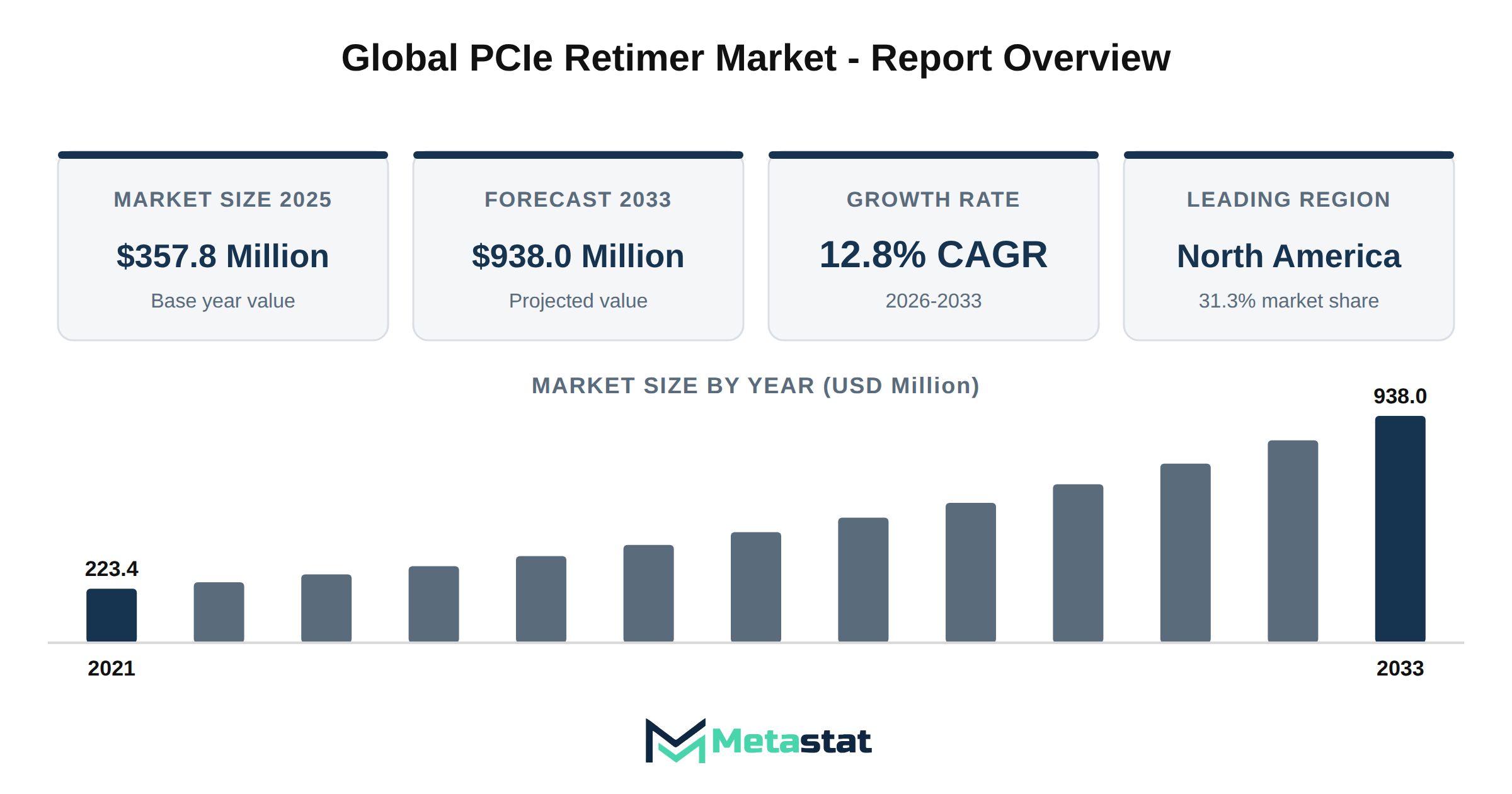
The PCIe Retimer market encompasses products that facilitate high-speed data transmission in computing systems, replacing traditional signal integrity solutions. The market's growth reflects a significant increase in demand driven by advancements in data center technologies, telecommunications, and consumer electronics. The rise from USD 357.8 million to USD 938 million indicates a strong upward trajectory, highlighting the increasing reliance on efficient data processing solutions.
North America holds 31.3% in 2025, with the US leading the market share in 2026. Among the various segments, PCIe 5.x and PCIe 4.x demonstrate substantial growth potential, with projected values of USD 428.4 million and USD 269.8 million, respectively, by 2033. Buyers from diverse industries, including servers and data centers, drive this demand, motivated by the need for enhanced performance and efficiency in operations. Current technological advancements and increasing data processing requirements position the PCIe Retimer market for sustained growth.
The PCIe Retimer market serves critical roles in enhancing data integrity and transmission speeds across various applications. Growth in this sector stems from advancements in data centers and telecommunications, where significant investments in infrastructure drive demand for efficient data handling solutions. By 2033, the market is projected to grow to USD 938 million, reflecting a compound annual growth rate of 12.8%. This expansion highlights the increasing need for robust solutions to support high-performance computing and storage systems.
The PCIe 5.x segment emerges as a primary contributor to revenue, with its anticipated value reaching USD 428.4 million by 2033. Notable developments in the sector include the transition from PCIe 4.x to PCIe 5.x, which enhances bandwidth capabilities and accelerates data throughput. The focus on server applications indicates a strong demand for PCIe Retimers, particularly among organizations seeking to upgrade their technology to meet the growing data processing requirements.
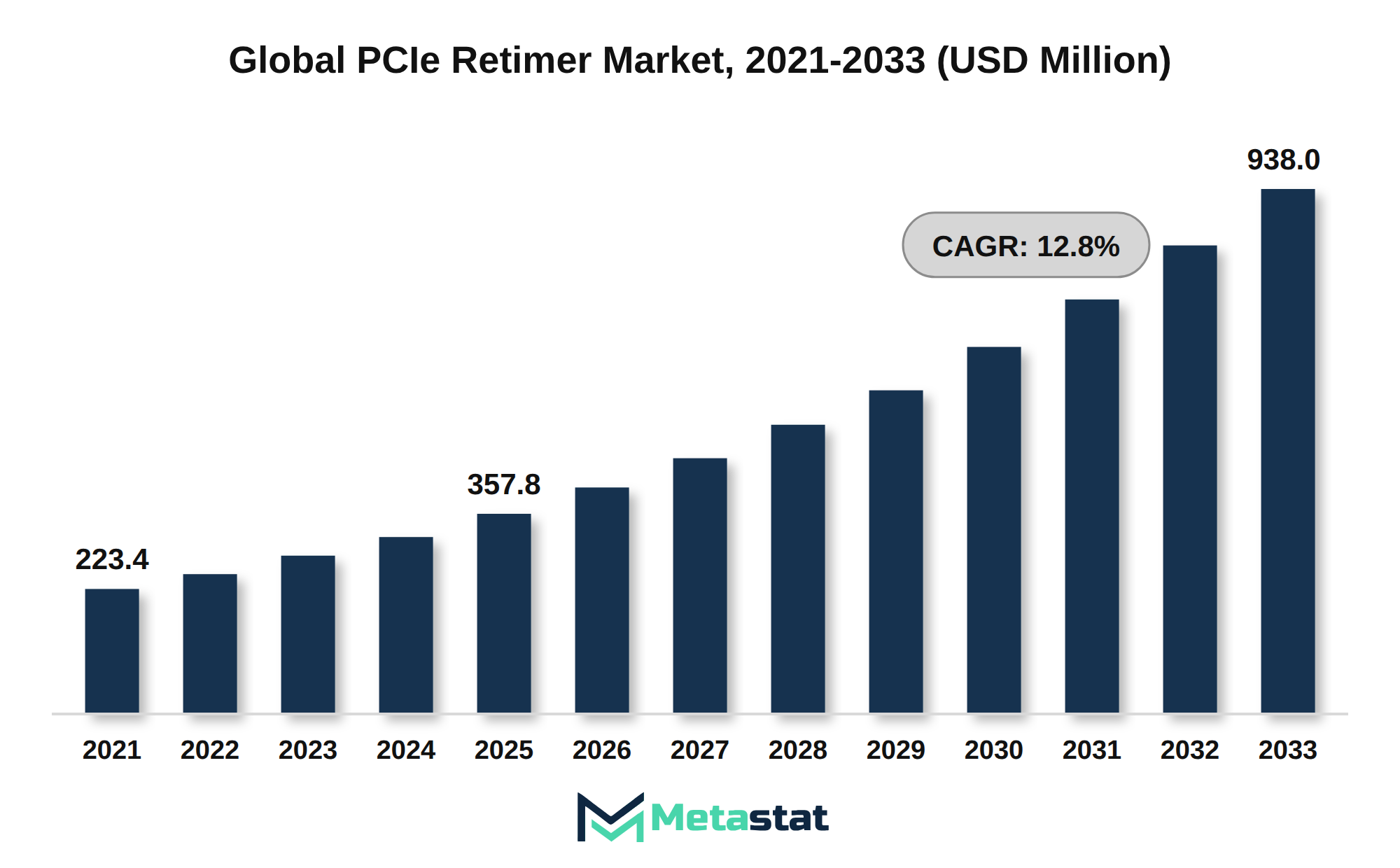
The adoption of hyperscale AI cluster architecture and CXL memory pooling significantly influences deployments in the PCIe Retimer market. These advancements enable more efficient data processing and management of memory resources, driving demand for enhanced connectivity solutions. The integration of these technologies allows for improved data flow between devices, increasing the performance of high-capacity storage and advanced computing systems.
In 2026, the market anticipates a value of USD 404.6 million, propelled by the rising need for robust infrastructure capable of accommodating AI workloads. The growth of data centers and the trend towards centralized computing architectures underpin this demand. With the continuous expansion of AI applications, organizations require high-speed interconnects, which PCIe Retimers provide, ensuring optimal performance for servers and storage systems.
The evolution of memory pooling techniques enhances resource utilization across multiple systems. This shift results in lower latency and improved scalability, making it easier for enterprises to manage large volumes of data efficiently. Investments in PCIe Retimers are expected to rise, reflecting the growing reliance on these technologies within the AI landscape. The combination of hyperscale architecture and advanced memory solutions reshapes operational frameworks in the PCIe Retimer market.
The transition to PCIe 6.0 PAM4 signaling significantly impacts component margins in the PCIe Retimer market. This technological advancement provides enhanced bandwidth, thereby supporting higher data transfer rates and improved performance in various applications. With the adoption of PCIe 6.0 accelerating, suppliers face both opportunities and challenges in adapting their product designs and pricing structures.
PAM4 signaling facilitates two bits of information per symbol instead of one, representing a critical shift that influences the market dynamics. PCIe 6.0 could account for a substantial portion of revenues, with projected figures indicating a market value increase from USD 357.8 million in 2025 to USD 938 million by 2033, reflecting a compound annual growth rate of 12.8%. This transition positions companies that invest in PAM4 technology ahead of competitors who remain reliant on older standards.
The reach extension capabilities of PCIe 6.0 further enhance the need for effective retimer technologies in long-distance communications. This development is crucial for data centers, telecommunications, and other sectors demanding reliability and high-speed connectivity. Suppliers focusing on innovative retimer solutions maintain a competitive edge.
Adoption of zonal ADAS computing combined with high-throughput sensor fusion significantly stimulates revenue growth in the PCIe Retimer market. The increasing complexity of automotive applications necessitates advanced computing architectures that optimize performance and efficiency. By 2033, the automotive sector is projected to generate substantial revenue, driven by the demand for advanced driver assistance systems (ADAS) and autonomous vehicle technologies.
The PCIe 5.x and PCIe 6.x generations contribute to market expansion, supporting increased data throughput essential for real-time processing of sensor data. This technological evolution aligns with an anticipated compound annual growth rate (CAGR) of 13.2% for the automotive segment within the broader market. Manufacturers focusing on high-speed interfaces find growing opportunities to enhance product offerings and meet the stringent requirements of the automotive industry.
High-throughput demands from safety systems and infotainment applications reshape the competitive landscape in the PCIe Retimer market. Automotive companies increasingly seek solutions that enable integration of advanced technologies, leading to higher performance expectations. The shift towards more integrated electronic systems in vehicles creates a need for high-speed connectivity solutions, expanding overall market potential.
Investments in research and development position suppliers to address these emerging needs effectively. This focus on innovation supports the enhancement of existing products and the development of new solutions, creating a stronger competitive edge. While automotive manufacturers prioritize advanced connectivity solutions, the market will see increased investment and strategic partnerships aimed at capturing emerging opportunities.
Severe insertion losses experienced at 64 GT/s are driving enterprises to replace redrivers with PCIe retimers, enhancing data integrity and overall performance. The transition to PCIe 5.x and beyond significantly increases bandwidth, demanding advanced solutions to manage signal integrity effectively. PCIe retimers serve as a critical component in this shift, providing necessary signal regeneration, thereby overcoming the limitations posed by redrivers. The estimated market value for PCIe 5.x is projected to reach USD 428.4 million by 2033, illustrating the adoption of this technology.
Manufacturers and data center operators increasingly prioritize the reduction of signal degradation in high-speed applications, prompting the adoption of PCIe retimers over traditional redrivers. The high-performance computing segments, particularly in data centers, gain substantial advantages from improved data rates and lower latency offered by retimers. This trend is part of a larger movement toward enhancing system efficiencies, ultimately driving demand in the PCIe retimer market.
The growing need for robust performance in enterprise applications fuels investments in PCIe retimers, as organizations seek to support increased data traffic and complex computing tasks. With a compound annual growth rate (CAGR) of 12.8% projected from 2026 to 2033, the market indicates strong commercial potential driven by these technological advancements. Enterprises transitioning to PCIe retimers position themselves strategically to leverage the benefits of next-generation technologies, ensuring long-term competitiveness in a dynamic environment.
The rapid expansion of data centers significantly influences growth in the PCIe Retimer market. Increasing data traffic and the need for higher bandwidth in cloud computing applications drive investments in advanced infrastructure. Enhanced performance requirements for data transmission prompt operators to seek innovative solutions that address signal integrity challenges. This environment creates a surge in demand for PCIe Retimers, which optimize data flow and reduce latency.
Growing reliance on cloud services and the Internet of Things drives data centers to require robust connectivity solutions to support diverse workloads. Migration towards high-performance computing systems necessitates upgrades to existing infrastructure. Consequently, organizations prioritize integrating PCIe Retimers to ensure reliable performance and scalability in their operations. The market experiences sustained growth, fueled by this ongoing trend in data center expansion.
Price sensitivity significantly impacts adoption among buyers in the PCIe Retimer market, particularly affecting small and medium-sized enterprises. Increased costs associated with advanced PCIe Retimer technologies lead to slower uptake and smaller order sizes, especially for businesses with limited budgets. This situation becomes critical in markets where cost competition drives purchasing decisions, resulting in delayed replacements of existing infrastructure. Buyers prioritize cost-effective solutions, hindering the transition toward high-performance PCIe Retimer alternatives that enhance data integrity and transmission speeds. The segment experiences a restrained growth trajectory, with potential customers opting for less expensive substitutes. This price-driven dynamic reduces overall market penetration and limits revenue opportunities for suppliers aiming to capture a broader customer base.
Rising input costs present significant challenges for suppliers in the PCIe Retimer market. Suppliers increasingly face pressure from fluctuating prices of raw materials and components, leading to tighter margins. This situation arises due to geopolitical tensions and logistical disruptions, which create an unstable sourcing environment. The necessity for advanced technology integration results in increased costs for research and development, impacting overall profitability.
In response, suppliers implement cost optimization strategies and seek to enhance operational efficiency. Investments in automation and streamlined manufacturing processes emerge as key approaches to mitigate rising expenses. Collaboration with material providers allows suppliers to secure better pricing agreements, helping to stabilize costs. Companies explore alternative sourcing options to diversify supply chains and reduce dependency on single suppliers.
The combined effects of these strategies reflect a proactive stance towards managing input costs, ensuring suppliers remain competitive within the PCIe Retimer market. This adaptability plays a critical role in sustaining growth and meeting evolving customer demands.
The transition to PCIe 6.x technology presents a significant growth opportunity within the PCIe Retimer market. Expected CAGR for this segment reaches 22.6 percent, driven by rising demand for high-speed data transfer in advanced computing applications. Key buyers, including data centers and telecommunications providers, increasingly adopt this technology to enhance operational efficiency and improve data throughput. The need for higher bandwidth and faster signal integrity in modern applications emphasizes the importance of PCIe 6.x. Manufacturers focusing on developing solutions in this segment position themselves to capitalize on expanding market potential. Investment in advanced PCIe 6.x retimer technologies not only meets evolving demands but enhances competitive standing in a rapidly changing landscape. This segment's growth reflects a broader trend toward higher performance in data transmission capabilities.
The Global PCIe Retimer market is segmented based on PCIe Generation, Device Type, Lane Width, and Application.
PCIe 3.x segment is valued at USD 70.5 million in 2026 and is projected to reach USD 101.7 million by 2033, at a CAGR of 5.4% during the forecast period. This segment primarily serves data centers and mid-range computing systems requiring balanced performance in data transfers. Key factors driving this segment include ongoing demand for reliable data integrity and necessity for cost-effective solutions among smaller enterprises. Growth in server installations contributes to increased usage of PCIe 3.x components, capitalizing on established technology. In contrast to faster segments like PCIe 4.x and PCIe 5.x, which experience higher growth rates of 9.9% and up, PCIe 3.x maintains a slower growth trajectory due to maturity and saturation in specific applications. Steady demand from targeted buyer segments facilitates consistent performance in the market.
PCIe 4.x segment is estimated to reach USD 269.8 million by 2033, at a CAGR of 9.9% during the forecast period. This segment primarily supports high-bandwidth applications in data centers and enterprise networking devices, attracting significant interest from cloud service providers and data center operators. Increasing demand for faster data transfer rates and improved system performance drives adoption in sectors requiring robust data handling capabilities. Compared to other segments, including PCIe 3.x, which offers slower growth, PCIe 4.x stands out with its higher data rate capabilities. The segment's growth is buoyed by the rising deployment of PCIe 5.x devices in the market, which emphasizes the ongoing need for advanced retimer solutions that enhance signal integrity and performance. This evolving environment highlights the increasing value of PCIe 4.x in meeting technological requirements in the market.
This segment finds applications primarily in high-end servers and networking devices, where enhanced data throughput plays a critical role. A significant driver propelling this segment includes rising demand for increased bandwidth in data centers and enterprise applications. Growth in cloud computing and virtualization requires robust connectivity, pushing suppliers to invest in PCIe 5.x technologies. Compared to sibling segments including PCIe 4.x, which is anticipated to reach USD 269.8 million by 2033, the PCIe 5.x segment experiences a faster growth rate, driven by its ability to support higher data rates. Adoption in sectors including gaming and high-performance computing further distinguishes this segment, leading to a competitive pricing strategy aimed at capturing these specialized markets. Within the PCIe Retimer market, the emphasis on speed and efficiency highlights the importance of PCIe 5.x solutions in meeting evolving technological demands.
PCIe 6.x segment is projected to grow at a CAGR of 22.6% during the forecast period. This segment finds extensive use in advanced data centers and high-performance computing applications, driven by the demand for increased bandwidth and reduced latency. Key buyers include technology companies and data center operators focusing on maximizing data throughput and enhancing overall system performance. The rapid evolution of applications including artificial intelligence and machine learning necessitates higher data transfer rates, propelling interest in PCIe 6.x technology. This segment distinguishes itself from others through its superior growth potential and capability to support next-generation workloads, aligning more closely with emerging technological advancements compared to lower PCIe generations. The expected value of the PCIe 6.x segment will further reflect its critical role in shaping the future of high-speed data transmission, contributing significantly to the overall growth of the market.
Servers are valued at USD 121.2 million in 2026 and are projected to reach USD 291.9 million by 2033, at a CAGR of 13.4% during the forecast period. This segment primarily supports data center operations, cloud service providers, and enterprise applications, where high-speed data transmission remains crucial. The ongoing shift towards advanced computing architectures, including virtualization and AI processing, significantly boosts demand for servers equipped with PCIe Retimers. Unlike other device types, including storage systems, which exhibit slightly lower growth rates, the servers segment benefits from a rapid expansion of data centers. The increasing necessity for enhanced processing power and reduced latency drives this growth, prompting technology upgrades that favor PCIe Retimers for optimizing performance. The market anticipates substantial investment in server infrastructure, further stimulating growth in the segment.
The Storage Systems segment is estimated to reach USD 170.8 million by 2033, at a CAGR of 12% during the forecast period. This segment finds application in various industries, including data centers and enterprise storage solutions, where efficient data handling is critical. The growing need for high-speed data access and storage efficiency drives demand within this segment. Recent technological advancements, including faster data transfer rates and improved reliability, influence adoption rates. Compared to its counterparts, this segment exhibits significant growth due to increasing investments in infrastructure and the ongoing transition to higher-capacity storage solutions. The market experiences heightened interest from buyers demanding efficient and scalable storage systems. The accessibility of advanced technologies enhances the competitiveness of this segment, allowing it to cater effectively to evolving customer requirements.
The Networking Devices segment is expected to reach USD 158.7 million by 2033. This segment primarily serves telecommunications companies and data center operators, who employ advanced networking solutions for communication and data transfer. The growth of cloud computing and remote work drives significant demand for high-performance networking equipment, enhancing the need for PCIe Retimers. Increased adoption of 5G technology further drives investments in networking infrastructure, facilitating the segment's expansion. Compared to other device types, Networking Devices experience a moderate growth rate, influenced by rapid advancements in communication technology. The emphasis on high-speed data transmission distinguishes this segment, making it attractive for customers seeking reliability and efficiency in operations. The focus on developing more advanced networking protocols reinforces the importance of this segment within the PCIe Retimer market.
The workstations segment is projected to grow at a CAGR of 12% during the forecast period. This segment serves professionals in fields including design, engineering, and content creation, where high-performance computing is essential. Increased demand for advanced graphics and processing capabilities drives growth in this segment, particularly among users requiring complex simulations and 3D rendering. The adoption of advanced hardware components enables workstations to outperform traditional PCs, creating a distinct market segment characterized by higher price points and specialized buyers. Compared to other device types, including servers or storage systems, workstations experience strong growth due to their tailored applications and revenue potential within the PCIe Retimer market. The integration of advanced PCIe technologies enhances performance and responsiveness, positioning workstations as an attractive option for demanding applications.
Accelerated Computing Systems play a critical role in high-performance computing environments, primarily serving data centers and AI-focused enterprises. Adoption of these systems drives demand for advanced PCIe Retimer solutions that enhance data transfer speeds and reliability. The segment experiences growth due to increasing processing requirements driven by machine learning applications and data analytics. Rapid technological advancements in GPU architectures influence this segment uniquely, differentiating it from other device types that do not require such high throughput. Compared to other segments, including Storage Systems or Networking Devices, Accelerated Computing Systems exhibit higher price elasticity and demand for specialized components, necessitating robust pricing strategies from suppliers. This segment's focus on advanced applications underlines its significance in shaping the future of the PCIe Retimer market.
Gaming Consoles involve advanced devices designed for interactive entertainment, engaging users in immersive experiences. Manufacturers use these consoles to support various multimedia applications, including gaming and streaming. The segment experiences increased demand driven by rising consumer interest in high-quality graphics and performance. Technological advancements enhance processing capabilities, influencing purchasing decisions among consumers seeking superior gaming experiences. Compared to other device types, Gaming Consoles exhibit slower growth due to market saturation and competition from mobile and PC gaming. Nonetheless, dedicated gaming hardware remains popular among enthusiasts, reinforcing its unique position within the broader market. This segment benefits from ongoing innovation, ensuring relevance in an evolving environment.
Embedded computing devices and industrial computers play critical roles in various sectors, including automation, robotics, and manufacturing. These devices require reliable and efficient connectivity solutions to ensure optimal functionality. The growth of this segment is driven by the increasing demand for automation in industrial processes, which influences the necessity for robust data transfer mechanisms. Advancements in technology lead to enhanced capabilities of embedded systems, boosting their adoption across various applications. Compared to other device types, this segment often experiences slower growth due to niche market characteristics and specific buyer needs. Many buyers prioritize high reliability and long-term support, often accepting higher price points for products that meet these stringent requirements. This focus differentiates the segment from others, where cost considerations play a more prominent role. Thus, the segment continues to hold significance in the broader PCIe Retimer market.
x4 segment is valued at USD 113.5 million in 2026 and is projected to reach USD 251.7 million by 2033, at a CAGR of 12.1% during the forecast period. This segment finds extensive application in data centers and high-performance computing systems, where efficient data transfer and low latency are critical. Demand for x4 configurations arises from the increasing need for high bandwidth and reliable connections in servers and storage systems. Growth in the data center sector pushes adoption, fueled by momentum towards enhanced computing capabilities. The x4 segment exhibits a slower growth rate compared to x8 and x16 segments, reflecting its specific use cases and price positioning, which cater primarily to cost-sensitive applications. While demand for PCIe Retimer solutions strengthens, the x4 segment maintains relevance by supporting a diverse range of devices within the market.
x8 segment is estimated to reach USD 338.3 million by 2033, at a CAGR of 13.4% during the forecast period. This segment primarily serves high-performance applications, acting as an integral component in systems like data centers and high-end servers that require reliable data transfer. Increased demand for bandwidth and efficiency within these systems drives growth in this segment, with the rise of cloud computing and data-intensive applications fueling adoption. Compared to sibling segments, the x8 segment experiences a distinct growth trajectory, characterized by its higher performance capabilities and price point. The segment is set to outperform others due to its critical role in supporting advanced applications, resulting in increased investments from manufacturers focused on meeting the evolving demands of the market.
x16 segment is expected to reach USD 289.9 million by 2033. This segment finds application primarily in advanced data center infrastructures and high-performance computing systems. Demand is driven by the increasing necessity for high bandwidth and low latency in data transmission. Users, particularly those in sectors like cloud computing and enterprise IT, seek solutions that support demanding workloads efficiently. Compared to other lane widths, the x16 segment experiences slower growth, but it maintains a stable market presence due to its integral role in high-speed applications. The necessary hardware investments for upgrading to higher lane widths act as a barrier for rapid adoption, while growing interest in optimizing data center performance ensures consistent interest in this segment. In the PCIe Retimer market, the x16 segment stands out for its particular focus on high-throughput requirements, differentiating it from other sub-segments.
Others (x1, x2) segment is projected to grow at a CAGR of 10.8% during the forecast period. This segment serves unique applications in specialized computing environments, particularly for embedded systems and low-latency communications. Demand for this segment primarily comes from sectors requiring compact designs and efficient data transmission. Growth in compact and modular computing solutions contributes to the increasing adoption of x1 and x2 lanes. Compared to other lane width segments, this segment experiences a slower growth rate, reflecting its niche applications. While broader segments like x4 and x8 cater to high-performance scenarios, Others (x1, x2) remains crucial for specific use cases that prioritize space and power efficiency. The expected increase in demand for compact solutions across various industries will drive growth in this segment, enhancing its contribution to the overall PCIe Retimer market.
Valued at USD 136.7 million in 2026, the Data Centers segment is projected to reach USD 298.6 million by 2033, at a CAGR of 11.8% during the forecast period. This segment serves critical functions for cloud service providers and enterprises that rely on large-scale data processing and storage. Increased demand for data-driven services, driven by the growth of cloud computing and big data analytics, significantly influences this segment. Compared to other segments, Data Centers exhibit steady growth due to the persistent rise in data generation and the necessity for efficient data management solutions. Investment in infrastructure upgrades to support high-speed data transmission and lower latency requirements encourages stronger adoption rates. The emphasis on improving operational efficiency fuels demand for PCIe Retimers tailored for these applications, distinguishing this segment from others, including consumer electronics, which experience different growth patterns and pricing pressures.
The telecommunications segment is estimated to reach USD 204.1 million by 2033, at a CAGR of 13.7% during the forecast period. This segment typically serves major telecommunication providers and equipment manufacturers, focusing on high-speed data transmission and network reliability. Increased demand for advanced communication services drives growth in this area, with the ongoing expansion of 5G networks pushing for enhanced performance. This segment distinguishes itself with a higher growth rate compared to others, including storage systems, due to the critical need for efficient data transfer in telecommunications. The emphasis on infrastructure upgrades and technological advancements significantly impacts pricing and value, aligning with broader trends within the market.
The Consumer Electronics segment is expected to reach USD 149.3 million by 2033. This segment encompasses devices in everyday technology, including smartphones, tablets, and televisions, appealing primarily to individual consumers and households. Growth in this sector is driven by increasing demand for high-definition video and gaming equipment, necessitating enhanced data transfer capabilities. The shift towards more sophisticated consumer electronics, featuring advanced functionalities and high-speed connectivity, significantly influences procurement decisions. Compared to other segments, the Consumer Electronics segment experiences strong growth rates, albeit at a lower price point than enterprise-focused applications. The market shows a growing emphasis on integrating PCIe Retimer technology to ensure optimal performance in increasingly complex devices.
The automotive segment is projected to grow at a CAGR of 13.2% during the forecast period. This segment finds application in advanced driver-assistance systems and in-vehicle networking, utilized by automotive manufacturers and technology providers. The growing demand for electric and autonomous vehicles drives significant investment in automotive electronics, increasing the need for high-speed data transfer solutions. Evolving regulatory standards concerning vehicle safety and emissions control further compel manufacturers to integrate sophisticated technology into their offerings. Unlike the telecommunications segment, which focuses on high-speed data transmission, the automotive segment offers different growth dynamics due to unique consumer requirements and technological advancements, creating distinct opportunities in the market. The trends in automotive electronics support the PCIe Retimer market, positioning it for robust development in the coming years.
Industrial applications consist of crucial infrastructures employed in various sectors, including automation, manufacturing, and robotics. This segment targets enterprises focused on enhancing their operational efficiency and reliability. The demand for PCIe Retimers in industrial settings experiences growth driven by the increasing need for high-speed data transfer and reliable connectivity within complex systems. Rapid advancements in automation technologies further support this trend, as industries seek to improve their performance through enhanced interconnectivity. Compared to other application segments, the industrial segment exhibits slower growth due to higher capital expenditure requirements and the need for specialized configurations. The specific requirements of industrial buyers often lead to tailored solutions that differ from those in consumer-oriented applications. The PCIe Retimer market reflects the essential role of these devices in enabling efficient communication and data management across diverse industrial environments.
This sub-segment includes applications serving the energy and transportation sectors, focusing on high-performance computing systems and data transmission reliability. Energy companies apply advanced technologies for real-time monitoring and control systems, while transportation agencies implement sophisticated infrastructure solutions for traffic management and logistics. Growing demand for efficient energy consumption and smart transportation networks drives adoption in this area. The emergence of renewable energy and electric vehicles significantly influences technology needs, pushing for enhanced capabilities. Compared to other segments, this sub-segment experiences slower growth due to stronger regulatory hurdles and longer implementation timelines. However, investments in smart grid technology and connected transportation systems present unique opportunities for growth, positioning this segment distinctly within the broader PCIe Retimer market.
Based on geography, the Global PCIe Retimer market is divided into North America, Europe, Asia-Pacific, South America, Middle East, and Africa.
Significant growth in digital infrastructure across the United States, Canada, and Mexico drives demand in the PCIe Retimer market. Major industries, including data centers and telecommunications, increasingly rely on advanced data transmission technologies to enhance performance. Government initiatives promoting digital transformation further support this trend, contributing to an expanding market landscape. North America holds a notable share of 31.3% of the global market in 2025, reflecting strong investment in next-generation technologies. By 2033, the region is projected to reach USD 282.5 million, indicating a robust demand trajectory. The evolution of high-performance computing and the push for enhanced connectivity in various applications continue to support growth in this region.
Germany, France, the UK, Italy, and Spain represent significant markets for PCIe Retimer solutions due to strong technological infrastructure and high demand for advanced computing solutions. The presence of industries including data centers and telecommunications drives considerable investment in high-performance computing and data transmission. Russia's growing technology sector contributes to market expansion, reflecting a regional focus on modernizing digital infrastructures. Regulatory frameworks promote innovation and investment in these technologies, enhancing competitiveness in European markets. By 2025, Europe holds a share of 25.7% of the global market, demonstrating the region's important role in the growth of PCIe Retimer solutions.
Rapid expansion within the PCIe Retimer market in Asia-Pacific stems from the significant investments in data centers and telecommunications infrastructure. Countries including China, Japan, and India drive demand due to their growing digital economies and increasing reliance on high-speed data transmission. The rise of cloud computing services acts as a catalyst, propelling the adoption of these technologies across various sectors. South Korea and Australia contribute to this trend with robust technology ecosystems and strong consumer bases. Southeast Asia reflects a dynamic market landscape, characterized by emerging startups and a young digital-savvy population eager for innovative solutions. This regional market holds a share of 30.0% in 2025, highlighting its importance in the global context.
Brazil and Argentina represent key markets within the PCIe Retimer market, driven by increasing investments in digital infrastructure and data centers. The region's growth stems from the expanding telecommunications sector, which requires efficient data transmission capabilities. Governments in both countries have initiated programs to enhance connectivity and boost technological adoption, further stimulating demand. South America holds a 6.2% share of the global PCIe Retimer market in 2025, illustrating the region's potential for growth. Increasing reliance on data-driven applications across various industries supports the adoption of PCIe Retimer solutions, enhancing performance and reliability in data processing. The market in South America is anticipated to evolve rapidly, driven by advancements in technology and the increasing need for high-speed data transmission.
The PCIe Retimer market sees notable interest in the Middle East and Africa, particularly in Saudi Arabia, UAE, and South Africa. Demand arises from industries including telecommunications and data centers, where the need for enhanced data transmission capabilities drives adoption. Increasing digital infrastructure investments serve as a catalyst for growth, particularly in countries like Saudi Arabia and the UAE, where government initiatives focus on technological advancements. The market accounts for a 6.8% share of the global landscape in 2025. South Africa represents a crucial market due to its expanding technology sector, which further accelerates demand for PCIe Retimers. While organizations continue to modernize their infrastructure, the market is positioned for a robust trajectory in the coming years, reflecting the ongoing regional focus on enhancing connectivity and performance.
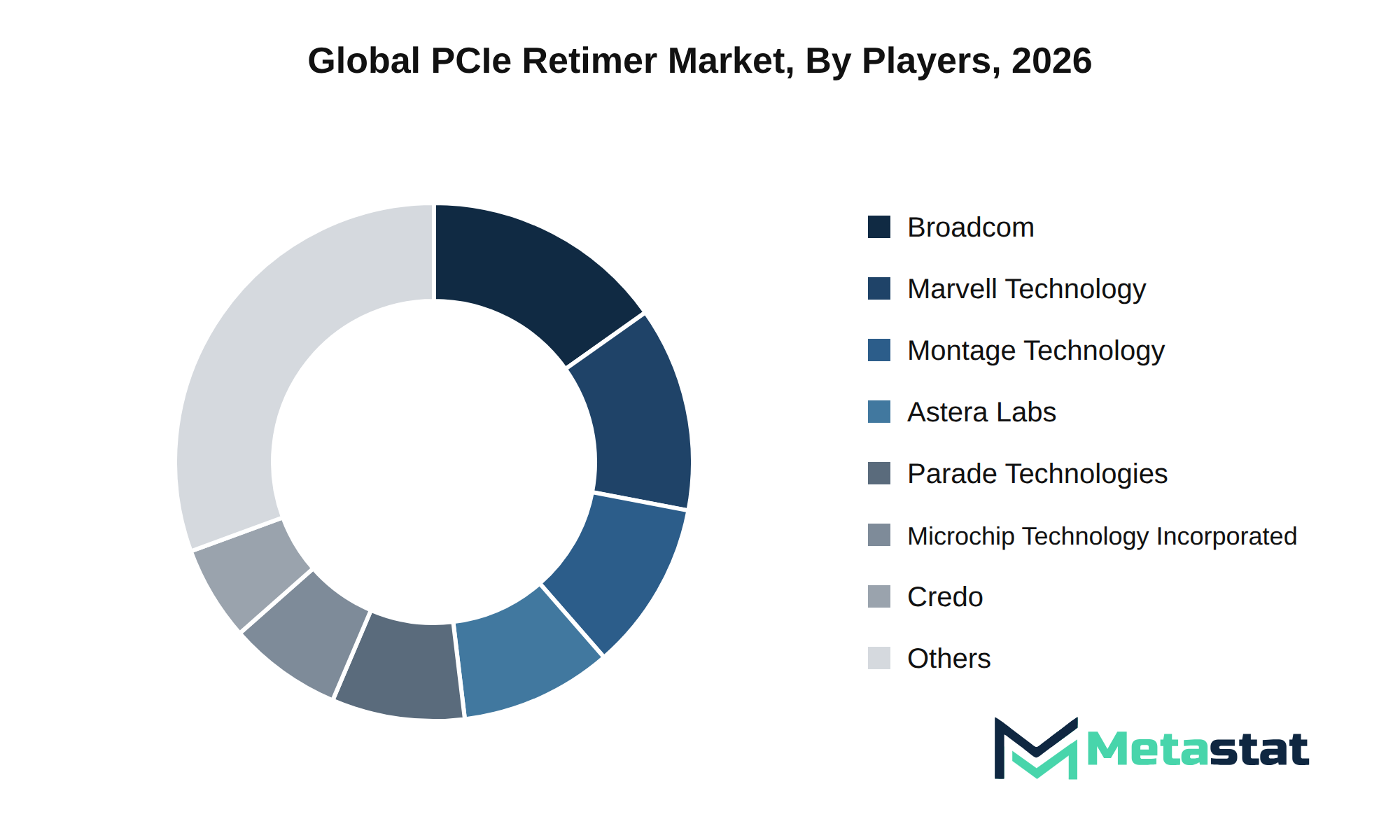
The PCIe Retimer market features diverse competition, with players focusing on various strategies to appeal to buyers. Companies differentiate through pricing, customization options, and the integration of technological ecosystems. Buyers prioritize these factors alongside product certification and after-sales service.
Montage Technology specializes in advanced solutions for data integrity, establishing a reputation for reliability. Broadcom Inc. emphasizes a robust product range that caters to different applications, enhancing its competitive edge. Marvell Technology, Inc. stands out for its innovation in high-performance retimer solutions, addressing the needs of data centers and networking devices. These strategic focuses allow companies to address the specific demands of buyers in the PCIe Retimer market, shaping competitive dynamics.
Achieving this target requires several key developments. These advanced generations provide enhanced speed and efficiency, appealing to sectors including data centers and telecommunications. Growth in device types like servers and storage systems will contribute significantly to market expansion, driven by ongoing digitization across industries. Strong demand from North America, representing 31.3% of market share, further supports this growth trajectory.
However, potential risks exist that could hinder progress. Supply chain disruptions or increased component costs could impact pricing and access to essential technologies, slowing growth in the PCIe Retimer market. Attention to these factors will determine the market's ability to achieve projected revenue levels. Monitoring technological advancements and regional developments will play a crucial role in shaping the market's future.
By Device Type: Servers, Storage Systems, Networking Devices, Workstations, Accelerated Computing Systems, Gaming Consoles, Others (Embedded Computing Devices, Industrial Computers)
By Application: Data Centers, Telecommunications, Consumer Electronics, Automotive, Industrial, Others (Energy, Transportation)
The report strategically identifies and profiles the key market players and analyses their core competencies in each sub-segment of the PCIe Retimer market.
|
Report Attributes |
Details |
|
Study Period |
2021-2033 |
|
Base Year |
2025 |
|
Estimated Year |
2026 |
|
Forecast Period |
2026-2033 |
|
Historical Period |
2021-2025 |
|
Growth Rate |
CAGR 12.8% from 2026 to 2033 |
|
Revenue Unit |
USD million |
|
Segmentation |
|
|
By Region |
North America (By PCIe Generation, Device Type, Lane Width, Application, and Country)
|
|
|
|
Asia Pacific (By PCIe Generation, Device Type, Lane Width, Application, and Country)
|
|
|
|
|
Middle East and Africa (By PCIe Generation, Device Type, Lane Width, Application, and Country)
|
Find answers to common questions about this report
The Metastat Insights study reveals that the PCIe Retimer market size was valued at USD 357.8 million in 2025.
The PCIe Retimer market is projected to grow at a CAGR of 12.8% during the forecast period from 2026 to 2033.
According to Metastat Insights analysis, the North America PCIe Retimer market size is estimated to reach USD 282.5 million by 2033.
The leading segment in the PCIe Retimer market is PCIe 5.x, projected to reach USD 428.4 million by 2033. This segment acts as the primary driver of growth, reflecting significant demand within the industry.
North America emerges as the dominant region in the PCIe Retimer market, projected to reach USD 282.5 million by 2033. The leading segment, PCIe 5.x, is expected to achieve significant growth, with a forecast value of USD 428.4 million by 2033.
North America holds the dominant share of the PCIe Retimer market, with a projected value of USD 282.5 million in 2033. This region accounts for 31.3 percent of the total market share.
The PCIe Retimer market is estimated to reach a valuation of USD 938 million by 2033.
Key players in the PCIe Retimer market include Montage Technology, Astera Labs, Inc., Broadcom Inc., Marvell Technology, Inc., Parade Technologies, Ltd., Microchip Technology Incorporated, and Intel Corporation.
The expected CAGR for PCIe 6.x technology reaches 22.6 percent, driven by rising demand for high-speed data transfer in advanced computing applications.
The rapid expansion of data centers and the increasing need for higher bandwidth in cloud computing applications drive demand for PCIe Retimers.
The analysts below cover Electronics and Semiconductor research at Metastat Insights.
LEAD ANALYST
Utkarsh Khirodkar is a Lead Market Research Analyst at MetaStat Insight, specializing in market intelligence, technology sector assessments, and competitive strategy.

PRINCIPAL CONSULTANT - ENTERPRISE AI & EMERGING TECHNOLOGIES
Banking & Finance · Electronics and Semiconductor · Energy and Power · Healthcare IT · Information & Technology · Professional Services
Vijay Gunti is a Principal Consultant at MetaStat Insight, bringing over two decades of experience across enterprise digital transformation, technology strategy, and intelligent systems.

PRINCIPAL CONSULTANT - QUALITY SYSTEMS & COMPLIANCE
Electronics and Semiconductor · Machinery & Equipment · Professional Services
Omkar Phadtare is an Industry Consultant at MetaStat Insight, specializing in quality systems, regulatory compliance, and standards benchmarking to drive data-driven market intelligence and strategic industry research.

ENERGY & INFRASTRUCTURE INDUSTRY CONSULTANT
Automotive and Transportation · Electronics and Semiconductor · Energy and Power · Machinery & Equipment
Saurabh Vasant Ganvir consults for Energy & Infrastructure Industry at MetaStat Insight, specializing in renewable energy, solar EPC, and electric vehicle (EV) infrastructure markets.

LEAD CONSULTANT - COMMUNICATION, TELECOM, AND IT
Electronics and Semiconductor · Information & Technology · Machinery & Equipment · Professional Services
Ravindra Sathe Consultants for Communication, Telecom, and IT at MetaStat Insight. He leads the firm's industry research initiatives across telecommunications infrastructure, digital connectivity, enterprise networking, and emerging information technology domains.
Evaluating sovereign cloud deployments for core banking platforms demands a clear view of data residency regulations and migration exit strategies. MetaStat Insight delivered an exhaustive review of regional latency tolerances, mainframe decommission milestones, and third-party vendor concentration risk. The regulatory compliance mapping across European and Asian financial jurisdictions gave our team a dependable baseline for multi-cloud infrastructure discussions.
Replacing petrochemical surfactants with bio-based alternatives requires realistic timelines on industrial precision fermentation scaling. The market research broke down commercialization timelines, feedstock sugar price sensitivities, and regional cosmetic ingredient regulatory approvals in Europe and East Asia. That supplier readiness mapping gave our formulations team reliable context when comparing renewable chemical sourcing roadmaps.
Tracking ceramic matrix composite adoption in high-bypass aero engines requires strict attention to material qualification cycles and FAA airworthiness testing milestones. The MetaStat Insight team provided a detailed timeline of silicon carbide fiber manufacturing capacity and commercial foundry lead times. Having clear visibility into upstream thermal barrier coating supply helped us stress-test our long-term component procurement strategy.
Explore related market intelligence reports worth reading alongside this one.