
LEAD ANALYST
Utkarsh Khirodkar is a Lead Market Research Analyst at MetaStat Insight, specializing in market intelligence, technology sector assessments, and competitive strategy.

Polyether Polyols for Polyurethane Market Size, Share, and Industry Analysis, By Type (PO-Based Polyols and Natural Oil-Based Polyols), By Application (Flexible Foams, Rigid Foams, Adhesives, and Others (Coatings, Sealants, Elastomers)), By End-Use Industry (Automotive, Construction, Consumer Goods, Electronics, Appliances, Footwear, Apparel, and Others (Aerospace, Marine, Industrial, Medical, and Packaging)), Growth, Trends, and Forecast, 2026-2033
Report ID
MSI-4540
Published
February, 2026
Pages
310 Pages
Format
Report Details
Choose Your License
Polyether Polyols for Polyurethane Market
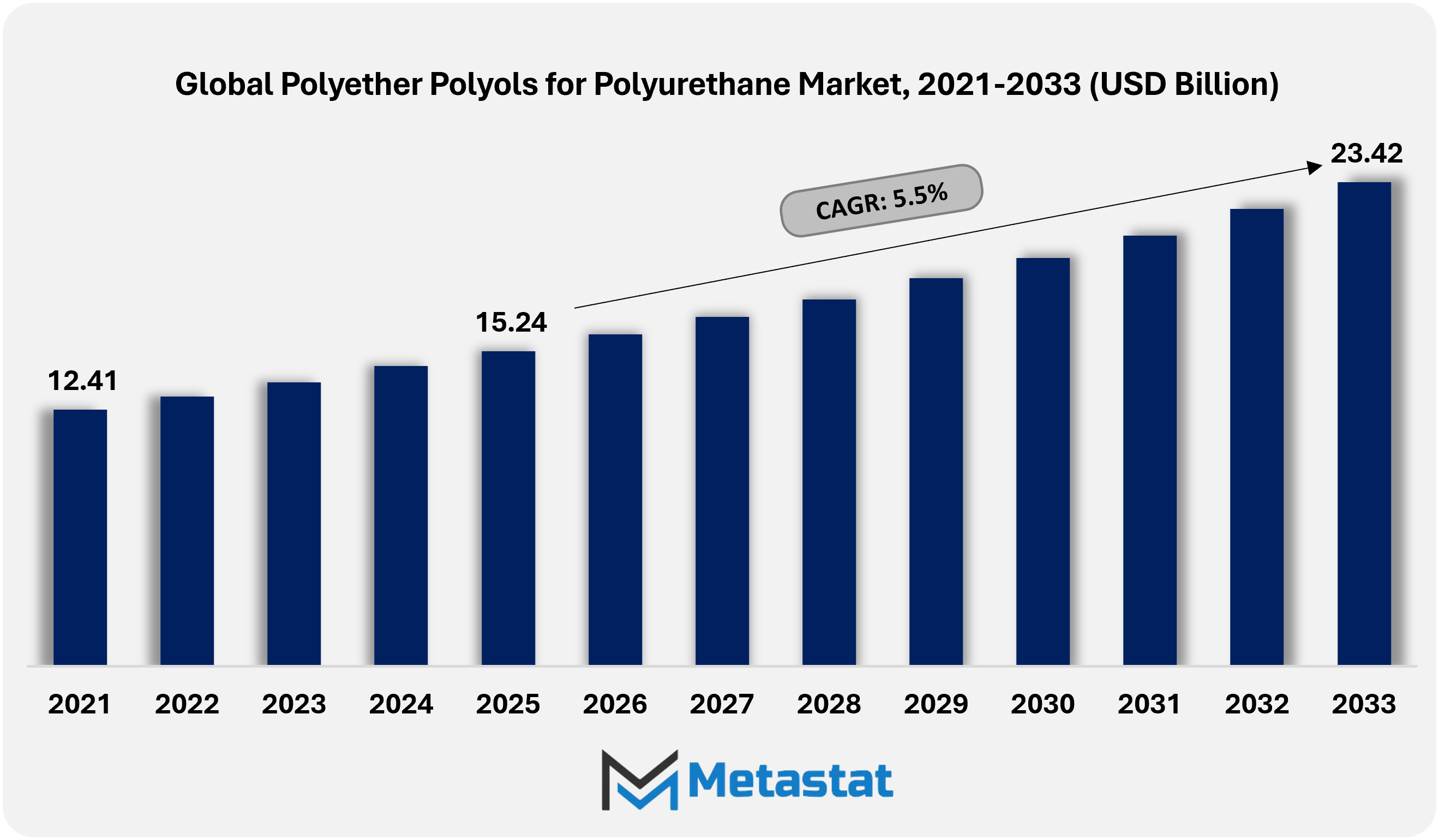
The global Polyether Polyols for Polyurethane market was valued at USD 15.2 billion in 2025 and is projected to reach USD 23.4 billion by 2033, registering a CAGR of 5.5% during 2026-2033.
The global Polyether Polyols for Polyurethane market volume was 4,821.6 kilotons in 2024 and expected to grow at a CAGR of 2.2% within forecast period.
The polyether polyols for polyurethane market within the global chemicals and materials industry expands beyond traditional boundaries as innovation, regulation and end-use expectations continue to change in the coming years. Instead of adhering to established production models or conventional application narratives, the market is defined by advanced material engineering, refined molecular architectures, and close integration with the downstream manufacturing ecosystem.
Providers will focus on formulating polyether polyols on the molecular level to fulfil relatively precise overall performance necessities in forecast period. The approach enables polyurethane formulations to achieve an optimal balance of flexibility, elasticity, thermal stability, and durability without dependence on standardized grades. As industries increasingly require materials tailored to precise engineering specifications, formulation science is shifting toward a collaborative development framework involving both manufacturers and end users.
Polyurethane foam usage in furniture, bedding, automotive seating, and building insulation will sustain polyether polyol consumption patterns across core applications. Manufacturing cycles prioritize polyether polyols owing to consistent processing and repeatable performance, supporting insulation standards across residential and commercial infrastructure projects.
Energy performance and lightweighting priorities in the automotive sector will boost adoption of advanced polyurethane insulation and structural additives. Regulatory alignment with thermal efficiency and fuel optimization dreams helps the expanded use of polyether polyols, as manufacturers prioritize decreased material weight while retaining energy, safety, and long-time period sturdiness benchmarks.
Volatility in propylene oxide and related petrochemical feedstock pricing will continue to be a value-facet venture. Fluctuating input costs affect the predictability of manufacturing, limiting margin sustainability. Strategic sourcing and supply chain changes will become important as producers attempt to stabilize pricing pressures with persistent manufacturing and contractual duties.
Environmental and regulatory pressures related to VOC emissions, petro-based feedstock dependence, and polyurethane system compliance will constrain manufacturing flexibility. Compliance necessities increase improvement timelines and value burdens, requiring non-stop development efforts. Regulatory variation will shape the destiny materials' attractiveness in many regional markets.
Development and commercialization of bio-based or low-carbon polyether polyols derived from natural oils or recycled carbon resources will open avenues for premium growth. Sustainable polyurethane applications will acquire priority in the construction and mobility sectors, helping logo differentiation, regulatory alignment, and long-term fabric innovation within performance-targeted price chains.
The global Polyether Polyols for Polyurethane market is segmented by Type, Application, and End-Use Industry.
PO-based Polyols segment was valued at USD 13.2 billion in 2026 and is projected to reach USD 19 billion by 2033, at a CAGR of 5.3% during the forecast period.
PO-based polyols continue to attract attention owing to consistent quality, stable processing behaviour, and compatibility with large-scale production systems. Future advances likely emphasize efficiency in manufacturing while supporting evolving industrial standards. The materials remain central where uniform performance and scalable output will be essential.
Natural Oil–based Polyols (NOPs) segment was valued at USD 2.8 billion in 2026 and is projected to reach USD 4.4 billion by 2033, at a CAGR of 6.7% during the forecast period.
Natural oil-based polyols gradually expand as the industry prioritizes resource responsibility and material origin transparency. Ongoing innovations focus on improving mechanical strength and processing reliability. Adoption of natural oil-based polyols strengthens as performance gaps narrow and sustainable material integration becomes a standard manufacturing expectation.
Flexible Foams segment is projected to reach USD 6.3 billion by 2033, at a CAGR of 5.3% during the forecast period.
Flexible foam sees widespread use as comfort, flexibility, and adaptability remain important in seating and cushioning solutions. Future designs focus on extended lifetime and improved recovery properties. The advancements will help evolve consumer expectations around comfort, safety, and long-term usability.
Rigid Foams segment is projected to reach USD 12.1 billion by 2033, at a CAGR of 5.8% during the forecast period.
Rigid foam continues to be essential for insulation and structural efficiency, especially as construction standards advance. Future development focuses on thermal performance and dimensional stability. Increasing infrastructure investments will support continued use where strength, insulation value and material stability remain critical.
Adhesive segment is projected to reach USD 1.6 billion by 2033, at a CAGR of 5.4% during the forecast period.
Adhesive applications expand as bonding solutions demand stronger performance on a variety of surfaces. Future formulations will support faster cure and better durability in different conditions. These developments align with the increasing demand for advanced assembly processes and reliable structural bonding.
Others (Coatings, Sealants, Elastomers, etc.) segment is projected to reach USD 3.5 billion by 2033, at a CAGR of 5.2% during the forecast period.
Coatings, sealants, and elastomers evolve with a focus on surface protection and resiliency. Future solutions support resistance against environmental stress and mechanical wear and tear. Adoption will broaden in applications requiring adaptability and sustained long-term performance across specialized industrial use cases.
By End-Use Industry, the market is segmented into:
Automotive segment is projected to reach USD 5.8 billion by 2033 with a share of 25.6% in 2025.
Automotive sector expands as lightweight materials support efficiency and design flexibility. Future material development will focus on sustainability and safety compliance. Integration across internal and structural components will increase as manufacturers balance performance expectations with emerging mobility trends.
Construction segment is projected to reach USD 8.3 billion by 2033 with a share of 34.3% in 2025.
Construction applications continue to expand as insulation efficiency and structural reliability remain priorities. Future construction methods rely on materials that support energy conservation and longevity. The adoption process strengthens as urban development and infrastructure modernization progress globally.
Consumer Goods segment is projected to reach USD 4.1 billion by 2033 with a share of 17.8% in 2025.
Manufacturers of consumer goods leverage material flexibility to support design variation and product comfort. Future use will emphasize sustainability and cost efficiency. These materials will remain relevant where everyday products require consistent quality and an adaptable look.
Electronics & Appliances segment is projected to reach USD 2.5 billion by 2033 with a share of 10.3% in 2025.
The electronics and appliances sector depends on material stability and insulation properties. Future demand will be in line with compact designs and better heat management. These characteristics support continued integration into protective and functional components.
Footwear & Apparel segment is projected to reach USD 1.7 billion by 2033 with a share of 7.6% in 2025.
Footwear and apparel applications benefit from lightweight and cushioning properties. Future product development focuses on comfort, wear resistance, and design innovation. The increase reflects the growing demand for performance-driven and lifestyle-oriented merchandise.
Others (Aerospace, Marine, Industrial, Medical, Packaging, etc.) segment is projected to reach USD 1 billion by 2033 with a share of 4.5% in 2025.
Key industries will undertake substances for tailored performance necessities. Future advancements will emphasize precision, protection requirements, and durability. Adoption will increase where optimized material performance supports complex operating conditions.
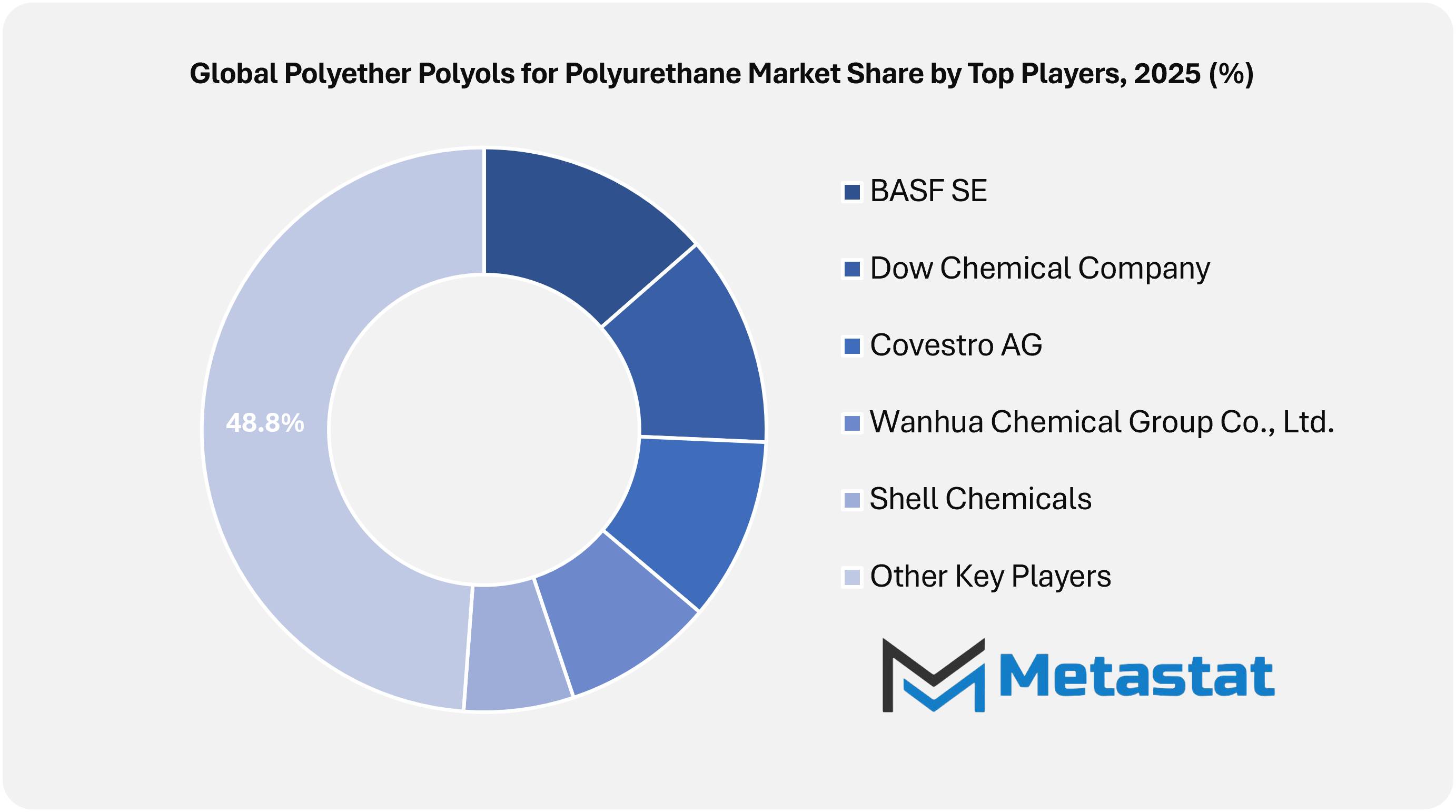
The global Polyether Polyols for Polyurethane market continues to see steady competitive activity, driven by large chemical manufacturers and specialized material producers. The industry is shaped by companies focused on improving product performance, maintaining supply reliability, and meeting changing downstream polyurethane requirements. Players also emphasize quality consistency, technical support, and long-term partnerships with manufacturers across construction, automotive, furniture, and insulation sectors. This balance among scale and specialization will outline how corporations position themselves in the marketplace.
Major industry players including Dow Chemical Company, Covestro AG, BASF SE, and Shell Chemicals maintain strong market positions, supported by global reach, integrated manufacturing assets, and strong R & D capabilities. These companies will continue to invest in process optimization and product refinement to meet demand for durable and sustainable polyurethane materials. Established supply chains and broad customer bases enable rapid response to market shifts while maintaining stable output levels.
Alongside global leaders, numerous local and mid-sized producers play an essential position in shaping opposition. Companies including Yadong Chemical Group, Wanhua Chemical Group Co., Ltd., Shandong INOV Polyurethane Co., Ltd., Jurong Ningwu New Material Co., Ltd., and Chimcomplex S.A. contribute to market diversity by focusing on cost-effective solutions and local demand patterns. Firms such as Sanyo Chemical Industries, Ltd., AGC Chemicals Americas, Inc., Perstorp Holding AB, PCC Group, and Repsol S.A. will reinforce opposition via centered product traces and strategic collaborations, mainly in uniqueness polyols and application-unique formulations.
Key trends across the market includes capacity expansion, technology upgrades, and sustainability-focused initiatives. Saudi Basic Industries Corporation (SABIC) and BASF SE, for instance, strive to align manufacturing techniques with performance and environmental desires, while Covestro AG and Dow Chemical Company focus on innovation to assist high-performance polyurethane systems. At the same time, players together with AGC Chemicals Americas, Inc. and Sanyo Chemical Industries, Ltd. will maintain attention on customized answers for unique commercial wishes.
Overall, the competitive panorama of the Polyether Polyols for Polyurethane market reflects a mix of worldwide leadership and regional strength. As demand from end-users stays stable, organizations will prioritize operational performance, product reliability, and strategic partnerships to keep relevance. This environment will encourage gradual development as opposed to surprising disruption, permitting mounted and emerging players alike to steady their role via regular performance and market-targeted techniques.
Market size is forecast to rise from USD 15.2 billion in 2025 to over USD 23.4 billion by 2033.
Digitization will quietly transform operational and commercial practices. Predictive modeling and data-driven quality control systems enable manufacturers to forecast performance outcomes before physical production begins. The shift reduces physical inefficiencies and shortens development timelines, supporting faster iteration to specific application demands. Looking ahead, the polyether polyols for the polyurethane market will not just expand in volume or geography. It matures into a knowledge-driven segment where innovation, precision chemistry, and responsible production practices will define the competitive position. Its future will be written less by scale and more by the ability to anticipate complex physical requirements in emerging industrial scenarios.
This research report categorizes the Polyether Polyols for Polyurethane market based on key segments and regions, forecasts revenue growth, and analyses trends in each submarket. The report analyses the key growth drivers, opportunities, and challenges influencing the Polyether Polyols for Polyurethane market. Recent market developments and competitive strategies such as expansion, product launch, partnership, merger, and acquisition have been included to draw the competitive landscape in the market.
The report strategically identifies and profiles the key market players and analyses their core competencies in each sub-segment of the Polyether Polyols for Polyurethane market.
|
Report Attributes |
Details |
|
Study Period |
2021-2033 |
|
Base Year |
2025 |
|
Estimated Year |
2026 |
|
Forecast Period |
2026-2033 |
|
Historical Period |
2021-2025 |
|
Growth Rate |
CAGR 5.5% from 2026 to 2033 |
|
Revenue Unit |
USD billion |
|
Sales Volume Unit |
Kilotons |
|
Segmentation |
By Type, Application, End-Use Industry, and Region |
|
By Types |
PO-based Polyols Natural Oil–based Polyols (NOPs) |
|
By Application |
Flexible Foams Rigid Foams Adhesive Others (Coatings, Sealants, Elastomers, etc.) |
|
By End-Use Industry |
Automotive Construction Consumer Goods Electronics & Appliances Footwear & Apparel Others (Aerospace, Marine, Industrial, Medical, Packaging, etc.) |
|
By Region |
North America (By Type, Application, End-Use Industry, and Country) United States Canada Mexico |
|
|
Europe (By Type, Application, End-Use Industry, and Country) Germany France UK Italy Spain Russia Rest of the Europe |
|
|
Asia Pacific (By Type, Application, End-Use Industry, and Country) China Japan India South Korea Australia Southeast Asia Rest of Asia Pacific |
|
|
South America (By Type, Application, End-Use Industry, and Country) Brazil Argentina Rest of South America |
|
|
Middle East and Africa (By Type, Application, End-Use Industry, and Country) Saudi Arabia UAE South Africa Rest of Middle East and Africa |
WHAT REPORT PROVIDES
Find answers to common questions about this report
The Metastat Insights study shows that the global Polyether Polyols for Polyurethane market size was USD 15.2 billion in 2025.
The global Polyether Polyols for Polyurethane market is likely to grow at a CAGR of 5.5% over the forecast period (2026-2033).
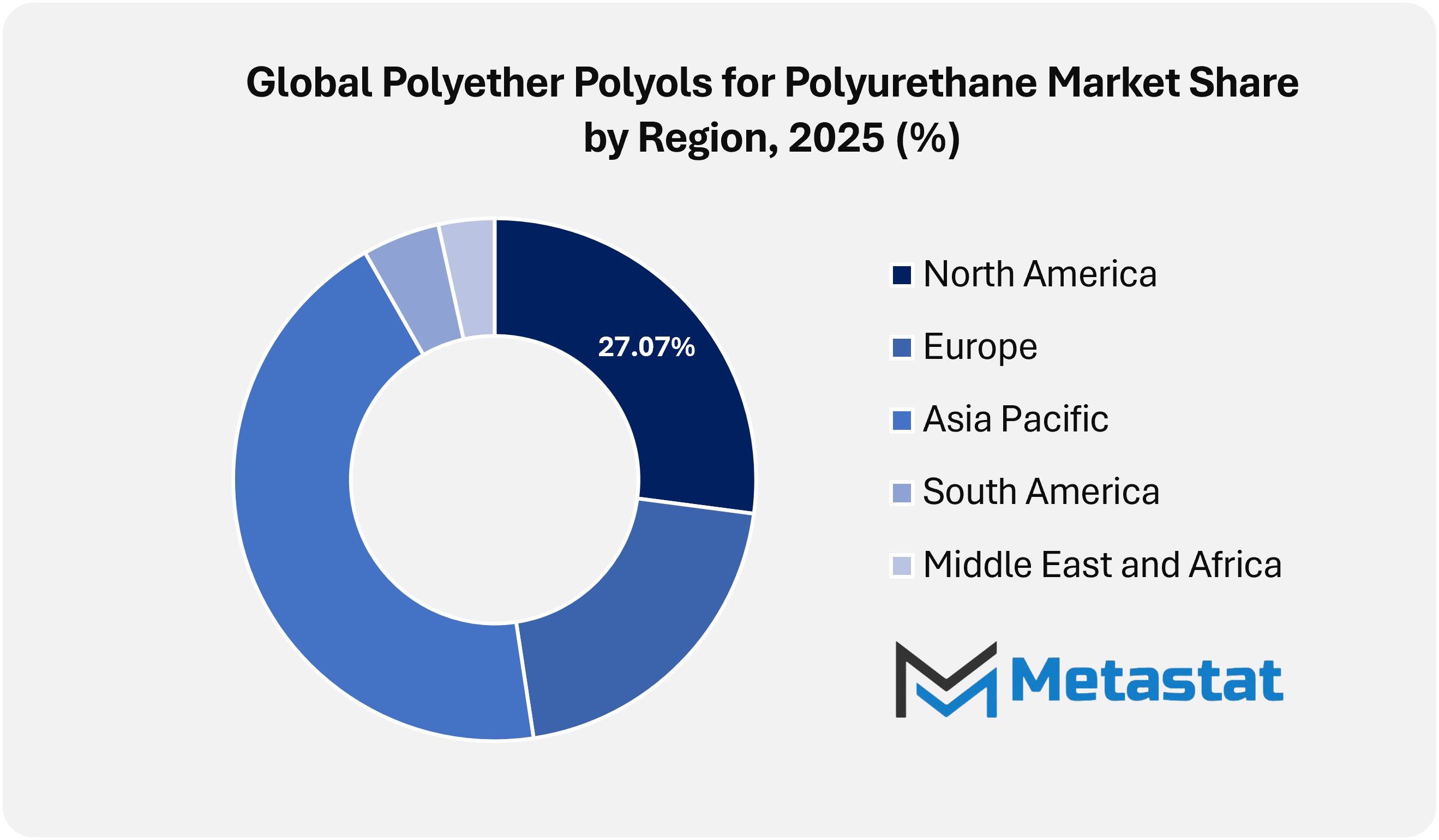
The Metastat Insights analysis shows that the North America Polyether Polyols for Polyurethane market size is estimated to be USD 6.3 billion by 2033.
PO-based polyols represent the leading type of segment in the global market.
Asia Pacific region dominates the market.
Global Polyether Polyols for Polyurethane market is estimated to reach USD 23.4 billion by 2033.
Top players operating in the Polyether Polyols for Polyurethane industry include Dow Chemical Company, Covestro AG, Shell Chemicals, BASF SE, Yadong Chemical Group, and AGC Chemicals Americas, Inc.
The Polyether Polyols for Polyurethane sales volume was 4,821.6 kilotons in 2024 with a estimated volume of 6,445.2 kilotons by 2032.
The analysts below cover Chemicals and Materials research at Metastat Insights.
LEAD ANALYST
Utkarsh Khirodkar is a Lead Market Research Analyst at MetaStat Insight, specializing in market intelligence, technology sector assessments, and competitive strategy.

INDUSTRY CONSULTANT - CHEMICALS & ADVANCED MATERIALS
Chemicals and Materials · Machinery & Equipment · Packaging
Amit Gadhekar Consultant for Chemicals and Materials at MetaStat Insight, directing sector-specific intelligence, research, and strategic consulting across global chemical and processing markets.
When evaluating distributed energy resource management systems, standard research summaries tend to gloss over the operational differences between front-of-the-meter utility deployments and behind-the-meter industrial sites. The MetaStat Insight report addressed those distinctions directly, especially regarding software interoperability standards and grid interconnection backlogs. The five-year market sizing across regional transmission organizations provided actionable context for our grid modernization strategy.
Most industry reports on warehouse automation bundle autonomous mobile robots and fixed conveyor installations into the same top-level numbers, which complicates advisory work. This study split the market cleanly by payload tiers, navigation technology, and fleet management software layers. The regional forecast for Western Europe gave our team defensible adoption benchmarks when evaluating capital allocation for logistics clients, saving us days of secondary data scrubbing.
Analyzing the transition from natural gas to green hydrogen in iron ore reduction requires realistic infrastructure timelines. Meta stat insight supplied a detailed regional assessment of DRI plant conversion costs and scrap metal availability in North America and Western Europe. Their report carefully examined pellet quality specs and electrical grid access constraints without making oversimplified market assumptions. The research material served as a practical reference during internal technology roadmap discussions.
Explore related market intelligence reports worth reading alongside this one.