
LEAD ANALYST
Utkarsh Khirodkar is a Lead Market Research Analyst at MetaStat Insight, specializing in market intelligence, technology sector assessments, and competitive strategy.

Global Smart Retail Market Size, Share, By Solution Type (Smart Point-of-Sale and Self-Checkout Systems, Electronic Shelf Labels and Smart Shelving Systems, Inventory and Merchandise Management Solutions, Retail Analytics and Customer Personalization Platforms, Virtual Try-On and Smart Fitting Solutions, Digital Signage and Interactive Retail Displays, Retail Security and Loss Prevention Solutions, Others), By Component (Hardware, Software, Services), By Technology (Artificial Intelligence and Computer Vision, Internet of Things and Connected Sensors, RFID and Wireless Identification Technologies, Augmented Reality and Virtual Reality, 3D Body Scanning and Garment Simulation, Robotics and Autonomous Navigation, Barcode and Optical Data Capture Technologies), By Retail Format (Supermarkets and Hypermarkets, Convenience Stores, Department Stores, Apparel and Footwear Stores, Consumer Electronics Stores, Pharmacies and Drugstores, Beauty and Personal Care Stores, Others), Industry Analysis, Growth, Trends, and Forecast, 2026-2033
Report ID
MSI-5473
Published
October, 2026
Pages
270 Pages
Format
Historical
Base year
Forecast
Forecast period
Report Details
Market Valuation: Valued at $53.9 Billion in 2025, projected to reach $462.2 Billion by 2033 at a 30.8% CAGR.
Dominant Segment: Smart Point-of-Sale and Self-Checkout Systems lead the market, driven by the need for operational efficiency and enhanced customer experiences. This segment is projected to grow significantly, reflecting retailers' shift towards digital transformation.
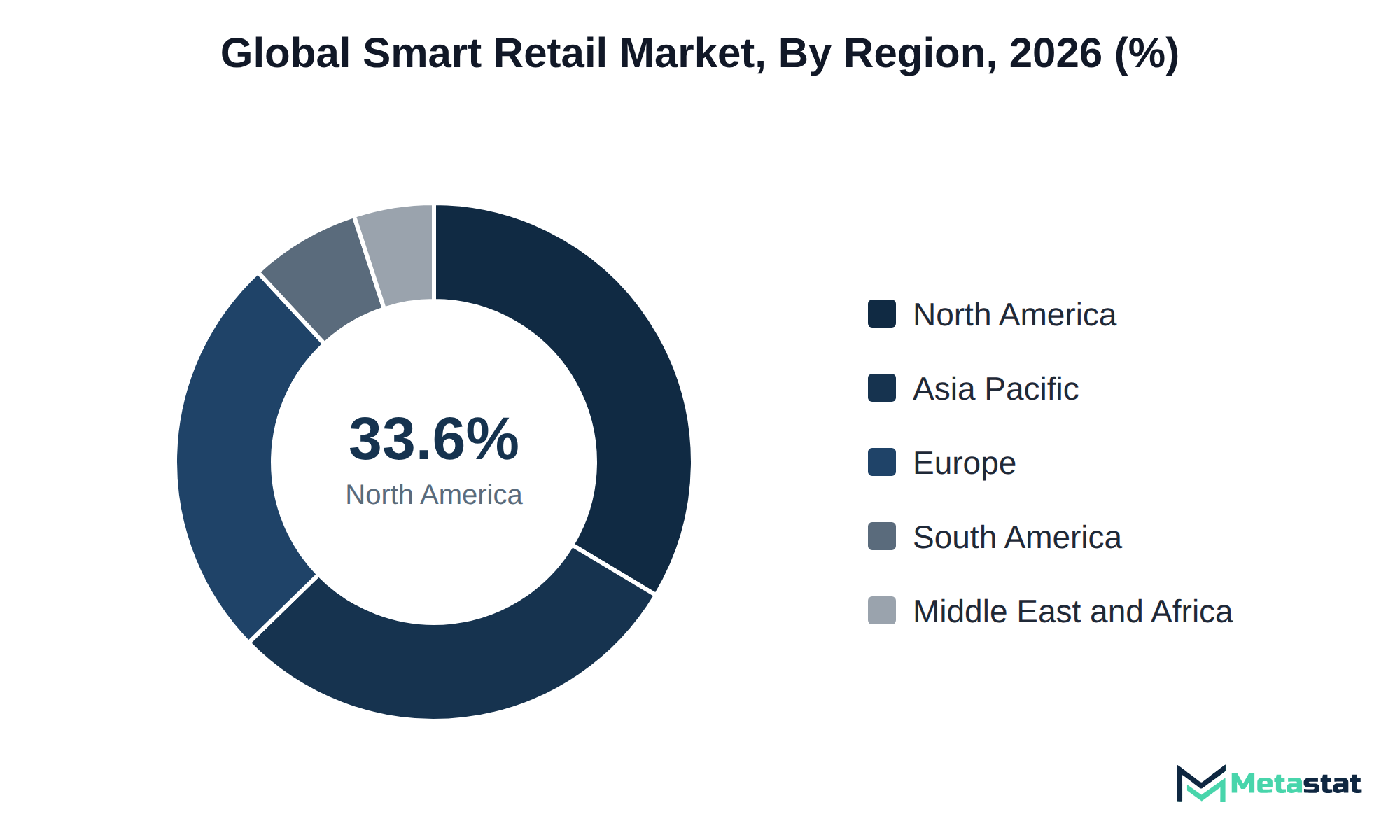
Geographic Lead: North America is the leading region, holding 33.6% of the market share in 2025, with the US expected to maintain this position in 2026. The region's strong technological infrastructure supports rapid adoption of smart retail solutions.
What's Inside: The report provides a comprehensive analysis of the Smart Retail market, including competitive coverage across various segments, detailed growth forecasts, and insights into technological advancements shaping the industry.
Emerging Technologies: AI-powered self-checkout systems and computer vision technologies are transforming in-store operations, with the segment projected to grow from USD 18.9 billion in 2026 to USD 107 billion by 2033, emphasizing efficiency and customer satisfaction.
Inventory Management Innovations: Electronic Shelf Labels and RFID technologies enhance real-time inventory visibility, with the segment expected to reach USD 53 billion by 2033, reflecting a CAGR of 33% as retailers seek effective pricing strategies.
Choose Your License
Global Smart Retail Market
The global Smart Retail market was valued at USD 53.9 billion in 2025 and is projected to reach USD 462.2 billion by 2033, growing at a CAGR of 30.8% over the forecast period.
The Smart Retail market encompasses a range of solutions designed to enhance the shopping experience, streamline operations, and improve inventory management. Investments in this market arise from the growing need for retailers to adapt to changing consumer behaviors and technological advancements. Buyers prioritize solutions that offer improved efficiency and better customer engagement, driving spending across various retail formats.
Growth in the market is propelled by the increasing adoption of advanced technologies, particularly in the area of Artificial Intelligence and Computer Vision. Supermarkets and Hypermarkets represent the segment with the highest value, reflecting significant consumer demand for enhanced shopping experiences. In terms of regional distribution, North America holds 33.6% of the market in 2025, with the US leading in 2026. This positioning highlights the region's strong infrastructure and technological readiness.
Investment in the Smart Retail market is expected to accelerate due to ongoing trends toward digital transformation and automation. The demand for solutions including Smart Point-of-Sale and Self-Checkout Systems illustrates the market's potential. By leveraging innovative technologies, retailers aim to optimize operations, create personalized shopping experiences, and drive revenue growth.
Investments in smart retail solutions reflect the importance of adapting to evolving consumer expectations and enhancing operational efficiency. Buyers in various sectors, including supermarkets, convenience stores, and department stores, prioritize technology that supports personalized shopping experiences and effective inventory management. The shift towards integration of digital and physical shopping environments drives spending in the market.
Growth in the smart retail sector is fueled by advancements in technology, particularly in artificial intelligence and the Internet of Things. These innovations enable enhanced data analytics, allowing retailers to optimize stock levels and improve customer engagement. Among the segments, Smart Point-of-Sale and Self-Checkout Systems represent the most significant value, while North America holds 33.6% of the market share in 2025, with the US leading in 2026.
The demand for smart retail solutions is expected to surge due to increasing consumer preferences for personalized shopping experiences. Retailers seek to implement systems that enhance operational efficiency and drive customer satisfaction. The market continues to evolve, with technology adoption leading to innovative solutions that reshape retail operations.
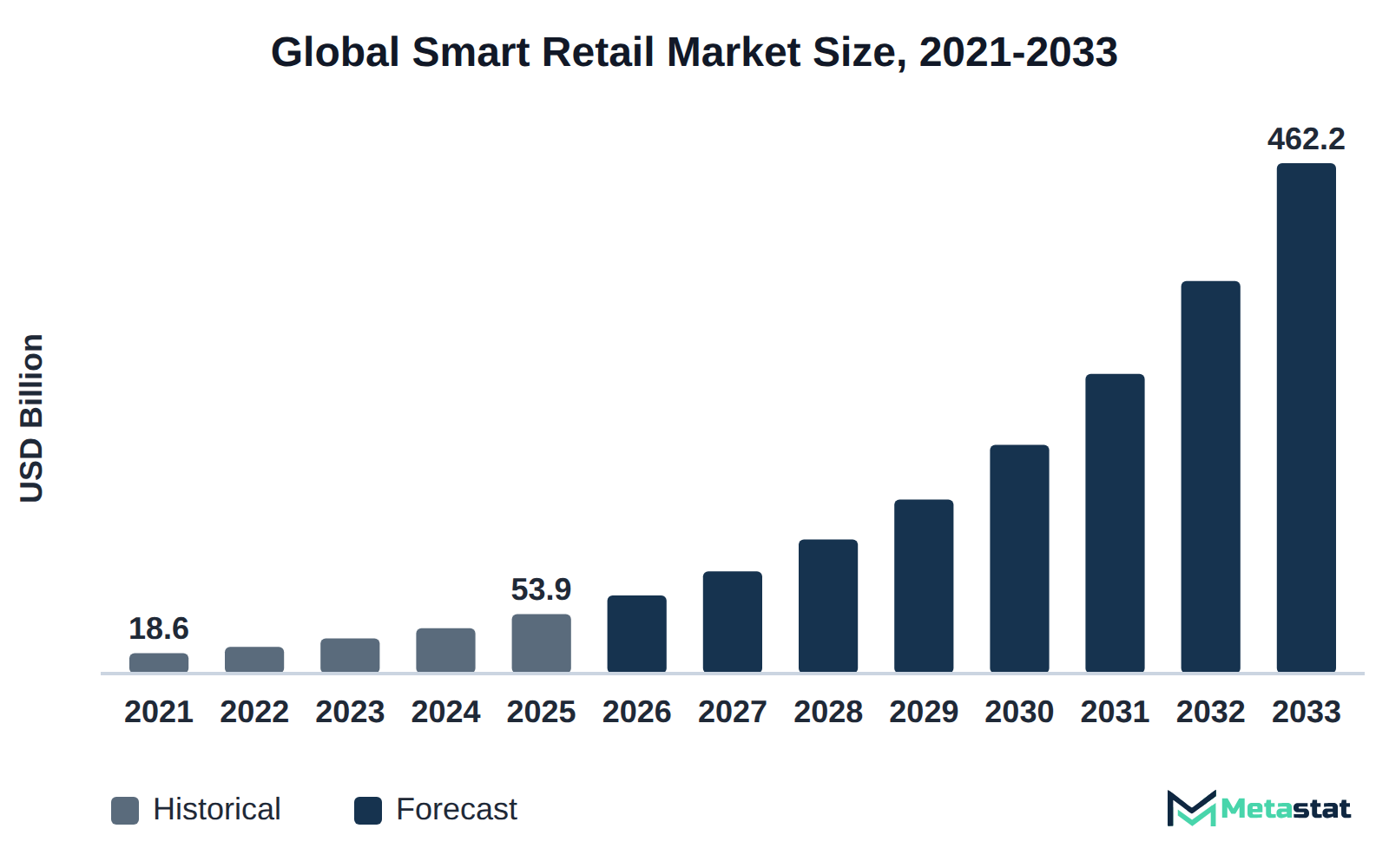
AI-powered self-checkout systems and computer vision technologies enhance in-store retail operations, improving customer experience and increasing operational efficiency. The Smart Retail market increasingly adopts these solutions, with smart point-of-sale and self-checkout systems projected to grow from USD 18.9 billion in 2026 to USD 107 billion by 2033, reflecting a compound annual growth rate of 28.1%. This growth is driven by the necessity for retailers to streamline operations and reduce labor costs while providing customers with an efficient shopping experience.
Computer vision technologies facilitate real-time inventory tracking and customer behavior analysis, enabling retailers to optimize product placement and enhance personalized marketing strategies. The integration of these technologies supports improved accuracy in self-checkout processes, reducing losses due to errors or theft. Retailers benefit from increased customer satisfaction through faster checkout experiences, leading to higher sales volume and improved profitability. In this competitive environment, the adoption of AI-powered solutions distinguishes innovative retailers, positioning them for growth in the evolving Smart Retail market.
Electronic Shelf Labels (ESLs) and RFID technologies significantly enhance inventory management within the Smart Retail market. These advancements facilitate real-time visibility of stock levels, allowing retailers to dynamically adjust pricing based on demand fluctuations. For instance, the segment for Electronic Shelf Labels and Smart Shelving Systems is expected to reach USD 53 billion by 2033, reflecting a compound annual growth rate of 33%. This rapid growth highlights the importance of ESLs in enabling retailers to execute effective pricing strategies and optimize inventory levels.
Buyers increasingly prefer solutions that integrate ESLs with robust software platforms for effective inventory management. Pricing models typically encompass upfront costs for hardware, along with recurring fees for software licenses and maintenance services. This structure ensures retailers remain aligned with the latest technological advancements while maintaining flexibility in their operational budgets. The emphasis on integrated solutions highlights how retailers prioritize systems that provide comprehensive visibility over inventory and pricing strategies.
By adopting ESLs alongside RFID technology, retailers enhance operational efficiency and improve customer experience. Real-time adjustments to pricing attract consumers and eliminate the risks associated with stockouts or overstock situations. Consequently, the Smart Retail market thrives on these technologies, driving demand for innovative inventory solutions that support agile retail environments.
Virtual try-on technology and AI-driven personalization significantly enhance the apparel shopping experience, directly impacting customer conversion rates. The segment of Virtual Try-On and Smart Fitting Solutions is increasingly popular among consumers seeking more engaging and tailored shopping experiences. By integrating these technologies, retailers improve customer satisfaction and reduce return rates, which have traditionally plagued the online apparel market.
Forecasts indicate that retail analytics and customer personalization platforms are set to grow at a compound annual growth rate (CAGR) of 33% through 2033. This growth reflects a broader trend where personalized shopping experiences lead to increased customer loyalty and repeat purchases. Retailers leveraging these advancements are positioned to attract discerning consumers who prioritize convenience and engagement in their buying journeys. The Smart Retail market is experiencing a significant shift toward solutions that enhance customer interaction and satisfaction within the apparel segment.
Retailers increasingly evaluate the return on investment (ROI) from Smart Retail technologies and store automation through specific performance metrics. A significant aspect of this evaluation centers on the effectiveness of Smart Point-of-Sale (POS) and Self-Checkout Systems. This growth indicates a substantial shift in how retailers approach customer transactions, emphasizing efficiency and enhanced customer experiences.
By leveraging data analytics, retailers track sales performance, customer behavior, and operational efficiency. The focus on these metrics allows for a clearer understanding of how investments in Smart Retail technologies translate into increased sales and reduced operational costs. The ongoing demand for robust analytics and customer personalization platforms, projected to grow at a CAGR of 33%, illustrates the market's shift towards data-driven decision-making.
Ultimately, the ability to measure ROI effectively influences investment decisions in the Smart Retail market, leading retailers to adopt advanced technologies that support growth and profitability. This analytical approach ensures that investments align with strategic objectives, providing a competitive advantage in a changing retail environment.
Retailers increasingly prioritize enhancing customer experience to drive sales and improve brand loyalty. The shift toward personalized and engaging shopping environments has prompted significant investment in advanced retail technologies. Retailers, particularly in the supermarkets and convenience stores segment, are adopting solutions like smart point-of-sale systems and digital signage. These technologies enable smooth transactions and improve product visibility. The increased deployment of smart retail technologies reflects a broader recognition of the adapt to evolving consumer expectations. The Smart Retail market is projected to reach USD 462.2 billion by 2033, indicating a strong growth trajectory fueled by a growing emphasis on improving customer satisfaction and operational efficiencies. This trend leads to an expected rise in both volume and pricing strategies as retailers seek to differentiate themselves in a competitive environment.
Technological advancements in inventory management play a crucial role in the growth of the market. Smart Point-of-Sale systems and Inventory and Merchandise Management Solutions provide retailers with real-time data, enabling efficient stock management and streamlined operations. This shift towards intelligent inventory practices results from increasing demand for operational efficiency and accuracy across various retail formats. Retailers adopting these technologies experience minimized stockouts and overstock situations, directly affecting profitability.
The integration of Internet of Things devices and connected sensors transforms how retailers monitor inventory levels and product movements. Enhanced visibility into supply chains allows for timely restocking and optimal product placement. The adoption of such technologies across sectors, particularly in supermarkets and hypermarkets, leads to significant operational savings. Overall, enhanced inventory management solutions contribute to the market's expected growth, allowing retailers to meet consumer demands while improving overall profitability.
Regulatory barriers significantly impact the adoption of advanced technologies in the Smart Retail market, particularly among smaller retailers. These companies often lack the resources to navigate complex compliance requirements associated with integrating smart technologies. Compliance with local, state, or national standards imposes financial and operational burdens that slow the decision-making process, leading to smaller orders and delayed replacements of outdated systems.
The need for extensive training and adjustment to new technologies further complicates implementation efforts. Retailers face challenges in ensuring that staff are adequately prepared to operate new systems, which contributes to the reluctance to invest in upgrades. This restraint affects overall market growth, limiting the potential for innovation and competitive advantage among retailers struggling to adapt.
The segment of Smart Point-of-Sale and Self-Checkout Systems represents a significant opportunity within the Smart Retail market. Retailers increasingly seek these systems to enhance operational efficiency and improve customer experience. This demand arises from the ongoing digital transformation within the retail sector, where effective payment solutions have become essential. Integration of advanced technologies, including artificial intelligence and contactless payments, further accelerates this adoption trend.
Retailers in various sectors, particularly grocery and convenience stores, leverage Smart Point-of-Sale systems to streamline transactions and reduce checkout times. These systems not only facilitate faster service but provide valuable data analytics capabilities, enabling retailers to better understand customer preferences and enhance inventory management. The focus on improving the shopping experience positions this segment as a key driver of growth in the market, highlighting the need for continuous innovation in payment technologies and customer engagement strategies.
The Global Smart Retail market is segmented based on Solution Type, Component, Technology, and Retail Format.
These systems serve retailers by facilitating transactions and improving customer experience through efficient payment processing. Increasing consumer preference for self-service options drives demand, particularly among supermarkets and convenience stores. This segment distinguishes itself through higher growth compared to other segments, fueled by advancements in technology, including artificial intelligence and machine learning. The adoption of smart point-of-sale systems enhances operational efficiency and reduces labor costs, differentiating it from traditional payment solutions. Other segments, including Inventory and Merchandise Management Solutions, experience slower growth rates, reflecting varying customer priorities and technological integration challenges. The Smart Retail market thrives on innovations that improve consumer interactions and streamline retail processes.
Electronic Shelf Labels (ESLs) enhance pricing strategy and inventory management for retailers by providing real-time updates on product prices and stock levels. Retailers deploying this technology include supermarkets, hypermarkets, and convenience stores, where efficient inventory management is crucial for profitability. The rapid advancement in ESL technology drives demand, owing to retailers seeking to improve customer experience and operational efficiency. This segment exhibits faster growth compared to the broader market, with a CAGR of 33%, reflecting stronger demand for innovative solutions compared to other solution types including traditional inventory management systems, which exhibit slower growth rates. The focus on sustainability and reducing labor costs further supports the adoption of ESLs, offering significant advantages over conventional methods.
Inventory and Merchandise Management Solutions segment is expected to reach USD 64.8 billion by 2033. This segment focuses on optimizing inventory levels and streamlining merchandise management for retailers. Retailers, ranging from supermarkets to apparel stores, apply these solutions to enhance operational efficiency and reduce costs associated with overstocking and stockouts. The growing trend of digital transformation in retail drives demand for these solutions, with a particular emphasis on software integration. Unlike other segments, the growth rate of this segment aligns closely with advancements in technology, achieving a CAGR of 33% which is competitive compared to segments like Smart Point-of-Sale and Self-Checkout Systems. This differentiates it by catering to retailers aiming for precision in inventory control amid increasing consumer demand for availability and speed in product delivery. The market continues to evolve, focusing on integrating artificial intelligence and data analytics for improved decision-making.
Retail Analytics and Customer Personalization Platforms segment is projected to grow at a CAGR of 33% during the forecast period. This segment analyzes customer behavior and preferences while providing personalized shopping experiences. Retailers leverage these platforms to enhance customer engagement and drive sales through targeted marketing strategies. The increasing demand for data-driven insights significantly influences this segment, driven by companies aiming to optimize operations and improve customer satisfaction. In comparison to other segments, this segment exhibits faster growth, reflecting the rising importance of personalized customer experiences in retail. Retail analytics technologies provide critical advantages by enabling retailers to tailor offerings and enhance brand loyalty among consumers. The market embraces this trend, highlighting a shift toward more sophisticated customer interaction methodologies.
Virtual Try-On and Smart Fitting Solutions employ augmented reality to improve apparel shopping experiences, allowing customers to visualize how clothing fits without physically trying them on. Retailers in the fashion and apparel sectors leverage this technology to boost customer engagement and conversion rates. The growing emphasis on personalization and convenience drives adoption, with consumers increasingly seeking tailored shopping experiences. This solutions type sees faster growth due to its ability to meet contemporary consumer demands for innovation in shopping methods. The technology differentiates itself through its focus on enhancing customer interaction and satisfaction, positioning it above traditional fitting solutions.
Digital signage and interactive retail displays enhance customer engagement by providing dynamic visual content and interactive experiences within retail environments. These technologies serve a variety of industries, including grocery, apparel, and electronics, where captivating displays attract shoppers and promote products effectively. Demand for these displays increases due to the need for retailers to differentiate themselves in a competitive market. The segment's growth is driven by advancements in display technology and improved content management systems. Compared to other solutions, including smart point-of-sale systems, this segment experiences distinct challenges due to higher implementation costs and the necessity for ongoing content updates and management. Retailers investing in digital signage seek solutions that attract consumers and drive sales without the immediate transactional focus found in more traditional smart retail solutions. This emphasis on long-term engagement indicates the unique strategic role digital signage plays in the broader smart retail market.
Retail Security and Loss Prevention Solutions encompass technologies designed to safeguard retail assets and prevent theft, fraud, and other security challenges. These solutions are essential for retailers prioritizing minimizing losses and enhancing operational efficiency. Retailers increasingly adopt advanced surveillance systems and loss prevention strategies driven by the rising threat of retail crime. The demand for these solutions reflects a growing recognition of their critical role in protecting profit margins and maintaining a secure shopping environment. Compared to other segments, this sub-segment experiences slower growth due to higher investment costs associated with implementing comprehensive security systems. However, the increasing integration of artificial intelligence and analytics into security solutions enhances their effectiveness, providing retailers with valuable insights into customer behavior and potential risks. While the market evolves, investment in security technologies continues to represent a vital strategy for retailers seeking to build consumer trust and ensure a safe shopping experience.
Smart vending systems and store energy management solutions enhance retail operations by optimizing inventory and improving energy efficiency. These technologies serve retailers focused on automating processes and reducing operational costs. Smart vending systems provide automated kiosks that dispense products while collecting consumer data, appealing to convenience-oriented customers. Store energy management solutions monitor energy consumption, allowing retailers to cut costs and achieve sustainability goals. Key drivers include the increasing demand for automation in retail environments and the growing emphasis on energy efficiency. This sub-segment experiences slower growth compared to more established categories like smart point-of-sale systems, with adoption remaining concentrated among tech-savvy retailers willing to invest in innovative solutions. The Smart Retail market features diverse technologies, each catering to specific operational needs, highlighting the importance of tailored solutions for various retailer demands.
Hardware segment is valued at USD 33.1 billion in 2026 and is projected to reach USD 190.7 billion by 2033, at a CAGR of 28.4% during the forecast period. This segment comprises physical devices in smart retail environments, including point-of-sale terminals, self-checkout systems, and electronic shelf labels. Retailers leverage these hardware solutions to enhance operational efficiency and improve customer experiences. The strong demand for advanced hardware solutions is driven by the increasing emphasis on automation and real-time data access within retail operations. Compared to other components, including software and services, the hardware segment shows significant growth due to the crucial role it plays in the overall smart retail infrastructure. By 2033, hardware is anticipated to achieve a share of the market, supporting the expansion of digital solutions across various retail formats.
The software segment is estimated to reach USD 183.7 billion by 2033, at a CAGR of 33% during the forecast period. This segment encompasses various applications used for data analysis, customer relationship management, and operational efficiency in retail environments. Retailers leverage software solutions to improve customer experiences and streamline operations. Advanced analytics tools contribute significantly to this trend by providing insights into consumer behavior, purchasing patterns, and inventory management. The increasing emphasis on data-driven decision-making drives the growth of this segment at a faster rate compared to hardware solutions, which have a lower CAGR of 28.4%. Retailers focusing on personalization initiatives and enhanced customer engagement find particular value in these software applications, reinforcing their role in the evolving smart retail market.
The services segment is expected to reach USD 87.8 billion by 2033. This segment includes essential offerings that support the implementation and operation of various retail technologies, catering mainly to retailers seeking to enhance efficiency and customer experiences. Demand for services is driven by the increasing complexity of retail operations and the necessity for ongoing technical support. Compared to other components, services experience slower growth, with a distinct focus on customer training, system integration, and maintenance, which differentiates it from faster-growing segments like software. Businesses in sectors including e-commerce and brick-and-mortar retail leverage these services to streamline processes and adopt new technologies effectively, ensuring sustainable operations. In the Smart Retail market, investments in services remain critical for maximizing the value derived from technology deployments.
Artificial Intelligence and Computer Vision segment is valued at USD 18.4 billion in 2026 and is projected to reach USD 134.9 billion by 2033, at a CAGR of 33% during the forecast period. This segment finds application in enhancing customer experiences and optimizing operational efficiencies through advanced data analytics and real-time decision-making. Retailers, especially in high-traffic environments, increasingly adopt these technologies to improve inventory accuracy and personalize customer interactions. The rapid growth in this segment is driven by advancements in computer vision algorithms and increased investment in artificial intelligence. Compared to other segments, this sub-segment exhibits faster growth, supported by a robust CAGR of 33%, distinguishing itself through its focus on innovative customer engagement strategies and operational insights that yield higher returns on investment.
Internet of Things and Connected Sensors segment is estimated to reach USD 93.3 billion by 2033, at a CAGR of 29% during the forecast period. This segment enhances operational efficiencies for retailers by enabling real-time monitoring and management of inventory, customer behavior, and store environments. Retailers implement Internet of Things solutions to optimize supply chains and improve customer experiences through data-driven insights. The growing emphasis on automation and data analytics strengthens demand for this segment. Compared to other technology segments, this segment exhibits a competitive CAGR, reflecting a significant growth trajectory driven mainly by technological advancements and increased adoption of connected devices. Unlike the Artificial Intelligence and Computer Vision segment, which carries a higher initial investment, Internet of Things and Connected Sensors appeal to a broader range of retailers seeking scalable solutions.
RFID and Wireless Identification Technologies segment is expected to reach USD 68.9 billion by 2033. This technology facilitates real-time tracking and inventory management, primarily employed by retailers to optimize supply chain operations and enhance customer experiences. The increasing demand for efficient inventory management and loss prevention drives growth within this segment. Compared to other technologies, RFID offers higher accuracy and speed, distinguishing it from solutions including barcode scanning. The segment's projected growth aligns with the overall trend of digital transformation in retail, where businesses aim to improve operational efficiency and customer engagement. This focus on enhancing operational capabilities positions RFID technologies as essential components for retail success in the evolving market.
Augmented Reality and Virtual Reality segment is projected to grow at a CAGR of 32.5% during the forecast period. This segment enhances consumer experiences by providing immersive and interactive environments, allowing retailers to engage customers through visual and experiential elements. Adoption is driven by increasing demand from retailers seeking to differentiate themselves in a competitive landscape. This technology finds use in various formats, enabling customers to visualize products effectively. Compared to other segments, including Inventory and Merchandise Management Solutions, which target operational efficiencies, augmented reality and virtual reality focus on customer engagement and experience enhancement. This segment is expected to attract investments due to its unique ability to create memorable shopping experiences, setting it apart from others that prioritize transaction-based improvements. Target buyers include supermarkets, department stores, and specialized retailers looking to innovate customer interactions.
3D Body Scanning and Garment Simulation employs advanced imaging technology to create precise digital representations of a customer's body shape. Retailers and apparel brands apply this technology to enhance fitting experiences and reduce return rates associated with sizing issues. Increasing demand for personalization drives this segment, with consumers seeking tailored solutions for clothing fit. The segment distinguishes itself from others through its focus on accurate body representation, setting it apart from conventional fitting technologies. The rising emphasis on customer experience in retail supports growth in this area. Unlike other segments within the technology classification, this segment addresses a unique consumer challenge, contributing to evolving shopping behaviors in the Smart Retail market.
Robotics and Autonomous Navigation apply advanced technologies to automate processes in retail environments, improving efficiency and enhancing customer experience. These systems find application in various sectors, including supermarkets and warehouses, where they streamline inventory management and assist with customer interactions. The increasing demand for operational efficiency drives growth in this segment, particularly among large retailers seeking to reduce labor costs and enhance service delivery. Compared to other technology segments, including Artificial Intelligence and Computer Vision, Robotics and Autonomous Navigation focus on physical tasks rather than data analysis, positioning them uniquely in the Smart Retail market. Buyers in this segment include large retail chains and logistics companies, seeking to implement automated solutions that provide long-term savings and operational benefits. The evolution of robotics technology continues to influence adoption rates, with advancements in AI integration enhancing the functionality and appeal of robotic solutions.
Barcode and Optical Data Capture Technologies streamline the process of tracking and managing inventory through the utilization of scanning devices and imaging technologies. Retailers, logistics companies, and manufacturers rely on these solutions to capture data efficiently, enhancing productivity and accuracy in operations. Increasing demand for automation and accuracy drives the adoption of these technologies across various sectors, improving supply chain management and customer experiences. Compared to other segments, including Artificial Intelligence and Computer Vision, this segment experiences more stable growth patterns driven by established applications in inventory management. Barcode and Optical Data Capture Technologies stand out due to lower initial investment requirements, making them accessible to a broader range of small and mid-sized retailers. The market continues to evolve with advancements in scanning technologies, ensuring relevance and competitive advantage in a dynamic retail environment.
Supermarkets and Hypermarkets segment is valued at USD 21.2 billion in 2026 and is projected to reach USD 127.7 billion by 2033, at a CAGR of 29.2% during the forecast period. This segment encompasses large retail establishments that offer a wide variety of food and non-food products, catering to diverse customer needs. The growing preference for one-stop shopping experiences drives this segment, with consumers valuing convenience and product variety. Advancements in technology, including automated checkout systems and inventory management solutions, enhance operational efficiency. Compared to other retail formats, this segment experiences a faster growth rate, reflecting strong consumer demand and significant investment in smart retail technologies. The Smart Retail market is expected to evolve, with supermarkets and hypermarkets adopting innovative solutions to improve customer experience and streamline operations.
Convenience Stores segment is estimated to reach USD 77.3 billion by 2033, at a CAGR of 32.6% during the forecast period. This retail format serves urban consumers seeking quick access to a wide range of products, including groceries and everyday essentials. Increased consumer preference for convenience and time efficiency drives demand in this segment, attracting significant investments in technology and infrastructure. In comparison to other segments, including Supermarkets and Hypermarkets, which exhibit a CAGR of 29.2%, convenience stores expand at a faster rate, reflecting a shift in shopping behaviors. The segment's growth is further supported by innovations in smart technologies that enable retailers to enhance customer experiences and streamline operations. These advancements position convenience stores as an essential component of the Smart Retail market, catering to the evolving preferences of modern consumers.
Department Stores segment is expected to reach USD 51.2 billion by 2033. This segment caters to consumers seeking a diverse range of products, from clothing to electronics, all under one roof. Growing consumer expectations for a convenient shopping experience drive demand within this segment. Retailers increasingly adopt advanced technologies to enhance customer service and optimize inventory management. The Department Stores segment exhibits a slower growth rate compared to others, with a CAGR reflecting broader market trends. This slower pace is attributed to the rise of specialized retail formats that attract price-sensitive and convenience-oriented shoppers. The increased focus on personalized shopping experiences and digital integration within department stores distinguishes it from other segments in the market.
Apparel and Footwear Stores segment is projected to grow at a CAGR of 32.8% during the forecast period. This segment serves retailers specializing in clothing and footwear, leveraging smart technologies to enhance customer experiences and streamline operations. Strong consumer demand for personalized shopping experiences drives growth in this area, with retailers adopting solutions including virtual fitting rooms to engage customers more effectively. Compared to other retail formats, the segment exhibits faster growth, driven by its innovative approach to retailing. Technologies employed focus on improving customer interaction, which distinguishes it from slower-growing segments. The market anticipates significant investment in smart retail technologies, positioning the Apparel and Footwear Stores segment as a leading contributor to overall market expansion.
Consumer Electronics Stores focus on selling various electronic devices and appliances, serving a wide range of customers from individual consumers to businesses. These stores employ advanced technologies to enhance customer engagement and streamline operations. Demand in this segment is driven primarily by the increasing adoption of smart devices and growing consumer expectations for personalized shopping experiences. Compared to other retail formats, this segment experiences a competitive edge in technology integration, making it more adaptable to emerging trends. While several segments experience faster growth rates, distinct technological advancements in Consumer Electronics Stores position it uniquely within the Smart Retail market. The need for effective inventory management solutions and data analytics tools continues to influence the purchasing decisions of retailers in this segment.
Pharmacies and Drugstores encompass retail formats focused on the sale of medications, health products, and personal care items. These establishments serve a diverse customer base including individuals seeking prescription medications, over-the-counter drugs, and health-related services. The adoption of technology, particularly advanced point-of-sale systems and inventory management solutions, drives efficiency and enhances customer experience in this segment. Demand for personalized healthcare solutions influences growth; customers increasingly seek tailored services. This segment differentiates itself from others by maintaining a consistent need for compliance with health regulations, which create barriers to rapid technological integration. Unlike other retail formats, Pharmacies and Drugstores emphasize health-related products, resulting in unique purchasing patterns and customer interactions. The Smart Retail market is expected to evolve in response to the specific needs of this segment, focusing on improving patient care and optimizing supply chain management.
Beauty and Personal Care Stores focus on delivering cosmetics, skincare products, and personal care items to consumers. These retail environments serve a diverse clientele, ranging from individuals seeking beauty solutions to professionals in the cosmetic industry. A significant force driving this segment involves the growing consumer emphasis on personal grooming and wellness, which fuels demand for high-quality products and innovative solutions. This sector distinguishes itself through higher price points compared to convenience stores, reflecting the premium nature of the products offered. Consumer preferences for personalized experiences and tailored product recommendations through retail analytics and customer personalization platforms enhance engagement and loyalty. The Smart Retail market supports technological integration in these stores, ensuring a smooth shopping experience through advanced solutions that cater specifically to this dynamic segment.
Others encompass retail formats including jewellery stores, sporting goods stores, and pet stores. These establishments cater to niche markets, providing specialized products that appeal to specific consumer preferences. The demand for technological advancements within these retail formats stems from the desire to enhance customer experience and streamline operations. Factors driving this segment include the growing trend of personalized shopping experiences and the integration of advanced technology to improve inventory management. Compared to larger formats like supermarkets and hypermarkets, these stores often experience slower growth due to market saturation and competition. However, the focus on customer engagement and tailored offerings creates unique opportunities for growth in the smart retail market.
Based on geography, the Global Smart Retail market is divided into North America, Europe, Asia-Pacific, South America, Middle East, and Africa.
The demand for innovative technologies in the Smart Retail market is significant in North America, particularly driven by the presence of advanced retail ecosystems in the United States, Canada, and Mexico. These countries emphasize the integration of smart point-of-sale systems and inventory management solutions, facilitating enhanced customer experiences and operational efficiency. The region's projection to reach USD 143.1 billion by the end of 2033 highlights its important role in the global market landscape. Infrastructure investments, particularly in digital payment systems and data analytics, support this growth. The focus on sustainability and energy efficiency in retail operations reflects changing consumer preferences and regulatory pressures. Overall, the Smart Retail market in North America exhibits strong potential due to technological advancements and shifting consumer behavior.
The Smart Retail market in Europe reflects a diverse and evolving landscape, driven by countries including Germany, France, the UK, Italy, and Spain. The region's prominent focus on technology, especially in retail analytics and customer personalization platforms, enhances competition among retailers striving to improve customer experiences. The presence of well-established infrastructure supports the deployment of advanced technologies, including Artificial Intelligence and Internet of Things, which play crucial roles in streamlining operations and boosting efficiency. Europe holds a significant share of the global market, indicating growth potential for the coming years, with companies in this region investing in innovative solutions to enhance their offerings and meet changing consumer demands. The Smart Retail market continues to expand, with projections indicating a growing emphasis on electronic shelf labels and smart shelving systems, driven by the need for increased inventory management efficiency.
In Asia-Pacific, the Smart Retail market thrives due to rapid digital transformation across various sectors. Key drivers include increasing adoption of Artificial Intelligence and Computer Vision in retail applications, significantly enhancing customer engagement and operational efficiency. Countries like China and India lead in investments toward advanced retail technologies, supported by robust infrastructure and a growing middle class. The focus on enhancing consumer experiences through smart technologies aligns with rising demand for personalized shopping experiences. By 2025, this region is projected to capture 29.1% of the global market share, with substantial growth anticipated through 2033. The commitment to integrating smart solutions positions Asia-Pacific as a critical player in the evolution of the market.
Brazil and Argentina represent key markets within the Smart Retail market, driven by increasing urbanization and a growing middle class. Infrastructure improvements have facilitated the adoption of advanced retail technologies, enhancing customer experiences and operational efficiency. The rise of e-commerce in these countries has further spurred demand for innovative solutions including smart point-of-sale systems and retail analytics platforms. The share of South America in the global market reflects the region's gradual integration of smart retail technologies. Investments in digital transformation initiatives are expected to strengthen market presence in Brazil and Argentina through 2033, supporting enhanced retail environments.
The Smart Retail market in the Middle East and Africa faces unique dynamics, driven by a growing emphasis on digital transformation among retailers. In Saudi Arabia and the UAE, investments in advanced technologies enhance operational efficiency and customer engagement. South Africa experiences a rising trend of retail modernization, especially in urban areas. The market reflects a share of 5.00% of the global market in 2025. Challenges related to infrastructure and cost conditions persist, influencing adoption rates. While the region continues to develop its retail ecosystems, the demand for innovative solutions remains robust, supporting ongoing growth in the Smart Retail market.
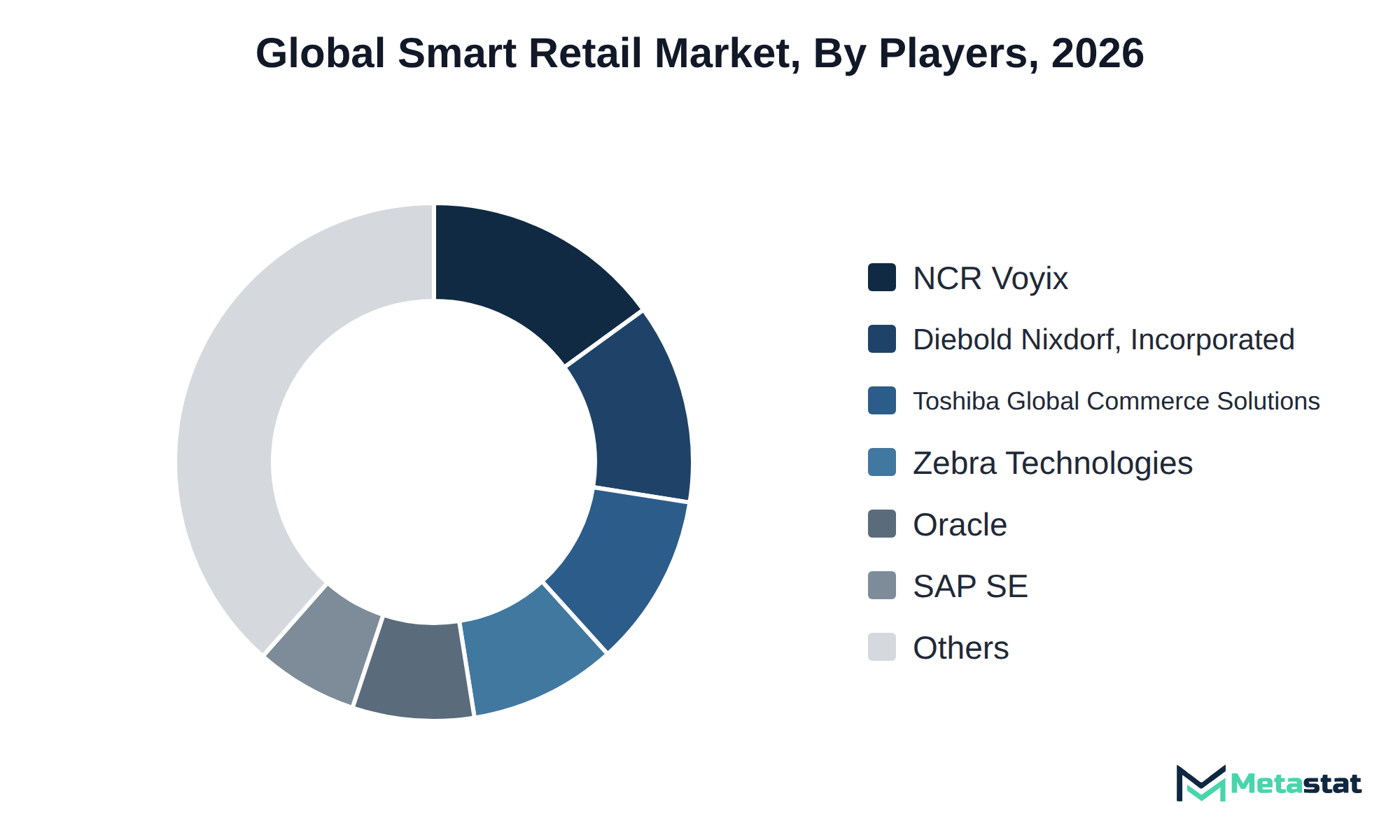
Companies in the smart retail market differentiate themselves through pricing strategies, technological innovation, and the breadth of services offered. Buyers often choose based on the combination of price, customization options, and service support. A strong ecosystem featuring various solutions enhances the overall value proposition.
NCR Voyix Corporation focuses on advanced point-of-sale solutions and self-checkout systems, targeting large retail chains seeking to streamline operations. In contrast, Zebra Technologies Corporation emphasizes data capture technologies, enabling retailers to enhance inventory management and operational efficiency. Oracle Corporation primarily offers integrated software solutions designed for retail analytics and customer personalization, appealing to businesses aiming to improve customer engagement.
Competition within the market is further influenced by the emphasis on innovative technologies. Companies like Huawei Technologies Co., Ltd. and Samsung Electronics Co., Ltd. leverage their expertise in hardware and IoT solutions to drive growth. These firms cater to increasingly tech-savvy consumers seeking effective integration and intelligent retail experiences.
Solutions from companies including Diebold Nixdorf, Incorporated focus on enhancing the security aspects of retail environments, while Simbe Robotics, Inc. offers robotic solutions for inventory management, highlighting the diverse capabilities available in the market. This strategic diversity ensures that retail businesses access a range of options to meet their specific operational needs and preferences, supporting overall effectiveness.
Achieving this growth relies on several key developments in the Smart Retail market. Firstly, the adoption of Smart Point-of-Sale and Self-Checkout Systems, projected to expand from USD 18.9 billion in 2026 to USD 107 billion by 2033, will enhance operational efficiency and customer experience in retail formats including supermarkets and hypermarkets. Secondly, the integration of Artificial Intelligence and Computer Vision technologies, expected to increase from USD 18.4 billion in 2026 to USD 134.9 billion by 2033, has the potential to drive innovation in inventory management and customer personalization across various segments. However, the market faces risks, particularly in regulatory compliance and cybersecurity vulnerabilities, which could hinder growth. For instance, businesses in the European region encounter stricter regulations, impacting their ability to implement advanced retail technologies effectively. Addressing these challenges while capitalizing on technological advancements will be crucial for realizing the forecasted market value.
By Solution Type: Smart Point-of-Sale and Self-Checkout Systems, Electronic Shelf Labels and Smart Shelving Systems, Inventory and Merchandise Management Solutions, Retail Analytics and Customer Personalization Platforms, Virtual Try-On and Smart Fitting Solutions, Digital Signage and Interactive Retail Displays, Retail Security and Loss Prevention Solutions, Others (Smart Vending Systems, Store Energy Management Solutions)
By Component: Hardware, Software, Services
By Technology: Artificial Intelligence and Computer Vision, Internet of Things and Connected Sensors, RFID and Wireless Identification Technologies, Augmented Reality and Virtual Reality, 3D Body Scanning and Garment Simulation, Robotics and Autonomous Navigation, Barcode and Optical Data Capture Technologies
By Retail Format: Supermarkets and Hypermarkets, Convenience Stores, Department Stores, Apparel and Footwear Stores, Consumer Electronics Stores, Pharmacies and Drugstores, Beauty and Personal Care Stores, Others (Jewellery Stores, Sporting Goods Stores, Pet Stores)
The report strategically identifies and profiles the key market players and analyses their core competencies in each sub-segment of the Smart Retail market.
Report Attributes | Details |
Study Period | 2021-2033 |
Base Year | 2025 |
Estimated Year | 2026 |
Forecast Period | 2026-2033 |
Historical Period | 2021-2025 |
Growth Rate | CAGR 30.8% from 2026 to 2033 |
Revenue Unit | USD billion |
Segmentation | By Solution Type, Component, Technology, Retail Format, and Region |
By Region | North America (By Solution Type, Component, Technology, Retail Format, and Country)
|
Europe (By Solution Type, Component, Technology, Retail Format, and Country)
| |
Asia Pacific (By Solution Type, Component, Technology, Retail Format, and Country)
| |
South America (By Solution Type, Component, Technology, Retail Format, and Country)
| |
Middle East and Africa (By Solution Type, Component, Technology, Retail Format, and Country)
|
Find answers to common questions about this report
The Smart Retail market size was valued at USD 53.9 billion in 2025.
The market is projected to grow at a CAGR of 30.8% during the forecast period from 2026 to 2033.
The North America Smart Retail market size is estimated to reach USD 143.1 billion by 2033.
Smart Point-of-Sale and Self-Checkout Systems lead the Smart Retail market, with a projected value of USD 107 billion by 2033. This segment demonstrates significant growth potential, driven by increasing demand for efficient transaction solutions.
Enhanced customer experience drives investment in advanced retail technologies. Technological advancements in inventory management contribute to operational efficiency and profitability.
North America holds the dominant share of the Smart Retail market, with a projected value of USD 143.1 billion in 2033, representing 33.6 percent of the total market. This figure surpasses the shares of other regions, including Europe and Asia Pacific.
Regulatory barriers significantly impact the adoption of advanced technologies, particularly among smaller retailers who face financial and operational burdens from compliance requirements. The need for extensive training and adjustment to new technologies complicates implementation efforts and contributes to reluctance in investing in upgrades.
The demand for advanced technology solutions, including artificial intelligence and Internet of Things applications, continues to grow. Retailers increasingly seek Smart Point-of-Sale and Self-Checkout Systems to enhance operational efficiency and improve customer experience, driving adoption in the industry.
The Smart Retail market is estimated to reach a valuation of USD 462.2 billion by 2033.
Key players operating in the Smart Retail market include NCR Voyix Corporation, Diebold Nixdorf, Incorporated, Toshiba Global Commerce Solutions, Inc., Zebra Technologies Corporation, Oracle Corporation, SAP SE, and Microsoft Corporation.
The analysts below cover Machinery & Equipment research at Metastat Insights.
LEAD ANALYST
Utkarsh Khirodkar is a Lead Market Research Analyst at MetaStat Insight, specializing in market intelligence, technology sector assessments, and competitive strategy.

INDUSTRY CONSULTANT - CHEMICALS & ADVANCED MATERIALS
Chemicals and Materials · Machinery & Equipment · Packaging
Amit Gadhekar Consultant for Chemicals and Materials at MetaStat Insight, directing sector-specific intelligence, research, and strategic consulting across global chemical and processing markets.

PRINCIPAL CONSULTANT - QUALITY SYSTEMS & COMPLIANCE
Electronics and Semiconductor · Machinery & Equipment · Professional Services
Omkar Phadtare is an Industry Consultant at MetaStat Insight, specializing in quality systems, regulatory compliance, and standards benchmarking to drive data-driven market intelligence and strategic industry research.

ENERGY & INFRASTRUCTURE INDUSTRY CONSULTANT
Automotive and Transportation · Electronics and Semiconductor · Energy and Power · Machinery & Equipment
Saurabh Vasant Ganvir consults for Energy & Infrastructure Industry at MetaStat Insight, specializing in renewable energy, solar EPC, and electric vehicle (EV) infrastructure markets.

LEAD CONSULTANT - COMMUNICATION, TELECOM, AND IT
Electronics and Semiconductor · Information & Technology · Machinery & Equipment · Professional Services
Ravindra Sathe Consultants for Communication, Telecom, and IT at MetaStat Insight. He leads the firm's industry research initiatives across telecommunications infrastructure, digital connectivity, enterprise networking, and emerging information technology domains.
Tracking maintenance cycle demand for secondary flight display units and terrain collision avoidance systems across regional jet fleets involves complex aftermarket dynamics. MetaStat Insight provided practical analysis separating airline retrofit programs from OEM forward-fit production schedules in North America and Southeast Asia. The supplier matrix highlighted component obsolescence timelines without resorting to vague generalizations. The dataset served as a dependable reference during our annual program review meetings.
Evaluating secondary resin quality across post-consumer packaging streams requires reliable technical segmentation. MetaStat Insight delivered an objective assessment that distinguished between extrusion-grade flake pricing and optical sorting throughput limitations across Western Europe. The competitive positioning breakdown for licensed depolymerization technology providers answered several questions during our feedstock feasibility audit. Their team clarified regional trade restrictions on mixed plastic scrap quickly when our team submitted follow-up requests.
Evaluating sovereign cloud deployments for core banking platforms demands a clear view of data residency regulations and migration exit strategies. MetaStat Insight delivered an exhaustive review of regional latency tolerances, mainframe decommission milestones, and third-party vendor concentration risk. The regulatory compliance mapping across European and Asian financial jurisdictions gave our team a dependable baseline for multi-cloud infrastructure discussions.
Explore related market intelligence reports worth reading alongside this one.