
LEAD ANALYST
Utkarsh Khirodkar is a Lead Market Research Analyst at MetaStat Insight, specializing in market intelligence, technology sector assessments, and competitive strategy.

Thailand Vegetable Seeds Market Size, Share, By Breeding Technology (Open Pollinated Varieties, and Hybrid), By Crop Type (Solanaceae, Root, Bulb, Cucurbit, Brassica, Leafy, and Others), By Form (Organic and Inorganic), By Cultivation Method (Protected and Open Field), Industry Analysis, Growth, Trends, and Forecast, 2026-2033
Report ID
MSI-4807
Published
June, 2026
Pages
304 Pages
Format
Report Details
Choose Your License
Thailand Vegetable Seeds Market
Thailand Vegetable Seeds market size is valued at USD 52.4 million in 2025 and projected to grow at a CAGR of 3.6% during the forecast period, reaching USD 69.4 million by 2033.
Thailand Vegetable Seeds market valued at USD 52.4 million in 2025, growing at a CAGR of 3.6% through 2033, with potential to exceed USD 69.4 million.
Open Pollinated Varieties segment account for a market share of 32.5% in 2025.
Key trends driving growth: Expansion of hybrid seed adoption across tropical vegetable cultivation, Government support for Thailand as a tropical seed hub and export base
Opportunities include rising demand for disease-resistant, high-yield tropical vegetable varieties for domestic and export channels.
Key insight: Strong demand for improved crop productivity in Thailand vegetable farming strengthens adoption of advanced vegetable seed varieties.
The Thailand vegetable seeds market plays an important role in supporting the country’s agricultural productivity and food supply chain. Vegetable cultivation remains a key part of Thailand’s agricultural sector, with farmers increasingly seeking improved seed varieties that deliver higher yields, pest resistance, and consistent crop quality. Demand for high-quality vegetable seeds continues to rise as farmers aim to improve farm output and maintain crop reliability amid changing environmental conditions.
Thailand has developed into a regional hub for tropical vegetable seed production and distribution. Favourable climatic conditions established seed breeding programs, and a strong agricultural export sector have encouraged domestic and international seed companies to operate in the country. The Thailand vegetable seeds market benefits from ongoing research focused on improved hybrid varieties designed for tropical cultivation environments.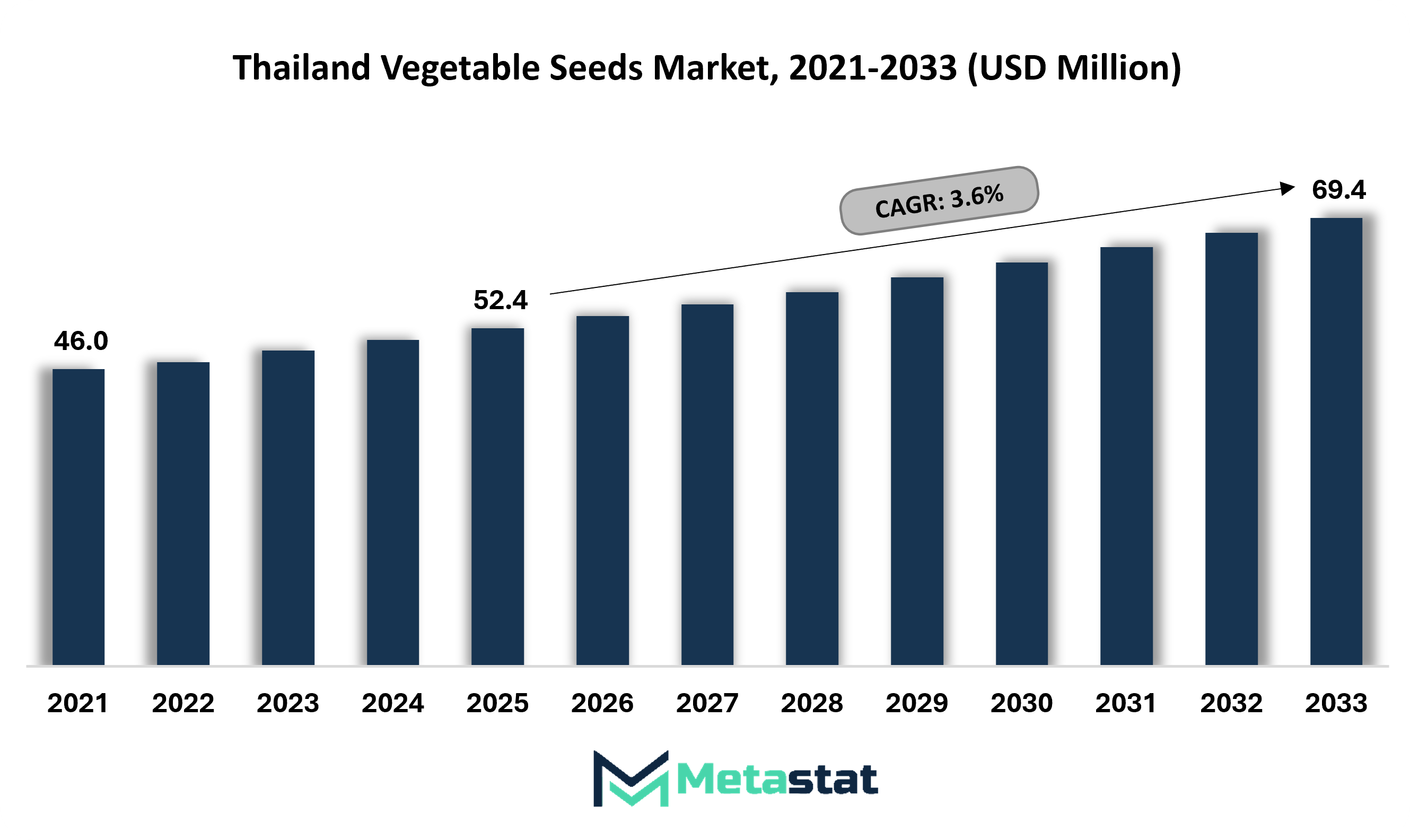
Expansion of hybrid seed adoption across tropical vegetable cultivation.
Farmers across Thailand are steadily adopting hybrid vegetable seeds to improve crop productivity and achieve consistent harvests. Hybrid seeds often provide higher yields, stronger disease resistance, and improved crop uniformity, making them attractive for commercial vegetable cultivation. These benefits are encouraging farmers to shift toward advanced seed varieties in the Thailand vegetable seeds market.
Government support for Thailand as a tropical seed hub and export base
Government support for agricultural development also contributes to market growth. Agricultural agencies continue to promote advanced seed distribution, research programs, and farmer training initiatives that strengthen vegetable production systems across Thailand. These efforts support wider adoption of advanced seed varieties.
High sensitivity of seed production to climate variability, pests, and diseases
Vegetable seed production requires stable environmental conditions and careful crop health management. Changes in rainfall patterns, temperature variations, and pest outbreaks can affect seed yield and quality. These risks create challenges for both seed producers and farmers operating in the Thailand vegetable seeds market.
Higher seed costs and intellectual-property barriers for advanced hybrids
In addition, advanced hybrid seeds often involve higher development and production costs. Intellectual property protections associated with hybrid varieties can increase seed prices, which can restrict adoption among small-scale farmers.
Rising demand for disease-resistant, high-yield tropical vegetable varieties for domestic and export channels
Demand for fresh vegetables continues to increase across domestic and international markets. Rising consumption is creating strong opportunities for seed producers to develop vegetable varieties that perform well under tropical cultivation conditions while offering improved resistance to pests and diseases. Export-oriented vegetable production is also driving interest in improved seed varieties that produce uniform crops suitable for international markets. These trends present growth opportunities for seed developers and suppliers operating in the Thailand vegetable seeds market.
The Thailand vegetable seeds market is segmented based on breeding technology, crop type, form, and cultivation method.
Open Pollinated Varieties segment is valued at USD 17.6 million in 2026 and is projected to reach USD 18.2 million by 2033, at a CAGR of 0.5% during the forecast period.
Open-pollinated varieties will retain relevance in the Thailand vegetable seeds market owing to seed-saving capability, stable genetic performance, and suitability across multiple planting cycles. Community farming programs and local vegetable cultivation projects will support continued demand for open-pollinated varieties that offer local climate adaptability and cost-efficient seed production.
Hybrid segment is valued at USD 36.6 million in 2026 and is projected to reach USD 51.2 million by 2033, at a CAGR of 4.9% during the forecast period.
Hybrid breeding technology will record strong expansion in the Thailand vegetable seeds market owing to improved yield potential, pest resistance, and consistent crop quality. Investment in advanced breeding programs and biotechnology research will strengthen hybrid seed adoption among commercial vegetable growers seeking higher productivity and reliable harvest outcomes.
Solanaceae segment is projected to reach USD 19.8 million by 2033, at a CAGR of 4.2% during the forecast period.
Solanaceae crops will gain importance in the Thailand vegetable seeds market owing to rising cultivation of tomato, chili, and eggplant across commercial vegetable farms. Advanced hybrid seed development and climate-resilient varieties will support stable production levels required for domestic consumption and export-oriented vegetable supply chains.
Root & Bulb segment is projected to reach USD 7.3 million by 2033, at a CAGR of 3% during the forecast period.
Root and bulb crops will expand in the Thailand vegetable seeds market with rising cultivation of onion, garlic, carrot, and radish across agricultural districts. Progress in disease-resistant seed varieties and uniform root development will encourage farmers to strengthen production capacity for food processing industries and local market distribution.
Cucurbit segment is projected to reach USD 14.8 million by 2033, at a CAGR of 3.9% during the forecast period.
Cucurbit crops will witness steady demand in the Thailand vegetable seeds market, supported by cultivation of cucumber, pumpkin, bitter gourd, and other tropical vegetables. Breeding improvements focused on fruit uniformity, shelf stability, and disease tolerance will contribute to higher productivity levels across domestic vegetable supply and commercial greenhouse cultivation.
Brassica segment is projected to reach USD 10.2 million by 2033, at a CAGR of 2.8% during the forecast period.
Brassica crops will gain traction in the Thailand vegetable seeds market owing to increased cultivation of cabbage, broccoli, and cauliflower across vegetable-growing regions. Innovation in temperature-tolerant seed varieties will strengthen crop performance under shifting climatic patterns, supporting year-round vegetable availability across retail markets and foodservice supply networks.
Leafy segment is projected to reach USD 9.1 million by 2033, at a CAGR of 2.8% during the forecast period.
Leafy vegetables will record steady growth in the Thailand vegetable seeds market owing to rising consumption of lettuce, spinach, mustard greens, and other fresh vegetables. Breeding programs focused on fast growth cycles and high leaf yield will support intensive vegetable production across urban agriculture projects and commercial greenhouse farming operations.
Others segment is projected to reach USD 8.1 million by 2033, at a CAGR of 4.2% during the forecast period.
Additional vegetable crop categories in the Thailand vegetable seeds market include beans, peas, and specialty vegetables cultivated across regional farming clusters. Development of location-specific seed varieties will support wider crop selection, dietary diversity, local food supply stability, and sustainable agricultural production systems.
Organic segment is projected to reach USD 15.1 million by 2033.
Organic seed demand will expand in the Thailand vegetable seeds market owing to rising preference for chemical-free agricultural inputs among environmentally conscious growers. Regulatory encouragement for sustainable farming practices and organic vegetable certification programs will increase adoption of organically produced vegetable seeds across smallholder and commercial farms.
Inorganic segment is projected to reach USD 54.3 million by 2033.
Inorganic seeds will continue to dominate the Thailand vegetable seeds market owing to broad availability and strong compatibility with conventional farming systems. Commercial vegetable cultivation will rely on inorganic seed varieties developed through advanced breeding programs designed to deliver high yield potential and strong resistance to pests and diseases.
Protected segment is projected to grow at a CAGR of 5% during the forecast period.
Protected cultivation will gain traction in the Thailand vegetable seeds market with rising greenhouse vegetable production across high-value farming operations. Integration of climate-controlled cultivation systems will support efficient vegetable production cycles, enabling growers to maintain consistent supply across urban markets and large retail distribution channels.
Open Field segment is projected to grow at a CAGR of 3.1% during the forecast period.
Open-field cultivation will remain critical for large-scale vegetable production across Thailand’s agricultural landscapes. Growth in rural farming zones will support extensive open-field vegetable farming using resilient seed varieties capable of adapting to variable soil conditions and seasonal climate variations.
Thailand has a strong agricultural base, and vegetable farming plays a critical role in local food supply and rural income. Demand for high-quality vegetable seeds will continue to rise as farmers focus on higher yields, pest resistance, and stable crop performance. Small and medium farms across the country are gradually shifting toward improved seed varieties that offer reliable output under changing weather conditions. Urban population growth and higher vegetable consumption will also support steady demand for seeds that produce consistent harvests throughout the year.
Seed companies operating in Thailand are investing in research, hybrid development, and farmer training to strengthen their position in the market. Companies such as East-West Seed Group and BASF continue to focus on seed innovation and crop protection support. Local producers work closely with farmers to test new varieties suited to Thailand’s climate and soil conditions. At the same time, established agricultural companies such as Chia Tai Company Limited and Known-You Seed Company Ltd. maintain strong distribution networks that help reach growers across major farming regions.
International seed developers are also active in Thailand’s vegetable seed industry. Companies such as Enza Zaden Beheer B.V., Syngenta Group, Hazera Seeds Ltd., and Rijk Zwaan Zaadteelt en Zaadhandel B.V. continue introducing hybrid varieties designed to improve productivity and crop quality. Their focus includes disease resistance, longer shelf life, and improved taste attributes, supporting local markets and export demand. Farmers increasingly choose seeds that help reduce crop loss and provide stable harvest cycles.
Other prominent companies contributing to the Thailand vegetable seeds market include Sakata Seed Corporation, Namdhari Seeds Pvt. Ltd., Kaneko Seeds Co., Ltd., KWS Vegetables, and local suppliers such as Thai Seed & Agriculture Co., Ltd., Seedline Co., Ltd., Vanda Seeds Co., Ltd., and Lion Seeds (International) Co., Ltd. Through product development, field support, and farmer partnerships, these companies will continue to shape the direction of Thailand’s vegetable seed industry while helping growers improve productivity and maintain crop quality.
Market size is forecast to rise from USD 52.4 million in 2025 to over USD 69.4 million by 2033.
The Thailand vegetable seeds market is projected to expand steadily during the forecast period as vegetable farming continues to modernize and adopt improved agricultural inputs. Rising consumption of high-quality vegetable produce will encourage farmers to invest in seed varieties that support improved productivity, stronger disease resistance, and reliable crop performance.
This research report categorizes the Thailand vegetable seeds market based on key segments, forecasts revenue growth, and analyzes trends across each submarket. The report analyzes the key growth drivers, opportunities, and challenges influencing the Thailand vegetable seeds market. Recent market developments and competitive strategies such as expansions, product launches, partnerships, mergers, and acquisitions have been included to define the competitive landscape of the market.
The report identifies and profiles key market players and analyzes their core competencies across each sub-segment of the Thailand vegetable seeds market.
|
Report Attributes |
Details |
|
Study Period |
2021-2033 |
|
Base Year |
2025 |
|
Estimated Year |
2026 |
|
Forecast Period |
2026-2033 |
|
Historical Period |
2021-2025 |
|
Growth Rate |
CAGR 3.6% from 2026 to 2033 |
|
Revenue Unit |
USD million |
|
Sales Volume Unit |
Kilograms |
|
Segmentation |
By Breeding Technology, Crop Type, Form, Cultivation Method |
|
By Breeding Technology |
|
|
By Crop Type |
|
|
By Form |
|
|
By Cultivation Method |
|
Find answers to common questions about this report
Top players operating in the Thailand Vegetable Seeds industry includes East-West Seed Group, BASF, Chia Tai Company Limited, Known-You Seed Company Ltd., Enza Zaden Beheer B.V., Syngenta Group, and Hazera Seeds Ltd.
The Solanaceae is the leading type of segment in the Thailand market.
High sensitivity of seed production to climate variability, pests, and diseases will hamper the market growth within the forecast period.
The Thailand Vegetable Seeds market is expected to grow at a CAGR of 3.6% over the forecast period (2026-2033).
Thailand Vegetable Seeds market is estimated to reach USD 69.4 million by 2033.
Expansion of hybrid seed adoption across tropical vegetable cultivation and government support for Thailand as a tropical seed hub and export base are key driving factors, boosting the market.
The Metastat Insights study shows that the Thailand Vegetable Seeds market size was USD 52.4 million in 2025.
The analysts below cover Agriculture research at Metastat Insights.
LEAD ANALYST
Utkarsh Khirodkar is a Lead Market Research Analyst at MetaStat Insight, specializing in market intelligence, technology sector assessments, and competitive strategy.
Tracking maintenance cycle demand for secondary flight display units and terrain collision avoidance systems across regional jet fleets involves complex aftermarket dynamics. MetaStat Insight provided practical analysis separating airline retrofit programs from OEM forward-fit production schedules in North America and Southeast Asia. The supplier matrix highlighted component obsolescence timelines without resorting to vague generalizations. The dataset served as a dependable reference during our annual program review meetings.
Evaluating secondary resin quality across post-consumer packaging streams requires reliable technical segmentation. MetaStat Insight delivered an objective assessment that distinguished between extrusion-grade flake pricing and optical sorting throughput limitations across Western Europe. The competitive positioning breakdown for licensed depolymerization technology providers answered several questions during our feedstock feasibility audit. Their team clarified regional trade restrictions on mixed plastic scrap quickly when our team submitted follow-up requests.
Evaluating sovereign cloud deployments for core banking platforms demands a clear view of data residency regulations and migration exit strategies. MetaStat Insight delivered an exhaustive review of regional latency tolerances, mainframe decommission milestones, and third-party vendor concentration risk. The regulatory compliance mapping across European and Asian financial jurisdictions gave our team a dependable baseline for multi-cloud infrastructure discussions.
Explore related market intelligence reports worth reading alongside this one.
Starting from
$2950