
LEAD ANALYST
Utkarsh Khirodkar is a Lead Market Research Analyst at MetaStat Insight, specializing in market intelligence, technology sector assessments, and competitive strategy.

Global Triethylene Glycol Divinyl Ether Market Size, Share, By Type (98% Purity, 99% Purity, and Others), By Application (Adhesives, Coatings, Inks, Electronics, Pharmaceuticals, and Others), By End-Users (Automotive, Construction, Electronics, Healthcare, and Others), Industry Analysis, Growth, Trends, and Forecast, 2026-2033
Report ID
MSI-4627
Published
April, 2026
Pages
320 Pages
Format
Report Details
Choose Your License
Triethylene Glycol Divinyl Ether Market
Global Triethylene Glycol Divinyl Ether market size is valued at USD 266.1 million in 2025 and projected to grow at a CAGR of 5.5% during the forecast period, reaching USD 408.1 million by 2033.
North America holds 26.3% in 2025 with US leading the market share in 2025.
98% Purity segment accounts for a market share of 42.7% in 2025.
Key trends driving growth: Rising adoption of UV-curable coatings and inks in packaging and electronics propels demand for vinyl ether monomers, along with increasing preference for low-VOC and energy-efficient curing technologies supports usage in advanced formulations.
Opportunities include growth in high-performance coatings and 3D printing materials creates new application potential for specialty vinyl ether compounds.
Key insight: Rising utilization of triethylene glycol divinyl ether in coatings, adhesives, and polymer synthesis signals a material shift toward high-performance, chemically resistant formulations across industrial sectors.
The Global Triethylene Glycol Divinyl Ether Market represents a specialized segment within the broader chemical intermediates industry, supported by its role in advanced polymer synthesis, coatings, adhesives, and crosslinking applications. The compound is valued for its high reactivity, formulation flexibility, and compatibility with multiple resin systems, making it suitable for applications requiring controlled curing, durability, and chemical resistance.
The market is gaining traction with rising demand for high-performance materials across electronics, automotive coatings, and industrial manufacturing. Its use in UV-curable systems and specialty formulations is expanding, particularly in applications where efficiency, precision, and formulation performance remain critical. Manufacturers are focusing on improving purity levels, optimizing production processes, and ensuring regulatory compliance to meet evolving industry standards.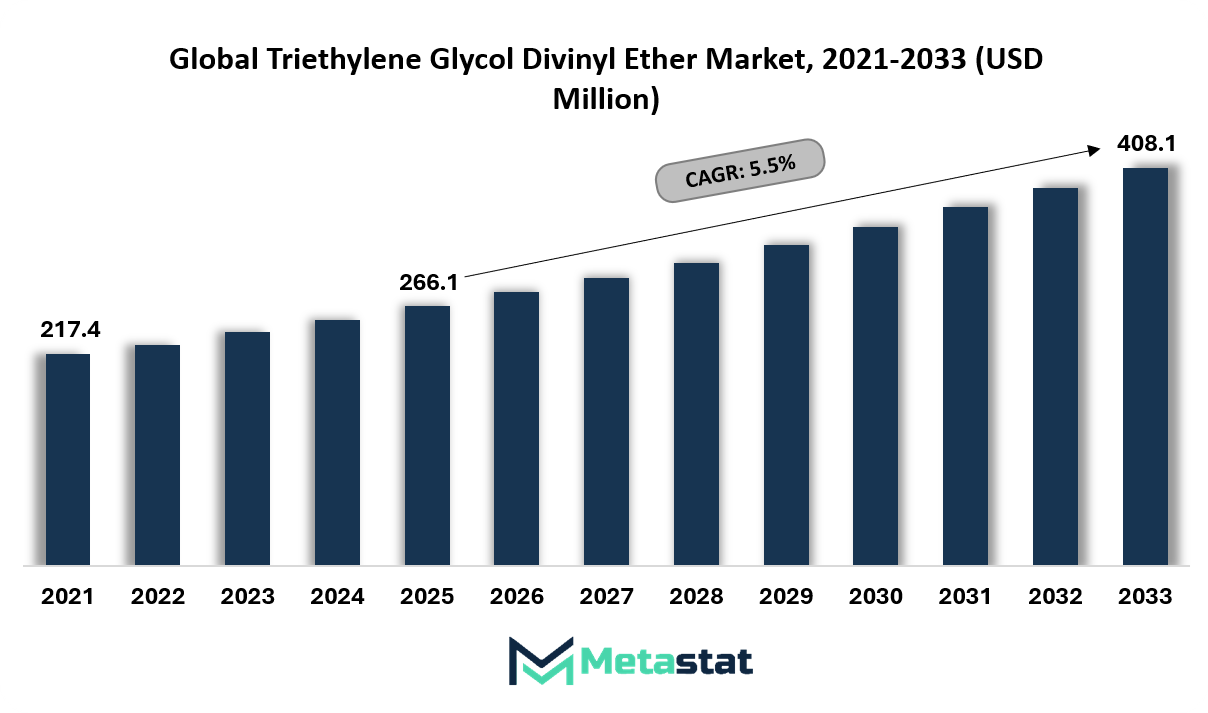
Rising adoption of UV-curable coatings and inks in packaging and electronics propels demand for vinyl ether monomers.
Rising demand for faster curing solutions in packaging and electronics is strengthening the use of advanced coating systems. The Global Triethylene Glycol Divinyl Ether Market benefits from improved print quality, reduced curing time, and enhanced surface performance, supporting broader commercial adoption across flexible packaging and high-precision electronic components.
Increasing preference for low-VOC and energy-efficient curing technologies supports usage in advanced formulations
Stricter environmental regulations and rising industry focus on sustainability are encouraging the adoption of low-VOC materials. The Global Triethylene Glycol Divinyl Ether Market is expanding through integration into formulations requiring energy-efficient curing, enabling manufacturers to meet compliance standards while maintaining product quality and operational performance across multiple end-use sectors.
Limited raw material availability and price volatility impact production consistency and cost structures
Fluctuations in feedstock supply create instability in production cycles and pricing strategies. The Global Triethylene Glycol Divinyl Ether Market faces pressure from inconsistent input costs, leading to challenges in long-term contracts, profit margins, and supply chain planning for manufacturers operating in competitive global environments.
Competition from alternative reactive diluents and acrylate-based systems restricts widespread adoption
The presence of cost-effective substitutes limits penetration across price-sensitive applications. The Global Triethylene Glycol Divinyl Ether Market encounters resistance from industries relying on established acrylate systems, where switching costs and performance familiarity influence purchasing decisions and slow the transition toward vinyl ether-based solutions.
Growth in high-performance coatings and 3D printing materials creates new application potential for specialty vinyl ether compounds
Advancements in additive manufacturing and specialty coatings are opening new pathways for material innovation. The Global Triethylene Glycol Divinyl Ether Market is gaining momentum through the development of customized formulations designed for durability, precision, and rapid curing, supporting expansion into aerospace, medical devices, and next-generation industrial applications.
The Global Triethylene Glycol Divinyl Ether market is classified based on Type, Application, and End-Users.
98% Purity segment is valued at USD 119.6 million in 2026 and is projected to reach USD 168.5 million by 2033, at a CAGR of 5% during the forecast period.
98% purity grade maintains steady demand across price-sensitive production environments where standard performance remains acceptable. Industrial users prefer balanced pricing and reliable functionality, supporting stable consumption in bulk manufacturing cycles. Future expansion will reflect consistent supply conditions and sustained use across mid-tier applications.
99% Purity segment is valued at USD 137.4 million in 2026 and is projected to reach USD 209.6 million by 2033, at a CAGR of 6.2% during the forecast period.
99% purity grade is witnessing rising preference owing to improved chemical stability and enhanced performance outcomes. High-end applications require refined composition to ensure reliability and precision. Demand remains supported by advanced manufacturing sectors seeking better product consistency and stricter quality benchmarks across operations.
Others segment is valued at USD 23.4 million in 2026 and is projected to reach USD 30.1 million by 2033, at a CAGR of 3.7% during the forecast period.
Other purity grades cater to niche requirements where customized formulations remain necessary. Specialized industries adopt flexible purity levels to meet specific processing conditions. Future demand will emerge from experimental applications and evolving industrial standards requiring tailored chemical properties beyond conventional classifications.
Adhesives segment is projected to reach USD 94.8 million by 2033, at a CAGR of 5.6% during the forecast period.
Adhesives application is expanding with strong bonding performance and durability across multiple surfaces. Manufacturing sectors rely on improved adhesion strength for long-lasting assembly solutions. Future development aligns with rising demand for high-performance materials across industrial manufacturing and specialized construction applications.
Coatings segment is projected to reach USD 87.2 million by 2033, at a CAGR of 4.9% during the forecast period.
Coatings application is gaining momentum with the protective and finishing properties offered by the compound. Surface treatment industries are adopting advanced formulations to improve resistance to environmental exposure. Future demand remains supported by increased focus on durability, aesthetic value, and long-term material protection.
Inks segment is projected to reach USD 52 million by 2033, at a CAGR of 3.9% during the forecast period.
Inks application is developing steadily with the expansion of printing technologies and packaging applications. Its chemical properties support improved drying performance and print quality. Future progress will be supported by rising demand for high-resolution printing and sustainable ink formulations across industrial and commercial use.
Electronics segment is projected to reach USD 75.7 million by 2033, at a CAGR of 6.9% during the forecast period.
Electronics application is accelerating with growing precision requirements in component manufacturing. High-performance materials support insulation, stability, and reliability in electronic devices. Future demand remains linked to the expansion of semiconductor manufacturing and advanced electronic systems requiring dependable chemical integration.
Pharmaceuticals segment is projected to reach USD 59.5 million by 2033, at a CAGR of 6.9% during the forecast period.
Pharmaceuticals application is recording controlled growth, supported by strict regulatory standards and the need for high-purity compounds. Chemical applications support formulation processes and specialized drug delivery systems. Future adoption depends on continued innovation in pharmaceutical development and compliance with safety frameworks.
Others segment is projected to reach USD 38.9 million by 2033, at a CAGR of 4.3% during the forecast period.
Other applications are emerging across diverse industrial uses where specific chemical properties provide functional advantages. Experimental and evolving sectors support gradual demand development. Future opportunities are likely to arise from innovation-led industries exploring alternative uses and new product development pathways.
Automotive segment is projected to reach USD 83.5 million by 2033.
Automotive end-user demand is increasing with stronger focus on durable materials and efficient manufacturing processes. Adhesives and coatings play an important role in vehicle assembly, protection, and performance. Future demand aligns with developments in lightweight vehicles and improved material performance standards.
Construction segment is projected to reach USD 112.4 million by 2033.
Construction end-user demand is rising with growing infrastructure activity and demand for strong bonding materials. Chemical solutions enhance structural integrity and durability across multiple building applications. Future expansion remains supported by urban development and increased investment in residential and commercial construction.
Electronics segment is projected to reach USD 87.2 million by 2033.
Electronics end-user demand is registering strong growth, supported by rapid technological advancement. Demand for reliable and efficient materials is increasing in device manufacturing. Future expansion reflects rising consumption of electronic products and continued innovation in smart technologies.
Healthcare segment is projected to reach USD 56.1 million by 2033.
Healthcare end-user demand is developing steadily with rising need for high-quality materials in medical applications. Its chemical properties support safe and precise use in specialized formulations. Future demand remains linked to advances in healthcare infrastructure and rising need for specialized medical solutions.
Others segment is projected to reach USD 68.9 million by 2033.
Other end-users in the Global Triethylene Glycol Divinyl Ether Market will contribute to diversified demand across emerging industries. Unique application areas will utilize adaptable chemical characteristics for varied purposes. Future expansion will be influenced by industrial innovation and exploration of new use cases across multiple sectors.
Based on geography, the Global Triethylene Glycol Divinyl Ether market is divided into North America, Europe, Asia-Pacific, South America, Middle East, and Africa.
Advanced manufacturing ecosystems in North America are supporting demand for high-performance coatings and specialty chemicals formulated with triethylene glycol divinyl ether.
Stable demand in North America is supported by established industrial and chemical processing sectors, sustaining consistent consumption levels.
Asia-Pacific offers high-growth potential with rapid industrialization and expanding manufacturing hubs across countries such as China and India.
Rising infrastructure investment and increased adoption of advanced materials create favorable conditions for broader application expansion in Asia-Pacific.
Emerging economies across the Middle East, Africa, and South America are showing gradual adoption, supported by expanding industrial bases and rising chemical consumption, although growth remains uneven owing to infrastructure and investment variability.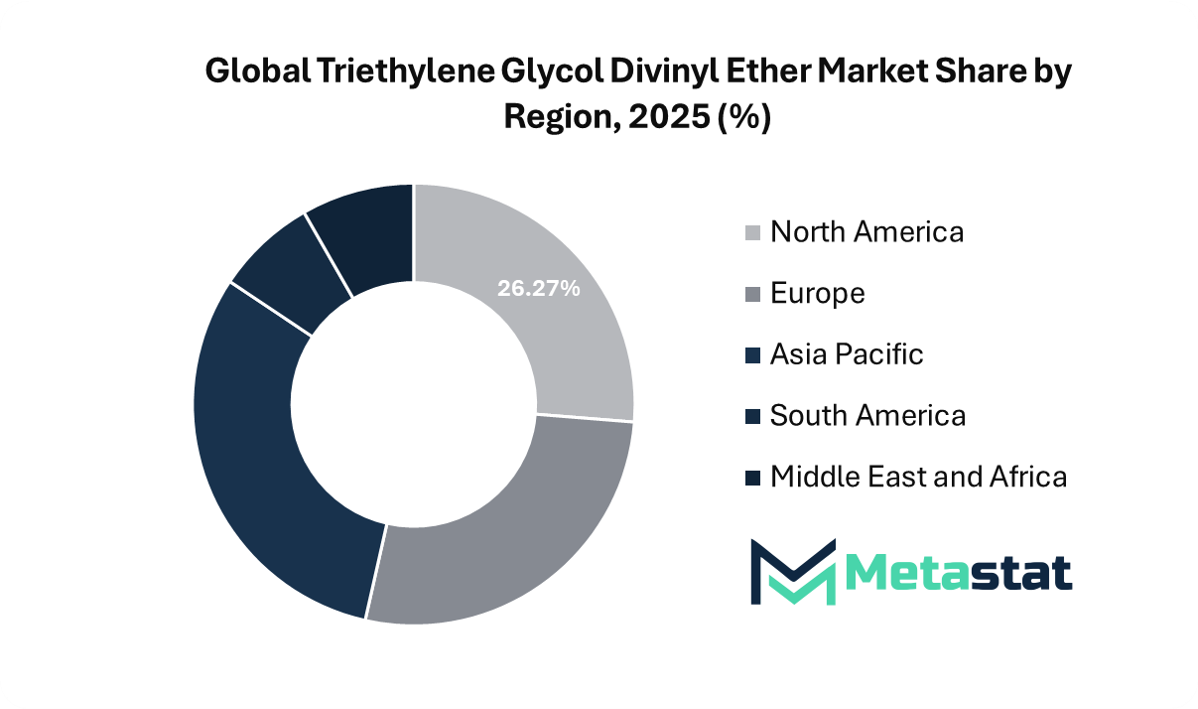
The Global Triethylene Glycol Divinyl Ether Market continues to attract attention with its role in specialized chemical applications where stability and performance remain critical. Demand is rising across industries that rely on advanced intermediates, particularly in coatings, adhesives, and crosslinking systems. Producers are focusing on improving product efficiency and consistency, which is strengthening the need for reliable chemical inputs.
Market activity remains influenced by industrial expansion and the gradual shift toward high-performance materials. Companies continue to balance cost with functionality, shaping purchasing decisions across regions. At the same time, supply chains are adapting to changing raw material availability, encouraging businesses to secure long-term sourcing strategies. Environmental considerations are also gaining importance, leading producers to adopt safer handling practices and cleaner production methods without disrupting output.
Competition in the industry remains active, with both established companies and emerging suppliers working to strengthen their positions. Key Global Triethylene Glycol Divinyl Ether industry players such as BASF SE, abcr GmbH, Alfa Chemistry, Ataman Kimya A.Ş., Azelis Group NV, Biosynth AG, BOC Sciences Inc., CHEMBSF (Shanghai) Biomedical Technology Co., Ltd., Chem-Impex International, Inc., Connect Chemicals GmbH, CP Lab Safety, Inc., Cymit Química S.L., Hebei Yanxi Chemical Co., Ltd., Hefei TNJ Chemical Industry Co., Ltd., JIANGSU BSECHEM Chemical Technology Co., Ltd., Jiaozuo Xinjing Technology Co., Ltd., MedChemExpress LLC, Merck KGaA (Sigma-Aldrich), Nanjing Chemical Material Corp., Ltd. (NCC), NANTONG REFORM PETRO-CHEMICAL CO., LTD., Ningxia Jinghong Chemical Co., Ltd., and Qingdao ECHEMI Digital Technology Co., Ltd. continue to invest in research capabilities and distribution networks.
Regional markets are showing varied patterns based on industrial growth and regulatory frameworks. Some regions are recording faster adoption with expanding manufacturing sectors, while others are progressing at a steadier pace supported by established supply systems. Businesses are monitoring these differences closely to align their strategies with local demand conditions.
Market size is forecast to rise from USD 266.1 million in 2025 to over USD 408.1 million by 2033.
The Global Triethylene Glycol Divinyl Ether Market is set to witness steady expansion over the forecast period, supported by rising demand for high-performance materials and advanced chemical formulations. The shift toward sustainable and efficient production methods will shape future market development, encouraging innovation in synthesis, purification, and application technologies.
By Type:
By Application:
By End-Users:
This research report categorizes the Triethylene Glycol Divinyl Ether market based on key segments and regions, forecasts revenue growth, and analyses trends in each submarket. The report analyses the key growth drivers, opportunities, and challenges influencing the Triethylene Glycol Divinyl Ether market. Recent market developments and competitive strategies such as expansion, product launch, partnership, merger, and acquisition have been included to draw the competitive landscape in the market.
The report strategically identifies and profiles the key market players and analyses their core competencies in each sub-segment of the Triethylene Glycol Divinyl Ether market.
|
Report Attributes |
Details |
|
Study Period |
2021-2033 |
|
Base Year |
2025 |
|
Estimated Year |
2026 |
|
Forecast Period |
2026-2033 |
|
Historical Period |
2021-2025 |
|
Growth Rate |
CAGR 5.5% from 2026 to 2033 |
|
Revenue Unit |
USD million |
|
Segmentation |
By Type, Application, End-Users, and Region |
|
By Region |
North America (By Type, Application, End-Users, and Country)
|
|
Europe (By Type, Application, End-Users, and Country)
|
|
|
Asia Pacific (By Type, Application, End-Users, and Country)
|
|
|
South America (By Type, Application, End-Users, and Country)
|
|
|
Middle East and Africa (By Type, Application, End-Users, and Country)
|
Find answers to common questions about this report
Global Triethylene Glycol Divinyl Ether market is estimated to reach USD 408.1 million by 2033.
Top players operating in the Triethylene Glycol Divinyl Ether industry include BASF SE, abcr GmbH, Alfa Chemistry, Ataman Kimya A.Ş., Azelis Group NV, and Biosynth AG.
The Global Triethylene Glycol Divinyl Ether market is expected to grow at a CAGR of 5.5% over the forecast period (2026-2033).
The 99% Purity is the leading type segment in the Global market.
The Metastat Insights analysis shows that the North America Triethylene Glycol Divinyl Ether market size is estimated to be USD 103.7 million by 2033.
Asia Pacific region dominates the market.
Limited raw material availability and price volatility impact production consistency and cost structures will hamper the market growth within the forecast period.
Rising adoption of UV-curable coatings and inks in packaging and electronics propels demand for vinyl ether monomers and increasing preference for low-VOC and energy-efficient curing technologies supports usage in advanced formulations are key driving factors, boosting the market.
The Metastat Insights study shows that the Global Triethylene Glycol Divinyl Ether market size was USD 266.1 million in 2025.
The analysts below cover Chemicals and Materials research at Metastat Insights.
LEAD ANALYST
Utkarsh Khirodkar is a Lead Market Research Analyst at MetaStat Insight, specializing in market intelligence, technology sector assessments, and competitive strategy.

INDUSTRY CONSULTANT - CHEMICALS & ADVANCED MATERIALS
Chemicals and Materials · Machinery & Equipment · Packaging
Amit Gadhekar Consultant for Chemicals and Materials at MetaStat Insight, directing sector-specific intelligence, research, and strategic consulting across global chemical and processing markets.
Integrating zero-trust access controls across legacy electronic health record systems involves complex compliance overhead. Team produced an analysis that clearly separated identity governance and administration tools from privileged access management platforms. Their evaluation of HIPAA and GDPR compliance features across cloud native solutions gave our architecture group clear baseline criteria. The custom data request regarding biometric authentication adoption in hospital networks was returned promptly with clear documentation.
Evaluating calorific value requirements and air permit compliance across municipal waste facilities requires localized data. Metastat Insight structured their analysis around operational throughput capacity and feedstock composition variations in Latin America and Eastern Europe. Their competitive mapping of sorting equipment vendors helped clarify technology differences between optical separators and heavy media systems. The study provided an objective baseline during our capital expenditure reviews.
Decarbonizing industrial thermal processes hinges on refrigerant regulations and compressor efficiency limits. Metastat Insights delivered a thorough market analysis that evaluated natural refrigerants like CO2 and hydrocarbons against synthetic low-GWP alternatives. The breakdown of utility incentives and grid capacity constraints across key European manufacturing hubs offered valuable perspective. The follow-up conversation with their sector analysts addressed our specific questions on mechanical vapor recompression systems efficiently.
Explore related market intelligence reports worth reading alongside this one.
Starting from
$2950