
LEAD ANALYST
Utkarsh Khirodkar is a Lead Market Research Analyst at MetaStat Insight, specializing in market intelligence, technology sector assessments, and competitive strategy.

UAE Digital Payments and Infrastructure Market Size, Share, By Solution Type (Payment Network, Card Scheme and Switching Services, Merchant Acquiring Services, Payment Gateway and Acceptance Platforms, Payment Processing and Issuer Processing, Instant Account-to-Account Payment Infrastructure, Digital Wallet and Stored-Value Services, Cross-Border Payment and Remittance Infrastructure, Payment Orchestration and Open Finance Payment Initiation), By Payment Flow (Peer-to-Peer (P2P), Consumer-to-Business / Person-to-Merchant (C2B/P2M), Business-to-Business (B2B), Business-to-Consumer (B2C), Government-to-Person (G2P), Person-to-Government (P2G), Government-to-Business (G2B), Business-to-Government (B2G)), By Transaction Type (Domestic Payments, Cross-Border Payments), By End-Use Industry (Retail and E-commerce, Banking, Financial Services and Fintech, Government and Public Sector, Travel, Hospitality and Transportation, Telecommunications, Utilities, Healthcare, Education, Media, Gaming and Entertainment), Industry Analysis, Growth, Trends, and Forecast, 2026-2033
Report ID
MSI-5204
Published
September, 2026
Pages
306 Pages
Format
Historical
Base year
Forecast
Forecast period
Report Details
Choose Your License
UAE Digital Payments and Infrastructure Market
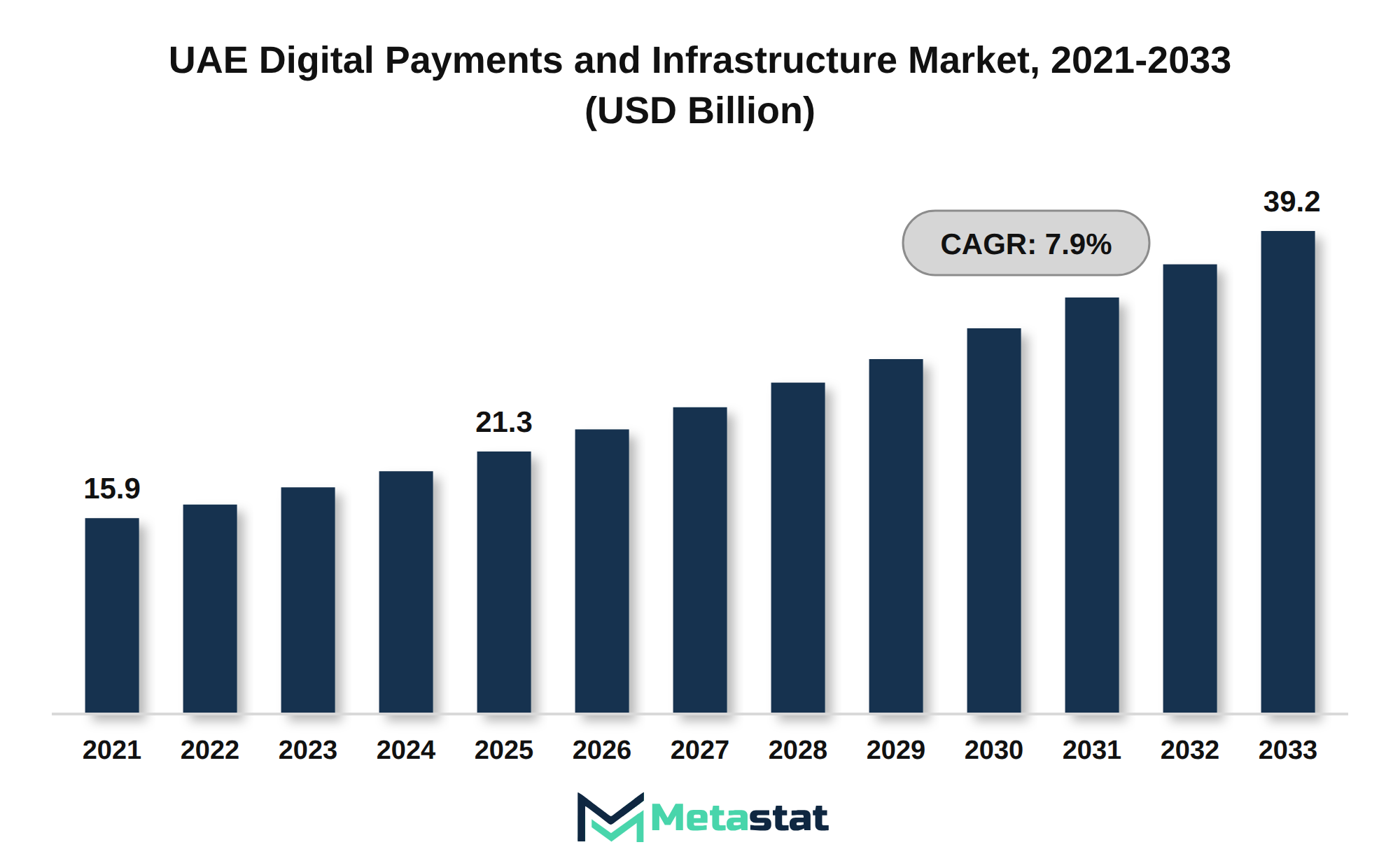
The UAE Digital Payments and Infrastructure market was valued at USD 21.3 billion in 2025 and is projected to reach USD 39.2 billion by 2033, growing at a CAGR of 7.9% over the forecast period.
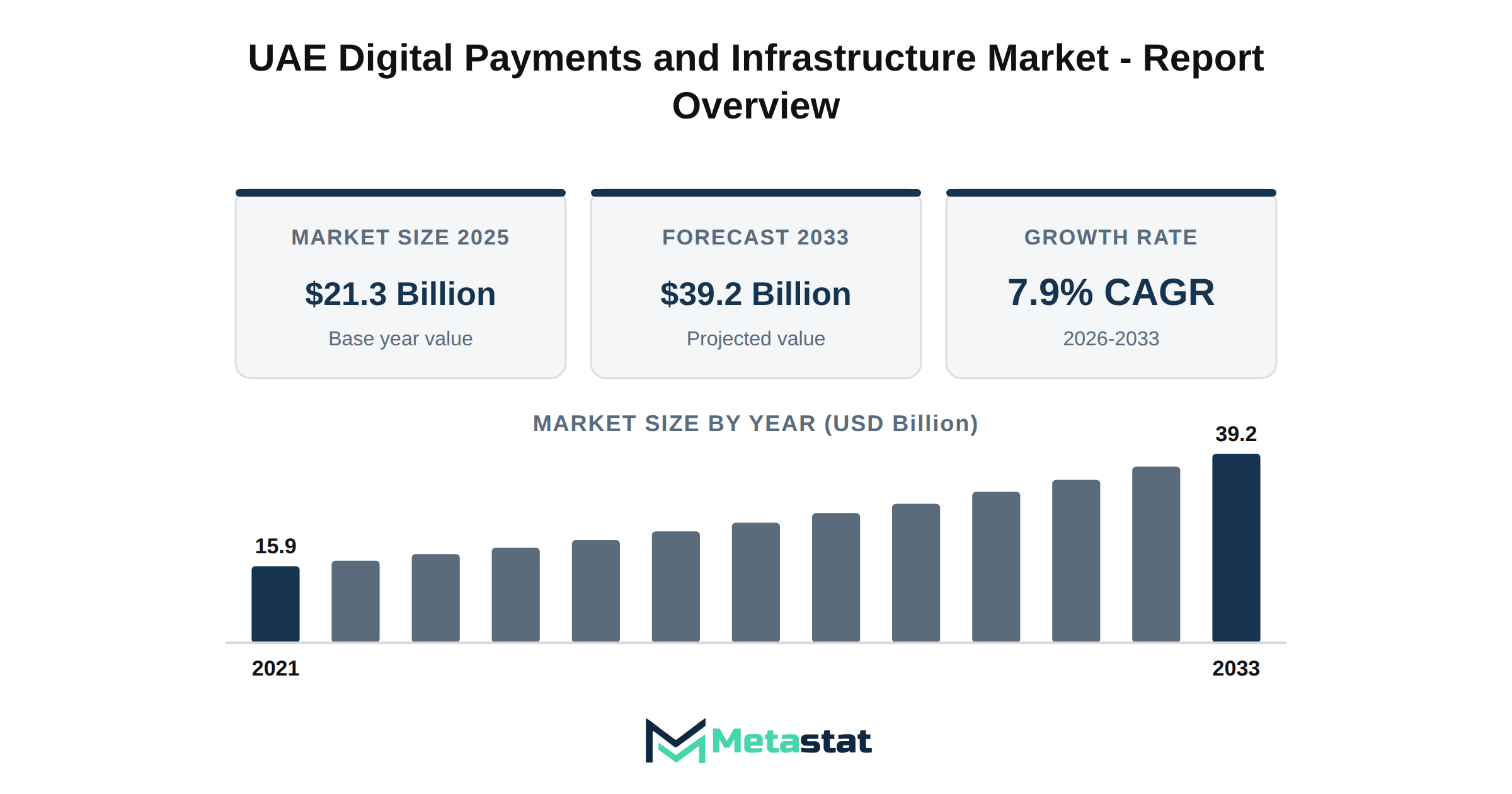
The UAE Digital Payments and Infrastructure market reached a valuation of USD 21.3 billion in 2025, reflecting a strong growth trajectory from USD 15.9 billion in 2021. This upward trend is projected to continue, with the market anticipated to expand to USD 39.2 billion by 2033, representing a compound annual growth rate (CAGR) of 7.9%. The growth is driven by increasing digitalization across various sectors and a shift towards cashless transactions.
Key developments influencing the market include advancements in payment technologies and enhanced interoperability solutions. The rollout of innovative services, including co-badging and Aani adoption, supports efficient payment experiences for consumers and merchants. Regulatory compliance and licensing frameworks by the Central Bank of the UAE (CBUAE) further streamline operations, promoting a secure digital payment ecosystem.
Domestic payment data sovereignty has emerged because a critical focus area, ensuring that sensitive transaction information remains within national borders. This focus enhances consumer trust and aligns with global data protection standards. Merchant acceptance cost economics play a significant role in the expansion of digital payment solutions, driving down transaction fees and making digital platforms more accessible to small and medium-sized enterprises.
Challenges including payment fraud and cybersecurity threats persist, necessitating ongoing investment in security infrastructure. Financial inclusion initiatives contribute to cashless adoption, particularly within underserved communities. The emphasis on next-generation innovation and sustainable transformation highlights the market's commitment to evolving alongside technological advancements and environmental considerations.
The strategic outlook for the UAE Digital Payments and Infrastructure market includes significant capital allocation for infrastructure investments, ensuring strength during inflationary pressures and currency volatility. Corporate imperatives guide organizations toward aligning with high-value recommendations that further enhance their competitive positioning.
The adoption of advanced technologies including Jaywan Rollout and co-badging solutions enhances payment options for consumers and businesses. This trend drives the growth of the UAE Digital Payments and Infrastructure market, enabling quicker and more efficient transactions across various platforms.
Interoperability between different digital payment systems promotes user convenience and encourages broader acceptance. Aani adoption has been essential in ensuring efficient transactions, which strengthens the market's infrastructure and enhances customer experience.
Data sovereignty regarding domestic payments has become a critical focus, ensuring that financial information remains within national borders. This regulatory emphasis builds trust among consumers and businesses, contributing to the growth of the market.
Merchant acceptance costs represent a significant factor in the expansion of digital payments. Competitive pricing structures and innovative solutions drive down these costs, encouraging more merchants to integrate digital payment systems into their operations.
Regulatory and licensing developments from the Central Bank of the UAE (CBUAE) create a structured framework for market participants. Such measures promote transparency and compliance, ultimately creating a stable environment for investment and growth.
Payment fraud and cybersecurity concerns remain prominent due to increasing digital transactions. A robust security framework is essential for protecting consumer data and maintaining confidence in digital payment systems.
Financial inclusion initiatives enhance cashless adoption, addressing the needs of underserved populations. By expanding access to digital payment solutions, the market supports economic growth and social development.
Regulatory compliance and standards ensure that market participants adhere to established guidelines, promoting fair competition and consumer protection. These frameworks are crucial for maintaining the integrity of the UAE Digital Payments and Infrastructure market.
Geopolitical risks influence market dynamics, compelling stakeholders to adapt strategies accordingly. Awareness of these factors allows companies to adjust to potential disruptions and align with evolving market conditions.
Research and development trajectories indicate a shift towards next-generation innovations. Investment in emerging technologies drives the evolution of digital payment solutions, enhancing the market's competitiveness.
Sustainable transformation efforts highlight the importance of decarbonization and circular economy dynamics within the market. Emphasizing sustainable practices aligns with global trends and attracts environmentally conscious consumers.
The supply chain and logistics architecture undergo continuous refinement to accommodate the increasing demand for digital payment solutions. Strategic sourcing enhances operational efficiency, benefiting market players.
Market fragmentation presents challenges and opportunities for consolidation. Mergers and acquisitions dynamics reshape competitive positioning, enabling companies to leverage synergies and expand their market reach.
The value chain in the digital payments ecosystem requires strategic procurement approaches to optimize resource allocation. Aligning capital investments with market demands ensures sustained growth and profitability.
Customer journey dynamics are evolving, driven by the need for personalized experiences in digital transactions. Understanding these shifts allows companies to tailor offerings and enhance customer satisfaction.
Capital allocation is crucial in infrastructure investments, ensuring that resources are directed towards high-impact initiatives. Strategic funding decisions will shape the future landscape of the market.
Inflationary pressures and currency volatility impact operational costs and pricing strategies within the market. Companies remain agile in adjusting approaches to mitigate these external influences.
A future strategic outlook emphasizes innovation, regulatory alignment, and customer-centric practices. High-value recommendations focus on leveraging technology and adapting to changing consumer preferences, ensuring sustained growth in the UAE Digital Payments and Infrastructure market.
The UAE Digital Payments and Infrastructure market experiences significant growth driven by ongoing digital transformation across various sectors. Organizations prioritize advancements in technology, facilitating the adoption of digital payment solutions that enhance operational efficiency and customer engagement. Investments in automation, artificial intelligence, and software integration improve existing processes, allowing businesses to streamline operations and reduce costs.
Consumer expectations for efficient transactions compel businesses to innovate their payment offerings continually. The rising prevalence of e-commerce and mobile transactions fuels demand for sophisticated digital payment infrastructures. While consumers shift toward digital solutions, companies in the UAE adapt their strategies to align with evolving buying preferences, ensuring relevance in a rapidly changing marketplace.
The focus on digital transformation enhances customer experiences and positions businesses to capture a larger share of the growing market. Organizations reinforce their commitment to adopting new technologies, and the UAE Digital Payments and Infrastructure market is projected to experience continued expansion, marked by increased investment and innovation.
The evolving preferences of consumers significantly influence the UAE Digital Payments and Infrastructure market. Increased smartphone penetration and internet access facilitate the shift toward digital payment methods. Changing lifestyles, particularly among younger demographics, drive the demand for mobile wallets and contactless payments. This shift results in higher transaction volumes through various platforms, enhancing overall market growth.
The trend toward e-commerce and online shopping has transformed consumer expectations regarding payment options. Customers prioritize convenience and speed in transactions, prompting businesses to adopt innovative payment solutions. This transformation supports the expansion of digital payment systems, making them essential for competitiveness in the market.
The population's growing comfort with technology, coupled with urbanization, accelerates digital payment adoption. Increased exposure to digital tools creates a culture of convenience, where consumers prefer efficient payment experiences. This changing landscape positions the UAE Digital Payments and Infrastructure market for sustained growth, driven by alignment with contemporary consumer behavior.
The UAE Digital Payments and Infrastructure market faces significant regulatory challenges that impede growth. Compliance hurdles related to varying regional standards create barriers for companies aiming for market entry or expansion. Uncertainty in legal mandates leads to reluctance among businesses to invest in new technologies or platforms, impacting overall market dynamics.
Macroeconomic headwinds, including inflationary pressures, increase operational costs for market participants. High capital investment requirements for infrastructure development and technological upgrades further strain resources, particularly for startups and smaller firms. This financial strain restricts innovation and reduces competitiveness, ultimately slowing market progress.
Infrastructure gaps and connectivity deficits contribute to deployment bottlenecks, delaying the introduction of new payment solutions. These inefficiencies hinder access to reliable digital services, particularly in underserved areas, limiting market penetration. Skilled labor deficiencies exacerbate these issues, arising from a shortage of qualified professionals that hampers the implementation of advanced payment technologies.
Data security vulnerabilities and privacy concerns pose additional risks, leading to consumer skepticism regarding digital payment solutions. These factors create an environment of reluctance towards adoption, affecting the market's overall growth trajectory. Competition from alternative offerings and substitution risks further fragment the market, challenging existing players to maintain market share in an increasingly complex environment.
These regulatory challenges and operational constraints significantly impact the growth potential of the UAE Digital Payments and Infrastructure market, necessitating strategic responses from stakeholders to navigate this complex environment.
The UAE Digital Payments and Infrastructure market encounters challenges owing to geopolitical fragmentation, affecting cross-border transactions and overall payment flows. These tensions lead to trade deficits and tariff friction, creating an unstable environment for international monetary exchanges. While countries impose varying trade policies, businesses face increased compliance overhead, raising operational costs and complicating the payment ecosystem.
Technological disruptions introduce further complexities, particularly in interoperability. Organizations struggle with integrating diverse systems, which hinders transaction processing. This friction affects payment gateway and acceptance platforms, limiting their effectiveness in serving customers. Such challenges negatively impact growth prospects within the market.
Rising input costs due to global supply chain instability exacerbate margin pressures for businesses in the digital payments sector. Organizations strive to manage their expenses while navigating escalating costs associated with infrastructure development and implementation bottlenecks. The tightening regulatory standards further complicate operational strategies, driving prices upward while constraining profitability.
Workforce skill gaps pose additional hurdles, attributed to companies striving to recruit and retain talent proficient in advanced payment technologies. Automation displacements create uncertainty, prompting concerns about job security and employee retention. These factors contribute to an environment where innovation stalls, thereby limiting the potential for new solutions in the UAE Digital Payments and Infrastructure market.
Finally, evolving downstream demands for enhanced security measures, particularly cybersecurity protocols, intensify pressure on firms. Data vulnerabilities threaten consumer trust, compelling organizations to invest significantly in data protection. This necessity diverts resources from other strategic initiatives, further hindering growth in the market.
The UAE Digital Payments and Infrastructure market experiences significant opportunities stemming from emerging regional demands. Increased consumer reliance on digital transactions encourages firms to enhance their payment solutions, leading to a greater focus on technological disruptions that prioritize convenience and security. Regions across the UAE demonstrate a rising appetite for innovative payment methods, including digital wallets and contactless solutions, fueling investments in infrastructure modernization.
Geographical expansion into underserved areas promotes access to digital payment services, enhancing participation across various demographics. This expansion aligns with the trend of digital transformation, where businesses integrate advanced technologies into their operational frameworks, optimizing processes and improving customer experiences. The integration of next-generation innovations creates avenues for product diversification, allowing firms to cater to niche applications that fulfill specific market needs.
Sustainability imperatives shape market strategies, driven by companies aligning their operations with eco-friendly practices and emphasizing ESG-driven initiatives. This alignment increases demand for green transformations in payment systems, including sustainable payment processing options. Evolving buying behaviors indicate a shift towards digital procurement, encouraging businesses to adapt their commercial models to remain competitive.
The market experiences strategic consolidation and cross-industry collaborations, leading to the development of comprehensive solutions that address diverse customer needs. Enhanced partnerships facilitate the integration of various services, creating a robust ecosystem that supports growth in both traditional and digital payment sectors. These factors collectively drive the long-term growth trajectory of the UAE Digital Payments and Infrastructure market, reflecting an evolving environment characterized by continuous innovation and adaptation.
The UAE Digital Payments and Infrastructure market is segmented based on Solution Type, Payment Flow, Transaction Type, and End-Use Industry.
Valued at USD 4.2 billion in 2026, the Payment Network, Card Scheme & Switching Services segment is projected to reach USD 6.3 billion by 2033, reflecting a CAGR of 6% during the forecast period. This segment benefits from increased consumer adoption of digital payment solutions driven by the rise of e-commerce and mobile transactions. The growing demand for efficient payment experiences places pressure on service providers to enhance their offerings.
Technological maturation is essential in facilitating innovations within this segment. Enhanced security measures and improved transaction speeds become critical because competition intensifies. The integration of next-generation technologies, including artificial intelligence and blockchain, supports operational efficiencies and strengthens consumer trust in digital payments.
Investment in infrastructure continues to expand in response to market dynamics. Financial institutions and fintech companies prioritize strategic partnerships to enhance their payment processing capabilities. This collaborative approach enables broader access to payment networks, directly impacting the growth trajectory of the UAE Digital Payments and Infrastructure market.
Regulatory compliance remains a significant factor affecting operations within the segment. Adhering to policies ensures that entities mitigate risks and maintain a competitive edge. Organizations that successfully navigate these regulations position themselves favorably in the evolving landscape of digital payments.
Growth in the Merchant Acquiring Services segment reflects increasing demand for digital payment solutions among businesses and consumers. This segment is estimated to reach USD 5.7 billion by 2033, at a CAGR of 6.7% during the forecast period. Rapid expansion of e-commerce platforms necessitates efficient payment processing solutions. Retailers seek effective merchant acquiring services that enhance transaction speeds and improve customer experiences.
Innovations in payment technology, including contactless payments and mobile wallet integration, enhance service functionalities and attract more businesses. The retail and e-commerce sectors significantly contribute to the segment's growth, with changing consumer preferences towards digital transactions fueling demand for enhanced merchant acquiring capabilities. Regulatory measures promoting cashless transactions support this trend, creating a favorable environment for market expansion.
Competition among service providers intensifies, prompting investments in next-gen upgrades and product evolution. Providers focus on delivering secure payment solutions while emphasizing customer satisfaction and loyalty. These developments position the UAE Digital Payments and Infrastructure market for sustained growth and increased adoption of merchant acquiring services across various industries.
Growth in the Payment Gateway & Acceptance Platforms sub-segment reflects increasing demand for effective and secure digital transactions among consumers and businesses. Enhanced digital payment infrastructure and the rise of e-commerce significantly influence this segment, driving the need for effective payment solutions.
The Payment Gateway & Acceptance Platforms segment is projected to reach USD 5.3 billion by 2033. This expansion aligns with trends in consumer behavior, where a shift towards online shopping and digital services accelerates demand for efficient payment systems. Merchants require reliable and versatile platforms to facilitate transactions, contributing to the segment's growth.
Technological advancements, including real-time payment processing and enhanced security measures, encourage adoption across various industries. Retail and e-commerce, banking, and financial services actively seek innovative payment solutions, reinforcing their importance in the UAE Digital Payments and Infrastructure market.
Regulatory compliance standards further shape the segment, ensuring that payment systems align with local and international guidelines. Adhering to these regulations enhances consumer trust, driving greater usage of digital payment solutions. While businesses adapt to evolving consumer expectations, the Payment Gateway & Acceptance Platforms sub-segment plays a crucial role in the broader digital payments landscape.
Continuous advancements in technology drive the growth of the Payment Processing & Issuer Processing sub-segment, projected to grow at a CAGR of 7% during the forecast period. Increased demand for efficient transaction processes pushes businesses to adopt innovative payment solutions, enhancing customer experiences and streamlining operations. The expanding footprint of e-commerce in the UAE significantly influences this segment, with retailers seeking reliable processing services to accommodate rising transaction volumes.
The introduction of next-generation upgrades enhances transaction security and efficiency, reinforcing consumer confidence. Businesses navigate competition, and effective payment processing becomes a critical factor in maintaining operational effectiveness. Regulatory compliance standards shape the landscape, compelling providers to align with stringent requirements while introducing advanced functionalities.
Cost structures in this sub-segment fluctuate due to technological advancements and market competition, with pricing volatility impacting margins. Strategic partnerships among payment processors, banks, and fintech firms create a conducive environment for innovation, presenting strategic opportunity windows for investment. Evolving dynamics within the UAE Digital Payments and Infrastructure market emphasize the importance of agile responses to emerging consumer preferences and technological advancements.
Growth in the Instant Account-to-Account Payment Infrastructure segment emerges from the rising demand for efficient and instantaneous transactions among consumers and businesses. Digital transformation across various sectors accelerates the adoption of these payment solutions, driven by the increasing reliance on mobile and online financial services. Enhanced consumer experiences encourage businesses to integrate these infrastructures to remain competitive in the evolving landscape.
The expansion of e-commerce and digital banking in the UAE creates a conducive environment for this segment. Retailers and financial institutions increasingly implement account-to-account payment solutions to streamline their operations, reduce costs, and enhance customer satisfaction. Significant investments in technology and infrastructure support the growing reliance on real-time payment systems.
Regulatory compliance influences the segment. Financial authorities emphasize the importance of secure and efficient payment systems, driving organizations to adopt advanced technologies that align with compliance standards. This focus on security and efficiency not only mitigates risks but encourages further investment in account-to-account payment solutions.
Technological advancements, including blockchain and artificial intelligence, enhance the capabilities of account-to-account payment infrastructures. These innovations improve transaction speeds, lower costs, and enhance security measures, positioning the segment for sustained growth. The UAE Digital Payments and Infrastructure market stands to benefit significantly from these trends, establishing itself because a leader in the digital payment landscape.
The rising popularity of digital wallets and stored-value services transforms the payment landscape within the UAE Digital Payments and Infrastructure market. Increasing smartphone penetration and a tech-savvy population drive consumer preferences toward contactless payment solutions. Enhanced security features, including biometric authentication and tokenization, strengthen consumer confidence in these platforms, promoting widespread adoption across various demographics.
Major retail and e-commerce sectors actively embrace digital wallet solutions, enabling efficient transactions and enhancing customer experiences. This shift aligns with evolving consumer behaviors that prioritize convenience and speed, promoting a competitive environment among service providers. Consequently, the market for digital wallets and stored-value services experiences significant expansion, driven by demand for innovative payment solutions that align with modern consumer expectations.
Regulatory compliance and standards play a crucial role in shaping the growth of this sub-segment. Institutions implementing stringent security measures and policy frameworks create a robust infrastructure that supports consumer trust and mitigates risks. This proactive approach to regulatory alignment facilitates market growth, ensuring that digital wallets and stored-value services remain integral to the UAE Digital Payments and Infrastructure market.
Cross-border payments and remittance infrastructure play a crucial role in enhancing financial connectivity within the UAE Digital Payments and Infrastructure market. This segment experiences demand driven by the increasing globalization of commerce and the growth in expatriate populations seeking efficient means to transfer funds. Enhanced digital infrastructure facilitates transactions, enabling both individuals and businesses to engage in cross-border trade effectively.
Emerging technological advancements significantly influence the segment's evolution, with innovations in blockchain and fintech solutions enhancing transaction security and speed. Enhanced regulatory frameworks surrounding cross-border transactions contribute to increased consumer confidence, further driving adoption. Financial institutions and technology providers actively invest in developing next-generation solutions that cater to the diverse needs of consumers, contributing to the segment's continuous growth.
Shifts in consumer behavior, particularly the rising preference for digital and mobile solutions, support the increased adoption of cross-border payment services. Retailers and service providers integrate these solutions to meet consumer demands for faster, more cost-effective payment options. Regulatory compliance standards tailored to cross-border transactions ensure that the infrastructure remains robust, promoting transparency and security.
Strategic opportunity windows exist for businesses seeking to capitalize on the growing need for efficient remittance services. Investment in infrastructure development, along with partnerships between financial and technology companies, positions the segment to capture a larger share of the market. The ongoing evolution of cross-border payment solutions will reshape the future of the UAE Digital Payments and Infrastructure market, driving demand and enhancing overall financial inclusivity.
Integration of payment orchestration and open finance payment initiation within the UAE Digital Payments and Infrastructure market reflects a growing emphasis on flexibility and interoperability among financial services. Financial institutions and payment service providers increasingly adopt these technologies to enhance customer experiences and streamline payment processes. The shift towards open banking policies facilitates data sharing between banks and third-party providers, promoting innovation and competition in the market.
Demand for efficient payment experiences drives the adoption of payment orchestration solutions. Businesses seek to optimize transaction flows and reduce costs associated with multiple payment providers. This segment improves operational efficiency and supports diverse payment methods, catering to evolving consumer and enterprise preferences.
Technological maturation contributes to the expansion of this segment. Enhanced APIs and advanced data analytics enable businesses to offer personalized payment solutions and integrations. These advancements support the development of next-generation upgrades, allowing real-time transactions and improved fraud detection capabilities.
Market forces encourage financial institutions and payment processors to explore strategic opportunities within the payment orchestration and open finance space. Continuous investment in technology and infrastructure aims to drive innovation and meet regulatory compliance standards. The ongoing evolution of consumer behavior further shapes demand dynamics, prompting stakeholders to adopt agile solutions that align with changing market trends.
While navigating the complexities of regulatory compliance, players in this segment focus on establishing partnerships that enhance service offerings and broaden market reach. These collaborations provide access to essential resources and expertise, reinforcing the resilience and competitiveness of the market.
The adoption of tokenization technologies enhances security measures and facilitates efficient payment processing within the UAE Digital Payments and Infrastructure market. Growth in this segment is driven by the increasing demand for secure transactions and the protection of sensitive customer information. Various industries, including retail and financial services, benefit from the implementation of specialized payment enablement solutions, which streamline transaction processes and reduce fraud risks.
Next-gen upgrades in technology, including the integration of artificial intelligence and machine learning, contribute to the evolution of tokenization and specialized payment solutions. These advancements enable businesses to provide efficient transaction experiences, thus improving customer satisfaction and loyalty. The regulatory landscape surrounding payment security further encourages adoption, driven by compliance with stringent security standards that become essential for market participants.
Investment in this sub-segment creates strategic opportunity windows, particularly for companies focused on enhancing their digital payment infrastructures. By leveraging innovative practices, businesses enhance their competitive positioning and better meet evolving consumer expectations. Downstream applications, including mobile payments and e-commerce transactions, increasingly rely on these specialized solutions, driving demand across various sectors within the market.
Peer-to-Peer (P2P) segment is valued at USD 2.9 billion in 2026 and is projected to reach USD 5.4 billion by 2033, at a CAGR of 9.4% during the forecast period. Innovations in digital payment solutions significantly influence the growth of this segment, driven by increasing consumer demand for effective money transfer options. Enhanced connectivity and smartphone penetration facilitate the adoption of P2P payment applications, enabling users to conduct transactions easily. The growing inclination toward digital transactions across various demographics, particularly among younger consumers, fuels market expansion.
Advancements in technology, including biometric verification and enhanced encryption methods, improve transaction security, which in turn boosts consumer confidence in P2P platforms. Regulatory measures supporting digital payment adoption further contribute to the segment's growth, ensuring compliance and building consumer trust. Retail and e-commerce sectors leverage P2P solutions to enhance customer experience, leading to increased usage. The UAE Digital Payments and Infrastructure market is expected to capitalize on these trends, enhancing the overall value of the P2P segment.
Competition among major players in the P2P space drives continuous product evolution and innovation, focusing on user-friendly interfaces and integration with other financial services. This competitive dynamic enhances the value proposition for consumers and businesses alike, allowing for greater transaction volumes and improved payment processes. Strategic partnerships between tech companies and financial institutions strengthen the ecosystem, ensuring a robust infrastructure for P2P transactions and reinforcing the segment's position within the market.
Increasing consumer preferences for digital transactions influence the growth of the Consumer-to-Business / Person-to-Merchant (C2B/P2M) segment. This sub-segment is projected to reach USD 12.1 billion by 2033, at a CAGR of 8.3% during the forecast period. The rise of e-commerce and mobile payments drives higher adoption among consumers and businesses. Enhanced convenience and security provided by digital payment solutions lead to increased transaction volumes, attracting more service providers into the market.
Technological advancements, including the integration of AI and machine learning, improve fraud detection and enhance user experiences, further propelling segment growth. Retailers and service providers leverage these technologies to streamline payment processes, resulting in improved efficiency and customer satisfaction. The demand for efficient payment experiences continues to shape consumer expectations, driving the expansion of the C2B/P2M segment within the broader UAE Digital Payments and Infrastructure market.
Regulatory compliance standards significantly shape the market environment. Adherence to these standards ensures security and builds consumer trust. While regulatory frameworks evolve, businesses adapt to maintain compliance, which drives innovation in payment solutions. Strategic investment in next-generation payment technologies positions companies effectively within the competitive landscape.
Overall, the Consumer-to-Business / Person-to-Merchant (C2B/P2M) segment benefits from a confluence of factors, including technological maturation, evolving consumer behavior, and regulatory pressures. The segment is poised for substantial growth, contributing to the expansion of the UAE Digital Payments and Infrastructure market.
Growth in the Business-to-Business (B2B) segment reflects a shift towards more efficient payment processing solutions among enterprises in the UAE Digital Payments and Infrastructure market. This evolution stems from increasing demand for rapid transactions that support business operations, enhancing cash flow management and operational efficiency. Companies implement advanced payment systems to automate invoicing, reduce transaction times, and improve overall financial management.
The anticipated growth in the segment links to the transformation of business ecosystems driven by digitalization and the integration of advanced technologies. Adoption of innovative payment solutions encourages greater collaboration between businesses, stimulating cross-industry partnerships that optimize transaction processes. The segment is projected to reach USD 10 billion by 2033, indicating robust investment in technology and infrastructure that enables efficient B2B transactions.
An increased focus on regulatory compliance standards shapes operations within the B2B segment to ensure that digital payment systems align with national and international regulations. This emphasis on compliance builds trust and security among businesses, further driving the adoption of digital payment solutions. Businesses that adopt these systems benefit from enhanced transaction security, leading to reduced fraud and improved customer satisfaction, crucial factors in a competitive market environment.
Continued advancements in technology, including blockchain and artificial intelligence, create opportunities for innovative payment solutions in the market. These technologies enhance transaction transparency and reliability, further encouraging businesses to embrace digital payment methods. While businesses prioritize efficiency and security in their financial operations, the B2B segment’s growth trajectory reflects a broader trend within the UAE Digital Payments and Infrastructure market, aligning with ongoing digital transformation initiatives across various sectors.
Rapid increases in e-commerce and digital transactions drive expansion within the Business-to-Consumer (B2C) segment of the UAE Digital Payments and Infrastructure market. Shifting consumer behavior towards online shopping necessitates effective payment solutions, prompting retailers to adopt advanced digital payment options. This segment is projected to grow at a CAGR of 7.6% during the forecast period.
Enhanced security measures, driven by technological maturation, influence consumer confidence in online payments. The implementation of advanced encryption techniques and robust authentication methods protects sensitive information, encouraging consumers to engage in digital transactions more frequently. Retailers benefit from increased customer trust, leading to higher conversion rates and increased revenues.
The market experiences a notable shift towards mobile payment solutions, enhancing convenience for consumers. With the growing adoption of smartphones, mobile wallets and applications simplify the payment process, allowing customers to complete transactions with minimal friction. Increased customer satisfaction broadens the consumer base for businesses adopting these technologies.
Increased competition among payment service providers fuels innovation within the B2C segment. Companies continuously enhance product features to improve user experiences and differentiate their offerings. This competitive landscape drives investment in next-generation upgrades, contributing to market growth and expanding the range of payment solutions available to consumers.
The rise of subscription-based services and digital goods further increases demand within the B2C segment. Consumers increasingly prefer flexible payment options for services including streaming platforms and e-commerce subscriptions. While these trends continue to evolve, the market anticipates significant growth opportunities, reflecting changing consumer preferences and the ongoing evolution of payment methods.
Government-to-Person (G2P) transactions gain traction through an emphasis on digital inclusion and enhanced access to government services. Citizens increasingly rely on digital platforms for receiving benefits and subsidies, prompting government entities to adapt their payment infrastructure accordingly. This transition reflects a broader trend towards digitalization within public services, aligning with global best practices for efficiency and transparency.
Technological advancements facilitate the evolution of G2P payment systems, enabling real-time processing and improved security measures. Adoption of next-generation technologies, including biometric authentication and blockchain, enhances trust and minimizes fraud risks, leading to higher acceptance among users. The integration of these technologies into the framework of the UAE Digital Payments and Infrastructure market supports a user-friendly experience and promotes broader participation.
Regulatory compliance and support from governmental authorities provide a strong foundation for G2P payment growth. Governments implement frameworks that ensure the protection of user data and facilitate integration across various platforms. Such initiatives increase confidence among beneficiaries, encouraging utilization of digital payments for government services.
Cost efficiency and reduced operational burdens drive the adoption of G2P systems. Digital payments streamline administrative processes, reduce the need for physical cash distribution, and lower transaction costs associated with traditional payment methods. This efficiency delivers significant savings for both governments and beneficiaries, enhancing the overall appeal of digital payment solutions.
Continued investment in infrastructure and services tailored to the G2P segment positions the UAE Digital Payments and Infrastructure market for sustained growth. Strategic opportunities arise from increasing urbanization, a young population, and a commitment to technology-driven governance. This environment creates fertile ground for innovative digital payment solutions that cater to the diverse needs of citizens.
Adoption of Person-to-Government (P2G) payment solutions emerges from the increasing emphasis on efficient government services and enhanced citizen engagement within the UAE Digital Payments and Infrastructure market. Governments prioritize electronic payments to streamline tax collection, utility payments, and various public services, promoting transparency and efficiency. Enhanced digital infrastructure facilitates access for citizens and businesses, aligning with governmental objectives for modernization and operational efficiency.
Technological maturation drives the expansion of P2G solutions, enabling integration with existing government systems. Advancements in security measures and encryption technologies increase user confidence in digital transactions, reducing instances of fraud and ensuring data integrity. This evolution supports government initiatives to enhance public trust in digital platforms and services.
Regulatory compliance shapes the P2G landscape. Governments implement stringent policies to ensure secure and transparent transactions, which aligns with broader objectives for financial inclusion and citizen engagement. Adherence to these regulations enhances the credibility of digital payment platforms, encouraging greater adoption among users.
End-use dynamics indicate a growing preference among citizens for convenient and time-efficient payment methods, reducing the need for physical interactions at government offices. Digital payments offer a streamlined process for users to access services and fulfill obligations, reflecting a shift in consumption patterns toward online methods. This trend aligns with the broader digital transformation initiatives promoted by the UAE government.
Strategic opportunity windows arise from the need for improved service delivery in the public sector. Investment in innovative P2G solutions generates value for governments by enhancing operational efficiency and reducing costs associated with traditional payment methods. This focus translates into increased capital investment in digital infrastructure, positioning the market for sustained growth in the coming years.
Increased focus on digital transformation within government operations drives significant demand for Government-to-Business (G2B) payment solutions. Agencies seek to streamline payment processes and enhance transparency, contributing to growth in this segment. The UAE Digital Payments and Infrastructure market reflects this trend, highlighting a shift towards efficient digital interactions between governments and businesses.
The implementation of advanced technologies supports the evolution of G2B payment systems. Solutions that integrate automation, real-time processing, and enhanced security capabilities facilitate smoother transactions and improve user experiences. Regulatory frameworks and compliance standards shape the development of these solutions, ensuring alignment with national strategies for digital economy growth.
Businesses increasingly demand rapid and secure payment processing, prompting government agencies to adapt to these expectations. Enhanced efficiency in transactions positively impacts cash flow management for businesses, creating a favorable environment for growth. This development encourages further investment in innovative payment technologies within the market.
Broadening applications of G2B payment solutions across various sectors, including healthcare and education, illustrate the segment's potential. The ongoing digitalization of services strengthens ties between public institutions and private businesses, ensuring that payment solutions evolve according to sector-specific needs. The UAE Digital Payments and Infrastructure market continues to expand, driven by strategic opportunities arising from these collaborations.
Investment in infrastructure to support G2B transactions remains critical for facilitating interactions. Enhanced payment capabilities strengthen supply chain resilience, enabling businesses to operate more effectively in a digital-first environment. While technological advancements progress, G2B payment solutions will undergo significant evolution to meet changing market demands.
Increasing emphasis on digital transformation within government operations drives the growth of Business-to-Government (B2G) payment solutions in the UAE Digital Payments and Infrastructure market. Demand for efficient and secure payment systems stems from government entities striving to streamline interactions with citizens and businesses. Digital payment solutions enhance tax collection, fee payments, and service access, improving operational efficiency and transparency.
Technological maturation and the introduction of next-generation upgrades drive innovations in B2G payment systems. Solutions that integrate seamlessly with existing governmental processes support higher adoption rates among public sector entities. Regulatory compliance standards shape the development of B2G frameworks, ensuring that payment methods align with national policies and security protocols.
Demand shifts towards contactless and mobile payment options in the public sector reflect changing consumer behaviors and preferences. While citizens increasingly favor digital interactions, government systems adapt to accommodate these expectations. This evolution allows for improved accessibility to governmental services, further driving the growth of digital payments in the market.
Strategic opportunity windows arise owing to governments looking to optimize budgets and enhance service delivery through digital transformation initiatives. Investments in fintech partnerships and infrastructure development position public sectors to capitalize on emerging trends within the digital payments landscape. The focus on cost efficiency and improved citizen engagement highlights the importance of advancing B2G payment solutions in the UAE Digital Payments and Infrastructure market.
Growth in the Others (Government-to-Government and Niche Institutional Flows) segment reflects the increasing need for secure and efficient transaction methods among governmental bodies. Enhanced digital infrastructure supports improved financial operations, facilitating communication and collaboration between different governmental entities. The emergence of innovative technologies, including blockchain, strengthens the trust and transparency essential for these transactions, allowing institutions to securely share sensitive information while reducing potential fraud risks.
Regulatory compliance plays a vital role in shaping the market, with governments implementing stricter guidelines to ensure security and accountability in financial dealings. This regulatory environment encourages the adoption of advanced solutions, creating a competitive landscape among providers aiming to meet these standards. Institutions investing in digital payment infrastructure position themselves favorably to benefit from the growing demand for government-related transactions, enhancing operational efficiency and reducing costs associated with traditional methods.
The evolution of digital payment solutions aligns with broader trends in digitization across various sectors. Increased focus on providing efficient services encourages institutions to adopt next-gen upgrades, enabling faster and more effective payment processes. This shift towards digital platforms reflects changing consumer expectations, with a growing preference for quick and accessible payment options across all transaction types.
Strategic partnerships among technology providers and government entities enhance the capacity for innovation within the market. Collaborating on new solutions and integrating complementary services creates new opportunities for growth, enabling institutions to better serve the needs of their constituents while remaining competitive in an evolving environment.
Overall, the Others (Government-to-Government and Niche Institutional Flows) segment within the UAE Digital Payments and Infrastructure market displays significant potential for expansion, driven by technological advancements, regulatory developments, and the increasing emphasis on digital transformation within governmental systems.
Valued at USD 19 billion in 2026, the Domestic Payments segment is projected to reach USD 31.3 billion by 2033, reflecting a CAGR of 7.4% during the forecast period. The segment's growth stems from increasing consumer reliance on digital payments, driven by the rise of e-commerce and the demand for convenience in transactions. Enhanced payment security measures and technological advancements contribute significantly to this demand, allowing users to engage in efficient online and in-store payments.
Growing adoption of digital wallets and mobile payment solutions supports the expansion of the Domestic Payments segment. Retail and e-commerce industries play an important role in this trend, creating a robust environment for innovative payment solutions. Enhanced access to payment infrastructure and improved connectivity further assist the transition towards digital transactions. The increasing number of payment options available drives consumer acceptance and usage, ultimately boosting the segment's growth within the UAE Digital Payments and Infrastructure market.
Regulatory compliance standards push for improved security protocols, increasing greater trust in digital payment methods. While merchants and consumers alike prioritize secure and efficient transaction processes, the segment experiences accelerated adoption rates. The ongoing technological maturation of payment solutions positions the Domestic Payments segment because a crucial driver of growth within the market, enabling various stakeholders to capitalize on emerging opportunities and respond to evolving consumer expectations.
Expansion in cross-border payments aligns with increasing globalization and digitalization trends, which promote the need for efficient international transactions. Businesses and consumers seek effective solutions for remittances and cross-border commerce, driving demand in this segment. Regulatory frameworks in various regions support such transactions by facilitating compliance, encouraging service providers to enhance their offerings within the market. Innovations in technology, including blockchain and advanced payment gateways, streamline these processes, enabling quicker and more secure transfers.
The cross-border payments segment is projected to reach USD 7.8 billion by 2033, at a CAGR of 9.8% during the forecast period. This growth reflects robust interest among consumers and businesses in reducing transaction times and costs associated with international payments. Enhanced digital infrastructure strengthens the capacity for these transactions, allowing the market to meet evolving consumer expectations.
Focusing on user experience, various service providers within the UAE Digital Payments and Infrastructure market aim to capture a broader customer base. The introduction of next-generation payment solutions, which offer transparency and lower fees, enables firms to differentiate themselves in a competitive environment. Overall, strategic opportunities within cross-border payments highlight the importance of adapting to shifting consumer preferences and technological advancements.
Valued at USD 6.8 billion in 2026, the Retail & E-commerce segment is projected to reach USD 11.9 billion by 2033, at a CAGR of 8.4% during the forecast period. Growth in this segment reflects increasing consumer engagement in online shopping and digital payment solutions. The surge in e-commerce transactions drives significant demand for efficient payment processing systems. Retailers and e-commerce platforms seek to enhance customer experiences through effective payment gateways and acceptance platforms.
Technological maturation within payment infrastructure supports the expansion of this segment. Retailers adopt next-gen upgrades to ensure robust security and streamline transactions. The growing acceptance of digital wallets and stored-value services enhances convenience for consumers, prompting shifts in consumption patterns. Regulatory compliance standards influence the adoption of secure payment solutions, ensuring that businesses meet necessary certifications and operational requirements.
Capital investment outlook remains strong, with businesses focusing on innovative payment solutions that align with evolving consumer preferences. This trend positions the UAE Digital Payments and Infrastructure market for sustained growth. Competitive dynamics within the industry encourage strategic opportunity windows that benefit both consumers and service providers, creating a resilient ecosystem capable of adapting to changing market demands.
Significant growth in the Banking, Financial Services & Fintech segment aligns with a strategic shift towards digitalization in the financial sector. Increasing adoption of innovative digital payment solutions drives this segment's expansion, influenced by enhanced consumer expectations for convenience and security in financial transactions. Financial institutions prioritize investments in advanced technologies to improve service delivery and operational efficiency, creating a competitive landscape within the UAE Digital Payments and Infrastructure market.
The Banking, Financial Services & Fintech segment is projected to reach USD 6.9 billion by 2033, at a CAGR of 7.5% during the forecast period. This growth reflects robust demand for efficient payment processing solutions and digital wallets, which simplify transactions for both consumers and businesses. The segment's evolution is further supported by compliance with regulatory standards that encourage secure and transparent financial transactions.
Increased focus on customer-centric solutions enhances consumer engagement and drives demand for tailored financial products. The ongoing technological maturation within the sector allows for integration of emerging payment technologies, contributing to higher transaction volumes. While digital transformation continues to reshape the financial landscape, the segment remains a critical component of the overall growth trajectory within the market.
Significant growth in digital payment solutions within the Government & Public Sector reflects ongoing efforts to enhance efficiency and transparency in public service delivery. The shift towards digital transactions results from the drive for modernization and improved citizen engagement, driven by increasing demand for secure and effective payment systems. Government initiatives to adopt smart technologies support the transition to digital payment infrastructures.
Government policies aimed at simplifying payment processes contribute to the expansion of this segment. Regulatory compliance standards play an essential role in shaping the landscape for digital payments, ensuring that systems align with national security and privacy requirements. The integration of advanced technologies enables efficient transactions, reinforcing the digital payment ecosystem within the public sector.
Investment in digital infrastructure is critical for enhancing service delivery, with the Government & Public Sector segment projected to reach USD 3.9 billion by 2033. A focus on integrating next-gen upgrades and evolving product offerings enables agencies to address the diverse needs of the population effectively. The adoption of innovative payment solutions positions the UAE Digital Payments and Infrastructure market for sustained growth, benefiting both government entities and citizens alike.
Investment in the Travel, Hospitality & Transportation segment contributes significantly to the UAE Digital Payments and Infrastructure market. The segment is projected to grow at a CAGR of 8.4% during the forecast period. Increased travel activities, a rise in tourism, and the adoption of contactless payment solutions drive this growth. Enhanced digital payment infrastructures facilitate efficient transactions, catering to both local and international travelers.
Shifts in consumer behavior towards preferences for quick and secure payment options during travel and hospitality experiences result in greater demand for digital payment solutions. The integration of advanced technologies, including mobile wallets and digital currencies, supports this trend, creating new opportunities for growth within the segment. Key players in the market invest in technological advancements to enhance service offerings, ensuring competitiveness in an evolving market.
Regulatory frameworks promoting digital transactions and ensuring consumer protection further strengthen the segment's growth prospects. Continuous improvements in payment processing technologies, alongside collaborative efforts with financial institutions, enhance transaction efficiency and security. The expansion of payment acceptance points across various travel and hospitality sectors reinforces consumer confidence, driving higher adoption rates of digital payment solutions.
Overall, the Travel, Hospitality & Transportation segment plays a critical role in the broader context of the UAE Digital Payments and Infrastructure market, reflecting changing consumer preferences and technological advancements. Investment within this segment is expected to yield substantial returns, driven by the ongoing digitalization of payment processes and an expanding customer base eager for innovative payment solutions.
Growing demand for efficient payment solutions drives advancements in the telecommunications sector. Increased smartphone penetration and internet connectivity enhance consumer access to digital payment platforms. The shift toward mobile and contactless payment methods stimulates demand for secure and effective transaction processing systems. Telecommunications companies play a crucial role in facilitating these transactions through robust network infrastructures and innovative service offerings.
Technological maturation enables the integration of advanced payment solutions within telecommunications services. Enhancements in cybersecurity protocols and data encryption increase consumer confidence in digital transactions, supporting market growth. The ongoing evolution of telecommunications infrastructure, including the rollout of 5G technology, supports faster transaction processing and improved customer experiences.
Investments in next-generation upgrades enhance system capabilities and increase operational efficiency across the telecommunications segment. Increased collaboration between telecommunications providers and financial technology firms encourages the development of innovative payment solutions tailored to meet diverse consumer needs. These strategic partnerships enable the introduction of new products including digital wallets and payment applications, expanding the range of services offered.
Changes in consumer behavior, particularly the shift toward online shopping and digital services, drive demand for effective payment solutions. The rise of e-commerce platforms necessitates efficient payment processing systems capable of handling high transaction volumes. Evolving regulatory compliance standards within the telecommunications sector prompt firms to enhance their operational frameworks to meet emerging guidelines.
Cost structures in telecommunications impact pricing strategies for digital payment solutions. Increasing competition within the market compels providers to streamline operations and adopt cost-effective technologies. Pricing volatility associated with infrastructure investments poses challenges for firms, necessitating strategic planning to maintain margins while delivering competitive services.
Supply chain resilience remains essential for ensuring the availability of technology and resources necessary for service delivery. Vulnerabilities in logistics disrupt operations, highlighting the importance of robust contingency plans. Telecommunications providers face substitution risks from emerging disruptive alternatives, emphasizing the need for continuous innovation and adaptation to shifting market dynamics.
Strategic opportunity windows arise from the increasing convergence of telecommunications and digital payment solutions. Capital investment outlooks for the telecommunications segment indicate a focus on expanding digital payment capabilities, presenting avenues for growth within the overall UAE Digital Payments and Infrastructure market. This alignment of interests positions telecommunications firms to capitalize on the growing digital economy.
Investment in digital payment solutions within the utilities sector aligns with the growing demand for efficient service delivery and customer engagement. Enhanced consumer expectations for effective transactions boost the adoption of innovative payment systems. Regulatory compliance in financial transactions emphasizes transparency and security, compelling utilities to invest in advanced digital infrastructure.
Technological maturation drives the integration of next-generation payment solutions, facilitating real-time transactions and improving operational efficiencies. Utilities increasingly adopt these platforms to streamline billing processes and enhance customer satisfaction. Consumption shifts towards digital channels prompt utilities to adapt their payment mechanisms, ensuring alignment with evolving consumer behaviors.
Strategic opportunity windows emerge because utilities explore partnerships with financial technology firms, expanding their service offerings. White-space analysis identifies gaps in current payment solutions, encouraging innovation to meet diverse customer needs. Continuous capital investment in digital payment technologies positions utilities to leverage advancements and remain competitive within the UAE Digital Payments and Infrastructure market.
Technological advancements within the healthcare sector significantly influence the UAE Digital Payments and Infrastructure market. The integration of digital payment solutions enhances transaction efficiency, thereby improving patient experiences and operational workflows for healthcare providers. Adoption of these solutions aligns with the increasing demand for efficient payment methods among both patients and healthcare facilities. Healthcare providers increasingly prioritize operational efficiency and cost reduction, driving investments in advanced payment infrastructure.
Regulatory compliance requirements further drive the shift towards digital payment solutions, owing to healthcare organizations seeking to meet standards and improve patient data security. The current healthcare landscape experiences a growing emphasis on transparency and accountability, prompting institutions to enhance their digital infrastructures. This transformation supports the integration of next-generation technologies, including AI-driven analytics and blockchain, which promise to improve transaction security and efficiency.
Diverse end-use dynamics within the healthcare segment reveal unique consumption shifts, with patients increasingly favoring digital wallets and mobile payment applications over traditional payment methods. This trend indicates a strong movement towards convenience and accessibility in healthcare payments, creating a competitive environment for service providers and technology suppliers. Strategic opportunity windows emerge because digital solutions evolve and adapt to meet the distinctive needs of healthcare organizations, ensuring growth within the market.
Digital payment solutions increasingly facilitate transactions within the education sector, responding to the rising demand for efficient financial services across academic institutions. The adoption of these solutions is driven largely by the need for streamlined payment processes, enhancing user experiences for students, parents, and educational institutions alike. Institutions prioritize secure and efficient transaction methods to adapt to evolving expectations from tech-savvy students and families.
Investment in next-generation upgrades and technological advancements improves operational efficiency and enhances service delivery in educational institutions. Digital wallets and online payment platforms have emerged because critical components, simplifying tuition fee payment and increasing overall convenience for users. Enhanced payment gateways contribute to a better cash flow management system, allowing institutions to allocate resources more effectively.
Regulatory compliance within the education sector influences the adoption of digital payments, ensuring secure transactions and protecting user data. Institutions increasingly focus on meeting these standards to build trust and confidence in their payment systems. This emphasis on compliance drives the growth of the UAE Digital Payments and Infrastructure market, encouraging institutions to invest in robust, secure solutions that comply with local regulations.
Shifts in consumer behavior, including a stronger preference for online transactions, stimulate ongoing growth within the educational payment sector. The digital landscape continues to evolve, with institutions embracing innovations that enhance user engagement and satisfaction. This transformation establishes competitive advantages, positioning educational institutions favorably within the UAE Digital Payments and Infrastructure market.
Strong demand for innovative payment solutions within the Media, Gaming & Entertainment sector significantly influences the UAE Digital Payments and Infrastructure market. This segment benefits from rapid advancements in technology, including streaming services and gaming platforms that require efficient payment processing. Consumer expectations for frictionless transactions drive increased adoption of digital wallets and payment applications, enhancing user experience and engagement.
Investment in next-generation payment technologies drives segment expansion. The implementation of blockchain and smart contracts streamlines payment processes, reducing transaction times and costs. The growth of e-sports and online gaming increases the need for secure payment gateways, encouraging service providers to innovate and enhance their offerings.
Changing consumption patterns affect market dynamics. A shift towards subscription-based models within media services necessitates flexible billing solutions and recurring payment capabilities. Regulatory compliance within this ecosystem ensures that payment solutions adhere to security and privacy standards, building trust among consumers and stakeholders.
Strategic opportunities arise from emerging trends including augmented reality (AR) and virtual reality (VR) experiences, which require integrated payment solutions. Adapting payment systems to accommodate these technologies positions stakeholders favorably within the competitive environment. Continuous capital investment in these areas enhances the segment's growth potential in the UAE Digital Payments and Infrastructure market.
Demand for digital payment solutions across various industries shows a noticeable increase. Growing reliance on electronic transactions within the real estate, professional services, and non-profit organizations drives this trend. Adoption of efficient and secure payment mechanisms enhances operational effectiveness, enabling these sectors to meet client expectations and streamline services.
Technological maturation plays a critical role in this growth, with advancements facilitating integration of digital payment systems. Next-generation upgrades, including contactless payments and mobile wallets, enhance user convenience and accessibility, attracting more businesses to adopt these solutions.
End-use dynamics indicate a shift toward digitalization within the real estate sector, where property transactions increasingly leverage online platforms for payments. Professional services, including consulting and legal firms, benefit from the transparency and efficiency introduced by digital payments. Non-profit organizations find the implementation of these solutions helps in managing donations and facilitating transactions, thus broadening their reach and engagement.
Regulatory compliance standards continue to evolve, pushing organizations to adopt advanced payment solutions that align with legal requirements. Cost structures within these sectors adapt owing to organizations prioritizing investments in secure and scalable payment technologies. This strategic focus enhances operational efficiencies, ultimately supporting the expansion of the UAE Digital Payments and Infrastructure market.
Digital transformation offers new pathways for growth, with organizations evaluating their payment processes to enhance customer satisfaction and organizational effectiveness. Continuous investment in digital payment technologies represents a strategic opportunity for businesses in this sub-segment, enabling them to capitalize on emerging trends and customer preferences.
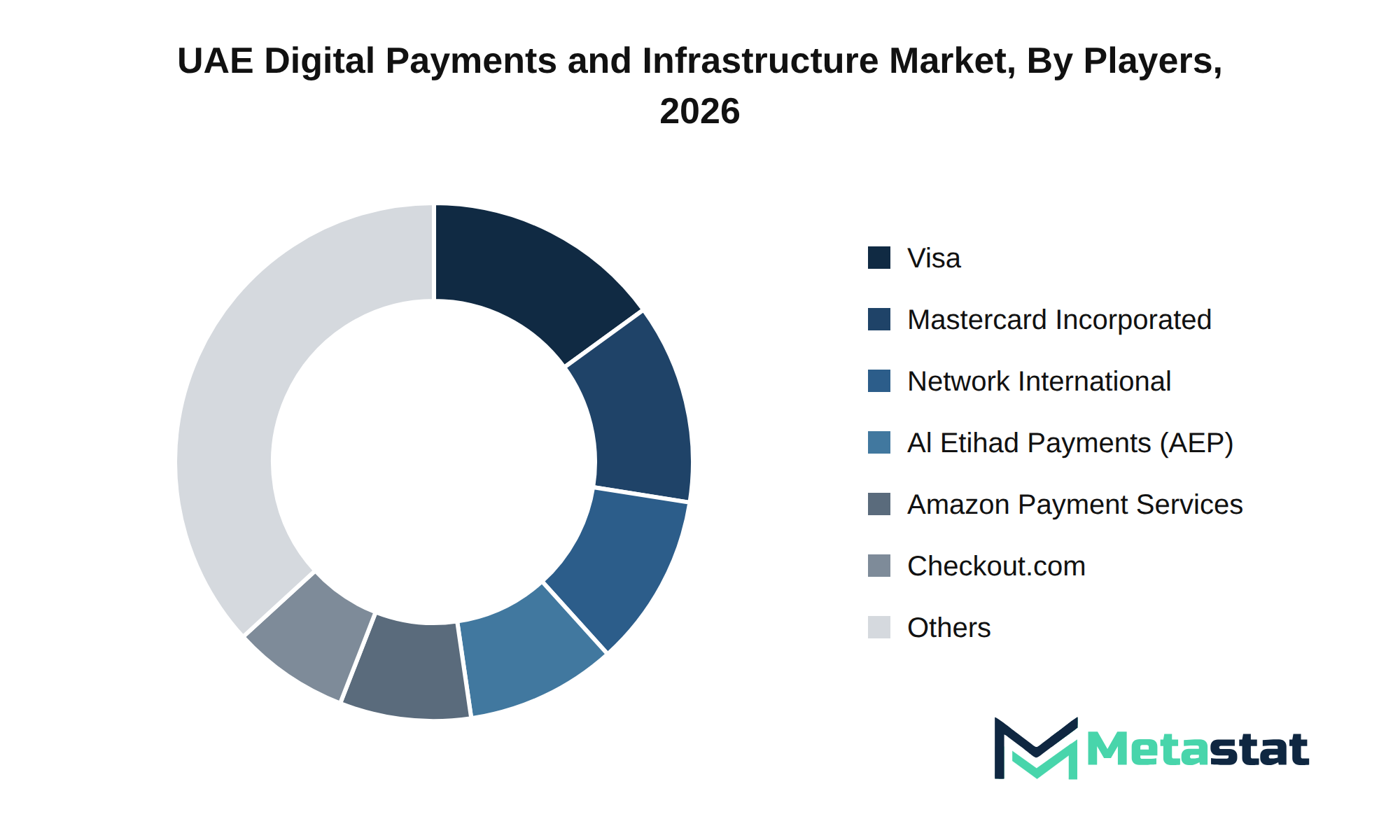
The UAE Digital Payments and Infrastructure market features a dynamic competitive environment driven by various strategic behaviors among key players. Companies including Visa Inc., Mastercard Incorporated, and Network International LLC highlight their positions through extensive payment network and merchant acquiring services. They focus on enhancing product differentiation and building strong brand equity, which enhances customer loyalty in a changing market.
Innovative offerings from firms like Checkout.com, Adyen N.V., and Amazon Payment Services emphasize advancements in payment gateways and acceptance platforms. These companies leverage proprietary technology and robust R&D pipelines to enhance user experience and streamline transaction processes. Strategic alliances and partnerships with regional firms further strengthen their foothold in the market.
Emerging players, including PayTabs, Geidea Payment LLC, and Tap Payments, contribute to the market's growth through disruptive technologies and unique commercial models. These companies present opportunities for competition while navigating barriers to entry, particularly in areas like customer retention strategies and procurement leverage. The competitive outlook for the UAE Digital Payments and Infrastructure market suggests continued evolution and innovation driven by companies adapting to consumer demands and market trends.
Market size is forecast to rise from USD 21.3 billion in 2025 to over USD 39.2 billion by 2033. The base case projects growth at a 7.9% CAGR, driven by increasing digital transactions and infrastructure improvements across various sectors. In the bull case, accelerated technology adoption and enhanced regulatory frameworks push growth rates higher, leading to more robust investment in digital payment systems. Conversely, the bear case highlights risks, including potential regulatory hurdles and economic downturns, which could temper growth trajectories.
The UAE Digital Payments and Infrastructure market is influenced by macroeconomic conditions, including fluctuations in consumer demand, shifts in global supply chains, and geopolitical dynamics. Strategic capital allocation towards infrastructure development and digital technologies plays a critical role in shaping the market landscape. Emerging white-space opportunities exist in areas including digital wallets, cross-border payments, and comprehensive payment orchestration solutions. Identifying and addressing unmet enterprise needs through innovation enhances competitive positioning within the market.
Compliance with evolving regulations and policy enforcement requires ongoing adjustments within the sector. Firms focusing on next-generation technology integration and R&D commercialization gain significant advantages, particularly in addressing changing consumer preferences and enhancing service delivery. Future growth recommendations emphasize the importance of developing defensibility roadmaps that align with industry trends and market demands.
The report strategically identifies and profiles the key market players and analyses their core competencies in each sub-segment of the Digital Payments and Infrastructure market.
Report Attributes | Details |
Study Period | 2021-2033 |
Base Year | 2025 |
Estimated Year | 2026 |
Forecast Period | 2026-2033 |
Historical Period | 2021-2025 |
Growth Rate | CAGR 7.9% from 2026 to 2033 |
Revenue Unit | USD billion |
Segmentation | By Solution Type, Payment Flow, Transaction Type, End-Use Industry, and Region |
Find answers to common questions about this report
The Digital Payments and Infrastructure market size in the UAE was valued at USD 21.3 billion in 2025, according to the Metastat Insights study.
The Digital Payments and Infrastructure market is projected to grow at a CAGR of 7.9% during the forecast period from 2026 to 2033.
The segment "Payment Network, Card Scheme & Switching Services" leads the UAE Digital Payments and Infrastructure market, with a projected value of USD 6.3 billion by 2033. This segment holds the largest share compared to other segments in the market.
The key drivers for the UAE Digital Payments and Infrastructure market include ongoing digital transformation across sectors, heightened consumer expectations for efficient transactions, and increased smartphone penetration. Organizations prioritize technology advancements to enhance operational efficiency and customer engagement, increasing demand for innovative payment solutions.
Regulatory challenges, compliance hurdles, and macroeconomic headwinds significantly restrain the growth of the UAE Digital Payments and Infrastructure market. infrastructure gaps, skilled labor deficiencies, and data security vulnerabilities create barriers to adoption and innovation, further impacting market dynamics.
The Digital Payments and Infrastructure market is estimated to reach a valuation of USD 39.2 billion by 2033.
Key players operating in the UAE Digital Payments and Infrastructure market include Al Etihad Payments (AEP), Visa Inc., Mastercard Incorporated, Network International LLC, Checkout.com, Adyen N.V., and Amazon Payment Services.
The UAE Digital Payments and Infrastructure market is projected to grow at a CAGR of 7.9% from 2026 to 2033.
The Peer-to-Peer (P2P) payment flow segment is anticipated to grow at a CAGR of 9.4% from 2026 to 2033.
Increased smartphone penetration and changing consumer lifestyles drive the demand for digital wallets, particularly among younger demographics.
The analysts below cover Banking & Finance research at Metastat Insights.
LEAD ANALYST
Utkarsh Khirodkar is a Lead Market Research Analyst at MetaStat Insight, specializing in market intelligence, technology sector assessments, and competitive strategy.

PRINCIPAL CONSULTANT - ENTERPRISE AI & EMERGING TECHNOLOGIES
Banking & Finance · Electronics and Semiconductor · Energy and Power · Healthcare IT · Information & Technology · Professional Services
Vijay Gunti is a Principal Consultant at MetaStat Insight, bringing over two decades of experience across enterprise digital transformation, technology strategy, and intelligent systems.
Evaluating calorific value requirements and air permit compliance across municipal waste facilities requires localized data. Metastat Insight structured their analysis around operational throughput capacity and feedstock composition variations in Latin America and Eastern Europe. Their competitive mapping of sorting equipment vendors helped clarify technology differences between optical separators and heavy media systems. The study provided an objective baseline during our capital expenditure reviews.
Decarbonizing industrial thermal processes hinges on refrigerant regulations and compressor efficiency limits. Metastat Insights delivered a thorough market analysis that evaluated natural refrigerants like CO2 and hydrocarbons against synthetic low-GWP alternatives. The breakdown of utility incentives and grid capacity constraints across key European manufacturing hubs offered valuable perspective. The follow-up conversation with their sector analysts addressed our specific questions on mechanical vapor recompression systems efficiently.
Assessing 200mm wafer transition schedules and substrate supply bottlenecks requires precise technical intelligence. MetaStat Insight supplied an actionable breakdown comparing planar and trench MOSFET architectures across automotive and industrial drive markets. The regional capacity estimates for Asia-Pacific foundries helped clarify lead-time uncertainties during our strategic planning session. When we needed additional clarification on high-purity raw material sourcing, their analyst team responded with helpful context within twenty-four hours.
Explore related market intelligence reports worth reading alongside this one.
Starting from
$2950