
US Optical Switches Market
US Optical Switches Market Size, Share, By Technology (MEMS-Based Switches, Electro-Optic Switches, Thermo-Optic Switches, Liquid Crystal Switches, Acousto-Optic Switches, Silicon Photonics-Based Switches, PLC Switches and Others), By Switch Configuration (1×N and 1×M, 2×2, 2×N and N×2, M×N and N×N, Optical Circuit Switches and Others), By Application (Telecommunications & Optical Transport, Data Centers, Optical Network Monitoring & Protection, Test & Measurement, Fiber-Optic Sensing, Quantum Communications & Computing, Industrial & Biomedical Photonics and Other), By End-Use Industry (Telecommunications, Data Centers & Cloud Providers, IT & Networking, BFSI, Defense & Aerospace, Healthcare & Medical Systems, Industrial & Manufacturing, Retail and Others), Industry Analysis, Growth, Trends, and Forecast, 2026-2033
MSI-4983
August 19, 2026
Updated
296 Pages
Historical
Base year
Forecast
Forecast period
Report Details
Comprehensive Market Analysis And Insights
Market Overview
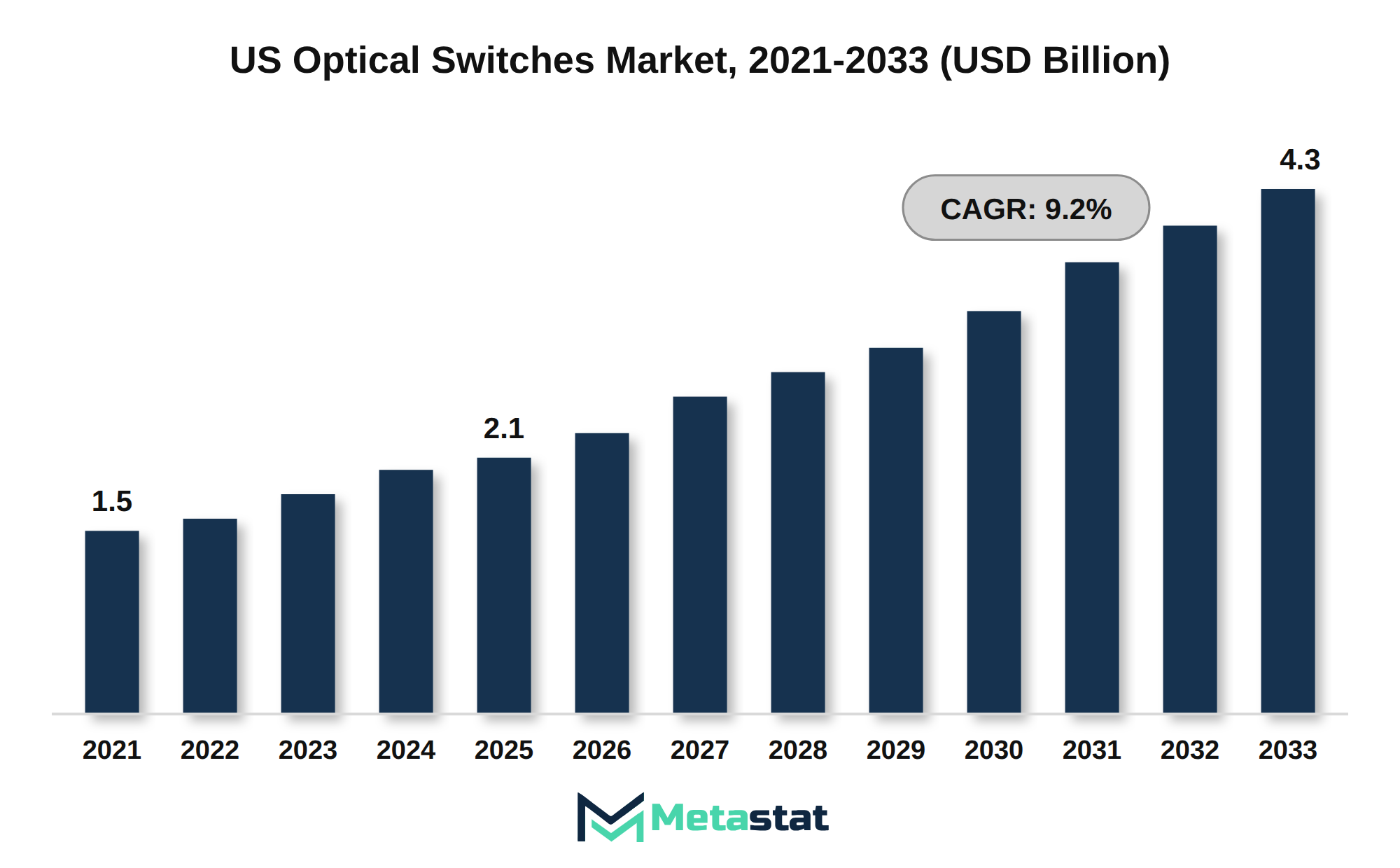
The US Optical Switches market was valued at USD 2.1 billion in 2025 and is projected to reach USD 4.3 billion by 2033, growing at a CAGR of 9.2% over the forecast period.
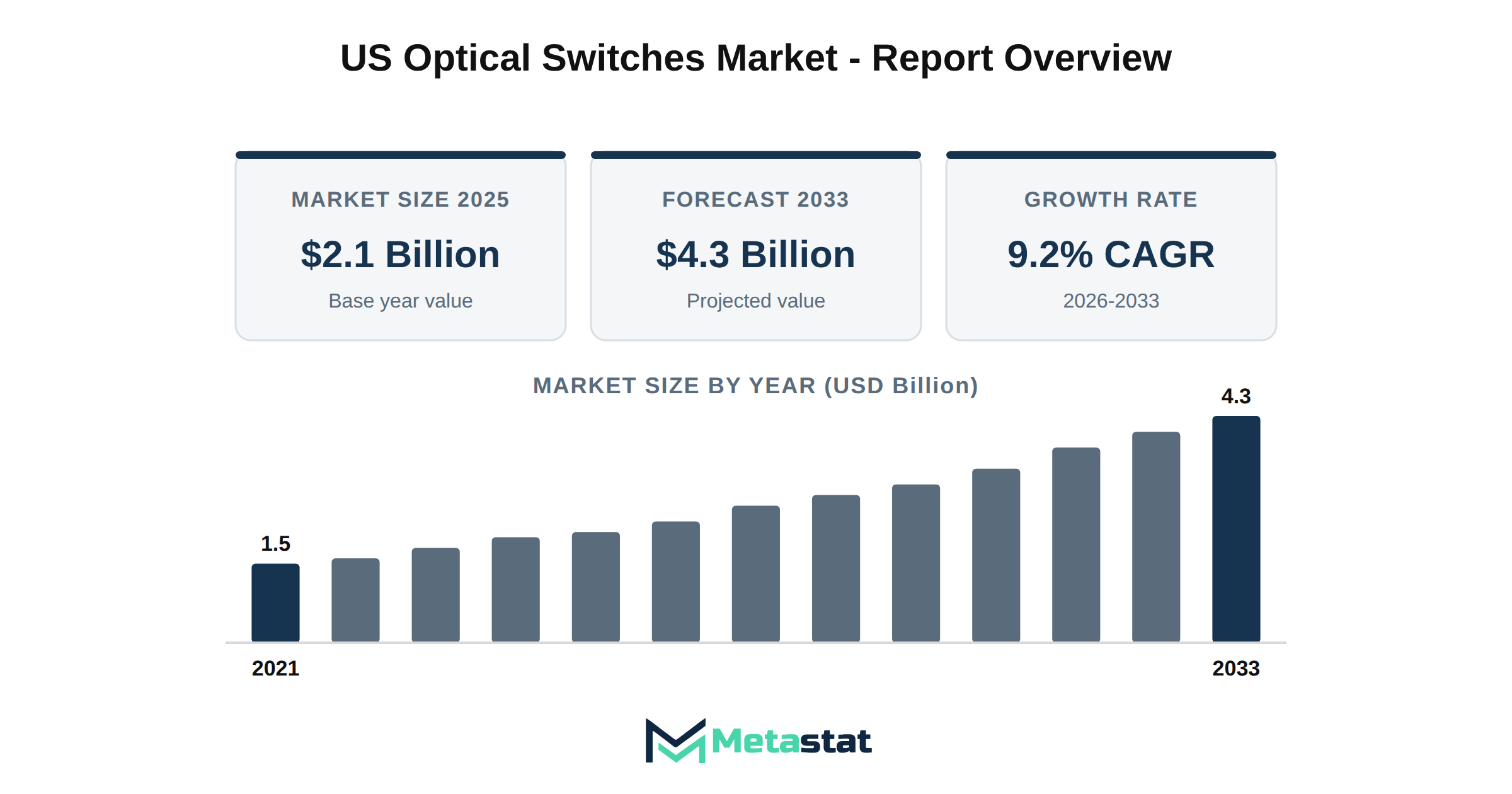
The US Optical Switches market reached a valuation of USD 2.1 billion in 2025, demonstrating a consistent growth trajectory from its historical value of USD 1.5 billion in 2021. The market is projected to expand to USD 4.3 billion by 2033, reflecting a compound annual growth rate (CAGR) of 9.2% over the forecast period.
This growth is driven by increasing demand for optical communication technologies across various sectors, particularly in telecommunications and data centers. The surge in data consumption and the expansion of high-speed internet services contribute significantly to the rising adoption of optical switches. Key applications in telecommunications and optical transport are expected to comprise a growing share of the market, supported by advancements in optical networking technologies.
Technological innovations play a significant role in shaping the market landscape. MEMS-based switches, accounting for 42.6% of the market share, represent a leading segment due to their efficiency and reliability. Liquid crystal switches and electro-optic switches follow, holding shares of 13% and 11.8%, respectively. The market's diversity in technology segments indicates a robust competitive environment, driving continuous improvements and innovations.
The US Optical Switches market is influenced by macroeconomic factors, including inflationary pressures and currency volatility, which impact cost structures and pricing strategies. Companies within the market navigate these challenges while capitalizing on emerging opportunities in the optical networking landscape. Infrastructure investments and capital allocation strategies will be essential for companies aiming to enhance their market presence and operational efficiency.
Overall, the US Optical Switches market is positioned for substantial growth, driven by technological advancements, increasing demand in telecommunications, and strategic investments in infrastructure. The evolution of optical technologies will continue to reshape the market dynamics, presenting both challenges and opportunities for stakeholders.
Several factors contribute to the evolving dynamics within the US Optical Switches market. Regulatory compliance and standards significantly influence manufacturers' operational strategies. Adherence to established guidelines ensures product reliability and enhances market credibility. Geopolitical risk frameworks impact supply chain decisions, prompting companies to reassess sourcing strategies and operational footprints.
Research and development trajectories remain critical for innovation within the market. Investment in next-generation technologies enhances competitive positioning and drives growth. Companies increasingly focus on sustainable transformation, emphasizing decarbonization and circular economy dynamics to align with environmental objectives and consumer expectations.
The supply chain landscape reflects ongoing changes, with logistics architecture adapting to fluctuations in demand and sourcing landscape. Market fragmentation becomes evident owing to numerous players vying for market share, intensifying competition. M&A dynamics influence strategic positioning, allowing firms to consolidate resources and expand capabilities.
The value chain in the market encompasses various stakeholders, from suppliers to end-users, each playing a vital role in delivering value. Procurement processes evolve with the need for agility and responsiveness to market shifts. Understanding customer journey dynamics remains essential for tailoring solutions to meet specific needs.
Capital allocation strategies focus on infrastructure investments in advanced technologies, optimizing capital expenditures and operational expenses. Macroeconomic headwinds, including inflationary pressures and currency volatility, challenge market participants. In response, firms adopt strategic initiatives to navigate these challenges.
The future strategic outlook for the US Optical Switches market emphasizes the importance of corporate imperatives, driving companies to prioritize innovation and sustainability. High-value recommendations suggest that businesses leverage emerging technologies to enhance efficiency and meet evolving customer demands.
Market Dynamics
Investment in infrastructure development drives growth
Increased investment in infrastructure development facilitates substantial growth within the US Optical Switches market. Governments and private entities prioritize upgrading physical and digital capacities, enhancing network capabilities to meet rising data demands. This investment trend results from several macro-economic factors, including GDP growth and public-private spending power.
The telecommunications and data center sectors experience significant benefits from these enhancements. Greater capacity and improved technology integration enable faster, more reliable services. This technological evolution supports the adoption of advanced optical switching solutions, essential for maintaining competitive advantages in a data-driven environment.
While infrastructure continues to modernize, market players respond by innovating and diversifying offerings. Increased competition leads to a broader range of products available. The market's growth trajectory appears closely linked to these infrastructure advancements, which create opportunities for improved operational productivity and cost-efficiency among end-users.
Overall, the focus on infrastructure development strengthens the market and aligns with the ongoing digital transformation across various industries. This trend promotes the adoption of optical switches, reflecting a critical component in modern network designs.
Digital transformation drives demand for optical switches
The US Optical Switches market experiences significant demand driven by ongoing digital transformation across various sectors. Enterprises increasingly adopt automation technologies, artificial intelligence, and software solutions to enhance operational efficiency. This transition creates a strong need for advanced optical switching solutions that facilitate faster data transmission and improve system reliability.
Investment in modernizing network infrastructure supports this trend. Organizations digitize legacy processes and require robust optical switch technology to manage increased data traffic effectively. Telecommunications and data centers represent key end-use industries benefiting from this technological integration, leading to enhanced capabilities and operational productivity.
The market reflects a growing emphasis on resource stewardship. Companies prioritize sustainability efforts, seeking solutions that minimize environmental impact while optimizing performance. This shift influences purchasing decisions and drives the adoption of optical switches that align with sustainability goals.
Overall, the combination of digital transformation initiatives and sustainable practices fuels growth in the US Optical Switches market, indicating a promising trajectory through the forecast period. Increasing investments in technology and infrastructure position the market for robust expansion.
High capital investment requirements hinder growth
High capital investment requirements present a significant restraint on the US Optical Switches market. The initial setup costs for deploying advanced optical switching technologies often exceed budget constraints for many organizations. These costs particularly impact smaller enterprises and startups, which struggle to secure the necessary funding. High capital requirements effectively limit market penetration and slow adoption rates across various sectors.
Escalating operating costs compound the challenge of entering the market. Businesses face increasing expenses related to maintenance, upgrades, and compliance. This financial pressure detracts from operational budgets and restricts investment in new technologies, further stalling growth opportunities within the market. Companies in sectors reliant on optical switches often recalibrate their investments, choosing to allocate resources to more immediate operational needs.
Supply chain disruptions contribute to the overall constraints experienced in the market. Global events influence the availability of critical components, leading to delays and increased prices. These disruptions force companies to reconsider their procurement strategies, potentially settling for lower-quality substitutes that do not meet the full performance spectrum of dedicated optical switches. Such compromises hinder overall system efficiency and functionality.
Technological obsolescence poses another significant restraint. Rapid advancements in technology prompt frequent updates, meaning older systems quickly become outdated. Companies that lack the capital to invest in the latest technologies find themselves at a disadvantage. This obsolescence risks diminishing market competitiveness, leading to stagnation of growth resulting from organizations hesitating to invest in technologies that do not remain viable.
High capital investment requirements, escalating operating costs, supply chain disruptions, and technological obsolescence collectively impose significant restraints on the US Optical Switches market. These challenges require strategic approaches to mitigate their impacts and ensure sustained growth in the face of ongoing market pressures.
Geopolitical tensions hinder supply chain stability
Geopolitical fragmentation significantly impacts the US Optical Switches market by creating uncertainties in supply chains and increasing operational risks. Trade deficits and tariff frictions contribute to rising costs for manufacturers, impacting pricing strategies and profit margins. These factors lead to a challenging environment for businesses, requiring adjustments in sourcing and distribution strategies to navigate the complexities of international trade.
Technological disruptions further complicate market dynamics, resulting from challenges companies face in integrating new technologies with existing systems. This leads to interoperability friction, which slows down product development and deployment. Companies strive to innovate, but the complexity of research and development integrations introduces delays and increases costs, affecting competitive positioning in the market.
Logistics disruptions have become more frequent, adding to the instability of supply chains. Fluctuations in feedstock and component availability lead to unpredictable input costs, adversely affecting production timelines and pricing structures. This situation creates a ripple effect, impacting revenue and market share for players in the optical switches sector.
Workforce skill gaps present another challenge for the US Optical Switches market. Businesses struggle to find qualified talent capable of managing advanced technologies and meeting evolving demands. Talent retention pressures compound these issues, making it difficult for companies to maintain operational efficiency and capitalize on growth opportunities.
While industries increasingly focus on sustainability, environmental lifecycle footprints and decarbonization mandates enforce stricter compliance requirements. These evolving legal liabilities add overhead costs and necessitate investments in greener technologies. Meeting such demands presents challenges and opportunities for market players, ultimately shaping the future trajectory of the US Optical Switches market.
Emerging technological innovations drive market potential
The US Optical Switches market stands to benefit significantly from rapid technological innovations. These advancements enhance product functionalities and enable the integration of newer optical switch technologies. Increasing data traffic and the need for efficient connectivity solutions drive heightened demand for next-generation optical switches that support high-speed data transmission.
Digital transformation continues to reshape industries, influencing the market. The shift towards cloud computing, 5G networks, and Internet of Things (IoT) applications creates opportunities for optical switches that provide advanced capabilities. These factors facilitate the adoption of optical switches across diverse applications, including telecommunications and data centers, promoting growth and diversification.
Geographical expansion represents another avenue for market potential. Emerging regional demands for high-performance connectivity solutions prompt manufacturers to explore new market opportunities. This exploration aligns with ongoing trends of infrastructure modernization and the deployment of advanced network technologies.
Sustainability imperatives contribute to shaping the market by driving eco-friendly product development. The increasing emphasis on green technologies influences companies to align their strategies with environmental, social, and governance (ESG) criteria. This alignment enhances brand reputation and attracts environmentally conscious customers.
Investment in strategic consolidation and cross-industry collaborations facilitates the development of integrated optical switch solutions. By pooling resources and expertise, companies boost their competitiveness and expand their product offerings, addressing the evolving needs of the market.
Overall, the US Optical Switches market presents substantial opportunities driven by technological advancements, sustainability efforts, and strategic collaborations. These elements collectively create a robust environment for growth, encouraging further innovations and expansions within the industry.
Market Segmentation Analysis
The US Optical Switches market is segmented based on Technology, Switch Configuration, Application, and End-Use Industry.
By Technology, the market is further segmented into:
- MEMS-Based Switches
- Electro-Optic Switches
- Thermo-Optic Switches
- Liquid Crystal Switches
- Acousto-Optic Switches
- Silicon Photonics-Based Switches
- PLC Switches
- Others (Magneto-Optic, Solid-State Switches, Emerging Technologies)
MEMS-Based Switches
Valued at USD 1 billion in 2026, the MEMS-Based Switches segment is projected to reach USD 2 billion by 2033, reflecting a CAGR of 9.9% during the forecast period. Increased demand for high-speed data transmission drives the adoption of MEMS (Micro-Electro-Mechanical Systems) technology in optical switches, particularly within telecommunications and data center applications. The technological maturation of MEMS-based solutions enhances operational efficiency, enabling faster switching speeds and reduced power consumption compared to traditional optical switches.
The continuous evolution of products in this segment aligns with the growing need for advanced network infrastructure, particularly in light of increasing data traffic generated by cloud computing and IoT applications. Companies operating in the US Optical Switches market invest significantly in research and development to enhance the capabilities of MEMS-based switches, creating strategic opportunities for growth. This segment's performance is further supported by downstream applications, including optical network monitoring and protection, which require reliable and efficient switching solutions.
End-use dynamics indicate a strong preference among telecommunications and data center operators for MEMS technology due to scalability and adaptability. Regulatory compliance standards increasingly emphasize energy efficiency and sustainability, pushing suppliers to innovate and adhere to best practices in design and production. Consequently, rising demand for environmentally friendly solutions strengthens the market for MEMS-based switches.
Pricing volatility in raw materials used for MEMS technology introduces potential margin pressures for manufacturers. However, robust supply chain resilience within this segment mitigates risks associated with raw material sourcing and logistics vulnerabilities. By investing in technological advancements and maintaining competitive pricing strategies, companies capitalize on strategic opportunity windows presented by growing demand for optical switches across various sectors.
Electro-Optic Switches
Investments in advanced telecommunication infrastructure drive demand for Electro-Optic Switches within the US Optical Switches market. The increasing need for higher bandwidth and faster data transmission supports the adoption of these switches, particularly in data centers and telecommunications applications. Electro-Optic Switches offer advantages including rapid switching speeds and low power consumption, aligning with industry requirements for efficient optical networks.
Technological maturation significantly influences segment expansion, with continuous advancements enhancing product capabilities. The ongoing development of next-generation optical components drives innovation in Electro-Optic Switches, allowing for integration into various applications, including optical transport networks. Downstream applications benefit from these technologies, resulting in enhanced performance and reliability in data transmission.
The Electro-Optic Switches segment is projected to reach USD 0.4 billion by 2033, at a CAGR of 7% during the forecast period. Increasing regulatory compliance standards, along with the push for sustainable technologies, promote the adoption of efficient and environmentally friendly optical solutions. Competitive dynamics within the market further encourage manufacturers to innovate and improve product offerings, ultimately benefiting consumers through enhanced choices.
Market participants face challenges related to pricing volatility and cost structures that impact profit margins. Effective supply chain management and raw material sourcing strategies become vital in mitigating these issues, ensuring consistent availability and affordability of components. The US Optical Switches market reflects a strategic opportunity for companies focusing on Electro-Optic technologies to capture market share and meet evolving customer demands.
Thermo-Optic Switches
Growth within the Thermo-Optic Switches segment of the US Optical Switches market is driven by advancements in technology that enhance performance and efficiency. Increasing demand for high-speed data transmission in telecommunications and data centers pushes adoption forward. This segment is projected to reach USD 0.3 billion by 2033, reflecting growing interest in innovative switching technologies that support modern networking requirements.
Technological maturation allows for significant enhancements in manufacturing processes, leading to improved product reliability and performance. Next-generation upgrades and product evolution play a crucial role in maintaining competitiveness in a market that evolves quickly. The shift towards more energy-efficient and compact designs supports broader applications across various industries, including telecommunications and IT services.
End-use dynamics show rising consumption of Thermo-Optic Switches in data centers and cloud services, driven by the increasing necessity for rapid data processing and transmission capabilities. Regulatory compliance standards necessitate the adoption of advanced technologies, creating a favorable environment for growth. Pricing volatility remains a concern; however, strategic investments in research and development alleviate margin pressures and strengthen supply chain resilience.
Strategic opportunity windows arise from the demand for disruptive alternatives to traditional switching technologies. Companies focusing on innovation and product differentiation position themselves favorably within the competitive environment. The overall capital investment outlook for the Thermo-Optic Switches segment remains positive, supporting ongoing development and expansion within the US Optical Switches market.
Liquid Crystal Switches
Innovation in Liquid Crystal Switches drives significant growth in the US Optical Switches market. This segment is projected to grow at a CAGR of 9.3% during the forecast period. The increasing demand for high-speed optical communication in various applications, including telecommunications and data centers, is driving investment in liquid crystal technology. These switches offer advantages in terms of flexibility and efficiency, making them appealing for modern optical networks.
Demand for Liquid Crystal Switches aligns with broader trends toward energy-efficient and high-performance solutions. Regulatory compliance standards promoting sustainability influence manufacturers to adopt these technologies, enhancing their market appeal. The evolution of optical networks toward more complex configurations encourages greater adoption of Liquid Crystal Switches, responding to the needs of advanced optical communication systems.
Technological advancements and product evolution, including enhanced performance features and lower production costs, further support growth in this segment. Strategic investments in research and development enable suppliers to innovate, resulting in improved product offerings that meet the demands of end-users. The focus on higher bandwidth and greater data transmission speeds in the market highlights the importance of Liquid Crystal Switches in future optical infrastructure.
Overall, the Liquid Crystal Switches segment significantly shapes the future of the US Optical Switches market through technological advancements and increased adoption driven by demand for efficiency and performance.
Acousto-Optic Switches
Technological advancements drive the performance and adoption of Acousto-Optic Switches within the US Optical Switches market. These switches operate by using the acousto-optic effect, allowing them to control light beams in optical systems effectively. Rising demand for high-speed data transmission and increased bandwidth requirements are fueling the necessity for innovative optical switching solutions.
Product evolution in this segment focuses on enhancing speed, reliability, and efficiency. Manufacturers prioritize the development of next-generation acousto-optic switches that offer improved performance metrics and integration capabilities with existing systems. This evolution aligns with trends in telecommunications and data centers, where high-performance optical components are essential for operational success.
Consumer preferences shift towards integrated systems that offer versatility and reduced operational costs. Acousto-Optic Switches appeal to end-users seeking reliable and efficient solutions for optical network management. Adoption in industries including telecommunications and data centers highlights the increasing importance of this technology in facilitating advanced optical transport networks, strengthening long-term demand.
Regulatory compliance standards dictate the operational framework for manufacturers in the market. Adhering to these standards influences the design and functionality of acousto-optic solutions, ensuring they meet safety and performance criteria. Compliance shapes market dynamics, affecting product acceptance among consumers and increasing operational costs for manufacturers.
Investment in research and development remains critical for sustaining competitive advantage in the Acousto-Optic Switches segment. Companies focus on capital investment to enhance product offerings and improve supply chain resilience. These strategic investments align with industry trends, preparing manufacturers to meet the evolving demands of the US Optical Switches market and expanding the addressable base.
Silicon Photonics-Based Switches
Advancements in silicon photonics technology drive the demand for Silicon Photonics-Based Switches within the US Optical Switches market. The ability to integrate optical components on silicon chips enhances device performance while reducing overall energy consumption. This growing emphasis on energy efficiency aligns with the needs of data centers and telecommunications, where capacity expansion and operational efficiency are critical.
Investment in research and development encourages innovation in this segment, leading to next-generation upgrades and product evolution. Companies focus on developing highly scalable solutions that cater to increasing data traffic across networks. Consequently, strategic collaborations among technology providers enhance market competitiveness, enabling firms to combine complementary strengths and improve product offerings.
End-use dynamics reflect an increasing reliance on Silicon Photonics-Based Switches for applications including high-speed data transmission and optical network monitoring. The ongoing shift towards cloud-based services and edge computing necessitates robust optical solutions, highlighting the importance of this technology in meeting emerging demands. Regulatory compliance standards related to environmental sustainability reinforce the adoption of energy-efficient optical solutions, supporting the segment's growth trajectory.
With continuous advancements in silicon photonics, opportunities arise for market participants to address potential substitution risks and technological obsolescence. This sector offers a strategic opportunity window for investment and innovation, positioning firms to capitalize on future developments within the US Optical Switches market.
PLC Switches
Growing demand for PLC Switches in the US Optical Switches market results from the increasing need for high-performance optical networking solutions across various industries. Adoption of these switches gains momentum due to their ability to enhance data transmission, improve network efficiency, and reduce operational costs. Their application in telecommunications and data centers significantly contributes to expansion, driven by the surge in bandwidth requirements and the proliferation of internet-connected devices.
Technological maturation influences the development of PLC Switches, with continuous enhancements in performance and reliability leading to broader acceptance in critical applications. Upgrades to next-generation infrastructure highlight the importance of integrating PLC technology, ensuring compatibility with emerging standards and protocols in the market. This evolution supports the growing need for advanced optical switching solutions that cater to the demands of modern communication networks.
End-use dynamics focus on the telecommunications sector, where PLC Switches facilitate connectivity in optical transport networks. Consumption shifts toward more efficient and flexible switching solutions align with the industry's drive for innovation. Regulatory compliance standards encourage the adoption of reliable and high-quality optical technologies, resulting in enhanced performance metrics and improved operational efficiencies.
Cost structures and pricing volatility represent significant aspects of the PLC Switches segment, impacting manufacturers and end-users alike. Strategic opportunity windows arise from the increasing focus on sustainability and energy efficiency, prompting suppliers to invest in environmentally friendly technologies. The ongoing evolution of the market presents avenues for growth and innovation, reflecting the necessity for continued capital investment in advanced optical switching solutions.
Others (Magneto-Optic, Solid-State Switches, Emerging Technologies)
Emerging technologies in the US Optical Switches market, particularly in the Others (Magneto-Optic, Solid-State Switches) sub-segment, show growing relevance due to advancements in optical communication methods. Increased integration of these technologies across various applications enhances system capabilities and overall performance. Demand arises from sectors seeking optimized solutions for data transmission and processing, particularly where traditional systems prove inadequate.
Technological maturation within this sub-segment reflects ongoing research and development efforts aimed at enhancing the efficiency and reliability of magneto-optic and solid-state switches. Investments in next-generation upgrades lead to improvements in data transfer rates and reduced latency, which are essential for high-performance applications including telecommunications and data centers.
Increased focus on regulatory compliance and certifications influences product development in this sub-segment. Adhering to stringent standards boosts market confidence and encourages further adoption among end-users. Companies recognize the importance of ensuring products meet required safety and performance benchmarks, which drives investment in innovative technologies.
In terms of consumption shifts, a trend towards greater reliance on solid-state technologies emerges due to their advantages in size, durability, and energy efficiency. This shift is significant for industries prioritizing sustainability and operational efficiency. These technologies evolve and present strategic opportunities for market players aiming to capture value in high-demand sectors.
Supply chain resilience remains critical amid fluctuating raw material sourcing and logistics vulnerabilities impacting the availability of components necessary for these technologies. Companies actively seek to mitigate substitution risks by diversifying supplier relationships and exploring alternative materials that ensure continuity in production.
By Switch Configuration, the market is further segmented into:
- 1×N and 1×M
- 2×2
- 2×N and N×2
- M×N and N×N
- Optical Circuit Switches
- Others (Multicast Switches, Broadcast-Select Switches)
1×N and 1×M
Valued at USD 0.7 billion in 2026, the 1×N and 1×M segment is projected to reach USD 1.1 billion by 2033, at a CAGR of 6.9% during the forecast period. Demand for this segment escalates owing to its critical role in enhancing network capacity and flexibility within telecommunications infrastructure. The increasing reliance on high-speed data transmission drives the adoption of these configurations, particularly in environments that require efficient bandwidth allocation.
Technological maturation continues to drive innovations in 1×N and 1×M configurations, enabling better performance metrics. Next-gen upgrades facilitate improved scalability and reliability, attracting operators striving for enhanced operational efficiency. The ongoing evolution of optical networking technologies influences the segment, with a focus on product development that meets the specific needs of end-users.
End-use dynamics significantly shape the demand for this segment, with telecommunications and data centers being primary consumers of these switch configurations. Both sectors experience substantial growth, pushing the boundaries of traditional networking solutions. Consumption shifts toward more efficient optical products drive the transition from legacy systems to modern, high-capacity alternatives.
Regulatory compliance standards and certifications impose additional pressures on manufacturers within this segment, ensuring that new products align with industry expectations. Cost structures remain a consideration, impacting pricing strategies and margin dynamics across the market. The necessity for competitive pricing, combined with the pressure to innovate, presents challenges that firms actively address to maintain market share.
Strategic opportunity windows emerge owing to advancements in optical technology that create potential for investment and development. The segment benefits from supply chain resilience and raw material sourcing strategies that reduce logistical vulnerabilities. While competition intensifies, manufacturers focus on mitigating substitution risks through innovative solutions, reinforcing the segment's position within the US Optical Switches market.
2×2
Demand for 2×2 optical switches contributes to the ongoing expansion of the US Optical Switches market. This segment is projected to benefit from advancements in telecommunications and data center technologies, driving increased adoption of high-capacity switching solutions. The segment is estimated to reach USD 0.5 billion by 2033, at a CAGR of 6.3% during the forecast period. Technological maturation within the optical switching industry enhances performance and reliability, allowing sectors including telecommunications and data centers to utilize these systems more effectively.
End-use dynamics within the telecommunications industry play a crucial role in shaping the demand for 2×2 optical switches. Increasing bandwidth requirements and the need for efficient data transmission fuel the necessity for reliable switch configurations. The rise of cloud-based services and the growth of data centers enhance the market landscape for 2×2 switches. Consequently, this segment attracts significant interest from operators aiming to optimize their infrastructure and improve service quality.
Strategic opportunities arise from the ongoing evolution of networking technologies, presenting a favorable outlook for the 2×2 segment. Competition among key players focuses on enhancing product features and reducing costs, benefiting end-users by increasing value while maintaining operational efficiency. The market remains vigilant to shifts in consumption patterns and regulatory compliance standards that influence product development and market entry. Overall, the 2×2 optical switch segment is expected to experience growth in a rapidly advancing technological environment.
2×N and N×2
Anticipated growth within the 2×N and N×2 sub-segment of the US Optical Switches market reflects increasing demand for flexible and efficient optical networking solutions. This segment is expected to reach USD 0.4 billion by 2033, driven by advancements in technology that enable higher data transmission rates and improved network efficiency. Telecommunications and data center operators prioritize these configurations due to their scalability and reliability in handling diverse traffic loads.
Competitive pressures within the market prompt manufacturers to innovate and enhance product features. Enhanced performance characteristics of 2×N and N×2 configurations align with the evolving needs of end-users, particularly in applications requiring rapid deployment and adaptability. Continued investment in infrastructure development fuels the adoption of these switching technologies, ensuring they remain integral to the broader US Optical Switches market.
M×N and N×N
Significant growth in the M×N and N×N segment is projected to occur, with a CAGR of 10.6% during the forecast period. This expansion results from the increasing demand for high-capacity optical switching solutions, particularly in data-intensive applications including telecommunications and cloud computing. Enhanced data transfer rates and improved network performance drive adoption among key players in the US Optical Switches market.
Technological advancements play a critical role in this growth, with next-generation upgrades facilitating faster switching capabilities and greater flexibility in network configurations. The evolution of products within this segment addresses the growing complexity of network infrastructures, enabling enhanced performance and scalability. While organizations strive to meet the demands of digital transformation and increasing bandwidth requirements, M×N and N×N switches emerge because vital components in maintaining competitive advantages.
End-use dynamics further influence this segment's trajectory, with telecommunications and data center operators adopting advanced switching configurations. Investment in these technologies reflects a strategic response to consumption shifts driven by the expanding Internet of Things (IoT) ecosystem and the growing reliance on cloud services. Consequently, the US Optical Switches market stands poised for continued growth, supported by rising capital investments and a favorable regulatory environment that encourages innovation and technological adoption.
Optical Circuit Switches
Growing interest in Optical Circuit Switches stems from increasing demand for high-capacity data transfer and reliable network management solutions. This segment is essential in applications including telecommunications and data centers, where efficient traffic management is crucial.
Technological maturation significantly influences the adoption of Optical Circuit Switches. Continuous evolution of related technologies enhances performance, driving operators to implement next-generation upgrades. These advancements address the need for enhanced bandwidth and flexibility in network architectures.
Demand within the US Optical Switches market reflects a shift towards more automated and intelligent network solutions. End-users prioritize systems that enable integration and high-speed operations, which align with the capabilities offered by Optical Circuit Switches.
Regulatory compliance standards and certifications shape the market for Optical Circuit Switches. Adherence to these standards ensures that products meet quality and safety benchmarks, increasing confidence among users and encouraging market growth.
Pricing volatility and margin pressures impact the strategic decisions of companies operating in this segment. Manufacturers focus on optimizing cost structures while maintaining quality and performance of Optical Circuit Switches, enabling competitiveness in a dynamic market environment.
Strategic opportunity windows arise from innovations within the Optical Circuit Switches segment. Companies investing in research and development identify unmet needs and create tailored solutions that align with customer demands.
Others (Multicast Switches, Broadcast-Select Switches)
Demand for Others (Multicast Switches, Broadcast-Select Switches) within the US Optical Switches market reflects the growing complexity in network configurations and the need for improved data handling capabilities. Increasing adoption of these switching technologies aligns with rising requirements for efficient data traffic management in various applications, particularly in telecommunications and data centers.
Technological maturation in optical switching solutions drives interest in multicast and broadcast-select switches. These products enable advanced networking functions, allowing for efficient data distribution and improved bandwidth management. The ability to cater to diverse applications enhances appeal among end-users seeking to optimize network performance.
Investment in next-generation upgrades provides a significant catalyst for the expansion of this sub-segment. Enhanced functionalities and performance improvements are essential for maintaining competitive advantage in the changing landscape of data communications. While organizations prioritize infrastructure upgrades, demand for innovative switching solutions grows.
Regulatory compliance standards play a crucial role in shaping product development and market dynamics. Meeting stringent requirements ensures that these switches operate effectively within larger network architectures, thereby facilitating wider adoption across various industries. The relationship between compliance and innovation creates a robust environment for growth in the market.
Strategic opportunity windows arise from the increasing need for reliable and efficient data transmission methods. Organizations focusing on upgrading their infrastructure seek optical switches that offer enhanced performance, reliability, and scalability. This trend indicates a favorable outlook for the Others segment within the broader market.
By Application, the market is further segmented into:
- Telecommunications & Optical Transport
- Data Centers
- Optical Network Monitoring & Protection
- Test & Measurement
- Fiber-Optic Sensing
- Quantum Communications & Computing
- Industrial & Biomedical Photonics
- Other (Specialty Photonic Applications)
Telecommunications & Optical Transport
Valued at USD 0.7 billion in 2026, the Telecommunications & Optical Transport segment is projected to reach USD 1.3 billion by 2033, with a CAGR of 7.9% during the forecast period. Increasing data traffic and the ongoing demand for high-speed connectivity drive significant growth in this segment. Companies in the telecommunications industry adopt advanced optical switching technologies to enhance network capabilities and support evolving consumer needs.
Technological advancements, including the development of next-generation optical switches, facilitate improved performance and efficiency in data transmission. This innovation prompts increased investments in optical transport networks, contributing to the overall expansion within the US Optical Switches market. Enhanced operational efficiencies and reduced latency from these technologies are critical for maintaining competitive advantages in the telecommunications sector.
Shifts in consumption patterns among end-users drive demand for advanced optical switching solutions. The growing necessity for reliable and high-capacity optical networks underscores the segment's importance in supporting robust telecommunications infrastructure. Continued investment in upgrading existing networks to meet rising data demands establishes a favorable landscape for telecommunications and optical transport applications.
Data Centers
Growth in data centers significantly influences the US Optical Switches market. With demand for high-speed data transmission and increased bandwidth requirements, data centers emerge because a primary driver for optical switch adoption. Data centers are expected to reach USD 1.5 billion by 2033, at a CAGR of 11.1% during the forecast period. This expansion results from heightened reliance on cloud services, increased internet traffic, and the ongoing digital transformation across various sectors.
The need for efficient data management and processing fuels the demand for advanced optical switching solutions. Rapid technological advancements enable enhancements in switch performance, leading to greater operational efficiency and reduced latency. Adoption of next-generation upgrades further supports segment growth, because operators seek to modernize infrastructure and improve service offerings.
Competition among service providers and cloud operators heightens the urgency for investments in optical technologies. Migration to 5G networks and the development of smart cities necessitate reliable, high-capacity switching solutions. Consequently, the market experiences a shift toward scalable and flexible optical switching technologies, catering to evolving user demands and regulatory requirements.
Data centers face pressures related to cost structures, pricing volatility, and margin management. Strategic investments in innovative technologies mitigate these pressures while ensuring compliance with emerging standards and certifications. The relationship between supply chain resilience and raw material sourcing further impacts operational dynamics within the market.
Overall, the data centers segment illustrates a robust trajectory within the US Optical Switches market, driven by advancements in technology, evolving end-use dynamics, and strategic capital investments aimed at meeting growing consumer demands.
Optical Network Monitoring & Protection
Test & Measurement
Growth in the Test & Measurement segment aligns with expanding applications in data integrity and network performance assessment. Increasing reliance on high-speed optical networks creates demand for precise measurement tools, driving the adoption of advanced optical switches. The segment is projected to grow at a CAGR of 7% during the forecast period. Rising complexity in telecommunications infrastructure necessitates robust testing solutions, enhancing market potential for optical switches tailored for this application.
Investment in next-generation technologies, including software-defined networking and 5G, further influences the Test & Measurement segment's growth. Increased focus on regulatory compliance and standards in telecommunications and data centers necessitates high-performance testing equipment. The US Optical Switches market reflects these trends, indicating an upward trajectory in segment revenue.
Fiber-Optic Sensing
Advancements in Fiber-Optic Sensing technology drive increasing integration across various sectors, including telecommunications and industrial applications. Enhanced sensing capabilities facilitate real-time monitoring, crucial for maintaining operational efficiency and safety standards in critical infrastructures. The demand for high-performance sensing solutions in environments with stringent regulatory compliance standards drives market growth, because industries seek reliable and accurate data collection methods.
Technological maturation enhances the appeal of Fiber-Optic Sensing, because innovations in sensor design and signal processing improve measurement accuracy and system reliability. Emerging next-generation upgrades, including smart sensing systems capable of integrating with IoT platforms, expand applications and increase adoption rates among end-users. Such developments indicate a shift in consumption patterns, with industries prioritizing advanced sensing technologies that offer strong performance.
Downstream applications including environmental monitoring, structural health assessment, and energy management rely heavily on Fiber-Optic Sensing solutions. Demand dynamics in these end-use industries reflect a broader trend towards automation and data-driven decision-making processes. Investment in Fiber-Optic Sensing technologies supports operational resilience, enabling firms to respond effectively to market changes and regulatory challenges.
Capital investment outlook remains positive, driven by the increasing recognition of Fiber-Optic Sensing's value in enhancing operational efficiencies and enabling proactive maintenance strategies. Strategic opportunities arise from the need for advanced sensing solutions that mitigate risks associated with traditional sensing methods. The market continues to evolve, with ongoing product evolution meeting the demands of diverse industries, further reinforcing the role of Fiber-Optic Sensing in the US Optical Switches market.
Quantum Communications & Computing
Interest in quantum communications and computing drives significant growth in the US Optical Switches market. This sub-segment benefits from advancements in quantum technologies, which require highly efficient and precise optical switching solutions. The increasing need for secure communication and high-speed data processing is driving adoption in various sectors, including telecommunications and data centers.
Technological maturation continues to enhance the product landscape, with next-generation upgrades focusing on improving performance and integration capabilities. These advancements lead to better interoperability with existing infrastructure, promoting wider acceptance among end-users. Regulatory compliance standards influence design and operational requirements, ensuring that new solutions meet stringent performance criteria.
Cost structures and pricing volatility affect purchasing decisions in this segment. Suppliers face pressure to optimize production costs while maintaining quality, impacting margins. Strategic opportunity windows arise from the ongoing evolution of quantum technologies, encouraging firms to invest in research and development, driving innovation and competitiveness in the market.
Industrial & Biomedical Photonics
Innovations in the Industrial & Biomedical Photonics sub-segment drive advancements in the US Optical Switches market. Applications in healthcare and industrial settings require high-performance optical solutions for processes including imaging, sensing, and data transmission. Rising demand for reliable and efficient optical switches in these applications strengthens market opportunities.
Technological maturation enhances product performance and lowers costs, enabling broader adoption in biomedical systems and industrial applications. The segment benefits from ongoing research and development, leading to next-generation upgrades that integrate advanced functionalities into existing systems. These upgrades include improved signal integrity, lower latency, and enhanced scalability.
Regulatory compliance standards and certifications significantly influence purchasing decisions in the Industrial & Biomedical Photonics sector. Compliance with industry regulations ensures product safety and reliability, thereby attracting more end-users focused on quality and performance in critical applications. This focus on compliance drives manufacturers to prioritize quality assurance in their production processes.
Increasing investments in healthcare infrastructure and manufacturing capabilities create strategic opportunities within this sub-segment. Manufacturers and suppliers actively seek partnerships to develop innovative solutions tailored to the specific needs of medical and industrial applications. This collaboration enhances product offerings and strengthens supply chain resilience.
Market dynamics reflect shifts in consumption patterns, with an emphasis on energy efficiency and cost-effectiveness. Clients seek products that fulfill operational needs while fitting within budget constraints. Pressure on pricing and margin necessitates strategic sourcing and collaboration throughout the supply chain to mitigate volatility.
Overall, the Industrial & Biomedical Photonics sector within the US Optical Switches market demonstrates significant potential for growth driven by technological advancements, stringent compliance requirements, and an evolving landscape of application demands.
Other (Specialty Photonic Applications)
Growth in the Other (Specialty Photonic Applications) sub-segment is influenced by advancements in applications requiring specialized optical solutions. Demand arises from industries focusing on niche markets, where unique optical properties and functionalities are crucial for performance. The integration of optical switches in these applications enhances operational capabilities, driving innovation and product development.
Technological maturation further supports expansion, driven by manufacturers investing in R&D to create tailored solutions that meet specific customer needs. Regulatory compliance standards in various sectors promote the adoption of advanced optical technologies, ensuring products meet safety and performance requirements. This trend reflects the ongoing evolution within the US Optical Switches market, because players respond to shifting consumer preferences and emerging application areas.
Investment in these specialized segments opens strategic opportunity windows for suppliers looking to differentiate their offerings. By addressing the unique challenges associated with specialty photonic applications, firms enhance their competitive positioning. Increased focus on product evolution and next-generation upgrades plays a significant role in capturing market share and addressing the dynamic needs of end users.
By End-Use Industry, the market is further segmented into:
- Telecommunications
- Data Centers & Cloud Providers
- IT & Networking
- BFSI
- Defense & Aerospace
- Healthcare & Medical Systems
- Industrial & Manufacturing
- Retail
- Others (Utilities and Specialty Industries)
- Competitive Landscape and Strategic Insights
- Optical Switches Market Key Segments
- By Technology
- MEMS-Based Switches
- Electro-Optic Switches
- Thermo-Optic Switches
- Liquid Crystal Switches
- Acousto-Optic Switches
- Silicon Photonics-Based Switches
- PLC Switches
- Others (Magneto-Optic, Solid-State Switches, Emerging Technologies)
- By Switch Configuration
- 1×N and 1×M
- 2×2
- 2×N and N×2
- M×N and N×N
- Optical Circuit Switches
- Others (Multicast Switches, Broadcast-Select Switches)
- By Application
- Telecommunications & Optical Transport
- Data Centers
- Optical Network Monitoring & Protection
- Test & Measurement
- Fiber-Optic Sensing
- Quantum Communications & Computing
- Industrial & Biomedical Photonics
- Other (Specialty Photonic Applications)
- By End-Use Industry
- Telecommunications
- Data Centers & Cloud Providers
- IT & Networking
- BFSI
- Defense & Aerospace
- Healthcare & Medical Systems
- Industrial & Manufacturing
- Retail
- Others (Utilities and Specialty Industries)
- Key Optical Switches Industry Players
- Ciena Corporation
- Keysight Technologies
- Broadcom
- Fujitsu
- NTT ADVANCED TECHNOLOGY CORPORATION
- Lumentum Operations LLC
- POLATIS
- Molex
- Yokogawa Electric Corporation
- ZTE Corporation
- Gooch & Housego PLC
- Quantifi Photonics Limited
- Report Coverage
- WHAT REPORT PROVIDES
- FREQUENTLY ASKED QUESTIONS
- How big is the US market?
- What is the US Optical Switches market growth rate?
- Which type segment leads the US Optical Switches market?
- What are the key drivers for the US Optical Switches market?
- What factors are restraining the US Optical Switches market growth?
- What factors are favoring product adoption in this industry?
- What is the forecasted size of the US Optical Switches market by 2033?
- Who are the key players in the US Optical Switches Market?
- Table of Content
- Market Introduction
- Executive Summary
- Market Definition
- Market Scope
- Research Methodology
- Primary Research
- Secondary Research
- Assumptions and Exclusions
- Secondary Data Sources
- Optical Switches Market Dynamics and Overview
- Report Segmentation and Scope
- Key Market Trends
- Drivers
- Restraints
- Opportunity
- Porter's Five Forces Analysis
- Market Share Analysis
- Technology Overview
- Introduction
- Market Size and Forecast
- MEMS-Based Switches
- Market Size and Forecast
- Electro-Optic Switches
- Market Size and Forecast
- Thermo-Optic Switches
- Market Size and Forecast
- Liquid Crystal Switches
- Market Size and Forecast
- Acousto-Optic Switches
- Market Size and Forecast
- Silicon Photonics-Based Switches
- Market Size and Forecast
- PLC Switches
- Market Size and Forecast
- Others (Magneto-Optic, Solid-State Switches, Emerging Technologies)
- Market Size and Forecast
- Market Size and Forecast
- Market Size and Forecast
- Switch Configuration Overview
- Introduction
- Market Size and Forecast
- 1×N and 1×M
- Market Size and Forecast
- 2×2
- Market Size and Forecast
- 2×N and N×2
- Market Size and Forecast
- M×N and N×N
- Market Size and Forecast
- Optical Circuit Switches
- Market Size and Forecast
- Others (Multicast Switches, Broadcast-Select Switches)
- Market Size and Forecast
- Market Size and Forecast
- Market Size and Forecast
- Market Size and Forecast
- Market Size and Forecast
- Application Overview
- Introduction
- Market Size and Forecast
- Telecommunications & Optical Transport
- Market Size and Forecast
- Data Centers
- Market Size and Forecast
- Optical Network Monitoring & Protection
- Market Size and Forecast
- Test & Measurement
- Market Size and Forecast
- Fiber-Optic Sensing
- Market Size and Forecast
- Quantum Communications & Computing
- Market Size and Forecast
- Industrial & Biomedical Photonics
- Market Size and Forecast
- Other (Specialty Photonic Applications)
- Market Size and Forecast
- Market Size and Forecast
- Market Size and Forecast
- End-Use Industry Overview
- Introduction
- Market Size and Forecast
- Telecommunications
- Market Size and Forecast
- Data Centers & Cloud Providers
- Market Size and Forecast
- IT & Networking
- Market Size and Forecast
- BFSI
- Market Size and Forecast
- Defense & Aerospace
- Market Size and Forecast
- Healthcare & Medical Systems
- Market Size and Forecast
- Industrial & Manufacturing
- Market Size and Forecast
- Retail
- Market Size and Forecast
- Others (Utilities and Specialty Industries)
- Market Size and Forecast
- Market Size and Forecast
- Company Profile
- Company Basic Information, Operating Footprint, Service Area, and Key Competitors
- Cisco Systems, Inc. Product Category, Application, and Specification
- Cisco Systems, Inc. Financial Performance
- Main Business/Business Overview
- Ciena Corporation
- Keysight Technologies
- Broadcom
- Fujitsu
- NTT ADVANCED TECHNOLOGY CORPORATION
- Lumentum Operations LLC
- POLATIS
- Molex
- Yokogawa Electric Corporation
- ZTE Corporation
- Gooch & Housego PLC
- Quantifi Photonics Limited
Telecommunications
Investment in network infrastructure continues to drive demand for optical switches in the telecommunications sector. Increasing data traffic and the push for faster, more reliable communication technologies create a robust environment for optical switch adoption. Telecommunications providers prioritize upgrades to enhance service quality and capacity, necessitating advanced switching solutions. The shift towards 5G networks and smart cities further increases the demand for efficient optical networking solutions. Evolving regulatory standards influence companies to adapt by integrating innovative technologies that ensure compliance and enhance operational efficiency. This environment creates opportunities for product evolution and technological maturation, aligning with broader trends in the US Optical Switches market.
Rapid technological advancements facilitate next-generation upgrades in optical switch configurations. Telecommunications companies focus on creating agile infrastructures capable of meeting the dynamic demands of modern communication. The integration of software-defined networking (SDN) and network function virtualization (NFV) into optical switching solutions enhances flexibility and operational efficiency. This sector experiences increased competition and strategic partnerships among key players, driving innovation and reducing costs. The ongoing evolution of telecommunications systems necessitates continuous investment in optical switch technologies, reinforcing their critical role in shaping the future of the market.
Data Centers & Cloud Providers
Transformation within data centers and cloud providers reflects the increasing reliance on advanced optical switch technologies. The exponential growth in data generation drives the demand for efficient data management and transmission solutions. While organizations expand their digital infrastructure, the need for high-performance optical switches becomes critical to ensure reliable and swift data communication.
Technological maturation in optical switches enables enhanced performance, leading to greater adoption across data centers. The integration of next-generation upgrades promotes more agile and scalable network architectures, optimizing resource utilization. This shift assists in meeting the complex demands of cloud services and large-scale data processing, ensuring that data centers remain competitive in an evolving market.
Cost structures influence investment decisions within this sub-segment. With increasing pricing volatility in raw materials, organizations face margin pressures that compel them to evaluate their optical switch options carefully. This evaluation leads to strategic partnerships and collaborations, enhancing supply chain resilience and ensuring access to innovative technologies.
Opportunities for strategic growth abound, particularly attributed to organizations adapting to changing regulatory compliance standards. Meeting these standards often necessitates the adoption of advanced technologies, positioning optical switches because vital components in modern data infrastructure. While demand for secure and efficient data transfer escalates, the US Optical Switches market experiences continual growth, driven by the evolving needs of data centers and cloud providers.
Consumption shifts towards energy efficiency and sustainability influence purchasing decisions in this sub-segment. Companies increasingly prioritize solutions that not only enhance operational efficiency but align with environmentally responsible practices. This trend presents a compelling case for investment in next-generation optical switches, further emphasizing their importance in the market.
IT & Networking
Demand for optical switches among IT and networking applications undergoes significant expansion owing to increasing data traffic and the need for efficient network management. Organizations prioritize high-speed connectivity and reliability, prompting investments in advanced optical technologies. Adoption of optical switches enhances data transfer rates while reducing latency, which aligns with the evolving requirements of modern IT infrastructures.
Technological maturation serves because a catalyst for growth within this segment. Innovations including software-defined networking (SDN) and network function virtualization (NFV) integrate seamlessly with optical switch technologies, supporting next-generation upgrades. Enhanced product evolution, characterized by increased integration and automation, drives demand within the IT and networking segment.
End-use dynamics indicate a shift toward cloud-based services and increased reliance on data centers. These developments necessitate robust optical switching solutions capable of handling the heightened demand for bandwidth. Consumption shifts toward scalable and flexible solutions further influence the market, because enterprises seek to optimize their network operations.
Regulatory compliance standards related to data security and transmission efficiency present challenges and opportunities for the market. Organizations pursue certifications to comply with industry regulations, which influences their purchasing decisions. Cost structures and pricing volatility are critical factors impacting adoption, necessitating strategic planning from suppliers and end-users.
Strategic opportunity windows arise because IT and networking sectors focus on enhancing supply chain resilience. Raw material sourcing and logistics vulnerabilities affect pricing strategies and operational efficiency. Keeping pace with disruptive alternatives and technological obsolescence remains essential for companies operating in this market.
Capital investment outlook remains optimistic, with enterprises committing resources to expand their optical networking capabilities. The emphasis on long-term growth and adaptation to changing technological landscapes enhances the prospects for the US Optical Switches market in the IT and networking segment.
BFSI
Financial institutions increasingly seek advanced optical switches to support high-speed data transmission and enhance network performance. The need for secure and reliable communication systems in banking, financial services, and insurance (BFSI) drives demand for these solutions. Investments in digital transformation initiatives within the BFSI sector create catalysts for optical switch adoption, facilitating efficient transaction processing and real-time data analytics. Regulatory compliance standards necessitate robust infrastructure capable of handling sensitive customer information.
Technological maturation, coupled with the advent of next-generation optical switch technologies, transforms operational capabilities in the BFSI space. Emerging applications, including quantum communications and fiber-optic sensing, expand the functionalities of optical switches, catering to the unique demands of financial operations. Financial service providers continue to adopt innovative technologies, making the integration of optical switches into their existing systems imperative.
Downstream application dynamics increasingly favor optical switches in the BFSI sector, where data integrity and transmission speed are critical. Consumption shifts towards cloud-based solutions further accentuate the importance of high-performance optical switches for data centers that serve financial institutions. Companies look to innovate their product offerings, aligning with evolving consumer expectations in the digital finance landscape, creating strategic opportunity windows.
Investment in infrastructure and modernization of legacy systems enhances supply chain resilience within the BFSI sector. Pricing volatility and margin pressures remain pertinent, driven by organizations navigating competitive landscapes and seeking cost-effective optical switch solutions. Overall, the US Optical Switches market is poised for growth, driven by the BFSI segment's ongoing evolution and the demand for enhanced operational efficiencies.
Defense & Aerospace
Investment in the Defense & Aerospace sector drives the demand for advanced optical switches, reflecting the sector's focus on enhancing communication and data management capabilities. Military applications increasingly require robust, high-speed optical networks to support various operations, necessitating the adoption of reliable switching technologies. The ongoing evolution of defense technologies leads to rising interest in optical switches, particularly for applications related to secure communications and data transmission.
Technological maturation in the optical switches market aligns with the stringent requirements of defense operations, where performance and reliability remain critical. Enhanced product evolution, including next-generation upgrades, offers innovative solutions tailored to military specifications. These advancements improve operational efficiency and address the unique challenges faced by defense applications, ensuring compliance with regulatory standards.
Consumption shifts towards more integrated and compact optical switch solutions characterize the Defense & Aerospace segment. This trend arises from the increasing need for energy-efficient components that support high-performance systems within constrained environments. The rising complexity of defense systems further increases the demand for optical switches capable of integration with existing infrastructure.
Regulatory compliance standards and certifications significantly impact the market, particularly regarding defense contracts that necessitate adherence to specific guidelines. These compliance requirements influence procurement strategies, driving investments in technologies that fulfill both operational and regulatory demands. Consequently, this creates strategic opportunity windows for suppliers focusing on innovation and compliance within the sector.
The Defense & Aerospace sector presents unique challenges related to cost structures and margin pressures. Budget constraints often dictate procurement decisions, compelling suppliers to offer cost-effective, high-value solutions. These dynamics encourage competition among manufacturers, creating an environment where technological obsolescence poses a risk if innovation fails to keep pace with evolving demands.
Overall, the Defense & Aerospace segment within the US Optical Switches market reflects a confluence of strategic investments, technological advancements, and regulatory compliance, shaping the trajectory of demand and adoption in this specialized field.
Healthcare & Medical Systems
Growth in the Healthcare & Medical Systems sector drives demand for optical switches, reflecting the importance of high-speed data transmission and connectivity in medical applications. The need for enhanced patient care and the shift towards telemedicine necessitate advanced technologies that enable fast and reliable data exchange. Optical switches play a crucial role in ensuring real-time data access, which is vital for telehealth services, electronic health records, and medical imaging systems.
Regulatory compliance standards influence the adoption of optical switches within this sector. Manufacturers and healthcare providers prioritize technologies that align with healthcare regulations, ensuring both safety and efficiency in data handling. Upgrades to next-generation optical switch technologies facilitate improved performance and robustness, addressing the pressing demands of healthcare applications.
Investment in healthcare infrastructure further increases demand for optical switches, with hospitals and medical facilities seeking to modernize their systems. While healthcare institutions expand their networks, optical switches become essential for managing increased data traffic and enhancing communication capabilities among diverse medical devices. This evolution highlights the strategic importance of optical switches in future healthcare applications.
The US Optical Switches market anticipates significant growth opportunities within the Healthcare & Medical Systems segment, driven by the increasing reliance on technology in patient care and operational efficiency. Enhanced connectivity and the capability to integrate with various medical devices and systems raise the importance of optical switches in meeting the evolving needs of the healthcare sector.
Industrial & Manufacturing
Growth within the Industrial & Manufacturing sector highlights the increasing adoption of optical switch technology. The sector experiences a strong demand for high-performance connectivity solutions that enhance operational efficiency and streamline processes. Manufacturers increasingly invest in optical switches to support automation and advanced manufacturing initiatives, driving significant improvements in speed and reliability.
Technological maturation plays a critical role in the evolution of optical switch products tailored for industrial applications. Innovations in MEMS-based switches and liquid crystal switches address the specific needs of this sector, providing solutions that meet stringent performance standards. While industries transition to smart manufacturing, the integration of optical switches facilitates robust data communication essential for real-time monitoring and control systems.
Consumption shifts toward integrated optical systems reflect the growing importance of high-speed data transfer in industrial environments. Regulatory compliance standards further influence the adoption of this technology, driven by manufacturers seeking solutions that adhere to environmental and operational guidelines. This trend emphasizes the need for energy-efficient and sustainable optical switch solutions, enhancing the market's appeal.
Investment in next-generation upgrades creates a competitive environment within the Industrial & Manufacturing sector. Companies explore advanced optical technologies to differentiate their offerings and improve production capabilities. Strategic planning around these upgrades positions firms to capitalize on emerging opportunities and enhance their market presence.
The US Optical Switches market benefits from a diverse landscape of suppliers and technological advancements. Strategic partnerships among key players enhance product offerings and accelerate innovation, enabling the market to meet the evolving demands of industrial clients. This collaborative approach enhances supply chain resilience and mitigates risks associated with material sourcing and logistics challenges.
Retail
Retail sector adoption of optical switches highlights a shift towards advanced technology solutions that enhance operational efficiency and customer experience. Increasing demand for high-speed data transmission and reliable connectivity drives retailers to invest in optical switch technology. The emergence of next-generation upgrades and innovations in optical switches enables retailers to optimize their communication networks, improving service delivery and responsiveness to market changes.
Within end-use dynamics, the desire for improved data management and operational agility compels retailers to integrate optical switches into their infrastructure. This integration supports various applications, including inventory management and customer relationship management, ultimately leading to enhanced performance. Regulatory compliance standards regarding data security and privacy further influence investment in optical switch technology within the retail sector.
Pricing volatility in raw materials and competition among suppliers creates margin pressures for retailers. Strategic partnerships with technology providers enhance supply chain resilience, allowing retailers to mitigate potential disruptions. Prioritizing technological maturation and product evolution positions the US Optical Switches market to meet the growing needs of the retail sector.
Others (Utilities and Specialty Industries)
Adoption of optical switches in utilities and specialty industries stems from a growing necessity for reliable and efficient data transmission systems. Increased focus on infrastructure modernization drives demand, aligning with the broader goal of enhancing operational efficiency across various segments. Industries including utilities leverage advanced optical technologies to optimize network management and improve communication systems, leading to significant operational benefits.
Technological maturation influences the expansion of this segment. Emerging solutions facilitate enhanced performance and reliability, allowing utilities to address evolving demands for faster and more secure data transfers. Next-gen upgrades in optical switch technologies align with the need for robust solutions that support the increasing complexity of utility management processes.
Specific end-use dynamics impact the market, particularly in sectors that require effective integration of optical systems for monitoring and control applications. Regulatory compliance standards prompt utilities to adopt advanced optical switching solutions, ensuring adherence to safety and operational guidelines. This trend results in a shift in consumption patterns, with utilities investing in technologies that enhance efficiency while meeting regulatory requirements.
Strategic opportunity windows arise within the utilities sector, where modernization efforts intersect with the need for advanced optical solutions. Companies operating in this market seek to capitalize on innovations that improve service delivery, reduce operational risks, and streamline processes. This segment is expected to see increased investment driven by regulatory influences and the growing demand for enhanced technological capabilities.
Overall, utilities and specialty industries exhibit a strong inclination towards adopting advanced optical switch technologies, supported by the need for improved infrastructure and operational efficiencies. This evolving landscape presents significant opportunities for growth within the US Optical Switches market, reflecting the industry's capacity to adapt and innovate in response to changing demands.
Competitive Landscape and Strategic Insights
Strategic consolidation within the US Optical Switches market shapes competitive dynamics. Major players engage in mergers and acquisitions to enhance product portfolios and expand market reach. These partnerships contribute to innovation, facilitating the development of next-generation technologies that align with evolving market demands.
Technological maturation serves because a catalyst for product evolution, allowing companies to differentiate offerings through proprietary technologies. Organizations invest in research and development to create advanced solutions that address the growing needs of telecommunications and data center applications. This sector’s dynamics drive consumption shifts, emphasizing the importance of adaptability in meeting customer requirements.
Regulatory compliance standards increasingly influence product offerings, compelling manufacturers to align with stringent policies. This regulatory environment impacts cost structures and pricing strategies, necessitating a delicate balance between competitive pricing and maintaining quality. Organizations face margin pressures due to rising raw material costs and the need for continued investment in technological advancements.
Supply chain resilience emerges because a critical focus area, with players working to mitigate vulnerabilities through strategic sourcing and logistics optimization. Companies prioritize securing reliable raw material sources to reduce risks associated with substitution and disruptive alternatives. The competitive landscape reinforces the necessity for robust operational strategies to ensure sustained market presence.
Future growth vectors highlight strategic opportunity windows that organizations pursue to enhance their market position. Technological obsolescence looms, and companies remain vigilant in assessing emerging trends and consumer needs. This proactive approach enables players to capitalize on high-growth pockets within the US Optical Switches market.
Forecast and Future Outlook
Market size is forecast to rise from USD 2.1 billion in 2025 to over USD 4.3 billion by 2033. This substantial growth in the US Optical Switches market derives from increasing demand for advanced telecommunications solutions. The expansion of data centers and cloud services drives significant investments in optical switching technologies, enhancing operational efficiency and data transmission capabilities. Key industries, including telecommunications and data management, prioritize the integration of high-performance optical switches to accommodate growing bandwidth requirements and improve network reliability.
Technological maturation in optical switching solutions, particularly in MEMS-based and liquid crystal switches, contributes to market growth. These technologies support next-generation upgrades and product evolution, driven by the need for faster, more reliable data transmission. Demand for innovative applications in quantum communications and fiber-optic sensing technologies further drives growth in this segment, resulting from organizations seeking to leverage advanced capabilities.
Regulatory compliance standards and advancements in optical technology create a favorable environment for market players. Companies investing in research and development to enhance product offerings will likely capture significant market share. This competitive landscape encourages continuous innovation and adaptation to meet evolving customer demands, ultimately improving the market's position.
Optical Switches Market Key Segments
Investment in the Telecommunications segment continues to drive the growth of the US Optical Switches market, reflecting the demand for enhanced connectivity and advanced network solutions. This segment experiences expansion due to increasing data traffic and the need for robust optical networks, supporting long-term demand.
The Data Centers & Cloud Providers segment thrives on the rising demand for high-capacity data handling and efficient network performance. Operators are investing heavily in upgrading their optical infrastructure to support cloud services and digital transformation initiatives, reinforcing the segment's position in the market.
Technological maturation within the healthcare and medical systems sector significantly influences the demand for optical switches. The integration of advanced optical technologies facilitates faster and more reliable communications, essential for critical healthcare applications, enhancing operational efficiency.
Within the BFSI sector, the push for increased cybersecurity and efficient data management drives demand for optical switches. Financial institutions focus on upgrading their infrastructures to support secure transactions and real-time processing, resulting in increased investment across the value chain.
Evolution in the Industrial & Manufacturing sector drives the adoption of optical switches. Increasing automation and the need for real-time data transmission are vital for operational efficiency, resulting in heightened investment in optical technologies, expanding the addressable base.
Retail applications experience rising demand due to the implementation of omnichannel strategies that require reliable connectivity and fast data transfer. The integration of optical switches enhances operational efficiency and customer experiences in this sector, supporting market expansion.
Downstream applications across various segments of the market are evolving. The increasing emphasis on energy efficiency and sustainable practices influences purchasing decisions, leading to a shift towards more efficient optical technologies, limiting adoption among price-sensitive buyers.
The market's overall growth trajectory reflects a convergence of these factors. Regulatory compliance standards and certifications play a crucial role in shaping investment strategies, ensuring the adoption of reliable and efficient optical solutions across end-use industries, reinforcing long-term demand.
By Technology
Demand for MEMS-Based Switches in the US Optical Switches market benefits from advancements in optical communication technologies. Increasing applications in telecommunications and optical transport sectors drive the necessity for high-performance switches. The evolution of next-generation network architectures necessitates the deployment of these switches to support higher bandwidth and lower latency requirements, strengthening long-term demand.
Electro-Optic Switches find significant adoption in environments requiring high-speed data transfer, supporting demanding applications within data centers. This segment's growth is influenced by the need for energy-efficient solutions that adhere to regulatory compliance standards, enhancing overall operational efficiency and increasing investment across the value chain.
Thermo-Optic Switches play a crucial role in applications where temperature stability is essential. The integration of these switches into various systems improves functionality while maintaining performance standards. Continuous improvements in manufacturing processes contribute to the segment's expansion, allowing for better scalability and reliability, reinforcing the segment's position.
Liquid Crystal Switches are gaining traction due to their cost-effectiveness and versatility in various applications. These switches offer competitive pricing while providing adequate performance for medium- to low-volume data transmission. Their adoption across diverse end-use industries illustrates their growing significance within the market, expanding the addressable base.
Acousto-Optic Switches contribute to niche applications, particularly in environments that require precise control over light paths. Their unique capabilities attract specific industries focused on high accuracy and reliability. The limited but growing adoption within specialized sectors highlights opportunities for future advancements, increasing compliance costs for participants.
Silicon Photonics-Based Switches support the increasing demand for integrated photonic circuits, particularly in the telecommunications and data center domains. These switches enable integration with electronic components, enhancing overall system efficiency. Ongoing research and development in photonics technology is expected to advance this segment further, driving market growth.
PLC Switches provide a reliable solution for multi-channel signal routing, appealing to applications requiring efficient distribution of optical signals. Their design flexibility and robustness make them suitable for various end-user applications, further enhancing their role in the US Optical Switches market.
The presence of emerging technologies within the optical switches sector presents both opportunities and challenges. Innovations in magneto-optic and solid-state switches indicate a shift towards next-generation optical solutions, aligning with the market's trajectory towards higher efficiency and performance standards.
Significant growth in the MEMS-Based Switches segment of the US Optical Switches market aligns with advancements in miniaturization and integration of optical components. Increased demand from telecommunications and data center applications fuels adoption, driven by the need for enhanced performance and energy efficiency. The shift towards higher bandwidth requirements and data transmission rates in communication networks acts because a catalyst for the expansion of this technology. Technological maturation, characterized by improved fabrication techniques and cost efficiencies, contributes to sustained interest in MEMS technology.
Product evolution continues to enhance the capabilities of MEMS-Based Switches, resulting in greater flexibility and reduced footprint. Downstream applications, particularly in high-speed optical networks and cloud computing, exhibit a strong reliance on the performance advantages offered by this technology. End-use dynamics reflect a growing emphasis on network reliability and speed, leading to increased integration of MEMS-Based Switches in critical infrastructure.
Consumption shifts towards scalable solutions highlight the importance of MEMS technology in meeting future demands. Regulatory compliance standards around energy consumption and efficiency drive manufacturers to innovate, ensuring products remain competitive in the market. Cost structures within the segment benefit from economies of scale achieved through mass production, enhancing profit margins.
Strategic opportunity windows arise from ongoing advancements in complementary technologies, including AI and machine learning, integrated into optical networks. This creates a favorable environment for investment and development in MEMS-Based Switches, positioning the segment for significant growth within the US Optical Switches market.
Demand for Electro-Optic Switches within the US Optical Switches market stems from the increasing needs of telecommunications and data-intensive applications. The growing adoption of high-speed internet and advancements in optical communication technologies drive this demand. Key players in the telecommunications sector employ electro-optic switches to enhance network performance and reliability, leading to improved service quality for end-users.
Technological maturation in the electro-optic segment promotes the development of next-generation upgrades and product evolution. Innovations including integration with optical network monitoring systems and enhanced signal processing capabilities further support market growth. Consequently, businesses increasingly invest in upgrading existing infrastructure to accommodate rising data traffic and ensure compliance with evolving regulatory standards.
Pricing volatility in raw materials influences the cost structures associated with electro-optic switches. Fluctuations in component prices lead to margin pressures for manufacturers, impacting overall profitability. Strategic opportunity windows emerge for companies that navigate these challenges effectively, ensuring supply chain resilience and a stable production environment.
Consumption shifts towards more energy-efficient and compact switching solutions align with global sustainability initiatives. This trend prompts manufacturers to focus on developing eco-friendly products that meet the demands of environmentally conscious consumers. Electro-optic switches positioned due to energy-efficient alternatives gaining traction within the market.
Thermo-Optic Switches represent a niche within the US Optical Switches market, where demand is primarily driven by the growing need for efficient thermal management in optical systems. These switches play an essential role in applications that require precise temperature regulation, particularly in telecommunications and data center environments. The expansion of high-speed internet services and advancements in optical technology increase the adoption of these switches, ensuring optimal performance in varying temperature conditions.
Technological maturation in the segment facilitates the development of next-generation products that enhance performance and reliability. Continuous innovation allows for better integration with existing technologies, leading to increased efficiency and reduced energy consumption. The transition toward more sustainable solutions influences consumer preferences, driving manufacturers to focus on environmentally friendly materials and processes in the production of Thermo-Optic Switches.
End-use dynamics in the US Optical Switches market demonstrate a shift toward greater reliance on automation and smart technologies, creating a favorable environment for Thermo-Optic Switches. Industries including telecommunications and data centers increasingly prioritize the implementation of advanced solutions that optimize operational efficiency and reduce costs. Regulatory compliance standards further incentivize the adoption of these switches, driven by companies seeking to meet stringent energy efficiency requirements.
Cost structures for Thermo-Optic Switches reflect the complex manufacturing processes involved, alongside the need for high-quality components. Pricing volatility affects market accessibility, but strategic investments in research and development support long-term growth and competitive positioning. Supply chain resilience remains crucial, with manufacturers focusing on reliable sourcing and logistics management to mitigate risks associated with raw material availability and delivery timelines.
The segment offers strategic opportunity windows, particularly for companies willing to innovate and differentiate their products. White-space analysis indicates potential for further market penetration, especially in emerging applications that seek to leverage the unique properties of Thermo-Optic technology. Capital investment in this area will likely yield significant returns, because demand for efficient optical solutions continues to grow.
Liquid Crystal Switches serve a critical role in the US Optical Switches market, driven by increasing demand for high-speed data transmission and efficient signal management. Adoption within telecommunications and data center applications highlights the importance of these switches in facilitating effective connectivity and bandwidth allocation. Segment expansion is fueled by advancements in liquid crystal technologies, leading to enhanced performance metrics including faster switching speeds and improved energy efficiency.
Technological maturation in the field allows for innovative upgrades, enhancing the functionality and reliability of Liquid Crystal Switches. This evolution aligns with the growing requirements for real-time data processing and optimized network performance. The demand for next-generation upgrades reflects a shift towards more sophisticated applications, particularly in sectors that prioritize high data throughput and minimal latency.
End-use dynamics reveal a trend toward increased integration of liquid crystal technologies in optical networks, with downstream applications benefiting from enhanced optical signal routing capabilities. Consumption shifts indicate a greater reliance on advanced optical switching solutions, driven by the surge in digital transformation initiatives across various industries. Cost structures for Liquid Crystal Switches remain competitive, although pricing volatility in raw materials impacts overall profitability.
Regulatory compliance standards and certifications significantly influence market dynamics, ensuring that Liquid Crystal Switches meet stringent performance criteria. Supply chain resilience is essential, particularly in navigating potential disruptions linked to raw material sourcing and logistics vulnerabilities. Substitution risks exist owing to alternative technologies that continue to emerge, yet Liquid Crystal Switches maintain a strong position attributed to their unique advantages.
Strategic opportunity windows arise from ongoing innovation and capital investment outlooks in the optical switching landscape. Companies investing in R&D for Liquid Crystal Switches capitalize on unmet needs in specialized applications. Overall, this segment demonstrates potential for growth, driven by evolving market demands and technological advancements.
The adoption of Acousto-Optic Switches within the US Optical Switches market reflects a diversification of optical technologies driven by advancements in telecommunications and data center applications. Significant demand arises from the need for high-speed data transmission and efficient signal routing, particularly in environments where bandwidth and flexibility are priorities. This segment benefits from ongoing technological maturation, where innovations in material science and device miniaturization enhance performance and reliability.
Growing awareness of the advantages of Acousto-Optic technology, including its ability to provide rapid switching capabilities without the need for moving parts, supports its penetration into various end-use industries. Industry players are investing in next-generation upgrades that improve the scalability and functionality of Acousto-Optic Switches, aligning with broader trends in optical communication systems. The continuous evolution of product offerings ensures that this segment remains competitive within the larger market framework.
Shifts in consumption patterns, driven by the rapid expansion of data centers and increasing reliance on cloud services, increase the need for efficient optical solutions. Regulatory compliance standards in telecommunications further necessitate innovations in this segment, compelling manufacturers to align their products with evolving guidelines and certifications. Acousto-Optic Switches, with their specific advantages, position themselves because a viable alternative in scenarios demanding low latency and high bandwidth.
Strategic opportunity windows arise from the potential for integration of Acousto-Optic technology in emerging applications including quantum communications and fiber-optic sensing. Capital investment outlook for this segment remains positive, with stakeholders focusing on enhancing supply chain resilience and optimizing raw material sourcing to mitigate risks associated with market fluctuations. Overall, the segment's alignment with technological trends and industry demands underpins its significance in the US Optical Switches market.
Silicon Photonics-Based Switches play a significant role in the evolution of the US Optical Switches market, driven by advancements in semiconductor technology and the increasing demand for high-speed data communication. Industries including telecommunications and data centers leverage these switches for their enhanced performance and efficiency, enabling faster data transfer rates and reduced latency in optical networks. The rapid adoption of cloud computing and data-intensive applications fuels this segment's growth, driven by organizations seeking solutions that support their digital transformation initiatives.
Technological maturation in silicon photonics leads to improved product evolution, enhancing the capabilities and functionalities of these switches. Continuous research and development investments contribute to innovations that address the growing complexities of modern optical networks. Strategic partnerships between technology providers and end-users enhance the integration of silicon photonics into existing infrastructures, ensuring compatibility and efficient operation.
Regulatory compliance standards play a significant role in shaping the landscape for silicon photonics, with increasing emphasis on energy efficiency and sustainability. This focus drives manufacturers to develop solutions that comply with stringent regulations while minimizing environmental impact. The segment's resilience against supply chain vulnerabilities is supported by diverse sourcing strategies for raw materials and components, which mitigate risks associated with geopolitical tensions and market fluctuations.
Consumption shifts towards energy-efficient and high-performance solutions prompt businesses to invest in next-generation upgrades, further accelerating the adoption of silicon photonics in various end-use industries. The segment's strategic opportunity windows arise from the growing demand for advanced technologies, positioning silicon photonics because a key player in the evolving US Optical Switches market.
Shifts in consumer preferences and technological advancements significantly influence the demand for PLC Switches within the US Optical Switches market. The ongoing transition towards automation and data-centric processes requires reliable and efficient switching solutions, propelling the need for PLC Switches. Sectors including telecommunications and data centers represent key areas where these switches find extensive application, driven by a requirement for high-performance optical networking capabilities.
Technological maturation leads to improvements in PLC Switches, enhancing their operational efficiency and reliability. Continuous innovation and next-generation upgrades contribute to a competitive edge, allowing manufacturers to meet evolving market demands. Shifts in consumption patterns towards higher bandwidth and speed support the expansion of PLC Switches in various end-use applications, particularly in environments with increasing data traffic.
Regulatory compliance standards play a critical role in shaping the market dynamics, because adherence to safety and efficiency guidelines influences product adoption. The cost structures surrounding PLC Switches reflect not only manufacturing expenses but align with sustainability goals, driving investments in more efficient production methods. The evaluation of pricing volatility and margin pressures emphasizes the necessity for manufacturers to adapt strategically to remain competitive in the market.
Supply chain resilience emerges because a focal point, with raw material sourcing and logistics vulnerabilities posing risks to consistent product availability. The potential for substitution risks due to emerging technologies challenges traditional PLC Switches, compelling manufacturers to innovate continuously. Strategic opportunity windows in the US Optical Switches market arise from the integration of disruptive alternatives, pushing for advancements in product development to capture unmet needs.
Growing interest in emerging technologies drives the development of the Others (Magneto-Optic, Solid-State Switches, Emerging Technologies) segment within the US Optical Switches market. Innovations in magneto-optic switches offer advantages in data transmission efficiency, appealing to industries requiring high-performance solutions. The transition towards solid-state technologies highlights a shift towards reliability and enhanced performance, supporting sectors focused on automation and advanced communication systems.
Challenges in regulatory compliance impact the adoption of new technologies, necessitating adherence to industry standards. These standards influence design and operational parameters, shaping market dynamics. Companies prioritize training and certifications to align with evolving regulations, ensuring competitiveness and operational integrity.
Investment in research and development drives technological maturation within this segment, allowing for the introduction of next-generation upgrades. The focus on product evolution aligns with market demand for high-speed, efficient switching solutions that cater to diverse applications. End-user industries including telecommunications and data centers increasingly seek advanced solutions to meet growing bandwidth and connectivity demands.
Strategic opportunity windows arise from consumption shifts towards more efficient and scalable optical switch technologies. Companies that capitalize on these trends position themselves favorably for long-term growth. Supply chain resilience remains a key consideration, with firms aiming to mitigate disruptions and secure raw materials critical for production.
Overall, the Others (Magneto-Optic, Solid-State Switches, Emerging Technologies) segment reflects a changing environment, driven by technological advancements and evolving market needs within the US Optical Switches market.
By Switch Configuration
Demand for various switch configurations drives growth in the US Optical Switches market. The 1×N and 1×M configurations gain traction due to their versatility and scalability, appealing to telecommunications and data centers. These configurations support increased bandwidth demands and facilitate the expansion of optical networks. The market for 2×2 configurations remains relevant, particularly for applications requiring compact solutions that deliver reliable performance in high-density environments. Technological advancements enhance the value proposition of M×N and N×N configurations, which enable efficient data routing and support the increasing complexity of network architectures. Adoption of these configurations aligns with the shift towards more integrated and efficient optical solutions. Downstream applications, particularly in telecommunications and data center operations, benefit significantly from these configurations, highlighting their critical role in modern network infrastructures. Regulatory compliance standards influence the adoption of specific switch configurations, driving manufacturers to innovate and develop solutions that meet stringent performance criteria. Increased emphasis on energy efficiency and sustainability influences product evolution, reflecting a trend towards more eco-friendly designs that fulfill both market demands and regulatory requirements. The combination of these factors contributes to ongoing segment expansion, positioning the market for continued growth.
Rapid advancements in telecommunications technology drive significant demand for the 1×N and 1×M switch configurations. These configurations enable efficient data routing and optimal bandwidth management, crucial for high-performance networks. Adoption of these configurations aligns with the industry's ongoing shift towards increased connectivity and data transmission capacities, necessitating robust infrastructure capable of supporting diverse applications.
The segment experiences expansion catalysts through technological maturation and next-generation upgrades. These enhancements lead to innovative product evolution, creating reliable and scalable solutions that meet the stringent demands of end-users. Telecommunications and data centers emerge because primary downstream applications benefiting from the efficiencies offered by these configurations, which support efficient data flow and enhanced network performance.
Regulatory compliance standards and certifications further shape the landscape, ensuring that products meet specific performance and safety criteria. Cost structures and pricing volatility influence procurement strategies, prompting manufacturers to optimize their supply chains. Margin pressures arise from intensifying competition, compelling industry players to enhance operational efficiencies and explore strategic partnerships that strengthen market position.
Strategic opportunity windows highlight the potential for companies to innovate and differentiate their offerings. Investment in R&D remains essential to mitigating risks associated with technological obsolescence and disruptive alternatives. The 1×N and 1×M configurations position themselves because vital components in the US Optical Switches market, reflecting the industry's response to evolving demands and consumption shifts.
Adoption of 2×2 optical switches within the US Optical Switches market reflects several dynamics. Strong growth in telecommunications and data centers fuels interest in this configuration due to its efficient switching capabilities. Rising demand for bandwidth and the need for improved network performance drive investments in advanced switching technologies. Operators focus on enhancing network flexibility and reliability, making 2×2 configurations increasingly attractive.
Technological maturation shapes the segment's trajectory. Innovations in semiconductor technology improve the performance and reliability of 2×2 switches, attracting interest from various end-use industries. The shift towards next-generation optical networks emphasizes the importance of efficient switching solutions, further driving demand. The competitive landscape encourages companies to invest in research and development to enhance product offerings.
Regulatory compliance standards impact market dynamics. Companies align their products with evolving compliance requirements, ensuring that 2×2 switches meet industry specifications. This alignment enhances marketability and strengthens competitive positioning. Investments in supply chain resilience and raw material sourcing support the growth of manufacturers, helping them mitigate risks associated with logistics vulnerabilities and substitution threats.
The ongoing evolution of the US Optical Switches market presents strategic opportunity windows for stakeholders. Companies that recognize and adapt to consumption shifts leverage emerging applications and capitalize on expanding market segments. This adaptability creates a robust competitive environment, compelling players to differentiate their offerings through innovation and quality improvements.
In the 2×N and N×2 segment, demand arises from the need for flexibility in optical networks, allowing for adaptive routing and efficient management of data flows. This configuration benefits various applications, particularly in telecommunications, where managing diverse bandwidth requirements becomes essential. The market experiences growth fueled by the increasing data traffic generated by internet usage and cloud computing. Adoption of these switch configurations enhances operational efficiency and provides scalability required by data centers and telecommunications companies.
Technological maturation contributes to the advancement of 2×N and N×2 switches, with manufacturers developing more sophisticated solutions that offer improved performance and reliability. This evolution aligns with the broader trend of integrating next-generation technologies into optical networks, including artificial intelligence and machine learning, which streamline operations and enhance decision-making processes. Consequently, end users experience reduced operational costs and improved service delivery.
Regulatory compliance standards influence the design and deployment of optical switches, ensuring that manufacturers meet specific requirements for safety and performance. Adhering to these standards builds market trust and encourages investment in new technologies. Strategic opportunity windows arise owing to manufacturers innovating to meet compliance while addressing the growing demand for high-capacity data transmission.
Identifying white-space opportunities within the market highlights potential areas for growth, particularly in sectors requiring high-performance optical solutions. Industries increasingly integrate optical technologies into their operations, making investment in 2×N and N×2 configurations crucial for achieving competitive advantages. Overall, the segment aligns with the trend of expanding optical networks, driven by increased data consumption and the necessity for efficient communication systems.
Adoption of M×N and N×N optical switches reflects an ongoing trend toward increased capacity and efficiency within various end-use industries. Demand stems from the need for higher data transmission rates, particularly in environments including data centers and telecommunications. Factors including evolving network infrastructures and the push for improved bandwidth drive this segment's relevance.
Technological maturation influences the capabilities of optical switches, leading to enhanced performance metrics. The integration of next-generation upgrades facilitates improved functionalities and supports diverse applications, which increases market interest. End-users exhibit a preference for solutions that enhance operational efficiency and leverage cost-effective designs.
Compliance with regulatory standards shapes product development and adoption criteria, ensuring that manufacturers align with necessary certifications. This factor influences competitive dynamics, driven by companies striving to meet or exceed market expectations while managing cost structures and pricing volatility.
Investments in research and development play a crucial role in the evolution of the M×N and N×N segment, driving innovative solutions that cater to emerging market needs. Strategic opportunity windows arise owing to technology progress, allowing firms to capitalize on new applications and expand their market share within the US Optical Switches market.
Interest in optical circuit switches continues to grow within the US Optical Switches market owing to increasing demand for efficient data routing and management solutions. Adoption of these switches aligns with trends in high-capacity networks, particularly in telecommunications and data center applications. Enhanced network performance and reduced latency contribute to their appeal, enabling organizations to manage traffic more effectively.
Technological maturation serves because a catalyst for the implementation of optical circuit switches. Advances in materials and design have led to improved performance metrics, facilitating their integration into existing systems. With the ongoing evolution of network infrastructure, businesses recognize the advantages of switching to optical circuit technology to meet growing data demands.
Downstream applications heavily influence the market, particularly in telecommunications and cloud computing sectors. These industries express heightened interest in solutions that improve operational efficiency and scalability. While organizations adapt to evolving communication demands, the strategic integration of optical circuit switches supports their operational objectives.
Regulatory compliance standards play a role in shaping the landscape, because organizations navigate the requirements for data transmission and network reliability. Meeting these standards enhances the credibility of optical circuit switches, encouraging more firms to invest in this technology. The emphasis on compliance drives continuous innovation, influencing the development of next-generation optical switches that align with regulatory expectations.
Cost structures and pricing volatility affect the market dynamics for optical circuit switches. Providers face pressures associated with raw material sourcing and production costs, which impact pricing strategies. Strategic capital allocation is essential for manufacturers seeking to navigate these challenges while maintaining competitive pricing, ultimately influencing market expansion opportunities.
Strategic opportunity windows arise from consumption shifts in the optical switching landscape. Companies exploring innovative applications and partnerships leverage these windows to capture market share. By addressing unmet needs, businesses enhance their positioning within the competitive environment, creating opportunities for sustainable growth in the US Optical Switches market.
Growth in the Others segment, comprising Multicast Switches and Broadcast-Select Switches, reflects shifts in data handling and transmission demands across various industries. The increasing emphasis on efficient and flexible data routing capabilities drives investments in multicast technologies, which enable the simultaneous delivery of data to multiple destinations. This advancement caters to evolving application requirements, particularly in sectors like telecommunications and data centers.
End-use industries seek solutions that enhance network performance while reducing operational costs. The integration of multicast switches provides significant benefits in bandwidth management and resource allocation, aligning with the broader trends of digital transformation. This evolution necessitates continuous innovation in product development to meet the increasing complexity of data traffic.
The need for interoperability with existing systems and compliance with regulatory standards adds layers of complexity to the adoption process. Ensuring that new technologies align with industry certifications and regulatory guidelines becomes crucial for market penetration. This dynamic environment supports the drive for strategic partnerships and collaborations, allowing for shared expertise and resources among industry players.
Competitive pressures intensify because companies explore strategic opportunities within the market, focusing on enhancing their product portfolios. Innovations aim to address specific consumer needs while capitalizing on the anticipated growth within multicast and broadcast-select technologies. Ultimately, the segment's development hinges on the broader trends shaping the US Optical Switches market, driving a focus on adaptive, high-performance switching solutions.
By Application
Telecommunications and optical transport applications drive substantial demand within the US Optical Switches market. This growth results from increased data traffic and the transition to fiber-optic networks, which require efficient optical switching solutions. Data center operators prioritize high-speed connectivity and low latency, leading to advanced optical switch adoption for improved performance and reliability. Integration of optical switches in network infrastructure enhances overall system efficiency, allowing efficient communication between multiple data sources.
In the context of optical network monitoring and protection, the necessity for real-time data transmission and fault detection increases the significance of optical switches. These systems support enhanced network management capabilities, enabling timely responses to potential disruptions and ensuring service continuity. The ongoing evolution of test and measurement applications further drives market demand, with organizations investing in sophisticated optical testing equipment to maintain network integrity and performance standards.
End-use dynamics reflect an expanding reliance on optical switching technologies across various sectors. Telecommunications, data centers, and specialized applications emphasize the importance of high-capacity and reliable switching solutions. The market experiences shifts in consumption patterns driven by organizations adapting to evolving technology and increasing data demands, prompting a reevaluation of their optical infrastructure needs. Consequently, strategic investments in next-generation optical switch technologies position companies to capitalize on emerging opportunities.
Telecommunications & Optical Transport represents a critical area within the US Optical Switches market, driven by the rapid expansion of communication networks and the increasing demand for high-speed data transmission. Investment in network infrastructure is essential in this segment, with operators seeking to enhance capacity and improve performance. Adoption of advanced optical switching technologies supports the need for greater bandwidth, enabling service providers to meet the growing requirements of consumers and businesses alike.
Technological maturation in optical switches drives innovation, allowing for next-generation upgrades that enhance functionality and efficiency. This segment experiences significant shifts in consumption patterns, with organizations prioritizing scalable solutions that accommodate evolving network demands. Regulatory compliance standards and certifications push manufacturers to deliver reliable products that adhere to stringent industry requirements, influencing design and production processes.
Strategic opportunity windows emerge, driven by telecommunications companies focusing on enhancing their service offerings, leading to increased investments in optical transport technologies. Competitive dynamics in the market drive firms to differentiate their product portfolios, maintaining relevance amid evolving customer expectations. Consequently, the telecommunications & optical transport segment significantly influences the growth trajectory of the US Optical Switches market.
Investment in data centers drives significant demand for optical switches. The growing need for enhanced data transfer speeds and improved network reliability fuels the adoption of advanced optical switching technologies. Data centers continuously expand to meet increasing consumer and business demands for data storage, processing power, and connectivity. While these facilities change, the integration of optical switches becomes essential to support high-capacity networks and efficient data management.
Technological maturation acts because a catalyst for the adoption of optical switches within data centers. The ongoing development of network infrastructure emphasizes the importance of high-performance solutions that accommodate increased data traffic. Innovations in optical switching technology lead to improved performance and reliability, encouraging data center operators to upgrade their existing systems.
Next-generation upgrades in optical switching systems enable data centers to enhance operational capabilities. Enhanced functionalities, including lower latency and better bandwidth management, position optical switches because indispensable components in modern data environments. Such advancements facilitate communication and superior data processing capabilities within the broader US Optical Switches market.
Cost structures within the data center segment significantly influence purchasing decisions for optical switches. Operators seek to balance initial investments with long-term operational savings. The competitive pricing landscape encourages suppliers to offer scalable solutions, allowing operators to optimize their capital expenditure while ensuring that the infrastructure remains future-proof.
Regulatory compliance standards impact the adoption of optical switches in data centers. While data privacy and security regulations evolve, operators ensure that their technological investments align with compliance mandates. Upgrading to advanced optical switching systems not only addresses these regulations but enhances operational efficiency and performance.
Strategic opportunity windows emerge because data centers aim to capitalize on emerging trends including edge computing and cloud services. The growth of these areas presents a favorable environment for optical switch adoption. By investing in state-of-the-art technologies, data center operators position themselves for sustained growth and competitive advantage in the digital landscape.
Demand for optical network monitoring and protection benefits from increasing reliance on high-performance data transmission systems across various industries. Significant adoption stems from the necessity for real-time monitoring capabilities, enabling operators to ensure optimal network performance and reduce downtime. The expansion of data centers and cloud service providers contributes to this demand, driven by enhanced monitoring solutions that enable efficient management of expansive network architectures.
Technological maturation in optical switches leads to more sophisticated monitoring and protection capabilities, enhancing system reliability and security. Next-generation upgrades focus on integrating artificial intelligence and machine learning, allowing for predictive analytics that further strengthen network resilience. This evolution poses strategic opportunities for providers to innovate and differentiate their offerings within the US Optical Switches market.
Regulatory compliance standards prompt organizations to seek robust monitoring solutions to ensure adherence to industry-specific guidelines. Such compliance drives investment in optical switches aimed at facilitating efficient monitoring processes, thus enhancing operational reliability. Increased awareness of cybersecurity threats spurs demand for advanced monitoring systems, driven by organizations prioritizing the protection of sensitive data and infrastructure.
Overall, the optical network monitoring and protection segment enhances the broader context of the US Optical Switches market, reflecting shifting consumption patterns influenced by technological advancements and industry regulatory frameworks. Providers focusing on enhancing product capabilities in this area position themselves favorably amid market growth trends.
Investment in advanced testing methodologies drives adoption within the Test & Measurement segment of the US Optical Switches market. The rise of next-generation technologies necessitates sophisticated measurement tools, influencing demand for optical switches that support high-speed data transmission and accurate signal testing.
Technological maturation significantly contributes to segment expansion, with ongoing innovations enhancing operational efficiencies and measurement accuracy. The shift towards automated testing systems further increases the need for reliable optical switches that ensure precise performance monitoring in various applications.
Emerging trends in the end-use industry, including the integration of optical technologies in various sectors, support the market's growth. The focus on regulatory compliance standards and certifications emphasizes the importance of high-quality optical switches, driven by industries striving to meet stringent performance benchmarks.
Investment in capital equipment and infrastructure advancements creates strategic opportunity windows within the Test & Measurement segment. Initiatives aimed at enhancing measurement capabilities position optical switches because essential components in testing environments, driving increased adoption rates across different sectors.
Cost structures and pricing volatility remain critical considerations for stakeholders within the segment. Companies seek to optimize their supply chains and raw material sourcing strategies to mitigate margin pressures, ensuring competitiveness in a dynamic market.
Growing adoption of fiber-optic sensing technology within various industries drives significant interest in optical switches. This segment benefits from advancements in sensing technologies, which enhance precision and reliability in applications including structural health monitoring, environmental sensing, and industrial automation.
Increased demand arises from the need for real-time data acquisition and monitoring across critical infrastructure. Developments in sensor technologies and the integration of optical switches with next-generation sensing systems create opportunities for innovation, enhancing system capabilities while reducing costs.
Regulatory compliance and the need for improved safety standards in sectors including healthcare and transportation compel organizations to invest in advanced sensing solutions. These dynamics contribute to the overall growth of the US Optical Switches market, reflecting a shift towards sophisticated, data-driven solutions within the fiber-optic sensing sub-segment.
Significant advancements in quantum computing technologies drive interest in the Quantum Communications & Computing segment of the US Optical Switches market. Companies increasingly seek solutions that enhance data processing capabilities and secure data transmission. The transition from classical to quantum systems necessitates specialized optical switching technologies that facilitate high-speed and low-latency communications.
Technological maturation within quantum computing supports the adoption of optical switches designed specifically for quantum applications. The evolution of quantum networks creates a need for sophisticated switching solutions that manage complex data workflows. Enhanced product offerings that bridge classical and quantum computing are expected to spur investment and growth in this segment.
End-use dynamics reflect a growing demand for secure communication and data integrity, especially within financial services, defense, and research institutions. Regulatory compliance and standards increasingly emphasize the importance of encryption and secure data channels, further propelling the adoption of optical switches. The drive for faster, more reliable quantum communication systems positions the market for significant expansion.
The strategic opportunity window for investments in quantum technologies remains robust. Increased capital allocations toward research and development in quantum communications indicate a long-term commitment to advancing this segment. Stakeholders in the US Optical Switches market should leverage emerging technologies and capitalize on the evolving environment to enhance competitive positioning.
Investment in the Industrial & Biomedical Photonics sector contributes to the ongoing evolution of the US Optical Switches market. This segment benefits from advancements in laser technologies and the integration of photonic devices in medical applications, which enhance diagnostic and therapeutic capabilities. The growing adoption of precision medicine and the increasing demand for minimally invasive procedures drive the need for robust optical switching solutions.
Technological maturation enhances this segment, where innovations lead to improved performance and efficiency of optical switches. Next-gen upgrades, facilitated by research and development efforts, support the creation of more sophisticated products that cater to the unique requirements of the biomedical field. This evolution is complemented by the increasing use of optical technologies in industrial applications, enhancing productivity and operational efficiency.
Regulatory compliance standards and certifications in the medical field shape the landscape for optical switches. Manufacturers align with these standards to ensure their products meet safety and efficacy requirements. This regulatory framework influences adoption rates and shapes product offerings within the segment. The focus on quality and reliability in medical applications drives investment in high-performance optical solutions.
Overall, the Industrial & Biomedical Photonics segment presents strategic opportunity windows for key players in the market. The increasing integration of optical switches in healthcare technology and industrial processes positions this segment for growth and contributes to the expansion of the overall US Optical Switches market.
Growing interest in specialty photonic applications enhances the demand for optical switches within niche markets. Industries including industrial sensing, biomedical applications, and quantum communications increasingly require efficient and reliable optical switching solutions. The necessity for high-performance optical components in these applications drives technological advancements and product evolution. Enhanced performance characteristics and the ability to integrate next-generation technologies become critical factors. Regulatory compliance standards impose additional requirements, encouraging manufacturers to innovate while adhering to safety and performance protocols. Dependence on advanced materials for optical switches influences cost structures, leading to fluctuations in pricing and margin pressures. Innovations continue to shape specialty photonic applications, presenting strategic opportunities for manufacturers seeking to penetrate this segment of the US Optical Switches market.
Investment in research and development enhances product offerings, supporting the segment's expansion. Supply chain resilience becomes essential to mitigate risks associated with raw material sourcing and logistics vulnerabilities. Companies face substitution risks due to emerging technologies, compelling them to maintain competitive advantages through continuous improvement and differentiation. The landscape of specialty photonic applications presents a unique growth opportunity, driven by demand shifts toward advanced solutions in response to evolving end-use dynamics. While the US Optical Switches market advances, effective capital investment strategies and strategic opportunity windows define participants' success in capturing market share.
By End-Use Industry
Telecommunications stands because a critical end-use industry for optical switches, driven by the increasing demand for high-capacity data transmission and enhanced network infrastructure. Investments in fiber-optic networks and related technologies significantly contribute to this trend, facilitating both voice and data communication across vast distances. This segment's requirement for reliable and efficient optical switches positions it because a leader in the US Optical Switches market.
Data centers experience rapid growth in optical switches utilization owing to the rising demand for cloud services and data storage solutions. The transition towards digitalization in various sectors fuels this growth, with data centers requiring advanced switching technologies to support high bandwidth and low latency operations. While the market evolves, this segment reflects substantial potential for innovation and expansion.
The BFSI (Banking, Financial Services, and Insurance) sector increasingly relies on optical switches to support secure and efficient transaction processing. The industry's focus on enhancing security measures and reducing latency in communication channels drives the adoption of optical solutions. This dynamic emphasizes the importance of optical switches in maintaining operational efficiency and compliance with regulatory standards.
Industrial and manufacturing applications demonstrate a growing interest in optical switches to improve automation and process efficiency. The integration of advanced technologies, including IoT and AI, within manufacturing processes necessitates robust optical solutions for reliable data communication. This trend highlights the segment's significant contribution to the overall growth of the market.
Defense and aerospace applications reflect a demand for optical switches due to requirements for secure communication and data handling in sensitive environments. The need for reliability and performance in high-stakes scenarios drives investment in optical technology that meets stringent specifications, reinforcing the importance of this segment within the US Optical Switches market.
Healthcare systems increasingly adopt optical switches to optimize data exchange between devices and systems. The push for telemedicine and remote patient monitoring solutions creates a need for high-speed, reliable communication networks. This trend illustrates the role of optical switches in enhancing healthcare operational capabilities and patient outcomes.
While technological advancements continue to evolve, the US Optical Switches market is expected to experience shifts in consumption patterns and end-use dynamics across various industries. The ongoing development and enhancement of optical technology promise to create new opportunities and drive growth in this segment.
Investment in network infrastructure continues to drive demand for optical switches in the telecommunications sector. Increasing data traffic and the push for faster, more reliable communication technologies create a robust environment for optical switch adoption. Telecommunications providers prioritize upgrades to enhance service quality and capacity, necessitating advanced switching solutions. The shift towards 5G networks and smart cities further increases the demand for efficient optical networking solutions. Evolving regulatory standards influence companies to adapt by integrating innovative technologies that ensure compliance and enhance operational efficiency. This environment creates opportunities for product evolution and technological maturation, aligning with broader trends in the US Optical Switches market.
Rapid technological advancements facilitate next-generation upgrades in optical switch configurations. Telecommunications companies focus on creating agile infrastructures capable of meeting the dynamic demands of modern communication. The integration of software-defined networking (SDN) and network function virtualization (NFV) into optical switching solutions enhances flexibility and operational efficiency. This sector experiences increased competition and strategic partnerships among key players, driving innovation and reducing costs. The ongoing evolution of telecommunications systems necessitates continuous investment in optical switch technologies, reinforcing their critical role in shaping the future of the market.
Transformation within data centers and cloud providers reflects the increasing reliance on advanced optical switch technologies. The exponential growth in data generation drives the demand for efficient data management and transmission solutions. While organizations expand their digital infrastructure, the need for high-performance optical switches becomes critical to ensure reliable and swift data communication.
Technological maturation in optical switches enables enhanced performance, leading to greater adoption across data centers. The integration of next-generation upgrades promotes more agile and scalable network architectures, optimizing resource utilization. This shift assists in meeting the complex demands of cloud services and large-scale data processing, ensuring that data centers remain competitive in an evolving market.
Cost structures influence investment decisions within this sub-segment. With increasing pricing volatility in raw materials, organizations face margin pressures that compel them to evaluate their optical switch options carefully. This evaluation leads to strategic partnerships and collaborations, enhancing supply chain resilience and ensuring access to innovative technologies.
Opportunities for strategic growth abound, particularly attributed to organizations adapting to changing regulatory compliance standards. Meeting these standards often necessitates the adoption of advanced technologies, positioning optical switches because vital components in modern data infrastructure. While demand for secure and efficient data transfer escalates, the US Optical Switches market experiences continual growth, driven by the evolving needs of data centers and cloud providers.
Consumption shifts towards energy efficiency and sustainability influence purchasing decisions in this sub-segment. Companies increasingly prioritize solutions that not only enhance operational efficiency but align with environmentally responsible practices. This trend presents a compelling case for investment in next-generation optical switches, further emphasizing their importance in the market.
Demand for optical switches among IT and networking applications undergoes significant expansion owing to increasing data traffic and the need for efficient network management. Organizations prioritize high-speed connectivity and reliability, prompting investments in advanced optical technologies. Adoption of optical switches enhances data transfer rates while reducing latency, which aligns with the evolving requirements of modern IT infrastructures.
Technological maturation serves because a catalyst for growth within this segment. Innovations including software-defined networking (SDN) and network function virtualization (NFV) integrate seamlessly with optical switch technologies, supporting next-generation upgrades. Enhanced product evolution, characterized by increased integration and automation, drives demand within the IT and networking segment.
End-use dynamics indicate a shift toward cloud-based services and increased reliance on data centers. These developments necessitate robust optical switching solutions capable of handling the heightened demand for bandwidth. Consumption shifts toward scalable and flexible solutions further influence the market, because enterprises seek to optimize their network operations.
Regulatory compliance standards related to data security and transmission efficiency present challenges and opportunities for the market. Organizations pursue certifications to comply with industry regulations, which influences their purchasing decisions. Cost structures and pricing volatility are critical factors impacting adoption, necessitating strategic planning from suppliers and end-users.
Strategic opportunity windows arise because IT and networking sectors focus on enhancing supply chain resilience. Raw material sourcing and logistics vulnerabilities affect pricing strategies and operational efficiency. Keeping pace with disruptive alternatives and technological obsolescence remains essential for companies operating in this market.
Capital investment outlook remains optimistic, with enterprises committing resources to expand their optical networking capabilities. The emphasis on long-term growth and adaptation to changing technological landscapes enhances the prospects for the US Optical Switches market in the IT and networking segment.
Financial institutions increasingly seek advanced optical switches to support high-speed data transmission and enhance network performance. The need for secure and reliable communication systems in banking, financial services, and insurance (BFSI) drives demand for these solutions. Investments in digital transformation initiatives within the BFSI sector create catalysts for optical switch adoption, facilitating efficient transaction processing and real-time data analytics. Regulatory compliance standards necessitate robust infrastructure capable of handling sensitive customer information.
Technological maturation, coupled with the advent of next-generation optical switch technologies, transforms operational capabilities in the BFSI space. Emerging applications, including quantum communications and fiber-optic sensing, expand the functionalities of optical switches, catering to the unique demands of financial operations. Financial service providers continue to adopt innovative technologies, making the integration of optical switches into their existing systems imperative.
Downstream application dynamics increasingly favor optical switches in the BFSI sector, where data integrity and transmission speed are critical. Consumption shifts towards cloud-based solutions further accentuate the importance of high-performance optical switches for data centers that serve financial institutions. Companies look to innovate their product offerings, aligning with evolving consumer expectations in the digital finance landscape, creating strategic opportunity windows.
Investment in infrastructure and modernization of legacy systems enhances supply chain resilience within the BFSI sector. Pricing volatility and margin pressures remain pertinent, driven by organizations navigating competitive landscapes and seeking cost-effective optical switch solutions. Overall, the US Optical Switches market is poised for growth, driven by the BFSI segment's ongoing evolution and the demand for enhanced operational efficiencies.
Investment in the Defense & Aerospace sector drives the demand for advanced optical switches, reflecting the sector's focus on enhancing communication and data management capabilities. Military applications increasingly require robust, high-speed optical networks to support various operations, necessitating the adoption of reliable switching technologies. The ongoing evolution of defense technologies leads to rising interest in optical switches, particularly for applications related to secure communications and data transmission.
Technological maturation in the optical switches market aligns with the stringent requirements of defense operations, where performance and reliability remain critical. Enhanced product evolution, including next-generation upgrades, offers innovative solutions tailored to military specifications. These advancements improve operational efficiency and address the unique challenges faced by defense applications, ensuring compliance with regulatory standards.
Consumption shifts towards more integrated and compact optical switch solutions characterize the Defense & Aerospace segment. This trend arises from the increasing need for energy-efficient components that support high-performance systems within constrained environments. The rising complexity of defense systems further increases the demand for optical switches capable of integration with existing infrastructure.
Regulatory compliance standards and certifications significantly impact the market, particularly regarding defense contracts that necessitate adherence to specific guidelines. These compliance requirements influence procurement strategies, driving investments in technologies that fulfill both operational and regulatory demands. Consequently, this creates strategic opportunity windows for suppliers focusing on innovation and compliance within the sector.
The Defense & Aerospace sector presents unique challenges related to cost structures and margin pressures. Budget constraints often dictate procurement decisions, compelling suppliers to offer cost-effective, high-value solutions. These dynamics encourage competition among manufacturers, creating an environment where technological obsolescence poses a risk if innovation fails to keep pace with evolving demands.
Overall, the Defense & Aerospace segment within the US Optical Switches market reflects a confluence of strategic investments, technological advancements, and regulatory compliance, shaping the trajectory of demand and adoption in this specialized field.
Growth in the Healthcare & Medical Systems sector drives demand for optical switches, reflecting the importance of high-speed data transmission and connectivity in medical applications. The need for enhanced patient care and the shift towards telemedicine necessitate advanced technologies that enable fast and reliable data exchange. Optical switches play a crucial role in ensuring real-time data access, which is vital for telehealth services, electronic health records, and medical imaging systems.
Regulatory compliance standards influence the adoption of optical switches within this sector. Manufacturers and healthcare providers prioritize technologies that align with healthcare regulations, ensuring both safety and efficiency in data handling. Upgrades to next-generation optical switch technologies facilitate improved performance and robustness, addressing the pressing demands of healthcare applications.
Investment in healthcare infrastructure further increases demand for optical switches, with hospitals and medical facilities seeking to modernize their systems. While healthcare institutions expand their networks, optical switches become essential for managing increased data traffic and enhancing communication capabilities among diverse medical devices. This evolution highlights the strategic importance of optical switches in future healthcare applications.
The US Optical Switches market anticipates significant growth opportunities within the Healthcare & Medical Systems segment, driven by the increasing reliance on technology in patient care and operational efficiency. Enhanced connectivity and the capability to integrate with various medical devices and systems raise the importance of optical switches in meeting the evolving needs of the healthcare sector.
Growth within the Industrial & Manufacturing sector highlights the increasing adoption of optical switch technology. The sector experiences a strong demand for high-performance connectivity solutions that enhance operational efficiency and streamline processes. Manufacturers increasingly invest in optical switches to support automation and advanced manufacturing initiatives, driving significant improvements in speed and reliability.
Technological maturation plays a critical role in the evolution of optical switch products tailored for industrial applications. Innovations in MEMS-based switches and liquid crystal switches address the specific needs of this sector, providing solutions that meet stringent performance standards. While industries transition to smart manufacturing, the integration of optical switches facilitates robust data communication essential for real-time monitoring and control systems.
Consumption shifts toward integrated optical systems reflect the growing importance of high-speed data transfer in industrial environments. Regulatory compliance standards further influence the adoption of this technology, driven by manufacturers seeking solutions that adhere to environmental and operational guidelines. This trend emphasizes the need for energy-efficient and sustainable optical switch solutions, enhancing the market's appeal.
Investment in next-generation upgrades creates a competitive environment within the Industrial & Manufacturing sector. Companies explore advanced optical technologies to differentiate their offerings and improve production capabilities. Strategic planning around these upgrades positions firms to capitalize on emerging opportunities and enhance their market presence.
The US Optical Switches market benefits from a diverse landscape of suppliers and technological advancements. Strategic partnerships among key players enhance product offerings and accelerate innovation, enabling the market to meet the evolving demands of industrial clients. This collaborative approach enhances supply chain resilience and mitigates risks associated with material sourcing and logistics challenges.
Retail sector adoption of optical switches highlights a shift towards advanced technology solutions that enhance operational efficiency and customer experience. Increasing demand for high-speed data transmission and reliable connectivity drives retailers to invest in optical switch technology. The emergence of next-generation upgrades and innovations in optical switches enables retailers to optimize their communication networks, improving service delivery and responsiveness to market changes.
Within end-use dynamics, the desire for improved data management and operational agility compels retailers to integrate optical switches into their infrastructure. This integration supports various applications, including inventory management and customer relationship management, ultimately leading to enhanced performance. Regulatory compliance standards regarding data security and privacy further influence investment in optical switch technology within the retail sector.
Pricing volatility in raw materials and competition among suppliers creates margin pressures for retailers. Strategic partnerships with technology providers enhance supply chain resilience, allowing retailers to mitigate potential disruptions. Prioritizing technological maturation and product evolution positions the US Optical Switches market to meet the growing needs of the retail sector.
Adoption of optical switches in utilities and specialty industries stems from a growing necessity for reliable and efficient data transmission systems. Increased focus on infrastructure modernization drives demand, aligning with the broader goal of enhancing operational efficiency across various segments. Industries including utilities leverage advanced optical technologies to optimize network management and improve communication systems, leading to significant operational benefits.
Technological maturation influences the expansion of this segment. Emerging solutions facilitate enhanced performance and reliability, allowing utilities to address evolving demands for faster and more secure data transfers. Next-gen upgrades in optical switch technologies align with the need for robust solutions that support the increasing complexity of utility management processes.
Specific end-use dynamics impact the market, particularly in sectors that require effective integration of optical systems for monitoring and control applications. Regulatory compliance standards prompt utilities to adopt advanced optical switching solutions, ensuring adherence to safety and operational guidelines. This trend results in a shift in consumption patterns, with utilities investing in technologies that enhance efficiency while meeting regulatory requirements.
Strategic opportunity windows arise within the utilities sector, where modernization efforts intersect with the need for advanced optical solutions. Companies operating in this market seek to capitalize on innovations that improve service delivery, reduce operational risks, and streamline processes. This segment is expected to see increased investment driven by regulatory influences and the growing demand for enhanced technological capabilities.
Overall, utilities and specialty industries exhibit a strong inclination towards adopting advanced optical switch technologies, supported by the need for improved infrastructure and operational efficiencies. This evolving landscape presents significant opportunities for growth within the US Optical Switches market, reflecting the industry's capacity to adapt and innovate in response to changing demands.
Key Optical Switches Industry Players
Investment from key players significantly impacts the US Optical Switches market, particularly in the telecommunications and data center sectors. Major companies strive for product differentiation through continuous innovation and enhancements, driving the adoption of advanced optical switch technologies. This competitive environment encourages collaboration among leading firms, facilitating strategic alliances that enhance technological capabilities and market reach.
The presence of established players like Cisco Systems, Inc., Juniper Networks, Inc., and Ciena Corporation strengthens market dynamics. These companies invest in research and development to create next-generation solutions. Their focus on product evolution ensures alignment with evolving customer requirements and technological advancements, influencing the broader market landscape.
Market players face challenges from pricing volatility and margin pressures, especially in the context of rising raw material costs. Such factors influence operational strategies, prompting companies to optimize their supply chains and explore alternative raw material sourcing options. Maintaining a resilient supply chain remains crucial for mitigating disruptions and ensuring consistent product availability.
Technological obsolescence remains a critical concern, compelling firms to invest strategically in upgrades and new product lines. Addressing these risks allows companies to capitalize on emerging opportunities within the market while meeting regulatory compliance standards and consumer expectations. The landscape continually transforms owing to companies adapting to shifts in demand, emphasizing the importance of strategic foresight and investment to thrive in the US Optical Switches market.
Ciena Corporation
Expansion of Ciena Corporation within the US Optical Switches market emphasizes the crucial role of telecommunications infrastructure in modern networks. The company’s innovation in optical switching technology supports high-bandwidth applications, essential for meeting increasing data demands across various sectors, particularly in telecommunications and data centers. Enterprises adopt next-generation technologies, and Ciena Corporation’s offerings align with the trend toward network virtualization and scalability, facilitating enhanced operational efficiency.
Investment in research and development remains a strategic priority for Ciena Corporation, allowing the company to stay ahead in technological maturation and product evolution. This focus on innovation drives significant upgrades in optical networks, enhancing connectivity and performance for end-users. Regulatory compliance standards around network performance and security influence Ciena's product strategies, ensuring solutions meet industry requirements while promoting customer trust.
Shifts in consumption patterns toward cloud-based services and increased reliance on mobile data lead to rising demand for efficient optical solutions. Ciena Corporation's ability to navigate these changes positions it favorably within the market, aligning with the broader push for improved network reliability and reduced latency. The company’s proactive approach to capital investment ensures resilience in supply chains, enabling effective sourcing and logistics management to mitigate potential vulnerabilities.
Keysight Technologies
Keysight Technologies plays an important role within the US Optical Switches market, driven by increasing demand for high-performance optical networking solutions. Adoption is fueled by the growing need for enhanced data transmission speeds and the rising complexity of network infrastructures in various sectors, including telecommunications and data centers. Significant technological maturation within the optical switching landscape leads to innovative product offerings, pushing the boundaries of performance and efficiency.
Investment in next-generation upgrades enhances the applicability of optical switches, particularly in high-capacity data centers, where rapid data processing is critical. The evolution of products, focusing on advanced features including reduced latency and increased bandwidth, aligns with the shifting consumption patterns observed across end-use industries. Regulatory compliance standards shape the landscape, requiring robust solutions that meet stringent performance benchmarks.
Pricing volatility presents challenges within the market, impacting cost structures and margin pressures for players like Keysight Technologies. Strategic opportunity windows arise because companies seek to differentiate their offerings through innovation and value-added services, enhancing their competitive positioning in this dynamic environment. Overall, the increasing reliance on optical switches in mission-critical applications continues to drive demand and strengthen market presence.
Broadcom
Broadcom operates within the US Optical Switches market, driven by increasing demand for advanced optical solutions across various sectors. The company's focus on innovation and development of high-performance optical switches aligns with evolving requirements of telecommunications and data center applications. Ongoing digital transformation supports the need for enhanced data transmission speeds and reliability, catering to both established and emerging markets.
Technological maturation within the optical switches segment facilitates Broadcom's expansion strategies. Integration of next-generation technologies, including AI and machine learning, enhances the company's capability to provide effective solutions. This evolution in product offerings meets current market demands and anticipates future needs, positioning Broadcom favorably against competitors in the market.
Investment in research and development remains a priority for Broadcom, ensuring a steady pipeline of innovative products. This commitment supports strategic opportunity windows, allowing adaptation to changing customer preferences and regulatory compliance standards. Consumption shifts towards more sophisticated optical solutions. Broadcom's proactive approach to product evolution reinforces its competitive edge and market presence.
Cost structures and pricing strategies within the market influence Broadcom’s operational decisions. The company continually evaluates raw material sourcing and supply chain resilience to mitigate pricing volatility and margin pressures. Addressing these challenges effectively enhances Broadcom's financial performance and strengthens its position within the US Optical Switches market.
Fujitsu
Fujitsu's engagement in the US Optical Switches market reflects a strategic focus on advancing optical communication technologies. The firm capitalizes on the growing demand for efficient, high-performance switching solutions within telecommunications and data-centric applications. Organizations increasingly adopt next-gen network architectures, and Fujitsu's innovations in optical switching play a crucial role in meeting rising bandwidth demands and enhancing data transmission speeds.
Technological maturation within the sector presents significant opportunities for Fujitsu to refine and expand its product offerings. Emphasis on research and development facilitates the introduction of next-gen upgrades, positioning the company favorably against competitors. Customer appetite for enhanced performance and reliability drives Fujitsu to evolve its product line.
Shifts in consumption patterns, particularly within telecommunications and data center applications, influence Fujitsu's market strategies. Regulatory compliance standards and certifications contribute to shaping product development, ensuring alignment with industry requirements. Navigating these standards effectively enhances Fujitsu's competitive edge within the market.
Cost structures and pricing volatility present challenges that Fujitsu addresses through strategic sourcing and operational efficiencies. By optimizing supply chain resilience, the company mitigates potential disruptions while maintaining profitability. Continued investment in innovative practices positions Fujitsu to leverage future growth opportunities within the US Optical Switches market.
NTT ADVANCED TECHNOLOGY CORPORATION
Market dynamics for NTT ADVANCED TECHNOLOGY CORPORATION reflect the increasing reliance on advanced optical technologies within various industries. This reliance stems from the demand for higher bandwidth and faster data transmission capabilities, particularly in telecommunications and data centers. The ongoing push towards digital transformation drives substantial investments in optical switches, highlighting NTT ADVANCED TECHNOLOGY CORPORATION's role because a supplier in this changing landscape.
Innovation and product evolution stand central to NTT ADVANCED TECHNOLOGY CORPORATION's strategy, with a focus on next-generation upgrades that enhance operational efficiency and reduce latency. Increasing complexity in network architectures requires robust solutions, thus promoting the adoption of advanced optical switching technologies. The company prioritizes compliance with regulatory standards and certifications that ensure reliability and performance in critical applications.
Downstream applications, specifically in telecommunications and data centers, significantly impact demand dynamics. Organizations prioritize security and efficiency, which leads to a shift towards optical solutions that deliver reliable performance. The market's growth trajectory aligns with ongoing trends in digital infrastructure expansion, creating further opportunities for NTT ADVANCED TECHNOLOGY CORPORATION.
Cost structures and pricing volatility remain relevant considerations for NTT ADVANCED TECHNOLOGY CORPORATION. Fluctuations in raw material prices influence overall margins, necessitating strategic sourcing and supply chain resilience. Technological obsolescence presents challenges; thus, continuous innovation is crucial for maintaining a competitive edge in the market.
Strategic opportunity windows emerge because companies seek to enhance their operational capabilities and address the growing complexities of network demands. NTT ADVANCED TECHNOLOGY CORPORATION is well-positioned to capture these opportunities through targeted investments in research and development, aiming to create solutions that align with evolving market needs.
Lumentum Operations LLC
Investment in next-generation optical technologies drives substantial interest within the Lumentum Operations LLC segment of the US Optical Switches market. Companies consistently pursue advancements that enhance switching capabilities, thereby improving network performance. Adoption of these technologies occurs across various sectors, including telecommunications, data centers, and cloud services, where high-speed data transmission is critical.
Segment expansion relies on catalysts including technological maturation, which facilitates the integration of advanced optical switching solutions. These solutions provide enhanced bandwidth management, lower latency, and improved reliability for service providers. The transition towards automated network management systems stimulates demand for innovative optical switches, driving companies to explore new product features and capabilities.
Regulatory compliance standards play a significant role in shaping product development strategies. Organizations prioritize meeting industry standards to ensure compatibility and security in their offerings. This focus on compliance results in increased investments in research and development, aimed at creating robust products that address market needs while satisfying regulatory demands.
Cost structures and pricing volatility impact profitability within this segment. Suppliers face challenges related to raw material sourcing and potential disruptions in supply chains, requiring strategic management to mitigate risks. The segment's resilience hinges on the ability to navigate these economic factors while maintaining competitive pricing. Strategic opportunity windows emerge owing to customer preferences shifting towards high-performance and energy-efficient solutions.
Companies that lead in innovation within the optical switches domain position themselves for sustained growth in the market. Continuous evaluation of market dynamics and consumer trends allows these organizations to adapt their strategies effectively, ensuring relevance and competitiveness in the evolving market.
POLATIS
Growing investments in innovative optical technologies facilitate the expansion of the POLATIS segment within the US Optical Switches market. Enhanced efficiency and reliability in data transmission drive adoption among telecommunications and cloud service providers. While demand for high-speed communication increases, organizations explore advanced solutions that improve network performance, supporting the segment's growth.
Technological maturation within optical switch solutions leads to continuous enhancements, including improved power efficiency and reduced latency. These advancements attract interest from industries focused on optimizing operational capabilities and integrating next-generation applications. The POLATIS segment benefits from an evolving environment that emphasizes high-performance solutions capable of meeting future telecommunications requirements.
Industry dynamics reflect a shift toward regulatory compliance and standards that prioritize sustainability and energy efficiency. This trend encourages investment in environmentally friendly technologies, which enhances the competitive standing of the POLATIS segment. Companies adopting these standards experience operational benefits while positioning themselves favorably in the marketplace.
Strategic opportunity windows emerge driven by market players focusing on product evolution, addressing specific application needs including data centers and optical transport systems. Enhanced functionalities in optical switches appeal to users seeking reliable and scalable solutions. The increasing complexity of networking demands drives interest in high-performance optical solutions.
Cost structures in the segment undergo transformation owing to manufacturers optimizing production processes and supply chain management. Competitive pricing strategies enable broader access to advanced technologies, appealing to a wider range of end-users. This pricing volatility influences market dynamics, compelling companies to innovate continually to maintain margins.
Investments in research and development play a crucial role in the advancement of POLATIS solutions, enabling the introduction of innovative technologies that enhance performance and reliability. Companies committed to innovation capture significant market share by addressing emerging consumer needs and preferences.
Molex
Continual advancements in technology influence the adoption of optical switches within various end-use industries. The need for high-speed data transmission and improved network performance drives significant interest in these products. Ongoing developments in telecommunications, data centers, and cloud services contribute to the expansion of the US Optical Switches market. Investment in next-generation upgrades and product evolution enhances the operational efficiency of optical switches, positioning them because essential components in modern network infrastructures.
Increased demand for reliable connectivity and efficient data handling solutions stimulates growth in optical switch applications. The telecommunications sector demonstrates a strong preference for switches that provide flexibility and scalability to accommodate evolving network requirements. Regulatory compliance standards support the adoption of advanced optical switching technologies, ensuring that systems meet stringent performance and safety criteria.
Price volatility and margin pressures present challenges that companies face within this segment. Organizations navigate these pressures by refining cost structures and optimizing supply chain resilience. Strategic opportunity windows arise from shifts in consumption patterns and technological obsolescence, prompting stakeholders to explore innovative solutions that deliver enhanced value.
Investment in research and development remains critical for industry players to sustain competitiveness and meet emerging consumer needs. A focus on disruptive alternatives and substitution risks encourages firms to stay ahead of market trends, enhancing their technology portfolios. Continuous evaluation of capital investment outlooks supports growth trajectories and positions companies to capitalize on the expanding market.
Yokogawa Electric Corporation
Yokogawa Electric Corporation's involvement in the US Optical Switches market highlights its commitment to enhancing optical communication technologies. The firm responds to increasing demand for high-performance optical switching solutions, driven by the expansion of data centers and telecommunications networks. Significant technological maturation within the industry encourages investments in advanced optical systems, enabling Yokogawa to leverage its expertise in precision measurement and control systems.
Market expansion catalysts include the growing necessity for efficient data routing and management, particularly in cloud computing and telecommunications sectors. Next-generation upgrades in optical technologies contribute to improved system performance, reducing latency and increasing bandwidth capacity. The ongoing evolution of optical switch products ensures compatibility with modern network infrastructures, supporting a range of applications from data transmission to network monitoring.
End-use dynamics highlight the importance of regulatory compliance and certifications in maintaining product integrity. Firms within the market prioritize adherence to industry standards, enhancing consumer trust and facilitating wider adoption of optical switch technologies. Pricing volatility and margin pressures remain critical factors influencing strategic decisions, compelling companies like Yokogawa to optimize production processes and strengthen supply chain resilience.
Strategic opportunity windows arise from the need for innovative solutions in optical networking, prompting investment in research and development. The company’s focus on addressing unmet enterprise needs positions it favorably against competitive pressures. Consistent engagement in strategic partnerships enhances Yokogawa's capacity to capture emerging segments within the market, supporting its growth trajectory and reinforcing its competitive position.
ZTE Corporation
Strategic initiatives by ZTE Corporation strengthen its position in the US Optical Switches market. Rising demand for efficient and high-performance optical switching solutions drives investment in advanced technologies. ZTE's commitment to research and development enhances innovation in product offerings, aligning with the evolving needs of end-users in telecommunications and data centers.
Next-generation upgrades within ZTE's product lines enhance operational efficiency and reliability. This evolution reflects a broader trend in the market towards more sophisticated optical technologies that support increasing bandwidth demands. Shifts in downstream applications highlight the growing importance of optical switches in sectors including cloud computing and high-speed data transmission.
Regulatory compliance remains crucial for ZTE, influencing product development and market strategies. Adhering to industry standards enhances competitive positioning and boosts customer confidence. The focus on compliance addresses cost structures and pricing strategies, impacting profitability and market share.
Market dynamics indicate a shift towards cost-effective solutions amid pricing volatility. ZTE's agile supply chain management and robust sourcing strategies mitigate potential disruptions and enhance resilience. These factors contribute to the company's strategic opportunity windows, enabling it to capitalize on emerging market trends.
Technological obsolescence and disruptive alternatives pose challenges, pushing ZTE to continuously innovate and adapt to customer preferences. The company’s proactive approach to addressing these risks positions it favorably for future growth within the market.
Gooch & Housego PLC
Gooch & Housego PLC operates within the US Optical Switches market, emphasizing advanced optical technologies that cater to diverse end-use industries including telecommunications, data centers, and healthcare. Driving demand for their solutions involves the increasing need for efficient and reliable optical communication systems, which support high-speed data transmission and enhance connectivity across various sectors. The company actively participates in the ongoing evolution of optical switches, focusing on product innovation and technology advancements to maintain competitive advantages.
Adoption of Gooch & Housego's offerings aligns with broader industry trends toward digitization and the growing reliance on data-driven applications. Enhanced performance requirements, along with the proliferation of Internet of Things (IoT) devices, stimulate the demand for high-quality optical switches. This environment encourages collaboration with key players in telecommunications and IT infrastructure to ensure integration and functionality of their products.
Technological maturation within the optical switch landscape supports the company's strategic initiatives, allowing for next-generation upgrades that meet evolving consumer expectations. Regulatory compliance and standards play a critical role in shaping the development of optical technologies, necessitating ongoing investment in research and development. These factors collectively enhance the market position of Gooch & Housego PLC, positioning the company well for future growth opportunities.
Quantifi Photonics Limited
Quantifi Photonics Limited represents a significant player within the US Optical Switches market, focusing on innovative optical technology solutions. Increasing demand for high-performance optical switches drives interest in its products, particularly driven by industries seeking enhanced data transmission capabilities. The company's focus on product evolution aligns with the broader trend toward next-generation upgrades in optical technologies, positioning it favorably among competitors.
Adoption of Quantifi Photonics' solutions reflects changing consumption patterns, particularly within sectors requiring advanced telecommunications infrastructure. Regulatory compliance standards and certifications influence product offerings, driving the need for reliable and efficient optical switch solutions. While industries continue to prioritize efficiency and performance, the company benefits from heightened interest and investment in its technologies.
Downstream applications across telecommunications and data centers create additional demand, with Quantifi Photonics capitalizing on opportunities for growth. Strategic focus on innovation and adaptability strengthens its competitive edge within the market, allowing the company to navigate potential challenges effectively. Technological advancements progress, and the company meets evolving industry needs, contributing to its overall market relevance.
Report Coverage
Factors driving demand within the US Optical Switches market include the increasing need for high-speed data transmission and enhanced network performance. The market experiences significant growth owing to the expansion of data centers and cloud computing, which require advanced optical technologies for efficient operations. Technological maturation enhances the reliability and performance of optical switches through innovations in switch designs and configurations. Next-generation upgrades capture attention, driven by organizations seeking to implement the latest technologies to stay competitive. Product evolution reflects ongoing advancements, ensuring compatibility with emerging applications and industry standards.
Downstream applications demonstrate a strong reliance on optical switches, particularly in telecommunications and data center environments. End-use dynamics shift in response to evolving consumer demands and regulatory compliance standards, prompting manufacturers to adapt their strategies. Cost structures and pricing volatility impact market dynamics, with companies navigating these challenges to maintain profitability. Supply chain resilience becomes essential, particularly in light of raw material sourcing and logistics vulnerabilities affecting production timelines.
Disruptive alternatives and technological obsolescence present challenges that companies address to remain relevant in the market. Strategic opportunity windows arise from the need for innovative solutions, driving investment in research and development. White-space analysis highlights potential areas for growth, encouraging stakeholders to explore untapped segments and applications. The capital investment outlook indicates a commitment to expanding capacity and enhancing product offerings to meet future demand.
WHAT REPORT PROVIDES: Key Company Market Share, Revenue, and Position/Ranking; Key Market Leaders; Full In-Depth Analysis of the Parent Industry; Industry Statistics; Important Changes in Market and Its Dynamics; Segmentation Details of the Market; Historical, Ongoing, and Projected Market Analysis; Assessment of Niche Industry Developments; Market Share Analysis; Key Strategies of Major Players; Company Profiles of Key Players; Unique Selling Propositions of Leading Market Players; Emerging Segments and Regional Growth Potential; Key Strategic Recommendations; Competitive Benchmarking.
WHAT REPORT PROVIDES
Primary demand drivers within the US Optical Switches market include the growing need for high-speed data transfer and the expansion of telecommunications infrastructure. The adoption of advanced optical switching solutions enhances network performance and efficiency, facilitating increased data traffic management. Segment expansion catalysts consist of technological maturation, which enables next-generation upgrades, and product evolution driven by customer demand for improved reliability and speed.
Downstream application dynamics significantly shape end-use industry performance, particularly within telecommunications and data centers. These sectors experience consumption shifts toward more efficient optical solutions, responding to the increasing volume of data generated. Regulatory compliance standards and certifications influence purchasing decisions, driving manufacturers to adhere to industry benchmarks.
Cost structures affect pricing volatility and margin pressures across the market. These factors necessitate strategic responses from players, ensuring competitive pricing without compromising quality. Supply chain resilience remains vital among manufacturers, with raw material sourcing and logistics vulnerabilities impacting operational efficiency. Substitution risks and disruptive alternatives require continuous innovation and adaptation from market participants.
Technological obsolescence poses challenges, urging companies to invest in research and development. Strategic opportunity windows arise from emerging technologies, presenting avenues for growth. White-space analysis identifies unmet needs within the market, guiding companies toward potential market entry strategies and capital investment outlooks.
FREQUENTLY ASKED QUESTIONS
Investment in the US Optical Switches market reflects increasing demand for high-speed data transmission and processing. Adoption of optical switches across various end-use industries is driven by the need for enhanced bandwidth and reduced latency. The telecommunications, data centers, and IT & networking sectors generate significant growth due to ongoing digital transformation initiatives.
Technological maturation shapes market dynamics. Advancements in MEMS-based and electro-optic switch technologies support the transition to next-generation optical networks. Product evolution focuses on improving efficiency, reliability, and scalability, directly impacting customer satisfaction and competitive positioning.
End-use dynamics indicate consumption shifts towards more complex and integrated optical switching solutions. Regulatory compliance standards and certifications promote better quality assurance and performance in optical systems, influencing market growth. Cost structures and pricing volatility introduce challenges for manufacturers, necessitating strategic responses to maintain margins.
Strategic opportunity windows arise from the exploration of disruptive alternatives and the emergence of new technologies. Supply chain resilience is increasingly important in mitigating risks associated with raw material sourcing and logistics vulnerabilities. Ongoing capital investment in research and development enhances innovation and addresses evolving customer needs.
How big is the US market?
The Metastat Insights study indicates that the Optical Switches market size was valued at USD 2.1 billion in 2025. This valuation reflects robust demand stemming from the telecommunications sector, emphasizing the importance of optical switching technologies in enhancing network efficiency. Significant investments in infrastructure modernization drive growth, particularly in data centers and cloud services. Market expansion aligns with the increasing need for high-speed data transmission and reliable network performance, leading to heightened adoption of optical switches.
By 2033, the US Optical Switches market is projected to reach USD 4.3 billion, demonstrating a compound annual growth rate (CAGR) of 9.2 percent. The telecommunications and data center segments contribute extensively to this growth trajectory, supported by advances in optical technologies and rising data traffic. Adoption of next-generation optical solutions facilitates improved operational efficiency and better management of network resources, creating a favorable environment for market participants and reinforcing long-term demand.
What is the US Optical Switches market growth rate?
The Optical Switches market is projected to grow at a CAGR of 9.2% during the forecast period from 2026 to 2033. This growth trajectory reflects increased investment in telecommunications and data center infrastructure, driving higher demand for optical switching solutions. Key end-use industries, particularly telecommunications, will see significant adoption driven by upgrades to their existing systems for enhanced performance and capacity. The expansion of data centers and cloud service providers will further stimulate the market, emphasizing the need for efficient optical transport systems.
Technological advancements, including the development of MEMS-based switches, facilitate greater efficiency, reliability, and scalability within the market. Consequently, organizations prioritize investing in next-generation optical solutions to meet rising data transmission requirements. Regulatory compliance related to network performance and efficiency standards further influences purchasing decisions, reinforcing the transition toward modern optical technology.
Overall, the combination of robust demand from end-use industries, continuous technological evolution, and regulatory pressure sustains the growth momentum within the US Optical Switches market throughout the forecast period.
Which type segment leads the US Optical Switches market?
Telecommunications represents the leading end-use industry within the US Optical Switches market. This sector's growth results from increasing demand for high-speed data transfer and improved network capacity. The ongoing expansion of 5G technology fuels the need for advanced optical switching solutions, enhancing data transmission efficiency and network reliability. The Data Centers and Cloud Providers sectors experience significant growth due to rising data consumption and the need for robust infrastructure to support cloud services.
The BFSI sector shows expanding adoption of optical switches, driven by the need for secure and rapid data processing. Investment in advanced optical technologies enhances the operational capabilities of this sector, creating opportunities for innovative applications. The focus on regulatory compliance and standards influences the adoption of optical switches, ensuring that the BFSI sector meets evolving operational requirements.
What are the key drivers for the US Optical Switches market?
Rapid advancements in telecommunications technology drive investment and adoption within the US Optical Switches market. Increased data traffic, fueled by the proliferation of cloud computing and IoT applications, necessitates efficient and high-capacity optical switching solutions. Telecommunications companies invest heavily in upgrading their infrastructure to support next-generation services, enhancing demand for advanced optical switching technologies.
The expansion of data centers significantly influences the market, with rising needs for fast and reliable data transmission. Data centers require efficient and scalable optical switch solutions to manage the growing volume of data flowing through their networks. This increased demand from data centers encourages manufacturers to innovate and offer more efficient products, strengthening long-term demand.
Technological maturation within the optical switching sector facilitates the development of versatile and cost-effective solutions. Manufacturers focus on refining their product offerings, enhancing performance while reducing operational costs. This evolution attracts a broader range of customers, including small to medium enterprises seeking to upgrade their optical systems, expanding the addressable base.
Regulatory compliance standards related to data transmission security and network reliability contribute to market dynamics. Companies actively invest in optical switch technologies that fulfill these standards, ensuring their solutions align with regulatory requirements. This trend promotes greater investment in optical switch infrastructure, further supporting overall market expansion.
Strategic investments in R&D by key players in the market enhance their competitive positioning. Firms including Cisco Systems, Inc. and Huawei Technologies Co., Ltd. focus on developing innovative technologies that address the specific needs of end-users. These efforts improve existing products and create opportunities for new applications in various industries, increasing investment across the value chain.
Overall, technological advancements, increased data traffic from telecommunications and data centers, adherence to regulatory standards, and strategic R&D investments are vital components influencing growth within the US Optical Switches market.
What factors are restraining the US Optical Switches market growth?
Challenges in the US Optical Switches market arise from several factors impacting growth trajectories. One significant constraint involves high costs associated with advanced optical switch technology, which deters adoption among smaller enterprises and budget-conscious organizations. The capital-intensive nature of developing and implementing optical switching solutions often leads to increased financial burdens on companies, particularly in competitive sectors like telecommunications and data centers.
Regulatory compliance standards further complicate market dynamics. Stringent regulations governing the telecommunications industry impose additional costs and procedural delays, which hinder the pace at which companies introduce new optical switching technologies. Organizations navigate complex compliance landscapes, diverting resources from innovation and operational efficiency.
Technological obsolescence represents another considerable challenge. Rapid advancements in optical technology create pressure on existing systems, necessitating frequent upgrades and replacements. Firms struggle to balance investment in new technologies against the risk of current assets becoming outdated, leading to hesitancy in capital expenditure.
Market fragmentation contributes to competitive pressures, with numerous players offering varied optical switching solutions. This fragmentation dilutes brand loyalty and complicates purchasing decisions for end-users, because they evaluate multiple options across a diverse array of providers. Consequently, companies face challenges in differentiating their products and securing market share.
Supply chain vulnerabilities further exacerbate growth restraints. Disruptions in raw material sourcing and logistics delay production timelines, impacting the availability of optical switches in the market. Companies strategize their supply chain resilience to mitigate risks that could affect operational continuity.
What factors are favoring product adoption in this industry?
Technological maturation acts because a significant catalyst for product adoption in the US Optical Switches market. Continuous advancements in optical switching technology enhance network performance and efficiency, supporting the shift toward higher bandwidth applications. Adoption of next-generation technologies enables organizations to upgrade their existing infrastructure, ensuring compatibility with evolving digital communication standards and facilitating effective data transmission.
End-use dynamics further influence product adoption. Demand from the telecommunications sector remains strong due to service providers seeking to expand capacity and improve service quality. The growing emphasis on data center optimization and cloud services drives investment in optical switching solutions, reflecting changes in consumption patterns and operational strategies within the IT and networking sectors.
Regulatory compliance standards shape market dynamics because organizations comply with evolving data transmission regulations. Certification requirements ensure that products meet industry benchmarks, promoting consumer confidence and encouraging purchases. Ongoing investments in research and development reinforce a commitment to innovation, driving the evolution of optical switch products and enhancing their appeal across various applications.
Cost structures and pricing dynamics influence product adoption. Price competition among key players drives cost reductions, enabling broader access to advanced optical switching technologies. This pricing volatility encourages end users to explore new options for upgrading their systems, further contributing to growth. Overall, these factors together support the expansion of the US Optical Switches market, leading to robust adoption rates and driving future investment opportunities.
What is the forecasted size of the US Optical Switches market by 2033?
The forecast indicates significant growth within the US Optical Switches market, projected to reach a valuation of USD 4.3 billion by 2033. This expansion is driven by increasing demand for high-speed data transmission, particularly in telecommunications and data center applications. Technological advancements continue to enhance the performance and efficiency of optical switches, influencing market dynamics. Adoption across various industries reflects a growing emphasis on optimizing network infrastructure to support higher bandwidth requirements, strengthening long-term demand.
Shifts in consumption patterns demonstrate a strong preference for MEMS-based switches, which account for a substantial portion of the market. The drive toward more efficient and reliable communication systems fuels investments in optical switching technologies, supporting the anticipated market valuation. End-use industries increasingly prioritize innovation and adaptability, compelling manufacturers to enhance product offerings and embrace next-generation solutions, reinforcing the segment's position.
Who are the key players in the US Optical Switches Market?
Cisco Systems, Inc. operates within the US Optical Switches market, leveraging expertise in networking and telecommunications to enhance operational capabilities. Juniper Networks, Inc. maintains a strong presence by offering innovative solutions tailored for optical switching applications, addressing the specific needs of various sectors. Ciena Corporation emphasizes advanced optical networking technologies that enhance data transmission and connectivity, supporting the growing demand for high-speed communication. Huawei Technologies Co., Ltd. integrates advanced optical solutions to meet the increasing demands of industries including telecommunications and data centers.
Keysight Technologies specializes in test and measurement solutions that support the optical switch segment, ensuring quality and reliability for manufacturers and end-users. Agiltron Inc. focuses on developing high-performance optical devices that enhance operational efficiency across applications, contributing to improved performance metrics. Broadcom engages in designing and supplying essential components for optical switching systems, which contributes to overall market growth. Strategic initiatives from these companies indicate a commitment to advancing technologies and services within the US Optical Switches market, reflecting a competitive landscape driven by innovation.
Table of Content
Demand shifts within the US Optical Switches market are influenced by advancements in telecommunications infrastructure and the increasing need for efficient data management solutions. Adoption among key sectors including telecommunications and data centers drives the expansion of this market. Technological maturation ensures that optical switches evolve to meet the growing demands for higher bandwidth and lower latency, enhancing performance in applications like optical transport and monitoring.
Investment in next-gen upgrades creates strategic opportunity windows for companies operating in the market. Enhanced product evolution focuses on integrating emerging technologies including silicon photonics, which deliver significant performance improvements. Downstream applications including optical network monitoring serve vital growth areas, reflecting broader consumption shifts toward more sophisticated network solutions.
Regulatory compliance standards and certifications play crucial roles in shaping market dynamics, necessitating that manufacturers adhere to stringent guidelines. Pricing volatility impacts cost structures, influencing profit margins for suppliers and end-users alike. Awareness of substitution risks and disruptive alternatives remains vital, because companies continuously evaluate innovations that could affect the market.
Supply chain resilience, including strategic raw material sourcing, contributes to market stability. A proactive approach to logistics vulnerabilities helps mitigate challenges in production and distribution. Overall, the combined effect of these factors creates a strong environment for growth, reinforcing the importance of capital investment outlooks in the US Optical Switches market.
Market Introduction
Adoption of optical switches in the end-use industry reflects increasing demand for high-speed data transmission and enhanced network efficiency. Telecommunications remains a core sector driving growth, spurred by the need for advanced infrastructure to support expanding data applications. Alongside telecommunications, data centers and cloud providers experience heightened demand for optical switches, driven by the need for scalable and efficient connectivity solutions to accommodate growing workloads. The convergence of technologies including 5G and edge computing further increases the need for robust optical switching solutions, supporting industry evolution.
Technological maturation plays a critical role in the US Optical Switches market, with ongoing advancements in switch technology leading to improved performance and reduced costs. Innovations in MEMS-based switches and liquid crystal technologies enhance flexibility and reliability, allowing for smooth integration into existing networks. Evolving consumption patterns highlight a shift towards energy-efficient solutions, positioning manufacturers to respond to regulatory compliance standards aimed at reducing environmental impact. These dynamics create strategic opportunities for companies looking to innovate and capture market share.
Cost structures and pricing volatility within the market arise from fluctuations in raw material availability and supply chain resilience challenges. Companies seek to optimize their sourcing strategies, ensuring quality while managing costs amid competitive pressures. Strategic capital investments become essential to support R&D initiatives, enabling product evolution that aligns with market demands. The interaction of these factors shapes the competitive landscape, influencing the strategies of key players and their ability to adapt to changing market conditions.
Executive Summary
The US Optical Switches market experiences significant contributions from the telecommunications sector, characterized by strong demand for high-speed data transmission and enhanced network capabilities. The relentless pursuit of improved efficiency and lower latency drives investments in optical switching technologies across various end-use industries. Data centers, representing a rapidly expanding segment, rely heavily on these technologies to accommodate increasing data traffic and facilitate effective communication.
Technological advancements, particularly in MEMS-based switches, play an important role in shaping the market. This innovation drives adoption across multiple applications, supporting the shift towards automated and intelligent network management solutions. The emergence of next-generation technologies creates opportunities for product evolution, enhancing performance and expanding potential use cases within various industries.
Regulatory compliance standards and certifications influence purchasing decisions, ensuring that optical switches meet the necessary operational criteria. This evolving environment results in strategic opportunities for companies to innovate and provide solutions that align with industry regulations. The ongoing focus on sustainability encourages manufacturers to optimize their product offerings, reinforcing market competitiveness.
Cost structures and pricing volatility present challenges for players in the market. Manufacturers face pressures related to raw material sourcing, impacting overall production costs and profitability. Strategic investment in supply chain resilience and logistics efficiency is essential for maintaining competitive pricing while meeting customer demands. The market's evolution reflects shifting consumption patterns, driven by increasing reliance on optical technologies across diverse applications.
Market Definition
In the US Optical Switches market, the end-use industry encompasses various sectors that leverage optical switch technology to enhance operational efficiency and performance. Telecommunications stands out because a primary application, driven by the industry's demand for faster and more reliable data transmission capabilities. Data centers have emerged because another critical segment, necessitating advanced optical switching solutions to manage increasing data traffic and improve connectivity.
End-use dynamics reflect ongoing shifts towards higher bandwidth requirements, prompting investments in next-generation optical switch technologies. The proliferation of cloud services and IoT applications further influences the adoption of optical switching solutions across industries, driving the need for robust infrastructure. Regulatory compliance standards shape the market landscape, because organizations strive to meet performance requirements and ensure interoperability.
Technological maturation and product evolution present significant catalysts for growth within the market. Innovations in MEMS-based, electro-optic, and liquid crystal switches enhance performance attributes, making these solutions increasingly attractive to end-users. Consumption shifts toward more efficient, scalable solutions create strategic opportunity windows for manufacturers and suppliers to capture market share and meet evolving customer needs.
Market Scope
Growing interest in advanced networking solutions drives significant demand for optical switches within the end-use industry. Telecommunications, data centers, and cloud providers represent critical sectors fueling adoption, driven by their requirement for high-performance, reliable connectivity. Increasing data traffic and the need for faster transmission speeds enhance the role of optical switches in these applications.
Technological maturation of optical switch technologies supports market expansion by introducing innovative products that enhance efficiency and operational capabilities. The development of next-generation upgrades contributes to improved performance and reliability while reducing costs for end-users. These improvements create strategic opportunity windows that encourage investments in the market.
Shifts in consumption patterns reflect the increasing reliance on digital infrastructure, propelling demand for optical switches. Regulatory compliance standards and certifications shape product offerings and influence purchasing decisions across various industries. Companies face margin pressures due to pricing volatility, which requires strategic approaches to maintain competitiveness in the market.
Supply chain resilience remains a priority because manufacturers navigate sourcing challenges and logistics vulnerabilities. The risk of technological obsolescence necessitates ongoing innovation, prompting organizations to invest in research and development to stay ahead of disruptive alternatives. Strategic capital allocation will determine future growth trajectories, focusing on enhancing product portfolios and expanding market reach.
Research Methodology
The evolving environment of the US Optical Switches market reflects several primary demand drivers shaping growth. Key factors include advancements in telecommunications technology, which increase reliance on high-performance optical switches. Adoption of next-gen upgrades and product evolution further influences market expansion, addressing evolving customer needs in high-speed data transmission.
End-use dynamics indicate significant consumption shifts, particularly in telecommunications and data centers. These sectors demand enhanced efficiency and speed, propelling investments in optical switching technologies. Regulatory compliance standards and certifications impact operational practices, necessitating adherence to industry requirements and building trust among consumers.
Cost structures and pricing volatility remain critical considerations for market participants. Fluctuating raw material prices exert margin pressures, prompting companies to optimize sourcing strategies. Supply chain resilience is essential in mitigating logistics vulnerabilities and ensuring consistent product availability in a competitive marketplace.
Strategic opportunity windows emerge due to technological obsolescence challenges facing existing solutions. Companies focusing on disruptive alternatives and innovative applications capitalize on identified white-space analysis, positioning themselves favorably within the market. Continuous capital investment ensures readiness to meet future demands and sustain long-term growth.
Primary Research
Investment in primary research within the US Optical Switches market reflects an increasing need for enhanced data analytics, reliability, and precision in optical communications. Various industries are pursuing advanced methodologies to improve their optical systems, which drives demand for innovative optical switch technologies. The trend towards integrating next-generation technologies highlights a commitment to continuous improvement and operational efficiency.
Growing adoption of automated systems and artificial intelligence influences the landscape of primary research activities. Companies increasingly prioritize technological maturation, which serves because a foundation for superior product evolution and optimized performance. This focus creates a competitive environment where firms strive to stay ahead in a rapidly changing market.
Regulatory compliance standards and policy frameworks exert significant influence on research and development strategies. Ensuring adherence to these standards builds trust and reliability among stakeholders, enhancing the market's overall integrity. In particular, certifications linked to optical switch technologies play a crucial role in validating the performance and safety of products within the end-use industry.
Strategic opportunity windows emerge because firms capitalize on gaps in the market, allowing for targeted investment in research initiatives. By identifying unmet needs and aligning with evolving industry demands, companies enhance their market position and drive sustainable growth. The continuous push for innovation aligns with larger trends in consumption shifts, emphasizing the need for advanced solutions in optical technology.
Cost structures within the primary research segment reflect the complexities associated with sourcing raw materials and managing supply chain dynamics. Pricing volatility in the optical components market affects production costs, challenging firms to implement effective strategies for cost management. By addressing these factors, companies enhance their resilience and maintain competitiveness in the optical switches segment.
Secondary Research
Demand drivers within the Secondary Research sub-segment focus on the increasing reliance on data analytics and insights in various industries. Organizations emphasize the need for accurate information to enhance operational efficiency and make informed decisions. Heightened competition across sectors accelerates the demand for advanced optical switches, enabling better data transmission and connectivity.
Adoption patterns highlight the integration of optical switches into existing infrastructures, allowing for streamlined operations and improved performance. Industries prioritize segment expansion catalysts, including technological advancements and greater bandwidth requirements, which facilitate the implementation of next-generation solutions.
Technological maturation plays a significant role in the evolution of optical switches, with innovations enhancing their capabilities and performance metrics. The market experiences continuous product evolution, with manufacturers integrating advanced features that cater to the specific needs of various applications.
End-use dynamics demonstrate a shift towards greater consumption of optical switches in sectors emphasizing high data throughput and connectivity. Regulatory compliance standards and certifications increasingly influence the design and functionality of products, aligning them with industry requirements and enhancing their appeal to potential buyers.
Cost structures within the segment reflect competitive pricing strategies adopted by key players, aiming to maintain profitability while addressing market demands. Pricing volatility impacts procurement processes, requiring businesses to adapt their strategies accordingly.
Strategic opportunity windows arise from increasing investment in research and development, enabling companies to innovate and differentiate their offerings. The focus on supply chain resilience becomes critical in mitigating risks associated with raw material sourcing and logistics vulnerabilities, ensuring a steady supply of components essential for production.
Substitution risks associated with disruptive alternatives influence market dynamics, prompting companies to enhance their technology offerings and remain competitive. Technological obsolescence represents a concern for manufacturers, necessitating ongoing investment in next-gen upgrades to meet evolving market demands.
Overall, the Secondary Research sub-segment of the US Optical Switches market presents a landscape characterized by evolving trends, competitive pressures, and opportunities for growth driven by technological advancements and market demands.
Assumptions and Exclusions
Primary demand drivers in the US Optical Switches market include the increasing need for high-speed data transmission across various applications. Telecommunications and data centers show notable investment in optical technologies, reflecting a shift towards efficient and high-performance solutions. Rapid adoption of next-generation communication technologies enhances the appeal of optical switches, facilitating significant market growth.
Technological maturation supports segment expansion, with advancements in MEMS-based and liquid crystal switches attracting attention. Regulatory compliance standards and certifications drive product evolution, prompting manufacturers to innovate and meet evolving market demands. These factors contribute to the overall consumption shifts and end-use dynamics observed in the market.
Cost structures and pricing volatility impact strategic decisions within the end-use industries. Companies actively seek supply chain resilience to mitigate potential disruptions that could arise from sourcing raw materials. Strategic opportunity windows emerge because businesses align their offerings with market needs, ensuring competitive advantage.
Disruptive alternatives and technological obsolescence require continuous adaptation from industry players. Capital investment outlooks reflect confidence in the market, underlining the commitment of companies to enhance their technological capabilities. The combination of these factors shapes the future trajectory of the US Optical Switches market, presenting avenues for growth and innovation.
Secondary Data Sources
In the US Optical Switches market, secondary data sources play an important role in shaping market intelligence and strategic decisions. Consumption shifts observed within various end-use industries influence the demand for optical switches, prompting stakeholders to seek comprehensive insights derived from secondary data. Such sources facilitate the understanding of market dynamics, allowing companies to identify trends, evaluate competitive landscapes, and assess technological advancements.
Adoption rates for optical switches are closely tied to technological maturation and product evolution. Secondary data sources enable organizations to track these developments, providing valuable information on emerging applications and segments. This data informs strategic decision-making and enhances capacity for next-generation upgrades across various applications.
End-use dynamics, particularly in sectors like telecommunications, data centers, and IT networking, heavily rely on insights gathered from secondary data. These insights support the identification of strategic opportunity windows and assist in navigating regulatory compliance standards. Understanding cost structures and pricing volatility through secondary sources contributes to a comprehensive view of market challenges and opportunities.
Overall, secondary data sources remain integral to growth strategy in the US Optical Switches market, offering essential information that drives informed decision-making, strategic planning, and investment in innovative technologies.
Optical Switches Market Dynamics and Overview
Primary demand drivers within the US Optical Switches market include the increasing reliance on high-speed data transmission and network infrastructure enhancements. Significant investment in data centers and telecommunications infrastructure fuels the adoption of optical switches, aiming to meet rising bandwidth demands from various industries. Segment expansion catalysts focus on the growth of cloud computing and edge computing, which necessitate advanced optical networking solutions. Technological maturation supports the integration of innovative optical switch designs, enhancing performance and operational efficiency.
Next-generation upgrades play a crucial role in maintaining competitive advantages within the market. Continuous product evolution driven by advancements in fiber optics and integration with emerging technologies, including artificial intelligence and machine learning, further enhances the appeal of optical switches. Downstream applications in telecommunications and data centers drive demand, resulting from organizations seeking reliable solutions to support their expanding network requirements.
End-use dynamics exhibit a shift towards automation and digital transformation across various sectors, prompting businesses to invest in advanced optical networking technologies. Consumption shifts towards higher-capacity solutions arise from the increasing demand for reliable connectivity and data processing. Compliance with regulatory standards and certifications reinforces the need for organizations to adopt reliable and efficient optical switch solutions.
Cost structures within the market fluctuate due to technological advancements and raw material sourcing complexities. Pricing volatility emerges because manufacturers strive to balance competitive pricing strategies with innovation investments. Margin pressures from rising production costs present challenges for market participants, necessitating strategic adjustments to maintain profitability. Supply chain resilience remains critical, owing to disruptions in raw material availability impacting production timelines and costs.
Strategic opportunity windows exist for companies willing to invest in research and development, targeting unmet needs in the optical switches segment. White-space analysis identifies potential growth areas, particularly in sectors including healthcare and industrial applications, where demand for advanced optical solutions continues to escalate. Capital investment outlook highlights the importance of funding for innovation and the expansion of manufacturing capabilities, ensuring that market players remain competitive in a changing environment.
Report Segmentation and Scope
In the US Optical Switches market, end-use industry dynamics significantly influence segment growth and development. Primary demand drivers include the increasing reliance on high-speed data transmission across various sectors including telecommunications and data centers. Expanding adoption of optical switches results from advancements in network infrastructure, which necessitate faster and more reliable communication methods.
Technological maturation, along with next-generation upgrades, encourages competition among suppliers striving to offer innovative solutions. This competitive environment promotes product evolution that addresses specific customer requirements related to performance and efficiency. In addition, consumption shifts driven by the growing digital economy further increase the need for enhanced optical switching capabilities.
Regulatory compliance standards and certifications play a crucial role in shaping market dynamics, compelling manufacturers to adhere to stringent guidelines that ensure product reliability and safety. Consequently, these regulations affect cost structures and pricing volatility within the market, creating challenges for suppliers aiming to maintain profit margins.
Strategic opportunity windows arise from the ongoing evolution of end-use industries. Organizations in sectors including IT, healthcare, and BFSI increasingly invest in advanced optical solutions to enhance operational efficiency and customer experience. The drive toward digital transformation across these industries positions the market for continued growth, with a clear trajectory toward increased optical switch adoption.
The convergence of technological advancements, regulatory frameworks, and evolving end-use dynamics presents a compelling outlook for the US Optical Switches market, supporting sustained expansion and innovation.
Key Market Trends
Technological maturation within the US Optical Switches market drives significant advancements in optical switches across various end-use industries. Increased demand for high-performance networking solutions emphasizes the necessity for enhanced operational capabilities. Rapid expansion of data centers and cloud services further accelerates the adoption of advanced optical switching technologies, highlighting the competitive environment among service providers. Strategic capital investments focus on next-generation upgrades, enabling organizations to meet evolving customer requirements and enhance operational efficiency.
End-use dynamics and consumption shifts reflect an increasing reliance on telecommunications and networking solutions. The push for improved data transmission speeds and reliability influences purchasing decisions, with organizations seeking state-of-the-art solutions to maintain a competitive edge. Regulatory compliance standards and technological obsolescence present challenges, compelling firms to continually innovate and adapt their offerings to remain relevant in a fast-evolving marketplace.
Emerging segments within the market indicate potential growth opportunities, particularly in applications including optical network monitoring and protection. Companies are exploring white-space analysis to identify unmet needs and capitalize on strategic opportunity windows. Continuous assessment of cost structures and pricing volatility remains crucial, driven by organizations navigating margin pressures while striving to deliver value to customers.
The US Optical Switches market experiences ongoing evolution driven by technological advancements, regulatory considerations, and shifting consumer demands. Increased focus on product evolution and strategic collaborations will shape the future of this dynamic market.
Drivers
Growth in the US Optical Switches market is significantly driven by advancements in telecommunications infrastructure. Increased demand for high-speed data transmission fuels investments in optical switches, enhancing network efficiency and capacity. The rise in data center constructions, driven by cloud computing and big data analytics, necessitates advanced optical networking solutions. Expanding digital operations among businesses escalates the requirement for reliable and high-performance optical switches, propelling market growth.
Technological maturation plays a critical role in shaping the market. Innovations in MEMS-based switches and electro-optic technologies enhance performance and reduce operational costs. Emerging applications, including fiber-optic sensing and quantum communications, create new avenues for product evolution. Continuous demand for next-generation upgrades reinforces the need for modern optical switching solutions, ensuring compatibility with evolving network architectures.
End-use dynamics exhibit a notable trend toward increased consumption of optical switches among telecommunications and data center providers. These sectors prioritize efficiency and reliability, leading to strategic investments in advanced optical solutions. The regulatory landscape influences adoption rates, with compliance standards driving organizations to invest in modern technology to meet operational requirements.
Cost structures within the market remain dynamic, influenced by pricing volatility in raw material sourcing. Fluctuations in component costs impact profit margins for manufacturers, necessitating strategic cost management. Companies that effectively navigate these challenges position themselves favorably in the competitive environment, capturing increased market share and enhancing customer loyalty.
Restraints
Challenges within the end-use industry of the US Optical Switches market stem from various factors that impact adoption and growth. High costs associated with advanced optical switch technologies create barriers for smaller firms, limiting their ability to compete with established players. Fluctuating raw material prices contribute to pricing volatility, complicating the financial outlook for manufacturers and end-users.
Regulatory compliance standards further complicate market dynamics. Companies navigate stringent regulations that govern product safety and environmental impact, resulting in potential delays and increased operational costs. These compliance requirements hinder innovation and slow the pace of technological advancements, limiting overall market growth.
Technological obsolescence poses another significant risk. Rapid advancements in optical switch technology render existing products outdated, forcing firms to invest continuously in research and development to keep pace. This pressure to innovate strains financial resources and affects profitability in an already competitive environment.
Market participants face competition from disruptive alternatives. Emerging technologies and novel solutions threaten to shift demand away from traditional optical switches, challenging existing market players to adapt or risk losing market share. In this context, strategic opportunity windows arise. Capital investment remains essential for firms aiming to capitalize on these emerging trends while navigating existing constraints.
Opportunity
Opportunities in the US Optical Switches market arise from several factors, including the increasing demand for high-speed data transmission and the need for improved network infrastructure. The telecommunications sector, particularly, seeks advanced optical solutions to enhance bandwidth and reduce latency, triggering investments in optical switches. Next-generation upgrades emerge because a key driver of this demand, focusing on technologies that enable higher data rates and efficiency.
Technological maturation facilitates the integration of optical switches into existing infrastructures, promoting adoption across various end-use industries. The evolution of products to meet specific sector needs, including telecommunications and data centers, highlights a strategic pathway for growth. Regulatory compliance standards and certifications encourage investments in optical switch technologies, ensuring alignment with industry requirements.
Further examination of consumption shifts indicates a trend toward more efficient and reliable optical solutions. Increased competition among suppliers fuels innovation, creating a market ripe for strategic partnerships and alliances. The capital investment outlook remains positive, driven by the anticipated growth of sectors including data centers and cloud computing, which necessitate reliable optical switching solutions.
Overall, the growing emphasis on network reliability and performance creates favorable conditions for expansion in the US Optical Switches market, positioning it for growth in the coming years.
Porter's Five Forces Analysis
Competitive forces within the US Optical Switches market shape the strategies and performance of industry players. The threat of new entrants remains moderate, influenced by high capital requirements and established brand loyalty that existing manufacturers enjoy. Existing players leverage technological advancements and proprietary solutions, creating barriers to entry that protect their market positions. Supplier power varies, influenced by the availability of raw materials and technological components essential for switch production. Companies investing in long-term partnerships with suppliers strengthen their supply chain resilience, mitigating risks associated with price volatility and availability. Customer bargaining power is increasing, driven by the proliferation of alternative technologies and the need for cost-effective solutions. This dynamic influences pricing strategies and product offerings throughout the market.
Rivalry among established competitors intensifies, driven by firms differentiating themselves through innovation and quality. Companies focus on research and development to enhance product capabilities and capture market share. Strategic alliances and partnerships play a crucial role in expanding technological capabilities and enhancing competitive advantage. Disruptive alternatives, including emerging technologies in optical networking, challenge traditional approaches, prompting existing players to adapt. The environment requires continuous evaluation of competitive strategies to sustain growth and profitability in a changing context.
Market Share Analysis
In the US Optical Switches market, end-use dynamics play a significant role in shaping demand and market strategies. Rapid advancements in telecommunications infrastructure, along with the expansion of data centers and cloud services, drive substantial consumption of optical switches across several applications. Increased reliance on high-speed connectivity, fueled by the growing number of connected devices and IoT applications, influences the need for efficient optical networks.
While end-use industries adapt to evolving technological landscapes, investments in upgrading legacy systems become crucial. Organizations prioritize next-generation optical solutions to enhance operational efficiency, improve bandwidth capacity, and reduce latency. The shift towards software-defined networking (SDN) and network function virtualization (NFV) emphasizes the necessity for agile and scalable optical switch solutions.
Regulatory compliance standards and certifications impact the adoption of optical switches, particularly within the telecommunications and data center sectors. Adherence to industry-specific guidelines ensures reliable performance, security, and interoperability across diverse systems. This aspect contributes to heightened demand for certified optical solutions that align with best practices and technological advancements.
Price volatility and margin pressures remain significant factors in the market, affecting procurement strategies and overall profitability. Fluctuations in raw material costs and supply chain challenges influence pricing dynamics, requiring companies to adopt strategic approaches to mitigate risks. Managing cost structures while delivering high-performance solutions is vital for maintaining a competitive advantage.
Technological obsolescence presents ongoing challenges, necessitating continuous innovation and product evolution. Companies invest in research and development to remain relevant and capitalize on emerging opportunities within the market. Strategic investment in next-generation optical switch technologies expands market share and improves customer retention in an increasingly competitive environment.
Technology Overview
Growth in advanced technologies significantly influences the US Optical Switches market, particularly in telecommunications and data centers. Increasing bandwidth requirements and the demand for high-speed data transfer drive the need for efficient optical switching solutions. Adoption of MEMS-based switches, which account for a substantial market share, reflects the industry's shift towards more reliable and compact solutions with lower power consumption. Electro-optic and thermo-optic switches contribute to this segment, offering enhanced performance in specific applications.
Investment in next-generation upgrades remains a key factor in segment expansion. Technological maturation leads to continuous enhancements in product capabilities, driving competition among suppliers. Emerging applications including quantum communications and fiber-optic sensing highlight the need for innovative optical switching technologies to support these advanced use cases.
End-use dynamics within the market emphasize the growing importance of regulatory compliance and standards. Adherence to industry certifications ensures product reliability and enhances market acceptance. Consumption shifts towards more energy-efficient solutions encourage manufacturers to rethink cost structures and pricing strategies while addressing margin pressures.
Strategic opportunity windows arise from the increasing demand for optical switches in various industries, including healthcare and industrial automation. Companies investing in research and development strengthen their competitive position, enabling them to seize market opportunities effectively. Overall, the evolving dynamics of the US Optical Switches market highlight the importance of adapting to technological advances and changing consumer needs.
Introduction
Rapid technological advancements significantly influence the dynamics of the US Optical Switches market. Continuous innovations create new opportunities for product evolution and next-generation upgrades, driving demand across diverse applications. The integration of optical switches in data centers, telecommunications, and other sectors highlights a shift towards enhanced network capabilities and efficiency. Increased reliance on high-speed data transmission and processing necessitates the adoption of advanced optical solutions. Regulatory compliance standards reinforce the need for robust optical systems that ensure reliability and performance in critical applications.
Downstream application trends indicate a growing focus on energy efficiency and cost-effectiveness, prompting customers to seek sustainable solutions. Consumption shifts towards more sophisticated technologies reflect the market's response to evolving customer needs and preferences. Supply chain resilience and raw material sourcing strategies are crucial in addressing pricing volatility and margin pressures within the sector. Strategic opportunity windows continue to emerge, encouraging investments in innovative optical technologies and positioning key players to capitalize on the growth potential of the market.
Market Size and Forecast
Demand for optical switches within the telecommunications sector significantly influences the US Optical Switches market. The increasing bandwidth requirements and the shift toward higher data transfer rates compel network operators to invest in advanced switching technologies. This trend aligns with the growing prevalence of 5G networks, which necessitate high-performance optical switching solutions to support their expansive infrastructure.
The data center industry's evolution further enhances demand for optical switches. While organizations transition to cloud-based services, the reliance on efficient data transmission and minimal latency drives investments in high-capacity optical switching solutions. The ongoing expansion of data center operations reflects a strategic focus on integrating advanced technologies that facilitate high-speed data processing and transfer.
Regulatory compliance standards play a critical role in shaping the market landscape. Compliance with industry-specific regulations encourages end-users to adopt advanced optical switches that meet stringent performance and reliability criteria. This dynamic highlights the importance of ensuring that products align with regulatory expectations, influencing purchasing decisions across various end-use industries.
Price volatility of raw materials impacts cost structures within the market. Fluctuating costs of essential components affect overall pricing strategies, compelling manufacturers to optimize their supply chains and enhance operational efficiencies. Consequently, effective cost management strategies emerge, driven by a critical focus for players in this segment, influencing competitive positioning and market share.
The industry's trajectory points toward substantial growth opportunities driven by the continuous evolution of technology. Strategic investment in research and development efforts enables companies to innovate and introduce next-generation optical switch solutions tailored to the changing demands of end-users. This commitment to technological maturation supports the market's expansion and positions it favorably for future growth.
Significant growth in the MEMS-Based Switches segment of the US Optical Switches market aligns with advancements in miniaturization and integration of optical components. Increased demand from telecommunications and data center applications fuels adoption, driven by the need for enhanced performance and energy efficiency. The shift towards higher bandwidth requirements and data transmission rates in communication networks acts because a catalyst for the expansion of this technology. Technological maturation, characterized by improved fabrication techniques and cost efficiencies, contributes to sustained interest in MEMS technology.
Product evolution continues to enhance the capabilities of MEMS-Based Switches, resulting in greater flexibility and reduced footprint. Downstream applications, particularly in high-speed optical networks and cloud computing, exhibit a strong reliance on the performance advantages offered by this technology. End-use dynamics reflect a growing emphasis on network reliability and speed, leading to increased integration of MEMS-Based Switches in critical infrastructure.
Consumption shifts towards scalable solutions highlight the importance of MEMS technology in meeting future demands. Regulatory compliance standards around energy consumption and efficiency drive manufacturers to innovate, ensuring products remain competitive in the market. Cost structures within the segment benefit from economies of scale achieved through mass production, enhancing profit margins.
Strategic opportunity windows arise from ongoing advancements in complementary technologies, including AI and machine learning, integrated into optical networks. This creates a favorable environment for investment and development in MEMS-Based Switches, positioning the segment for significant growth within the US Optical Switches market.
Demand for optical switches within the telecommunications sector significantly influences the US Optical Switches market. The increasing bandwidth requirements and the shift toward higher data transfer rates compel network operators to invest in advanced switching technologies. This trend aligns with the growing prevalence of 5G networks, which necessitate high-performance optical switching solutions to support their expansive infrastructure.
The data center industry's evolution further enhances demand for optical switches. While organizations transition to cloud-based services, the reliance on efficient data transmission and minimal latency drives investments in high-capacity optical switching solutions. The ongoing expansion of data center operations reflects a strategic focus on integrating advanced technologies that facilitate high-speed data processing and transfer.
Regulatory compliance standards play a critical role in shaping the market landscape. Compliance with industry-specific regulations encourages end-users to adopt advanced optical switches that meet stringent performance and reliability criteria. This dynamic highlights the importance of ensuring that products align with regulatory expectations, influencing purchasing decisions across various end-use industries.
Price volatility of raw materials impacts cost structures within the market. Fluctuating costs of essential components affect overall pricing strategies, compelling manufacturers to optimize their supply chains and enhance operational efficiencies. Consequently, effective cost management strategies emerge, driven by a critical focus for players in this segment, influencing competitive positioning and market share.
The industry's trajectory points toward substantial growth opportunities driven by the continuous evolution of technology. Strategic investment in research and development efforts enables companies to innovate and introduce next-generation optical switch solutions tailored to the changing demands of end-users. This commitment to technological maturation supports the market's expansion and positions it favorably for future growth.
Demand for Electro-Optic Switches within the US Optical Switches market stems from the increasing needs of telecommunications and data-intensive applications. The growing adoption of high-speed internet and advancements in optical communication technologies drive this demand. Key players in the telecommunications sector employ electro-optic switches to enhance network performance and reliability, leading to improved service quality for end-users.
Technological maturation in the electro-optic segment promotes the development of next-generation upgrades and product evolution. Innovations including integration with optical network monitoring systems and enhanced signal processing capabilities further support market growth. Consequently, businesses increasingly invest in upgrading existing infrastructure to accommodate rising data traffic and ensure compliance with evolving regulatory standards.
Pricing volatility in raw materials influences the cost structures associated with electro-optic switches. Fluctuations in component prices lead to margin pressures for manufacturers, impacting overall profitability. Strategic opportunity windows emerge for companies that navigate these challenges effectively, ensuring supply chain resilience and a stable production environment.
Consumption shifts towards more energy-efficient and compact switching solutions align with global sustainability initiatives. This trend prompts manufacturers to focus on developing eco-friendly products that meet the demands of environmentally conscious consumers. Electro-optic switches positioned due to energy-efficient alternatives gaining traction within the market.
Demand for optical switches within the telecommunications sector significantly influences the US Optical Switches market. The increasing bandwidth requirements and the shift toward higher data transfer rates compel network operators to invest in advanced switching technologies. This trend aligns with the growing prevalence of 5G networks, which necessitate high-performance optical switching solutions to support their expansive infrastructure.
The data center industry's evolution further enhances demand for optical switches. While organizations transition to cloud-based services, the reliance on efficient data transmission and minimal latency drives investments in high-capacity optical switching solutions. The ongoing expansion of data center operations reflects a strategic focus on integrating advanced technologies that facilitate high-speed data processing and transfer.
Regulatory compliance standards play a critical role in shaping the market landscape. Compliance with industry-specific regulations encourages end-users to adopt advanced optical switches that meet stringent performance and reliability criteria. This dynamic highlights the importance of ensuring that products align with regulatory expectations, influencing purchasing decisions across various end-use industries.
Price volatility of raw materials impacts cost structures within the market. Fluctuating costs of essential components affect overall pricing strategies, compelling manufacturers to optimize their supply chains and enhance operational efficiencies. Consequently, effective cost management strategies emerge, driven by a critical focus for players in this segment, influencing competitive positioning and market share.
The industry's trajectory points toward substantial growth opportunities driven by the continuous evolution of technology. Strategic investment in research and development efforts enables companies to innovate and introduce next-generation optical switch solutions tailored to the changing demands of end-users. This commitment to technological maturation supports the market's expansion and positions it favorably for future growth.
Thermo-Optic Switches represent a niche within the US Optical Switches market, where demand is primarily driven by the growing need for efficient thermal management in optical systems. These switches play an essential role in applications that require precise temperature regulation, particularly in telecommunications and data center environments. The expansion of high-speed internet services and advancements in optical technology increase the adoption of these switches, ensuring optimal performance in varying temperature conditions.
Technological maturation in the segment facilitates the development of next-generation products that enhance performance and reliability. Continuous innovation allows for better integration with existing technologies, leading to increased efficiency and reduced energy consumption. The transition toward more sustainable solutions influences consumer preferences, driving manufacturers to focus on environmentally friendly materials and processes in the production of Thermo-Optic Switches.
End-use dynamics in the US Optical Switches market demonstrate a shift toward greater reliance on automation and smart technologies, creating a favorable environment for Thermo-Optic Switches. Industries including telecommunications and data centers increasingly prioritize the implementation of advanced solutions that optimize operational efficiency and reduce costs. Regulatory compliance standards further incentivize the adoption of these switches, driven by companies seeking to meet stringent energy efficiency requirements.
Cost structures for Thermo-Optic Switches reflect the complex manufacturing processes involved, alongside the need for high-quality components. Pricing volatility affects market accessibility, but strategic investments in research and development support long-term growth and competitive positioning. Supply chain resilience remains crucial, with manufacturers focusing on reliable sourcing and logistics management to mitigate risks associated with raw material availability and delivery timelines.
The segment offers strategic opportunity windows, particularly for companies willing to innovate and differentiate their products. White-space analysis indicates potential for further market penetration, especially in emerging applications that seek to leverage the unique properties of Thermo-Optic technology. Capital investment in this area will likely yield significant returns, because demand for efficient optical solutions continues to grow.
Demand for optical switches within the telecommunications sector significantly influences the US Optical Switches market. The increasing bandwidth requirements and the shift toward higher data transfer rates compel network operators to invest in advanced switching technologies. This trend aligns with the growing prevalence of 5G networks, which necessitate high-performance optical switching solutions to support their expansive infrastructure.
The data center industry's evolution further enhances demand for optical switches. While organizations transition to cloud-based services, the reliance on efficient data transmission and minimal latency drives investments in high-capacity optical switching solutions. The ongoing expansion of data center operations reflects a strategic focus on integrating advanced technologies that facilitate high-speed data processing and transfer.
Regulatory compliance standards play a critical role in shaping the market landscape. Compliance with industry-specific regulations encourages end-users to adopt advanced optical switches that meet stringent performance and reliability criteria. This dynamic highlights the importance of ensuring that products align with regulatory expectations, influencing purchasing decisions across various end-use industries.
Price volatility of raw materials impacts cost structures within the market. Fluctuating costs of essential components affect overall pricing strategies, compelling manufacturers to optimize their supply chains and enhance operational efficiencies. Consequently, effective cost management strategies emerge, driven by a critical focus for players in this segment, influencing competitive positioning and market share.
The industry's trajectory points toward substantial growth opportunities driven by the continuous evolution of technology. Strategic investment in research and development efforts enables companies to innovate and introduce next-generation optical switch solutions tailored to the changing demands of end-users. This commitment to technological maturation supports the market's expansion and positions it favorably for future growth.
Liquid Crystal Switches serve a critical role in the US Optical Switches market, driven by increasing demand for high-speed data transmission and efficient signal management. Adoption within telecommunications and data center applications highlights the importance of these switches in facilitating effective connectivity and bandwidth allocation. Segment expansion is fueled by advancements in liquid crystal technologies, leading to enhanced performance metrics including faster switching speeds and improved energy efficiency.
Technological maturation in the field allows for innovative upgrades, enhancing the functionality and reliability of Liquid Crystal Switches. This evolution aligns with the growing requirements for real-time data processing and optimized network performance. The demand for next-generation upgrades reflects a shift towards more sophisticated applications, particularly in sectors that prioritize high data throughput and minimal latency.
End-use dynamics reveal a trend toward increased integration of liquid crystal technologies in optical networks, with downstream applications benefiting from enhanced optical signal routing capabilities. Consumption shifts indicate a greater reliance on advanced optical switching solutions, driven by the surge in digital transformation initiatives across various industries. Cost structures for Liquid Crystal Switches remain competitive, although pricing volatility in raw materials impacts overall profitability.
Regulatory compliance standards and certifications significantly influence market dynamics, ensuring that Liquid Crystal Switches meet stringent performance criteria. Supply chain resilience is essential, particularly in navigating potential disruptions linked to raw material sourcing and logistics vulnerabilities. Substitution risks exist owing to alternative technologies that continue to emerge, yet Liquid Crystal Switches maintain a strong position attributed to their unique advantages.
Strategic opportunity windows arise from ongoing innovation and capital investment outlooks in the optical switching landscape. Companies investing in R&D for Liquid Crystal Switches capitalize on unmet needs in specialized applications. Overall, this segment demonstrates potential for growth, driven by evolving market demands and technological advancements.
Demand for optical switches within the telecommunications sector significantly influences the US Optical Switches market. The increasing bandwidth requirements and the shift toward higher data transfer rates compel network operators to invest in advanced switching technologies. This trend aligns with the growing prevalence of 5G networks, which necessitate high-performance optical switching solutions to support their expansive infrastructure.
The data center industry's evolution further enhances demand for optical switches. While organizations transition to cloud-based services, the reliance on efficient data transmission and minimal latency drives investments in high-capacity optical switching solutions. The ongoing expansion of data center operations reflects a strategic focus on integrating advanced technologies that facilitate high-speed data processing and transfer.
Regulatory compliance standards play a critical role in shaping the market landscape. Compliance with industry-specific regulations encourages end-users to adopt advanced optical switches that meet stringent performance and reliability criteria. This dynamic highlights the importance of ensuring that products align with regulatory expectations, influencing purchasing decisions across various end-use industries.
Price volatility of raw materials impacts cost structures within the market. Fluctuating costs of essential components affect overall pricing strategies, compelling manufacturers to optimize their supply chains and enhance operational efficiencies. Consequently, effective cost management strategies emerge, driven by a critical focus for players in this segment, influencing competitive positioning and market share.
The industry's trajectory points toward substantial growth opportunities driven by the continuous evolution of technology. Strategic investment in research and development efforts enables companies to innovate and introduce next-generation optical switch solutions tailored to the changing demands of end-users. This commitment to technological maturation supports the market's expansion and positions it favorably for future growth.
The adoption of Acousto-Optic Switches within the US Optical Switches market reflects a diversification of optical technologies driven by advancements in telecommunications and data center applications. Significant demand arises from the need for high-speed data transmission and efficient signal routing, particularly in environments where bandwidth and flexibility are priorities. This segment benefits from ongoing technological maturation, where innovations in material science and device miniaturization enhance performance and reliability.
Growing awareness of the advantages of Acousto-Optic technology, including its ability to provide rapid switching capabilities without the need for moving parts, supports its penetration into various end-use industries. Industry players are investing in next-generation upgrades that improve the scalability and functionality of Acousto-Optic Switches, aligning with broader trends in optical communication systems. The continuous evolution of product offerings ensures that this segment remains competitive within the larger market framework.
Shifts in consumption patterns, driven by the rapid expansion of data centers and increasing reliance on cloud services, increase the need for efficient optical solutions. Regulatory compliance standards in telecommunications further necessitate innovations in this segment, compelling manufacturers to align their products with evolving guidelines and certifications. Acousto-Optic Switches, with their specific advantages, position themselves because a viable alternative in scenarios demanding low latency and high bandwidth.
Strategic opportunity windows arise from the potential for integration of Acousto-Optic technology in emerging applications including quantum communications and fiber-optic sensing. Capital investment outlook for this segment remains positive, with stakeholders focusing on enhancing supply chain resilience and optimizing raw material sourcing to mitigate risks associated with market fluctuations. Overall, the segment's alignment with technological trends and industry demands underpins its significance in the US Optical Switches market.
Demand for optical switches within the telecommunications sector significantly influences the US Optical Switches market. The increasing bandwidth requirements and the shift toward higher data transfer rates compel network operators to invest in advanced switching technologies. This trend aligns with the growing prevalence of 5G networks, which necessitate high-performance optical switching solutions to support their expansive infrastructure.
The data center industry's evolution further enhances demand for optical switches. While organizations transition to cloud-based services, the reliance on efficient data transmission and minimal latency drives investments in high-capacity optical switching solutions. The ongoing expansion of data center operations reflects a strategic focus on integrating advanced technologies that facilitate high-speed data processing and transfer.
Regulatory compliance standards play a critical role in shaping the market landscape. Compliance with industry-specific regulations encourages end-users to adopt advanced optical switches that meet stringent performance and reliability criteria. This dynamic highlights the importance of ensuring that products align with regulatory expectations, influencing purchasing decisions across various end-use industries.
Price volatility of raw materials impacts cost structures within the market. Fluctuating costs of essential components affect overall pricing strategies, compelling manufacturers to optimize their supply chains and enhance operational efficiencies. Consequently, effective cost management strategies emerge, driven by a critical focus for players in this segment, influencing competitive positioning and market share.
The industry's trajectory points toward substantial growth opportunities driven by the continuous evolution of technology. Strategic investment in research and development efforts enables companies to innovate and introduce next-generation optical switch solutions tailored to the changing demands of end-users. This commitment to technological maturation supports the market's expansion and positions it favorably for future growth.
Silicon Photonics-Based Switches play a significant role in the evolution of the US Optical Switches market, driven by advancements in semiconductor technology and the increasing demand for high-speed data communication. Industries including telecommunications and data centers leverage these switches for their enhanced performance and efficiency, enabling faster data transfer rates and reduced latency in optical networks. The rapid adoption of cloud computing and data-intensive applications fuels this segment's growth, driven by organizations seeking solutions that support their digital transformation initiatives.
Technological maturation in silicon photonics leads to improved product evolution, enhancing the capabilities and functionalities of these switches. Continuous research and development investments contribute to innovations that address the growing complexities of modern optical networks. Strategic partnerships between technology providers and end-users enhance the integration of silicon photonics into existing infrastructures, ensuring compatibility and efficient operation.
Regulatory compliance standards play a significant role in shaping the landscape for silicon photonics, with increasing emphasis on energy efficiency and sustainability. This focus drives manufacturers to develop solutions that comply with stringent regulations while minimizing environmental impact. The segment's resilience against supply chain vulnerabilities is supported by diverse sourcing strategies for raw materials and components, which mitigate risks associated with geopolitical tensions and market fluctuations.
Consumption shifts towards energy-efficient and high-performance solutions prompt businesses to invest in next-generation upgrades, further accelerating the adoption of silicon photonics in various end-use industries. The segment's strategic opportunity windows arise from the growing demand for advanced technologies, positioning silicon photonics because a key player in the evolving US Optical Switches market.
Demand for optical switches within the telecommunications sector significantly influences the US Optical Switches market. The increasing bandwidth requirements and the shift toward higher data transfer rates compel network operators to invest in advanced switching technologies. This trend aligns with the growing prevalence of 5G networks, which necessitate high-performance optical switching solutions to support their expansive infrastructure.
The data center industry's evolution further enhances demand for optical switches. While organizations transition to cloud-based services, the reliance on efficient data transmission and minimal latency drives investments in high-capacity optical switching solutions. The ongoing expansion of data center operations reflects a strategic focus on integrating advanced technologies that facilitate high-speed data processing and transfer.
Regulatory compliance standards play a critical role in shaping the market landscape. Compliance with industry-specific regulations encourages end-users to adopt advanced optical switches that meet stringent performance and reliability criteria. This dynamic highlights the importance of ensuring that products align with regulatory expectations, influencing purchasing decisions across various end-use industries.
Price volatility of raw materials impacts cost structures within the market. Fluctuating costs of essential components affect overall pricing strategies, compelling manufacturers to optimize their supply chains and enhance operational efficiencies. Consequently, effective cost management strategies emerge, driven by a critical focus for players in this segment, influencing competitive positioning and market share.
The industry's trajectory points toward substantial growth opportunities driven by the continuous evolution of technology. Strategic investment in research and development efforts enables companies to innovate and introduce next-generation optical switch solutions tailored to the changing demands of end-users. This commitment to technological maturation supports the market's expansion and positions it favorably for future growth.
Shifts in consumer preferences and technological advancements significantly influence the demand for PLC Switches within the US Optical Switches market. The ongoing transition towards automation and data-centric processes requires reliable and efficient switching solutions, propelling the need for PLC Switches. Sectors including telecommunications and data centers represent key areas where these switches find extensive application, driven by a requirement for high-performance optical networking capabilities.
Technological maturation leads to improvements in PLC Switches, enhancing their operational efficiency and reliability. Continuous innovation and next-generation upgrades contribute to a competitive edge, allowing manufacturers to meet evolving market demands. Shifts in consumption patterns towards higher bandwidth and speed support the expansion of PLC Switches in various end-use applications, particularly in environments with increasing data traffic.
Regulatory compliance standards play a critical role in shaping the market dynamics, because adherence to safety and efficiency guidelines influences product adoption. The cost structures surrounding PLC Switches reflect not only manufacturing expenses but align with sustainability goals, driving investments in more efficient production methods. The evaluation of pricing volatility and margin pressures emphasizes the necessity for manufacturers to adapt strategically to remain competitive in the market.
Supply chain resilience emerges because a focal point, with raw material sourcing and logistics vulnerabilities posing risks to consistent product availability. The potential for substitution risks due to emerging technologies challenges traditional PLC Switches, compelling manufacturers to innovate continuously. Strategic opportunity windows in the US Optical Switches market arise from the integration of disruptive alternatives, pushing for advancements in product development to capture unmet needs.
Demand for optical switches within the telecommunications sector significantly influences the US Optical Switches market. The increasing bandwidth requirements and the shift toward higher data transfer rates compel network operators to invest in advanced switching technologies. This trend aligns with the growing prevalence of 5G networks, which necessitate high-performance optical switching solutions to support their expansive infrastructure.
The data center industry's evolution further enhances demand for optical switches. While organizations transition to cloud-based services, the reliance on efficient data transmission and minimal latency drives investments in high-capacity optical switching solutions. The ongoing expansion of data center operations reflects a strategic focus on integrating advanced technologies that facilitate high-speed data processing and transfer.
Regulatory compliance standards play a critical role in shaping the market landscape. Compliance with industry-specific regulations encourages end-users to adopt advanced optical switches that meet stringent performance and reliability criteria. This dynamic highlights the importance of ensuring that products align with regulatory expectations, influencing purchasing decisions across various end-use industries.
Price volatility of raw materials impacts cost structures within the market. Fluctuating costs of essential components affect overall pricing strategies, compelling manufacturers to optimize their supply chains and enhance operational efficiencies. Consequently, effective cost management strategies emerge, driven by a critical focus for players in this segment, influencing competitive positioning and market share.
The industry's trajectory points toward substantial growth opportunities driven by the continuous evolution of technology. Strategic investment in research and development efforts enables companies to innovate and introduce next-generation optical switch solutions tailored to the changing demands of end-users. This commitment to technological maturation supports the market's expansion and positions it favorably for future growth.
Growing interest in emerging technologies drives the development of the Others (Magneto-Optic, Solid-State Switches, Emerging Technologies) segment within the US Optical Switches market. Innovations in magneto-optic switches offer advantages in data transmission efficiency, appealing to industries requiring high-performance solutions. The transition towards solid-state technologies highlights a shift towards reliability and enhanced performance, supporting sectors focused on automation and advanced communication systems.
Challenges in regulatory compliance impact the adoption of new technologies, necessitating adherence to industry standards. These standards influence design and operational parameters, shaping market dynamics. Companies prioritize training and certifications to align with evolving regulations, ensuring competitiveness and operational integrity.
Investment in research and development drives technological maturation within this segment, allowing for the introduction of next-generation upgrades. The focus on product evolution aligns with market demand for high-speed, efficient switching solutions that cater to diverse applications. End-user industries including telecommunications and data centers increasingly seek advanced solutions to meet growing bandwidth and connectivity demands.
Strategic opportunity windows arise from consumption shifts towards more efficient and scalable optical switch technologies. Companies that capitalize on these trends position themselves favorably for long-term growth. Supply chain resilience remains a key consideration, with firms aiming to mitigate disruptions and secure raw materials critical for production.
Overall, the Others (Magneto-Optic, Solid-State Switches, Emerging Technologies) segment reflects a changing environment, driven by technological advancements and evolving market needs within the US Optical Switches market.
Demand for optical switches within the telecommunications sector significantly influences the US Optical Switches market. The increasing bandwidth requirements and the shift toward higher data transfer rates compel network operators to invest in advanced switching technologies. This trend aligns with the growing prevalence of 5G networks, which necessitate high-performance optical switching solutions to support their expansive infrastructure.
The data center industry's evolution further enhances demand for optical switches. While organizations transition to cloud-based services, the reliance on efficient data transmission and minimal latency drives investments in high-capacity optical switching solutions. The ongoing expansion of data center operations reflects a strategic focus on integrating advanced technologies that facilitate high-speed data processing and transfer.
Regulatory compliance standards play a critical role in shaping the market landscape. Compliance with industry-specific regulations encourages end-users to adopt advanced optical switches that meet stringent performance and reliability criteria. This dynamic highlights the importance of ensuring that products align with regulatory expectations, influencing purchasing decisions across various end-use industries.
Price volatility of raw materials impacts cost structures within the market. Fluctuating costs of essential components affect overall pricing strategies, compelling manufacturers to optimize their supply chains and enhance operational efficiencies. Consequently, effective cost management strategies emerge, driven by a critical focus for players in this segment, influencing competitive positioning and market share.
The industry's trajectory points toward substantial growth opportunities driven by the continuous evolution of technology. Strategic investment in research and development efforts enables companies to innovate and introduce next-generation optical switch solutions tailored to the changing demands of end-users. This commitment to technological maturation supports the market's expansion and positions it favorably for future growth.
Demand for optical switches within the telecommunications sector significantly influences the US Optical Switches market. The increasing bandwidth requirements and the shift toward higher data transfer rates compel network operators to invest in advanced switching technologies. This trend aligns with the growing prevalence of 5G networks, which necessitate high-performance optical switching solutions to support their expansive infrastructure.
The data center industry's evolution further enhances demand for optical switches. While organizations transition to cloud-based services, the reliance on efficient data transmission and minimal latency drives investments in high-capacity optical switching solutions. The ongoing expansion of data center operations reflects a strategic focus on integrating advanced technologies that facilitate high-speed data processing and transfer.
Regulatory compliance standards play a critical role in shaping the market landscape. Compliance with industry-specific regulations encourages end-users to adopt advanced optical switches that meet stringent performance and reliability criteria. This dynamic highlights the importance of ensuring that products align with regulatory expectations, influencing purchasing decisions across various end-use industries.
Price volatility of raw materials impacts cost structures within the market. Fluctuating costs of essential components affect overall pricing strategies, compelling manufacturers to optimize their supply chains and enhance operational efficiencies. Consequently, effective cost management strategies emerge, driven by a critical focus for players in this segment, influencing competitive positioning and market share.
The industry's trajectory points toward substantial growth opportunities driven by the continuous evolution of technology. Strategic investment in research and development efforts enables companies to innovate and introduce next-generation optical switch solutions tailored to the changing demands of end-users. This commitment to technological maturation supports the market's expansion and positions it favorably for future growth.
Demand for optical switches within the telecommunications sector significantly influences the US Optical Switches market. The increasing bandwidth requirements and the shift toward higher data transfer rates compel network operators to invest in advanced switching technologies. This trend aligns with the growing prevalence of 5G networks, which necessitate high-performance optical switching solutions to support their expansive infrastructure.
The data center industry's evolution further enhances demand for optical switches. While organizations transition to cloud-based services, the reliance on efficient data transmission and minimal latency drives investments in high-capacity optical switching solutions. The ongoing expansion of data center operations reflects a strategic focus on integrating advanced technologies that facilitate high-speed data processing and transfer.
Regulatory compliance standards play a critical role in shaping the market landscape. Compliance with industry-specific regulations encourages end-users to adopt advanced optical switches that meet stringent performance and reliability criteria. This dynamic highlights the importance of ensuring that products align with regulatory expectations, influencing purchasing decisions across various end-use industries.
Price volatility of raw materials impacts cost structures within the market. Fluctuating costs of essential components affect overall pricing strategies, compelling manufacturers to optimize their supply chains and enhance operational efficiencies. Consequently, effective cost management strategies emerge, driven by a critical focus for players in this segment, influencing competitive positioning and market share.
The industry's trajectory points toward substantial growth opportunities driven by the continuous evolution of technology. Strategic investment in research and development efforts enables companies to innovate and introduce next-generation optical switch solutions tailored to the changing demands of end-users. This commitment to technological maturation supports the market's expansion and positions it favorably for future growth.
Switch Configuration Overview
Switch configuration significantly shapes the US Optical Switches market. Various configurations, including 1×N and 1×M, 2×2, and M×N and N×N, contribute to the segment’s growth trajectory. This segment experiences demand driven by advancements in technology and the increasing complexity of network architectures. Telecommunications and data center applications serve because primary end-users, prompting development in switch configurations that enhance capacity and efficiency.
Technological maturation, coupled with the need for next-generation upgrades, drives innovation within the switch configuration domain. Influencing factors include a shift towards high-performance optical networks and the rising requirement for faster data transmission rates. Evolving consumption patterns towards scalable solutions result in heightened interest in modular switch configurations that support diverse applications.
Regulatory compliance standards and certifications significantly impact market dynamics, influencing the selection of switch configurations among end users. Cost structures within the segment reflect the demand for advanced features and the integration of next-gen technology, which introduces pricing volatility. Strategic investment in R&D ensures that manufacturers remain competitive, addressing current demands and anticipating future trends within the market.
The ongoing evolution of optical switch configurations presents strategic opportunity windows for innovation and differentiation. Companies focus on product evolution that aligns with emerging technologies and disruptive alternatives. Competitive pressures encourage firms to enhance their offerings, ensuring growth within this segment of the US Optical Switches market.
Rapid technological advancements significantly influence the dynamics of the US Optical Switches market. Continuous innovations create new opportunities for product evolution and next-generation upgrades, driving demand across diverse applications. The integration of optical switches in data centers, telecommunications, and other sectors highlights a shift towards enhanced network capabilities and efficiency. Increased reliance on high-speed data transmission and processing necessitates the adoption of advanced optical solutions. Regulatory compliance standards reinforce the need for robust optical systems that ensure reliability and performance in critical applications.
Downstream application trends indicate a growing focus on energy efficiency and cost-effectiveness, prompting customers to seek sustainable solutions. Consumption shifts towards more sophisticated technologies reflect the market's response to evolving customer needs and preferences. Supply chain resilience and raw material sourcing strategies are crucial in addressing pricing volatility and margin pressures within the sector. Strategic opportunity windows continue to emerge, encouraging investments in innovative optical technologies and positioning key players to capitalize on the growth potential of the market.
Demand for optical switches within the telecommunications sector significantly influences the US Optical Switches market. The increasing bandwidth requirements and the shift toward higher data transfer rates compel network operators to invest in advanced switching technologies. This trend aligns with the growing prevalence of 5G networks, which necessitate high-performance optical switching solutions to support their expansive infrastructure.
The data center industry's evolution further enhances demand for optical switches. While organizations transition to cloud-based services, the reliance on efficient data transmission and minimal latency drives investments in high-capacity optical switching solutions. The ongoing expansion of data center operations reflects a strategic focus on integrating advanced technologies that facilitate high-speed data processing and transfer.
Regulatory compliance standards play a critical role in shaping the market landscape. Compliance with industry-specific regulations encourages end-users to adopt advanced optical switches that meet stringent performance and reliability criteria. This dynamic highlights the importance of ensuring that products align with regulatory expectations, influencing purchasing decisions across various end-use industries.
Price volatility of raw materials impacts cost structures within the market. Fluctuating costs of essential components affect overall pricing strategies, compelling manufacturers to optimize their supply chains and enhance operational efficiencies. Consequently, effective cost management strategies emerge, driven by a critical focus for players in this segment, influencing competitive positioning and market share.
The industry's trajectory points toward substantial growth opportunities driven by the continuous evolution of technology. Strategic investment in research and development efforts enables companies to innovate and introduce next-generation optical switch solutions tailored to the changing demands of end-users. This commitment to technological maturation supports the market's expansion and positions it favorably for future growth.
Rapid advancements in telecommunications technology drive significant demand for the 1×N and 1×M switch configurations. These configurations enable efficient data routing and optimal bandwidth management, crucial for high-performance networks. Adoption of these configurations aligns with the industry's ongoing shift towards increased connectivity and data transmission capacities, necessitating robust infrastructure capable of supporting diverse applications.
The segment experiences expansion catalysts through technological maturation and next-generation upgrades. These enhancements lead to innovative product evolution, creating reliable and scalable solutions that meet the stringent demands of end-users. Telecommunications and data centers emerge because primary downstream applications benefiting from the efficiencies offered by these configurations, which support efficient data flow and enhanced network performance.
Regulatory compliance standards and certifications further shape the landscape, ensuring that products meet specific performance and safety criteria. Cost structures and pricing volatility influence procurement strategies, prompting manufacturers to optimize their supply chains. Margin pressures arise from intensifying competition, compelling industry players to enhance operational efficiencies and explore strategic partnerships that strengthen market position.
Strategic opportunity windows highlight the potential for companies to innovate and differentiate their offerings. Investment in R&D remains essential to mitigating risks associated with technological obsolescence and disruptive alternatives. The 1×N and 1×M configurations position themselves because vital components in the US Optical Switches market, reflecting the industry's response to evolving demands and consumption shifts.
Demand for optical switches within the telecommunications sector significantly influences the US Optical Switches market. The increasing bandwidth requirements and the shift toward higher data transfer rates compel network operators to invest in advanced switching technologies. This trend aligns with the growing prevalence of 5G networks, which necessitate high-performance optical switching solutions to support their expansive infrastructure.
The data center industry's evolution further enhances demand for optical switches. While organizations transition to cloud-based services, the reliance on efficient data transmission and minimal latency drives investments in high-capacity optical switching solutions. The ongoing expansion of data center operations reflects a strategic focus on integrating advanced technologies that facilitate high-speed data processing and transfer.
Regulatory compliance standards play a critical role in shaping the market landscape. Compliance with industry-specific regulations encourages end-users to adopt advanced optical switches that meet stringent performance and reliability criteria. This dynamic highlights the importance of ensuring that products align with regulatory expectations, influencing purchasing decisions across various end-use industries.
Price volatility of raw materials impacts cost structures within the market. Fluctuating costs of essential components affect overall pricing strategies, compelling manufacturers to optimize their supply chains and enhance operational efficiencies. Consequently, effective cost management strategies emerge, driven by a critical focus for players in this segment, influencing competitive positioning and market share.
The industry's trajectory points toward substantial growth opportunities driven by the continuous evolution of technology. Strategic investment in research and development efforts enables companies to innovate and introduce next-generation optical switch solutions tailored to the changing demands of end-users. This commitment to technological maturation supports the market's expansion and positions it favorably for future growth.
Adoption of 2×2 optical switches within the US Optical Switches market reflects several dynamics. Strong growth in telecommunications and data centers fuels interest in this configuration due to its efficient switching capabilities. Rising demand for bandwidth and the need for improved network performance drive investments in advanced switching technologies. Operators focus on enhancing network flexibility and reliability, making 2×2 configurations increasingly attractive.
Technological maturation shapes the segment's trajectory. Innovations in semiconductor technology improve the performance and reliability of 2×2 switches, attracting interest from various end-use industries. The shift towards next-generation optical networks emphasizes the importance of efficient switching solutions, further driving demand. The competitive landscape encourages companies to invest in research and development to enhance product offerings.
Regulatory compliance standards impact market dynamics. Companies align their products with evolving compliance requirements, ensuring that 2×2 switches meet industry specifications. This alignment enhances marketability and strengthens competitive positioning. Investments in supply chain resilience and raw material sourcing support the growth of manufacturers, helping them mitigate risks associated with logistics vulnerabilities and substitution threats.
The ongoing evolution of the US Optical Switches market presents strategic opportunity windows for stakeholders. Companies that recognize and adapt to consumption shifts leverage emerging applications and capitalize on expanding market segments. This adaptability creates a robust competitive environment, compelling players to differentiate their offerings through innovation and quality improvements.
Demand for optical switches within the telecommunications sector significantly influences the US Optical Switches market. The increasing bandwidth requirements and the shift toward higher data transfer rates compel network operators to invest in advanced switching technologies. This trend aligns with the growing prevalence of 5G networks, which necessitate high-performance optical switching solutions to support their expansive infrastructure.
The data center industry's evolution further enhances demand for optical switches. While organizations transition to cloud-based services, the reliance on efficient data transmission and minimal latency drives investments in high-capacity optical switching solutions. The ongoing expansion of data center operations reflects a strategic focus on integrating advanced technologies that facilitate high-speed data processing and transfer.
Regulatory compliance standards play a critical role in shaping the market landscape. Compliance with industry-specific regulations encourages end-users to adopt advanced optical switches that meet stringent performance and reliability criteria. This dynamic highlights the importance of ensuring that products align with regulatory expectations, influencing purchasing decisions across various end-use industries.
Price volatility of raw materials impacts cost structures within the market. Fluctuating costs of essential components affect overall pricing strategies, compelling manufacturers to optimize their supply chains and enhance operational efficiencies. Consequently, effective cost management strategies emerge, driven by a critical focus for players in this segment, influencing competitive positioning and market share.
The industry's trajectory points toward substantial growth opportunities driven by the continuous evolution of technology. Strategic investment in research and development efforts enables companies to innovate and introduce next-generation optical switch solutions tailored to the changing demands of end-users. This commitment to technological maturation supports the market's expansion and positions it favorably for future growth.
In the 2×N and N×2 segment, demand arises from the need for flexibility in optical networks, allowing for adaptive routing and efficient management of data flows. This configuration benefits various applications, particularly in telecommunications, where managing diverse bandwidth requirements becomes essential. The market experiences growth fueled by the increasing data traffic generated by internet usage and cloud computing. Adoption of these switch configurations enhances operational efficiency and provides scalability required by data centers and telecommunications companies.
Technological maturation contributes to the advancement of 2×N and N×2 switches, with manufacturers developing more sophisticated solutions that offer improved performance and reliability. This evolution aligns with the broader trend of integrating next-generation technologies into optical networks, including artificial intelligence and machine learning, which streamline operations and enhance decision-making processes. Consequently, end users experience reduced operational costs and improved service delivery.
Regulatory compliance standards influence the design and deployment of optical switches, ensuring that manufacturers meet specific requirements for safety and performance. Adhering to these standards builds market trust and encourages investment in new technologies. Strategic opportunity windows arise owing to manufacturers innovating to meet compliance while addressing the growing demand for high-capacity data transmission.
Identifying white-space opportunities within the market highlights potential areas for growth, particularly in sectors requiring high-performance optical solutions. Industries increasingly integrate optical technologies into their operations, making investment in 2×N and N×2 configurations crucial for achieving competitive advantages. Overall, the segment aligns with the trend of expanding optical networks, driven by increased data consumption and the necessity for efficient communication systems.
Demand for optical switches within the telecommunications sector significantly influences the US Optical Switches market. The increasing bandwidth requirements and the shift toward higher data transfer rates compel network operators to invest in advanced switching technologies. This trend aligns with the growing prevalence of 5G networks, which necessitate high-performance optical switching solutions to support their expansive infrastructure.
The data center industry's evolution further enhances demand for optical switches. While organizations transition to cloud-based services, the reliance on efficient data transmission and minimal latency drives investments in high-capacity optical switching solutions. The ongoing expansion of data center operations reflects a strategic focus on integrating advanced technologies that facilitate high-speed data processing and transfer.
Regulatory compliance standards play a critical role in shaping the market landscape. Compliance with industry-specific regulations encourages end-users to adopt advanced optical switches that meet stringent performance and reliability criteria. This dynamic highlights the importance of ensuring that products align with regulatory expectations, influencing purchasing decisions across various end-use industries.
Price volatility of raw materials impacts cost structures within the market. Fluctuating costs of essential components affect overall pricing strategies, compelling manufacturers to optimize their supply chains and enhance operational efficiencies. Consequently, effective cost management strategies emerge, driven by a critical focus for players in this segment, influencing competitive positioning and market share.
The industry's trajectory points toward substantial growth opportunities driven by the continuous evolution of technology. Strategic investment in research and development efforts enables companies to innovate and introduce next-generation optical switch solutions tailored to the changing demands of end-users. This commitment to technological maturation supports the market's expansion and positions it favorably for future growth.
Adoption of M×N and N×N optical switches reflects an ongoing trend toward increased capacity and efficiency within various end-use industries. Demand stems from the need for higher data transmission rates, particularly in environments including data centers and telecommunications. Factors including evolving network infrastructures and the push for improved bandwidth drive this segment's relevance.
Technological maturation influences the capabilities of optical switches, leading to enhanced performance metrics. The integration of next-generation upgrades facilitates improved functionalities and supports diverse applications, which increases market interest. End-users exhibit a preference for solutions that enhance operational efficiency and leverage cost-effective designs.
Compliance with regulatory standards shapes product development and adoption criteria, ensuring that manufacturers align with necessary certifications. This factor influences competitive dynamics, driven by companies striving to meet or exceed market expectations while managing cost structures and pricing volatility.
Investments in research and development play a crucial role in the evolution of the M×N and N×N segment, driving innovative solutions that cater to emerging market needs. Strategic opportunity windows arise owing to technology progress, allowing firms to capitalize on new applications and expand their market share within the US Optical Switches market.
Demand for optical switches within the telecommunications sector significantly influences the US Optical Switches market. The increasing bandwidth requirements and the shift toward higher data transfer rates compel network operators to invest in advanced switching technologies. This trend aligns with the growing prevalence of 5G networks, which necessitate high-performance optical switching solutions to support their expansive infrastructure.
The data center industry's evolution further enhances demand for optical switches. While organizations transition to cloud-based services, the reliance on efficient data transmission and minimal latency drives investments in high-capacity optical switching solutions. The ongoing expansion of data center operations reflects a strategic focus on integrating advanced technologies that facilitate high-speed data processing and transfer.
Regulatory compliance standards play a critical role in shaping the market landscape. Compliance with industry-specific regulations encourages end-users to adopt advanced optical switches that meet stringent performance and reliability criteria. This dynamic highlights the importance of ensuring that products align with regulatory expectations, influencing purchasing decisions across various end-use industries.
Price volatility of raw materials impacts cost structures within the market. Fluctuating costs of essential components affect overall pricing strategies, compelling manufacturers to optimize their supply chains and enhance operational efficiencies. Consequently, effective cost management strategies emerge, driven by a critical focus for players in this segment, influencing competitive positioning and market share.
The industry's trajectory points toward substantial growth opportunities driven by the continuous evolution of technology. Strategic investment in research and development efforts enables companies to innovate and introduce next-generation optical switch solutions tailored to the changing demands of end-users. This commitment to technological maturation supports the market's expansion and positions it favorably for future growth.
Interest in optical circuit switches continues to grow within the US Optical Switches market owing to increasing demand for efficient data routing and management solutions. Adoption of these switches aligns with trends in high-capacity networks, particularly in telecommunications and data center applications. Enhanced network performance and reduced latency contribute to their appeal, enabling organizations to manage traffic more effectively.
Technological maturation serves because a catalyst for the implementation of optical circuit switches. Advances in materials and design have led to improved performance metrics, facilitating their integration into existing systems. With the ongoing evolution of network infrastructure, businesses recognize the advantages of switching to optical circuit technology to meet growing data demands.
Downstream applications heavily influence the market, particularly in telecommunications and cloud computing sectors. These industries express heightened interest in solutions that improve operational efficiency and scalability. While organizations adapt to evolving communication demands, the strategic integration of optical circuit switches supports their operational objectives.
Regulatory compliance standards play a role in shaping the landscape, because organizations navigate the requirements for data transmission and network reliability. Meeting these standards enhances the credibility of optical circuit switches, encouraging more firms to invest in this technology. The emphasis on compliance drives continuous innovation, influencing the development of next-generation optical switches that align with regulatory expectations.
Cost structures and pricing volatility affect the market dynamics for optical circuit switches. Providers face pressures associated with raw material sourcing and production costs, which impact pricing strategies. Strategic capital allocation is essential for manufacturers seeking to navigate these challenges while maintaining competitive pricing, ultimately influencing market expansion opportunities.
Strategic opportunity windows arise from consumption shifts in the optical switching landscape. Companies exploring innovative applications and partnerships leverage these windows to capture market share. By addressing unmet needs, businesses enhance their positioning within the competitive environment, creating opportunities for sustainable growth in the US Optical Switches market.
Demand for optical switches within the telecommunications sector significantly influences the US Optical Switches market. The increasing bandwidth requirements and the shift toward higher data transfer rates compel network operators to invest in advanced switching technologies. This trend aligns with the growing prevalence of 5G networks, which necessitate high-performance optical switching solutions to support their expansive infrastructure.
The data center industry's evolution further enhances demand for optical switches. While organizations transition to cloud-based services, the reliance on efficient data transmission and minimal latency drives investments in high-capacity optical switching solutions. The ongoing expansion of data center operations reflects a strategic focus on integrating advanced technologies that facilitate high-speed data processing and transfer.
Regulatory compliance standards play a critical role in shaping the market landscape. Compliance with industry-specific regulations encourages end-users to adopt advanced optical switches that meet stringent performance and reliability criteria. This dynamic highlights the importance of ensuring that products align with regulatory expectations, influencing purchasing decisions across various end-use industries.
Price volatility of raw materials impacts cost structures within the market. Fluctuating costs of essential components affect overall pricing strategies, compelling manufacturers to optimize their supply chains and enhance operational efficiencies. Consequently, effective cost management strategies emerge, driven by a critical focus for players in this segment, influencing competitive positioning and market share.
The industry's trajectory points toward substantial growth opportunities driven by the continuous evolution of technology. Strategic investment in research and development efforts enables companies to innovate and introduce next-generation optical switch solutions tailored to the changing demands of end-users. This commitment to technological maturation supports the market's expansion and positions it favorably for future growth.
Growth in the Others segment, comprising Multicast Switches and Broadcast-Select Switches, reflects shifts in data handling and transmission demands across various industries. The increasing emphasis on efficient and flexible data routing capabilities drives investments in multicast technologies, which enable the simultaneous delivery of data to multiple destinations. This advancement caters to evolving application requirements, particularly in sectors like telecommunications and data centers.
End-use industries seek solutions that enhance network performance while reducing operational costs. The integration of multicast switches provides significant benefits in bandwidth management and resource allocation, aligning with the broader trends of digital transformation. This evolution necessitates continuous innovation in product development to meet the increasing complexity of data traffic.
The need for interoperability with existing systems and compliance with regulatory standards adds layers of complexity to the adoption process. Ensuring that new technologies align with industry certifications and regulatory guidelines becomes crucial for market penetration. This dynamic environment supports the drive for strategic partnerships and collaborations, allowing for shared expertise and resources among industry players.
Competitive pressures intensify because companies explore strategic opportunities within the market, focusing on enhancing their product portfolios. Innovations aim to address specific consumer needs while capitalizing on the anticipated growth within multicast and broadcast-select technologies. Ultimately, the segment's development hinges on the broader trends shaping the US Optical Switches market, driving a focus on adaptive, high-performance switching solutions.
Demand for optical switches within the telecommunications sector significantly influences the US Optical Switches market. The increasing bandwidth requirements and the shift toward higher data transfer rates compel network operators to invest in advanced switching technologies. This trend aligns with the growing prevalence of 5G networks, which necessitate high-performance optical switching solutions to support their expansive infrastructure.
The data center industry's evolution further enhances demand for optical switches. While organizations transition to cloud-based services, the reliance on efficient data transmission and minimal latency drives investments in high-capacity optical switching solutions. The ongoing expansion of data center operations reflects a strategic focus on integrating advanced technologies that facilitate high-speed data processing and transfer.
Regulatory compliance standards play a critical role in shaping the market landscape. Compliance with industry-specific regulations encourages end-users to adopt advanced optical switches that meet stringent performance and reliability criteria. This dynamic highlights the importance of ensuring that products align with regulatory expectations, influencing purchasing decisions across various end-use industries.
Price volatility of raw materials impacts cost structures within the market. Fluctuating costs of essential components affect overall pricing strategies, compelling manufacturers to optimize their supply chains and enhance operational efficiencies. Consequently, effective cost management strategies emerge, driven by a critical focus for players in this segment, influencing competitive positioning and market share.
The industry's trajectory points toward substantial growth opportunities driven by the continuous evolution of technology. Strategic investment in research and development efforts enables companies to innovate and introduce next-generation optical switch solutions tailored to the changing demands of end-users. This commitment to technological maturation supports the market's expansion and positions it favorably for future growth.
Demand for optical switches within the telecommunications sector significantly influences the US Optical Switches market. The increasing bandwidth requirements and the shift toward higher data transfer rates compel network operators to invest in advanced switching technologies. This trend aligns with the growing prevalence of 5G networks, which necessitate high-performance optical switching solutions to support their expansive infrastructure.
The data center industry's evolution further enhances demand for optical switches. While organizations transition to cloud-based services, the reliance on efficient data transmission and minimal latency drives investments in high-capacity optical switching solutions. The ongoing expansion of data center operations reflects a strategic focus on integrating advanced technologies that facilitate high-speed data processing and transfer.
Regulatory compliance standards play a critical role in shaping the market landscape. Compliance with industry-specific regulations encourages end-users to adopt advanced optical switches that meet stringent performance and reliability criteria. This dynamic highlights the importance of ensuring that products align with regulatory expectations, influencing purchasing decisions across various end-use industries.
Price volatility of raw materials impacts cost structures within the market. Fluctuating costs of essential components affect overall pricing strategies, compelling manufacturers to optimize their supply chains and enhance operational efficiencies. Consequently, effective cost management strategies emerge, driven by a critical focus for players in this segment, influencing competitive positioning and market share.
The industry's trajectory points toward substantial growth opportunities driven by the continuous evolution of technology. Strategic investment in research and development efforts enables companies to innovate and introduce next-generation optical switch solutions tailored to the changing demands of end-users. This commitment to technological maturation supports the market's expansion and positions it favorably for future growth.
Demand for optical switches within the telecommunications sector significantly influences the US Optical Switches market. The increasing bandwidth requirements and the shift toward higher data transfer rates compel network operators to invest in advanced switching technologies. This trend aligns with the growing prevalence of 5G networks, which necessitate high-performance optical switching solutions to support their expansive infrastructure.
The data center industry's evolution further enhances demand for optical switches. While organizations transition to cloud-based services, the reliance on efficient data transmission and minimal latency drives investments in high-capacity optical switching solutions. The ongoing expansion of data center operations reflects a strategic focus on integrating advanced technologies that facilitate high-speed data processing and transfer.
Regulatory compliance standards play a critical role in shaping the market landscape. Compliance with industry-specific regulations encourages end-users to adopt advanced optical switches that meet stringent performance and reliability criteria. This dynamic highlights the importance of ensuring that products align with regulatory expectations, influencing purchasing decisions across various end-use industries.
Price volatility of raw materials impacts cost structures within the market. Fluctuating costs of essential components affect overall pricing strategies, compelling manufacturers to optimize their supply chains and enhance operational efficiencies. Consequently, effective cost management strategies emerge, driven by a critical focus for players in this segment, influencing competitive positioning and market share.
The industry's trajectory points toward substantial growth opportunities driven by the continuous evolution of technology. Strategic investment in research and development efforts enables companies to innovate and introduce next-generation optical switch solutions tailored to the changing demands of end-users. This commitment to technological maturation supports the market's expansion and positions it favorably for future growth.
Demand for optical switches within the telecommunications sector significantly influences the US Optical Switches market. The increasing bandwidth requirements and the shift toward higher data transfer rates compel network operators to invest in advanced switching technologies. This trend aligns with the growing prevalence of 5G networks, which necessitate high-performance optical switching solutions to support their expansive infrastructure.
The data center industry's evolution further enhances demand for optical switches. While organizations transition to cloud-based services, the reliance on efficient data transmission and minimal latency drives investments in high-capacity optical switching solutions. The ongoing expansion of data center operations reflects a strategic focus on integrating advanced technologies that facilitate high-speed data processing and transfer.
Regulatory compliance standards play a critical role in shaping the market landscape. Compliance with industry-specific regulations encourages end-users to adopt advanced optical switches that meet stringent performance and reliability criteria. This dynamic highlights the importance of ensuring that products align with regulatory expectations, influencing purchasing decisions across various end-use industries.
Price volatility of raw materials impacts cost structures within the market. Fluctuating costs of essential components affect overall pricing strategies, compelling manufacturers to optimize their supply chains and enhance operational efficiencies. Consequently, effective cost management strategies emerge, driven by a critical focus for players in this segment, influencing competitive positioning and market share.
The industry's trajectory points toward substantial growth opportunities driven by the continuous evolution of technology. Strategic investment in research and development efforts enables companies to innovate and introduce next-generation optical switch solutions tailored to the changing demands of end-users. This commitment to technological maturation supports the market's expansion and positions it favorably for future growth.
Demand for optical switches within the telecommunications sector significantly influences the US Optical Switches market. The increasing bandwidth requirements and the shift toward higher data transfer rates compel network operators to invest in advanced switching technologies. This trend aligns with the growing prevalence of 5G networks, which necessitate high-performance optical switching solutions to support their expansive infrastructure.
The data center industry's evolution further enhances demand for optical switches. While organizations transition to cloud-based services, the reliance on efficient data transmission and minimal latency drives investments in high-capacity optical switching solutions. The ongoing expansion of data center operations reflects a strategic focus on integrating advanced technologies that facilitate high-speed data processing and transfer.
Regulatory compliance standards play a critical role in shaping the market landscape. Compliance with industry-specific regulations encourages end-users to adopt advanced optical switches that meet stringent performance and reliability criteria. This dynamic highlights the importance of ensuring that products align with regulatory expectations, influencing purchasing decisions across various end-use industries.
Price volatility of raw materials impacts cost structures within the market. Fluctuating costs of essential components affect overall pricing strategies, compelling manufacturers to optimize their supply chains and enhance operational efficiencies. Consequently, effective cost management strategies emerge, driven by a critical focus for players in this segment, influencing competitive positioning and market share.
The industry's trajectory points toward substantial growth opportunities driven by the continuous evolution of technology. Strategic investment in research and development efforts enables companies to innovate and introduce next-generation optical switch solutions tailored to the changing demands of end-users. This commitment to technological maturation supports the market's expansion and positions it favorably for future growth.
Application Overview
Primary demand drivers within the US Optical Switches market stem from the increasing need for high-speed, reliable data transfer across various applications. The telecommunications and data centers sectors exhibit strong growth trajectories, contributing significantly to market expansion. Organizations prioritizing digital transformation initiatives drive rising demand for optical switches. Next-generation upgrades and technological maturation play crucial roles in enhancing product capabilities, enabling integration into existing systems.
Investment in product evolution reflects a focus on meeting diverse client requirements, ensuring compatibility with emerging technologies. Downstream applications, including telecommunications and optical transport, benefit from the advanced features offered by optical switches, driving higher adoption rates. End-use dynamics reflect shifts towards more efficient, scalable solutions, influencing purchasing decisions across industries.
Regulatory compliance standards and certifications influence product development, emphasizing the need for adherence to industry norms. Cost structures and pricing volatility challenge market players, prompting strategies aimed at maintaining profitability while enhancing product value. Supply chain resilience remains critical in ensuring consistent availability, while raw material sourcing influences overall production costs.
Technological obsolescence poses a risk, necessitating ongoing innovation to remain competitive. Strategic opportunity windows arise from unmet enterprise needs, providing avenues for growth. The focus on high-growth pockets within the market supports strategic capital allocation, creating an environment conducive to investment and expansion.
Rapid technological advancements significantly influence the dynamics of the US Optical Switches market. Continuous innovations create new opportunities for product evolution and next-generation upgrades, driving demand across diverse applications. The integration of optical switches in data centers, telecommunications, and other sectors highlights a shift towards enhanced network capabilities and efficiency. Increased reliance on high-speed data transmission and processing necessitates the adoption of advanced optical solutions. Regulatory compliance standards reinforce the need for robust optical systems that ensure reliability and performance in critical applications.
Downstream application trends indicate a growing focus on energy efficiency and cost-effectiveness, prompting customers to seek sustainable solutions. Consumption shifts towards more sophisticated technologies reflect the market's response to evolving customer needs and preferences. Supply chain resilience and raw material sourcing strategies are crucial in addressing pricing volatility and margin pressures within the sector. Strategic opportunity windows continue to emerge, encouraging investments in innovative optical technologies and positioning key players to capitalize on the growth potential of the market.
Demand for optical switches within the telecommunications sector significantly influences the US Optical Switches market. The increasing bandwidth requirements and the shift toward higher data transfer rates compel network operators to invest in advanced switching technologies. This trend aligns with the growing prevalence of 5G networks, which necessitate high-performance optical switching solutions to support their expansive infrastructure.
The data center industry's evolution further enhances demand for optical switches. While organizations transition to cloud-based services, the reliance on efficient data transmission and minimal latency drives investments in high-capacity optical switching solutions. The ongoing expansion of data center operations reflects a strategic focus on integrating advanced technologies that facilitate high-speed data processing and transfer.
Regulatory compliance standards play a critical role in shaping the market landscape. Compliance with industry-specific regulations encourages end-users to adopt advanced optical switches that meet stringent performance and reliability criteria. This dynamic highlights the importance of ensuring that products align with regulatory expectations, influencing purchasing decisions across various end-use industries.
Price volatility of raw materials impacts cost structures within the market. Fluctuating costs of essential components affect overall pricing strategies, compelling manufacturers to optimize their supply chains and enhance operational efficiencies. Consequently, effective cost management strategies emerge, driven by a critical focus for players in this segment, influencing competitive positioning and market share.
The industry's trajectory points toward substantial growth opportunities driven by the continuous evolution of technology. Strategic investment in research and development efforts enables companies to innovate and introduce next-generation optical switch solutions tailored to the changing demands of end-users. This commitment to technological maturation supports the market's expansion and positions it favorably for future growth.
Telecommunications & Optical Transport represents a critical area within the US Optical Switches market, driven by the rapid expansion of communication networks and the increasing demand for high-speed data transmission. Investment in network infrastructure is essential in this segment, with operators seeking to enhance capacity and improve performance. Adoption of advanced optical switching technologies supports the need for greater bandwidth, enabling service providers to meet the growing requirements of consumers and businesses alike.
Technological maturation in optical switches drives innovation, allowing for next-generation upgrades that enhance functionality and efficiency. This segment experiences significant shifts in consumption patterns, with organizations prioritizing scalable solutions that accommodate evolving network demands. Regulatory compliance standards and certifications push manufacturers to deliver reliable products that adhere to stringent industry requirements, influencing design and production processes.
Strategic opportunity windows emerge, driven by telecommunications companies focusing on enhancing their service offerings, leading to increased investments in optical transport technologies. Competitive dynamics in the market drive firms to differentiate their product portfolios, maintaining relevance amid evolving customer expectations. Consequently, the telecommunications & optical transport segment significantly influences the growth trajectory of the US Optical Switches market.
Demand for optical switches within the telecommunications sector significantly influences the US Optical Switches market. The increasing bandwidth requirements and the shift toward higher data transfer rates compel network operators to invest in advanced switching technologies. This trend aligns with the growing prevalence of 5G networks, which necessitate high-performance optical switching solutions to support their expansive infrastructure.
The data center industry's evolution further enhances demand for optical switches. While organizations transition to cloud-based services, the reliance on efficient data transmission and minimal latency drives investments in high-capacity optical switching solutions. The ongoing expansion of data center operations reflects a strategic focus on integrating advanced technologies that facilitate high-speed data processing and transfer.
Regulatory compliance standards play a critical role in shaping the market landscape. Compliance with industry-specific regulations encourages end-users to adopt advanced optical switches that meet stringent performance and reliability criteria. This dynamic highlights the importance of ensuring that products align with regulatory expectations, influencing purchasing decisions across various end-use industries.
Price volatility of raw materials impacts cost structures within the market. Fluctuating costs of essential components affect overall pricing strategies, compelling manufacturers to optimize their supply chains and enhance operational efficiencies. Consequently, effective cost management strategies emerge, driven by a critical focus for players in this segment, influencing competitive positioning and market share.
The industry's trajectory points toward substantial growth opportunities driven by the continuous evolution of technology. Strategic investment in research and development efforts enables companies to innovate and introduce next-generation optical switch solutions tailored to the changing demands of end-users. This commitment to technological maturation supports the market's expansion and positions it favorably for future growth.
Investment in data centers drives significant demand for optical switches. The growing need for enhanced data transfer speeds and improved network reliability fuels the adoption of advanced optical switching technologies. Data centers continuously expand to meet increasing consumer and business demands for data storage, processing power, and connectivity. While these facilities change, the integration of optical switches becomes essential to support high-capacity networks and efficient data management.
Technological maturation acts because a catalyst for the adoption of optical switches within data centers. The ongoing development of network infrastructure emphasizes the importance of high-performance solutions that accommodate increased data traffic. Innovations in optical switching technology lead to improved performance and reliability, encouraging data center operators to upgrade their existing systems.
Next-generation upgrades in optical switching systems enable data centers to enhance operational capabilities. Enhanced functionalities, including lower latency and better bandwidth management, position optical switches because indispensable components in modern data environments. Such advancements facilitate communication and superior data processing capabilities within the broader US Optical Switches market.
Cost structures within the data center segment significantly influence purchasing decisions for optical switches. Operators seek to balance initial investments with long-term operational savings. The competitive pricing landscape encourages suppliers to offer scalable solutions, allowing operators to optimize their capital expenditure while ensuring that the infrastructure remains future-proof.
Regulatory compliance standards impact the adoption of optical switches in data centers. While data privacy and security regulations evolve, operators ensure that their technological investments align with compliance mandates. Upgrading to advanced optical switching systems not only addresses these regulations but enhances operational efficiency and performance.
Strategic opportunity windows emerge because data centers aim to capitalize on emerging trends including edge computing and cloud services. The growth of these areas presents a favorable environment for optical switch adoption. By investing in state-of-the-art technologies, data center operators position themselves for sustained growth and competitive advantage in the digital landscape.
Demand for optical switches within the telecommunications sector significantly influences the US Optical Switches market. The increasing bandwidth requirements and the shift toward higher data transfer rates compel network operators to invest in advanced switching technologies. This trend aligns with the growing prevalence of 5G networks, which necessitate high-performance optical switching solutions to support their expansive infrastructure.
The data center industry's evolution further enhances demand for optical switches. While organizations transition to cloud-based services, the reliance on efficient data transmission and minimal latency drives investments in high-capacity optical switching solutions. The ongoing expansion of data center operations reflects a strategic focus on integrating advanced technologies that facilitate high-speed data processing and transfer.
Regulatory compliance standards play a critical role in shaping the market landscape. Compliance with industry-specific regulations encourages end-users to adopt advanced optical switches that meet stringent performance and reliability criteria. This dynamic highlights the importance of ensuring that products align with regulatory expectations, influencing purchasing decisions across various end-use industries.
Price volatility of raw materials impacts cost structures within the market. Fluctuating costs of essential components affect overall pricing strategies, compelling manufacturers to optimize their supply chains and enhance operational efficiencies. Consequently, effective cost management strategies emerge, driven by a critical focus for players in this segment, influencing competitive positioning and market share.
The industry's trajectory points toward substantial growth opportunities driven by the continuous evolution of technology. Strategic investment in research and development efforts enables companies to innovate and introduce next-generation optical switch solutions tailored to the changing demands of end-users. This commitment to technological maturation supports the market's expansion and positions it favorably for future growth.
Demand for optical network monitoring and protection benefits from increasing reliance on high-performance data transmission systems across various industries. Significant adoption stems from the necessity for real-time monitoring capabilities, enabling operators to ensure optimal network performance and reduce downtime. The expansion of data centers and cloud service providers contributes to this demand, driven by enhanced monitoring solutions that enable efficient management of expansive network architectures.
Technological maturation in optical switches leads to more sophisticated monitoring and protection capabilities, enhancing system reliability and security. Next-generation upgrades focus on integrating artificial intelligence and machine learning, allowing for predictive analytics that further strengthen network resilience. This evolution poses strategic opportunities for providers to innovate and differentiate their offerings within the US Optical Switches market.
Regulatory compliance standards prompt organizations to seek robust monitoring solutions to ensure adherence to industry-specific guidelines. Such compliance drives investment in optical switches aimed at facilitating efficient monitoring processes, thus enhancing operational reliability. Increased awareness of cybersecurity threats spurs demand for advanced monitoring systems, driven by organizations prioritizing the protection of sensitive data and infrastructure.
Overall, the optical network monitoring and protection segment enhances the broader context of the US Optical Switches market, reflecting shifting consumption patterns influenced by technological advancements and industry regulatory frameworks. Providers focusing on enhancing product capabilities in this area position themselves favorably amid market growth trends.
Demand for optical switches within the telecommunications sector significantly influences the US Optical Switches market. The increasing bandwidth requirements and the shift toward higher data transfer rates compel network operators to invest in advanced switching technologies. This trend aligns with the growing prevalence of 5G networks, which necessitate high-performance optical switching solutions to support their expansive infrastructure.
The data center industry's evolution further enhances demand for optical switches. While organizations transition to cloud-based services, the reliance on efficient data transmission and minimal latency drives investments in high-capacity optical switching solutions. The ongoing expansion of data center operations reflects a strategic focus on integrating advanced technologies that facilitate high-speed data processing and transfer.
Regulatory compliance standards play a critical role in shaping the market landscape. Compliance with industry-specific regulations encourages end-users to adopt advanced optical switches that meet stringent performance and reliability criteria. This dynamic highlights the importance of ensuring that products align with regulatory expectations, influencing purchasing decisions across various end-use industries.
Price volatility of raw materials impacts cost structures within the market. Fluctuating costs of essential components affect overall pricing strategies, compelling manufacturers to optimize their supply chains and enhance operational efficiencies. Consequently, effective cost management strategies emerge, driven by a critical focus for players in this segment, influencing competitive positioning and market share.
The industry's trajectory points toward substantial growth opportunities driven by the continuous evolution of technology. Strategic investment in research and development efforts enables companies to innovate and introduce next-generation optical switch solutions tailored to the changing demands of end-users. This commitment to technological maturation supports the market's expansion and positions it favorably for future growth.
Investment in advanced testing methodologies drives adoption within the Test & Measurement segment of the US Optical Switches market. The rise of next-generation technologies necessitates sophisticated measurement tools, influencing demand for optical switches that support high-speed data transmission and accurate signal testing.
Technological maturation significantly contributes to segment expansion, with ongoing innovations enhancing operational efficiencies and measurement accuracy. The shift towards automated testing systems further increases the need for reliable optical switches that ensure precise performance monitoring in various applications.
Emerging trends in the end-use industry, including the integration of optical technologies in various sectors, support the market's growth. The focus on regulatory compliance standards and certifications emphasizes the importance of high-quality optical switches, driven by industries striving to meet stringent performance benchmarks.
Investment in capital equipment and infrastructure advancements creates strategic opportunity windows within the Test & Measurement segment. Initiatives aimed at enhancing measurement capabilities position optical switches because essential components in testing environments, driving increased adoption rates across different sectors.
Cost structures and pricing volatility remain critical considerations for stakeholders within the segment. Companies seek to optimize their supply chains and raw material sourcing strategies to mitigate margin pressures, ensuring competitiveness in a dynamic market.
Demand for optical switches within the telecommunications sector significantly influences the US Optical Switches market. The increasing bandwidth requirements and the shift toward higher data transfer rates compel network operators to invest in advanced switching technologies. This trend aligns with the growing prevalence of 5G networks, which necessitate high-performance optical switching solutions to support their expansive infrastructure.
The data center industry's evolution further enhances demand for optical switches. While organizations transition to cloud-based services, the reliance on efficient data transmission and minimal latency drives investments in high-capacity optical switching solutions. The ongoing expansion of data center operations reflects a strategic focus on integrating advanced technologies that facilitate high-speed data processing and transfer.
Regulatory compliance standards play a critical role in shaping the market landscape. Compliance with industry-specific regulations encourages end-users to adopt advanced optical switches that meet stringent performance and reliability criteria. This dynamic highlights the importance of ensuring that products align with regulatory expectations, influencing purchasing decisions across various end-use industries.
Price volatility of raw materials impacts cost structures within the market. Fluctuating costs of essential components affect overall pricing strategies, compelling manufacturers to optimize their supply chains and enhance operational efficiencies. Consequently, effective cost management strategies emerge, driven by a critical focus for players in this segment, influencing competitive positioning and market share.
The industry's trajectory points toward substantial growth opportunities driven by the continuous evolution of technology. Strategic investment in research and development efforts enables companies to innovate and introduce next-generation optical switch solutions tailored to the changing demands of end-users. This commitment to technological maturation supports the market's expansion and positions it favorably for future growth.
Growing adoption of fiber-optic sensing technology within various industries drives significant interest in optical switches. This segment benefits from advancements in sensing technologies, which enhance precision and reliability in applications including structural health monitoring, environmental sensing, and industrial automation.
Increased demand arises from the need for real-time data acquisition and monitoring across critical infrastructure. Developments in sensor technologies and the integration of optical switches with next-generation sensing systems create opportunities for innovation, enhancing system capabilities while reducing costs.
Regulatory compliance and the need for improved safety standards in sectors including healthcare and transportation compel organizations to invest in advanced sensing solutions. These dynamics contribute to the overall growth of the US Optical Switches market, reflecting a shift towards sophisticated, data-driven solutions within the fiber-optic sensing sub-segment.
Demand for optical switches within the telecommunications sector significantly influences the US Optical Switches market. The increasing bandwidth requirements and the shift toward higher data transfer rates compel network operators to invest in advanced switching technologies. This trend aligns with the growing prevalence of 5G networks, which necessitate high-performance optical switching solutions to support their expansive infrastructure.
The data center industry's evolution further enhances demand for optical switches. While organizations transition to cloud-based services, the reliance on efficient data transmission and minimal latency drives investments in high-capacity optical switching solutions. The ongoing expansion of data center operations reflects a strategic focus on integrating advanced technologies that facilitate high-speed data processing and transfer.
Regulatory compliance standards play a critical role in shaping the market landscape. Compliance with industry-specific regulations encourages end-users to adopt advanced optical switches that meet stringent performance and reliability criteria. This dynamic highlights the importance of ensuring that products align with regulatory expectations, influencing purchasing decisions across various end-use industries.
Price volatility of raw materials impacts cost structures within the market. Fluctuating costs of essential components affect overall pricing strategies, compelling manufacturers to optimize their supply chains and enhance operational efficiencies. Consequently, effective cost management strategies emerge, driven by a critical focus for players in this segment, influencing competitive positioning and market share.
The industry's trajectory points toward substantial growth opportunities driven by the continuous evolution of technology. Strategic investment in research and development efforts enables companies to innovate and introduce next-generation optical switch solutions tailored to the changing demands of end-users. This commitment to technological maturation supports the market's expansion and positions it favorably for future growth.
Significant advancements in quantum computing technologies drive interest in the Quantum Communications & Computing segment of the US Optical Switches market. Companies increasingly seek solutions that enhance data processing capabilities and secure data transmission. The transition from classical to quantum systems necessitates specialized optical switching technologies that facilitate high-speed and low-latency communications.
Technological maturation within quantum computing supports the adoption of optical switches designed specifically for quantum applications. The evolution of quantum networks creates a need for sophisticated switching solutions that manage complex data workflows. Enhanced product offerings that bridge classical and quantum computing are expected to spur investment and growth in this segment.
End-use dynamics reflect a growing demand for secure communication and data integrity, especially within financial services, defense, and research institutions. Regulatory compliance and standards increasingly emphasize the importance of encryption and secure data channels, further propelling the adoption of optical switches. The drive for faster, more reliable quantum communication systems positions the market for significant expansion.
The strategic opportunity window for investments in quantum technologies remains robust. Increased capital allocations toward research and development in quantum communications indicate a long-term commitment to advancing this segment. Stakeholders in the US Optical Switches market should leverage emerging technologies and capitalize on the evolving environment to enhance competitive positioning.
Demand for optical switches within the telecommunications sector significantly influences the US Optical Switches market. The increasing bandwidth requirements and the shift toward higher data transfer rates compel network operators to invest in advanced switching technologies. This trend aligns with the growing prevalence of 5G networks, which necessitate high-performance optical switching solutions to support their expansive infrastructure.
The data center industry's evolution further enhances demand for optical switches. While organizations transition to cloud-based services, the reliance on efficient data transmission and minimal latency drives investments in high-capacity optical switching solutions. The ongoing expansion of data center operations reflects a strategic focus on integrating advanced technologies that facilitate high-speed data processing and transfer.
Regulatory compliance standards play a critical role in shaping the market landscape. Compliance with industry-specific regulations encourages end-users to adopt advanced optical switches that meet stringent performance and reliability criteria. This dynamic highlights the importance of ensuring that products align with regulatory expectations, influencing purchasing decisions across various end-use industries.
Price volatility of raw materials impacts cost structures within the market. Fluctuating costs of essential components affect overall pricing strategies, compelling manufacturers to optimize their supply chains and enhance operational efficiencies. Consequently, effective cost management strategies emerge, driven by a critical focus for players in this segment, influencing competitive positioning and market share.
The industry's trajectory points toward substantial growth opportunities driven by the continuous evolution of technology. Strategic investment in research and development efforts enables companies to innovate and introduce next-generation optical switch solutions tailored to the changing demands of end-users. This commitment to technological maturation supports the market's expansion and positions it favorably for future growth.
Investment in the Industrial & Biomedical Photonics sector contributes to the ongoing evolution of the US Optical Switches market. This segment benefits from advancements in laser technologies and the integration of photonic devices in medical applications, which enhance diagnostic and therapeutic capabilities. The growing adoption of precision medicine and the increasing demand for minimally invasive procedures drive the need for robust optical switching solutions.
Technological maturation enhances this segment, where innovations lead to improved performance and efficiency of optical switches. Next-gen upgrades, facilitated by research and development efforts, support the creation of more sophisticated products that cater to the unique requirements of the biomedical field. This evolution is complemented by the increasing use of optical technologies in industrial applications, enhancing productivity and operational efficiency.
Regulatory compliance standards and certifications in the medical field shape the landscape for optical switches. Manufacturers align with these standards to ensure their products meet safety and efficacy requirements. This regulatory framework influences adoption rates and shapes product offerings within the segment. The focus on quality and reliability in medical applications drives investment in high-performance optical solutions.
Overall, the Industrial & Biomedical Photonics segment presents strategic opportunity windows for key players in the market. The increasing integration of optical switches in healthcare technology and industrial processes positions this segment for growth and contributes to the expansion of the overall US Optical Switches market.
Demand for optical switches within the telecommunications sector significantly influences the US Optical Switches market. The increasing bandwidth requirements and the shift toward higher data transfer rates compel network operators to invest in advanced switching technologies. This trend aligns with the growing prevalence of 5G networks, which necessitate high-performance optical switching solutions to support their expansive infrastructure.
The data center industry's evolution further enhances demand for optical switches. While organizations transition to cloud-based services, the reliance on efficient data transmission and minimal latency drives investments in high-capacity optical switching solutions. The ongoing expansion of data center operations reflects a strategic focus on integrating advanced technologies that facilitate high-speed data processing and transfer.
Regulatory compliance standards play a critical role in shaping the market landscape. Compliance with industry-specific regulations encourages end-users to adopt advanced optical switches that meet stringent performance and reliability criteria. This dynamic highlights the importance of ensuring that products align with regulatory expectations, influencing purchasing decisions across various end-use industries.
Price volatility of raw materials impacts cost structures within the market. Fluctuating costs of essential components affect overall pricing strategies, compelling manufacturers to optimize their supply chains and enhance operational efficiencies. Consequently, effective cost management strategies emerge, driven by a critical focus for players in this segment, influencing competitive positioning and market share.
The industry's trajectory points toward substantial growth opportunities driven by the continuous evolution of technology. Strategic investment in research and development efforts enables companies to innovate and introduce next-generation optical switch solutions tailored to the changing demands of end-users. This commitment to technological maturation supports the market's expansion and positions it favorably for future growth.
Growing interest in specialty photonic applications enhances the demand for optical switches within niche markets. Industries including industrial sensing, biomedical applications, and quantum communications increasingly require efficient and reliable optical switching solutions. The necessity for high-performance optical components in these applications drives technological advancements and product evolution. Enhanced performance characteristics and the ability to integrate next-generation technologies become critical factors. Regulatory compliance standards impose additional requirements, encouraging manufacturers to innovate while adhering to safety and performance protocols. Dependence on advanced materials for optical switches influences cost structures, leading to fluctuations in pricing and margin pressures. Innovations continue to shape specialty photonic applications, presenting strategic opportunities for manufacturers seeking to penetrate this segment of the US Optical Switches market.
Investment in research and development enhances product offerings, supporting the segment's expansion. Supply chain resilience becomes essential to mitigate risks associated with raw material sourcing and logistics vulnerabilities. Companies face substitution risks due to emerging technologies, compelling them to maintain competitive advantages through continuous improvement and differentiation. The landscape of specialty photonic applications presents a unique growth opportunity, driven by demand shifts toward advanced solutions in response to evolving end-use dynamics. While the US Optical Switches market advances, effective capital investment strategies and strategic opportunity windows define participants' success in capturing market share.
Demand for optical switches within the telecommunications sector significantly influences the US Optical Switches market. The increasing bandwidth requirements and the shift toward higher data transfer rates compel network operators to invest in advanced switching technologies. This trend aligns with the growing prevalence of 5G networks, which necessitate high-performance optical switching solutions to support their expansive infrastructure.
The data center industry's evolution further enhances demand for optical switches. While organizations transition to cloud-based services, the reliance on efficient data transmission and minimal latency drives investments in high-capacity optical switching solutions. The ongoing expansion of data center operations reflects a strategic focus on integrating advanced technologies that facilitate high-speed data processing and transfer.
Regulatory compliance standards play a critical role in shaping the market landscape. Compliance with industry-specific regulations encourages end-users to adopt advanced optical switches that meet stringent performance and reliability criteria. This dynamic highlights the importance of ensuring that products align with regulatory expectations, influencing purchasing decisions across various end-use industries.
Price volatility of raw materials impacts cost structures within the market. Fluctuating costs of essential components affect overall pricing strategies, compelling manufacturers to optimize their supply chains and enhance operational efficiencies. Consequently, effective cost management strategies emerge, driven by a critical focus for players in this segment, influencing competitive positioning and market share.
The industry's trajectory points toward substantial growth opportunities driven by the continuous evolution of technology. Strategic investment in research and development efforts enables companies to innovate and introduce next-generation optical switch solutions tailored to the changing demands of end-users. This commitment to technological maturation supports the market's expansion and positions it favorably for future growth.
Demand for optical switches within the telecommunications sector significantly influences the US Optical Switches market. The increasing bandwidth requirements and the shift toward higher data transfer rates compel network operators to invest in advanced switching technologies. This trend aligns with the growing prevalence of 5G networks, which necessitate high-performance optical switching solutions to support their expansive infrastructure.
The data center industry's evolution further enhances demand for optical switches. While organizations transition to cloud-based services, the reliance on efficient data transmission and minimal latency drives investments in high-capacity optical switching solutions. The ongoing expansion of data center operations reflects a strategic focus on integrating advanced technologies that facilitate high-speed data processing and transfer.
Regulatory compliance standards play a critical role in shaping the market landscape. Compliance with industry-specific regulations encourages end-users to adopt advanced optical switches that meet stringent performance and reliability criteria. This dynamic highlights the importance of ensuring that products align with regulatory expectations, influencing purchasing decisions across various end-use industries.
Price volatility of raw materials impacts cost structures within the market. Fluctuating costs of essential components affect overall pricing strategies, compelling manufacturers to optimize their supply chains and enhance operational efficiencies. Consequently, effective cost management strategies emerge, driven by a critical focus for players in this segment, influencing competitive positioning and market share.
The industry's trajectory points toward substantial growth opportunities driven by the continuous evolution of technology. Strategic investment in research and development efforts enables companies to innovate and introduce next-generation optical switch solutions tailored to the changing demands of end-users. This commitment to technological maturation supports the market's expansion and positions it favorably for future growth.
Demand for optical switches within the telecommunications sector significantly influences the US Optical Switches market. The increasing bandwidth requirements and the shift toward higher data transfer rates compel network operators to invest in advanced switching technologies. This trend aligns with the growing prevalence of 5G networks, which necessitate high-performance optical switching solutions to support their expansive infrastructure.
The data center industry's evolution further enhances demand for optical switches. While organizations transition to cloud-based services, the reliance on efficient data transmission and minimal latency drives investments in high-capacity optical switching solutions. The ongoing expansion of data center operations reflects a strategic focus on integrating advanced technologies that facilitate high-speed data processing and transfer.
Regulatory compliance standards play a critical role in shaping the market landscape. Compliance with industry-specific regulations encourages end-users to adopt advanced optical switches that meet stringent performance and reliability criteria. This dynamic highlights the importance of ensuring that products align with regulatory expectations, influencing purchasing decisions across various end-use industries.
Price volatility of raw materials impacts cost structures within the market. Fluctuating costs of essential components affect overall pricing strategies, compelling manufacturers to optimize their supply chains and enhance operational efficiencies. Consequently, effective cost management strategies emerge, driven by a critical focus for players in this segment, influencing competitive positioning and market share.
The industry's trajectory points toward substantial growth opportunities driven by the continuous evolution of technology. Strategic investment in research and development efforts enables companies to innovate and introduce next-generation optical switch solutions tailored to the changing demands of end-users. This commitment to technological maturation supports the market's expansion and positions it favorably for future growth.
End-Use Industry Overview
In the US Optical Switches market, the end-use industry of Data Centers & Cloud Providers demonstrates significant growth potential. This sector experiences increasing demand for robust data management and enhanced connectivity solutions, driven by the explosion of data generation and the expansion of cloud services. Telecommunications, which encompasses both traditional and next-generation networks, sustains a vital role in the market, focusing on the implementation of high-capacity optical switching to support rising bandwidth requirements.
Consumption shifts in the technology landscape prompt a gradual transition towards advanced optical switch solutions that offer improved efficiency and higher performance. The increasing need for data integrity and security in critical applications, including BFSI, fuels demand for optical switches that provide enhanced monitoring and protection capabilities. Regulatory compliance and evolving industry standards contribute to the adoption of advanced optical technologies across various end-use industries, enhancing overall market dynamics.
Strategic capital investment in optical switch technologies enhances supply chain resilience, ensuring that manufacturers meet the growing needs of diverse industries. The market experiences a continuous push for innovation, with next-generation upgrades reflecting advancements in optical switching technology that cater to a broader range of applications. Companies within the market pursue competitive differentiation by focusing on product evolution and strategic partnerships, positioning themselves for sustained growth within key end-use industries.
Rapid technological advancements significantly influence the dynamics of the US Optical Switches market. Continuous innovations create new opportunities for product evolution and next-generation upgrades, driving demand across diverse applications. The integration of optical switches in data centers, telecommunications, and other sectors highlights a shift towards enhanced network capabilities and efficiency. Increased reliance on high-speed data transmission and processing necessitates the adoption of advanced optical solutions. Regulatory compliance standards reinforce the need for robust optical systems that ensure reliability and performance in critical applications.
Downstream application trends indicate a growing focus on energy efficiency and cost-effectiveness, prompting customers to seek sustainable solutions. Consumption shifts towards more sophisticated technologies reflect the market's response to evolving customer needs and preferences. Supply chain resilience and raw material sourcing strategies are crucial in addressing pricing volatility and margin pressures within the sector. Strategic opportunity windows continue to emerge, encouraging investments in innovative optical technologies and positioning key players to capitalize on the growth potential of the market.
Demand for optical switches within the telecommunications sector significantly influences the US Optical Switches market. The increasing bandwidth requirements and the shift toward higher data transfer rates compel network operators to invest in advanced switching technologies. This trend aligns with the growing prevalence of 5G networks, which necessitate high-performance optical switching solutions to support their expansive infrastructure.
The data center industry's evolution further enhances demand for optical switches. While organizations transition to cloud-based services, the reliance on efficient data transmission and minimal latency drives investments in high-capacity optical switching solutions. The ongoing expansion of data center operations reflects a strategic focus on integrating advanced technologies that facilitate high-speed data processing and transfer.
Regulatory compliance standards play a critical role in shaping the market landscape. Compliance with industry-specific regulations encourages end-users to adopt advanced optical switches that meet stringent performance and reliability criteria. This dynamic highlights the importance of ensuring that products align with regulatory expectations, influencing purchasing decisions across various end-use industries.
Price volatility of raw materials impacts cost structures within the market. Fluctuating costs of essential components affect overall pricing strategies, compelling manufacturers to optimize their supply chains and enhance operational efficiencies. Consequently, effective cost management strategies emerge, driven by a critical focus for players in this segment, influencing competitive positioning and market share.
The industry's trajectory points toward substantial growth opportunities driven by the continuous evolution of technology. Strategic investment in research and development efforts enables companies to innovate and introduce next-generation optical switch solutions tailored to the changing demands of end-users. This commitment to technological maturation supports the market's expansion and positions it favorably for future growth.
Investment in network infrastructure continues to drive demand for optical switches in the telecommunications sector. Increasing data traffic and the push for faster, more reliable communication technologies create a robust environment for optical switch adoption. Telecommunications providers prioritize upgrades to enhance service quality and capacity, necessitating advanced switching solutions. The shift towards 5G networks and smart cities further increases the demand for efficient optical networking solutions. Evolving regulatory standards influence companies to adapt by integrating innovative technologies that ensure compliance and enhance operational efficiency. This environment creates opportunities for product evolution and technological maturation, aligning with broader trends in the US Optical Switches market.
Rapid technological advancements facilitate next-generation upgrades in optical switch configurations. Telecommunications companies focus on creating agile infrastructures capable of meeting the dynamic demands of modern communication. The integration of software-defined networking (SDN) and network function virtualization (NFV) into optical switching solutions enhances flexibility and operational efficiency. This sector experiences increased competition and strategic partnerships among key players, driving innovation and reducing costs. The ongoing evolution of telecommunications systems necessitates continuous investment in optical switch technologies, reinforcing their critical role in shaping the future of the market.
Demand for optical switches within the telecommunications sector significantly influences the US Optical Switches market. The increasing bandwidth requirements and the shift toward higher data transfer rates compel network operators to invest in advanced switching technologies. This trend aligns with the growing prevalence of 5G networks, which necessitate high-performance optical switching solutions to support their expansive infrastructure.
The data center industry's evolution further enhances demand for optical switches. While organizations transition to cloud-based services, the reliance on efficient data transmission and minimal latency drives investments in high-capacity optical switching solutions. The ongoing expansion of data center operations reflects a strategic focus on integrating advanced technologies that facilitate high-speed data processing and transfer.
Regulatory compliance standards play a critical role in shaping the market landscape. Compliance with industry-specific regulations encourages end-users to adopt advanced optical switches that meet stringent performance and reliability criteria. This dynamic highlights the importance of ensuring that products align with regulatory expectations, influencing purchasing decisions across various end-use industries.
Price volatility of raw materials impacts cost structures within the market. Fluctuating costs of essential components affect overall pricing strategies, compelling manufacturers to optimize their supply chains and enhance operational efficiencies. Consequently, effective cost management strategies emerge, driven by a critical focus for players in this segment, influencing competitive positioning and market share.
The industry's trajectory points toward substantial growth opportunities driven by the continuous evolution of technology. Strategic investment in research and development efforts enables companies to innovate and introduce next-generation optical switch solutions tailored to the changing demands of end-users. This commitment to technological maturation supports the market's expansion and positions it favorably for future growth.
Transformation within data centers and cloud providers reflects the increasing reliance on advanced optical switch technologies. The exponential growth in data generation drives the demand for efficient data management and transmission solutions. While organizations expand their digital infrastructure, the need for high-performance optical switches becomes critical to ensure reliable and swift data communication.
Technological maturation in optical switches enables enhanced performance, leading to greater adoption across data centers. The integration of next-generation upgrades promotes more agile and scalable network architectures, optimizing resource utilization. This shift assists in meeting the complex demands of cloud services and large-scale data processing, ensuring that data centers remain competitive in an evolving market.
Cost structures influence investment decisions within this sub-segment. With increasing pricing volatility in raw materials, organizations face margin pressures that compel them to evaluate their optical switch options carefully. This evaluation leads to strategic partnerships and collaborations, enhancing supply chain resilience and ensuring access to innovative technologies.
Opportunities for strategic growth abound, particularly attributed to organizations adapting to changing regulatory compliance standards. Meeting these standards often necessitates the adoption of advanced technologies, positioning optical switches because vital components in modern data infrastructure. While demand for secure and efficient data transfer escalates, the US Optical Switches market experiences continual growth, driven by the evolving needs of data centers and cloud providers.
Consumption shifts towards energy efficiency and sustainability influence purchasing decisions in this sub-segment. Companies increasingly prioritize solutions that not only enhance operational efficiency but align with environmentally responsible practices. This trend presents a compelling case for investment in next-generation optical switches, further emphasizing their importance in the market.
Demand for optical switches within the telecommunications sector significantly influences the US Optical Switches market. The increasing bandwidth requirements and the shift toward higher data transfer rates compel network operators to invest in advanced switching technologies. This trend aligns with the growing prevalence of 5G networks, which necessitate high-performance optical switching solutions to support their expansive infrastructure.
The data center industry's evolution further enhances demand for optical switches. While organizations transition to cloud-based services, the reliance on efficient data transmission and minimal latency drives investments in high-capacity optical switching solutions. The ongoing expansion of data center operations reflects a strategic focus on integrating advanced technologies that facilitate high-speed data processing and transfer.
Regulatory compliance standards play a critical role in shaping the market landscape. Compliance with industry-specific regulations encourages end-users to adopt advanced optical switches that meet stringent performance and reliability criteria. This dynamic highlights the importance of ensuring that products align with regulatory expectations, influencing purchasing decisions across various end-use industries.
Price volatility of raw materials impacts cost structures within the market. Fluctuating costs of essential components affect overall pricing strategies, compelling manufacturers to optimize their supply chains and enhance operational efficiencies. Consequently, effective cost management strategies emerge, driven by a critical focus for players in this segment, influencing competitive positioning and market share.
The industry's trajectory points toward substantial growth opportunities driven by the continuous evolution of technology. Strategic investment in research and development efforts enables companies to innovate and introduce next-generation optical switch solutions tailored to the changing demands of end-users. This commitment to technological maturation supports the market's expansion and positions it favorably for future growth.
Demand for optical switches among IT and networking applications undergoes significant expansion owing to increasing data traffic and the need for efficient network management. Organizations prioritize high-speed connectivity and reliability, prompting investments in advanced optical technologies. Adoption of optical switches enhances data transfer rates while reducing latency, which aligns with the evolving requirements of modern IT infrastructures.
Technological maturation serves because a catalyst for growth within this segment. Innovations including software-defined networking (SDN) and network function virtualization (NFV) integrate seamlessly with optical switch technologies, supporting next-generation upgrades. Enhanced product evolution, characterized by increased integration and automation, drives demand within the IT and networking segment.
End-use dynamics indicate a shift toward cloud-based services and increased reliance on data centers. These developments necessitate robust optical switching solutions capable of handling the heightened demand for bandwidth. Consumption shifts toward scalable and flexible solutions further influence the market, because enterprises seek to optimize their network operations.
Regulatory compliance standards related to data security and transmission efficiency present challenges and opportunities for the market. Organizations pursue certifications to comply with industry regulations, which influences their purchasing decisions. Cost structures and pricing volatility are critical factors impacting adoption, necessitating strategic planning from suppliers and end-users.
Strategic opportunity windows arise because IT and networking sectors focus on enhancing supply chain resilience. Raw material sourcing and logistics vulnerabilities affect pricing strategies and operational efficiency. Keeping pace with disruptive alternatives and technological obsolescence remains essential for companies operating in this market.
Capital investment outlook remains optimistic, with enterprises committing resources to expand their optical networking capabilities. The emphasis on long-term growth and adaptation to changing technological landscapes enhances the prospects for the US Optical Switches market in the IT and networking segment.
Demand for optical switches within the telecommunications sector significantly influences the US Optical Switches market. The increasing bandwidth requirements and the shift toward higher data transfer rates compel network operators to invest in advanced switching technologies. This trend aligns with the growing prevalence of 5G networks, which necessitate high-performance optical switching solutions to support their expansive infrastructure.
The data center industry's evolution further enhances demand for optical switches. While organizations transition to cloud-based services, the reliance on efficient data transmission and minimal latency drives investments in high-capacity optical switching solutions. The ongoing expansion of data center operations reflects a strategic focus on integrating advanced technologies that facilitate high-speed data processing and transfer.
Regulatory compliance standards play a critical role in shaping the market landscape. Compliance with industry-specific regulations encourages end-users to adopt advanced optical switches that meet stringent performance and reliability criteria. This dynamic highlights the importance of ensuring that products align with regulatory expectations, influencing purchasing decisions across various end-use industries.
Price volatility of raw materials impacts cost structures within the market. Fluctuating costs of essential components affect overall pricing strategies, compelling manufacturers to optimize their supply chains and enhance operational efficiencies. Consequently, effective cost management strategies emerge, driven by a critical focus for players in this segment, influencing competitive positioning and market share.
The industry's trajectory points toward substantial growth opportunities driven by the continuous evolution of technology. Strategic investment in research and development efforts enables companies to innovate and introduce next-generation optical switch solutions tailored to the changing demands of end-users. This commitment to technological maturation supports the market's expansion and positions it favorably for future growth.
Financial institutions increasingly seek advanced optical switches to support high-speed data transmission and enhance network performance. The need for secure and reliable communication systems in banking, financial services, and insurance (BFSI) drives demand for these solutions. Investments in digital transformation initiatives within the BFSI sector create catalysts for optical switch adoption, facilitating efficient transaction processing and real-time data analytics. Regulatory compliance standards necessitate robust infrastructure capable of handling sensitive customer information.
Technological maturation, coupled with the advent of next-generation optical switch technologies, transforms operational capabilities in the BFSI space. Emerging applications, including quantum communications and fiber-optic sensing, expand the functionalities of optical switches, catering to the unique demands of financial operations. Financial service providers continue to adopt innovative technologies, making the integration of optical switches into their existing systems imperative.
Downstream application dynamics increasingly favor optical switches in the BFSI sector, where data integrity and transmission speed are critical. Consumption shifts towards cloud-based solutions further accentuate the importance of high-performance optical switches for data centers that serve financial institutions. Companies look to innovate their product offerings, aligning with evolving consumer expectations in the digital finance landscape, creating strategic opportunity windows.
Investment in infrastructure and modernization of legacy systems enhances supply chain resilience within the BFSI sector. Pricing volatility and margin pressures remain pertinent, driven by organizations navigating competitive landscapes and seeking cost-effective optical switch solutions. Overall, the US Optical Switches market is poised for growth, driven by the BFSI segment's ongoing evolution and the demand for enhanced operational efficiencies.
Demand for optical switches within the telecommunications sector significantly influences the US Optical Switches market. The increasing bandwidth requirements and the shift toward higher data transfer rates compel network operators to invest in advanced switching technologies. This trend aligns with the growing prevalence of 5G networks, which necessitate high-performance optical switching solutions to support their expansive infrastructure.
The data center industry's evolution further enhances demand for optical switches. While organizations transition to cloud-based services, the reliance on efficient data transmission and minimal latency drives investments in high-capacity optical switching solutions. The ongoing expansion of data center operations reflects a strategic focus on integrating advanced technologies that facilitate high-speed data processing and transfer.
Regulatory compliance standards play a critical role in shaping the market landscape. Compliance with industry-specific regulations encourages end-users to adopt advanced optical switches that meet stringent performance and reliability criteria. This dynamic highlights the importance of ensuring that products align with regulatory expectations, influencing purchasing decisions across various end-use industries.
Price volatility of raw materials impacts cost structures within the market. Fluctuating costs of essential components affect overall pricing strategies, compelling manufacturers to optimize their supply chains and enhance operational efficiencies. Consequently, effective cost management strategies emerge, driven by a critical focus for players in this segment, influencing competitive positioning and market share.
The industry's trajectory points toward substantial growth opportunities driven by the continuous evolution of technology. Strategic investment in research and development efforts enables companies to innovate and introduce next-generation optical switch solutions tailored to the changing demands of end-users. This commitment to technological maturation supports the market's expansion and positions it favorably for future growth.
Investment in the Defense & Aerospace sector drives the demand for advanced optical switches, reflecting the sector's focus on enhancing communication and data management capabilities. Military applications increasingly require robust, high-speed optical networks to support various operations, necessitating the adoption of reliable switching technologies. The ongoing evolution of defense technologies leads to rising interest in optical switches, particularly for applications related to secure communications and data transmission.
Technological maturation in the optical switches market aligns with the stringent requirements of defense operations, where performance and reliability remain critical. Enhanced product evolution, including next-generation upgrades, offers innovative solutions tailored to military specifications. These advancements improve operational efficiency and address the unique challenges faced by defense applications, ensuring compliance with regulatory standards.
Consumption shifts towards more integrated and compact optical switch solutions characterize the Defense & Aerospace segment. This trend arises from the increasing need for energy-efficient components that support high-performance systems within constrained environments. The rising complexity of defense systems further increases the demand for optical switches capable of integration with existing infrastructure.
Regulatory compliance standards and certifications significantly impact the market, particularly regarding defense contracts that necessitate adherence to specific guidelines. These compliance requirements influence procurement strategies, driving investments in technologies that fulfill both operational and regulatory demands. Consequently, this creates strategic opportunity windows for suppliers focusing on innovation and compliance within the sector.
The Defense & Aerospace sector presents unique challenges related to cost structures and margin pressures. Budget constraints often dictate procurement decisions, compelling suppliers to offer cost-effective, high-value solutions. These dynamics encourage competition among manufacturers, creating an environment where technological obsolescence poses a risk if innovation fails to keep pace with evolving demands.
Overall, the Defense & Aerospace segment within the US Optical Switches market reflects a confluence of strategic investments, technological advancements, and regulatory compliance, shaping the trajectory of demand and adoption in this specialized field.
Demand for optical switches within the telecommunications sector significantly influences the US Optical Switches market. The increasing bandwidth requirements and the shift toward higher data transfer rates compel network operators to invest in advanced switching technologies. This trend aligns with the growing prevalence of 5G networks, which necessitate high-performance optical switching solutions to support their expansive infrastructure.
The data center industry's evolution further enhances demand for optical switches. While organizations transition to cloud-based services, the reliance on efficient data transmission and minimal latency drives investments in high-capacity optical switching solutions. The ongoing expansion of data center operations reflects a strategic focus on integrating advanced technologies that facilitate high-speed data processing and transfer.
Regulatory compliance standards play a critical role in shaping the market landscape. Compliance with industry-specific regulations encourages end-users to adopt advanced optical switches that meet stringent performance and reliability criteria. This dynamic highlights the importance of ensuring that products align with regulatory expectations, influencing purchasing decisions across various end-use industries.
Price volatility of raw materials impacts cost structures within the market. Fluctuating costs of essential components affect overall pricing strategies, compelling manufacturers to optimize their supply chains and enhance operational efficiencies. Consequently, effective cost management strategies emerge, driven by a critical focus for players in this segment, influencing competitive positioning and market share.
The industry's trajectory points toward substantial growth opportunities driven by the continuous evolution of technology. Strategic investment in research and development efforts enables companies to innovate and introduce next-generation optical switch solutions tailored to the changing demands of end-users. This commitment to technological maturation supports the market's expansion and positions it favorably for future growth.
Growth in the Healthcare & Medical Systems sector drives demand for optical switches, reflecting the importance of high-speed data transmission and connectivity in medical applications. The need for enhanced patient care and the shift towards telemedicine necessitate advanced technologies that enable fast and reliable data exchange. Optical switches play a crucial role in ensuring real-time data access, which is vital for telehealth services, electronic health records, and medical imaging systems.
Regulatory compliance standards influence the adoption of optical switches within this sector. Manufacturers and healthcare providers prioritize technologies that align with healthcare regulations, ensuring both safety and efficiency in data handling. Upgrades to next-generation optical switch technologies facilitate improved performance and robustness, addressing the pressing demands of healthcare applications.
Investment in healthcare infrastructure further increases demand for optical switches, with hospitals and medical facilities seeking to modernize their systems. While healthcare institutions expand their networks, optical switches become essential for managing increased data traffic and enhancing communication capabilities among diverse medical devices. This evolution highlights the strategic importance of optical switches in future healthcare applications.
The US Optical Switches market anticipates significant growth opportunities within the Healthcare & Medical Systems segment, driven by the increasing reliance on technology in patient care and operational efficiency. Enhanced connectivity and the capability to integrate with various medical devices and systems raise the importance of optical switches in meeting the evolving needs of the healthcare sector.
Demand for optical switches within the telecommunications sector significantly influences the US Optical Switches market. The increasing bandwidth requirements and the shift toward higher data transfer rates compel network operators to invest in advanced switching technologies. This trend aligns with the growing prevalence of 5G networks, which necessitate high-performance optical switching solutions to support their expansive infrastructure.
The data center industry's evolution further enhances demand for optical switches. While organizations transition to cloud-based services, the reliance on efficient data transmission and minimal latency drives investments in high-capacity optical switching solutions. The ongoing expansion of data center operations reflects a strategic focus on integrating advanced technologies that facilitate high-speed data processing and transfer.
Regulatory compliance standards play a critical role in shaping the market landscape. Compliance with industry-specific regulations encourages end-users to adopt advanced optical switches that meet stringent performance and reliability criteria. This dynamic highlights the importance of ensuring that products align with regulatory expectations, influencing purchasing decisions across various end-use industries.
Price volatility of raw materials impacts cost structures within the market. Fluctuating costs of essential components affect overall pricing strategies, compelling manufacturers to optimize their supply chains and enhance operational efficiencies. Consequently, effective cost management strategies emerge, driven by a critical focus for players in this segment, influencing competitive positioning and market share.
The industry's trajectory points toward substantial growth opportunities driven by the continuous evolution of technology. Strategic investment in research and development efforts enables companies to innovate and introduce next-generation optical switch solutions tailored to the changing demands of end-users. This commitment to technological maturation supports the market's expansion and positions it favorably for future growth.
Growth within the Industrial & Manufacturing sector highlights the increasing adoption of optical switch technology. The sector experiences a strong demand for high-performance connectivity solutions that enhance operational efficiency and streamline processes. Manufacturers increasingly invest in optical switches to support automation and advanced manufacturing initiatives, driving significant improvements in speed and reliability.
Technological maturation plays a critical role in the evolution of optical switch products tailored for industrial applications. Innovations in MEMS-based switches and liquid crystal switches address the specific needs of this sector, providing solutions that meet stringent performance standards. While industries transition to smart manufacturing, the integration of optical switches facilitates robust data communication essential for real-time monitoring and control systems.
Consumption shifts toward integrated optical systems reflect the growing importance of high-speed data transfer in industrial environments. Regulatory compliance standards further influence the adoption of this technology, driven by manufacturers seeking solutions that adhere to environmental and operational guidelines. This trend emphasizes the need for energy-efficient and sustainable optical switch solutions, enhancing the market's appeal.
Investment in next-generation upgrades creates a competitive environment within the Industrial & Manufacturing sector. Companies explore advanced optical technologies to differentiate their offerings and improve production capabilities. Strategic planning around these upgrades positions firms to capitalize on emerging opportunities and enhance their market presence.
The US Optical Switches market benefits from a diverse landscape of suppliers and technological advancements. Strategic partnerships among key players enhance product offerings and accelerate innovation, enabling the market to meet the evolving demands of industrial clients. This collaborative approach enhances supply chain resilience and mitigates risks associated with material sourcing and logistics challenges.
Demand for optical switches within the telecommunications sector significantly influences the US Optical Switches market. The increasing bandwidth requirements and the shift toward higher data transfer rates compel network operators to invest in advanced switching technologies. This trend aligns with the growing prevalence of 5G networks, which necessitate high-performance optical switching solutions to support their expansive infrastructure.
The data center industry's evolution further enhances demand for optical switches. While organizations transition to cloud-based services, the reliance on efficient data transmission and minimal latency drives investments in high-capacity optical switching solutions. The ongoing expansion of data center operations reflects a strategic focus on integrating advanced technologies that facilitate high-speed data processing and transfer.
Regulatory compliance standards play a critical role in shaping the market landscape. Compliance with industry-specific regulations encourages end-users to adopt advanced optical switches that meet stringent performance and reliability criteria. This dynamic highlights the importance of ensuring that products align with regulatory expectations, influencing purchasing decisions across various end-use industries.
Price volatility of raw materials impacts cost structures within the market. Fluctuating costs of essential components affect overall pricing strategies, compelling manufacturers to optimize their supply chains and enhance operational efficiencies. Consequently, effective cost management strategies emerge, driven by a critical focus for players in this segment, influencing competitive positioning and market share.
The industry's trajectory points toward substantial growth opportunities driven by the continuous evolution of technology. Strategic investment in research and development efforts enables companies to innovate and introduce next-generation optical switch solutions tailored to the changing demands of end-users. This commitment to technological maturation supports the market's expansion and positions it favorably for future growth.
Retail sector adoption of optical switches highlights a shift towards advanced technology solutions that enhance operational efficiency and customer experience. Increasing demand for high-speed data transmission and reliable connectivity drives retailers to invest in optical switch technology. The emergence of next-generation upgrades and innovations in optical switches enables retailers to optimize their communication networks, improving service delivery and responsiveness to market changes.
Within end-use dynamics, the desire for improved data management and operational agility compels retailers to integrate optical switches into their infrastructure. This integration supports various applications, including inventory management and customer relationship management, ultimately leading to enhanced performance. Regulatory compliance standards regarding data security and privacy further influence investment in optical switch technology within the retail sector.
Pricing volatility in raw materials and competition among suppliers creates margin pressures for retailers. Strategic partnerships with technology providers enhance supply chain resilience, allowing retailers to mitigate potential disruptions. Prioritizing technological maturation and product evolution positions the US Optical Switches market to meet the growing needs of the retail sector.
Demand for optical switches within the telecommunications sector significantly influences the US Optical Switches market. The increasing bandwidth requirements and the shift toward higher data transfer rates compel network operators to invest in advanced switching technologies. This trend aligns with the growing prevalence of 5G networks, which necessitate high-performance optical switching solutions to support their expansive infrastructure.
The data center industry's evolution further enhances demand for optical switches. While organizations transition to cloud-based services, the reliance on efficient data transmission and minimal latency drives investments in high-capacity optical switching solutions. The ongoing expansion of data center operations reflects a strategic focus on integrating advanced technologies that facilitate high-speed data processing and transfer.
Regulatory compliance standards play a critical role in shaping the market landscape. Compliance with industry-specific regulations encourages end-users to adopt advanced optical switches that meet stringent performance and reliability criteria. This dynamic highlights the importance of ensuring that products align with regulatory expectations, influencing purchasing decisions across various end-use industries.
Price volatility of raw materials impacts cost structures within the market. Fluctuating costs of essential components affect overall pricing strategies, compelling manufacturers to optimize their supply chains and enhance operational efficiencies. Consequently, effective cost management strategies emerge, driven by a critical focus for players in this segment, influencing competitive positioning and market share.
The industry's trajectory points toward substantial growth opportunities driven by the continuous evolution of technology. Strategic investment in research and development efforts enables companies to innovate and introduce next-generation optical switch solutions tailored to the changing demands of end-users. This commitment to technological maturation supports the market's expansion and positions it favorably for future growth.
Adoption of optical switches in utilities and specialty industries stems from a growing necessity for reliable and efficient data transmission systems. Increased focus on infrastructure modernization drives demand, aligning with the broader goal of enhancing operational efficiency across various segments. Industries including utilities leverage advanced optical technologies to optimize network management and improve communication systems, leading to significant operational benefits.
Technological maturation influences the expansion of this segment. Emerging solutions facilitate enhanced performance and reliability, allowing utilities to address evolving demands for faster and more secure data transfers. Next-gen upgrades in optical switch technologies align with the need for robust solutions that support the increasing complexity of utility management processes.
Specific end-use dynamics impact the market, particularly in sectors that require effective integration of optical systems for monitoring and control applications. Regulatory compliance standards prompt utilities to adopt advanced optical switching solutions, ensuring adherence to safety and operational guidelines. This trend results in a shift in consumption patterns, with utilities investing in technologies that enhance efficiency while meeting regulatory requirements.
Strategic opportunity windows arise within the utilities sector, where modernization efforts intersect with the need for advanced optical solutions. Companies operating in this market seek to capitalize on innovations that improve service delivery, reduce operational risks, and streamline processes. This segment is expected to see increased investment driven by regulatory influences and the growing demand for enhanced technological capabilities.
Overall, utilities and specialty industries exhibit a strong inclination towards adopting advanced optical switch technologies, supported by the need for improved infrastructure and operational efficiencies. This evolving landscape presents significant opportunities for growth within the US Optical Switches market, reflecting the industry's capacity to adapt and innovate in response to changing demands.
Demand for optical switches within the telecommunications sector significantly influences the US Optical Switches market. The increasing bandwidth requirements and the shift toward higher data transfer rates compel network operators to invest in advanced switching technologies. This trend aligns with the growing prevalence of 5G networks, which necessitate high-performance optical switching solutions to support their expansive infrastructure.
The data center industry's evolution further enhances demand for optical switches. While organizations transition to cloud-based services, the reliance on efficient data transmission and minimal latency drives investments in high-capacity optical switching solutions. The ongoing expansion of data center operations reflects a strategic focus on integrating advanced technologies that facilitate high-speed data processing and transfer.
Regulatory compliance standards play a critical role in shaping the market landscape. Compliance with industry-specific regulations encourages end-users to adopt advanced optical switches that meet stringent performance and reliability criteria. This dynamic highlights the importance of ensuring that products align with regulatory expectations, influencing purchasing decisions across various end-use industries.
Price volatility of raw materials impacts cost structures within the market. Fluctuating costs of essential components affect overall pricing strategies, compelling manufacturers to optimize their supply chains and enhance operational efficiencies. Consequently, effective cost management strategies emerge, driven by a critical focus for players in this segment, influencing competitive positioning and market share.
The industry's trajectory points toward substantial growth opportunities driven by the continuous evolution of technology. Strategic investment in research and development efforts enables companies to innovate and introduce next-generation optical switch solutions tailored to the changing demands of end-users. This commitment to technological maturation supports the market's expansion and positions it favorably for future growth.
Demand for optical switches within the telecommunications sector significantly influences the US Optical Switches market. The increasing bandwidth requirements and the shift toward higher data transfer rates compel network operators to invest in advanced switching technologies. This trend aligns with the growing prevalence of 5G networks, which necessitate high-performance optical switching solutions to support their expansive infrastructure.
The data center industry's evolution further enhances demand for optical switches. While organizations transition to cloud-based services, the reliance on efficient data transmission and minimal latency drives investments in high-capacity optical switching solutions. The ongoing expansion of data center operations reflects a strategic focus on integrating advanced technologies that facilitate high-speed data processing and transfer.
Regulatory compliance standards play a critical role in shaping the market landscape. Compliance with industry-specific regulations encourages end-users to adopt advanced optical switches that meet stringent performance and reliability criteria. This dynamic highlights the importance of ensuring that products align with regulatory expectations, influencing purchasing decisions across various end-use industries.
Price volatility of raw materials impacts cost structures within the market. Fluctuating costs of essential components affect overall pricing strategies, compelling manufacturers to optimize their supply chains and enhance operational efficiencies. Consequently, effective cost management strategies emerge, driven by a critical focus for players in this segment, influencing competitive positioning and market share.
The industry's trajectory points toward substantial growth opportunities driven by the continuous evolution of technology. Strategic investment in research and development efforts enables companies to innovate and introduce next-generation optical switch solutions tailored to the changing demands of end-users. This commitment to technological maturation supports the market's expansion and positions it favorably for future growth.
Company Profile
In the US Optical Switches market, primary demand drivers include the continuous evolution of telecommunications and data center applications. The increasing need for high-speed connectivity and reliable data transmission fuels the adoption of advanced optical switches. Expansion catalysts including the rise of 5G networks and growing internet traffic contribute to demand across various sectors.
Technological maturation within the optical switch domain supports the integration of next-generation upgrades. Innovations in MEMS-based and Electro-Optic switch technologies enhance performance capabilities and reliability, driving product evolution. Downstream applications in telecommunications and data centers require efficient optical switching solutions to meet rising bandwidth demands.
Shifts in consumption patterns reflect a trend towards increasingly sophisticated optical solutions that align with regulatory compliance standards. Companies in this sector invest in certifications that ensure adherence to quality benchmarks, further supporting market growth. Cost structures and pricing volatility impact margins, prompting manufacturers to seek supply chain resilience through strategic partnerships and innovative sourcing strategies.
Logistics vulnerabilities and substitution risks pose challenges within the market, necessitating proactive measures from players. Technological obsolescence requires continuous investment in R&D to maintain competitiveness and introduce disruptive alternatives. Strategic opportunity windows emerge because businesses pivot to emerging technologies that promise enhanced performance and efficiency.
Capital investment outlook remains positive, with firms focusing on upgrading infrastructure and adoption of advanced optical technologies. This momentum is expected to drive growth in the US Optical Switches market, creating a robust ecosystem characterized by innovation and strategic alignment with industry demands.
Company Basic Information, Operating Footprint, Service Area, and Key Competitors
Key players within the US Optical Switches market focus on strategic positioning to enhance competitive advantage. Companies like Cisco Systems, Inc. and Juniper Networks, Inc. leverage extensive technologies to cater to the growing telecommunications sector. Ciena Corporation, with its robust product portfolio, addresses increasing demand for high-performance optical switches among data centers and cloud providers.
Fujitsu and Huawei Technologies Co., Ltd. emphasize innovation and technological maturation to capture market share. These organizations invest significantly in research and development, creating next-generation upgrades that align with evolving customer requirements. Keysight Technologies and Agiltron Inc. focus on specialized applications, driving growth through tailored solutions that meet specific end-user needs.
The competitive landscape features a diverse range of companies, each bringing unique offerings that address distinct market segments. These players continuously adapt strategies to comply with regulatory standards while navigating cost structures and pricing volatility. Strategic alliances and partnerships enhance supply chain resilience, ensuring consistent product availability across various regions. The market remains dynamic, with ongoing shifts in consumption patterns influencing the strategic direction of key players.
Overall, the US Optical Switches market benefits from the collaboration of established firms and emerging innovators, each contributing to a robust competitive environment. This landscape creates awareness of technological obsolescence, prompting continuous improvement and investment in advanced optical switch technologies.
Cisco Systems, Inc. Product Category, Application, and Specification
Demand for Cisco Systems, Inc. products within the US Optical Switches market stems from the company's strong position in the telecommunications sector. The integration of advanced optical technologies enhances network performance and supports increasing bandwidth requirements across various applications. Significant investments in optical transport networks further stimulate demand for Cisco's optical switch offerings, particularly among major telecommunications providers focused on optimizing their infrastructure.
Technological maturation plays a critical role in driving the adoption of Cisco's optical switches. Continuous innovations in product design, including improvements in energy efficiency and reductions in latency, enhance their attractiveness to end-users. The evolution of software-defined networking (SDN) and network functions virtualization (NFV) aligns with Cisco's product capabilities, allowing for greater flexibility and scalability across networks.
Key end-use dynamics underline the strategic importance of Cisco's offerings in the data center segment. Increasing demand for cloud computing and the expansion of data centers require high-performance optical switches to facilitate efficient data transmission. This trend reflects a broader consumption shift towards integrated optical solutions that meet the needs of modern data architectures.
Regulatory compliance standards and policy frameworks influence the deployment of Cisco's optical switches. Compliance with industry regulations ensures that products meet quality benchmarks and performance specifications, reinforcing customer confidence. The cost structure surrounding Cisco's offerings includes considerations for research and development investments aimed at maintaining a competitive edge in the market.
Strategic opportunity windows emerge from Cisco's commitment to capital investment and R&D initiatives. The company's focus on next-generation upgrades positions its optical switches favorably within the market, catering to evolving customer requirements. By leveraging established brand equity, Cisco strengthens its market position while addressing the diverse needs of end-users across various sectors.
Cisco Systems, Inc. Financial Performance
Financial performance analysis for Cisco Systems, Inc. highlights the strategic alignment with the growing demand within the US Optical Switches market. While a key player, Cisco focuses on delivering advanced optical switching technologies that integrate seamlessly into existing telecommunications infrastructure. The company utilizes its extensive R&D capabilities to drive product evolution, ensuring offerings remain competitive and relevant in a rapidly changing environment.
Investment in next-generation upgrades strengthens Cisco's position in the market, aligning with the increased adoption of optical switches across various end-use industries. The firm actively engages in developing and refining technologies that contribute to efficient data transmission and enhanced network performance. This commitment to innovation enables Cisco to address consumption shifts driven by the expanding needs of data centers and telecommunications providers.
Regulatory compliance standards present challenges and opportunities for Cisco. Adhering to these standards requires continuous investment in technology and processes, ensuring products meet evolving requirements. The impact of pricing volatility on margins necessitates strategic pricing architectures that reflect market dynamics and operational costs. Cisco's financial strategies emphasize resilience while navigating these pressures, aiming to sustain profitability while expanding market presence.
Strategic partnerships and alliances enhance Cisco's competitive position, enabling the firm to improve supply chain resilience and mitigate risks associated with raw material sourcing. Collaborative ventures with industry leaders facilitate access to new technologies and broaden the product portfolio. These alliances create a collaborative ecosystem that promotes innovation and accelerates market entry for new solutions.
Main Business/Business Overview
Technological maturation within the telecommunications sector drives substantial investment in optical switches, particularly in the US Optical Switches market. End-use industries increasingly prioritize high-speed data transmission and reliability, enhancing demand for advanced optical switching solutions. The evolution of data centers, with their need for scalable and efficient infrastructure, significantly contributes to this market's growth. In particular, cloud providers require optical switches to manage large volumes of data traffic while maintaining low latency, reflecting strong adoption trends.
Regulatory compliance standards shape the development of optical switches, ensuring that products meet industry specifications for performance and safety. Manufacturers focus on enhancing product offerings to align with evolving regulations, which influences design and technology integration. The competitive environment drives innovation in optical switch technology, including advancements in MEMS-based and liquid crystal switches, reflecting demands for improved efficiency and performance.
Cost structures within the market are influenced by raw material sourcing and supply chain resilience. Volatility in pricing for essential components creates margin pressures for manufacturers, necessitating strategic sourcing and operational efficiencies. This dynamic requires players to adapt to fluctuations in material costs while maintaining competitive pricing for end-users, limiting profitability.
Strategic opportunity windows exist for companies focusing on next-generation upgrades and product evolution. Continued development of disruptive alternatives, including silicon photonics, presents challenges and opportunities for existing technologies. Companies that invest in R&D and differentiate their product lines are expected to gain market share within the competitive landscape.
Expansion of Ciena Corporation within the US Optical Switches market emphasizes the crucial role of telecommunications infrastructure in modern networks. The company’s innovation in optical switching technology supports high-bandwidth applications, essential for meeting increasing data demands across various sectors, particularly in telecommunications and data centers. Enterprises adopt next-generation technologies, and Ciena Corporation’s offerings align with the trend toward network virtualization and scalability, facilitating enhanced operational efficiency.
Investment in research and development remains a strategic priority for Ciena Corporation, allowing the company to stay ahead in technological maturation and product evolution. This focus on innovation drives significant upgrades in optical networks, enhancing connectivity and performance for end-users. Regulatory compliance standards around network performance and security influence Ciena's product strategies, ensuring solutions meet industry requirements while promoting customer trust.
Shifts in consumption patterns toward cloud-based services and increased reliance on mobile data lead to rising demand for efficient optical solutions. Ciena Corporation's ability to navigate these changes positions it favorably within the market, aligning with the broader push for improved network reliability and reduced latency. The company’s proactive approach to capital investment ensures resilience in supply chains, enabling effective sourcing and logistics management to mitigate potential vulnerabilities.
Keysight Technologies plays an important role within the US Optical Switches market, driven by increasing demand for high-performance optical networking solutions. Adoption is fueled by the growing need for enhanced data transmission speeds and the rising complexity of network infrastructures in various sectors, including telecommunications and data centers. Significant technological maturation within the optical switching landscape leads to innovative product offerings, pushing the boundaries of performance and efficiency.
Investment in next-generation upgrades enhances the applicability of optical switches, particularly in high-capacity data centers, where rapid data processing is critical. The evolution of products, focusing on advanced features including reduced latency and increased bandwidth, aligns with the shifting consumption patterns observed across end-use industries. Regulatory compliance standards shape the landscape, requiring robust solutions that meet stringent performance benchmarks.
Pricing volatility presents challenges within the market, impacting cost structures and margin pressures for players like Keysight Technologies. Strategic opportunity windows arise because companies seek to differentiate their offerings through innovation and value-added services, enhancing their competitive positioning in this dynamic environment. Overall, the increasing reliance on optical switches in mission-critical applications continues to drive demand and strengthen market presence.
Broadcom operates within the US Optical Switches market, driven by increasing demand for advanced optical solutions across various sectors. The company's focus on innovation and development of high-performance optical switches aligns with evolving requirements of telecommunications and data center applications. Ongoing digital transformation supports the need for enhanced data transmission speeds and reliability, catering to both established and emerging markets.
Technological maturation within the optical switches segment facilitates Broadcom's expansion strategies. Integration of next-generation technologies, including AI and machine learning, enhances the company's capability to provide effective solutions. This evolution in product offerings meets current market demands and anticipates future needs, positioning Broadcom favorably against competitors in the market.
Investment in research and development remains a priority for Broadcom, ensuring a steady pipeline of innovative products. This commitment supports strategic opportunity windows, allowing adaptation to changing customer preferences and regulatory compliance standards. Consumption shifts towards more sophisticated optical solutions. Broadcom's proactive approach to product evolution reinforces its competitive edge and market presence.
Cost structures and pricing strategies within the market influence Broadcom’s operational decisions. The company continually evaluates raw material sourcing and supply chain resilience to mitigate pricing volatility and margin pressures. Addressing these challenges effectively enhances Broadcom's financial performance and strengthens its position within the US Optical Switches market.
Fujitsu's engagement in the US Optical Switches market reflects a strategic focus on advancing optical communication technologies. The firm capitalizes on the growing demand for efficient, high-performance switching solutions within telecommunications and data-centric applications. Organizations increasingly adopt next-gen network architectures, and Fujitsu's innovations in optical switching play a crucial role in meeting rising bandwidth demands and enhancing data transmission speeds.
Technological maturation within the sector presents significant opportunities for Fujitsu to refine and expand its product offerings. Emphasis on research and development facilitates the introduction of next-gen upgrades, positioning the company favorably against competitors. Customer appetite for enhanced performance and reliability drives Fujitsu to evolve its product line.
Shifts in consumption patterns, particularly within telecommunications and data center applications, influence Fujitsu's market strategies. Regulatory compliance standards and certifications contribute to shaping product development, ensuring alignment with industry requirements. Navigating these standards effectively enhances Fujitsu's competitive edge within the market.
Cost structures and pricing volatility present challenges that Fujitsu addresses through strategic sourcing and operational efficiencies. By optimizing supply chain resilience, the company mitigates potential disruptions while maintaining profitability. Continued investment in innovative practices positions Fujitsu to leverage future growth opportunities within the US Optical Switches market.
Market dynamics for NTT ADVANCED TECHNOLOGY CORPORATION reflect the increasing reliance on advanced optical technologies within various industries. This reliance stems from the demand for higher bandwidth and faster data transmission capabilities, particularly in telecommunications and data centers. The ongoing push towards digital transformation drives substantial investments in optical switches, highlighting NTT ADVANCED TECHNOLOGY CORPORATION's role because a supplier in this changing landscape.
Innovation and product evolution stand central to NTT ADVANCED TECHNOLOGY CORPORATION's strategy, with a focus on next-generation upgrades that enhance operational efficiency and reduce latency. Increasing complexity in network architectures requires robust solutions, thus promoting the adoption of advanced optical switching technologies. The company prioritizes compliance with regulatory standards and certifications that ensure reliability and performance in critical applications.
Downstream applications, specifically in telecommunications and data centers, significantly impact demand dynamics. Organizations prioritize security and efficiency, which leads to a shift towards optical solutions that deliver reliable performance. The market's growth trajectory aligns with ongoing trends in digital infrastructure expansion, creating further opportunities for NTT ADVANCED TECHNOLOGY CORPORATION.
Cost structures and pricing volatility remain relevant considerations for NTT ADVANCED TECHNOLOGY CORPORATION. Fluctuations in raw material prices influence overall margins, necessitating strategic sourcing and supply chain resilience. Technological obsolescence presents challenges; thus, continuous innovation is crucial for maintaining a competitive edge in the market.
Strategic opportunity windows emerge because companies seek to enhance their operational capabilities and address the growing complexities of network demands. NTT ADVANCED TECHNOLOGY CORPORATION is well-positioned to capture these opportunities through targeted investments in research and development, aiming to create solutions that align with evolving market needs.
Investment in next-generation optical technologies drives substantial interest within the Lumentum Operations LLC segment of the US Optical Switches market. Companies consistently pursue advancements that enhance switching capabilities, thereby improving network performance. Adoption of these technologies occurs across various sectors, including telecommunications, data centers, and cloud services, where high-speed data transmission is critical.
Segment expansion relies on catalysts including technological maturation, which facilitates the integration of advanced optical switching solutions. These solutions provide enhanced bandwidth management, lower latency, and improved reliability for service providers. The transition towards automated network management systems stimulates demand for innovative optical switches, driving companies to explore new product features and capabilities.
Regulatory compliance standards play a significant role in shaping product development strategies. Organizations prioritize meeting industry standards to ensure compatibility and security in their offerings. This focus on compliance results in increased investments in research and development, aimed at creating robust products that address market needs while satisfying regulatory demands.
Cost structures and pricing volatility impact profitability within this segment. Suppliers face challenges related to raw material sourcing and potential disruptions in supply chains, requiring strategic management to mitigate risks. The segment's resilience hinges on the ability to navigate these economic factors while maintaining competitive pricing. Strategic opportunity windows emerge owing to customer preferences shifting towards high-performance and energy-efficient solutions.
Companies that lead in innovation within the optical switches domain position themselves for sustained growth in the market. Continuous evaluation of market dynamics and consumer trends allows these organizations to adapt their strategies effectively, ensuring relevance and competitiveness in the evolving market.
Growing investments in innovative optical technologies facilitate the expansion of the POLATIS segment within the US Optical Switches market. Enhanced efficiency and reliability in data transmission drive adoption among telecommunications and cloud service providers. While demand for high-speed communication increases, organizations explore advanced solutions that improve network performance, supporting the segment's growth.
Technological maturation within optical switch solutions leads to continuous enhancements, including improved power efficiency and reduced latency. These advancements attract interest from industries focused on optimizing operational capabilities and integrating next-generation applications. The POLATIS segment benefits from an evolving environment that emphasizes high-performance solutions capable of meeting future telecommunications requirements.
Industry dynamics reflect a shift toward regulatory compliance and standards that prioritize sustainability and energy efficiency. This trend encourages investment in environmentally friendly technologies, which enhances the competitive standing of the POLATIS segment. Companies adopting these standards experience operational benefits while positioning themselves favorably in the marketplace.
Strategic opportunity windows emerge driven by market players focusing on product evolution, addressing specific application needs including data centers and optical transport systems. Enhanced functionalities in optical switches appeal to users seeking reliable and scalable solutions. The increasing complexity of networking demands drives interest in high-performance optical solutions.
Cost structures in the segment undergo transformation owing to manufacturers optimizing production processes and supply chain management. Competitive pricing strategies enable broader access to advanced technologies, appealing to a wider range of end-users. This pricing volatility influences market dynamics, compelling companies to innovate continually to maintain margins.
Investments in research and development play a crucial role in the advancement of POLATIS solutions, enabling the introduction of innovative technologies that enhance performance and reliability. Companies committed to innovation capture significant market share by addressing emerging consumer needs and preferences.
Continual advancements in technology influence the adoption of optical switches within various end-use industries. The need for high-speed data transmission and improved network performance drives significant interest in these products. Ongoing developments in telecommunications, data centers, and cloud services contribute to the expansion of the US Optical Switches market. Investment in next-generation upgrades and product evolution enhances the operational efficiency of optical switches, positioning them because essential components in modern network infrastructures.
Increased demand for reliable connectivity and efficient data handling solutions stimulates growth in optical switch applications. The telecommunications sector demonstrates a strong preference for switches that provide flexibility and scalability to accommodate evolving network requirements. Regulatory compliance standards support the adoption of advanced optical switching technologies, ensuring that systems meet stringent performance and safety criteria.
Price volatility and margin pressures present challenges that companies face within this segment. Organizations navigate these pressures by refining cost structures and optimizing supply chain resilience. Strategic opportunity windows arise from shifts in consumption patterns and technological obsolescence, prompting stakeholders to explore innovative solutions that deliver enhanced value.
Investment in research and development remains critical for industry players to sustain competitiveness and meet emerging consumer needs. A focus on disruptive alternatives and substitution risks encourages firms to stay ahead of market trends, enhancing their technology portfolios. Continuous evaluation of capital investment outlooks supports growth trajectories and positions companies to capitalize on the expanding market.
Yokogawa Electric Corporation's involvement in the US Optical Switches market highlights its commitment to enhancing optical communication technologies. The firm responds to increasing demand for high-performance optical switching solutions, driven by the expansion of data centers and telecommunications networks. Significant technological maturation within the industry encourages investments in advanced optical systems, enabling Yokogawa to leverage its expertise in precision measurement and control systems.
Market expansion catalysts include the growing necessity for efficient data routing and management, particularly in cloud computing and telecommunications sectors. Next-generation upgrades in optical technologies contribute to improved system performance, reducing latency and increasing bandwidth capacity. The ongoing evolution of optical switch products ensures compatibility with modern network infrastructures, supporting a range of applications from data transmission to network monitoring.
End-use dynamics highlight the importance of regulatory compliance and certifications in maintaining product integrity. Firms within the market prioritize adherence to industry standards, enhancing consumer trust and facilitating wider adoption of optical switch technologies. Pricing volatility and margin pressures remain critical factors influencing strategic decisions, compelling companies like Yokogawa to optimize production processes and strengthen supply chain resilience.
Strategic opportunity windows arise from the need for innovative solutions in optical networking, prompting investment in research and development. The company’s focus on addressing unmet enterprise needs positions it favorably against competitive pressures. Consistent engagement in strategic partnerships enhances Yokogawa's capacity to capture emerging segments within the market, supporting its growth trajectory and reinforcing its competitive position.
Strategic initiatives by ZTE Corporation strengthen its position in the US Optical Switches market. Rising demand for efficient and high-performance optical switching solutions drives investment in advanced technologies. ZTE's commitment to research and development enhances innovation in product offerings, aligning with the evolving needs of end-users in telecommunications and data centers.
Next-generation upgrades within ZTE's product lines enhance operational efficiency and reliability. This evolution reflects a broader trend in the market towards more sophisticated optical technologies that support increasing bandwidth demands. Shifts in downstream applications highlight the growing importance of optical switches in sectors including cloud computing and high-speed data transmission.
Regulatory compliance remains crucial for ZTE, influencing product development and market strategies. Adhering to industry standards enhances competitive positioning and boosts customer confidence. The focus on compliance addresses cost structures and pricing strategies, impacting profitability and market share.
Market dynamics indicate a shift towards cost-effective solutions amid pricing volatility. ZTE's agile supply chain management and robust sourcing strategies mitigate potential disruptions and enhance resilience. These factors contribute to the company's strategic opportunity windows, enabling it to capitalize on emerging market trends.
Technological obsolescence and disruptive alternatives pose challenges, pushing ZTE to continuously innovate and adapt to customer preferences. The company’s proactive approach to addressing these risks positions it favorably for future growth within the market.
Gooch & Housego PLC operates within the US Optical Switches market, emphasizing advanced optical technologies that cater to diverse end-use industries including telecommunications, data centers, and healthcare. Driving demand for their solutions involves the increasing need for efficient and reliable optical communication systems, which support high-speed data transmission and enhance connectivity across various sectors. The company actively participates in the ongoing evolution of optical switches, focusing on product innovation and technology advancements to maintain competitive advantages.
Adoption of Gooch & Housego's offerings aligns with broader industry trends toward digitization and the growing reliance on data-driven applications. Enhanced performance requirements, along with the proliferation of Internet of Things (IoT) devices, stimulate the demand for high-quality optical switches. This environment encourages collaboration with key players in telecommunications and IT infrastructure to ensure integration and functionality of their products.
Technological maturation within the optical switch landscape supports the company's strategic initiatives, allowing for next-generation upgrades that meet evolving consumer expectations. Regulatory compliance and standards play a critical role in shaping the development of optical technologies, necessitating ongoing investment in research and development. These factors collectively enhance the market position of Gooch & Housego PLC, positioning the company well for future growth opportunities.
Quantifi Photonics Limited represents a significant player within the US Optical Switches market, focusing on innovative optical technology solutions. Increasing demand for high-performance optical switches drives interest in its products, particularly driven by industries seeking enhanced data transmission capabilities. The company's focus on product evolution aligns with the broader trend toward next-generation upgrades in optical technologies, positioning it favorably among competitors.
Adoption of Quantifi Photonics' solutions reflects changing consumption patterns, particularly within sectors requiring advanced telecommunications infrastructure. Regulatory compliance standards and certifications influence product offerings, driving the need for reliable and efficient optical switch solutions. While industries continue to prioritize efficiency and performance, the company benefits from heightened interest and investment in its technologies.
Downstream applications across telecommunications and data centers create additional demand, with Quantifi Photonics capitalizing on opportunities for growth. Strategic focus on innovation and adaptability strengthens its competitive edge within the market, allowing the company to navigate potential challenges effectively. Technological advancements progress, and the company meets evolving industry needs, contributing to its overall market relevance.
Market Positioning and Strategies
The US Optical Switches market features several key players leveraging distinct strategies to enhance their competitive edge. Companies including Cisco Systems, Inc., Juniper Networks, Inc., and Ciena Corporation focus on developing advanced technologies and forming strategic partnerships to strengthen their product offerings in the market. Huawei Technologies Co., Ltd. and Keysight Technologies emphasize innovation in their solutions, targeting the growing demands of data centers and telecommunications applications.
Emerging Players and Niche Strategies
Emerging players like Agiltron Inc. and Broadcom target niche segments within the market, focusing on specific applications including optical network monitoring and protection. Companies including Fujitsu, Lumentum Operations LLC, and POLATIS are expanding their product lines to include advanced optical switch technologies, addressing the diverse needs of various end-use industries. This dynamic competitive environment supports a positive growth outlook for the US Optical Switches market, driven by technological advancements and evolving customer requirements.
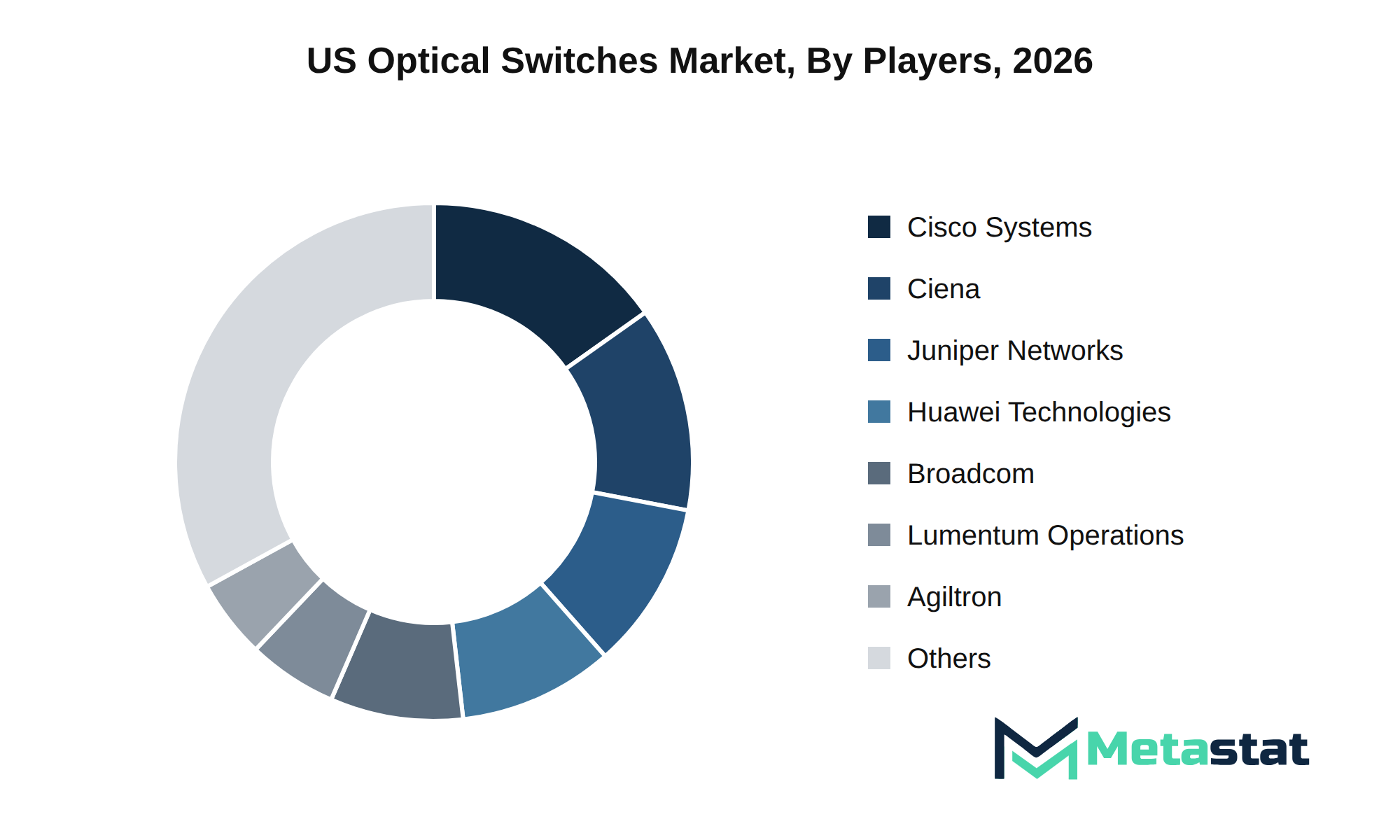
Market size is forecast to rise from USD 2.1 billion in 2025 to over USD 4.3 billion by 2033. This growth reflects a base case CAGR of 9.2%. The directionality of bull and bear cases highlights potential fluctuations based on market conditions, technological advancements, and shifts in industry dynamics.
Macroeconomic factors influence the demand for optical switches across various sectors, including telecommunications and data centers. Changes in downstream demand, driven by expansion in digital infrastructure and increased data consumption, support market growth. Next-generation technology integration and research and development commercialization timelines will further impact the market, driven by industry players aligning their strategies with emerging technological trends.
Regulatory evolution shapes the market landscape. Compliance milestones and policy enforcement horizons often dictate product development timelines and market entry strategies. While geopolitical realignments and evolving trade corridors emerge, companies face new challenges and opportunities, necessitating strategic capital allocation directives to ensure competitiveness in the market.
Infrastructure commitments and capital expenditure investment vectors will drive demand for optical switches, particularly in high-growth pockets including data centers and cloud service providers. Unmet enterprise needs present emerging white-space opportunities, prompting companies to explore innovative solutions that address specific market requirements. Executive-level strategic imperatives will focus on building defensibility roadmaps to ensure sustained growth in the evolving US Optical Switches market.
US Optical Switches Market Key Segments
By Technology:
- MEMS-Based Switches
- Electro-Optic Switches
- Thermo-Optic Switches
- Liquid Crystal Switches
- Acousto-Optic Switches
- Silicon Photonics-Based Switches
- PLC Switches
- Others (Magneto-Optic, Solid-State Switches, Emerging Technologies)
By Switch Configuration:
- 1×N and 1×M
- 2×2
- 2×N and N×2
- M×N and N×N
- Optical Circuit Switches
- Others (Multicast Switches, Broadcast-Select Switches)
By Application:
- Telecommunications & Optical Transport
- Data Centers
- Optical Network Monitoring & Protection
- Test & Measurement
- Fiber-Optic Sensing
- Quantum Communications & Computing
- Industrial & Biomedical Photonics
- Other (Specialty Photonic Applications)
By End-Use Industry:
- Telecommunications
- Data Centers & Cloud Providers
- IT & Networking
- BFSI
- Defense & Aerospace
- Healthcare & Medical Systems
- Industrial & Manufacturing
- Retail
- Others (Utilities and Specialty Industries)
Key US Optical Switches Industry Players
- Cisco Systems, Inc.
- Juniper Networks, Inc.
- Ciena Corporation
- Huawei Technologies Co., Ltd.
- Keysight Technologies
- Agiltron Inc.
- Broadcom
- Fujitsu
- Furukawa Electric Co. Ltd.
- NTT ADVANCED TECHNOLOGY CORPORATION
- Lumentum Operations LLC
- POLATIS
- Guilin GLsun Science and Tech Group Co.,LTD.
- DiCon Fiberoptics, Inc.
- Coherent Corp.
- Molex
- Yokogawa Electric Corporation
- ZTE Corporation
- Gooch & Housego PLC
- AC Photonics, Inc.
- EXFO Inc.
- Quantifi Photonics Limited
The report strategically identifies and profiles the key market players and analyses their core competencies in each sub-segment of the Optical Switches market.
Report Attributes | Details |
Study Period | 2021-2033 |
Base Year | 2025 |
Estimated Year | 2026 |
Forecast Period | 2026-2033 |
Historical Period | 2021-2025 |
Growth Rate | CAGR 9.2% from 2026 to 2033 |
Revenue Unit | USD billion |
Segmentation | By Technology, Switch Configuration, Application, and End-Use Industry |
- Company Market Share, Revenue and Ranking for the US Optical Switches Market
- Key Market Leaders in the US Optical Switches Market
- Full In-Depth Analysis of the Parent Industry
- Industry Statistics for the US Optical Switches Market
- Important Changes in Market and Its Dynamics
- Segmentation Details of the US Optical Switches Market
- Historical, Ongoing and Projected Market Analysis
- Key Strategies of Major Players in the Market
Frequently Asked Questions
Find answers to common questions about this report
The Optical Switches market size in the United States was valued at USD 2.1 billion in 2025.
The Optical Switches market is projected to grow at a CAGR of 9.2% during the forecast period from 2026 to 2033.
MEMS-Based Switches lead the US Optical Switches market with a share of 42.6% in 2025. This segment's dominance reflects its significant adoption in various applications compared to other technologies.
Increased investment in infrastructure development and the ongoing digital transformation across various sectors drive the US Optical Switches market. Enhanced network capabilities and the need for advanced optical switching solutions facilitate faster data transmission and improve system reliability, benefiting key industries including telecommunications and data centers.
High capital investment requirements and escalating operating costs significantly restrain growth in the US Optical Switches market. Supply chain disruptions and technological obsolescence further complicate market dynamics, leading to hesitance in adopting new technologies and limiting market penetration.
Investment in infrastructure development and ongoing digital transformation favor product adoption in the US Optical Switches market. Enhanced network capabilities and the need for faster data transmission drive demand for advanced optical switching solutions, particularly in telecommunications and data centers. Sustainability initiatives further influence purchasing decisions, promoting the adoption of optical switches that align with environmental goals.
The Optical Switches market is estimated to reach a valuation of USD 4.3 billion by 2033.
Top players operating in the US Optical Switches market include Cisco Systems, Inc., Juniper Networks, Inc., Ciena Corporation, Huawei Technologies Co., Ltd., Keysight Technologies, and Agiltron Inc.
The MEMS-Based Switches segment is projected to grow from USD 1.0 billion in 2026 to USD 2.0 billion by 2033, reflecting a CAGR of 9.9%.
The Data Centers application segment is anticipated to reach USD 1.5 billion by 2033, with a CAGR of 11.1%.
Choose Your License
US Optical Switches Market
Related Reports
Explore related market intelligence reports worth reading alongside this one.