
LEAD ANALYST
Utkarsh Khirodkar is a Lead Market Research Analyst at MetaStat Insight, specializing in market intelligence, technology sector assessments, and competitive strategy.

United States Terracotta Cladding Market Size, Share, By Product Type (Terracotta Panels, Terracotta Tiles, Terracotta Bricks, and Terracotta Rain Screen Systems), By End User (Residential, Commercial, Institutional, and Others), By Installation Type (New Construction, Renovation, and Retrofit), Industry Analysis, Growth, Trends, and Forecast, 2026-2033
Report ID
MSI-4543
Published
February, 2026
Pages
320 Pages
Format
Report Details
Choose Your License
US Terracotta Cladding Market
The United States Terracotta Cladding market size is valued at USD 897.6 million in 2025 and is projected to grow from USD 957.2 million in 2026 to USD 1520.8 million by 2033, exhibiting a CAGR of 6.8%.
Key trends driving growth include rising demand for sustainable, low-maintenance facade materials in commercial and institutional buildings, along with increased architectural emphasis on natural textures and energy-efficient design systems. The United States terracotta cladding market within architectural building materials will be shaped by how designers, regulators, and urban planners redefine material purpose over the coming decade. Terracotta cladding will evolve beyond its role as an exterior finish to become an architectural language that shapes zoning aesthetics, supports climate-responsive urban identity, and strengthens long-term building accountability.
Across the country, cities are reevaluating facade sustainability, and terracotta systems are gaining relevance in discussions on lifecycle responsibility and adaptive reuse. Public and semi-public developments are increasingly demanding materials that are visually dignified, allowing structures to remain relevant without frequent exterior replacement. Such trends will shift the of position terracotta cladding within architectural continuity discussions, particularly in districts where visual coherence is regulated.
Sustainable construction priorities will continue to shape material selection in large-scale projects. Terracotta cladding offers a long service life, strong weather resistance, and minimal maintenance requirements. These properties support operational efficiency in offices, hospitals, and educational facilities, maintaining a continued strong demand in the United States terracotta cladding market.
Architectural planning increasingly favors natural surface finishes that provide thermal stability. Terracotta cladding supports passive temperature control while offering an earthy texture that aligns with modern design priorities. The shift towards visually warmer and energy-conscious structures will strengthen the material's relevance in upcoming construction cycles.
High upfront material and installation costs will remain a limiting factor for widespread adoption. Terracotta systems require more upfront investment than artificial or steel alternatives. Despite long-term benefits, adoption may not suit budget-sensitive projects, limiting penetration across mid-tier construction programs in the United States terracotta cladding market.
Installation accuracy plays a critical role in system performance. Limited access to trained installers will restrict deployment in complex, schedule-driven projects. Such constraints extend project timelines and increase labor costs, influencing contractor decisions during early planning stages.
Sustainability benchmarks will pressure destiny demand as green certifications benefit precedence. Terracotta cladding supports recyclable materials, thermal efficiency, and low environmental impact. Alignment with certification standards will inspire tremendous recognition, positioning the US terracotta cladding market for long-term growth via responsible production practices.
The United States terracotta cladding market is primarily segmented by product type, end user, and installation type.
The terracotta panels segment was valued at USD 397.4 million in 2026 and is projected to reach USD 633.3 million by 2033, registering a CAGR of 6.9% during the forecast period.
Terracotta panels will support contemporary facade designs by offering a uniform finish, a lightweight structure, and a flexible mounting system. Demand will increase in the future as urban projects prioritize clean lines, thermal control and faster installation timelines. The panels will conform to emerging construction standards while maintaining natural aesthetics and long service life.
The terracotta tiles segment was valued at USD 270.8 million in 2026 and is projected to reach USD 427.3 million by 2033, registering a CAGR of 6.7% during the forecast period.
Terracotta tiles will maintain relevance through surface versatility and decorative adaptability. Increased preference for textured finishes and earth-toned exteriors will support adoption across mixed-use developments. Tile-based cladding will meet future layout dreams by means of balancing visible enchantment with moisture resistance and steady performance in numerous environmental situations.
The terracotta bricks segment was valued at USD 175.9 million in 2026 and is projected to reach USD 268.6 million by 2033, registering a CAGR of 6.2% during the forecast period.
Terracotta bricks will continue to be a favourite for structural depth and traditional architectural character. Future construction trends will blend classic brick formats with modern building envelopes, supporting longevity and thermal stability. Brick-based cladding will meet projects requiring strong façades that balance heritage appeal with increasing energy efficiency expectations.
The terracotta rain screen systems segment was valued at USD 113.2 million in 2026 and is projected to reach USD 191.6 million by 2033, registering a CAGR of 7.8% during the forecast period.
Terracotta rain screens will see an increased uptake owing to enhanced ventilation and moisture management capabilities. Rain screen adoption will increase owing to ventilation and moisture-management advantages that support durable façade performance and indoor comfort. Increased focus on wall-assembly performance will position rain screen solutions as a preferred approach within resilient building design.
Residential segment is projected to reach USD 592.9 Million by 2033, at a CAGR of 6.8% during the forecast period.
Residential sector will see a trend of using Terracotta Cladding to ensure aesthetic performance consistency. Materials that aid the efficiency of insulation and sustainable performance on the external façade will be favoured for future residential projects. Terracotta solutions will meet visual warmth expectations while supporting sustainable living standards in various residential formats.
Commercial segment is projected to reach USD 533.9 Million by 2033, at a CAGR of 6.7% during the forecast period.
The development of commercial sector will continue to integrate terracotta cladding to enhance the identity and sustainability of the façade. Office premises and retail structures will prefer materials that offer weather resistance and low maintenance. Future business design strategies will align the use of terracotta with branding goals, energy performance and long-term asset value.
Institutional segment is projected to reach USD 321 Million by 2033, at a CAGR of 7.4% during the forecast period.
Institutional buildings will depend on terracotta cladding for durability, safety and architectural dignity. Educational and healthcare facilities will benefit from fire resistance and stable material behavior. Future institutional projects will support terracotta solutions that support longevity, low lifecycle costs, and consistent outdoor performance.
Others segment is projected to reach USD 73 Million by 2033, at a CAGR of 6.3% during the forecast period.
Other applications will include transportation hubs, cultural centres, and public infrastructure projects. Terracotta cladding will support visual coherence and functional performance in high-traffic environments. Future urban planning initiatives will incorporate such materials to enhance public spaces while maintaining structural integrity.
New Construction segment is projected to reach USD 848.6 Million by 2033 with a share of 54.3% in 2025.
New construction will propel terracotta adoption, owing to compatibility with modern façade systems. The architects of new buildings will be encouraged to apply terracotta during the early stages of designing to ensure that the sustainability criteria are met.
Renovation and Retrofit segment is projected to reach USD 672.2 Million by 2033 with a share of 45.7% in 2025.
Renovation and retrofit activity will support terracotta adoption, owing to the need for façade performance upgrades. Lightweight cladding systems will support façade upgrades while limiting structural intervention requirements.
The United States terracotta cladding market presents a competitive landscape comprising established manufacturers and specialized providers focused on architectural design support and system performance. Terracotta cladding is attracting interest for its natural look, durability, and suitability for modern-day and traditional homes. Industry players are actively responding to the developing call for industrial, institutional, and high-end residential projects, in which architects and developers are putting more value on sustainable materials and long-term facade solutions. The surroundings will continue to encourage corporations to refine product excellence, increase design options, and strengthen their presence in regional markets.
Competition in this market is primarily shaped by product innovation, customization capability, and strong relationships with architects, façade consultants, and contractors. Companies are making an investment in better manufacturing strategies, coloration consistency, and installation structures that lessen assignment timelines. Many players are also focusing on compliance with construction requirements and electricity performance requirements, to continue to be vital as creation guidelines become increasingly focused on performance and safety. Strategic partnerships with vendors and facade specialists are helping businesses reach a broader patron base and aid complex architectural tasks.
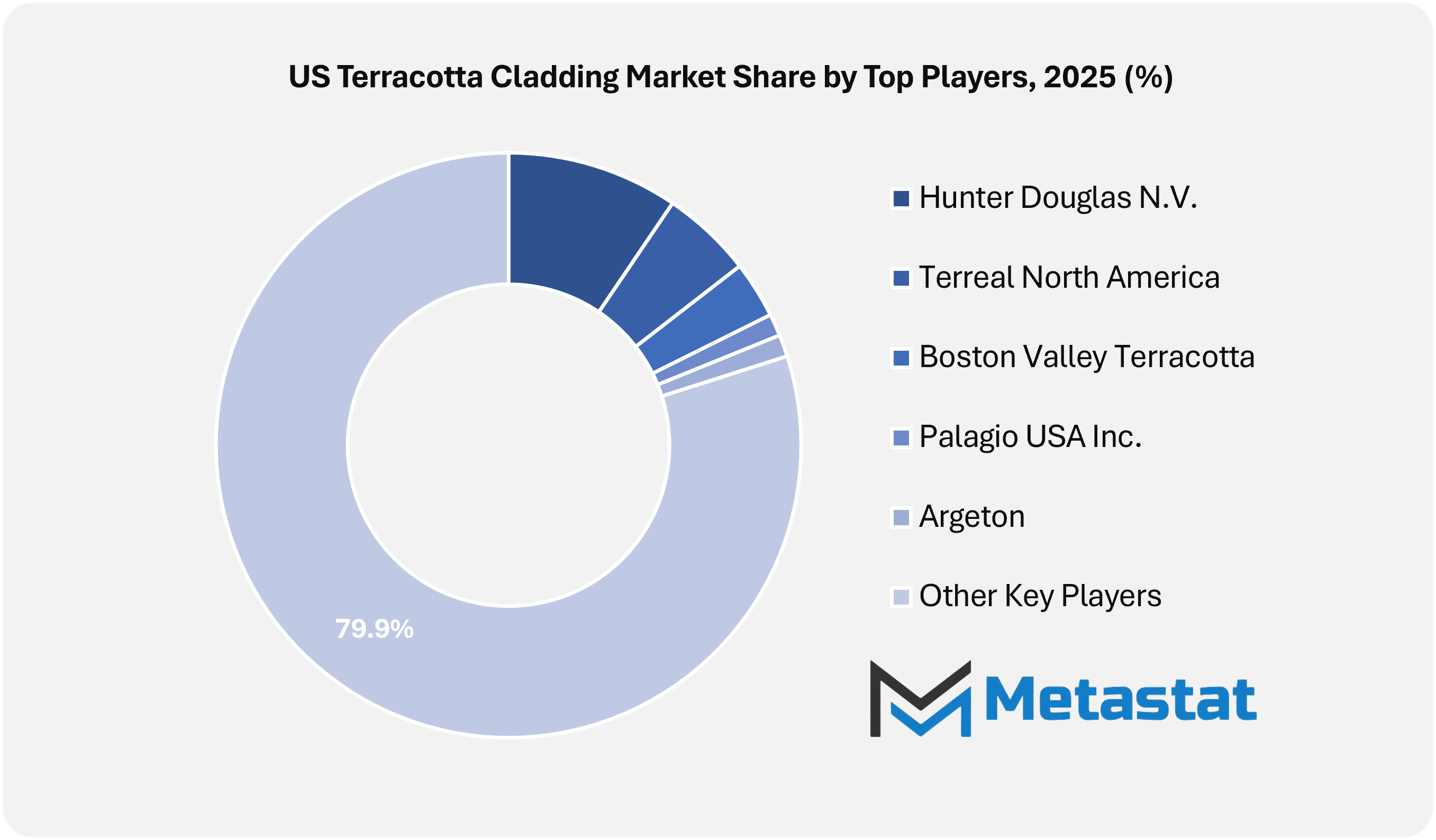
Major United States terracotta cladding industry players include Terreal North America, M.F. Murray Companies, Inc., Pace Representatives, Inc., Shildan, Inc., Argeton, Hunter Douglas N.V., Cladding Corp., Palagio USA Inc., Avenere Cladding LLC, Boston Valley Terracotta, ECO Cladding, and Telling Architectural Systems, LLC. The agencies vary in scale and expertise, with some focusing on huge commercial trends while others cater to precise architectural needs. Their combined presence creates a balanced market wherein competition encourages greater layout flexibility and higher provider standards.
Recent traits inside the aggressive landscape advocate a persevered awareness on increasing the product portfolio and enhancing technical guide. Many players are emphasizing digital equipment, mock-up services and layout help to assist architects visualize facades early within the planning phase. Sustainability messaging and neighbourhood sourcing have also turn out to be extra visible, as business's purpose to align with green building dreams. The production pastime continues across the United States, competition amongst those players will continue to be lively, with increasing differentiation based on best, reliability, and ability to support complicated architectural visions.
Market size is projected to rise from USD 897.6 million in 2025 to USD 1,520.8 million by 2033.
Beyond commercial construction, institutional stakeholders will adopt terracotta cladding as a visible marker of sustainability and civic responsibility. Educational campuses, transportation hubs, and cultural centres will support materials that communicate sustainability while supporting passive design philosophies. Industry decision-making will increasingly favor design intent and sustainability signaling through material selection rather than specification-only evaluation. In this expanded context, the United States terracotta cladding market will not simply support buildings but will actively shape how future American cities express sustainability, restraint, and architectural intent without relying on short-term visual trends.
This research report categorizes the terracotta cladding market by key segments and regions, forecasts revenue growth, and analyzes trends across submarkets. The report analyses the key growth drivers, opportunities, and challenges influencing the Terracotta Cladding market. Recent market developments and competitive strategies such as expansion, product launch, product development, partnerships, mergers, and acquisitions have been included to draw the competitive landscape in the market.
The report strategically identifies and profiles the key market players and analyses their core competencies in each sub-segment of the Terracotta Cladding market.
|
Report Attributes |
Details |
|
Study Period |
2021-2033 |
|
Base Year |
2025 |
|
Estimated Year |
2026 |
|
Forecast Period |
2026-2033 |
|
Historical Period |
2021-2025 |
|
Growth Rate |
CAGR 6.8% from 2026 to 2033 |
|
Revenue Unit |
USD Million |
|
Sales Volume Unit |
Thousand Units |
|
Segmentation |
By Product Type, End User, Installation Type, and Region |
|
By Product Type |
Terracotta Panels Terracotta Tiles Terracotta Bricks Terracotta Rain Screen Systems |
|
By End User |
Residential Commercial Institutional Others |
|
By Installation Type |
New Construction Renovation and Retrofit |
Find answers to common questions about this report
The Metastat Insights study shows that the United States Terracotta Cladding market size was USD 897.6 million in 2025.
The United States Terracotta Cladding market is likely to grow at a CAGR of 6.8% over the forecast period (2026-2033).
Terracotta panels are the leading product type segment in the United States market.
Rising demand for sustainable and low-maintenance façade materials in commercial and institutional buildings and growing architectural emphasis on natural textures and energy-efficient design systems are key driving factors, boosting the market.
High initial installation and material costs compared to alternative cladding options will hamper market growth within the forecast period.
United States Terracotta Cladding market is estimated to reach USD 1520.8 million by 2033.
Top players operating in the Terracotta Cladding industry include Terreal North America, M.F. Murray Companies, Inc., Pace Representatives, Inc., Shildan, Inc., Argeton, Hunter Douglas N.V., and Cladding Corp.
The analysts below cover Chemicals and Materials research at Metastat Insights.
LEAD ANALYST
Utkarsh Khirodkar is a Lead Market Research Analyst at MetaStat Insight, specializing in market intelligence, technology sector assessments, and competitive strategy.

INDUSTRY CONSULTANT - CHEMICALS & ADVANCED MATERIALS
Chemicals and Materials · Machinery & Equipment · Packaging
Amit Gadhekar Consultant for Chemicals and Materials at MetaStat Insight, directing sector-specific intelligence, research, and strategic consulting across global chemical and processing markets.
Integrating zero-trust access controls across legacy electronic health record systems involves complex compliance overhead. Team produced an analysis that clearly separated identity governance and administration tools from privileged access management platforms. Their evaluation of HIPAA and GDPR compliance features across cloud native solutions gave our architecture group clear baseline criteria. The custom data request regarding biometric authentication adoption in hospital networks was returned promptly with clear documentation.
Evaluating calorific value requirements and air permit compliance across municipal waste facilities requires localized data. Metastat Insight structured their analysis around operational throughput capacity and feedstock composition variations in Latin America and Eastern Europe. Their competitive mapping of sorting equipment vendors helped clarify technology differences between optical separators and heavy media systems. The study provided an objective baseline during our capital expenditure reviews.
Decarbonizing industrial thermal processes hinges on refrigerant regulations and compressor efficiency limits. Metastat Insights delivered a thorough market analysis that evaluated natural refrigerants like CO2 and hydrocarbons against synthetic low-GWP alternatives. The breakdown of utility incentives and grid capacity constraints across key European manufacturing hubs offered valuable perspective. The follow-up conversation with their sector analysts addressed our specific questions on mechanical vapor recompression systems efficiently.
Explore related market intelligence reports worth reading alongside this one.
Starting from
$2950
Starting from
$2950