
LEAD ANALYST
Utkarsh Khirodkar is a Lead Market Research Analyst at MetaStat Insight, specializing in market intelligence, technology sector assessments, and competitive strategy.

Video Content Protection and Digital Rights Management (DRM) Market Size, Share, By Type (CAS, DRM Systems, Forensic Watermarking, Encryption Solutions, Authentication Services, Anti-Piracy Solutions, License Management Platforms, Secure Content Delivery Platforms, Token-Based Access Control, and Others), By End User (Live Entertainment, Sports, PPV Streaming, Medical Video, Government, Defense, and Others), By Live Entertainment, By Sports, Industry Analysis, Growth, Trends, and Forecast, 2026-2033
Report ID
MSI-4568
Published
March, 2026
Pages
311 Pages
Format
Report Details
Choose Your License
Video Content Protection and DRM Market
The Global Video Content Protection and Digital Rights Management (DRM) market size was valued at USD 9,111.9 million in 2025. The market is projected to grow from USD 10,445.4 million in 2026 to USD 26,572.9 million by 2033, exhibiting a CAGR of 14.3% during the forecast period.
Global Video Content Protection and Digital Rights Management (DRM) market valued at USD 9,111.9 million in 2025 and projected to reach USD 26,572.9 million by 2033, at a CAGR of 14.3% during 2026-2033.
North America held 54.7% share in 2025, led by the United States.
Conditional Access Systems (CAS) segment accounts for a market share of 16.0% in 2025.
Key trends driving growth: Accelerating growth of OTT platforms and subscription-based streaming heightens demand for robust anti-piracy and license enforcement solutions.
Key opportunity includes rapid adoption of cloud-based DRM services, enabling scalable protection models for global content distribution.
Key insight: Rising premium video monetization and stricter digital rights enforcement are reshaping commercial priorities across the global video content protection and DRM landscape.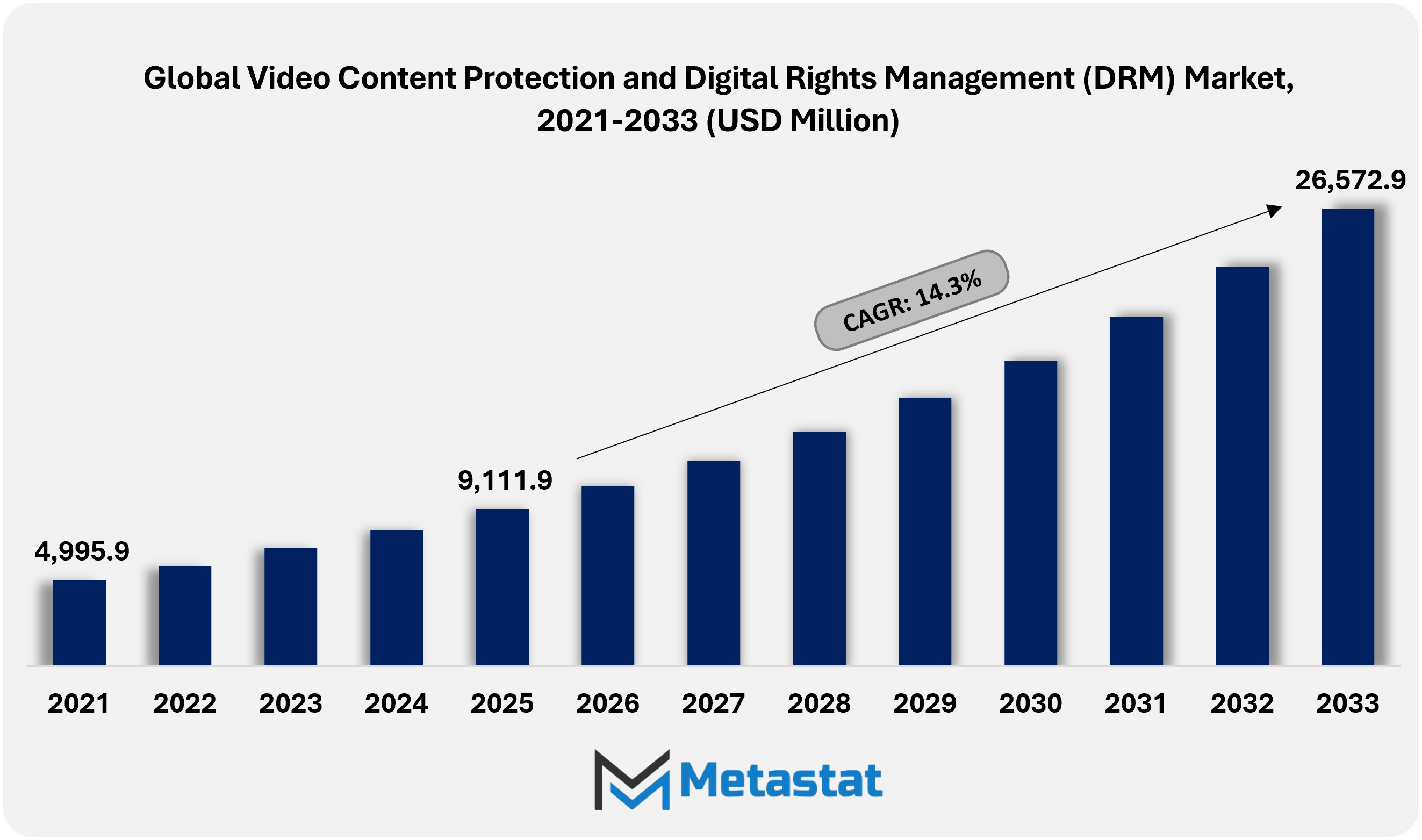
The global video content protection and digital rights management (DRM) market within the digital media security industry will move beyond traditional enforcement into structural coordination across distribution, monetization and trust. The future market direction will emphasize invisible control layers built deep inside content pipelines rather than surface-level access locks. Security systems will act increasingly before content is published, impacting production workflows, licensing logic, and partner onboarding, rather than reacting after a leak occurs.
Content ownership frameworks will evolve toward programmable governance where usage rights will be encoded directly into media assets. The systems will allow automated interactions between platforms, advertisers, and creators without any human intervention. Rights verification will occur consistently across devices, regions and networks, providing consistent accountability without disrupting viewing experiences. Enforcement models will support silent verification over disruptive playback restrictions, supporting premium engagement without any friction.
Within the global video content protection and digital rights management (DRM) market, increasing subscription monetization requires stronger controls over unauthorized access. Enhanced enforcement systems will support revenue assurance, contractual compliance, and long-term platform reliability.
Commercial deployment of premium digital assets will increase in professional training, interactive gaming and live sports broadcasting. Secure distribution frameworks will become essential to protect intellectual value. Encrypted delivery models will support controlled access, usage tracking, and contractual licensing integrity across diverse business environments.
Increased deployment fees related to licensing systems, infrastructure enhancements, and technical upgrades will discourage smaller stakeholders. Budget-constrained broadcasters will prioritize short-term operational continuity to avoid slowing full-scale adoption of advanced security infrastructure.
Changes in runtime requirements, hardware capabilities, and media formats will increase configuration complexity. Deployment timelines will extend owing to testing requirements, friction during large-scale rollouts, and delayed operational efficiency gains.
Cloud-based delivery models will reshape security economics. Scalable deployment will reduce dependency on infrastructure while enabling rapid geographic expansion. Service-based security platforms will support adaptive licensing, centralized updates, and cost-efficient deployment, strengthening the strategic position of the global video content protection and digital rights management (DRM) market.
The Global Video Content Protection and Digital Rights Management (DRM) market is classified based on Type, End User, Live Entertainment, and Sports.
Conditional Access Systems (CAS) segment is valued at USD 1,670.1 Million in 2026 and is projected to reach USD 4,537.4 Million by 2033, at a CAGR of 15.3% during the forecast period.
Conditional access systems will continue to shape controlled video distribution by restricting unauthorized viewing through encryption-linked access credentials. Future deployments will emphasize adaptive authorization models integrated with network intelligence. Future deployments will emphasize adaptive authorization models integrated with network intelligence. Systems will guide scalable subscriber verification across platforms, ensuring seamless delivery while maintaining content exclusivity amid rising multi-device consumption.
Digital Rights Management (DRM) Systems segment is valued at USD 3,141.6 Million in 2026 and is projected to reach USD 8,077.9 Million by 2033, at a CAGR of 14.4% during the forecast period.
Digital rights management systems will focus on policy-driven usage controls, governing playback duration, device limits, and redistribution restrictions. Progress will support interoperability across operating systems while aligning with local compliance mandates. Advanced automation will reduce operational friction, enabling content providers to protect monetization integrity without compromising audience reach or experience quality.
Forensic Watermarking segment is valued at USD 1,091.5 Million in 2026 and is projected to reach USD 3,069.4 Million by 2033, at a CAGR of 15.9% during the forecast period.
Forensic watermarking will gain relevance through invisible traceable identifiers embedded within video streams. Future implementation will strengthen the attribution of the breach by linking leaked assets to individual access points. Accuracy would discourage illegal redistribution, strengthening accountability in professional content supply chains, while supporting legal enforcement processes.
Encryption Solutions segment is valued at USD 1,433.8 Million in 2026 and is projected to reach USD 3,268.4 Million by 2033, at a CAGR of 12.5% during the forecast period.
Encryption solutions will move toward quantum-resistant frameworks designed to counter emerging cyber threats. The content security architecture will integrate real-time encryption key rotation to suit streaming latency demands. The developments would enable secure transmission over public and private networks, ensuring privacy in storage, transit, and playback environments.
Authentication Services segment is valued at USD 672.5 Million in 2026 and is projected to reach USD 1,456.5 Million by 2033, at a CAGR of 11.7% during the forecast period.
Authentication services will evolve into behavior-aware verification layers combining biometric signals, device reputation scoring, and contextual risk analysis. Future systems will reduce friction during access verification while preventing credential misuse. The continuous authentication model will strengthen trust in the premium content ecosystem without disrupting the audience engagement cycle.
Anti-Piracy Solutions segment is valued at USD 1,015.7 Million in 2026 and is projected to reach USD 2,892.7 Million by 2033, at a CAGR of 16.1% during the forecast period.
Anti-piracy solutions will transition from reactive removal mechanisms to predictive monitoring systems. Artificial intelligence will be able to quickly identify unauthorized distribution patterns on social platforms and streaming mirrors. The coordinated enforcement workflow will reduce revenue leakage while preserving brand equity for content owners.
License Management Platforms segment is valued at USD 460.6 Million in 2026 and is projected to reach USD 1,101.6 Million by 2033, at a CAGR of 13.3% during the forecast period.
License management platforms will streamline rights allocation through automated lifecycle governance. Future platforms will support dynamic licensing tied to geography, time windows, and audience levels. The precision will improve compliance transparency while enabling flexible commercial strategies in fragmented digital markets.
Secure Content Delivery Platforms segment is valued at USD 293.7 Million in 2026 and is projected to reach USD 593.1 Million by 2033, at a CAGR of 10.6% during the forecast period.
Secure content delivery platforms will integrate security layers directly into the content delivery network. Edge-based security controls will reduce attack surfaces while maintaining low latency delivery. The platforms would support high-definition streaming at scale while maintaining integrity across global access points.
Token-Based Access Control segment is valued at USD 233.2 Million in 2026 and is projected to reach USD 513.7 Million by 2033, at a CAGR of 11.9% during the forecast period.
Token-based access control will enable session-specific authorization through timed credentials. Future adoption will support detailed permissions management without the risk of persistent compromise. The mechanisms would enhance transactional security for short-form viewing models and premium event-based streaming formats.
Others (Subscriber Identity Modules, etc.) segment is valued at USD 432.7 Million in 2026 and is projected to reach USD 1,062.4 Million by 2033, at a CAGR of 13.7% during the forecast period.
Emerging security tools, including customer identity modules, will enhance device-level authentication. These solutions will support carrier-grade security models while enabling seamless eligibility verification. Integration with next-generation networks will further strengthen controlled access for mobile-first content consumption.
Live Entertainment segment is projected to reach USD 4,926.8 Million by 2033, at a CAGR of 14.8% during the forecast period.
Live entertainment applications will demand real-time security frameworks that support large concurrent audiences. Future systems will balance access control with latency optimization. Secure monetization will remain essential for virtual concerts and exclusive digital performances delivered through premium streaming channels.
Sports segment is projected to reach USD 5,553.8 Million by 2033, at a CAGR of 14.6% during the forecast period.
Sports content security will prioritize quick response security due to its high business value. Advanced tracking and enforcement tools will protect broadcasting rights in all territories. Future models will support direct-to-consumer distribution without the risk of unauthorized redistribution.
PPV Streaming segment is projected to reach USD 5,530 Million by 2033, at a CAGR of 14% during the forecast period.
Pay-per-view streaming will rely on transaction-specific authorization controls. Security systems shall support one-time access verification linked to payment confirmation. The alignment will strengthen consumer trust while reducing fraud in high-value digital events.
Medical Video segment is projected to reach USD 1,760.4 Million by 2033, at a CAGR of 16.6% during the forecast period.
Medical video distribution will require stringent privacy safeguards consistent with the regulatory framework. Encryption and access logging will ensure controlled sharing of sensitive visual data. Future platforms will support secure collaboration without compromising patient data integrity.
Government/Defense segment is projected to reach USD 1,040.2 Million by 2033, at a CAGR of 13% during the forecast period.
Government and defense use will emphasize classified material security through isolated delivery environments. Advanced authentication and audit mechanisms will support controlled dissemination; security strategies will be consistent with national security protocols and restricted access mandates.
Others (Subscription VoD, Education, Enterprise) segment is projected to reach USD 7,761.6 Million by 2033, at a CAGR of 13.6% during the forecast period.
Subscription-based video, education and enterprise communications will rely on scalable security models. Flexible licensing and secure access will support knowledge distribution while preventing unauthorized reuse. In future adoption, priority will be given to material safety as well as operational efficiency.
Concerts segment is projected to reach USD 9,247.4 Million by 2033 with a share of 35.3% in 2025.
Concert streaming will require strong access controls that support ticket verification and concurrent viewership. Security frameworks will prevent illegal restreaming while preserving audio-visual quality, secure delivery will increase stability of artist revenues across digital venues.
Festivals & Multi-Stage Events segment is projected to reach USD 6,784.1 Million by 2033 with a share of 24.6% in 2025.
Multi-stage event streaming will require synchronized security across multiple feeds. Advanced rights segmentation will allow differentiated access levels. Future solutions will support a global audience without compromising specificity or operational control.
Ticketed Streaming Events segment is projected to reach USD 5,282.7 Million by 2033 with a share of 20.2% in 2025.
Ticketed digital events will rely on identity-bound access credentials. Security mechanisms will enforce entry conditions throughout the event period. The systems will enable scalable monetization without the risk of content leakage.
Artist/Venue DTC OTT Channels segment is projected to reach USD 2,933.7 Million by 2033 with a share of 9.9% in 2025.
Direct-to-consumer channels will rely on integrated security to maintain brand ownership. License administration and secure playback controls will support customer retention. Future developments will align with personalized content delivery in controlled environments.
Others segment is projected to reach USD 2,325.1 Million by 2033 with a share of 9.9% in 2025.
Additional live formats will adopt security frameworks adaptable to the scale of audiences. Security strategies will ensure commercial viability while supporting creative experimentation in digital live entertainment formats.
Live Sports Broadcasting segment is projected to grow at a CAGR of 14% during the forecast period.
Live sports broadcasts will require ultra-low latency security aligned with broadcast workflows. Quick implementation will prevent unauthorized mirrors. Future deployments will support high-resolution streaming without compromising security.
League/Club Dtc Ott segment is projected to grow at a CAGR of 14.8% during the forecast period.
League and club-owned platforms will place emphasis on the protection of proprietary rights. Controlled access models will support fan engagement without dependency on third parties. Security integration will enable sustainable direct monetization strategies.
Regional & International Rights Protection segment is projected to grow at a CAGR of 14.4% during the forecast period.
Territory-based rights enforcement will gain sophistication through geofencing and license automation. Future systems will prevent cross-border violations while enabling legitimate distribution agreements.
Highlights/VoD and Archives segment is projected to grow at a CAGR of 13.8% during the forecast period.
Highlights/Vod and archival footage will require long-term security controls. Rights tracking will ensure authorized re-use across media channels. Preservation of historic properties will remain commercially valuable.
Others segment is projected to grow at a CAGR of 14.1% during the forecast period.
Additional game formats will adopt modular security strategies appropriate for specific audiences. Secure distribution will support emerging leagues while maintaining the integrity of the rights.
Based on geography, the Global Video Content Protection and Digital Rights Management (DRM) market is divided into North America, Europe, Asia-Pacific, South America, Middle East, and Africa.
North America Video Content Protection and Digital Rights Management (DRM) Market is set to expand at a CAGR of 14.3% within the forecast period, reaching a market size (TAM) of USD 13401.3 million by the end of 2033.
North America will see increasing DRM deployment driven by premium OTT platforms prioritizing licensed content protection in subscription-based revenue models.
North America will continue to strengthen DRM adoption due to studio-backed mandates for anti-piracy compliance in cloud delivery networks.
Asia Pacific will deliver strong DRM expansion capabilities through local streaming platforms driving rapid mobile-first video consumption and expanding paid content libraries.
Asia Pacific will provide long-term opportunities for DRM vendors through regional broadcaster digitization and multilingual content monetization strategies.
The Middle East, Africa and South America will progress unevenly, with DRM size increasing due to infrastructure maturity, regulatory enforcement gaps and growing demand for protected regional content catalogues.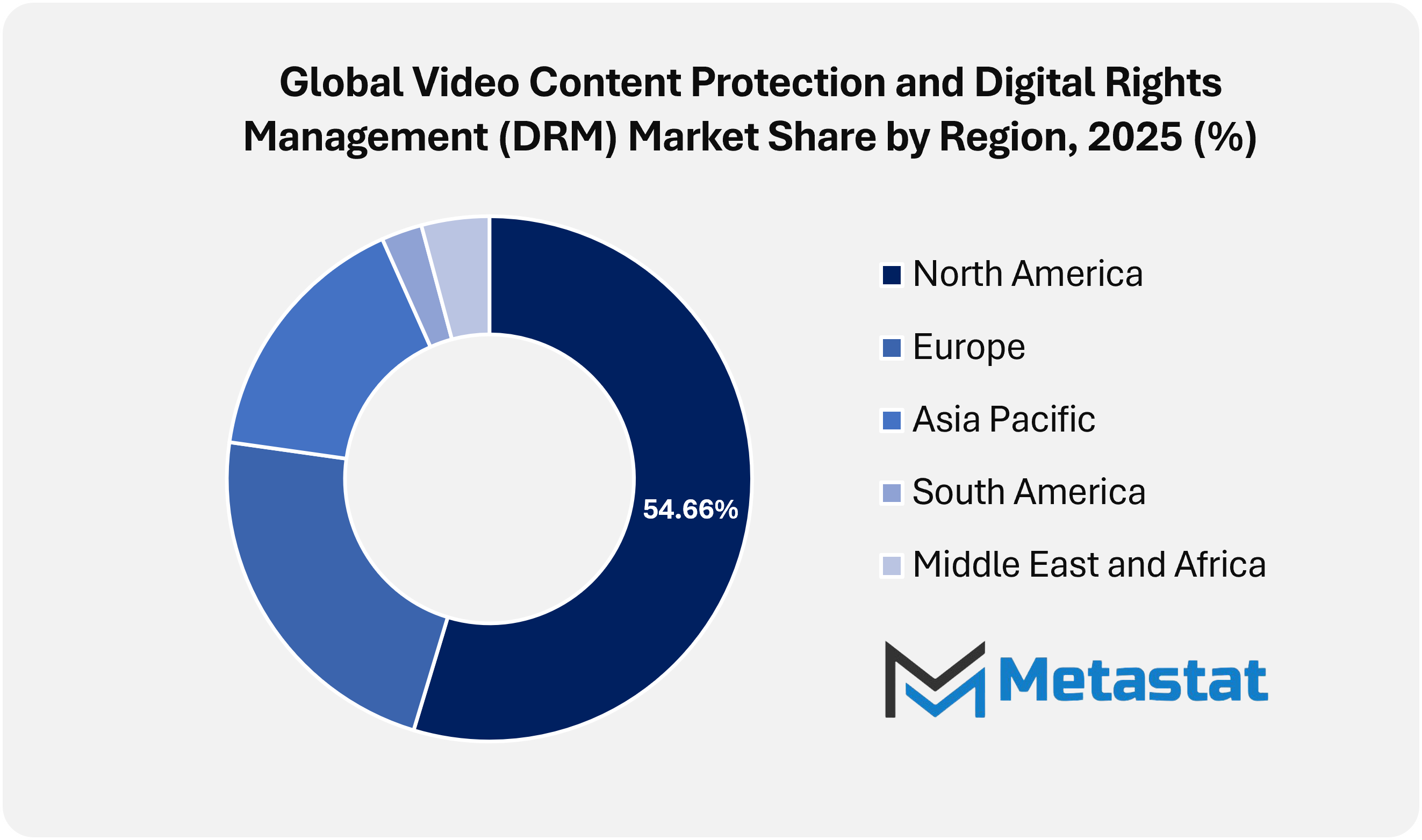
The global video content protection and digital rights management market is continuously growing due to the increasing demand for secure digital video delivery on streaming platforms, broadcasters and enterprise channels. Content owners will focus more on revenue, audience trust, and protecting licensing value when distributing video across multiple devices and networks. DRM solutions will support controlled access, prevent illegal redistribution, and maintain compliance with regional content regulations. Market participants will work toward balancing strong security with a seamless viewing experience, as user frustration often leads to platform switching.
Many established companies lead the market through mature encryption systems and license management tools. Verimatrix, Inc. will retain strong positioning through its security framework and anti-piracy monitoring services, while Irdeto B.V. will remain widely used among broadcasters and pay-TV operators. Kudelski Group will continue to support the media ecosystem through its Nagra business with flexible security layers suitable for live and on-demand formats. Synamedia Holdings Limited will strengthen its presence through end-to-end video security offerings designed for complex delivery environments.
Technology-driven companies will influence DRM adoption in connected devices and global streaming services. Intertrust Technologies Corporation will focus on interoperability and secure data exchange, enabling the use of content across different platforms. Google LLC via Widevine, Apple Inc. via FairPlay, and Microsoft via PlayReady will dominate device-level DRM integration, as major operating systems rely on native security standards. NFA Group Inc., which operates BuyDRM, will attract independent publishers and medium-sized platforms through a cost-friendly licensing model.
Specialized providers will support specific needs and advanced workflows. Axiom and CastLabs GmbH will serve OTT platforms seeking modular DRM deployment and analytics support. EZDRM, Inc. will remain relevant among startups through simplified implementation processes. Viaccess SA (Viaccess-Orca) will focus on hybrid broadcast and IP-based security needs. Friend MTS Limited will strengthen its market presence through proactive piracy detection and enforcement services, helping rights holders respond faster to illegal streaming threats.
Market size is forecast to rise from USD 9,111.9 million in 2025 to over USD 26,572.9 million by 2033.
Regulatory alignment will extend across borders through standardized compliance logic embedded in the security architecture. Regional licensing complexity will be addressed through automated jurisdictional intelligence capable of dynamically adjusting permissions. Privacy-preserving verification will gain importance, allowing identity to be confirmed without exposing personal data during access verification. Business strategy will shift toward security-driven monetization designs. Subscription tiers, dynamic pricing, and limited-access releases will be engineered directly within the rights framework. Global Video Content Protection and Digital Rights Management (DRM) market maturity will be measured by how smoothly security enables constructive price movement, not how aggressively it prevents abuse.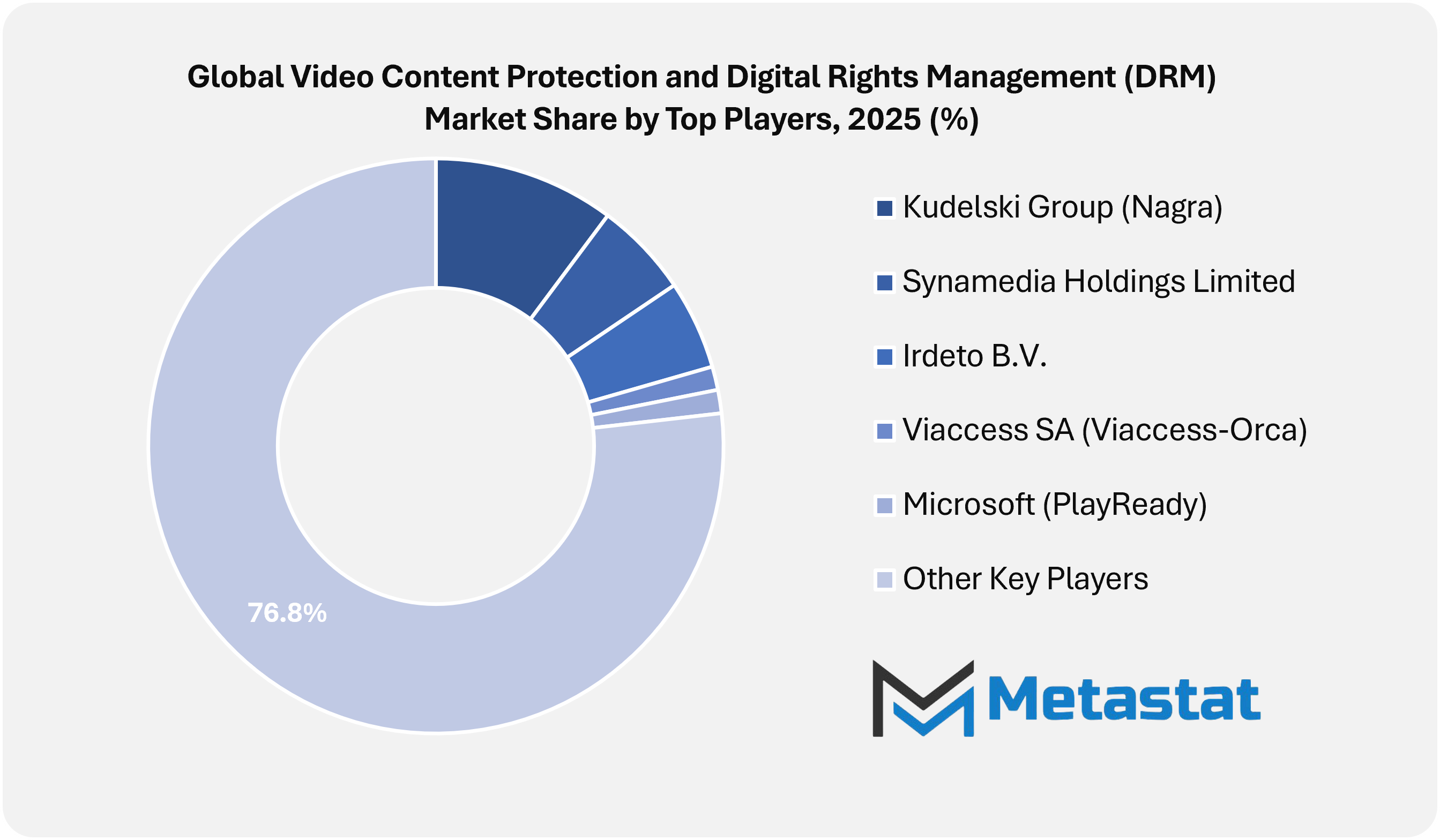
This research report categorizes the Video Content Protection and Digital Rights Management (DRM) market based on key segments and regions, forecasts revenue growth, and analyses trends in each submarket. The report analyses the key growth drivers, opportunities, and challenges influencing the Video Content Protection and Digital Rights Management (DRM) market. Recent market developments and competitive strategies such as expansion, type launch, development, partnership, merger, and acquisition have been included to draw the competitive landscape in the market.
The report strategically identifies and profiles the key market players and analyses their core competencies in each sub-segment of the Video Content Protection and Digital Rights Management (DRM) market.
|
Report Attributes |
Details |
|
Study Period |
2021-2033 |
|
Base Year |
2025 |
|
Estimated Year |
2026 |
|
Forecast Period |
2026-2033 |
|
Historical Period |
2021-2025 |
|
Growth Rate |
CAGR 14.3% from 2026 to 2033 |
|
Revenue Unit |
USD million |
|
Segmentation |
By Type, End User, Live Entertainment, Sports, and Region |
|
By Type |
|
|
By End User |
|
|
By Live Entertainment |
|
|
By Sports |
|
|
By Region |
North America (By Type, End User, Live Entertainment, Sports, and Country)
|
|
Europe (By Type, End User, Live Entertainment, Sports, and Country)
|
|
|
Asia Pacific (By Type, End User, Live Entertainment, Sports, and Country)
|
|
|
South America (By Type, End User, Live Entertainment, Sports, and Country)
|
|
|
Middle East and Africa (By Type, End User, Live Entertainment, Sports, and Country)
|
Find answers to common questions about this report
The Metastat Insights study shows that the Global Video Content Protection and Digital Rights Management (DRM) market size was USD 9,111.9 million in 2025.
The Global Video Content Protection and Digital Rights Management (DRM) market is likely to grow at a CAGR of 14.3% over the forecast period (2026-2033).
The Metastat Insights analysis shows that the North America Video Content Protection and Digital Rights Management (DRM) market size is estimated to be USD 13,401.3 million by 2033.
The Digital Rights Management (DRM) Systems is the leading type segment in the Global market.
Accelerating growth of OTT platforms and subscription-based streaming heightens demand for robust anti-piracy and license enforcement solutions are key driving factors, boosting the market.
North America region dominates the market.
Global Video Content Protection and Digital Rights Management (DRM) market is estimated to reach USD 26,572.9 million by 2033.
Top players operating in the Video Content Protection and Digital Rights Management (DRM) industry includes Verimatrix, Inc., Irdeto B.V., Kudelski Group (Nagra), Synamedia Holdings Limited, and Intertrust Technologies Corporation.
The analysts below cover Information & Technology research at Metastat Insights.
LEAD ANALYST
Utkarsh Khirodkar is a Lead Market Research Analyst at MetaStat Insight, specializing in market intelligence, technology sector assessments, and competitive strategy.

PRINCIPAL CONSULTANT - ENTERPRISE AI & EMERGING TECHNOLOGIES
Banking & Finance · Electronics and Semiconductor · Energy and Power · Healthcare IT · Information & Technology · Professional Services
Vijay Gunti is a Principal Consultant at MetaStat Insight, bringing over two decades of experience across enterprise digital transformation, technology strategy, and intelligent systems.

LEAD CONSULTANT - COMMUNICATION, TELECOM, AND IT
Electronics and Semiconductor · Information & Technology · Machinery & Equipment · Professional Services
Ravindra Sathe Consultants for Communication, Telecom, and IT at MetaStat Insight. He leads the firm's industry research initiatives across telecommunications infrastructure, digital connectivity, enterprise networking, and emerging information technology domains.
Assessing 200mm wafer transition schedules and substrate supply bottlenecks requires precise technical intelligence. MetaStat Insight supplied an actionable breakdown comparing planar and trench MOSFET architectures across automotive and industrial drive markets. The regional capacity estimates for Asia-Pacific foundries helped clarify lead-time uncertainties during our strategic planning session. When we needed additional clarification on high-purity raw material sourcing, their analyst team responded with helpful context within twenty-four hours.
Tracking maintenance cycle demand for secondary flight display units and terrain collision avoidance systems across regional jet fleets involves complex aftermarket dynamics. MetaStat Insight provided practical analysis separating airline retrofit programs from OEM forward-fit production schedules in North America and Southeast Asia. The supplier matrix highlighted component obsolescence timelines without resorting to vague generalizations. The dataset served as a dependable reference during our annual program review meetings.
Evaluating secondary resin quality across post-consumer packaging streams requires reliable technical segmentation. MetaStat Insight delivered an objective assessment that distinguished between extrusion-grade flake pricing and optical sorting throughput limitations across Western Europe. The competitive positioning breakdown for licensed depolymerization technology providers answered several questions during our feedstock feasibility audit. Their team clarified regional trade restrictions on mixed plastic scrap quickly when our team submitted follow-up requests.
Explore related market intelligence reports worth reading alongside this one.