
LEAD ANALYST
Utkarsh Khirodkar is a Lead Market Research Analyst at MetaStat Insight, specializing in market intelligence, technology sector assessments, and competitive strategy.

Women's Formal Wear Market Size, Share, By Product (Apparels, Footwear, and Accessories), By Price Range (Economy, Mid-Range, and Premium), By Distribution Channel (Hypermarket, Supermarket, Convenience Store, Departmental Store, Specialty Store, Online Store, and Others), Industry Analysis, Growth, Trends, and Forecast, 2026-2033
Report ID
MSI-4666
Published
April, 2026
Updated
Pages
313 Pages
Format
Report Details
Choose Your License
Women's Formal Wear Market
The Global Women's Formal Wear market size was valued at USD 206.4 billion in 2025 and projected to grow at a CAGR of 4.9% during the forecast period, reaching USD 303.3 billion by 2033.
North America accounted for 32.0% of the global market in 2025, with the United States leading regional revenue generation.
Apparel segment accounted for 79.2% of the global market in 2025.
Key trends driving growth: Workplace formalization & hybrid office returns increase demand for blazers, suits, and office-ready separates, rising social/occasion calendar (weddings, corporate events, formal gatherings) boosts purchases of dresses and occasion wear.
Opportunities include versatile desk-to-dinner and mix-and-match formal separates (wrinkle-resistant, stretch, easy-care) can drive premiumization and higher basket size.
Key insight: Premiumization, rising female workforce participation, and digital retail expansion are supporting growth in the Global Women's Formal Wear market, despite price sensitivity and competition from fast-fashion brands.
The Global Women's Formal Wear market will continue to evolve as structured dressing adapts to changing professional, ceremonial, and corporate expectations. Over the forecast period, the category will expand beyond traditional office tailoring into specialized formal segments shaped by executive branding, occasion wear, and public-facing professional use cases. Brands will focus on precision tailoring, adaptive sizing, and fabric innovation that improve comfort, fit, and wearability across climates and usage settings.
As more women take on senior leadership roles, formal wear is evolving to balance authority, comfort, and brand identity without relying on traditionally masculine tailoring cues. The market will see increased use of crease-resistant blends, bio-based fibers, and temperature-regulating linings suited for long workdays, events, and travel. Digital customization platforms using AI-assisted body scanning are also expected to improve fit accuracy, reduce alteration needs, and support lower production waste.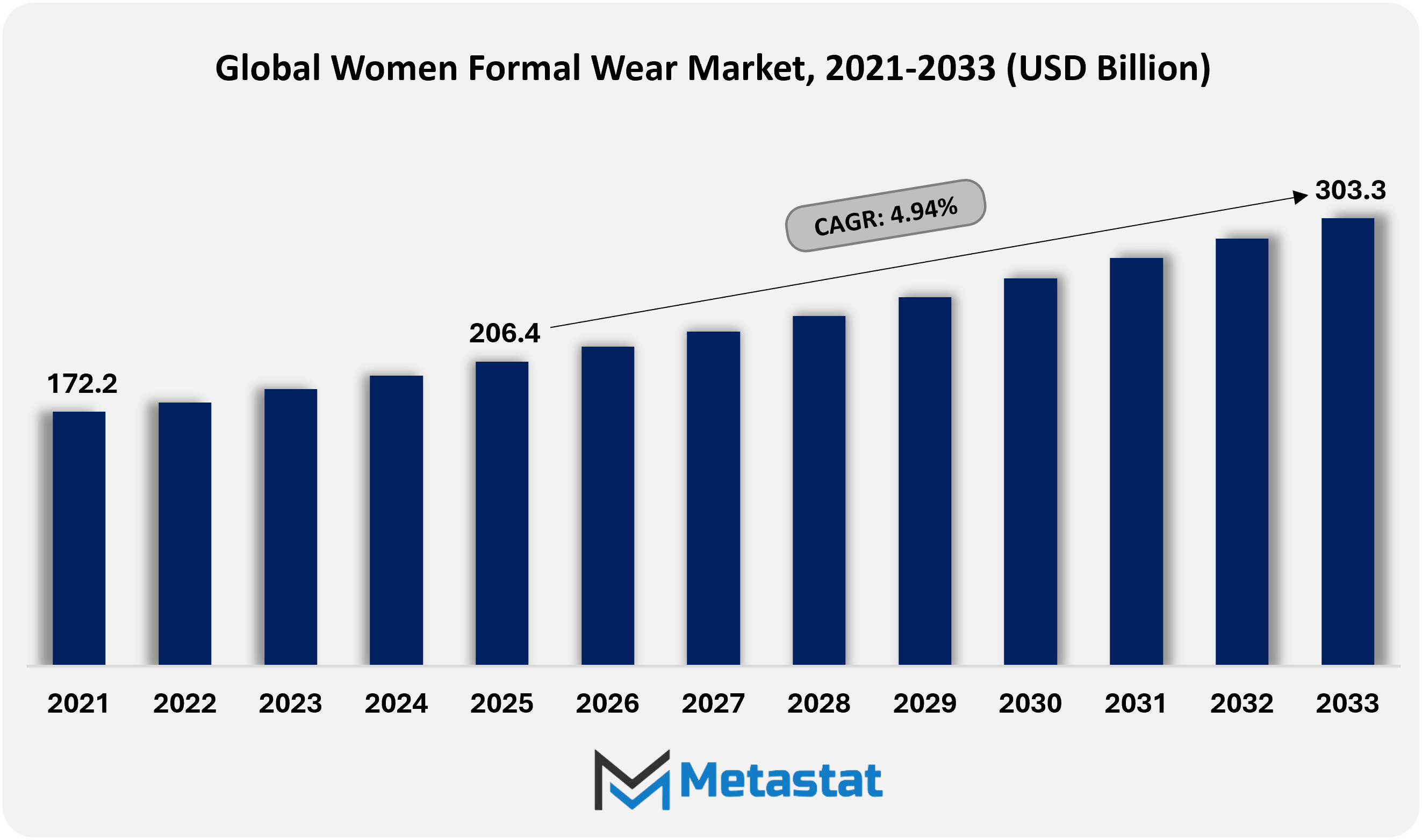
Workplace formalization & hybrid office returns increase demand for blazers, suits, and office-ready separates.
Renewed emphasis on structured workplace attire will support Women's Formal Wear market. Hybrid office models will inspire investment in polished blazers, tailored suits, and delicate separates desirable for professional settings. Corporate culture will prefer constant presentation standards, main to consistent shopping patterns. Design innovation centered on consolation and adaptability will further guide sustained class growth.
Rising social/occasion calendar (weddings, corporate events, formal gatherings) boosts purchases of dresses and occasion wear
An increasing calendar of weddings, company capabilities, and formal gatherings will increase consumption in the Women's Formal Wear marketplace. Consumers will be seeking for one-of-a-kind attire and event garments aligned with occasion-specific expectancies. Social visibility through expert networking and public appearances will inspire wardrobe upgrades. Seasonal celebrations and destination events will further stimulate different purchasing conduct throughout nearby markets.
Shift toward casual/athleisure and relaxed dress codes reduces frequency of formal-wear usage and repeat purchases
Growing preference for casual and athleisure apparel will moderate momentum in the Women's Formal Wear market. Relaxed dress codes throughout industries will decrease frequency of structured outfit usage. Reduced dependency on formal garments for day-by-day activities will restrict repeat transactions. Cultural popularity of informal presentation will preserve influencing buying choices, creating aggressive strain from consolation-driven apparel segments.
High price sensitivity and longer replacement cycles (formal pieces last longer) slow volume growth versus casual categories
Elevated charge focus among customers will present constraints for the Women's Formal Wear marketplace. Formal garments normally hold sturdiness and extended lifecycle, ensuing in slower alternative durations. Investment-oriented buying conduct will lessen impulse shopping styles. Volume increase will continue to be slight in comparison to casual categories, in which quicker trend turnover encourages common wardrobe renewal and broader intake cycles.
Versatile desk-to-dinner and mix-and-match formal separates (wrinkle-resistant, stretch, easy-care) can drive premiumization and higher basket size
Product innovation focused on adaptable desk-to-dinner styling will create value in the Global Women's Formal Wear market. Wrinkle-resistant fabrics, stretch construction, and easy-care materials will enhance purposeful appeal. Mix-and-match separates will sell coordinated purchases, growing transaction cost. Premium positioning supported by way of durability and multifunctional overall performance will reinforce emblem differentiation and long-term sales ability.
The Global Women's Formal Wear market is segmented by Product, Price Range, Distribution Channel, and Region.
Apparels segment is estimated at USD 171.3 billion in 2026 and is projected to reach USD 237.5 billion by 2033, at a CAGR of 4.8% during the forecast period.
Global Women's Formal Wear marketplace will witness robust increase in garb categories driven via rising personnel participation and management presence. Structured suits, tailor-made dresses, and coordinated sets will replicate self-assurance and professionalism.
Footwear segment is estimated at USD 27.4 billion in 2026 and is projected to reach USD 41.8 billion by 2033, at a CAGR of 6.2% during the forecast period.
Global Women's Formal Wear marketplace will experience innovation in shoes through ergonomic layout and fabric development. Formal heels, loafers, and dependent apartments will combine beauty with lengthy put on consolation. Demand will boom for lightweight soles, recyclable components, and customizable fittings, making sure professional appearance even as helping fitness, mobility, and everyday place of work performance standards.
Accessories segment is estimated at USD 17.7 billion in 2026 and is projected to reach USD 24 billion by 2033, at a CAGR of 4.5% during the forecast period.
Global Women's Formal Wear market will increase accessory services which includes handbags, belts, scarves, and minimal jewellery designed for government arrangements. Future collections will integrate purposeful elements which includes digital cubicles and sustainable sourcing. Accessories will give a boost to professional identification, raise coordinated clothing, and contribute to polished aesthetics appropriate for formal commercial enterprise engagements.
Economy segment is projected to reach USD 134.8 billion by 2033, at a CAGR of 5% during the forecast period.
The inside economy pricing of Women's Formal Wear market will cognizance on affordability without compromising vital high-quality. Mass manufacturing, green sourcing, and simplified designs will support accessible expert attire. Growth will stem from increasing employment in growing regions, in which value-powerful formal clothing will allow broader participation in structured company sectors.
Mid-Range segment is projected to reach USD 119.0 billion by 2033, at a CAGR of 4.6% during the forecast period.
Global Women's Formal Wear market in mid variety pricing will balance best, fashion, and affordability. Consumers will be searching for durable fabrics, modern cuts, and reliable craftsmanship. Future demand will encourage brands to combine ethical manufacturing and slight customization, presenting fee-pushed formal wear that aligns with career development and evolving expert expectancies.
Premium segment is projected to reach USD 49.5 billion by 2033, at a CAGR of 5.6% during the forecast period.
The below top-class pricing of Women's Formal Wear market will emphasize exclusivity, advanced tailoring, and excessive-grade substances. Luxury formal garments will feature delicate detailing, bespoke becoming services, and constrained collections. Growth will be supported by means of growing government representation and preference for exceptional apparel that alerts authority and refined taste.
Hypermarket/Supermarket segment is projected to reach USD 37.8 billion by 2033.
Global Women's Formal Wear market through hypermarket and supermarket channels will benefit from excessive foot visitors and huge product visibility. Organized retail expansion will enhance accessibility in urban facilities. Future techniques will encompass dedicated formal sections, non-public labels, and records-pushed stock management to fulfil dependent garb effectively.
Convenience/Departmental Store segment is projected to reach USD 55.9 billion by 2033.
Global Women's Formal Wear market within comfort and departmental stores will keep regular growth centralized buying stories. Departmental codecs will provide curated collections and customized assistance. Technological integration together with virtual fitting tools and stock monitoring will enhance purchasing performance and purchaser pride in formal wear segments.
Specialty Store segment is projected to reach USD 87.8 billion by 2033.
Global Women's Formal Wear market across specialty stores will highlight focused product and tailored provider. Exclusive formal collections, alteration facilities, and top rate session will differentiate uniqueness outlets. Future expansion will rely on experiential retail standards, reinforcing emblem identification and turning in specialized answers for professional wardrobe requirements.
Online Store segment is projected to reach USD 92.0 billion by 2033.
The online stores segment will expand strongly, supported by rising digital adoption, convenience, and broader product accessibility. Virtual fitting tools, size recommendation engines, customer reviews, and secure payment systems are helping improve purchase confidence in formal wear categories. E-commerce platforms are also enabling wider assortment reach, cross-border sales, and data-driven personalization across women's formal apparel, footwear, and accessories.
Others segment is projected to reach USD 29.8 billion by 2033.
The others segment includes boutiques, exhibitions, direct sales, institutional partnerships, and other niche distribution formats. Growth in this channel will be supported by curated retail concepts, limited-edition collections, and corporate or event-based procurement models. These formats help brands diversify revenue streams and strengthen market penetration across specialized professional and occasion wear segments.
Based on geography, the Global Women's Formal Wear market is segmented into North America, Europe, Asia Pacific, South America, and Middle East & Africa.
North America Women's Formal Wear Market is set to expand at a CAGR of 4.9% within the forecast period, reaching a market size (TAM) of USD 96.1 billion by the end of 2033.
In North America, rising female workforce participation, corporate dress expectations, and premium brand penetration continue to support demand in the Women's Formal Wear market.
Strong retail infrastructure, omnichannel presence, and premiumization trends further support market expansion across North America.
In Europe, demand is supported by mature fashion markets, strong premium-brand presence, and sustained consumption of formal and occasion wear across professional and ceremonial settings.
In Asia Pacific, urbanization, rising disposable income, and an expanding middle-class population are creating significant growth opportunities in the Women's Formal Wear market.
Rapid e-commerce expansion and increasing digital retail adoption are strengthening distribution reach across Asia Pacific.
In South America and Middle East & Africa, rising formal employment, increasing fashion awareness, and gradual retail modernization are supporting steady market growth.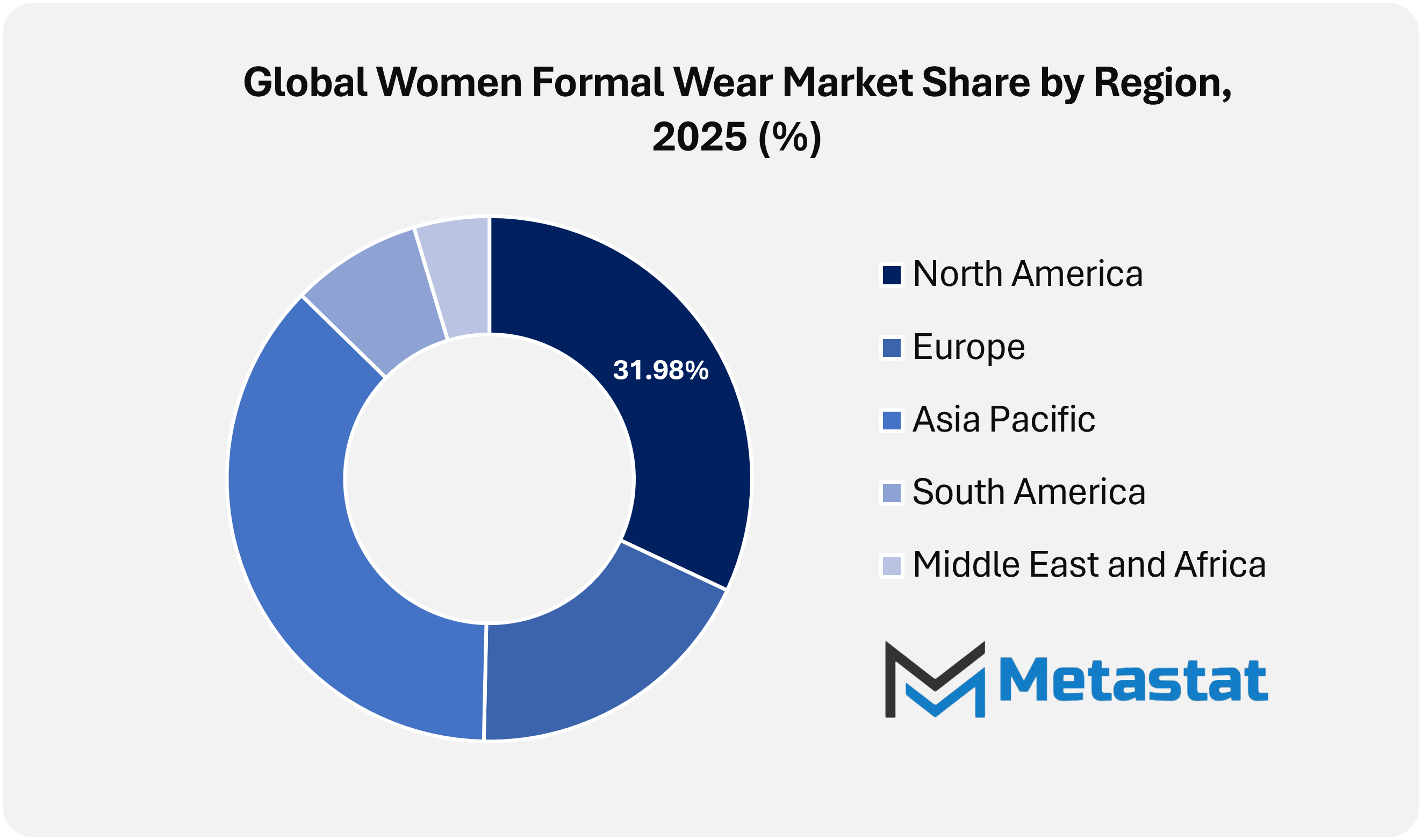
The Global Women's Formal Wear market is expanding steadily, supported by rising female workforce participation, greater attendance at business and formal social events, and increasing preference for polished yet functional attire. Consumers are seeking products that balance style, comfort, versatility, and professional presentation across office wear, occasion wear, and executive dressing needs. Formal wear has evolved beyond conventional suits and basic office essentials to include tailored dresses, structured blazers, refined trousers, coordinated separates, and occasion-led formal collections. As workplace dress norms become more flexible, brands are responding with formalwear assortments that combine sophistication with comfort, contemporary silhouettes, and broader wearability.
Consumer preferences vary across regions based on income levels, workplace culture, climate, fashion sensibilities, and purchasing power. North America and Europe remain important markets for premium and luxury formal wear, supported by mature retail ecosystems, strong brand awareness, and recurring demand from corporate, business, and ceremonial settings. Asia Pacific continues to present strong growth opportunities, supported by urbanization, expanding female employment, rising middle-class spending, and increasing online fashion penetration. E-commerce platforms are reshaping the competitive environment by expanding product access, enabling comparison-led shopping, and improving reach across both premium and value-oriented categories. Sustainability, responsible sourcing, inclusive sizing, and fit-focused product development are becoming important competitive differentiators.
Consumers are increasingly attentive to fabric quality, durability, labor practices, and environmental impact, encouraging brands to invest in sustainable materials, transparent supply chains, and more responsible production models. Companies that offer strong fit consistency, tailoring flexibility, wide size availability, and compelling omnichannel shopping experiences are likely to strengthen consumer loyalty.
Key players operating in the Global Women's Formal Wear market include Gap Inc., Industria de Diseño Textil, S.A., Fast Retailing Co., Ltd., H&M Hennes & Mauritz AB, Mango, PVH Corp., Ralph Lauren Corporation, Capri Holdings Limited, Tapestry, Inc., Hugo Boss AG, Max Mara Fashion Group, Giorgio Armani S.p.A., Valentino S.p.A., Burberry Group plc, Prada S.p.A., Chanel Limited, LVMH Moët Hennessy Louis Vuitton SE, and Kering SA. These companies compete on brand positioning, product quality, design relevance, fit, pricing architecture, and distribution reach. Premium and luxury brands emphasize craftsmanship, exclusivity, and elevated tailoring, while mass-market and fast-fashion players compete through affordability, faster trend cycles, and broader retail accessibility. Innovation in product design, digital marketing, omnichannel retailing, and customer experience will continue to shape the competitive structure of the market.
Market size is forecast to rise from USD 206.4 billion in 2025 to over USD 303.3 billion by 2033.
Future market expansion is expected to be supported by rising female workforce participation, increasing demand for polished professional attire, growth in social and formal event dressing, and broader acceptance of premium yet functional formalwear solutions. The market is also likely to benefit from product innovation focused on comfort, fabric performance, inclusive sizing, and versatile desk-to-dinner styling. Digital retail transformation, including virtual fitting tools, improved size guidance, omnichannel shopping, and personalized merchandising, is expected to strengthen online conversion and category reach. Across regions, established markets are likely to maintain demand through premiumization and brand-driven purchases, while emerging markets are expected to support incremental volume growth through urbanization, rising disposable income, and expanding formal employment.
This research report categorizes the Women's Formal Wear market based on key segments and regions, forecasts revenue growth, and analyses trends in each submarket. The report analyses the key growth drivers, opportunities, and challenges influencing the Women's Formal Wear market. Recent market developments and competitive strategies such as expansion, product launch, partnership, merger, and acquisition have been included to draw the competitive landscape in the market.
The report strategically identifies and profiles the key market players and analyses their core competencies in each sub-segment of the Women's Formal Wear market.
|
Report Attributes |
Details |
|
Study Period |
2021-2033 |
|
Base Year |
2025 |
|
Estimated Year |
2026 |
|
Forecast Period |
2026-2033 |
|
Historical Period |
2021-2025 |
|
Growth Rate |
CAGR 4.9% from 2026 to 2033 |
|
Revenue Unit |
USD Billion |
|
Sales Volume Unit |
Million Units |
|
Segmentation |
By Product, Price Range, Distribution Channel, and Region |
|
By Region |
North America (By Product, Price Range, Distribution Channel, and Country)
|
|
Europe (By Product, Price Range, Distribution Channel, and Country)
|
|
|
Asia Pacific (By Product, Price Range, Distribution Channel, and Country)
|
|
|
South America (By Product, Price Range, Distribution Channel, and Country)
|
|
|
Middle East and Africa (By Product, Price Range, Distribution Channel, and Country)
|
Find answers to common questions about this report
Top players operating in the Women's Formal Wear industry include Gap Inc., Inditex (Zara), Fast Retailing Co., Ltd., H&M Group, Mango (Punto Fa, S.L), PVH Corp., and Ralph Lauren Corporation.
Global Women's Formal Wear market is estimated to reach USD 303.3 billion by 2033.
Shift toward casual/athleisure and relaxed dress codes reduces frequency of formal-wear usage and repeat purchases will hamper the market growth within the forecast period.
Asia Pacific region dominates the market.
The Apparels is the leading type segment in the Global market.
The Metastat Insights study shows that the Global Women's Formal Wear market size was USD 206.4 billion in 2025.
Workplace formalization & hybrid office returns increase demand for blazers, suits, and office-ready separates and Rising social/occasion calendar (weddings, corporate events, formal gatherings) boosts purchases of dresses and occasion wear are key driving factors, boosting the market.
The Global Women's Formal Wear market is expected to grow at a CAGR of 4.9% over the forecast period (2026-2033).
The Metastat Insights analysis shows that the North America Women's Formal Wear market size is estimated to be USD 96.1 billion by 2033.
The analysts below cover Consumer Goods research at Metastat Insights.
LEAD ANALYST
Utkarsh Khirodkar is a Lead Market Research Analyst at MetaStat Insight, specializing in market intelligence, technology sector assessments, and competitive strategy.
Last Updated: August, 2026
Our team was tracking whether regional recycling infrastructure could realistically absorb the growing volume of lithium iron phosphate batteries over the next decade. The report did a solid job separating announced hydrometallurgical plant capacity from active, permitted operational throughput. That distinction made the feedstock availability projections and regional recovery rate models far more credible than standard commercial overviews.
Tracking capacity expansion in single-use bioprocessing requires dependable data on raw material availability and cleanroom-grade polymer supply chains. The competitive landscape chapter gave a grounded evaluation of secondary component suppliers across North America and Asia-Pacific rather than simply reprinting press releases. Having that level of supplier benchmarking helped clarify dual-sourcing considerations for our clinical pipeline planning.
When evaluating distributed energy resource management systems, standard research summaries tend to gloss over the operational differences between front-of-the-meter utility deployments and behind-the-meter industrial sites. The MetaStat Insight report addressed those distinctions directly, especially regarding software interoperability standards and grid interconnection backlogs. The five-year market sizing across regional transmission organizations provided actionable context for our grid modernization strategy.
Explore related market intelligence reports worth reading alongside this one.