
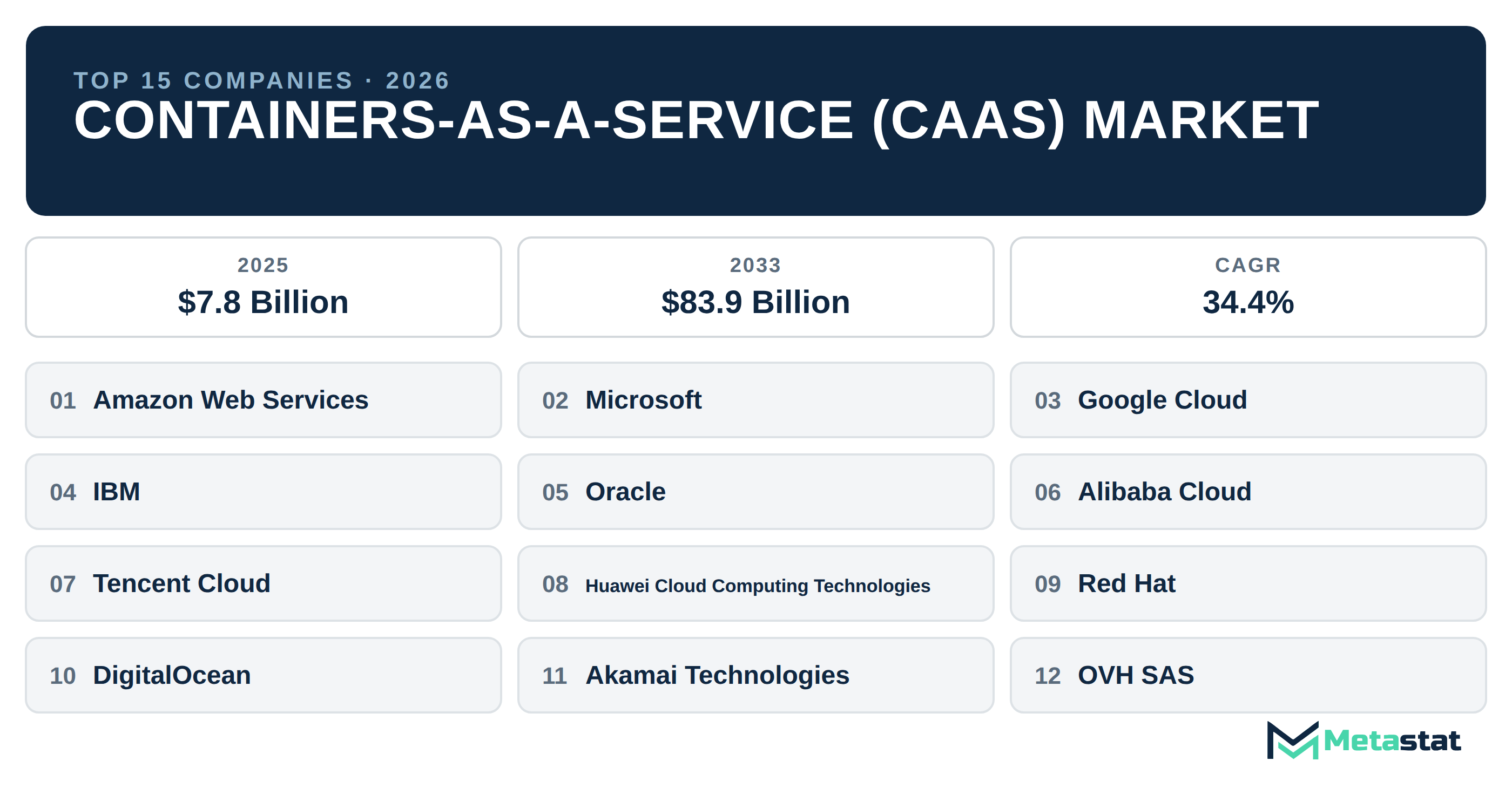
Explore the top 15 Companies in the Global Containers-As-A-Service (CAAS) Market, projected to grow from USD 7.8 Billion in 2025 to USD 83.9 Billion by 2033.
The Global Containers-As-A-Service (CAAS) Market is valued at USD 7.8 Billion in 2025 and is projected to reach USD 83.9 Billion by 2033, growing at a CAGR of 34.4%. This market encompasses a variety of services, including managed Kubernetes services, container application platforms, and serverless container services. The demand for flexible and scalable solutions drives organizations to adopt CAAS, facilitating easier deployment and management of containerized applications.
Businesses across sectors, such as IT and telecommunications, healthcare, and retail, leverage CAAS to enhance operational efficiency and reduce infrastructure costs. The trend towards digital transformation and the rise of cloud-native applications further fuel this market's growth.
Global Containers-As-A-Service (CAAS) Market Size, Data, & Statistics
The base year value of the Global Containers-As-A-Service (CAAS) Market stands at USD 4.4 Billion in 2023. This reflects the growing interest and adoption of container technologies across various industries.
The market is forecasted to reach USD 83.9 Billion by 2033, indicating a strong growth trajectory as organizations seek efficient cloud solutions.
The CAGR from 2025 to 2033 is 34.4%, highlighting the rapid expansion expected in this market segment. This growth will likely be driven by increasing demand for agile and scalable infrastructure.
Yearly figures reflect a consistent upward trend, with the market expected to grow from USD 7.8 Billion in 2025 to USD 10.6 Billion in 2026.
Regional distribution shows North America leading with 34.1%, followed by Europe at 26.8% and Asia Pacific at 24.5%. South America accounts for 7.2%, while the Middle East and Africa make up 7.5% of the market share.
Top 10 Trends in the Global Containers-As-A-Service (CAAS) Market
Increased adoption of Kubernetes
Kubernetes has gained significant traction as a preferred orchestration tool for managing containerized applications. Organizations recognize its ability to enhance scalability and automate deployment processes, leading to a more efficient management of resources.
Shift towards serverless architectures
Many companies are shifting to serverless architectures to streamline operations and minimize infrastructure management. This trend allows developers to focus on coding while the cloud provider manages server allocation, resulting in increased agility.
Focus on security enhancements
As cyber threats grow, businesses prioritize security in their containerized environments. Enhanced security measures are becoming essential to protect sensitive data and ensure compliance with regulations.
Integration with DevOps practices
CAAS solutions are increasingly integrated into DevOps workflows, promoting collaboration between development and operations teams. This integration speeds up software delivery and improves overall product quality.
Emphasis on multi-cloud strategies
Organizations are adopting multi-cloud strategies to avoid vendor lock-in and enhance flexibility. This approach allows them to leverage the best features of different cloud providers while optimizing costs.
Growth of edge computing applications
The rise of edge computing necessitates efficient container solutions that can operate in distributed environments. CAAS providers are adapting their services to meet the needs of edge deployments.
Containerized AI and ML deployments
Artificial intelligence and machine learning applications are often deployed in containers for improved scalability. This trend will likely drive further demand for CAAS solutions tailored to AI and ML workloads.
Emergence of hybrid cloud solutions
Hybrid cloud environments are gaining popularity as organizations seek to balance on-premises and cloud resources. CAAS plays an important role in facilitating integration and management across these environments.
Increased focus on sustainability
Sustainability is becoming a priority for many organizations. CAAS providers are adopting eco-friendly practices and technologies to reduce their carbon footprints while meeting customer demands.
Enhanced developer experience
CAAS platforms are focused on improving the developer experience through simplified workflows and user-friendly interfaces. This trend helps attract a broader range of developers to adopt container technologies.
Top 15 Companies in the Global Containers-As-A-Service (CAAS) Market
1. Amazon Web Services, Inc.
Headquarters: Seattle, United States · Founded: 2006. Amazon Web Services (AWS) offers a comprehensive suite of cloud services, including containers as a service. AWS's Elastic Kubernetes Service (EKS) and Amazon ECS provide strong solutions for managing containerized applications at scale.
AWS emphasizes flexibility, enabling developers to deploy applications in a managed environment. Their continuous innovation and extensive global infrastructure support businesses of all sizes looking to leverage container technologies.
2. Microsoft
Headquarters: Redmond, United States · Founded: 1975. Microsoft provides Azure Kubernetes Service (AKS), which allows users to deploy and manage containerized applications using Kubernetes. Azure integrates seamlessly with Microsoft's ecosystem, offering a wide range of services for developers.
Microsoft focuses on enabling organizations to build cloud-native applications, streamlining their development processes while ensuring security and scalability. The Azure platform is known for its enterprise-grade support and innovative features.
3. Google Cloud
Headquarters: Mountain View, United States · Founded: 1998. Google Cloud offers Google Kubernetes Engine (GKE), a managed service for deploying and scaling containerized applications. Leveraging Google's expertise in containerization, GKE supports a variety of workloads, including machine learning and big data.
The platform focuses on providing a highly reliable infrastructure with advanced features for developers. Google Cloud emphasizes collaboration and integration, making it a preferred choice for businesses seeking efficiency in their cloud operations.
4. IBM
Headquarters: Armonk, United States · Founded: 1911. IBM offers a range of Cloud services, including IBM Cloud Kubernetes Service, which enables users to manage and orchestrate containerized applications seamlessly. The company focuses on hybrid cloud solutions and enterprise capabilities.
IBM's approach emphasizes security, compliance, and support for mission-critical applications. By integrating their artificial intelligence capabilities, IBM enhances the functionality of its container services, appealing to a diverse range of industries.
5. Oracle
Headquarters: Redwood City, United States · Founded: 1977. Oracle provides Oracle Cloud Infrastructure, which includes Oracle Container Engine for Kubernetes. This service allows organizations to run containerized applications efficiently while leveraging Oracle's strong database solutions.
Oracle's emphasis on combining cloud services with database technology enables seamless integration for enterprises. Their strategic focus on performance and security addresses the complex requirements of large-scale deployments.
6. Alibaba Cloud
Headquarters: Hangzhou, China · Founded: 2009. Alibaba Cloud offers a variety of container services, including Alibaba Cloud Container Service and Kubernetes. Their solutions focus on providing scalable, high-performance environments for businesses looking to deploy applications in the cloud.
Alibaba Cloud's strong presence in Asia and growing global footprint support companies seeking to expand their cloud operations. Their services emphasize cost-effectiveness and compliance with regional regulations.
7. Tencent Cloud
Headquarters: Shenzhen, China · Founded: 2010. Tencent Cloud provides various container services, including Tencent Kubernetes Engine and microservices management. Their platform focuses on enhancing the developer experience and supporting rapid application development.
Tencent Cloud utilizes its extensive experience in gaming and social media to offer tailored solutions for businesses. The emphasis on innovation and user-friendly interfaces attracts a broad customer base.
8. Huawei Cloud Computing Technologies Co., Ltd.
Headquarters: Shenzhen, China · Founded: 2010. Huawei Cloud provides container services that facilitate the deployment and management of applications on its cloud platform. Huawei emphasizes scalability and efficiency in its cloud solutions, catering to various industries.
With a focus on innovation, Huawei Cloud integrates advanced technologies like AI and big data into its container offerings. Their commitment to providing comprehensive support enables organizations to harness the full potential of cloud services.
9. Red Hat
Headquarters: Raleigh, United States · Founded: 1993. Red Hat is known for its open-source solutions and offers Red Hat OpenShift, a leading container platform based on Kubernetes. Their services cater to enterprises seeking to adopt containerization while maintaining flexibility.
Red Hat focuses on providing a comprehensive ecosystem that supports developers and operations teams. Their commitment to open-source principles enhances collaboration and innovation in container development.
10. DigitalOcean, LLC.
Headquarters: New York City, United States · Founded: 2011. DigitalOcean offers a simplified approach to container management through its DigitalOcean Kubernetes service. This platform targets developers and small to medium-sized businesses seeking a user-friendly solution.
DigitalOcean emphasizes ease of use and affordability, making cloud deployment accessible for a wider audience. Their focus on community support and documentation fosters a strong developer ecosystem.
11. Akamai Technologies
Headquarters: Cambridge, United States · Founded: 1998. Akamai Technologies specializes in web performance and security solutions, providing services that integrate container technologies into existing infrastructures. Their focus on enhancing application delivery aligns with modern cloud needs.
Akamai integrates security features into its container offerings, ensuring that applications remain protected while delivering high performance. This dual emphasis on performance and security caters to enterprises with demanding requirements.
12. OVH SAS
Headquarters: Roubaix, France · Founded: 1999. OVH offers a range of cloud services, including container solutions that support organizations in deploying applications at scale. Their focus on affordability and flexibility attracts a diverse customer base.
OVH's unique approach emphasizes eco-friendly practices and sustainability in its cloud operations, appealing to environmentally conscious businesses. The company aims to provide reliable services without compromising on cost-effectiveness.
13. SUSE
Headquarters: Nuremberg, Germany · Founded: 1992. SUSE provides enterprise solutions focused on open-source software, including SUSE Rancher, a container management platform. This service enables organizations to manage multiple Kubernetes clusters effectively.
SUSE's commitment to open-source principles supports collaboration and community-driven innovation. Their focus on enterprise needs positions them well within the Containers-As-A-Service (CAAS) market.
14. Nutanix
Headquarters: San Jose, United States · Founded: 2009. Nutanix offers a hybrid cloud solution that includes container services for deploying and managing applications. Their focus on simplicity and scalability resonates with businesses seeking to streamline operations.
Nutanix emphasizes a smooth transition between on-premise and cloud environments, supporting organizations in their digital transformation efforts. Their strong platform appeals to enterprises looking to innovate effectively.
15. Servers.com
Headquarters: Los Angeles, United States · Founded: 2013. Servers.com specializes in providing cloud infrastructure and container services designed for developers. Their platform is tailored for performance and reliability, catering to various workloads.
Servers.com focuses on delivering efficient solutions that meet the needs of developers and organizations. Their commitment to customer support and technological advancements enhances their service offerings.
Conclusion
The Global Containers-As-A-Service (CAAS) Market is on a path of significant expansion, with a projected increase to USD 83.9 Billion by 2033. The emergence of diverse companies highlights the competitive nature of this market, with each organization bringing unique strengths to the table.
As businesses embrace the potential of Containers-As-A-Service (CAAS), selecting the right provider becomes crucial. Organizations should consider factors such as scalability, security, and integration capabilities when choosing a CAAS solution to meet their specific needs.
Tags
About the Authors

LEAD ANALYST
Utkarsh Khirodkar is a Lead Market Research Analyst at MetaStat Insight, specializing in market intelligence, technology sector assessments, and competitive strategy.

PRINCIPAL CONSULTANT - ENTERPRISE AI & EMERGING TECHNOLOGIES
Banking & Finance · Electronics and Semiconductor · Energy and Power · Healthcare IT · Information & Technology · Professional Services
Vijay Gunti is a Principal Consultant at MetaStat Insight, bringing over two decades of experience across enterprise digital transformation, technology strategy, and intelligent systems.

LEAD CONSULTANT - COMMUNICATION, TELECOM, AND IT
Electronics and Semiconductor · Information & Technology · Machinery & Equipment · Professional Services
Ravindra Sathe Consultants for Communication, Telecom, and IT at MetaStat Insight. He leads the firm's industry research initiatives across telecommunications infrastructure, digital connectivity, enterprise networking, and emerging information technology domains.