
LEAD ANALYST
Utkarsh Khirodkar is a Lead Market Research Analyst at MetaStat Insight, specializing in market intelligence, technology sector assessments, and competitive strategy.

Metastat Insights has released a report on the Energy Drinks market, forecasting growth from USD 85.7 billion in 2025 to USD 159.9 billion by 2033, with a CAGR of 8.1%. The report explores key drivers, challenges, market segmentation, and competitive landscape.
Metastat Insights has published "Global Energy Drinks Market Size, Share, By Product Format (Standard-Serve Carbonated Ready-to-Drink Energy Drinks, Standard-Serve Non-Carbonated Ready-to-Drink Energy Drinks, Concentrated Liquid Energy Shots, Powdered Energy Drink Mixes and Others (Syrups and Dispenser Concentrates)), By Sugar Content (Full-Sugar Energy Drinks, Low-Sugar Energy Drinks and Sugar-Free and Zero-Sugar Energy Drinks), By Distribution Channel (Supermarkets and Hypermarkets, Convenience Stores and Forecourt Retail, Traditional Grocery and Independent Retail, Drugstores and Pharmacies, Specialty Nutrition and Fitness Retailers, E-commerce and Direct-to-Consumer, Foodservice and On-Trade, Vending Machines and Warehouse Clubs and Others (Institutional and Travel Retail)), Industry Analysis, Growth, Trends, and Forecast, 2026-2033", detailing the market's value expansion from USD 85.7 billion in 2025 to USD 159.9 billion by 2033, translating to a compound annual growth rate (CAGR) of 8.1%.
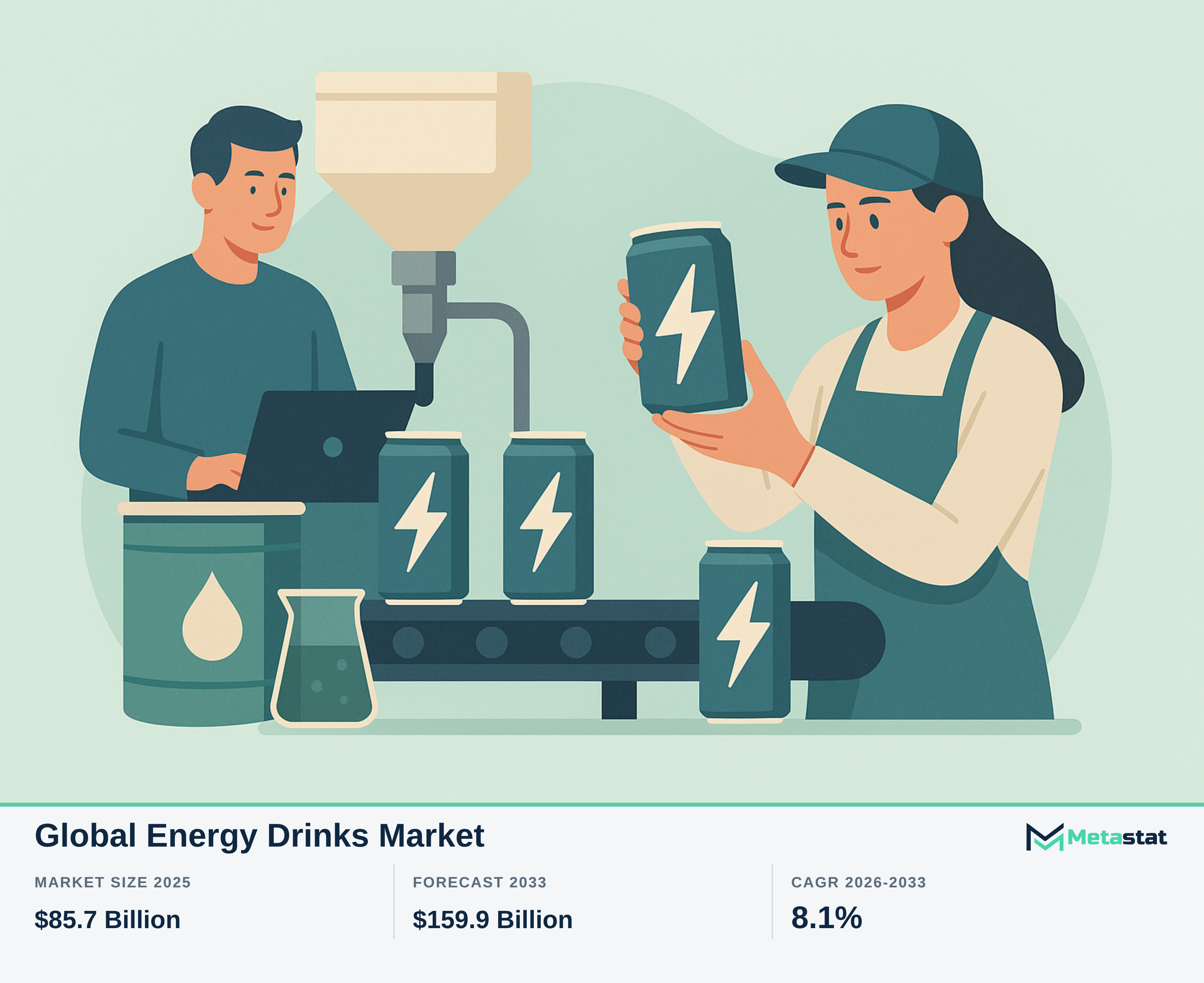
The Energy Drinks market experiences significant growth, propelled by increasing consumer awareness of health and wellness. A growing preference for functional beverages encourages consumers to seek energy drinks that align with healthier lifestyles. This trend is particularly prominent among younger demographics, who increasingly favor low-sugar and sugar-free options. Innovative product formulations that cater to these preferences enhance market competitiveness. Urbanization contributes to changing consumer behavior, with busy lifestyles driving demand for convenient, ready-to-drink energy solutions.
Inflationary pressures significantly impact the Energy Drinks market, leading to rising costs for raw materials including sugar and caffeine. These increases necessitate adjustments in pricing strategies, which deter consumers, particularly those in lower-income brackets. Regulatory compliance concerning ingredient labeling and health claims presents challenges. Geopolitical risks, including trade tensions, disrupt supply chains, further complicating the landscape for manufacturers and retailers within the market.
The Energy Drinks market features diverse segmentation based on product format, sugar content, and distribution channels. The market is divided into segments including standard-serve carbonated drinks, non-carbonated options, concentrated liquid energy shots, and powdered mixes. Each segment reveals distinct growth trajectories, with non-carbonated drinks projected to grow at a CAGR of 10.4% through 2033. Regionally, North America commands the largest market share at 37.7%, followed by Europe at 28.8% and Asia Pacific at 22.4%. Emerging markets in South America and the Middle East present additional opportunities for expansion.
Several prominent companies operate within the Energy Drinks market, including Red Bull GmbH, Monster Beverage Corporation, and PepsiCo, Inc. These companies continue to innovate and expand their product portfolios to attract a broader consumer base. Newer entrants, including Celsius Holdings, Inc. and GURU Organic Energy Corp., diversify the market further, contributing to intense competition. Companies invest significantly in marketing and promotional activities, enhancing brand loyalty and market presence.
For a comprehensive analysis of the Energy Drinks market, including detailed insights on trends, dynamics, and forecasts, visit the full report: Global Energy Drinks Market.
Related Report
Global Energy Drinks MarketLEAD ANALYST
Utkarsh Khirodkar is a Lead Market Research Analyst at MetaStat Insight, specializing in market intelligence, technology sector assessments, and competitive strategy.

LEAD PRINCIPAL ANALYST, PHARMA AND HEALTHCARE
Food and Beverages · Healthcare · Healthcare IT · Medical Devices
Ajay Devgire is the Lead Healthcare Analyst at MetaStat Insight, leading strategic research and market intelligence initiatives across the global healthcare domain.

SENIOR RESEARCH ANALYST
Biotechnology · Food and Beverages · Medical Devices · Packaging
Snehal Pasalkar is a Research Analyst at MetaStat Insight, operating at the intersection of life sciences research, competitive strategy, and market intelligence.