
LEAD ANALYST
Utkarsh Khirodkar is a Lead Market Research Analyst at MetaStat Insight, specializing in market intelligence, technology sector assessments, and competitive strategy.

2D Barcode Reader Market By Type (Handheld Readers, Fixed Readers, and Mobile (Mounted) Readers), By Technology (Imaging Scanners, Charge-coupled device (CCD) scanners, Complementary Metal Oxide Semiconductor (CMOS) Scanner, and Omnidirectional Scanners), By End Use Industry (Education, Government, Healthcare, Logistics, Transportation, Manufacturing, Retail, eCommerce, and Others), By Industry Analysis, Size, Share, Growth, Trends, and Forecast, 2033
Report ID
MSI-4333
Published
January, 2026
Pages
255 Pages
Format
Report Details
Choose Your License
2D Barcode Reader Market
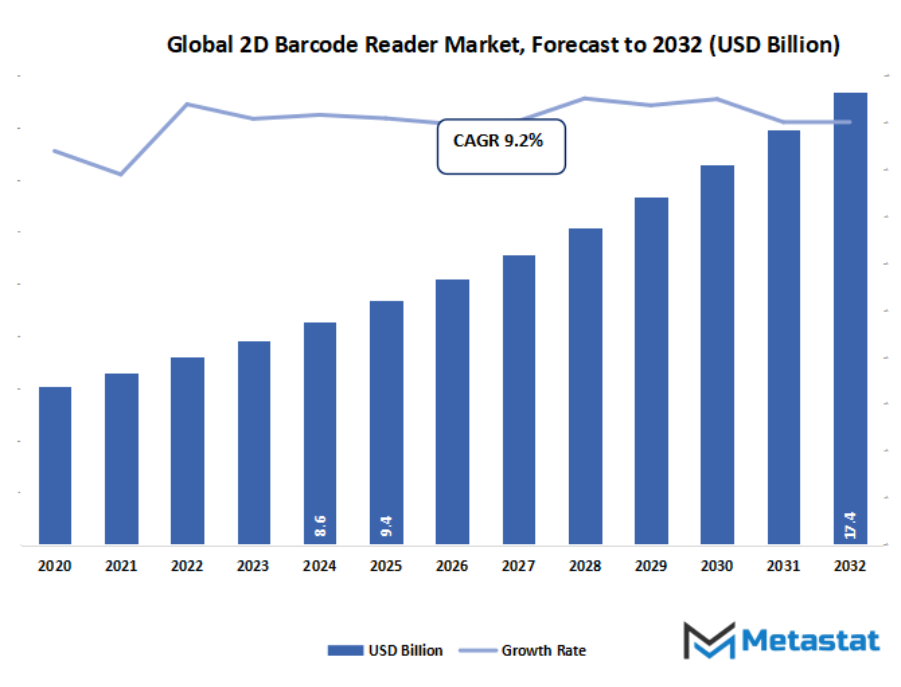
Global 2D barcode reader market valued at approximately USD 9.4 Billion in 2025, growing at a CAGR of around 9.2% through 2032, with potential to exceed USD 17.4 Billion.
Handheld Readers account for nearly 55.3% market revenues, driving innovation and expanding applications through intense research.
Key trends driving growth: Increasing adoption of automated data capture in retail and warehousing., Rising use of QR codes for digital payments and product authentication.
Opportunities include Growing integration of 2D barcode readers in mobile and smart devices for contactless operations.
Key insight: The market is set to grow exponentially in value over the next decade, highlighting significant growth opportunities.
The global 2D barcode reader market will break out of its current mold as industries in logistics, healthcare, retail, and manufacturing continue to digitize. What the future holds for this market will not be so much about quicker scanning or smaller devices but about how barcode readers will integrate with more extensive systems of intelligence and automation. The sector will move from individual scanning devices to integrated systems that interface with warehouse robots, self-service checkouts, and real-time inventory control platforms.
What should the destiny preserve for the global 2D barcode reader market as automation and smart technology redefine statistics monitoring and stock management? Could the rapid integration of AI and IoT create new disruptions, reshaping how industries utilize barcode structures for performance and accuracy? And as corporations shift in the direction of digital transformation, will rising challenges consisting of cybersecurity and compatibility influence the tempo of market growth?
As companies embrace more intelligent operational concepts, barcode readers will be seen as data-enabling devices instead of mere identifiers. The shift towards cloud connectivity will enable 2D barcode readers to exchange insights in real-time across multiple endpoints, enhancing coordination between supply chain layers. Their technology will also change lightweight, rugged, and able to work in harsher environments like factory plants and cold storage facilities. Beyond bodily features, software integration will define their destiny, allowing for predictive preservation, far off monitoring, and progressed facts accuracy.
The global 2D barcode reader market is mainly classified based on Type, Technology, End Use Industry.
Handheld Readers: The global 2D barcode reader market will experience a significant increase in demand for handheld readers as businesses continue to seek flexibility and mobility. Handheld readers will be embraced for their efficiency in scanning barcodes throughout warehouses, retail stores, and healthcare institutions. The devices will improve workflow precision and minimize human error.
Fixed Readers: Fixed readers will become more popular for their accuracy and speed in packaging lines and industrial automation. Their incorporation in conveyor units and production units will maximize efficiency. With growing automation, fixed readers will be used with preference where continuous scanning is needed with minimal supervision, enabling easy, uninterrupted operations.
Mobile (Mounted) Readers: Mobile or mounted readers will be an important component of digital tracking systems in logistics and intelligent manufacturing configurations. Their versatility in vehicles and robots will assist with real-time data collection and inventory management. Future developments will render them smaller, energy-efficient, and able to operate flawlessly within difficult operation environments.
Imaging Scanners: Imaging scanners will improve further with sophisticated optical sensors and software that decode barcodes quickly and with greater accuracy. The scanners will play a critical role in retail, medical, and logistics use where accuracy and readability are paramount. Future direction will be toward multi-code reading and tighter integration into data management systems.
Charge-Coupled Device (CCD) Scanners: Charge-coupled device scanners will continue to be valuable for proximity barcode reading. Their application will grow in environments that demand constant and solid image acquisition, including laboratories and electronic production lines. The improvement in CCD sensors will also further enhance data precision and aid in better quality assurance procedures.
Complementary Metal-Oxide Semiconductor (CMOS) Scanners:Complementary metal-oxide semiconductor scanners will see major technology advancements, where they will perform better and cost less to make. They will find extensive use because they consume less energy and are so much smaller in size. In the next-generation production environments, CMOS scanners will be crucial in high-speed and multi-angle barcode scan applications.
Omnidirectional Scanners: Omnidirectional scanners will continue to find uptake for their capacity to read information from various angles without the requirement for exact barcode orientation. They will play an increased role in retail and logistics processes where speedy checkout and uninterrupted product tracking are crucial. The market will prefer scanners that are more accurate and compatible with automated systems.
Education: In the education system, the global 2D barcode reader market will aid smart campus management, such as asset tracking, library management, and student identification. Barcode readers will streamline administrative processes and monitoring of data, enhancing efficiency in institutions. Future digitization of records will make data more accessible and transparent.
Government: Government agencies will implement barcode readers to track data, manage assets, and verify documents. The technology will help to ensure transparency and accountability. As public administration becomes increasingly digital, barcode readers will be used to make workflow management easier and protect sensitive data.
Healthcare: The healthcare space will keep on using 2D barcode readers for patient identification, drug tracking, and inventory management. The technology will enhance operational safety and precision in managing medical information. The future will witness wider applications in automated diagnostic and inventory systems to achieve improved patient outcomes.
Logistics & Transportation: Barcode readers will be a crucial factor in enhancing supply chain visibility across logistics and transportation. With their capacity for real-time tracking, they will make distribution networks stronger. Barcode readers, with automation and the integration of IoT, will enable quicker data transfer, assisting industries in effectively dealing with increasing global trade complexities.
Manufacturing: Barcode readers will be used by manufacturing facilities for process automation, inventory management, and equipment servicing. As industrial automation grows, barcode readers will automate data entry and reduce mistakes. With their integration with robotic systems and intelligent production lines, precision of operations and consistency of output will improve.
Retail & E-commerce: In retail and online shopping, barcode readers will continue to be necessary for inventory management, self-checkout, and shipment tracking. The global 2D barcode reader market will expand further with digital payments and online purchases increasing. Next-generation scanners will provide speedier processing and better customer experience on all platforms.
Others: Other sectors such as hospitality, utilities, and entertainment will implement barcode readers for efficient data management and customer service. The increasing digital infrastructure will provide new scope for their use in different operational environments. The market will keep evolving towards smarter, faster, and more resilient devices to address future needs.
|
Forecast Period |
2025-2032 |
|
Market Size in 2025 |
$9.4 Billion |
|
Market Size by 2032 |
$17.4 Billion |
|
Growth Rate from 2025 to 2032 |
9.2% |
|
Base Year |
2025 |
|
Regions Covered |
North America, Europe, Asia-Pacific, South America, Middle East & Africa |
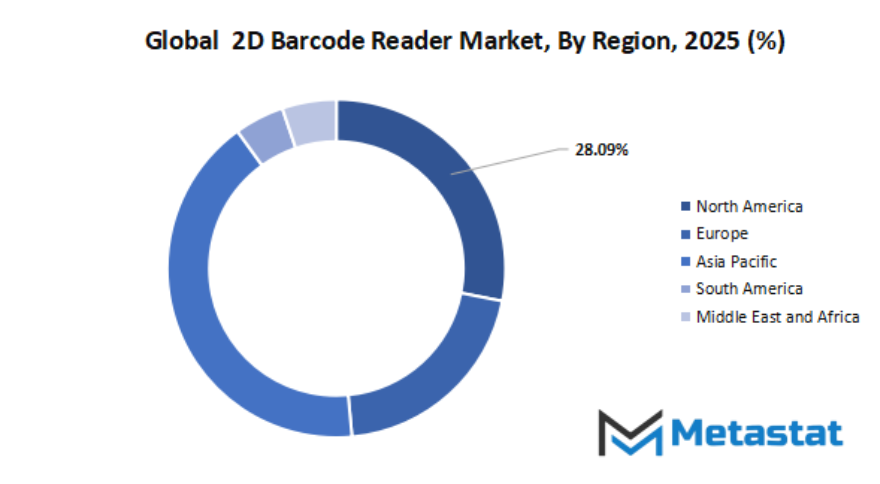
Based on geography, the global 2D barcode reader market is divided into North America, Europe, Asia-Pacific, South America, and Middle East & Africa. North America is further divided in the U.S., Canada, and Mexico, whereas Europe consists of the UK, Germany, France, Italy, and Rest of Europe. Asia-Pacific is segmented into India, China, Japan, South Korea, and Rest of Asia-Pacific. The South America region includes Brazil, Argentina, and the Rest of South America, while the Middle East & Africa is categorized into GCC Countries, Egypt, South Africa, and Rest of Middle East & Africa.
The global 2D barcode reader market is influenced by a combination of seasoned global firms and upstart regional players who continuously introduce innovation and competition to the market. With companies across industries shifting toward automation and precision in data, applications of 2D barcode readers have grown by leaps and bounds. Today, they are utilized in retail, logistics, healthcare, manufacturing, and other industries to enhance tracking, eliminate errors, and boost productivity. With technological changes affecting the majority of industries, the need for efficient barcode scanning systems will only increase, leaving room for global and local companies to excel.
Casio Computer Co., Ltd., Cognex Corp., Datalogic S.P.A., Denso Wave Inc., and Honeywell International, Inc. Are some of the groups which have been acknowledged to make massive strides in technology and have their presence globally. Their studies-based totally approach and sturdy distribution channels have enabled them to occupy a prime position inside the market. Zebra Technologies Corp. And Keyence Corp. Are also primary innovators, continuously refining high-overall performance scanners with higher speed, precision, and integration capability. These corporations are trendsetters for innovation, which motivates smaller organizations to comply with and create price-friendly solutions primarily based on nearby needs.
Concurrently, Juniper Systems Inc., Marson Technology Co., Ltd., Scandit, and Wasp Barcode Technologies are among the increasing numbers of emerging players defining the market with innovative concepts and adaptable product designs. Most of these companies target handheld and mobile scanning technology that can easily interface with smartphones, tablets, and industrial systems. Their flexibility and responsiveness enable them to address exact client requirements sooner, providing them with an advantage in special markets where affordability and customization are most important.
Other gamers like Omron Microscan Systems, Inc., Sato Holdings Corp., Unitech Electronics Co., Ltd., Zebex Industries Inc., and SICK AG preserve to increase product efficiency via the combination of sophisticated optics, sensors, and software. As automation turns into more and more used in warehouses, production traces, and hospitals, these companies are coming across sparkling opportunities to boom their application. The blend of tested experience and growing innovation guarantees that the global 2D barcode reader market will stay busy and aggressive over the following numerous years.
Overall, the global 2D barcode reader market with the aid of Metastat Insight is indicative of a harmonious stability between balance and innovation. The courting between key gamers, each in collaboration and competition with every different, will outline the future route of this marketplace with the arrival of smarter, faster, and greater low cost scanning answers globally.
Heavy preliminary cost of imposing sophisticated barcode scanning structures: The global 2D barcode reader market might be challenged by way of the heavy preliminary funding had to deploy cutting-edge scanning era. Most companies, especially small and medium enterprises, will resist changing existing arrangements due to monetary constraints. This monetary constraint will retard the price of adoption, mainly in rising economies.
Incompatibility with outdated IT infrastructure and software program: The global 2D barcode reader market will face challenges due to compatibility troubles between state-of-the-art barcode systems and legacy IT infrastructures. Several organizations retain to rely on legacy applications that do not guide new scanning standards. This will pose integration challenges, necessitating further expenditure on software program improvements or custom interfaces for seamless operations.
Increasing integration of 2D barcode readers into cellular and clever devices for contactless operations: global 2D barcode reader market will develop with the growing adoption of 2D barcode technology in smartphones, pills, and other sensible devices. Touch-free answer call for will develop by using leaps and limits in industries which include retail, logistics, and healthcare. Future improvements will deal with excessive-speed, secure, and energy-efficient scanning structures, allowing organizations to maximize purchaser experience and business efficiency.
Market size is forecast to rise from USD 9.4 Billion in 2025 to over USD 17.4 Billion by 2032. 2D Barcode Reader will maintain dominance but face growing competition from emerging formats.
In the imminent years, the global 2D barcode reader market will venture into new avenues spurred via the imperative for traceability and transparency. With groups focusing on automaton and conformity, readers of barcodes will act as the bridge among human interaction and clever intelligence. Improvements in picture popularity and decoding aided through AI will redefine their effectiveness, letting them read state-of-the-art symbols beneath detrimental lighting or bent surfaces. With organizations venturing into without boundaries virtual commerce, barcode era will allow actual-time authentication, shielding agencies and customers alike. Ultimately, the destiny of this enterprise will depend not simply on technological improvements however also on how smoothly barcode readers will integrate with the interconnected global making each experiment a step in the direction of shrewd, extra harmonized business structures.
This research report categorizes the global 2D barcode reader market based on various segments and regions, forecasts revenue growth, and analyzes trends in each submarket. The report analyses the key growth drivers, opportunities, and challenges influencing the global 2D barcode reader market. Recent market developments and competitive strategies such as expansion, type launch, development, partnership, merger, and acquisition have been included to draw the competitive landscape in the market. The report strategically identifies and profiles the key market players and analyses their core competencies in each sub-segment of the global 2D barcode reader market.
Find answers to common questions about this report
Global 2D Barcode Reader market is valued at $9.4 Billion in 2025.
Global 2D Barcode Reader market is estimated to grow with a CAGR of 9.2% from 2025 to 2032.
Global 2D Barcode Reader market is estimated to reach $17.4 Billion by 2032.
Top players operating in the 2D Barcode Reader industry includes Casio Computer Co., Ltd., Cognex Corp., Datalogic S.p.A., Denso Wave Inc., General, and Others.
The analysts below cover Electronics and Semiconductor research at Metastat Insights.
LEAD ANALYST
Utkarsh Khirodkar is a Lead Market Research Analyst at MetaStat Insight, specializing in market intelligence, technology sector assessments, and competitive strategy.

PRINCIPAL CONSULTANT - ENTERPRISE AI & EMERGING TECHNOLOGIES
Banking & Finance · Electronics and Semiconductor · Energy and Power · Healthcare IT · Information & Technology · Professional Services
Vijay Gunti is a Principal Consultant at MetaStat Insight, bringing over two decades of experience across enterprise digital transformation, technology strategy, and intelligent systems.

PRINCIPAL CONSULTANT - QUALITY SYSTEMS & COMPLIANCE
Electronics and Semiconductor · Machinery & Equipment · Professional Services
Omkar Phadtare is an Industry Consultant at MetaStat Insight, specializing in quality systems, regulatory compliance, and standards benchmarking to drive data-driven market intelligence and strategic industry research.

ENERGY & INFRASTRUCTURE INDUSTRY CONSULTANT
Automotive and Transportation · Electronics and Semiconductor · Energy and Power · Machinery & Equipment
Saurabh Vasant Ganvir consults for Energy & Infrastructure Industry at MetaStat Insight, specializing in renewable energy, solar EPC, and electric vehicle (EV) infrastructure markets.

LEAD CONSULTANT - COMMUNICATION, TELECOM, AND IT
Electronics and Semiconductor · Information & Technology · Machinery & Equipment · Professional Services
Ravindra Sathe Consultants for Communication, Telecom, and IT at MetaStat Insight. He leads the firm's industry research initiatives across telecommunications infrastructure, digital connectivity, enterprise networking, and emerging information technology domains.
Enterprise zero-trust network rollouts are often slowed down by multi-cloud transit latency and proprietary hardware retirement schedules. This study provided realistic total cost of ownership models comparing cloud-delivered security edge solutions against traditional hardware refreshes. The analysis of contract renewal lengths and software maintenance fees gave us clear visibility into enterprise replacement cycles over the next three to five years.
Scaling antibody-drug conjugate manufacturing hinges on contract manufacturing availability for high-potency active ingredients. The MetaStat Insight analysis looked closely at global cleanroom slot constraints, bioconjugation batch failure rates, and supply chain redundancies between the US, Europe, and India. The supplier capability matrix proved genuinely useful for our team when mapping secondary source options across our clinical pipeline.
Floating offshore wind feasibility relies heavily on specialized installation vessel availability and port crane limits, which most broad renewable energy forecasts ignore. The report delivered a thorough analysis of dry dock capacity, mooring chain supply constraints, and raw material pricing trends for deepwater anchor installations. It served as a solid independent sanity check for our offshore project capital expenditure assumptions.
Explore related market intelligence reports worth reading alongside this one.
Starting from
$2950