
LEAD ANALYST
Utkarsh Khirodkar is a Lead Market Research Analyst at MetaStat Insight, specializing in market intelligence, technology sector assessments, and competitive strategy.

5G Ready BSS Market Size, Share, By Type (Enterprise BSS and Smart BSS), By Application (Large, Small, and Medium Enterprises), By End User (BFSI, Information Technology (IT), Information Technology Enabled Services (ITES), Telecommunications, Retail, E-commerce, Media, Entertainment, Manufacturing, Energy, Utilities, and Others), Industry Analysis, Growth, Trends, and Forecast, 2026-2033
Report ID
MSI-4602
Published
April, 2026
Pages
320 Pages
Format
Report Details
Choose Your License
5G Ready BSS Market
Global 5G Ready BSS market size is valued at USD 12.4 billion in 2025 and projected to grow at a CAGR of 15.3% during the forecast period, reaching USD 38.9 billion by 2033.
North America holds 33.0% of the global market in 2025, with the U.S. leading the regional market.
Enterprise BSS segment accounts for a market share of 63.3% in 2025.
Key trends driving growth: New 5G revenue models propel BSS modernization through real-time charging, dynamic offers, and SLA-based service monetization, along with enterprise and IoT service expansion increases BSS requirements for multi-tenant, partner-led, and slice-aware billing and assurance.
Opportunities include open API-based partner ecosystems unlock new monetization via CPaaS-style bundles, network capability exposure, and B2B2X markets tied to 5G slices and private networks.
Key insight: Telecom operators accelerating standalone 5G deployment are pushing Business Support Systems toward cloud-native, API-driven architectures across the global 5G Ready BSS market.
The Global 5G Ready BSS market within the telecommunications software industry is evolving beyond traditional billing and customer management functions. Over the forecast period, it will shift from a back-end support layer to a strategic digital platform that shapes how service providers design commercial models for advanced connectivity. Traditional charging stacks are being replaced by modular, cloud-native environments that support network slicing monetization, real-time partner settlements, and usage-based enterprise contracts with lower latency and improved billing accuracy.
Going forward, operators will deploy intelligent orchestration engines that connect billing logic directly with network performance analytics, enabling dynamic service packaging. Enterprise customers will require programmable interfaces that allow them to adjust bandwidth allocation, security parameters, and edge capabilities through automated portals. These requirements will increase demand for platforms that synchronize operational data with commercial workflows in near real time. Subscription management will also evolve toward hybrid ecosystems in which telecom companies bundle connectivity with cloud storage, IoT device fleets, and digital security services under unified invoicing systems.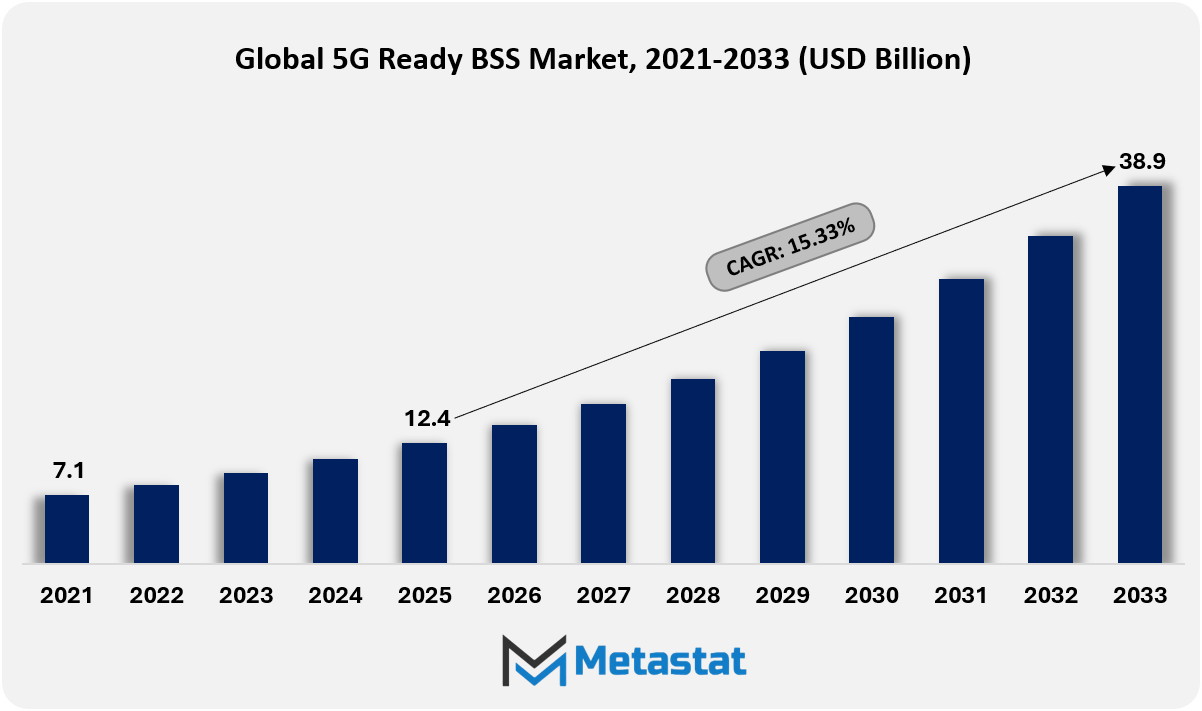
New 5G revenue models propel BSS modernization through real-time charging, dynamic offers, and SLA-based service monetization.
Telecom operators are diversifying revenue streams through outcome-based pricing, tiered service commitments, and usage-sensitive digital offerings. Real-time charging engines enable billing adjustments aligned with latency, bandwidth, and reliability requirements. Dynamic offer configuration supports industry-specific use cases, while SLA-linked monetization frameworks strengthen enterprise trust and long-term contract value.
Enterprise and IoT service expansion increases BSS requirements for multi-tenant, partner-led, and slice-aware billing and assurance.
Rising enterprise connectivity demand is expanding billing logic toward multi-tenant architectures supporting logistics, healthcare, manufacturing, and smart infrastructure deployments. IoT expansion requires granular device-level rating, partner revenue sharing, and automated assurance across network slices. BSS platforms are evolving into orchestrated systems capable of coordinating ecosystem stakeholders through integrated compliance, monitoring, and lifecycle management capabilities.
Legacy BSS fragmentation slows transformation with complex integration, data migration risk, and long deployment cycles.
Transformation in the Global 5G Ready BSS market faces operational friction created by disconnected legacy modules and siloed data repositories. Integration across aging billing engines, CRM databases, and mediation layers increases migration risk and extends implementation timelines. Prolonged deployment cycles delay return on investment and increase operational pressure during phased modernization programs.
High modernization cost and skills gaps constrain adoption across cloud-native architecture, microservices, and real-time analytics operations.
Financial pressure is increasing owing to investment requirements for cloud-native transformation, containerized microservices, and analytics-driven automation. Limited availability of professionals trained in DevOps, API orchestration, and distributed architecture governance is slowing execution speed. Budget constraints combined with workforce limitations are moderating modernization across regional telecom operators.
Open API-based partner ecosystems unlock new monetization via CPaaS-style bundles, network capability exposure, and B2B2X markets tied to 5G slices and private networks.
Strategic collaboration opportunities are expanding through standardized API exposure that allows developers, enterprises, and service aggregators to access programmable network features. CPaaS-oriented bundles integrate messaging, authentication, analytics, and edge services into unified commercial frameworks. B2B2X markets linked to private network deployments and dedicated 5G slices are creating scalable digital revenue streams across industries.
The Global 5G Ready BSS market is classified based on Type, Application, and End User.
Enterprise BSS segment is valued at USD 9.1 billion in 2026 and is projected to reach USD 23.3 billion by 2033, at a CAGR of 14.4% during the forecast period.
Enterprise BSS supports large-scale digital operations through unified billing, revenue management, and customer lifecycle control. Advanced network environments require automated orchestration aligned with growing 5G service complexity. Enterprise BSS platforms increasingly integrate analytics, cloud deployment models, and modular architecture to manage dynamic service portfolios across industries.
Smart BSS segment is valued at USD 5.3 billion in 2026 and is projected to reach USD 15.7 billion by 2033, at a CAGR of 16.8% during the forecast period.
Smart BSS is advancing through artificial intelligence, predictive analytics, and real-time charging capabilities. Intelligent automation improves customer engagement, network monetization, and service personalization. These solutions help telecom providers respond to data-driven usage patterns while maintaining operational efficiency and scalable digital ecosystems.
Large Enterprises segment is projected to reach USD 25.6 billion by 2033, at a CAGR of 14.7% during the forecast period.
Large enterprises are adopting advanced business support systems to manage complex subscriber bases, multi-location operations, and diversified service models. Integration with cloud infrastructure and private 5G networks is strengthening revenue assurance and compliance monitoring. Strategic digital transformation initiatives are accelerating adoption across enterprise-scale organizations.
Small And Medium Enterprises segment is projected to reach USD 13.3 billion by 2033, at a CAGR of 16.7% during the forecast period.
Small and medium enterprises are seeking cost-effective, cloud-native platforms that simplify billing, subscription management, and customer analytics. Scalable deployment options reduce infrastructure barriers and support flexible adoption. Rising participation in digital services and mobile-led business models is increasing demand for agile BSS frameworks tailored to SME growth requirements.
Banking, Financial Services and Insurance (BFSI) segment is projected to reach USD 4.6 billion by 2033.
Banking, Financial Services and Insurance (BFSI) organizations are leveraging secure, high-speed connectivity for digital banking platforms and transaction monitoring. Advanced BSS platforms support fraud detection, billing transparency, and regulatory reporting. Financial institutions are aligning 5G monetization strategies with stronger customer data management and service reliability standards.
Information Technology (IT) and Information Technology Enabled Services (ITES) segment is projected to reach USD 5.7 billion by 2033.
Information Technology (IT) and Information Technology Enabled Services (ITES) sectors in the Global 5G Ready BSS market require flexible service provisioning and subscription-based billing models. Rising demand for hybrid cloud environments, managed services, and global delivery infrastructure is supporting the deployment of automated BSS platforms that handle high data volumes and continuous connectivity.
Telecommunications segment is projected to reach USD 11.5 billion by 2033.
Telecommunications providers remain central to the Global 5G Ready BSS market through network slicing monetization, dynamic pricing models, and convergent billing capabilities. The shift toward standalone 5G architecture requires advanced orchestration tools and real-time charging functionality. Revenue diversification strategies increasingly depend on robust BSS frameworks capable of managing IoT, enterprise connectivity, and digital content services.
Retail And E-commerce segment is projected to reach USD 4.6 billion by 2033.
Retail and e-commerce participants are integrating real-time payment systems, loyalty management, and personalized promotions through enhanced connectivity. High-speed networks support immersive shopping experiences, customer engagement, and data analytics across digital commerce platforms.
Media and Entertainment segment is projected to reach USD 3.7 billion by 2033.
Media and entertainment companies are using high-bandwidth services for streaming, interactive content, and immersive applications. Advanced billing engines manage subscription tiers, pay-per-view offerings, and bundled service models. Enhanced analytics also support targeted content delivery and stronger monetization across digital distribution channels.
Manufacturing segment is projected to reach USD 3.6 billion by 2033.
Manufacturing organizations rely on reliable connectivity for smart factories, predictive maintenance, and supply chain monitoring. Integration of industrial IoT networks requires efficient billing and service assurance platforms. Automated BSS environments support machine-to-machine communication, production analytics, and end-to-end operational visibility.
Energy And Utilities segment is projected to reach USD 2.9 billion by 2033.
Energy and utilities sectors are adopting advanced platforms for smart grid management, remote asset monitoring, and usage-based billing. Expansion of connected infrastructure is increasing data exchange across distributed networks. Robust BSS systems help coordinate service provisioning, outage management, and consumption analytics across utility operations.
Others segment is projected to reach USD 2.3 billion by 2033.
Other industries participating are adopting flexible and modular business support systems aligned with sector-specific digital strategies. Public services, healthcare providers, and transportation networks are integrating high-speed connectivity with automated billing frameworks. Expansion of connected ecosystems continues to strengthen demand for adaptable BSS architectures.
Based on geography, the Global 5G Ready BSS market is divided into North America, Europe, Asia-Pacific, South America, Middle East, and Africa.
Strong investments by telecom operators in cloud-native transformation and digital customer engagement platforms are further strengthening adoption of modular 5G-ready BSS architectures across North America.
Asia Pacific is creating large-scale opportunities for scalable and convergent 5G-ready BSS solutions owing to expanding 5G subscriber bases across China, India, Japan, and South Korea.
Asia Pacific, Government-subsidized virtual infrastructure packages and growing business enterprise 5G adoption in Asia Pacific are beginning revenue avenues for bendy, AI-enabled BSS structures within the Global 5G Ready BSS market.
South America is experiencing gradual adoption of 5G-ready BSS frameworks as telecom modernization efforts, spectrum expansion initiatives, and rising mobile data consumption continue to build market momentum.
In the Middle East and Africa, operator digital transformation, smart city investments, and growing network expansion programs are supporting increased deployment of flexible 5G-ready BSS platforms.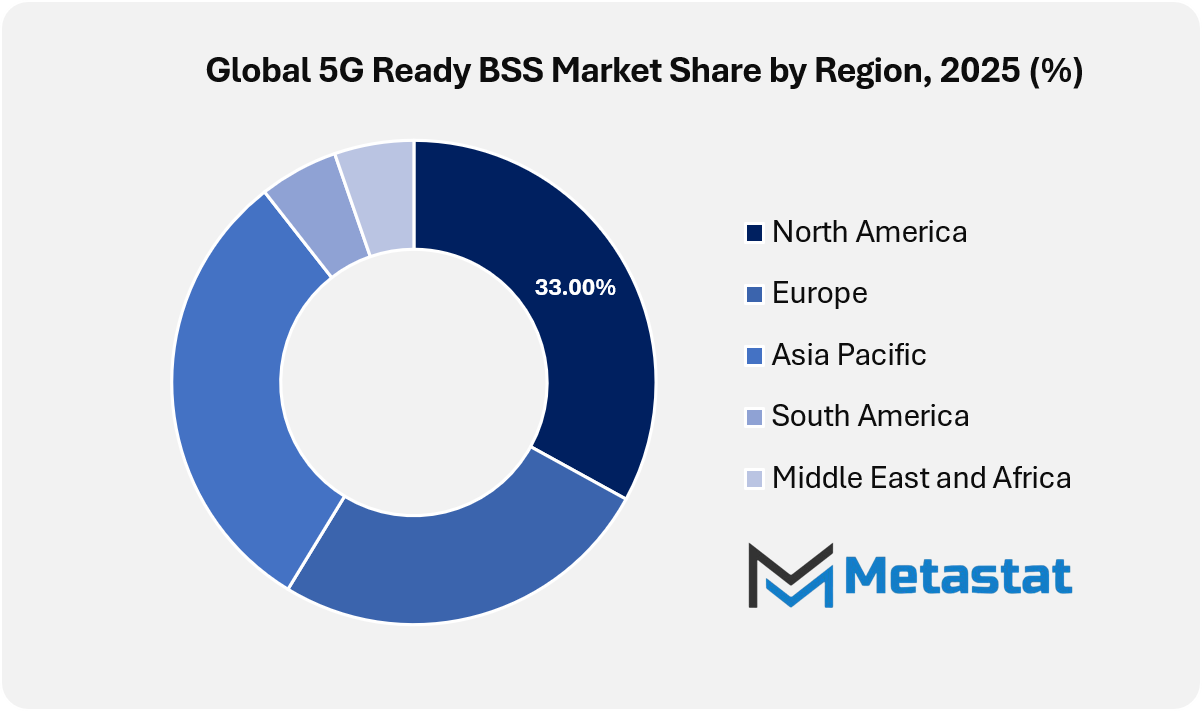
The Global 5G Ready BSS market is gaining strong momentum as telecom operators prepare their systems for faster networks and a growing base of connected devices. Business Support Systems, commonly known as BSS, manage billing, customer administration, revenue tracking, and product configuration for service providers. With 5G services expanding across markets, operators require platforms that can process large data volumes in real time, support flexible pricing, and manage complex service bundles. Traditional systems struggle to handle this level of scale and speed, which is increasing investment in modern, cloud-based, and modular BSS solutions.
The shift toward digital services continues to shape the market. Telecom providers are no longer limited to voice and data plans, and are increasingly offering streaming, gaming, IoT connectivity, and enterprise solutions. These services require accurate billing, transparent customer experiences, and faster service activation. A 5G-ready BSS platform supports dynamic charging, personalized plans, and automated workflows, while also helping operators reduce operational costs by replacing manual processes with digital tools.
Technology partnerships and system integration initiatives are also expanding across the Global 5G Ready BSS market. Operators increasingly rely on vendors that can deliver end-to-end capabilities ranging from consulting and deployment to long-term support. Cloud adoption is increasing steadily, and many telecom companies are migrating their BSS environments to hybrid or fully cloud-based models to improve flexibility, scalability, and security. Open APIs and microservices architecture are becoming standard as they support easier upgrades and faster rollout of new features. Regulatory compliance and data privacy requirements will continue to influence how BSS platforms are designed and managed.
Key players operating in the Global 5G Ready BSS market include Amdocs Limited, Ericsson AB, Nokia Corporation, Oracle Corporation, Netcracker Technology Corporation, Huawei Technologies Co., Ltd., ZTE Corporation, CSG Systems International, Inc., Cerillion plc, Comarch S.A., Tecnotree Corporation, Optiva Inc., Qvantel Oy, Nexign JSC, MATRIXX Software, Inc., 6D Technologies Private Limited, Bankai Infotech Pvt. Ltd., Alepo Technologies, Inc., MIND C.T.I. Ltd., Hansen Technologies Limited, Comviva Technologies Limited, Whale Cloud Technology Co., Ltd., AsiaInfo Technologies Limited, DigitalRoute AB, PortaOne, Inc., Telgoo5, Inc., SAP SE, SunTec Business Solutions Pvt. Ltd., Samsung Electronics Co., Ltd., Tech Mahindra Limited, and International Business Machines Corporation. These companies focus on digital billing, customer engagement platforms, analytics, and cloud-native BSS frameworks to support telecom operators during large-scale 5G rollouts. Their strategies include partnerships, product enhancements, platform modernization, and regional expansion to strengthen their competitive position in the market.
Market size is forecast to rise from USD 12.4 billion in 2025 to over USD 38.9 billion by 2033.
Over time, the vendor landscape is expected to consolidate around scalable microservices architectures that operate across public, private, and edge cloud environments. The next phase of market development will be shaped not only by revenue expansion but also by structural transformation, where monetization logic becomes programmable infrastructure. This shift is expected to redefine how telecom companies capture value from low-latency networks and high-capacity digital ecosystems across global markets.
By Type:
By Application:
By End User:
This research report categorizes the 5G Ready BSS market based on key segments and regions, forecasts revenue growth, and analyses trends in each submarket. The report analyses the key growth drivers, opportunities, and challenges influencing the 5G Ready BSS market. Recent market developments and competitive strategies such as expansion, product launch, partnership, merger, and acquisition have been included to draw the competitive landscape in the market.
The report strategically identifies and profiles the key market players and analyses their core competencies in each sub-segment of the 5G Ready BSS market.
|
Report Attributes |
Details |
|
Study Period |
2021-2033 |
|
Base Year |
2025 |
|
Estimated Year |
2026 |
|
Forecast Period |
2026-2033 |
|
Historical Period |
2021-2025 |
|
Growth Rate |
CAGR 15.3% from 2026 to 2033 |
|
Revenue Unit |
USD billion |
|
Segmentation |
By Type, Application, End User, and Region |
|
By Region |
North America (By Type, Application, End User, and Country)
|
|
Europe (By Type, Application, End User, and Country)
|
|
|
Asia Pacific (By Type, Application, End User, and Country)
|
|
|
South America (By Type, Application, End User, and Country)
|
|
|
Middle East and Africa (By Type, Application, End User, and Country)
|
Find answers to common questions about this report
Top players operating in the 5G Ready BSS industry include Amdocs Limited, Ericsson AB, Nokia Corporation, Oracle Corporation, Netcracker Technology Corporation, and Huawei Technologies Co., Ltd.
The Metastat Insights analysis shows that the North America 5G Ready BSS market size is estimated to be USD 12.7 billion by 2033.
The Metastat Insights study shows that the Global 5G Ready BSS market size was USD 12.4 billion in 2025.
Global 5G Ready BSS market is estimated to reach USD 38.9 billion by 2033.
Legacy BSS fragmentation slows transformation with complex integration, data migration risk, and long deployment cycles will hamper the market growth within the forecast period.
New 5G revenue models propel BSS modernization through real-time charging, dynamic offers, and SLA-based service monetization and Enterprise and IoT service expansion increases BSS requirements for multi-tenant, partner-led, and slice-aware billing and assurance. are key driving factors, boosting the market.
The Global 5G Ready BSS market is expected to grow at a CAGR of 15.3% over the forecast period (2026-2033).
The Enterprise BSS is the leading type segment in the Global market.
North America region dominates the market.
The analysts below cover Information & Technology research at Metastat Insights.
LEAD ANALYST
Utkarsh Khirodkar is a Lead Market Research Analyst at MetaStat Insight, specializing in market intelligence, technology sector assessments, and competitive strategy.

PRINCIPAL CONSULTANT - ENTERPRISE AI & EMERGING TECHNOLOGIES
Banking & Finance · Electronics and Semiconductor · Energy and Power · Healthcare IT · Information & Technology · Professional Services
Vijay Gunti is a Principal Consultant at MetaStat Insight, bringing over two decades of experience across enterprise digital transformation, technology strategy, and intelligent systems.

LEAD CONSULTANT - COMMUNICATION, TELECOM, AND IT
Electronics and Semiconductor · Information & Technology · Machinery & Equipment · Professional Services
Ravindra Sathe Consultants for Communication, Telecom, and IT at MetaStat Insight. He leads the firm's industry research initiatives across telecommunications infrastructure, digital connectivity, enterprise networking, and emerging information technology domains.
When evaluating distributed energy resource management systems, standard research summaries tend to gloss over the operational differences between front-of-the-meter utility deployments and behind-the-meter industrial sites. The MetaStat Insight report addressed those distinctions directly, especially regarding software interoperability standards and grid interconnection backlogs. The five-year market sizing across regional transmission organizations provided actionable context for our grid modernization strategy.
Most industry reports on warehouse automation bundle autonomous mobile robots and fixed conveyor installations into the same top-level numbers, which complicates advisory work. This study split the market cleanly by payload tiers, navigation technology, and fleet management software layers. The regional forecast for Western Europe gave our team defensible adoption benchmarks when evaluating capital allocation for logistics clients, saving us days of secondary data scrubbing.
Analyzing the transition from natural gas to green hydrogen in iron ore reduction requires realistic infrastructure timelines. Meta stat insight supplied a detailed regional assessment of DRI plant conversion costs and scrap metal availability in North America and Western Europe. Their report carefully examined pellet quality specs and electrical grid access constraints without making oversimplified market assumptions. The research material served as a practical reference during internal technology roadmap discussions.
Explore related market intelligence reports worth reading alongside this one.